


Secondary sourcePaintingca. 1752–1756
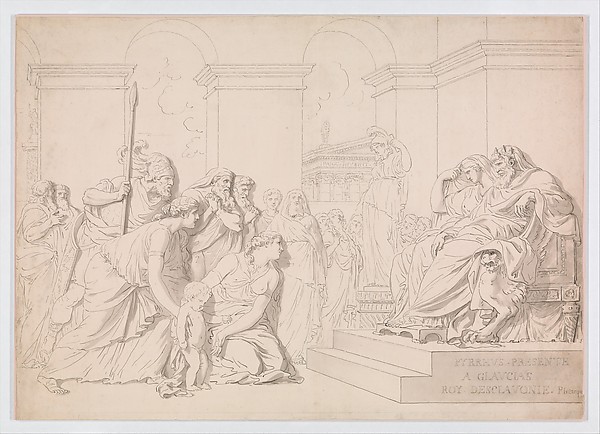
Pyrrhus in the House of Glaucias
Augustin Pajou · ca. 1752–1756
An 18th-century French drawing imagining the childhood legend of Pyrrhus being sheltered at the court of King Glaucias.
Depicts a legendary episode from Pyrrhus's childhood at the court of King Glaucias.
About this source
What it is
This is a pen, ink, and chalk drawing by the French sculptor Augustin Pajou, made around 1752–1756. It is now kept at the Metropolitan Museum of Art. The drawing shows a classical throne room where a king and queen receive kneeling figures, including a small child.
Why it matters
The scene illustrates a legend about the young Pyrrhus, who according to ancient stories was taken as a child to the court of King Glaucias for protection. Pajou, working centuries after Pyrrhus's lifetime, used this story to create a dramatic classical composition, showing how later European artists admired and reimagined ancient history.
Look closer
- Who are the figures on the throne, and how does their pose show power?
- Why might an 18th-century artist choose this particular legend to draw?
- What details in the drawing tell you it is imagined rather than a real record of events?
This painting is part of the curated material that grounds the AI version of Pyrrhus of Epirus on Humy.ai — when students ask about related events, the AI can quote it and cite it.
More Pyrrhus of Epirus sources
Browse all 78 →
Ready when you are
Start chatting with Pyrrhus of Epirus now.
20 messages free · No credit card · Available in 50+ languages.