


Secondary sourcePainting1779
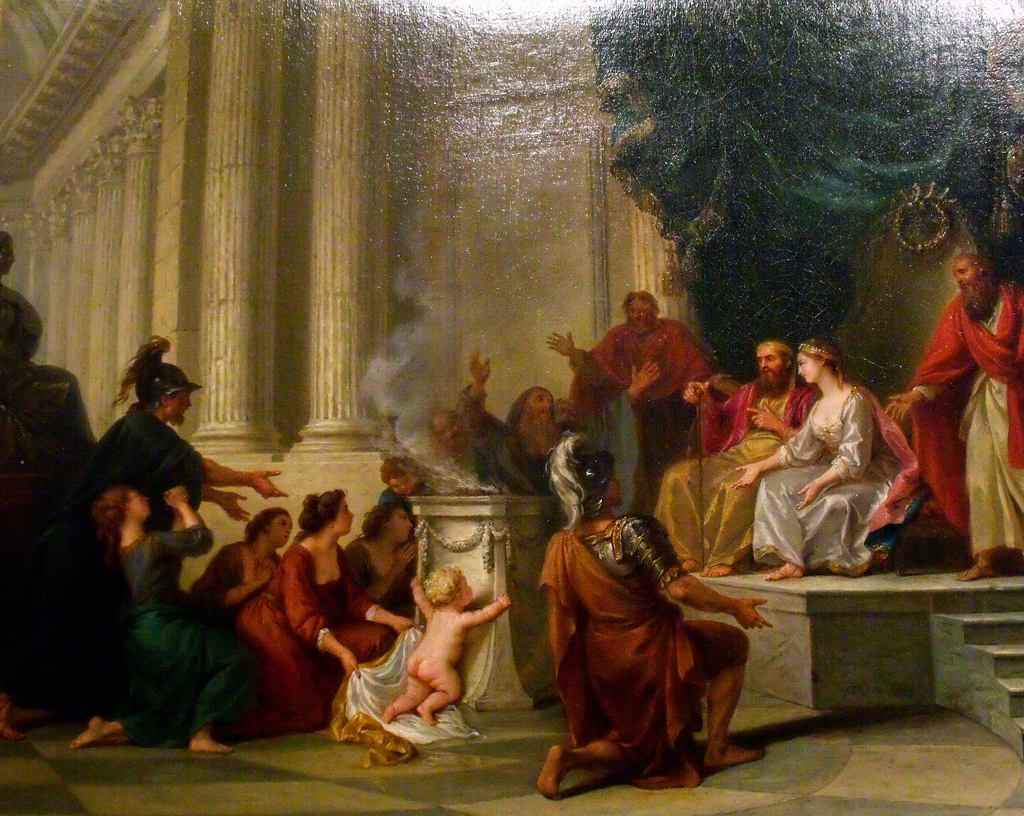
Pyrrhus presented to Glaucias
Nicolas-René Jollain · 1779
An 1779 print by Nicolas-René Jollain showing a later imagined scene of young Pyrrhus being presented at the court of King Glaucias.
Shows a later imagined version of Pyrrhus as a child at the court of Glaucias, the king who sheltered him.
About this source
What it is
This is an 18th-century print made by Nicolas-René Jollain in 1779. It shows a classical interior with tall columns, a bearded man and a crowned young woman seated on a raised marble platform, and a kneeling armored warrior in a red cloak gesturing toward them. A naked toddler stands by a smoking altar, and a helmeted soldier and seated figures in robes are at the left. The title in French is "Pyrrhus enfant présenté à Glaucias". The record describes it as a later imagined scene rather than a record of real events.
Why it matters
The print shows how people in 18th-century Europe pictured the childhood of Pyrrhus of Epirus, who was sheltered at the court of the Illyrian king Glaucias after his family lost their throne. Artists of this period often drew on ancient writers such as Plutarch and reshaped them for their own audiences. The scene tells us more about the taste and imagination of the 1770s than about the actual court of the 4th century BCE.
Look closer
- Which figures are placed high on the platform, and which are kneeling or standing below them? What does this arrangement suggest about power?
- Why might an 18th-century artist include a naked child and a smoking altar in a scene about a royal court?
- What parts of this scene might be accurate to ancient sources, and what parts might the artist have invented?
This painting is part of the curated material that grounds the AI version of Pyrrhus of Epirus on Humy.ai — when students ask about related events, the AI can quote it and cite it.
More Pyrrhus of Epirus sources
Browse all 78 →

Ready when you are
Start chatting with Pyrrhus of Epirus now.
20 messages free · No credit card · Available in 50+ languages.