


Primary sourceArtifact1710
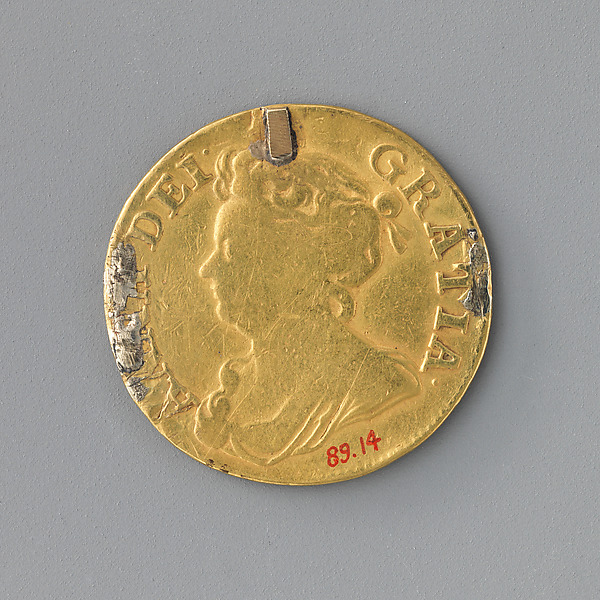
Queen Anne guinea gold coin, 1710
1710
A gold guinea struck in 1710, during Anne's reign, showing her profile portrait. It is a physical example of the currency of her rule.
Shows the currency of Anne's reign, with her portrait on a gold coin struck while she ruled.
About this source
What it is
This is a gold guinea coin dated 1710, held by The Metropolitan Museum of Art. The photograph shows a profile portrait of a crowned woman facing left, with partial lettering around the rim including 'DEI' and 'GRATIA'. The museum record lists it as a gift of Mrs. P. Barnett in 1889.
Why it matters
Coins carried the image of the ruler into everyday trade. A guinea was a gold coin, so this object shows the money used during Anne's reign, which lasted from 1702 to 1714. Coins like this were made by the royal mint, and they show how the monarch's face and name reached ordinary people.
Look closer
- What does the portrait show about how Anne wanted to be seen?
- Why might gold coins have been valued differently from silver ones?
- What can a coin tell us about the people who handled it, and what does it not tell us?
This artifact is part of the curated material that grounds the AI version of Anne, Queen of Great Britain on Humy.ai — when students ask about related events, the AI can quote it and cite it.
More Anne, Queen of Great Britain sources
Browse all 95 →
Ready when you are
Start chatting with Anne, Queen of Great Britain now.
20 messages free · No credit card · Available in 50+ languages.