


Secondary sourceSculpturecirca 1797 - 1802
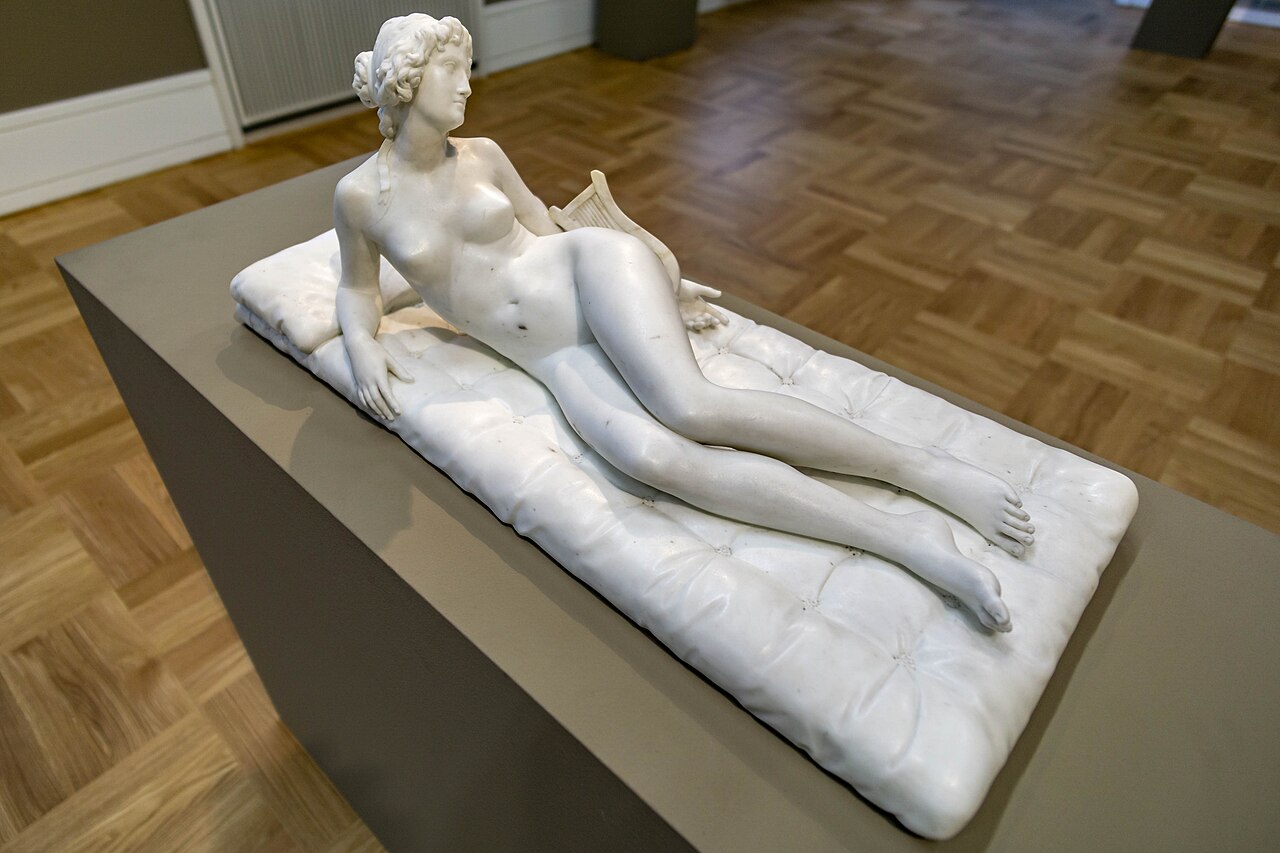
Reclining Sappho
Johann Heinrich von Dannecker · circa 1797 - 1802
A late eighteenth-century marble sculpture by Johann Heinrich von Dannecker showing Sappho reclining with a small lyre. It reflects the neoclassical image of the poet.
Shows a neoclassical sculptor's image of Sappho reclining with her lyre, a later portrayal that helps students compare ancient poet and modern imagery.
About this source
What it is
This is a white marble sculpture titled Reclining Sappho, by Johann Heinrich von Dannecker, made circa 1797 to 1802. It shows a fully nude woman reclining on a tufted cushion atop a grey pedestal. Her head is turned to the left, one arm props her up, and a small lyre rests beside her hip. The photograph shows the work in a museum with a parquet floor.
Why it matters
The sculpture reflects the neoclassical taste of its time, when artists drew on ancient Greek and Roman forms. It shows how a late eighteenth-century sculptor imagined Sappho, using a reclining pose and a lyre to suggest her as a poet. It is an image shaped by later ideas about the ancient world, not a likeness of her.
Look closer
- How does the pose and the cushion shape the way viewers understand the figure?
- Why might a sculptor of this period show a famous poet as a nude figure?
- What does the sculpture leave out about Sappho's own words and life?
This sculpture is part of the curated material that grounds the AI version of Sappho on Humy.ai — when students ask about related events, the AI can quote it and cite it.
More Sappho sources
Browse all 89 →



Ready when you are
Start chatting with Sappho now.
20 messages free · No credit card · Available in 50+ languages.