


Primary sourceArtifact1923–1948
Rentenmark
1923–1948
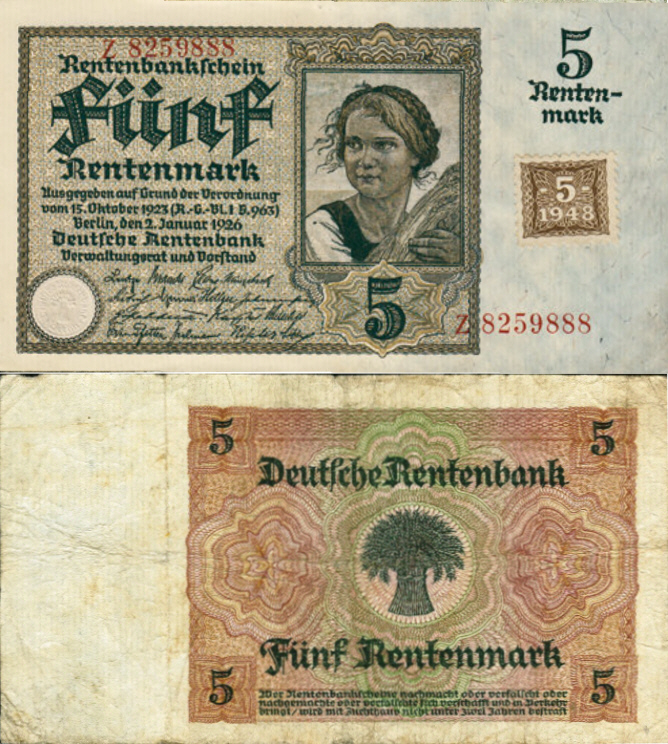
The emergency German currency introduced in 1923 to end hyperinflation, administered by Schacht as Currency Commissioner.
Schacht administered the Rentenmark's introduction as Currency Commissioner, the achievement that made his reputation.
About this source
What it is
The Rentenmark was a new German currency issued on 15 November 1923 to stop the hyperinflation that had destroyed the value of the old Papiermark. It was backed by mortgages on agricultural and business land rather than gold, since Germany had none to spare. It was replaced by the Reichsmark in 1924 but notes stayed valid until 1948.
Why it matters
Hjalmar Schacht was appointed Currency Commissioner to manage the new currency's introduction, working alongside Finance Minister Hans Luther. The successful stabilization made Schacht's reputation as a financial expert and led to his appointment as head of the Reichsbank. It shows how a currency crisis could be solved through emergency legal powers and careful management rather than new gold reserves.
Look closer
- Why was a new currency, rather than more of the old one, needed to solve the crisis?
- What does backing money with land instead of gold tell you about Germany's situation in 1923?
- What does this episode suggest about Schacht's skills and how they shaped his later career?
This artifact is part of the curated material that grounds the AI version of Hjalmar Schacht on Humy.ai — when students ask about related events, the AI can quote it and cite it.
More Hjalmar Schacht sources
Browse all 36 → Document
Primary source
Nuremberg Trials Record
1945–1946
 Photograph
Primary source
Hjalmar Schacht and Adolf Hitler
Unknown · 1934
Secondary source
Judgement of the International Military Tribunal at Nuremberg
1946
 Photograph
Primary source
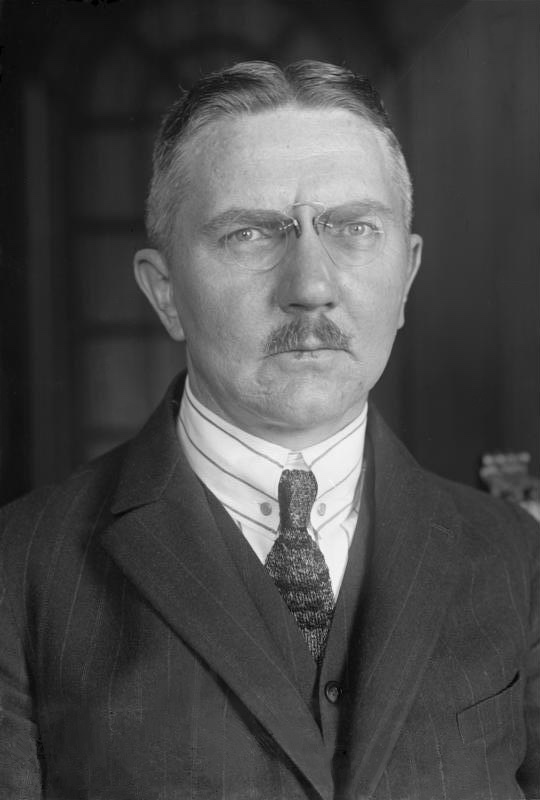
Portrait of Hjalmar Schacht as Reichsbank President
Unknown


Free account
Read every Hjalmar Schacht source
Sign up free →
Ready when you are
Start chatting with Hjalmar Schacht now.
20 messages free · No credit card · Available in 50+ languages.