


Secondary sourceArtifact3rd-4th century AD
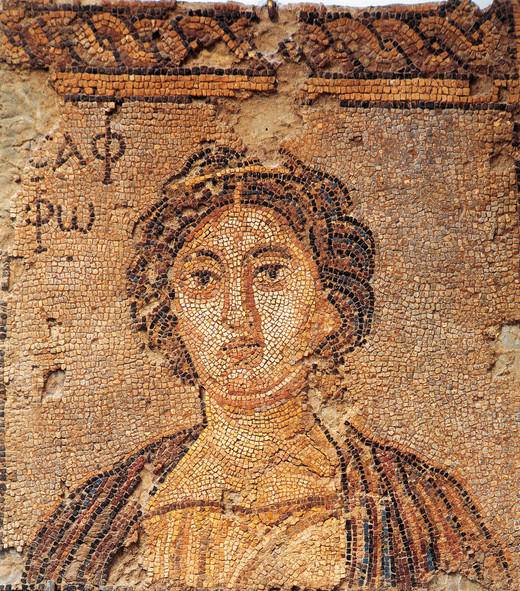
Roman mosaic of Sappho from Sparta
3rd-4th century AD
A Roman-era mosaic from Sparta shows a bust of the poet Sappho, labelled with her name in Greek letters. It shows how later Romans imagined her.
Shows how later Romans imagined Sappho, labelling a bust of her with her name, rather than recording her own appearance.
About this source
What it is
This is a Roman-era mosaic from Sparta. It shows a bust of the poet Sappho, and her name, written in Greek letters (Σαφφω), appears to the left of the head. The mosaic is made of small tesserae in ochre, brown, black and cream, with a decorative border across the top. Its creator is unknown, and the date is given only as the 3rd to 4th century AD, so it was made many centuries after Sappho lived.
Why it matters
Sappho lived on the island of Lesbos around 600 BCE, and very little of her poetry survives. Images like this one show how people in a much later time pictured her. The mosaic is not a likeness made from life. It reveals the Roman interest in Greek poets and the way they were honoured through art.
Look closer
- What details of the face and hair does the artist use to show a poet?
- Why do you think the name is written beside the head rather than only described in words?
- What does this image leave out about Sappho's own voice and daily life?
This artifact is part of the curated material that grounds the AI version of Sappho on Humy.ai — when students ask about related events, the AI can quote it and cite it.
More Sappho sources
Browse all 89 →


Ready when you are
Start chatting with Sappho now.
20 messages free · No credit card · Available in 50+ languages.