


Secondary sourcePainting1839
Sappho
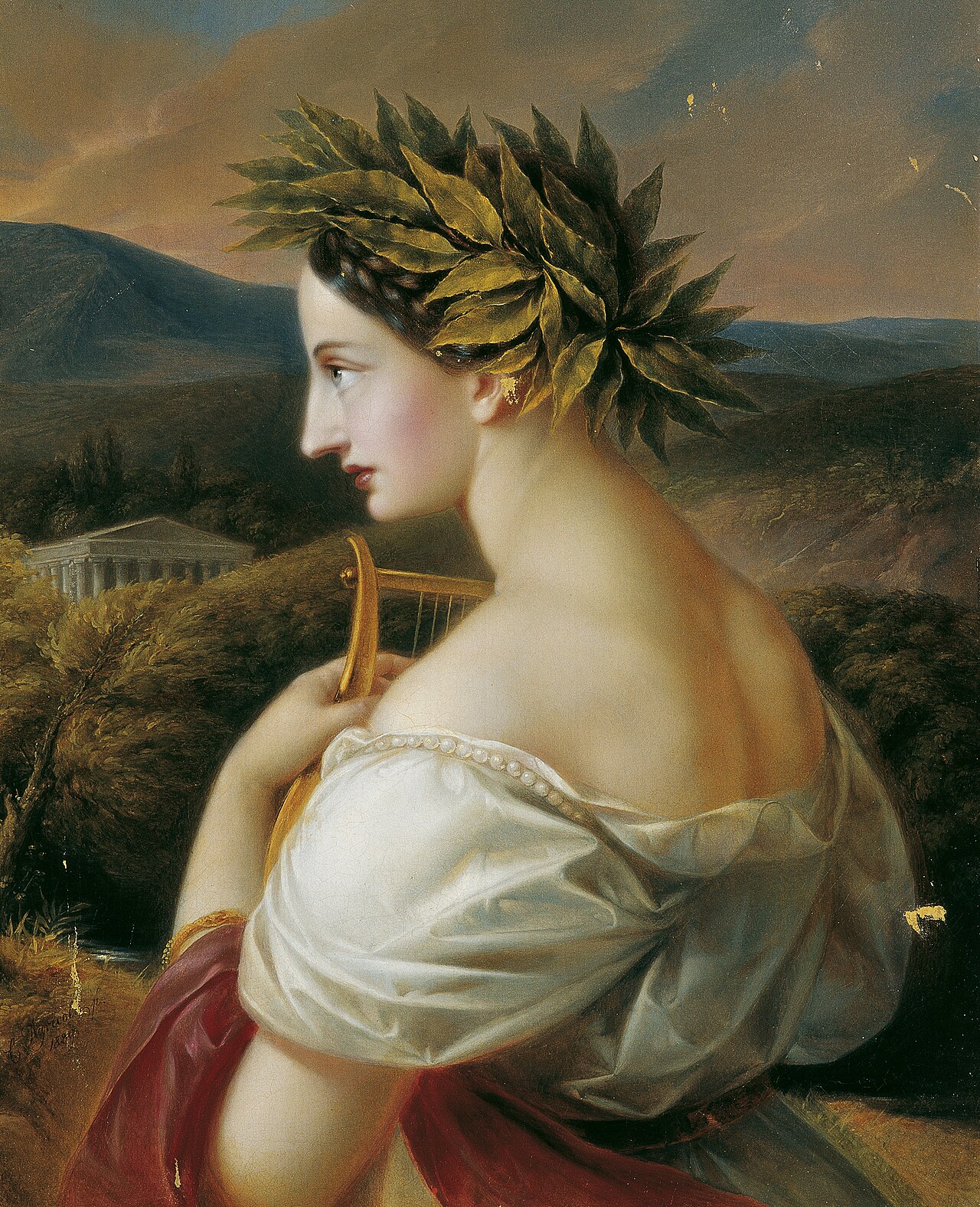
Karl Agricola · 1839
An 1839 German painting by Karl Agricola showing the poet Sappho with a lyre and laurel wreath in front of a classical temple. It is a later imagined portrait.
Shows how a 19th-century German artist pictured Sappho, using a lyre and wreath to mark her as a poet.
About this source
What it is
This is a painting by Karl Agricola, dated 1839. It shows a woman in profile wearing a laurel wreath and a white off-shoulder dress with a red drape. She holds a golden lyre against her shoulder. Behind her, a classical temple stands on a hillside under a dusky sky.
Why it matters
Sappho was an ancient Greek poet from Lesbos, who lived roughly between 630 and 570 BCE. Agricola was a nineteenth-century German artist. His picture shows how Sappho was pictured in Germany in 1839, more than two thousand years after her life. The lyre, wreath and temple are symbols that later artists used to identify a poet of ancient Greece.
Look closer
- Which objects in the painting signal that this woman is a poet, and which signal that she belongs to ancient Greece?
- Why might a German painter in 1839 choose a classical setting for a portrait?
- Does this image tell us anything about Sappho's own voice or words?
This painting is part of the curated material that grounds the AI version of Sappho on Humy.ai — when students ask about related events, the AI can quote it and cite it.
More Sappho sources
Browse all 89 →


Ready when you are
Start chatting with Sappho now.
20 messages free · No credit card · Available in 50+ languages.