


Secondary sourcePainting1884
Sappho
Jules Lefebvre · 1884
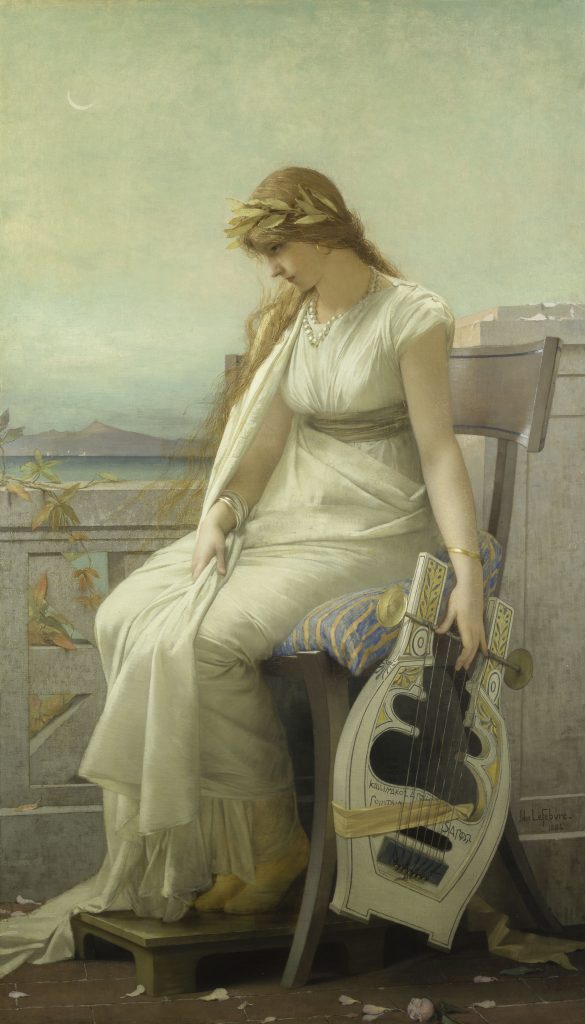
An 1884 painting by Jules Lefebvre showing Sappho seated beside a lyre, wearing a laurel wreath, under a crescent moon.
Shows Sappho as a calm, laurel-crowned poet with her lyre, a later academic image that reflects 1880s ideas of the ancient poet.
About this source
What it is
This is an 1884 painting by Jules Lefebvre. It shows a young woman with a laurel wreath in her auburn hair, seated in a white gown on a wooden chair beside a lyre. She looks downward. Behind her, a crescent moon hangs in a pale sky over a distant coastline, and a stone balustrade runs across the foreground. The painting is a later academic image of the poet, not a record made in her lifetime.
Why it matters
Sappho was a poet from the island of Lesbos, active around 630 to 570 BCE. Her poems were admired in antiquity, but most of them are now lost. Later artists, including Lefebvre, painted her again and again, and each image shows what that period valued: the lyre, the laurel wreath and the seaside setting became standard signs of a poet. The painting therefore tells us as much about 1880s France as about Sappho.
Look closer
- Which objects in the picture, such as the lyre and the wreath, tell you that she is a poet?
- Why might the artist show her looking downward rather than at the viewer?
- What does this image leave out about her actual poems and their words?
This painting is part of the curated material that grounds the AI version of Sappho on Humy.ai — when students ask about related events, the AI can quote it and cite it.
More Sappho sources
Browse all 89 →


Ready when you are
Start chatting with Sappho now.
20 messages free · No credit card · Available in 50+ languages.