


Secondary sourcePainting1800s
Sappho
Virginie Ancelot · 1800s
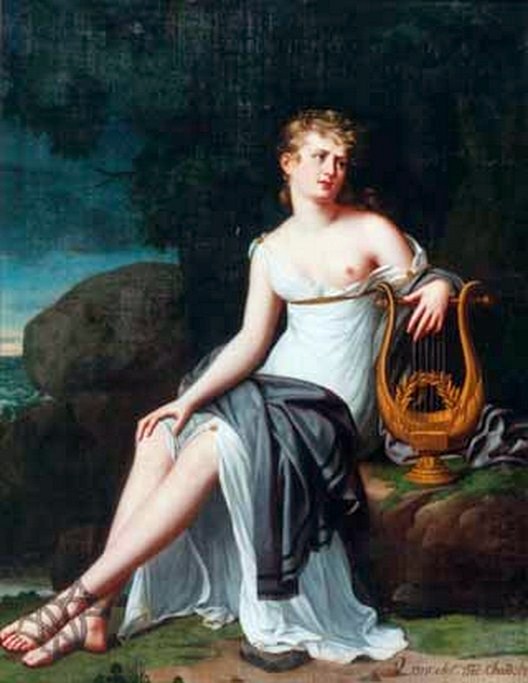
An imagined portrait of Sappho by Virginie Ancelot, dated to the 1800s, showing a seated woman in a classical gown beside a golden lyre.
Shows Sappho as an imagined figure, presented with a lyre to mark her as a poet in a 19th-century painter's view.
About this source
What it is
This is a painting by Virginie Ancelot, dated to the 1800s. It shows a seated woman in a white classical-style gown with a dark drape, with one breast partly exposed. Her sandals are laced to her calves. She rests her arm on a golden lyre in a dark wooded landscape, with rocks and sea at left.
Why it matters
Sappho was an ancient Greek poet from Lesbos, who lived roughly between 630 and 570 BCE. Ancelot painted her in the 1800s, so the work is an imagined portrait made long after Sappho's life. It shows how a 19th-century French painter, Virginie Ancelot, chose to present the poet, using the lyre and classical dress to suggest her art and her ancient world.
Look closer
- What details tell you the painter wanted to show Sappho as a poet, and what details suggest a classical setting?
- Why might an artist of the 1800s choose to show partial nudity in a portrait of an ancient poet?
- What would we need to know to decide how closely this woman resembles the real Sappho?
This painting is part of the curated material that grounds the AI version of Sappho on Humy.ai — when students ask about related events, the AI can quote it and cite it.
More Sappho sources
Browse all 89 →

Ready when you are
Start chatting with Sappho now.
20 messages free · No credit card · Available in 50+ languages.