


Secondary sourcePainting1748
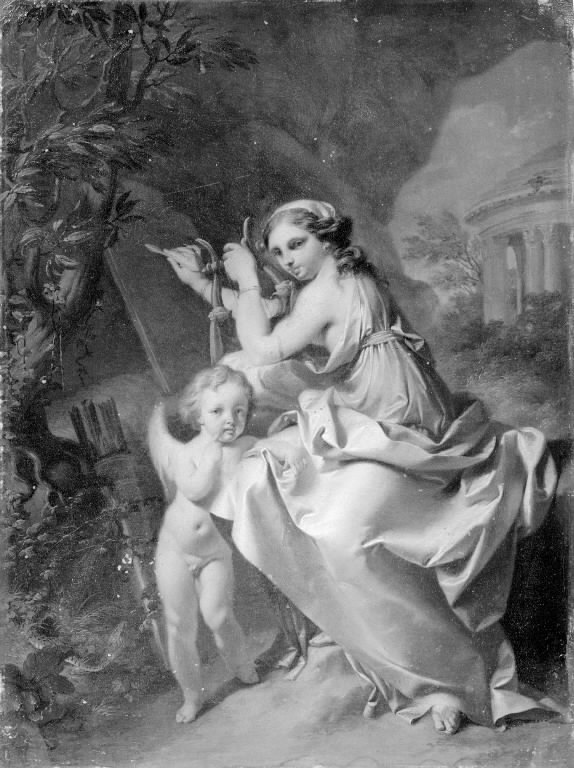
Sappho and Cupid
Carl Marcus Tuscher · 1748
A 1748 painting by Carl Marcus Tuscher shows Sappho seated with a lyre and a small winged Cupid beside her. It is a later artist's imagined image of her.
Shows an eighteenth-century artist's imagined Sappho, seated with a lyre and Cupid, rather than a record of her life.
About this source
What it is
This is a painting by Carl Marcus Tuscher, dated 1748. The reproduction is black and white. It shows a seated woman in flowing draped robes who holds a lyre and gazes to one side, while a small winged cupid stands beside her at lower left. Trees, a classical columned temple and a stone block appear in the landscape behind them.
Why it matters
Sappho lived around 600 BCE, so this painting was made more than two thousand years after her time. Eighteenth-century artists often pictured Sappho as a figure of love and music, and the cupid and lyre show that tradition. The painting tells us more about how Tuscher and his audience imagined a classical poet than about Sappho herself.
Look closer
- What objects does the artist place beside Sappho, and what do they suggest about her?
- Why might a painter add a Cupid and a classical temple to a picture of a poet?
- What parts of Sappho's real life and work are missing from this scene?
This painting is part of the curated material that grounds the AI version of Sappho on Humy.ai — when students ask about related events, the AI can quote it and cite it.
More Sappho sources
Browse all 89 →


Ready when you are
Start chatting with Sappho now.
20 messages free · No credit card · Available in 50+ languages.