


Secondary sourcePainting1833
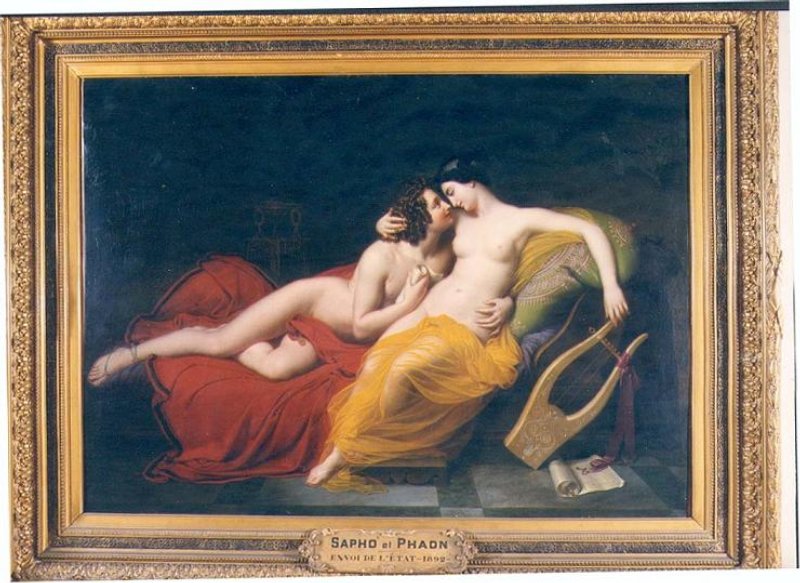
Sappho and Phaon
Pierre Claude François Delorme · 1833
An 1833 oil painting by Pierre Claude François Delorme showing Sappho with her lyre and Phaon, illustrating the legend of her unrequited love.
Shows Sappho in a later legend about her love for Phaon, so it reflects how she was imagined in the 1800s rather than her own life.
About this source
What it is
This is an oil painting by Pierre Claude François Delorme, dated 1833. It shows two reclining figures on a dark background: a woman holding a lyre and a man with curly hair, embracing, with a red drape and yellow cloth. The image is set in an ornate gold frame. A plaque on the frame reads 'Sapho et Phaon, Envoi de l'Etat, 1899'. The painting is held as a later image, so it is not a record made by Sappho herself.
Why it matters
Sappho lived on Lesbos around 630 to 570 BCE, and very little of her poetry survives. The story of her love for Phaon was told long after her time, and artists such as Delorme drew on it to show her as a figure of romance and tragedy. The painting reveals how nineteenth-century European artists imagined an ancient woman poet, often through legend rather than through her own words.
Look closer
- What do the lyre and the embracing pose tell you about how the artist wanted viewers to understand Sappho?
- Why might a painting made in 1833 focus on a love story rather than on Sappho's poetry?
- What parts of Sappho's life and work does this image leave out?
This painting is part of the curated material that grounds the AI version of Sappho on Humy.ai — when students ask about related events, the AI can quote it and cite it.
More Sappho sources
Browse all 89 →

Ready when you are
Start chatting with Sappho now.
20 messages free · No credit card · Available in 50+ languages.