


Secondary sourcePaintingcirca 1840
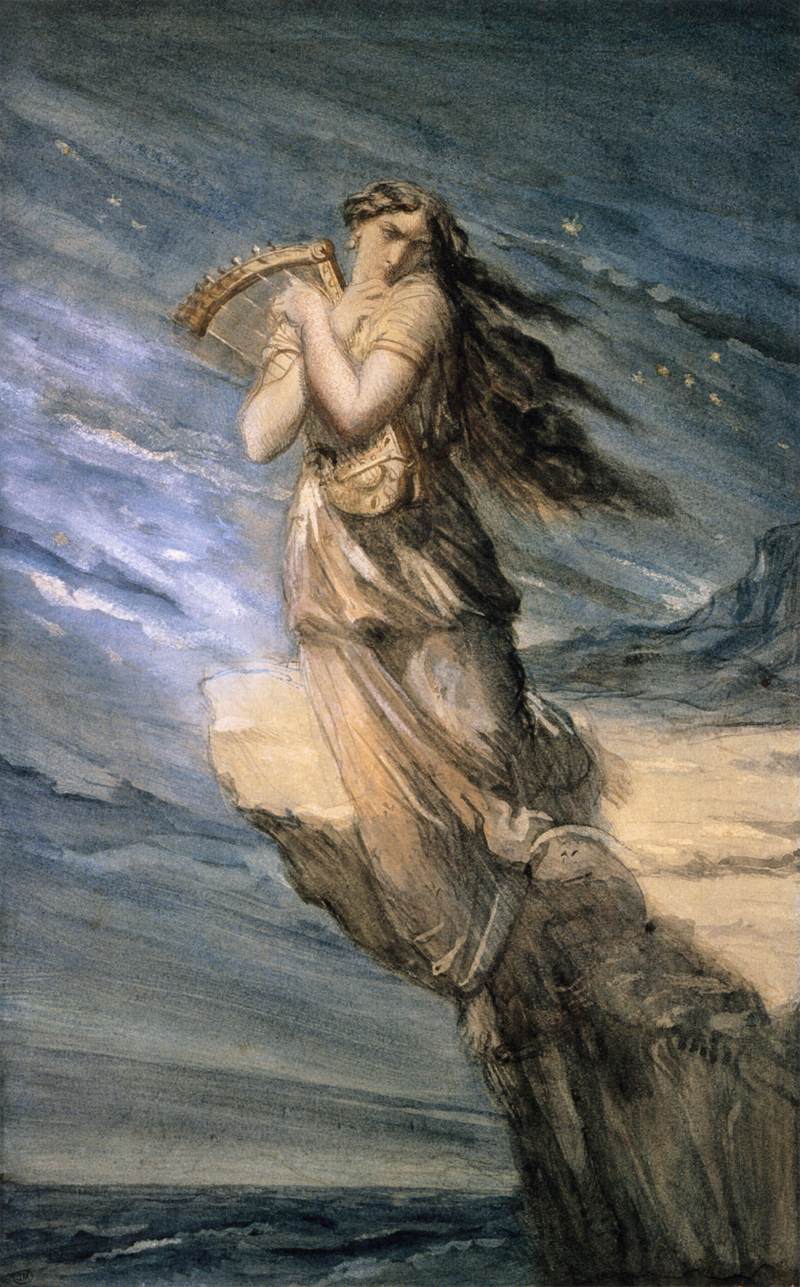
Sappho Leaping into the Sea
Théodore Chassériau · circa 1840
A watercolor and ink drawing by Théodore Chassériau, made around 1840, showing Sappho with her lyre on a cliff above the sea, imagining her leap.
Shows Sappho in a dramatic legend about her death at sea, so it reveals how later artists imagined her final moments.
About this source
What it is
This is a watercolor and ink drawing by Théodore Chassériau, dated circa 1840. It shows a woman with long dark hair blown back by the wind, playing a lyre and standing on a rocky cliff edge above a dark sea. A stormy blue night sky with scattered stars fills the background, and a rocky headland lies to the right. The work shows Sappho's leap from the Leucadian cliff, a scene that is part of later legend rather than a record of an event.
Why it matters
The story of Sappho leaping from a cliff appears in writings long after her lifetime, and it was taken up by artists in the 1800s. Chassériau's drawing shows how Romantic artists liked dramatic scenes of storms, cliffs and emotional extremes. The image reveals the way the poet was reshaped for a European audience, turning a legend into a visual drama about passion and despair.
Look closer
- How do the wind, the storm and the dark sea shape the mood of the scene?
- Why would an artist choose the moment before a leap rather than a calm portrait of a poet?
- What does the legend leave out about Sappho's own poems and her life on Lesbos?
This painting is part of the curated material that grounds the AI version of Sappho on Humy.ai — when students ask about related events, the AI can quote it and cite it.
More Sappho sources
Browse all 89 →


Ready when you are
Start chatting with Sappho now.
20 messages free · No credit card · Available in 50+ languages.