


Secondary sourcePainting1581
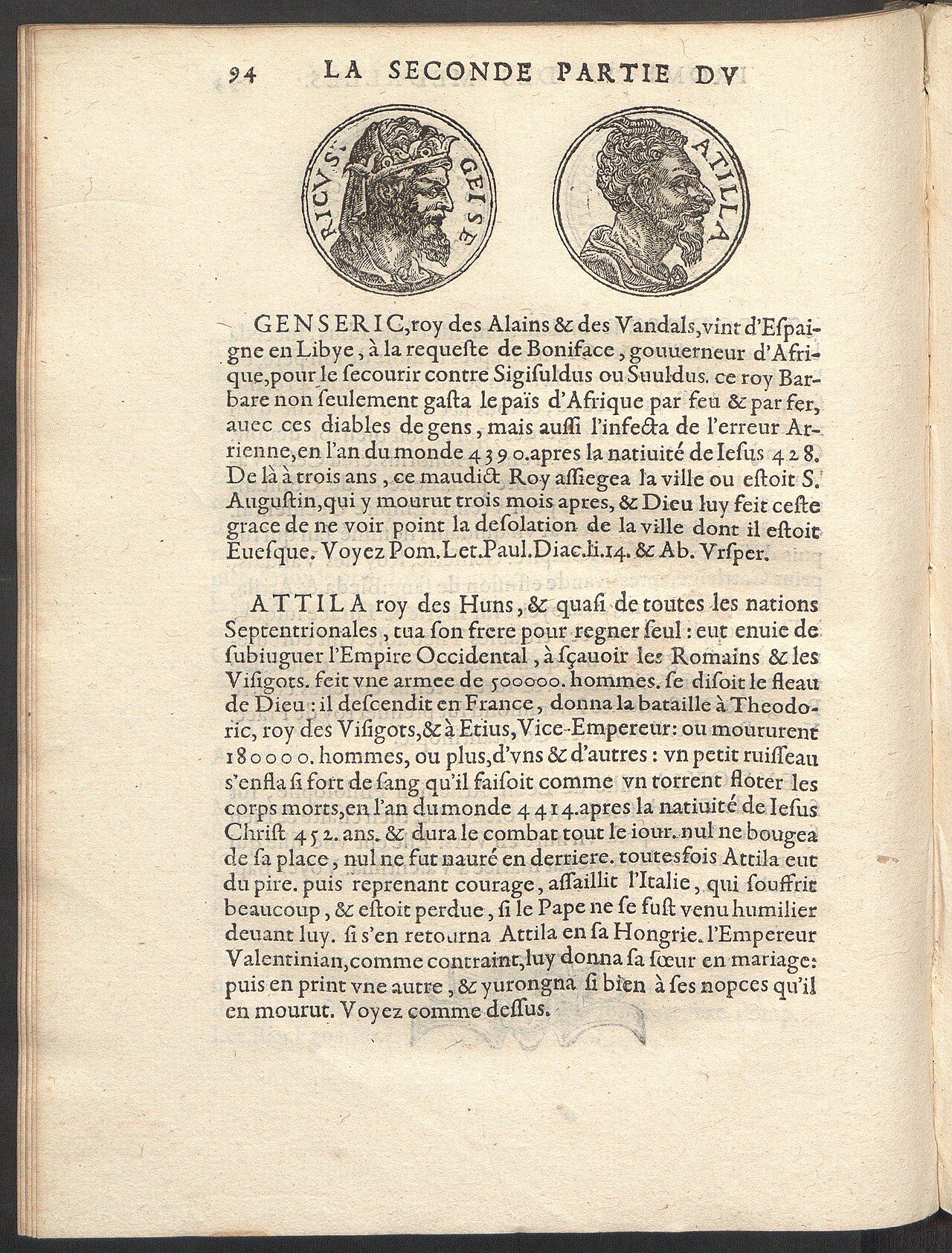
Seconde partie du promptuaire des médailles
Guillaume Rouillé · 1581
A 1581 printed book of imagined medal portraits, including an invented coin-style profile of Attila.
This printed book invents a fictional coin-portrait of Attila, showing how later artists imagined his appearance.
About this source
What it is
This page comes from a printed Renaissance book by Guillaume Rouillé, published in Lyon in 1581, which presents imaginary medal-style portraits of historical rulers. It shows two circular woodcut 'medallion' portraits, one labelled Genseric and one labelled Attila, each in profile, alongside printed French text describing them.
Why it matters
No real portrait of Attila survives from his own lifetime, so Renaissance antiquarians like Rouillé invented likenesses based on imagination rather than evidence. This book shows how later centuries pictured ancient 'barbarian' rulers according to the artistic conventions of their own time, not historical fact.
Look closer
- What clues show that this portrait is imagined rather than based on a real image of Attila?
- Why might a 16th-century printer want to include portraits of ancient rulers in a book of medals?
- How does this image compare with other depictions of Attila you have seen?
This painting is part of the curated material that grounds the AI version of Attila the Hun on Humy.ai — when students ask about related events, the AI can quote it and cite it.
More Attila the Hun sources
Meet the AI Attila the Hun →
Ready when you are
Start chatting with Attila the Hun now.
20 messages free · No credit card · Available in 50+ languages.