


Secondary sourceDocument
Subhat al-Akbar (Rosary of World History)
Unknown author
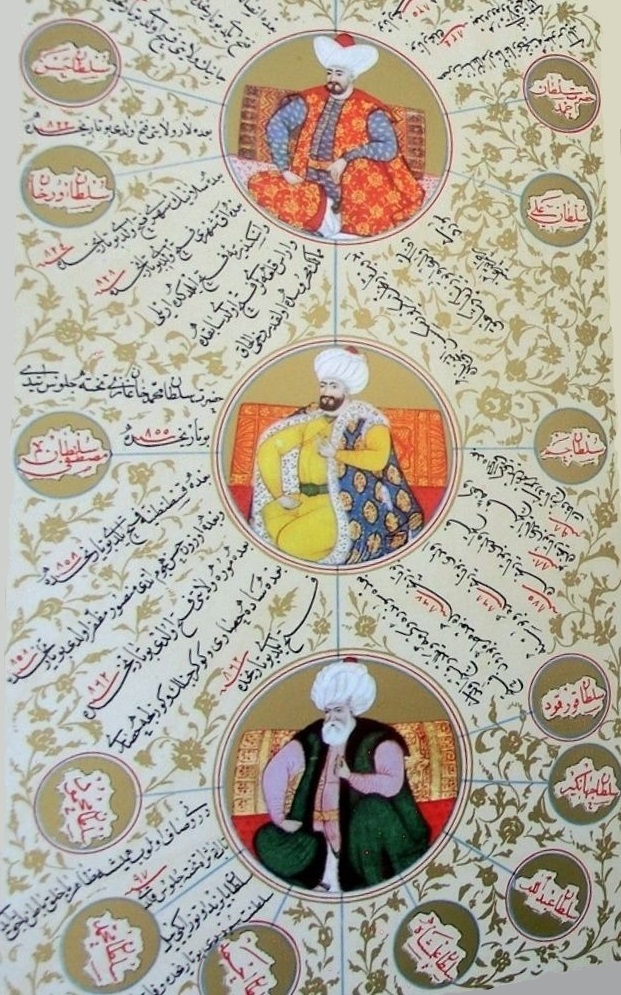
A page from an Ottoman Turkish genealogical manuscript tracing the Ottoman sultans, including Murad II, back to Adam.
Places Murad II within the Ottoman dynasty's genealogical line used to assert its legitimacy to rule.
About this source
What it is
This page comes from the Subhat al-Akbar, an Ottoman Turkish manuscript tracing the genealogy of the Ottoman sultans from Adam, regarded as the first human being and prophet, down to Sultan Mehmed IV, who died in 1687. The page shown has three circular portraits of seated rulers in turbans and robes, each labeled in red-and-black script, set against a gold floral background.
Why it matters
This manuscript reflects how the Ottoman dynasty, including Murad II, presented itself as part of a continuous line of rulers stretching back to the earliest human history. Genealogies like this one were political and religious tools, used to legitimize a sultan's right to rule by connecting him to a vast, sacred lineage.
Look closer
- Why would Ottoman sultans want their family tree linked all the way back to Adam?
- What does the careful, decorated layout of the page suggest about how important this record was considered?
- How might this kind of document have been used to support a sultan's authority?
This document is part of the curated material that grounds the AI version of Murad II on Humy.ai — when students ask about related events, the AI can quote it and cite it.
More Murad II sources
Browse all 80 →
Ready when you are
Start chatting with Murad II now.
20 messages free · No credit card · Available in 50+ languages.