


Secondary sourcePaintingbetween 1528 and 1588
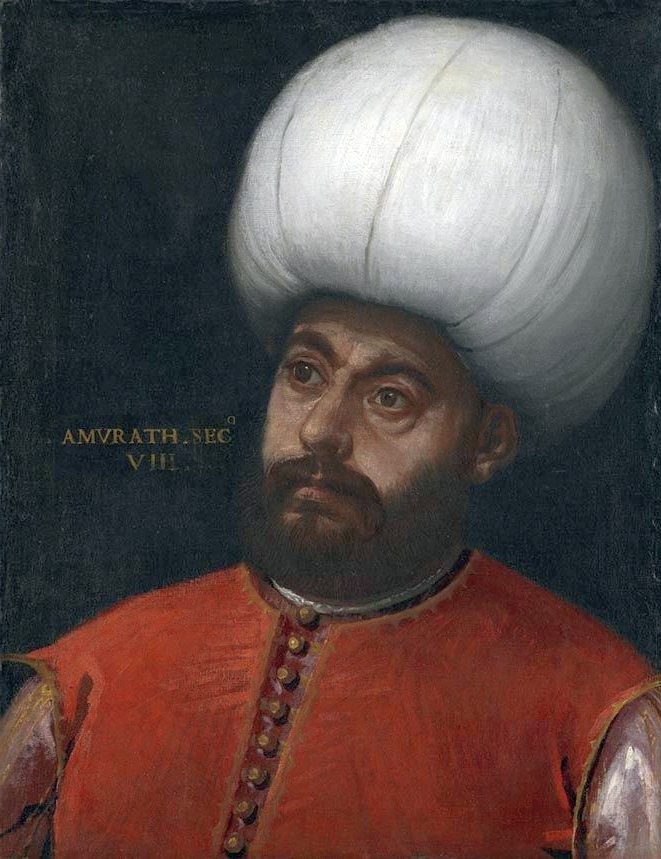
Sultan Murad II, portrait attributed to Paolo Veronese
Paolo Veronese · between 1528 and 1588
A later painting attributed to the Italian Renaissance artist Paolo Veronese, imagining the likeness of Murad II long after his death.
This later European painting imagines Murad II's likeness, created by an Italian Renaissance artist who never met him.
About this source
What it is
This painting, attributed to the Italian Renaissance artist Paolo Veronese, is said to depict Murad II. It shows a bearded man in a large white turban and a red garment with brass buttons, turned to face three-quarters left against a dark background. A gold Latin inscription reading AMVRATH NEC VIII appears beside his face. Veronese lived between 1528 and 1588, generations after Murad II's death in 1451.
Why it matters
Because Veronese worked long after Murad II's lifetime, this portrait could not have been painted from life. It belongs to a tradition of European artists imagining Ottoman rulers, often as part of series portraying famous historical figures for European patrons curious about the Ottoman Empire.
Look closer
- What does the Latin inscription suggest about the intended audience for this painting?
- How does the style compare to Ottoman portraits of the same figure?
- Why might European artists have been interested in painting Ottoman sultans they never met?
This painting is part of the curated material that grounds the AI version of Murad II on Humy.ai — when students ask about related events, the AI can quote it and cite it.
More Murad II sources
Browse all 80 →
Ready when you are
Start chatting with Murad II now.
20 messages free · No credit card · Available in 50+ languages.