


Secondary sourceArtifact10th century (object); legend recorded 1063/1077
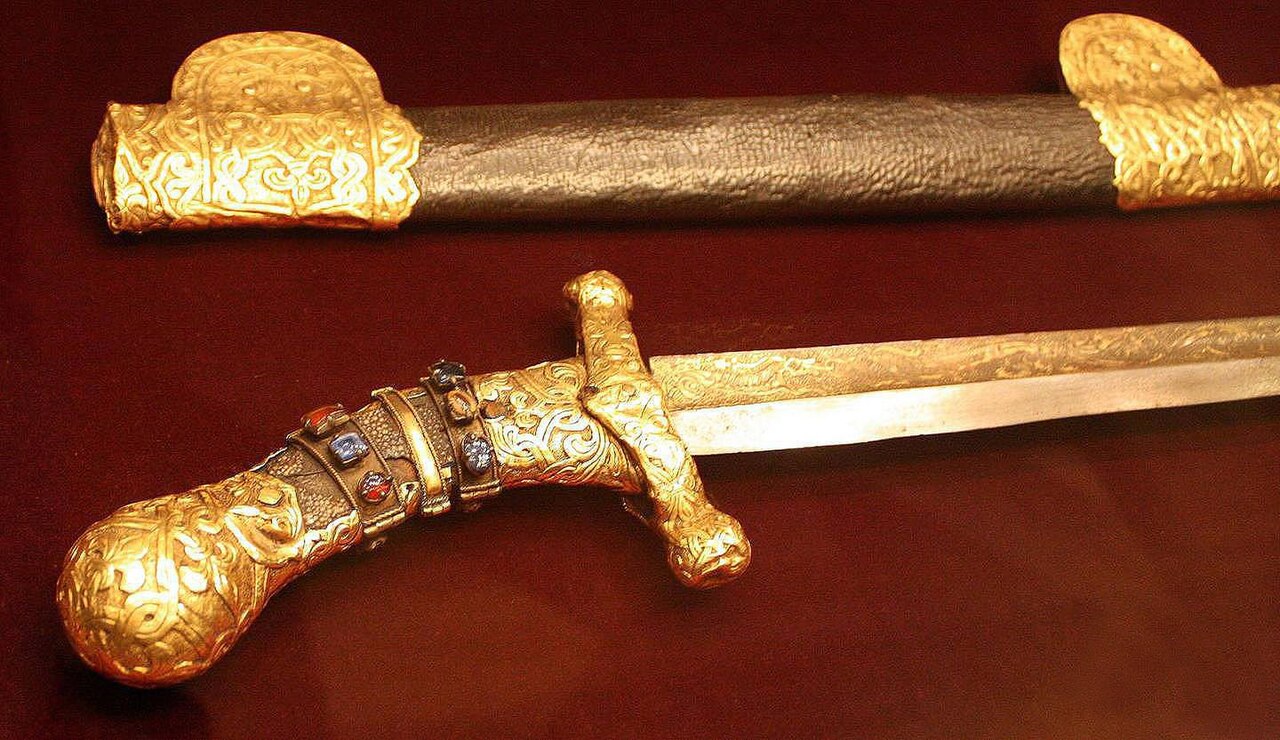
Sword of Attila
10th century (object); legend recorded 1063/1077
A richly decorated sabre long called the 'Sword of Attila' in Hungarian royal tradition, though actually made centuries after his death.
A sword long attributed to Attila by legend, showing how his name was used to add prestige centuries after he lived.
About this source
What it is
This gold-decorated sabre with an ornate hilt, jeweled pommel, and engraved blade is now in the Kunsthistorisches Museum in Vienna. According to the medieval Annals of Lampert of Hersfeld, Queen Mother Anastasia of Hungary gave it to Otto of Nordheim, Duke of Bavaria, in 1063, where it was already called the 'Sword of Attila.' Modern study shows it was actually made as a Hungarian sabre in the 10th century, long after Attila's lifetime.
Why it matters
The sword shows how later rulers used Attila's fearsome reputation to add prestige to objects and gifts, even when the object had no real connection to him. The museum itself notes the mismatch between legend and the sword's true origin.
Look closer
- Why might a queen want a sword associated with Attila's name for a diplomatic gift?
- What does the gap between legend and dating tell us about how reputations get attached to objects?
- How does the museum's own correction change how we should read the object's story?
This artifact is part of the curated material that grounds the AI version of Attila the Hun on Humy.ai — when students ask about related events, the AI can quote it and cite it.
More Attila the Hun sources
Meet the AI Attila the Hun →
Ready when you are
Start chatting with Attila the Hun now.
20 messages free · No credit card · Available in 50+ languages.