


Primary sourceDocument22 October 1986
Tax Reform Act of 1986
22 October 1986
A major U.S. tax law signed by President Reagan in 1986 that lowered income tax rates and eliminated many deductions.
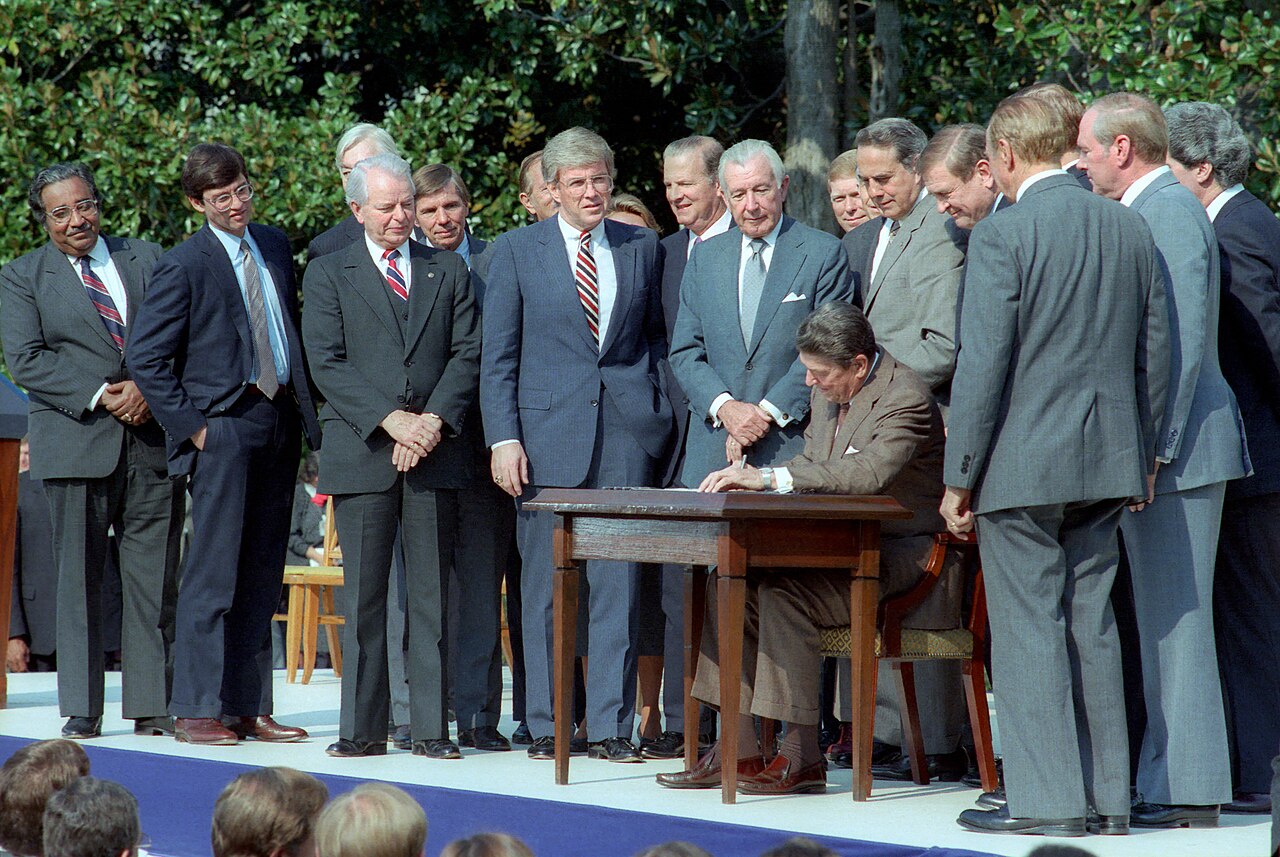
Reagan signed this act into law, his second major tax-cutting achievement as president.
About this source
What it is
A piece of U.S. federal legislation passed by the 99th Congress and signed into law by President Ronald Reagan on October 22, 1986. It was the top domestic priority of his second term.
Why it matters
The act lowered federal income tax rates, cutting the top rate from 50 percent to 28 percent, while expanding credits and deductions for lower-income Americans and removing many from the tax base. It eliminated numerous deductions, such as those for rental housing and retirement accounts, to offset the cuts. Passed with bipartisan support, including from Democratic Speaker Tip O'Neill, it reveals how Reagan worked across party lines on his signature domestic goal.
Look closer
- Why might a tax law need cooperation between a Republican president and a Democratic Speaker of the House?
- What groups gained and what groups lost from the trade-offs in this law?
- What does the signing photograph suggest about how major legislation is made official?
This document is part of the curated material that grounds the AI version of Ronald Reagan on Humy.ai — when students ask about related events, the AI can quote it and cite it.
More Ronald Reagan sources
Meet the AI Ronald Reagan → Speech
Primary source
Tear down this wall!
Ronald Reagan · 12 June 1987
Primary source
Ronald Reagan's Inaugural Address, January 20, 1981
Ronald Reagan · 20 January 1981
 Speech
Primary source
Evil Empire speech
Ronald Reagan · 8 March 1983
Primary source
A Time for Choosing
Ronald Reagan · 27 October 1964
 Document
Primary source
Intermediate-Range Nuclear Forces Treaty
8 December 1987
Ready when you are
Start chatting with Ronald Reagan now.
20 messages free · No credit card · Available in 50+ languages.