


Secondary sourcePainting1837
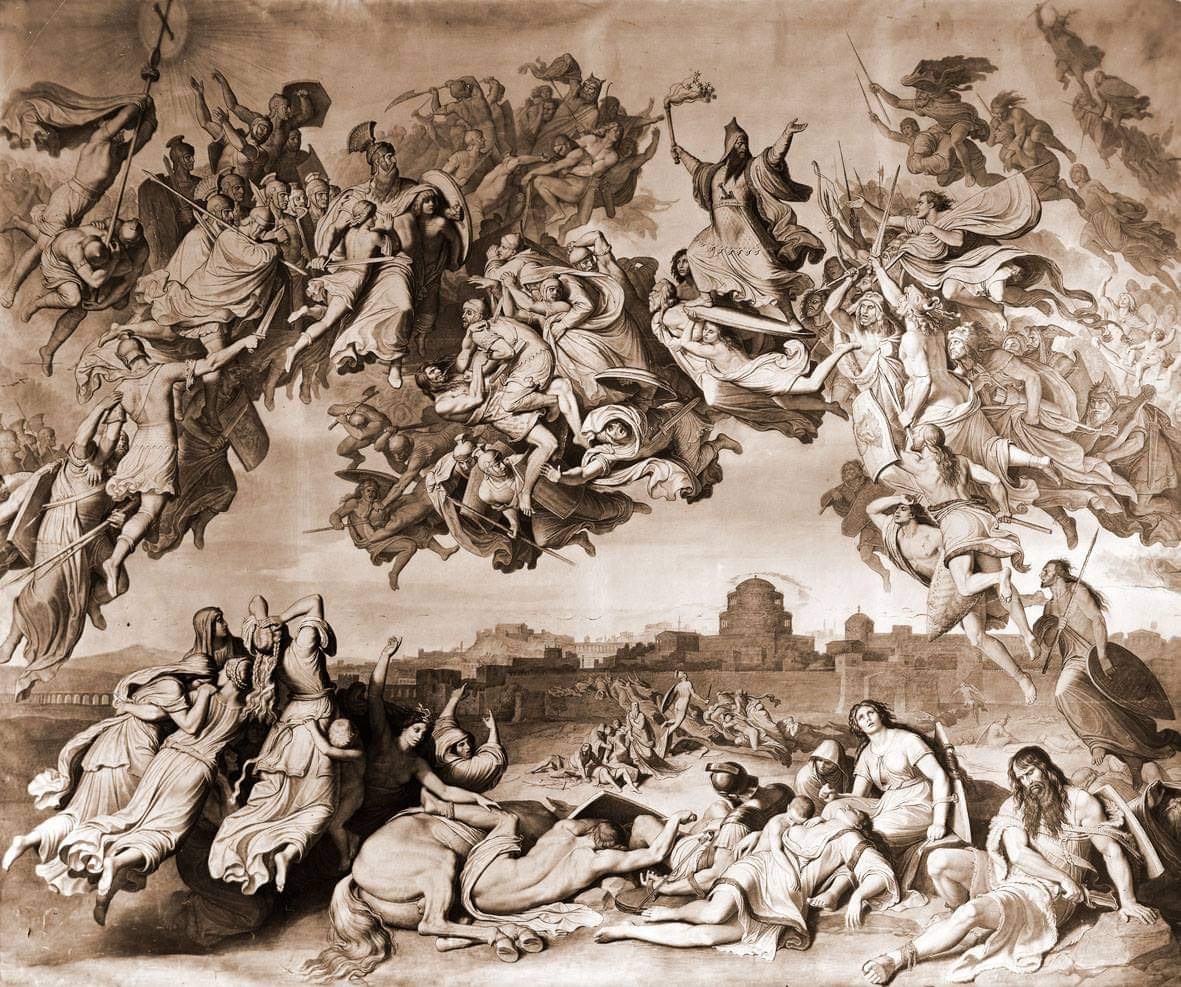
The Battle of the Huns
Wilhelm von Kaulbach · 1837
A 19th-century painting imagining the legendary ghostly battle fought after Attila's defeat at the Catalaunian Plains.
Imagines the mythic afterlife of Attila's defeat at the Catalaunian Plains, showing his 19th-century legendary image.
About this source
What it is
This painting, made in 1837 by German artist Wilhelm von Kaulbach, depicts a dramatic battle scene in swirling clouds above a walled city, with grieving and wounded figures on the ground below. It is held at the National Museum in Poznań.
Why it matters
The scene imagines a legend that after the real Battle of the Catalaunian Plains, the fallen soldiers' spirits rose to continue fighting as ghosts in the sky. Painted centuries after Attila's death, it reflects how 19th-century European artists turned him into a mythic, almost supernatural figure rather than a historical ruler — showing how later ages reimagined him for their own romantic tastes.
Look closer
- Why would an artist choose to paint a legend rather than the historical battle itself?
- What feelings does the composition — ghostly warriors above, grieving women below — try to create in the viewer?
- What does this image tell you about Kaulbach's time rather than about Attila's own era?
This painting is part of the curated material that grounds the AI version of Attila the Hun on Humy.ai — when students ask about related events, the AI can quote it and cite it.
More Attila the Hun sources
Meet the AI Attila the Hun →
Ready when you are
Start chatting with Attila the Hun now.
20 messages free · No credit card · Available in 50+ languages.