


Secondary sourcePainting1797
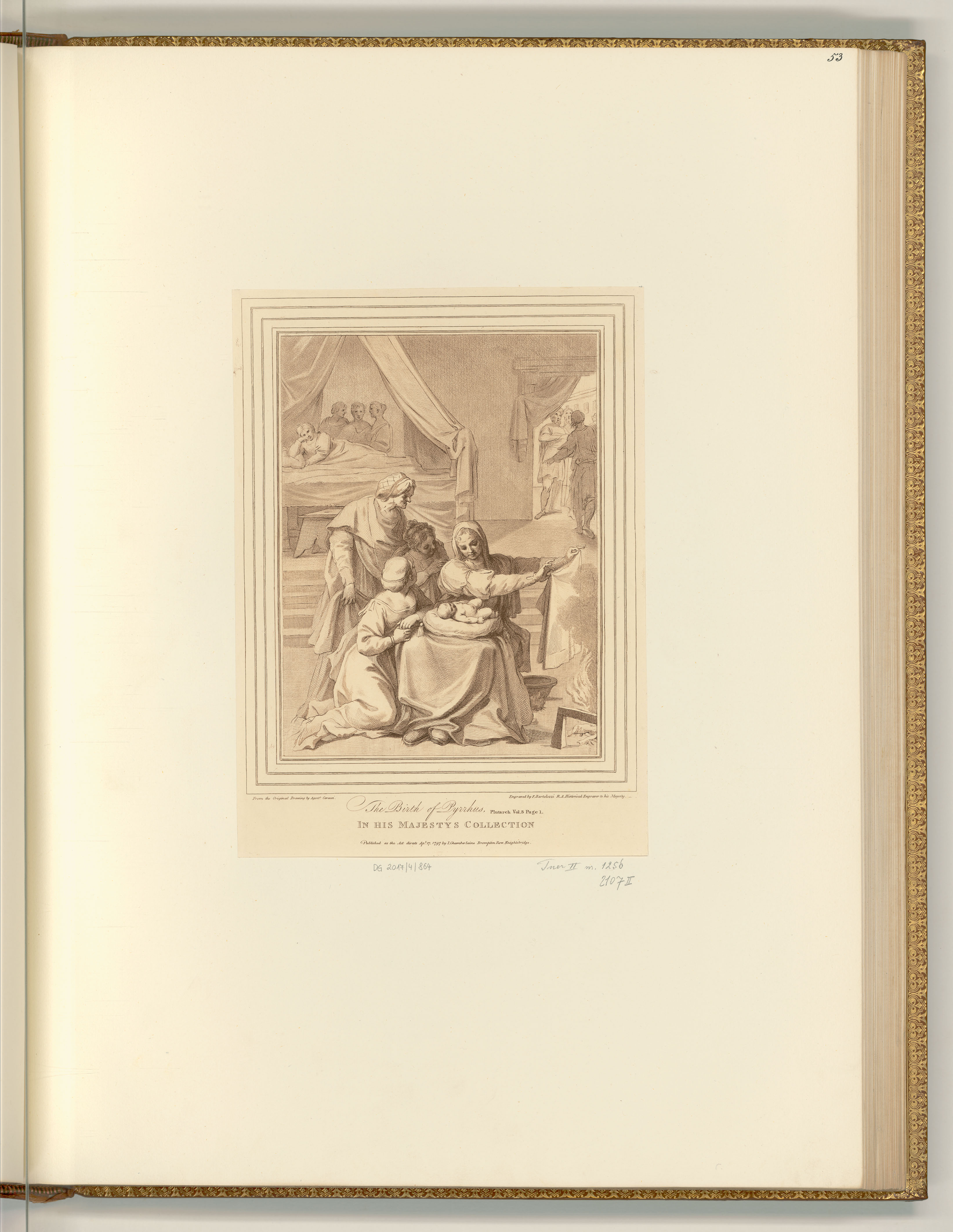
The Birth of Pyrrhus
1797
A German sepia engraving from 1797 showing an imagined scene of Pyrrhus's birth, from his legend rather than from contemporary record.
Shows an imagined scene from the legend of Pyrrhus's birth, one of the stories told about him in later art.
About this source
What it is
This is a sepia engraving dated 1797, shown on album page 53 and held by the Albertina Museum in Austria. It shows a woman in a bed-chamber holding a cloth toward a fire, with a newborn in a basket on her lap. Attendants kneel and stand around her, and other women sit in a bed in the background. The page is titled The Birth of Pyrrhus, Plutarch Vol.5 Page 1.
Why it matters
The engraving is a later imagined scene from the legend of Pyrrhus, not a record made during his life. Its title points to the ancient writer Plutarch, whose life of Pyrrhus is a main source for the story, so the picture shows how a late eighteenth-century artist understood a classical tale.
Look closer
- What does the fire, the basket and the group of attendants suggest about the importance of the birth?
- Why might an artist of 1797 choose to show a birth scene from an ancient legend?
- What does this image leave out about the real life of Pyrrhus?
This painting is part of the curated material that grounds the AI version of Pyrrhus of Epirus on Humy.ai — when students ask about related events, the AI can quote it and cite it.
More Pyrrhus of Epirus sources
Browse all 78 →
Ready when you are
Start chatting with Pyrrhus of Epirus now.
20 messages free · No credit card · Available in 50+ languages.