


Secondary sourceArtifact1797
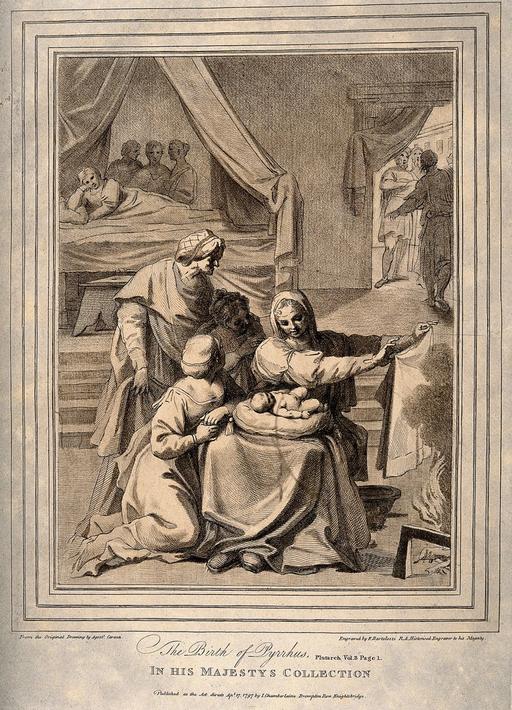
The Birth of Pyrrhus
Agostino Carracci · 1797
A 1797 engraving by F. Bartolozzi after a drawing by Agostino Carracci, illustrating Plutarch's Life of Pyrrhus. It shows scenes of a birth and the infant's care.
An illustration of Plutarch's Life of Pyrrhus, showing how his biography was pictured in a later English edition.
About this source
What it is
This is an engraving made in 1797 by F. Bartolozzi after an original drawing by Agostino Carracci. It illustrates volume 3 of an edition of Plutarch's Lives, on the page about the birth of Pyrrhus. The scene shows a woman recovering in bed while attendants care for a newborn in a basket. The inscription below reads The Birth of Pyrrhus, In His Majesty's Collection. The print is held by the Wellcome Collection in the United Kingdom.
Why it matters
Plutarch wrote about Pyrrhus, a king of Epirus who fought against Rome. This engraving is a later image based on a drawing by an Italian artist, made for an English edition in the late 1700s. It shows how Plutarch's stories were turned into pictures for readers of that time. It also shows the work of several people: the author, the drawing's artist, and the engraver.
Look closer
- Who in the scene seems to be caring for the newborn, and how are they positioned?
- What does the inscription tell you about who owned this image and how it was published?
- What does the engraving leave out about Pyrrhus's later life that Plutarch describes?
This artifact is part of the curated material that grounds the AI version of Plutarch on Humy.ai — when students ask about related events, the AI can quote it and cite it.
More Plutarch sources
Browse all 90 →



Ready when you are
Start chatting with Plutarch now.
20 messages free · No credit card · Available in 50+ languages.