


Secondary sourcePainting19th century
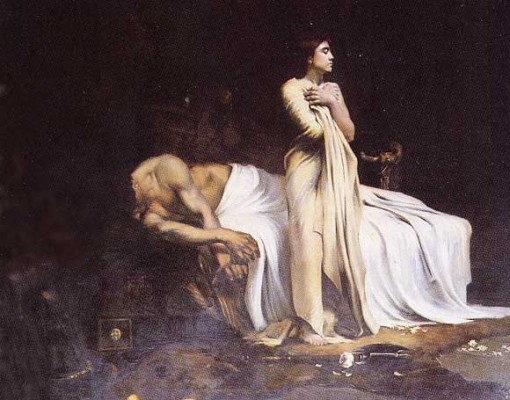
The Death of Attila
J. Villeclère · 19th century
A 19th-century painting by J. Villeclère showing Attila's death in a dark interior. It is a later artistic depiction of the Hunnic ruler.
Shows how a 19th-century artist imagined the death of Attila, a later artistic view rather than a record of events.
About this source
What it is
This is a painting in dark tones by J. Villeclère, from the 19th century. The catalogue note says it is held in a French museum. In the foreground a muscular nude man slumps over the arm of a chair. A woman in a long cream-coloured robe stands beside him, one hand pressed to her chest and looking upward. A white cloth drapes the chair, and objects lie on the floor.
Why it matters
The painting was made many centuries after Attila died, so it reflects how 19th-century artists imagined his final moments. Death scenes from the past were popular subjects for painters, who used them to show drama, grief and the fall of a powerful ruler. The painting does not itself tell us what happened, and it should be compared with written accounts from the time.
Look closer
- What emotions do the two figures show, and how does the artist make you feel them?
- Why does the artist show the man nude, and what does that choice add to the scene?
- What does the painting leave out that a written source about Attila's death would include?
This painting is part of the curated material that grounds the AI version of Attila the Hun on Humy.ai — when students ask about related events, the AI can quote it and cite it.
More Attila the Hun sources
Meet the AI Attila the Hun →
Ready when you are
Start chatting with Attila the Hun now.
20 messages free · No credit card · Available in 50+ languages.