


Secondary sourcePainting1896
The Death of Sappho
Charles Amable Lenoir · 1896
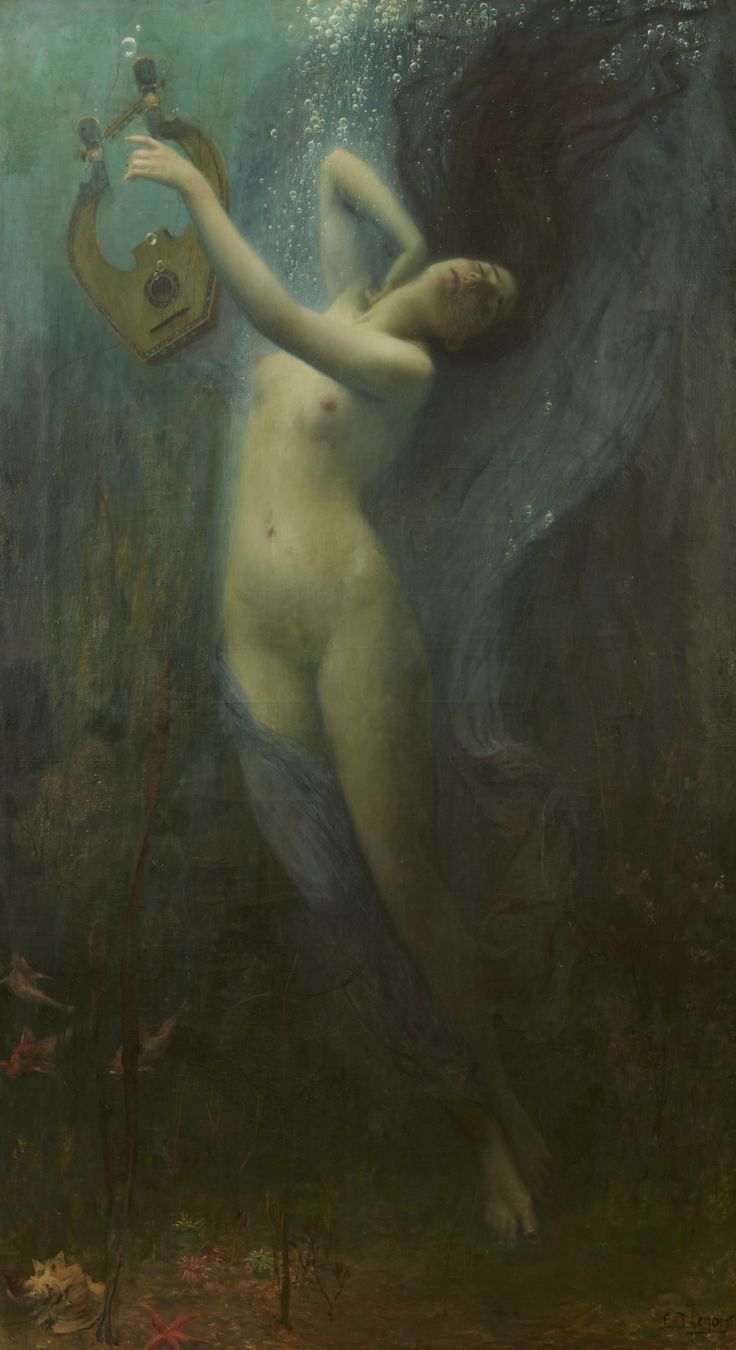
An 1896 oil painting by Charles Amable Lenoir showing a nude woman with a golden lyre floating underwater, imagining Sappho's death.
Shows Sappho's imagined death under water, a later legend that reveals how 1890s artists reworked her story.
About this source
What it is
This is an 1896 oil painting by Charles Amable Lenoir, titled The Death of Sappho. It shows a pale nude woman floating underwater with her eyes closed and dark hair flowing behind her. She holds a golden lyre aloft in one hand. Bubbles rise around her, and fish, a starfish and seaweed appear on the dark seabed below. The signature is in the lower right corner. The painting is a later reimagining of the poet's legend, not a record of an event.
Why it matters
Sappho lived on Lesbos around 630 to 570 BCE. Stories of how she died were written long after her time, and they were not based on her own work. Lenoir's painting shows how late-nineteenth-century artists turned her legend into a symbolic scene, with the lyre as a sign of her poetry even in death. The image reveals the taste of its period for dreamlike, mythic subjects and for the female nude.
Look closer
- Why might the artist place the lyre, a symbol of poetry, in the hand of a drowning figure?
- What does the underwater setting suggest about how the poet's death was understood?
- What does this painting leave out about Sappho's real life and the poems that survive?
This painting is part of the curated material that grounds the AI version of Sappho on Humy.ai — when students ask about related events, the AI can quote it and cite it.
More Sappho sources
Browse all 89 →


Ready when you are
Start chatting with Sappho now.
20 messages free · No credit card · Available in 50+ languages.