


Primary sourcePainting1829
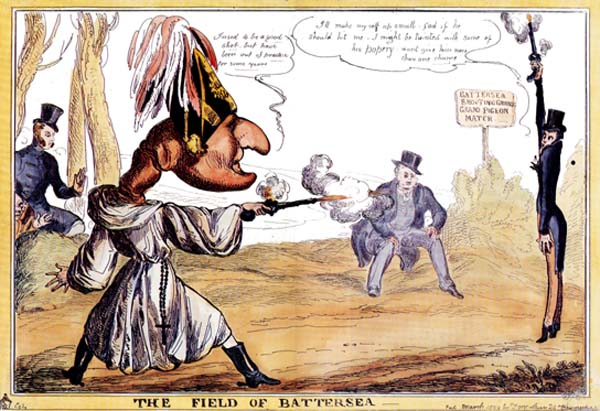
The Field of Battersea
William Heath · 1829
A caricature print of Wellington's 1829 pistol duel with the Earl of Winchilsea, drawing him as a lobster.
Satirises a real duel Wellington fought in 1829, showing him mocked despite his status as a national hero.
About this source
What it is
This hand-coloured caricature print, titled 'The Field of Battersea', was engraved by William Heath in 1829. It shows two men exchanging pistol fire, one drawn with a lobster's head and plumed hat, while a spectator in a top hat watches at a shooting ground.
Why it matters
The print mocks a real duel fought that year between the Duke of Wellington and George Finch-Hatton, 10th Earl of Winchilsea, over a political dispute. Wellington's friend and physician, John Robert Hume, appears as the onlooker. The image shows that duelling, though illegal, still settled disputes among the political elite, and that even a famous war hero like Wellington could be drawn as a figure of ridicule.
Look closer
- Why has the artist given Wellington a lobster's head instead of a human one?
- What does the presence of a physician at the duel suggest about how seriously it was taken?
- What does this source reveal about how the press treated political quarrels?
This painting is part of the curated material that grounds the AI version of Duke of Wellington (Arthur Wellesley) on Humy.ai — when students ask about related events, the AI can quote it and cite it.
More Duke of Wellington (Arthur Wellesley) sources
Browse all 94 →Primary source
Duke of Wellington's Dispatch, to Earl Bathurst
Arthur Wellesley, 1st Duke of Wellington · 19 June 1815
 Document
Primary source
Roman Catholic Relief Act 1829
1829
 Photograph
Primary source
Duke of Wellington Photo cleaned
Antoine Claudet · 1844
 Book
Primary source
The Dispatches of Field Marshal the Duke of Wellington
Arthur Wellesley, 1st Duke of Wellington · 1834-1839
Free account
Read every Duke of Wellington (Arthur Wellesley) source
Sign up free →
Ready when you are
Start chatting with Duke of Wellington (Arthur Wellesley) now.
20 messages free · No credit card · Available in 50+ languages.