


Secondary sourcePainting1813
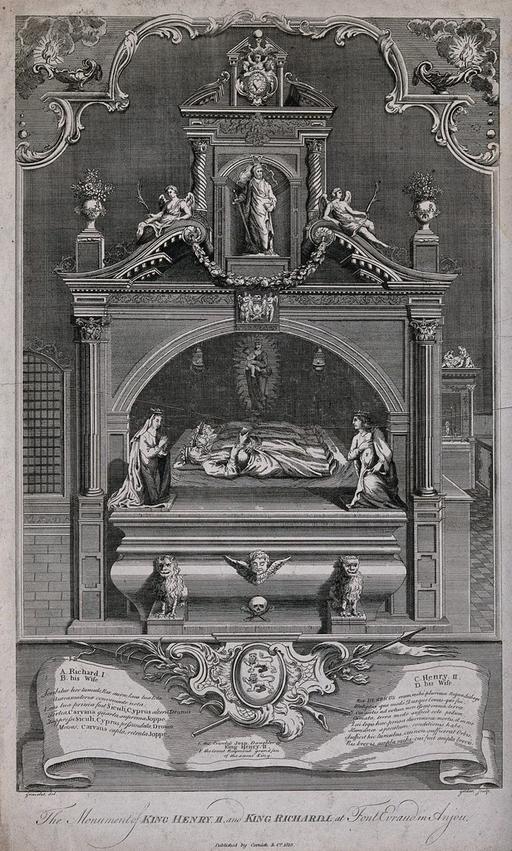
The monument of King Henry II and King Richard I at Fontevraud
Hubert François Bourguignon d'Anville Gravelot, with etching by J. Goldar · 1813
An 1813 engraving of the Fontevraud tomb effigies of Henry II and his son Richard I, held by the Wellcome Collection.
This engraving records the tomb of Richard I beside his father at Fontevraud, showing how his burial place was represented after his death.
About this source
What it is
This is an engraved print made in 1813 after a design by Hubert François Bourguignon d'Anville Gravelot, with etching by J. Goldar. It shows the tomb monument of Henry II and Richard I at Fontevraud in Anjou. A recumbent effigy lies on a tomb chest flanked by two kneeling female figures, with lions at the base, a skull and winged cherub head below, and a Christ figure above in an arched niche. The print is held by the Wellcome Collection in the United Kingdom.
Why it matters
Richard I was buried at Fontevraud Abbey beside his father, Henry II, and his mother's family were also honoured there. Tomb monuments like this one show how medieval rulers wanted to be remembered. This 1813 print is a later record of the monument, so it shows how people of the early 1800s saw Richard's tomb.
Look closer
- What symbols, figures and objects on the tomb suggest how the royal family wanted to be remembered?
- Why might an engraver in 1813 have chosen to record this monument?
- What can this print not show about the original tomb's colours, condition or setting?
This painting is part of the curated material that grounds the AI version of Richard the Lionheart on Humy.ai — when students ask about related events, the AI can quote it and cite it.
More Richard the Lionheart sources
Browse all 94 →
Ready when you are
Start chatting with Richard the Lionheart now.
20 messages free · No credit card · Available in 50+ languages.