


Secondary sourcePainting1750-1760
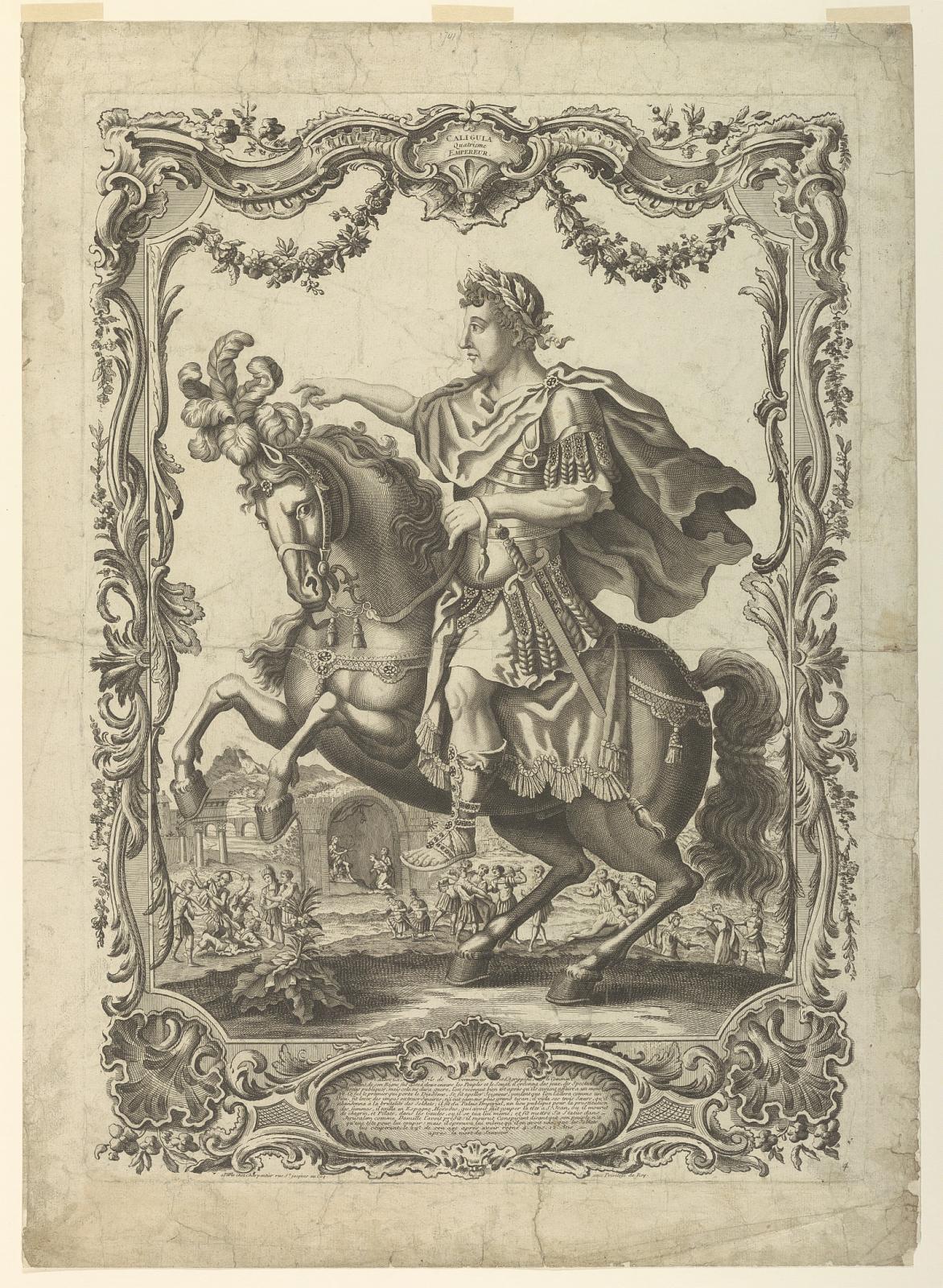
The Roman Emperor Caligula
Étienne Charpentier · 1750-1760
An 18th-century French print by Étienne Charpentier showing Caligula galloping on horseback, with scenes of violence in the background. It reflects how later artists imagined the emperor's reign.
Shows how a later artist imagined Caligula, depicted as a rider whose reign ends in violence, so it belongs in his archive as a later portrayal.
About this source
What it is
This is an engraved print made by Étienne Charpentier, a French artist, probably in the 1750s, according to the museum record dated 1750-1760. It shows the emperor Caligula, who ruled Rome from 37 to 41, riding a galloping horse toward the left. The record describes small scenes in the middle ground: two sisters of Caligula treated brutally by soldiers, a third sister killed, officers kneeling in worship, a statue of the emperor disguised as Jupiter, and Caligula himself killed by soldiers. The print is held by the Cooper Hewitt, Smithsonian Design Museum. The curator notes that the print is based on a later reading of his reign and that research on it is still in progress.
Why it matters
Caligula's reign was recorded by ancient Roman writers, and many later artists retold it in their own style. This print shows how an eighteenth-century French artist chose to present the emperor: as a violent and dramatic ruler whose life ends in death. It tells us more about the artist's time and taste than about the emperor himself. It is a useful source for studying how the reputation of a historical figure can change over the centuries.
Look closer
- What details in the print show power, and what details show violence? How are they placed in the picture?
- Why might an artist of the 1750s choose to show a Roman emperor in a rich Rococo frame?
- What does this image leave out, and which parts of Caligula's reign would you need other sources to understand?
This painting is part of the curated material that grounds the AI version of Caligula on Humy.ai — when students ask about related events, the AI can quote it and cite it.
More Caligula sources
Browse all 88 →
Ready when you are
Start chatting with Caligula now.
20 messages free · No credit card · Available in 50+ languages.