


Secondary sourcePainting1873
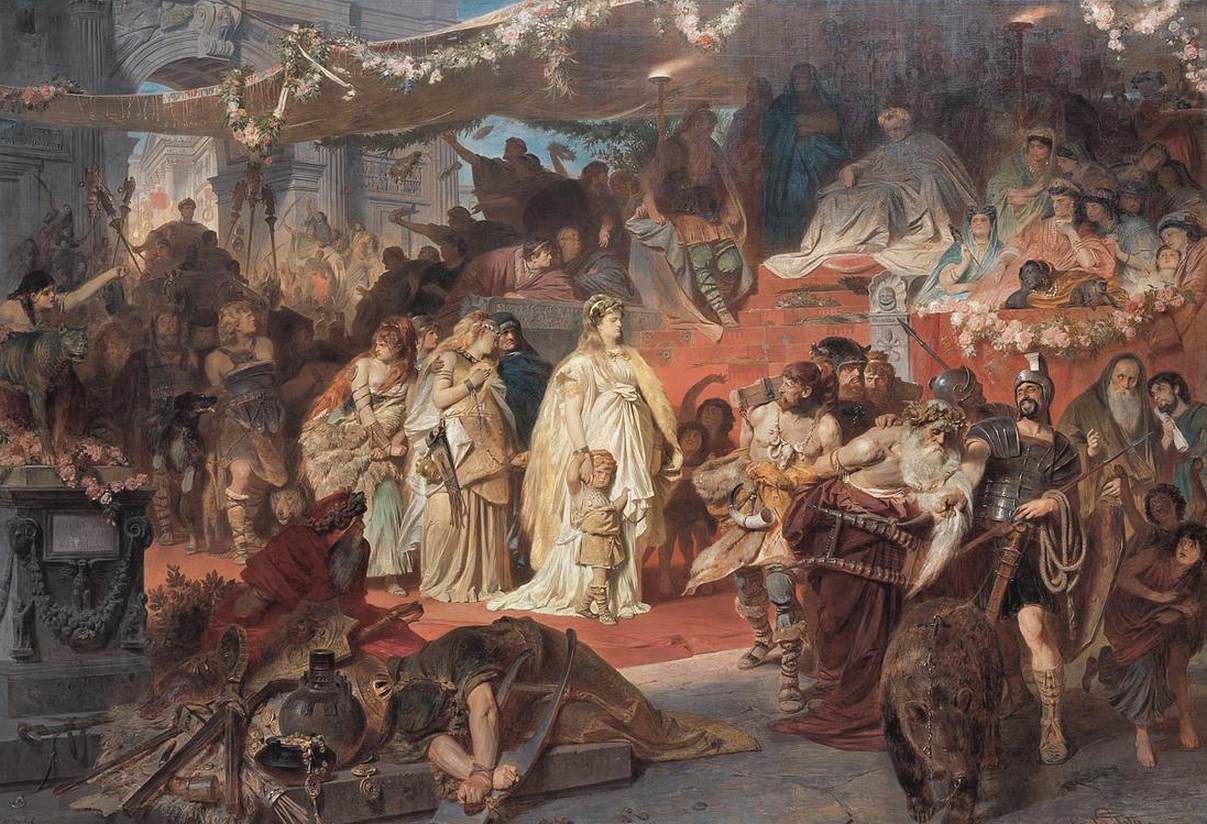
Thusnelda in the Triumphal Procession of Germanicus
Karl von Piloty · 1873
A huge 19th-century history painting showing Thusnelda, wife of Arminius, led as a captive through Rome in a Roman triumph.
Depicts Arminius's wife and son as Roman captives, showing the human cost behind his famous victory.
About this source
What it is
This large history painting was made by Karl von Piloty in 1873 and is held in the Bavarian State Painting Collections (Neue Pinakothek, Munich). It dramatises the ancient accounts of Strabo and Tacitus, imagining the moment when Thusnelda, the captive wife of Arminius, and their son were paraded through Rome during the triumph of the Roman general Germanicus.
Why it matters
The painting is not a record made at the time but a 19th-century imagination of a Roman event, created to appeal to German audiences fascinated by their ancient history. It shows how the story of Arminius's defeat of Rome, and the suffering of his family, was retold and dramatised centuries later to stir national feeling and sympathy for his lineage.
Look closer
- What emotions does the painter want the viewer to feel toward Thusnelda?
- Why might a 19th-century German artist choose this ancient scene to paint?
- What does the grandeur of the Roman setting tell us about how Rome wanted its triumphs to be seen?
This painting is part of the curated material that grounds the AI version of Arminius on Humy.ai — when students ask about related events, the AI can quote it and cite it.
More Arminius sources
Browse all 79 →
Ready when you are
Start chatting with Arminius now.
20 messages free · No credit card · Available in 50+ languages.