


Secondary sourcePhotograph
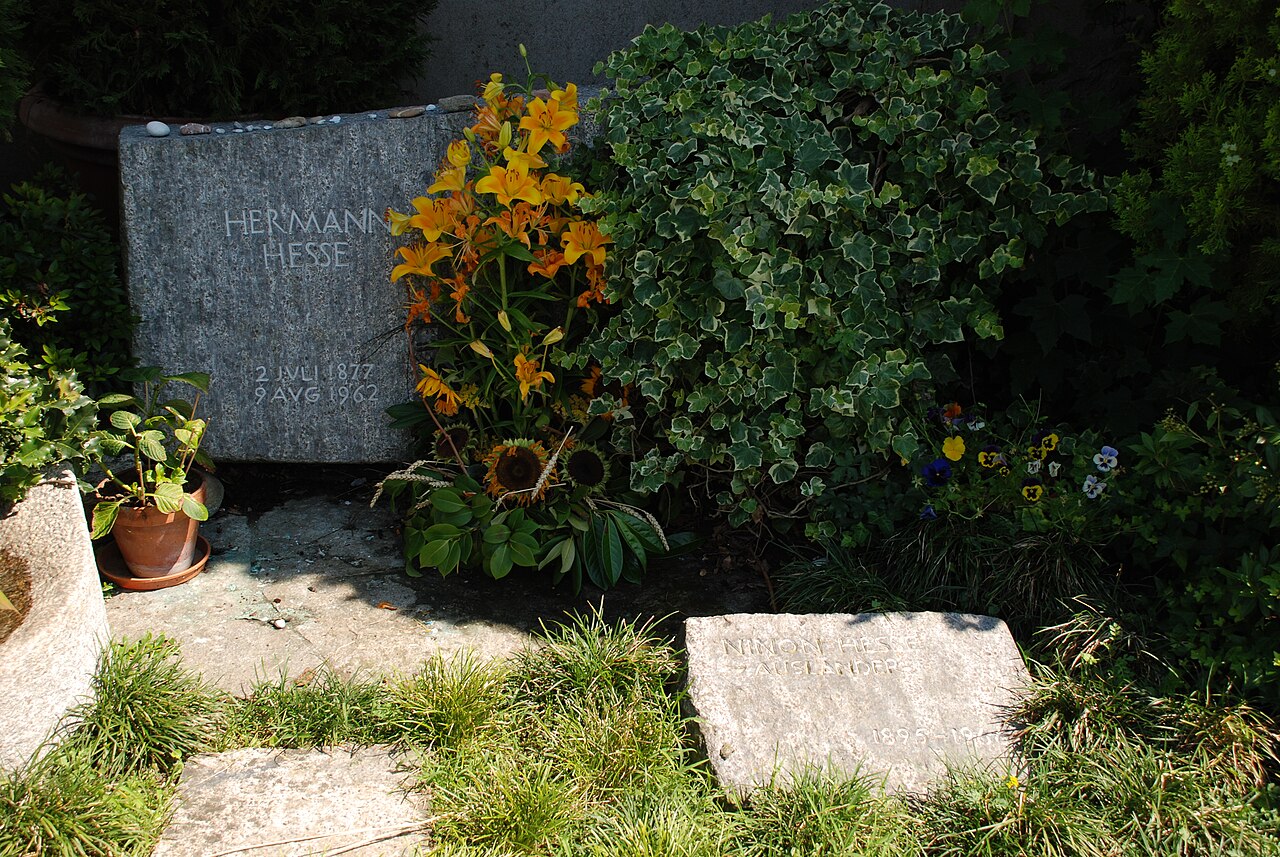
Tomb of Hermann Hesse, Montagnola
Hannes Röst
A photograph of Hermann Hesse's grave in Montagnola, Switzerland, showing the upright stone inscribed with his name and dates. It is a later memorial, not a primary record of his life.
Shows the grave where Hesse is buried, so it belongs in his archive as a record of how he is commemorated.
About this source
What it is
This is a photograph by Hannes Röst of the grave of Hermann Hesse in Montagnola. The image shows a grey upright stone inscribed HERMANN HESSE with the dates 2 Juli 1877 and 9 Aug 1962. Orange lilies, sunflowers and ivy grow beside it. A flat stone nearby is inscribed Ninon Hesse, 1886-1963.
The photograph was taken long after Hesse's death, so it shows a memorial rather than an object from his lifetime.
Why it matters
Hesse, a German-Swiss poet, novelist and painter who won the Nobel Prize, spent his later years in Montagnola. His grave there marks the place where he and his wife Ninon are buried. Ninon Hesse appears on the nearby stone, which links the grave to the couple's shared life.
Graves and memorials show how a society chooses to remember its writers. A photograph of a grave tells us how Hesse is honoured today, not how he lived.
Look closer
- What do the lilies, sunflowers and ivy suggest about how this grave is cared for and who visits it?
- Why might a photographer choose to show the stone next to the flat stone for Ninon Hesse?
- What does a grave photograph leave out about the everyday life of the person it remembers?
This photograph is part of the curated material that grounds the AI version of Hermann Hesse on Humy.ai — when students ask about related events, the AI can quote it and cite it.
More Hermann Hesse sources
Browse all 92 →

Ready when you are
Start chatting with Hermann Hesse now.
20 messages free · No credit card · Available in 50+ languages.