


Primary sourceDocument1603-1617
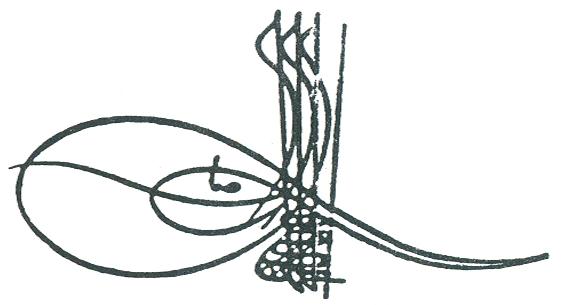
Tughra of Ahmed I
Unknown court calligrapher · 1603-1617
The calligraphic monogram that served as Ahmed I's official signature, stamped on decrees and coins throughout his reign.
This is Ahmed I's own official signature, used on his decrees and coinage throughout his reign.
About this source
What it is
This is a line drawing of a tughra, the elaborate calligraphic monogram used as the personal signature and seal of Sultan Ahmed I. It was created by an unknown court calligrapher and used on official documents and coins between 1603 and 1617.
Why it matters
Every Ottoman sultan had his own tughra, chosen at the start of his reign and reproduced by palace calligraphers on all state papers. Because it appears on every official document from his chancery, it is a direct and constant trace of Ahmed I's authority, repeated thousands of times across the empire.
Look closer
- What shapes and loops can you pick out in the design?
- Why might a ruler want such a complex, hard-to-copy signature?
- What does the use of a single sign on every document tell you about how the empire was run?
This document is part of the curated material that grounds the AI version of Ahmed I on Humy.ai — when students ask about related events, the AI can quote it and cite it.
More Ahmed I sources
Browse all 51 →
Ready when you are
Start chatting with Ahmed I now.
20 messages free · No credit card · Available in 50+ languages.