


Primary sourceArtifact1961
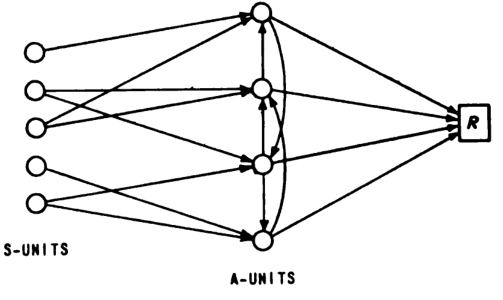
Typical connections in a close-loop cross-coupled perceptron
Frank Rosenblatt · 1961
A diagram by Frank Rosenblatt from his 1961 book Principles of Neurodynamics, showing a cross-coupled perceptron network.
This diagram is Rosenblatt's own drawing from his book, illustrating his theoretical model of the perceptron.
About this source
What it is
This is a diagram, Figure 47, drawn by Frank Rosenblatt for his 1961 book Principles of Neurodynamics. It shows sensory units (S-units) connected to association units (A-units), which are cross-connected to each other and feed into a single response unit (R).
Why it matters
This diagram shows Rosenblatt exploring networks where units are connected back to each other in loops, not just passing information forward. Ideas like this anticipated later recurrent neural network designs, including what became known as Hopfield networks, showing how early his thinking reached into territory that later became important in artificial intelligence.
Look closer
- Why might cross-connections between the A-units matter for how the network behaves?
- What does a diagram like this leave out about how a perceptron actually works?
- Why would a scientist publish a diagram like this in a book rather than just describing it in words?
This artifact is part of the curated material that grounds the AI version of Frank Rosenblatt on Humy.ai — when students ask about related events, the AI can quote it and cite it.
More Frank Rosenblatt sources
Browse all 7 →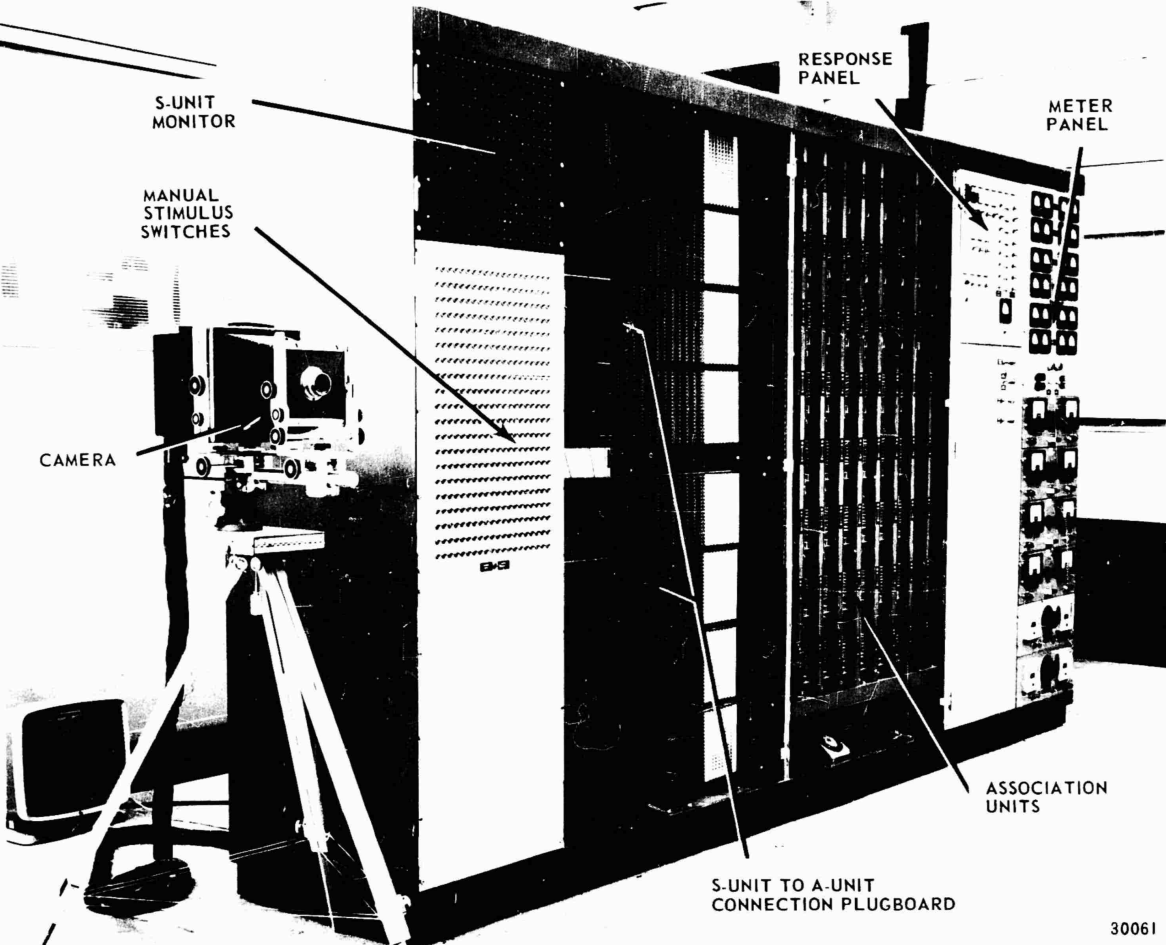
Ready when you are
Start chatting with Frank Rosenblatt now.
20 messages free · No credit card · Available in 50+ languages.