


Secondary sourceArtifact1955
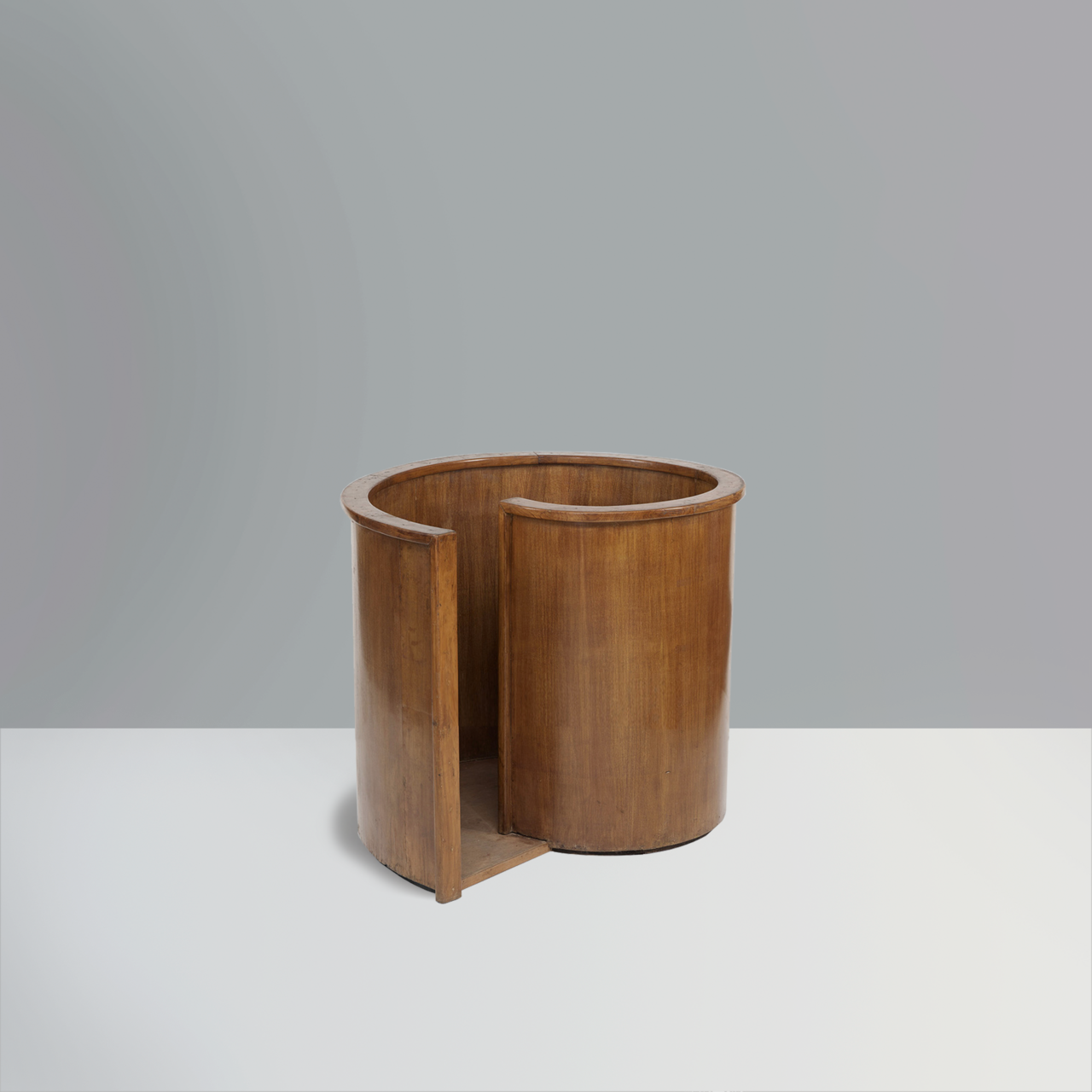
Witness Box for Chandigarh High Court
Le Corbusier · 1955
A teak witness box designed by Le Corbusier in 1955 for the High Court he built in Chandigarh, photographed in a gallery collection.
A piece of courtroom furniture designed by Le Corbusier for the Chandigarh High Court he architected.
About this source
What it is
This is a cylindrical teak witness box designed by Le Corbusier in 1955 for the High Court in Chandigarh, India. The photograph shows the piece as it is now held in the collection of P! Galerie in Zurich.
Why it matters
Le Corbusier designed not only buildings but also furniture for the spaces inside them. This witness box was made for the courtroom of the High Court, part of the larger Chandigarh project he led, showing how his design work extended down to small functional objects used every day inside his architecture.
Look closer
- Why might an architect design the furniture inside a building, not just the building itself?
- What does the simple, rounded shape of the box suggest about its purpose in a courtroom?
- What can't you learn about how the box was actually used just from this photograph?
This artifact is part of the curated material that grounds the AI version of Le Corbusier on Humy.ai — when students ask about related events, the AI can quote it and cite it.
More Le Corbusier sources
Browse all 88 →Primary source
Toward an Architecture
Le Corbusier · 1923
 Artifact
Primary source
Notre-Dame du Haut
Le Corbusier · 1955
 Artifact
Primary source
Chandigarh Capitol Complex
Le Corbusier · 1953
 Artifact
Primary source
Chandigarh
Le Corbusier · 1953
Free account
Read every Le Corbusier source
Sign up free →
Ready when you are
Start chatting with Le Corbusier now.
20 messages free · No credit card · Available in 50+ languages.