Case study
National Louis University Students Interview Their Founder
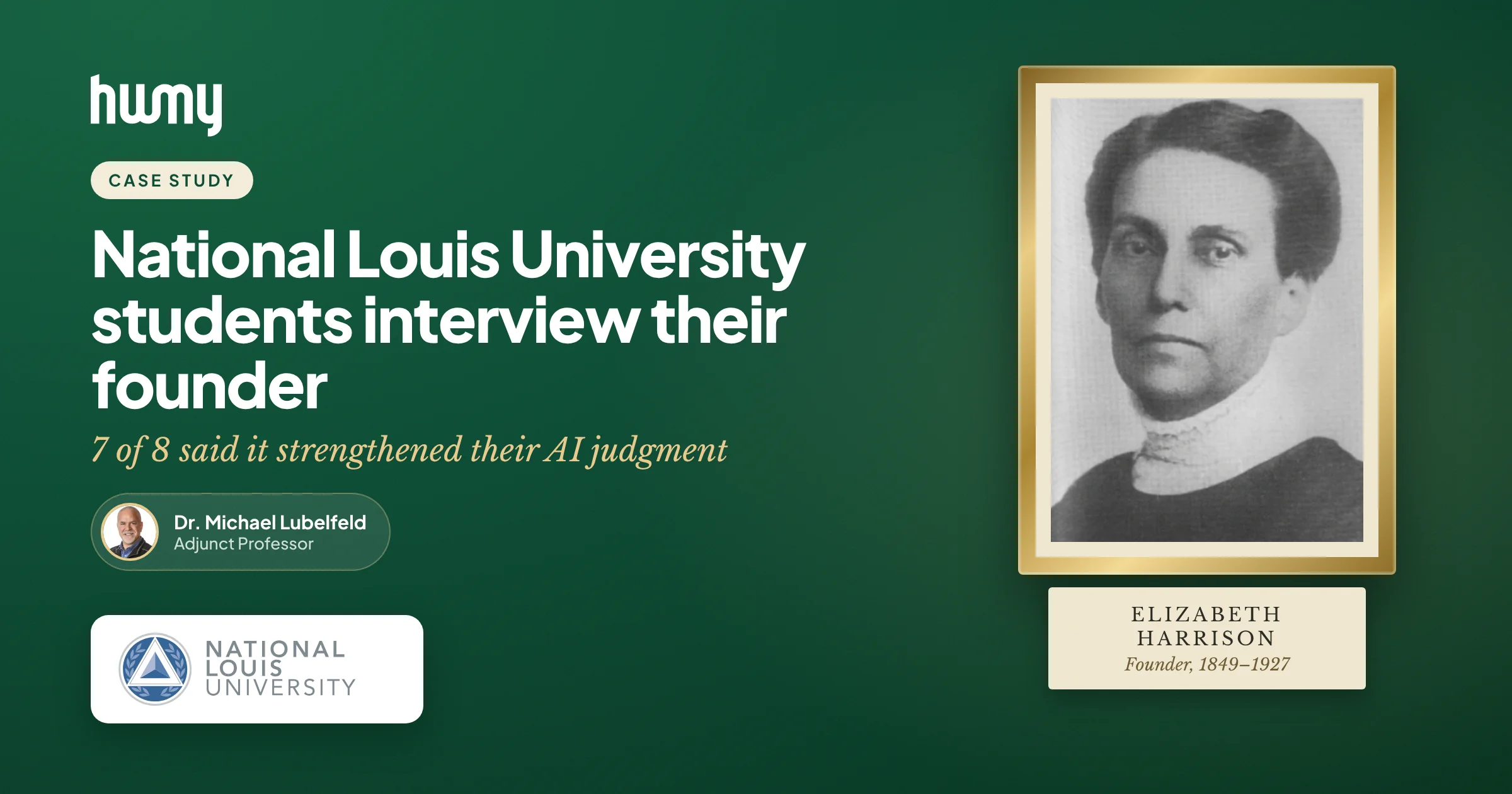
In summer 2026, 14 graduate students in National Louis University’s EDL 525, all aspiring or practicing school leaders, interviewed the woman who founded their university. Elizabeth Harrison died in 1927. The Harrison they questioned was an AI simulation on Humy, built from 25 primary and secondary sources in the NLU Library archives. Dr. Michael Lubelfeld, an adjunct professor in NLU’s Department of Educational Leadership and a former Illinois superintendent, built the assignment around her and evaluated the pilot. His quotes come from his write-ups about it.
At a glance
- Institution: National Louis University, Department of Educational Leadership
- Course: EDL 525, Summer 2026
- Participants: 14 graduate students
- AI simulation: Elizabeth Harrison, NLU’s founder, speaking in the first person
- Sources: 25 primary and secondary sources from the NLU Library archives, including her own writings, vetted by library staff. Nothing from the open web.
- Evidence: assignment exports, corroboration tables, a live focus group and an anonymous survey (8 of 14 responded)
The challenge
“Change leadership is usually taught through readings and cases. Students learn about leaders. They rarely get to question one,” Dr. Lubelfeld writes. The course also set out to teach responsible AI use by having students practice it, meeting the technology’s strengths and failures firsthand.
Who was Elizabeth Harrison?
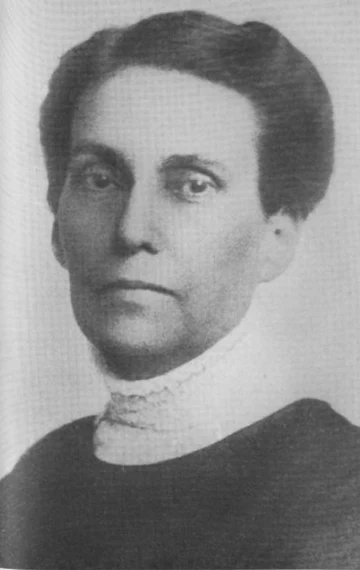
Born in Kentucky in 1849 and raised in Iowa, Harrison came to Chicago in 1879 to train as a kindergarten teacher with Alice Putnam. She went on to study with Susan Blow in St. Louis and Maria Kraus-Boelté in New York, two more pioneers of the American kindergarten. In 1885 or 1886 (the sources disagree) she opened a training class with five students and two mothers. With Rumah Crouse she grew it into the Chicago Kindergarten College, today’s National Louis University. She led the college until 1920.
Her main achievements, according to the NLU Library’s biography :
- Helped found the International Kindergarten Union in 1892.
- Organized the first national Mother’s Convocation, in Chicago in 1894. It drew 1,200 people and was a forerunner of the PTA.
- Spread the kindergarten across Chicago. By 1893 the area had 100 kindergartens, and her college’s students supervised 50 of them.
- Wrote A Study of Child-Nature, her talks for mothers and teachers, and many other books and essays.
- Studied Maria Montessori’s schools in Rome. The U.S. Bureau of Education published her report in 1914.
How the simulation works, with the NLU Library
NLU’s librarians pointed us to Harrison’s writings and papers in the library’s Digital Commons . Humy transcribed the scans so the simulation can search them before it answers, and every passage traces back to the original. A library specialist at NLU reviewed its answers and found them “insightful and largely accurate to her knowledge,” Dr. Lubelfeld reports.
One question, start to finish
Here is one question as a student sees it, from the archive search to the original document.
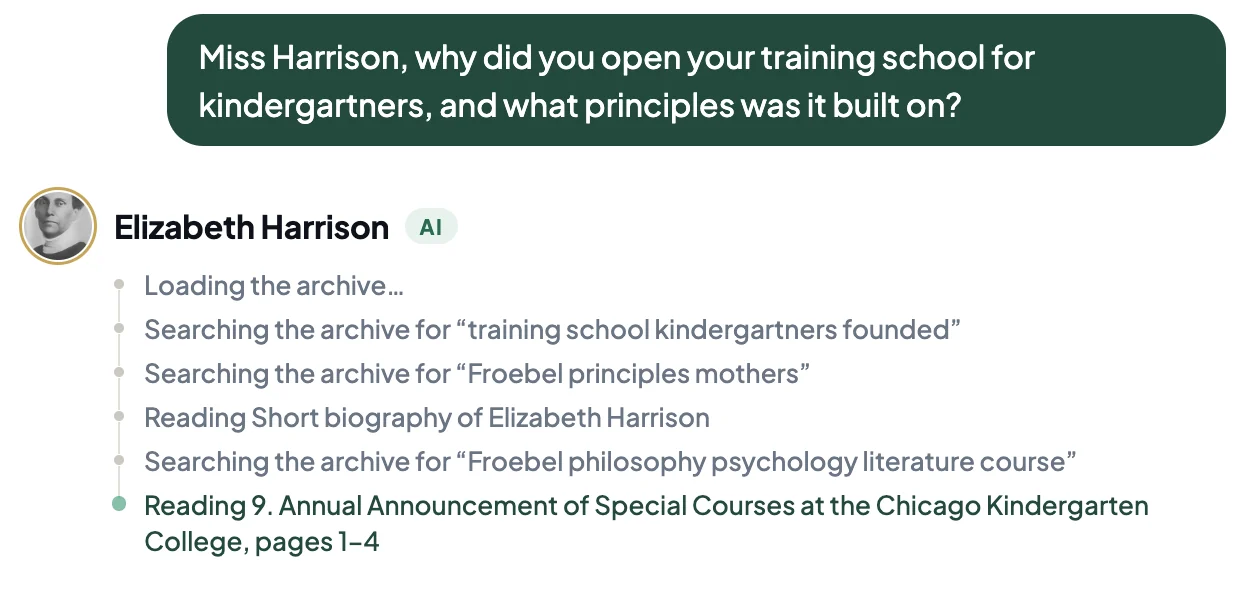
Before she answers, she searches her archive for the college's founding and Froebel's principles, then reads her short biography and the college's announcement of special courses.
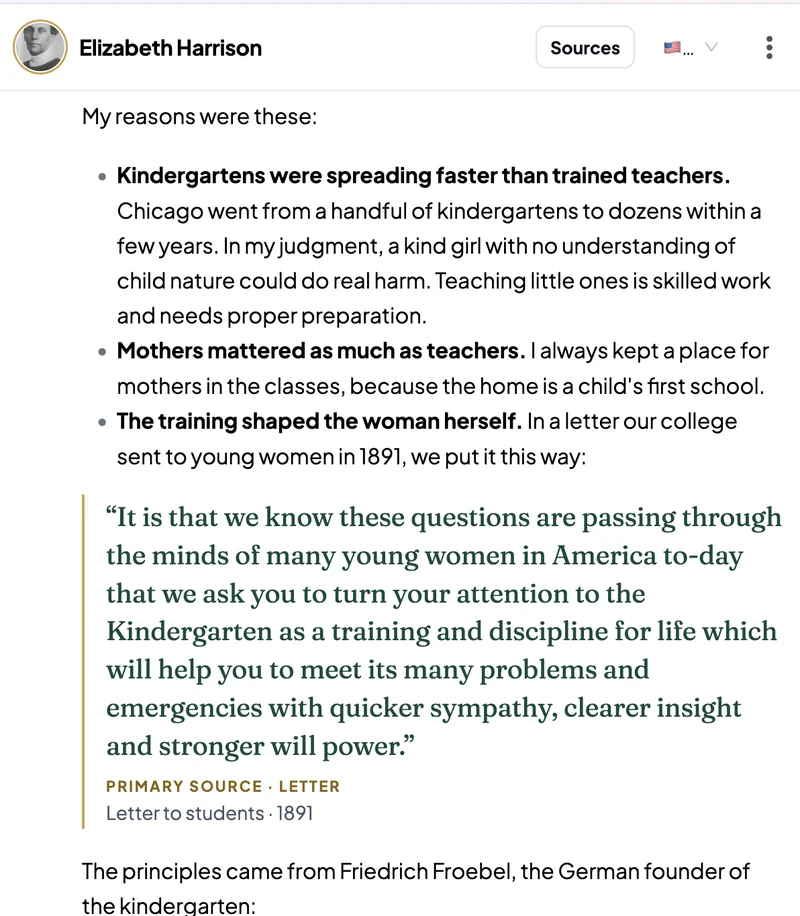
She answers in her own voice and quotes a primary source: the college's 1891 letter to students.
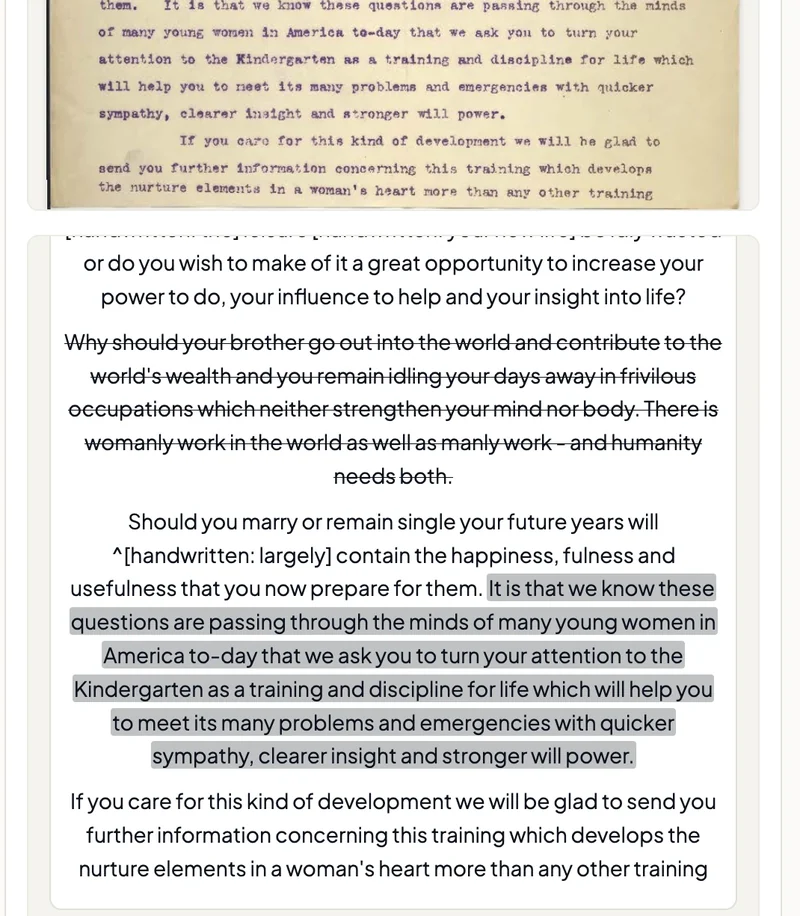
One click opens the original letter, scan and transcript, with the quoted passage highlighted.
The assignment
Dr. Lubelfeld built the assignment around three colors.
- Yellow, prepare: students write and refine their own interview questions.
- Green, interview: they question Harrison, follow up, challenge her answers and save the transcript.
- Red, corroborate and reflect: they check her claims against the sources, apply Douglas Reeves’ work on change readiness and the C.H.A.N.G.E. framework, and connect the lessons to their own schools.
Every student saw a disclaimer that Harrison is an AI simulation and turned in an AI Use Statement. Humy’s scores were formative only; a person graded the full assignment.
Impact
Responsible AI judgment
7 of 8
said the activity strengthened their judgment about responsible AI use
Simulation, not authority
7 of 8
understood it as a simulation, not an authority
Willing to push back
6 of 8
were comfortable challenging the AI simulation
Back to their schools
6 of 8
transferred the learning to a current leadership challenge
Students learned to catch what fluent AI gets wrong. When Harrison gave the founding year as 1886, they checked and found the sources split between 1885 and 1886. One student fed her a false premise on purpose; she corrected it, then cited evidence that complicated her own correction.
In the focus group, students supported keeping the activity and asked for more historical figures alongside Harrison, plus a starter script for first-time AI users. Dr. Lubelfeld’s evaluation recommends running it again with faculty guidance and trying it in a second course, EDL 526.
“The technology didn’t do the teaching. The design did, and the technology made the design come alive.”
 Dr. Michael LubelfeldAdjunct Professor, National Louis University
“I joined one of the calls with the students, and they were very grateful for the chance to use AI in their learning journey. A truly inspiring project. Thank you, Dr. Lubelfeld.”
 Stanislav ShakirovCo-founder and CEO, Humy.ai
Building a course around your own archive? See how Humy works for universities.