


Primary sourceArtifact521–486 BCE
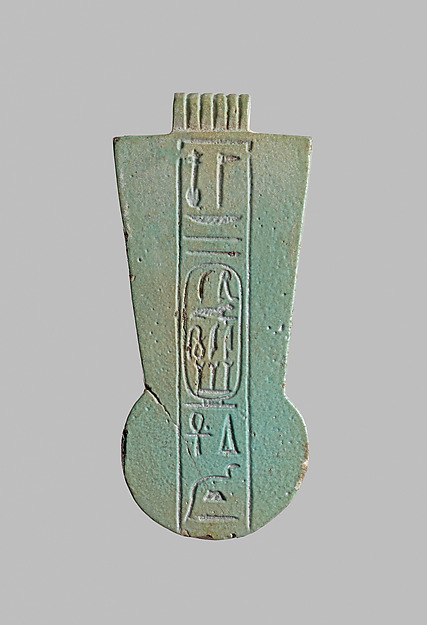
Menat counterpoise of Darius I
521–486 BCE
A green faience menat counterpoise inscribed with the name of Darius I, from his reign in Egypt. It is held by The Metropolitan Museum of Art.
An object from Darius I's reign in Egypt, inscribed with his name, showing how his rule extended to Egyptian royal and religious practice.
About this source
What it is
This is a menat counterpoise made of green faience, a glazed material. It is inscribed with hieroglyphs, including a cartouche, and carries the name of Darius I. The Metropolitan Museum of Art holds it, after a purchase made with the Edward S. Harkness Gift in 1926. Its date is given as 521-486 BCE, during the First Persian Period of Egypt under the Twenty-Seventh Dynasty.
Why it matters
The object shows that Darius I's rule reached Egypt, where he was recognized in traditional Egyptian royal form. The inscription links a Persian king to Egyptian religious and royal practice, which helps students see how the empire governed different peoples.
Look closer
- What features of the object, such as the ridged top and the hieroglyphs, show that it follows Egyptian design?
- Why would a Persian king's name appear on an object made in Egypt?
- What might this single object not tell us about how the Persian government treated Egyptian people?
This artifact is part of the curated material that grounds the AI version of Darius the Great on Humy.ai — when students ask about related events, the AI can quote it and cite it.
More Darius the Great sources
Meet the AI Darius the Great →

Ready when you are
Start chatting with Darius the Great now.
20 messages free · No credit card · Available in 50+ languages.