


Secondary sourcePainting1700-1799
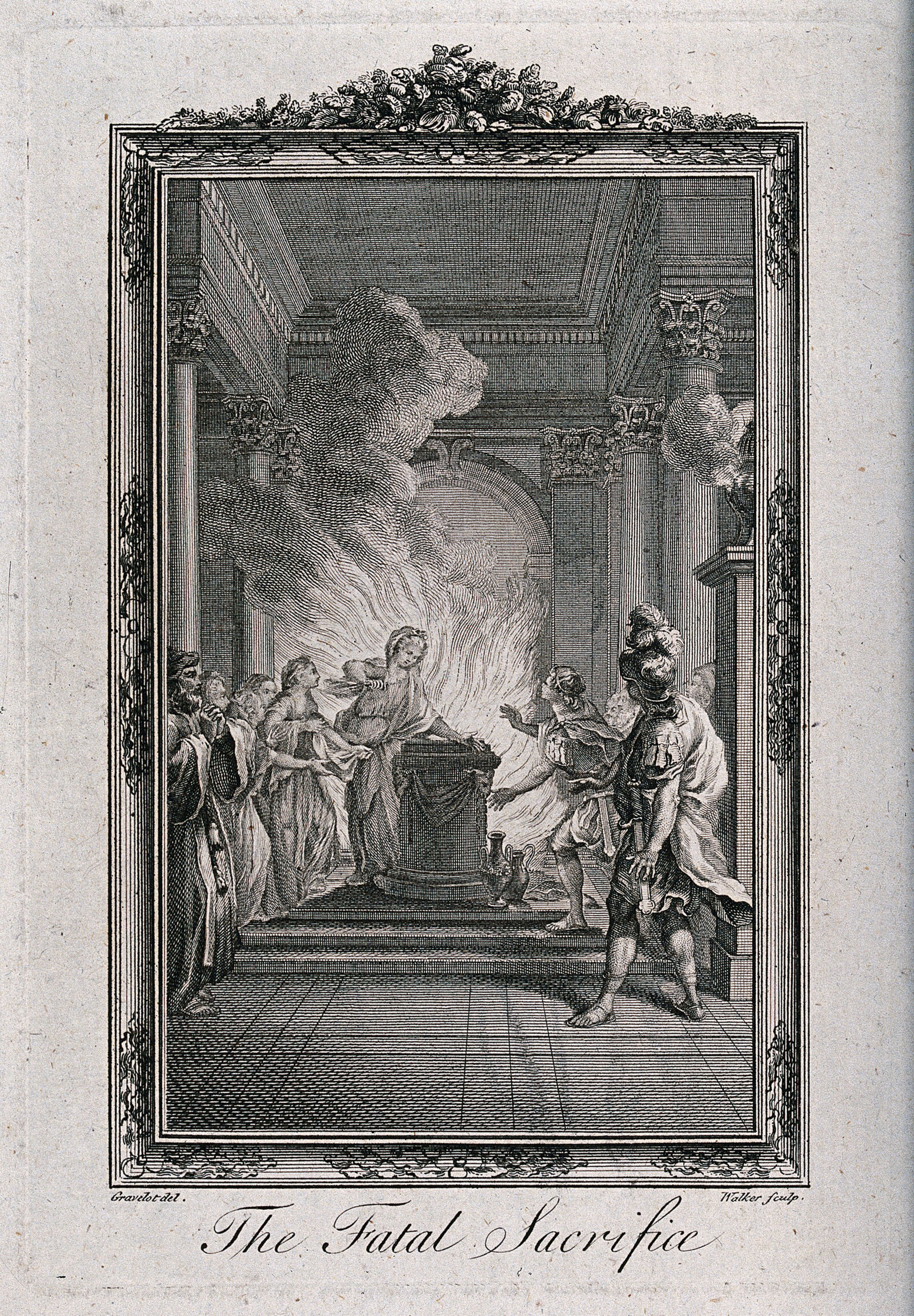
Olympia Throws Herself on the Fire
Hubert-François Gravelot · 1700-1799
An etching depicting a dramatic scene from Voltaire's play Olimpie, where the heroine sacrifices herself on a fire.
This etching illustrates a scene from Voltaire's play Olimpie, showing how his theatre was depicted visually.
About this source
What it is
This etching by Walker, after a design by Hubert-François Gravelot, illustrates a scene from Voltaire's play Olimpie. It shows Olympia at a stone altar with fire and smoke, surrounded by onlookers and an armed man, made during the 1700s and held by the Wellcome Collection in London.
Why it matters
Olimpie was one of Voltaire's tragedies, drawing on ancient history connected to Alexander the Great. This print shows how his plays were turned into popular images for audiences, and how illustrators like Gravelot helped shape the visual imagination of 18th-century theatre based on Voltaire's writing.
Look closer
- What does the setting (altar, fire, classical dress) tell you about the story being shown?
- Why might an illustrator choose this dramatic moment of self-sacrifice to depict?
- What questions do you have about the characters and plot that the image doesn't answer?
This painting is part of the curated material that grounds the AI version of Voltaire on Humy.ai — when students ask about related events, the AI can quote it and cite it.
More Voltaire sources
Meet the AI Voltaire →
Ready when you are
Start chatting with Voltaire now.
20 messages free · No credit card · Available in 50+ languages.