


Secondary sourcePainting1569
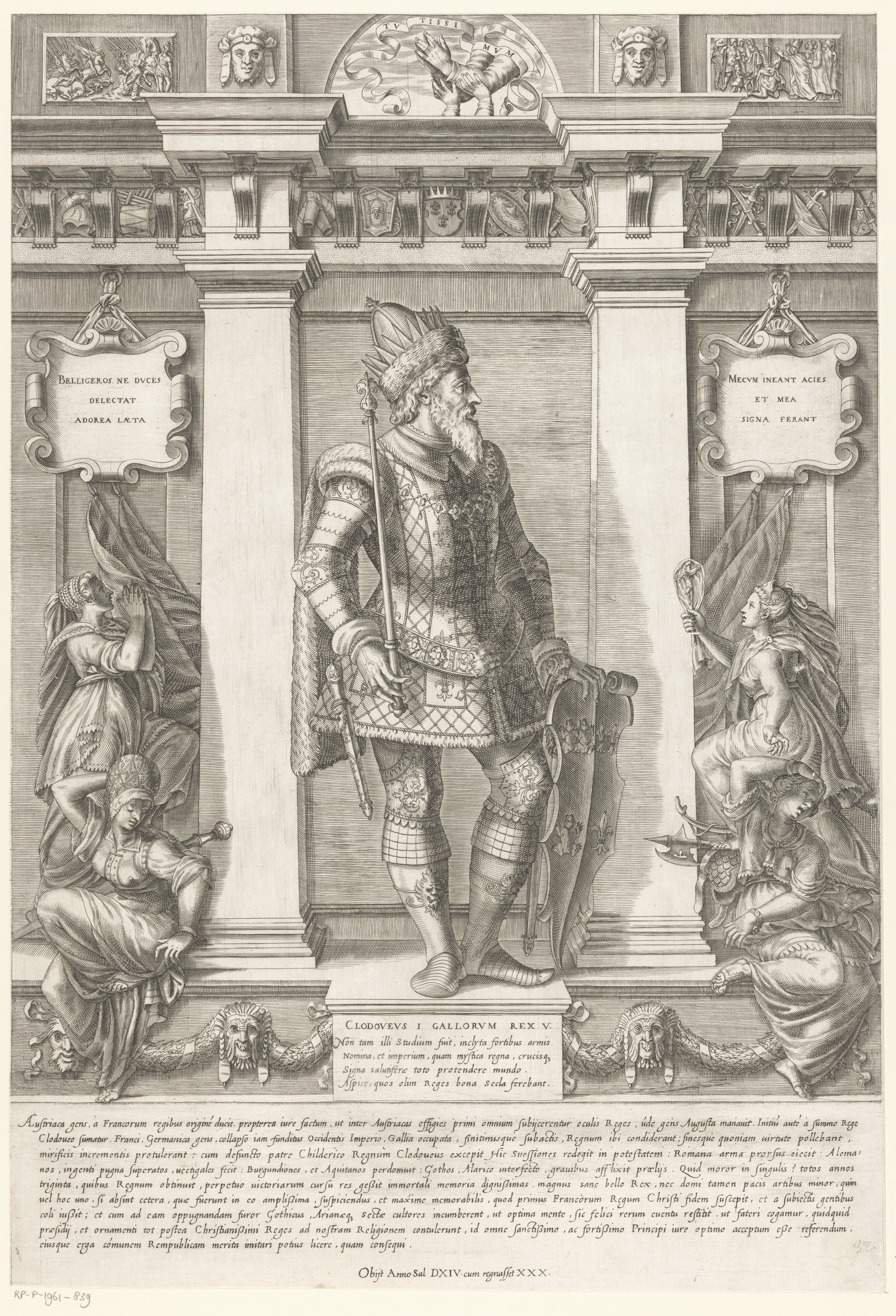
Portrait of Clovis I, King of the Franks
1569
A 1569 engraved print that imagines Clovis I as a crowned, armored king. It was made about a thousand years after his death.
Shows how Clovis was imagined as a royal ruler some ten centuries after his death, not a record of his appearance.
About this source
What it is
This is an engraved print from 1569, held by the Rijksmuseum in the Netherlands. It shows a bearded king in armor and a fur-trimmed mantle, wearing a spiked crown and holding a scepter. He stands before a classical arch, with two allegorical female figures on either side, scrolls above, and a Latin inscription and Dutch-titled text block below. The museum's note describes it as an imagined likeness.
Why it matters
Clovis died around 511, so this portrait was made roughly a thousand years later. No reliable likeness of him from his lifetime is known from these facts. The print shows how sixteenth-century artists wanted to picture early kings as powerful rulers, mixing medieval armor with classical architecture. It reveals the ideas of its makers and their time.
Look closer
- Which objects, such as the crown, scepter and armor, are meant to show power?
- Why might the artist have placed classical architecture and allegorical figures around an early medieval king?
- How do you know this is an imagined portrait rather than a record of his real appearance?
This painting is part of the curated material that grounds the AI version of Clovis I on Humy.ai — when students ask about related events, the AI can quote it and cite it.
Ready when you are
Start chatting with Clovis I now.
20 messages free · No credit card · Available in 50+ languages.