


Secondary sourceSculpture1705
Portrait of Heraclitus
Giuseppe Torretti · 1705
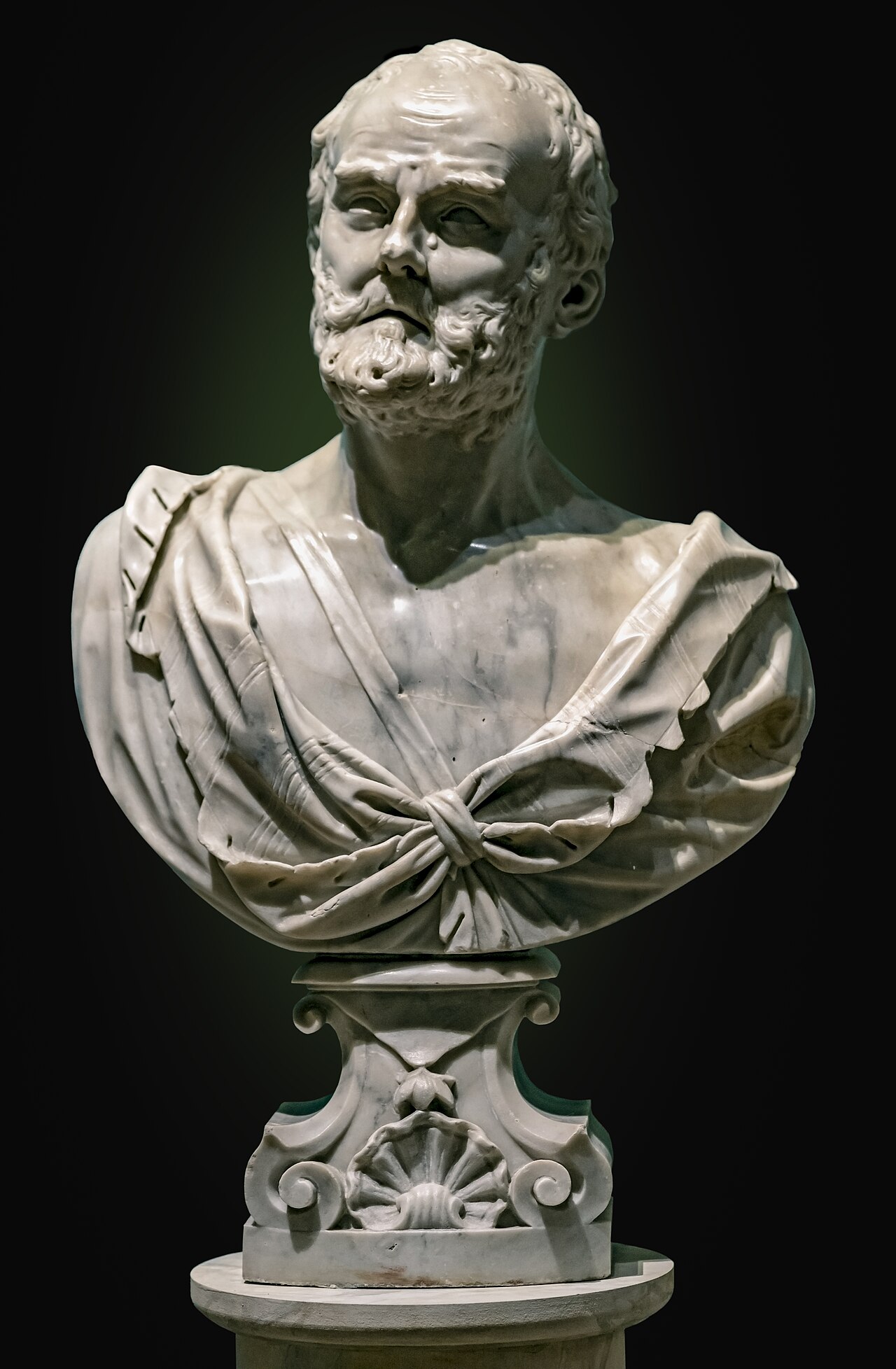
A 1705 marble bust by Giuseppe Torretti giving Heraclitus an imagined sculpted likeness, in Ca' Rezzonico, Venice.
An invented marble likeness of Heraclitus made nearly two millennia after his death, honouring him as a philosopher.
About this source
What it is
This marble bust, made in 1705 by the Venetian sculptor Giuseppe Torretti, shows a bearded, balding older man with curly hair and draped clothing, set on a decorated pedestal. It is located in the Ca' Rezzonico palace in Venice.
Why it matters
Because no authentic likeness of Heraclitus survives from his own lifetime, sculptors like Torretti invented portraits based on ideas of what an ancient philosopher should look like. This bust shows how Heraclitus continued to be honoured and imagined in grand decorative settings over two thousand years after his death.
Look closer
- What features make this figure look like a 'wise philosopher' to the sculptor?
- Why might a Venetian palace display a bust of an ancient Greek thinker?
- Since no real portrait of Heraclitus exists, what does this tell us about the limits of such sculptures as historical evidence?
This sculpture is part of the curated material that grounds the AI version of Heraclitus on Humy.ai — when students ask about related events, the AI can quote it and cite it.
More Heraclitus sources
Browse all 88 → Document
Primary source
Derveni Papyrus, Column IV
Unknown author · 4th century BC
 Book
Secondary source
Lives and Opinions of Eminent Philosophers, Book V (Life of Aristotle)
Diogenes Laërtius · c. 3rd century CE
Primary source
Cratylus
Plato
 Book
Secondary source
Metaphysics
Aristotle · c. 400 BCE
Free account
Read every Heraclitus source
Sign up free →
Ready when you are
Start chatting with Heraclitus now.
20 messages free · No credit card · Available in 50+ languages.