


Primary sourceBookearly 5th century AD
The City of God
Augustine of Hippo · early 5th century AD
Augustine's major work of Christian philosophy, written after the sack of Rome in 410, arguing that Christianity was not to blame and contrasting the earthly city with the city of God.
Augustine's own response to the sack of Rome, defending Christianity and shaping Christian views of history and politics.
Free Humy account · No credit card · 120,912 sources to read
About this source
What it is
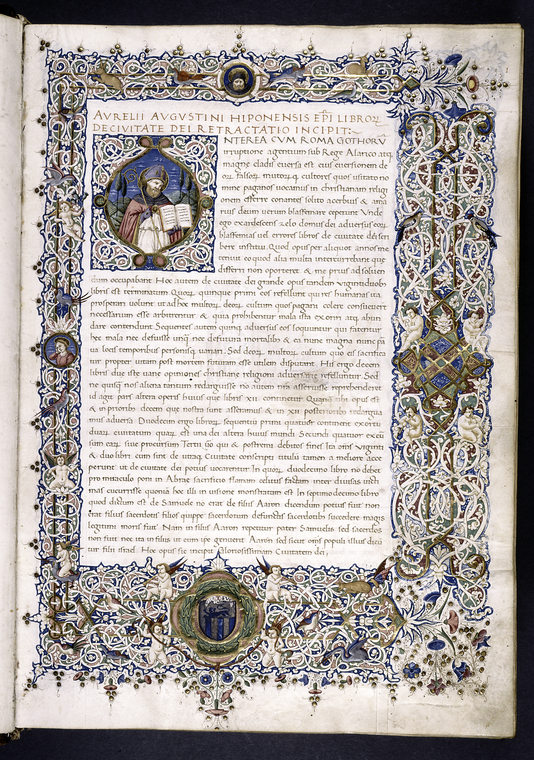
On the City of God Against the Pagans is a Latin work of Christian philosophy written by Augustine of Hippo in the early 5th century AD. It was written in response to the Visigothic sack of Rome in 410, when many blamed Christianity for Rome's decline. The manuscript page shown is from a later copy of Augustine's Retractions, an illuminated medieval book with decorated borders.
Why it matters
The City of God became one of the most important works of Western Christian thought, addressing the suffering of the righteous, the existence of evil, free will, and the doctrine of original sin. It argues that the ultimate victory belongs not to any earthly empire but to the spiritual 'City of God,' reshaping how Christians thought about politics and history for centuries.
Look closer
- Why might people living through the fall of Rome have needed this kind of argument?
- What does Augustine's choice to separate the 'earthly city' from the 'city of God' suggest about his view of politics?
- How might a work written to console people also be used to persuade them?
This book is part of the curated material that grounds the AI version of Saint Augustine, Theodosius I, Sulla and Spartacus on Humy.ai — when students ask about related events, the AI can quote it and cite it.
More Saint Augustine sources
Browse all 86 → Book
Primary source
Confessions
Augustine of Hippo · AD 397-400
Primary source
Sermons of Augustine of Hippo
Augustine of Hippo
Primary source
De libero arbitrio
Augustine of Hippo · 388-395 AD
Primary source
On the Trinity
Augustine of Hippo · c. 400-420s AD

Free account
Read every Saint Augustine source
Sign up free →
Ready when you are
Start chatting with Saint Augustine now.
20 messages free · No credit card · Available in 50+ languages.