


Secondary sourcePainting1596
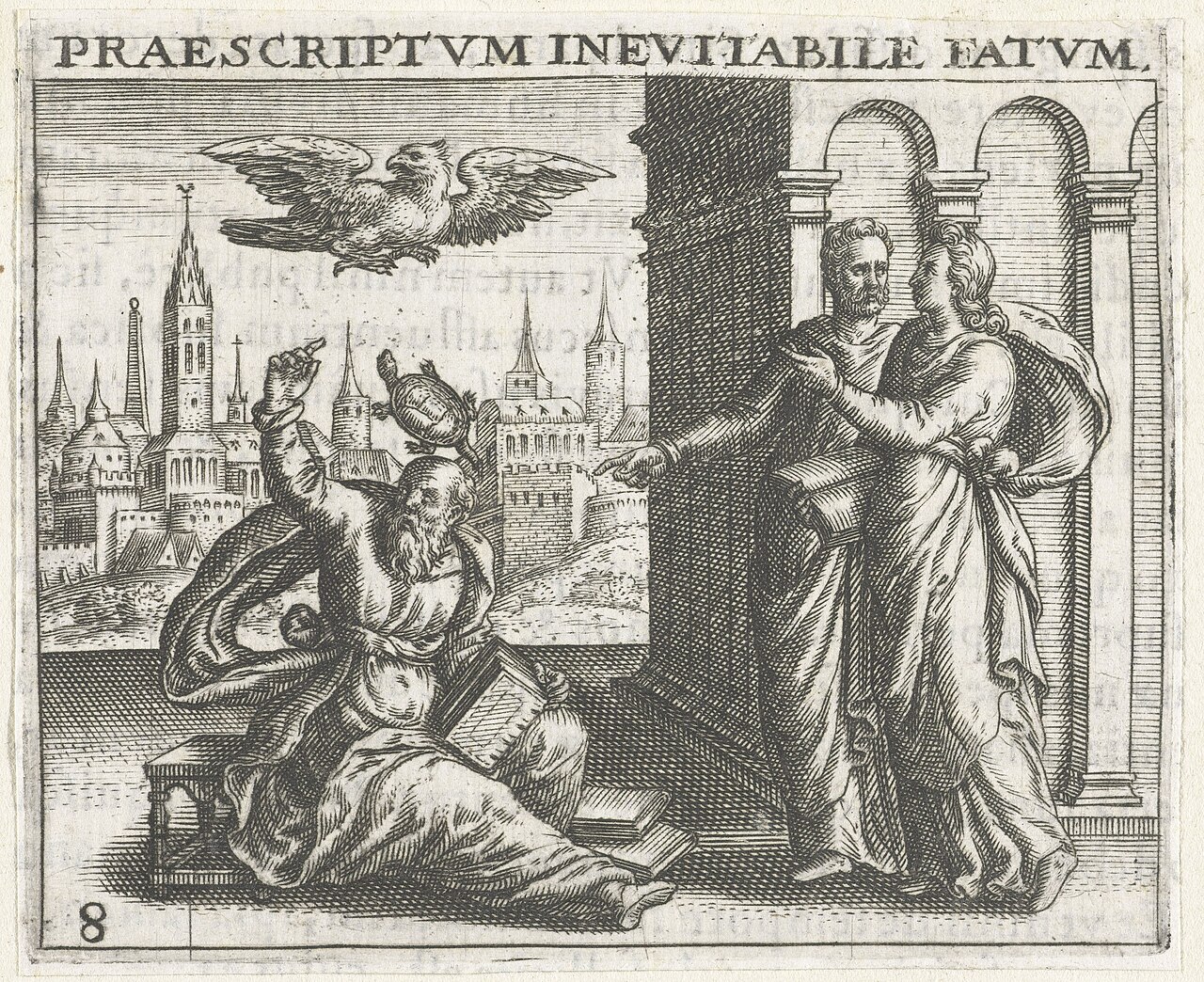
The Death of Aeschylus, emblem print by Denis Lebey de Batilly
Denis Lebey de Batilly · 1596
An 1596 emblem engraving from Denis Lebey de Batilly's Emblemata, showing an eagle dropping a tortoise on Aeschylus's head in the legend of his death.
It uses the legend of Aeschylus's death as a moral example, showing how his story was turned into a lesson in later European culture.
About this source
What it is
This is an engraved emblem plate, numbered 8, from Denis Lebey de Batilly's book Emblemata, published in Frankfurt am Main in 1596. The plate is titled PRAESCRIPTUM INEVITABILE FATUM and carries the motto MORS VITAE TERMINUS HAERET. The Rijksmuseum record describes the scene: an eagle drops a tortoise on the bald head of Aeschylus, mistaking his head for a stone. Two men beside him point toward the scene. The print was engraved by Theodor de Bry after a drawing by Jean Jacques Boissard.
Why it matters
Emblem books combined pictures, mottoes and short explanations to teach moral lessons. By placing Aeschylus in such a book, the author used the legend of his death as an example of how fate cannot be avoided. The print shows that by the late sixteenth century the story of the poet's death had become a familiar moral tale in Europe.
Look closer
- What does the Latin motto tell you about the lesson the image is meant to teach?
- Why do the two men beside Aeschylus point, and what role do they play in the scene?
- What does this print leave out about Aeschylus as a playwright, and why might that be?
This painting is part of the curated material that grounds the AI version of Aeschylus on Humy.ai — when students ask about related events, the AI can quote it and cite it.
Ready when you are
Start chatting with Aeschylus now.
20 messages free · No credit card · Available in 50+ languages.