


Secondary sourceArtifact1618
William the Conqueror, King of England and Duke of Normandy
Renold Elstrack · 1618
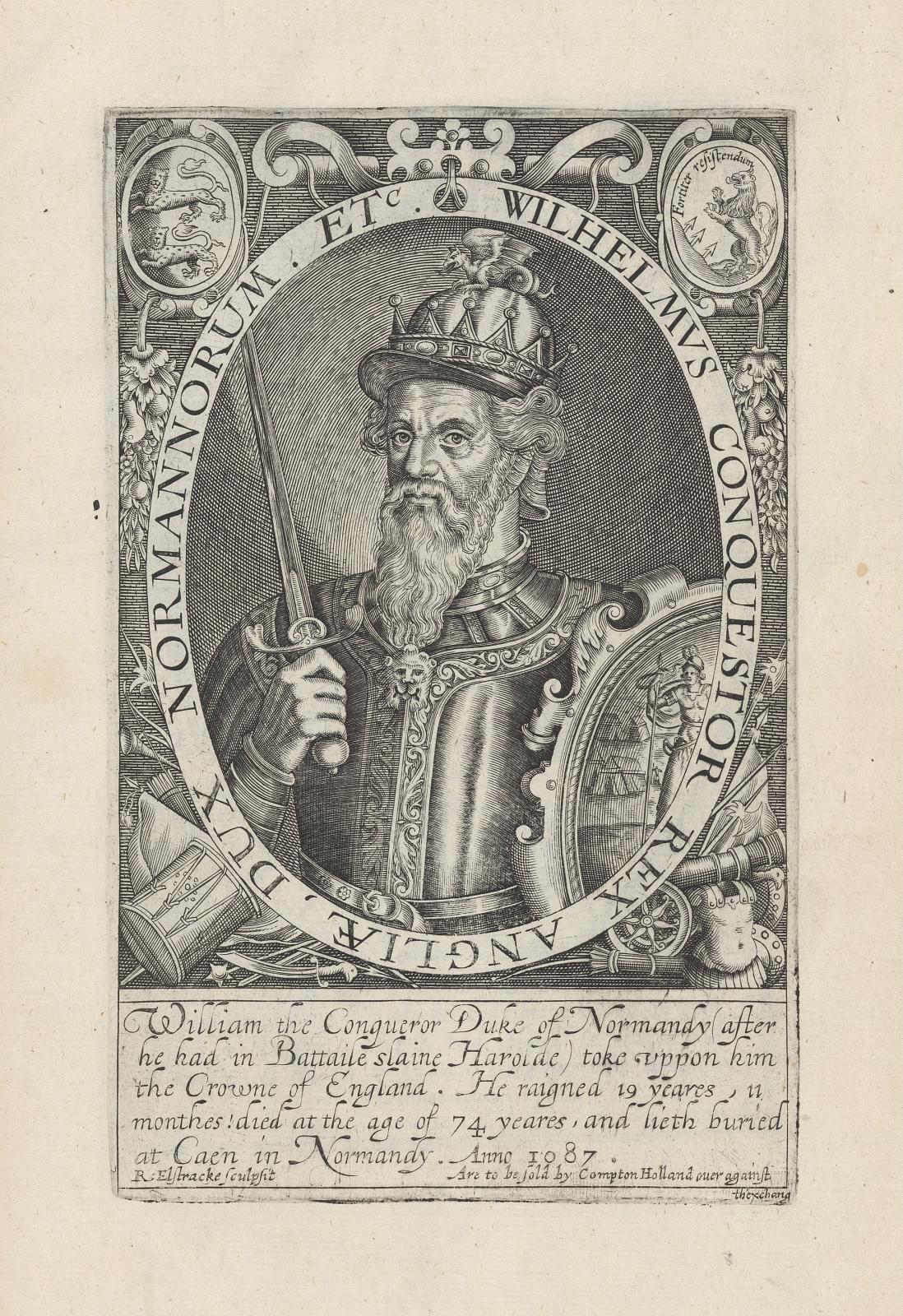
An engraved portrait print of William the Conqueror made in 1618 by Renold Elstrack, now held by the National Portrait Gallery.
A later printed likeness of William showing how he was pictured as king and conqueror, so it belongs in his archive as a portrait of his image rather than of his face.
About this source
What it is
This is an engraved print made in 1618 by Renold Elstrack. It shows a bearded man wearing a crown and armour, holding a sword and a shield, inside an oval frame. The Latin inscription reads 'Wilhelmus Conquestor Rex Angliae Dux Normannorum Etc.' Two small roundels at the top show heraldic lions, and a printed caption below names William and gives the date 1087. The print is held by the National Portrait Gallery.
Why it matters
This is a likeness made more than five centuries after William lived, so it shows how later artists imagined him, not how he looked. The print uses symbols of kingship, such as the crown, sword, shield and lions, to present him as a ruler. It shows how English people of the seventeenth century, who had their own kings and wars, chose to picture the Norman conqueror.
Look closer
- Which objects in the print tell you that this man was a ruler, and what does each one mean?
- Why might a 1618 artist give William a crown and armour rather than a plain appearance?
- What does this image leave out about William's actual life and appearance?
This artifact is part of the curated material that grounds the AI version of William the Conqueror on Humy.ai — when students ask about related events, the AI can quote it and cite it.
More William the Conqueror sources
Browse all 95 →
Ready when you are
Start chatting with William the Conqueror now.
20 messages free · No credit card · Available in 50+ languages.