


Secondary sourcePaintingbetween 1700 and 1799 (possibly 17th century)
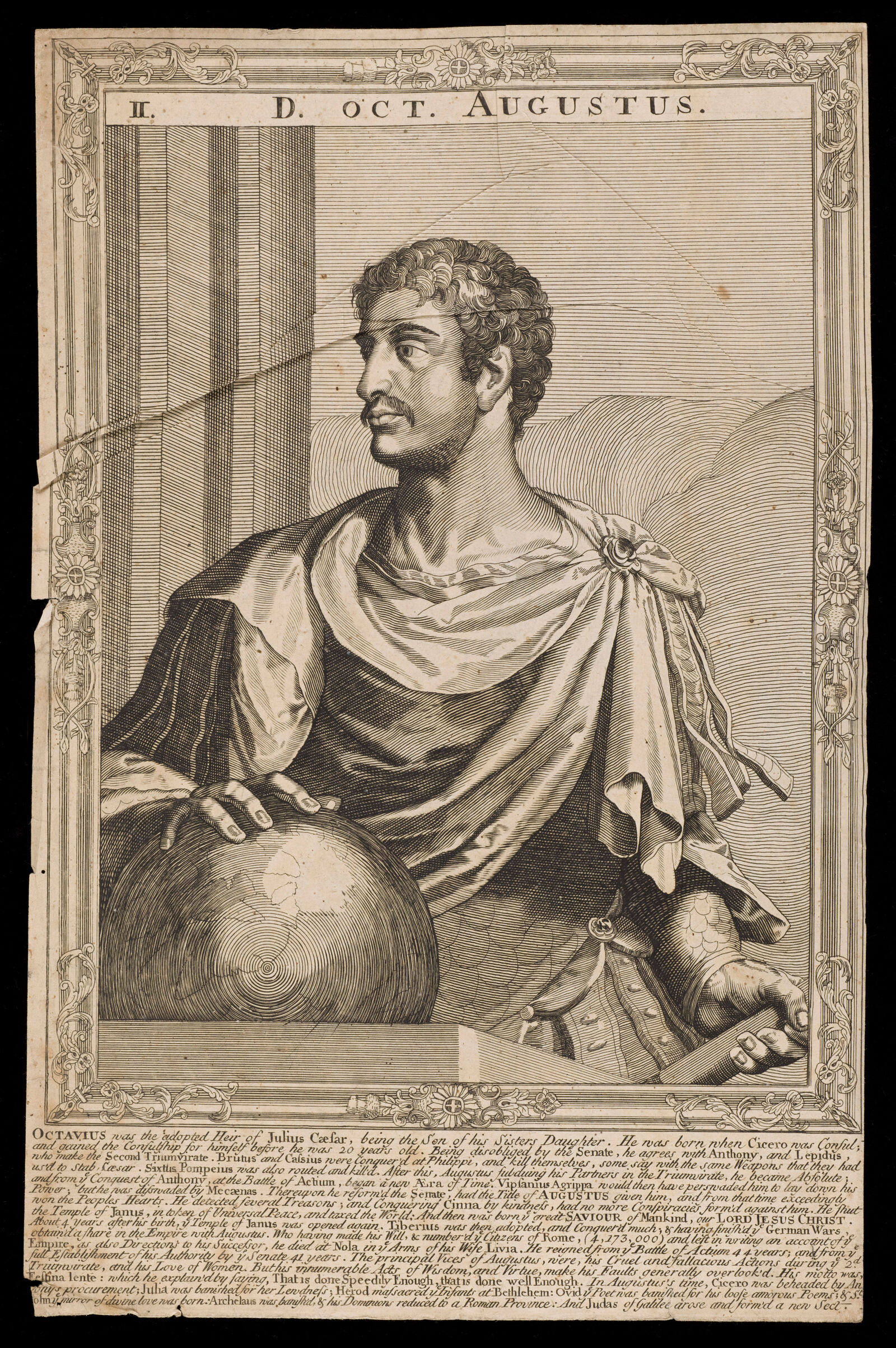
Emperor Augustus with Globe
After Titian (engraving by A. Sadeler, after Titian) · between 1700 and 1799 (possibly 17th century)
A later engraving imagining the Roman emperor Augustus, shown holding a globe, based on a painted portrait by Titian.
This later engraving imagines Augustus's appearance, showing how he was remembered and idealised long after his death.
About this source
What it is
This is a line engraving portrait of the Roman emperor Augustus, made long after his lifetime. It is based on a portrait by the painter Titian, and the print itself was made by an engraver working from that painting (some records credit A. Sadeler as the engraver after Titian). It shows Augustus in profile, draped in a Roman cloak, resting one hand on a globe and holding a scroll in the other. It is held today by the Wellcome Collection in London.
Why it matters
Augustus died long before this print was made, so it is not a true likeness from life but an imagined portrait, created centuries later to honour or illustrate his memory. It shows how later artists like Titian and the printmakers who copied his work kept reimagining famous rulers of the past, often using symbols like the globe to suggest the scale of their power.
Look closer
- Why do you think the artist placed a globe under the emperor's hand?
- What does this image tell us about how later generations imagined Roman emperors, rather than how Augustus actually looked?
- What is missing from this portrait that a real eyewitness image might include?
This painting is part of the curated material that grounds the AI version of Augustus on Humy.ai — when students ask about related events, the AI can quote it and cite it.
More Augustus sources
Meet the AI Augustus →
Ready when you are
Start chatting with Augustus now.
20 messages free · No credit card · Available in 50+ languages.