Portrait of Augustus

AI Historical Figure

Augustus

First Roman emperor. Also known as Octavian.

Chat with Augustus via text or voice — in 42 languages, drawing on a curated biography and 75 historical sources. Available 24/7.

Start chatting with Augustus20 messages free · No credit card
Lived
63 BCE–14 CE
From
Italy
Known for
Rulers & royaltyPolitics & government
Augustus

Augustus

Online · responds in seconds

Hello — I'm Augustus. First Roman emperor. Also known as Octavian. What would you like to ask me?

20 messages free · No credit card · Powered by Humy.ai

Live preview · Switch between 42 languages above · Send a message to continue in the app

Multilingual

Talk to Augustus in 42 languages

Ask Augustus questions in any language below, and the rest of Humy's app speaks it too. Pick yours to open the chat in that language.

Also in German (Austria), German (Switzerland), English (UK), English (Australia), English (Canada).

The sources behind this AI

75 sources · 21 artifacts · 17 paintings · 13 books · 11 documents · 10 sculptures · 2 speeches · 1 documentary

Augustus doesn’t improvise from thin air. The AI is grounded in 75 curated historical sources students can inspect. Open any of them to see what informs the conversation.

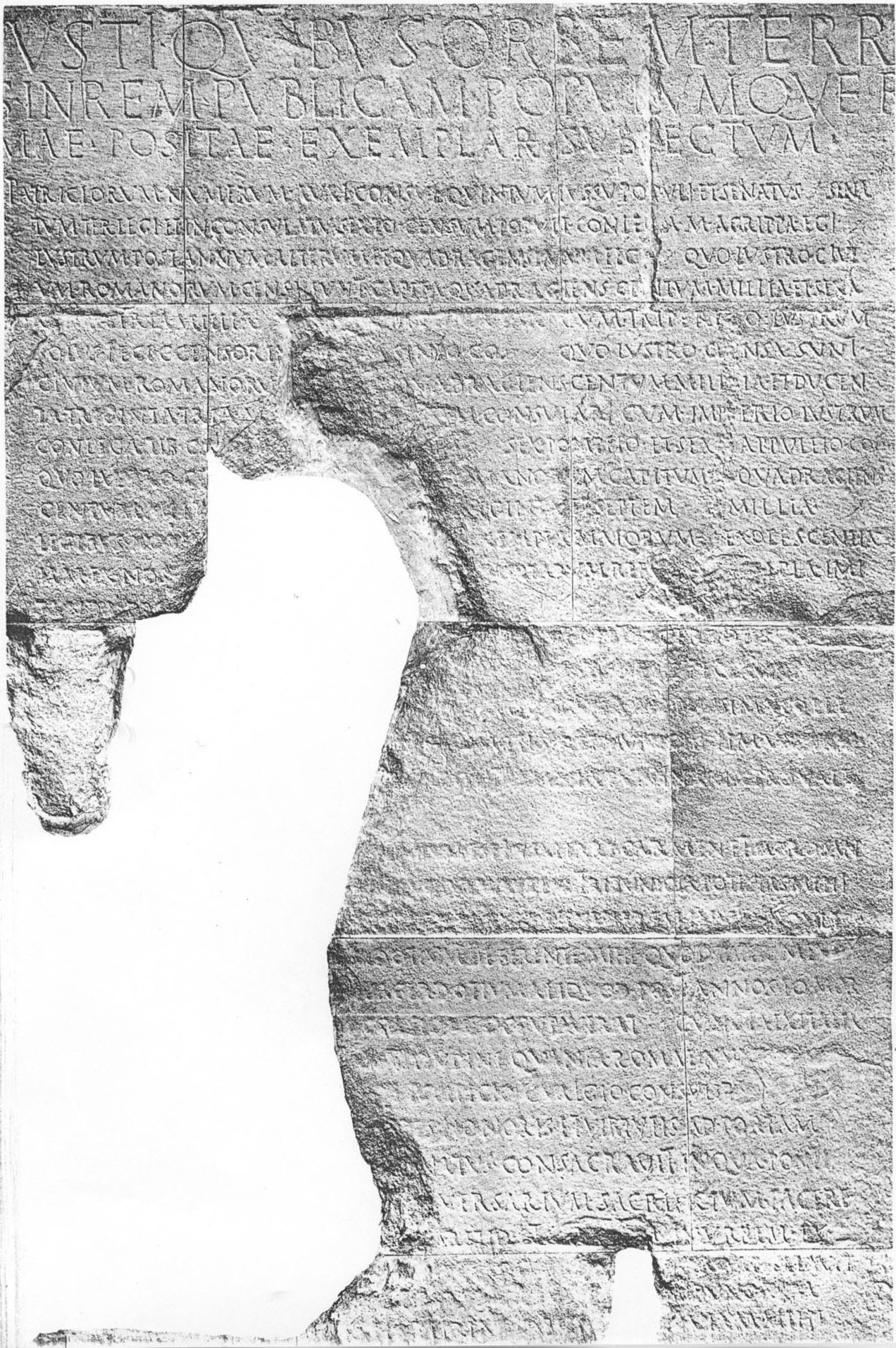
Black-and-white photograph of a large weathered marble inscription in Latin capital letters, arranged in horizontal lines across several panels, with a large white area where stone is missing on the left side.Document

Primary source

Res Gestae Divi Augusti

Augustus · 14 AD

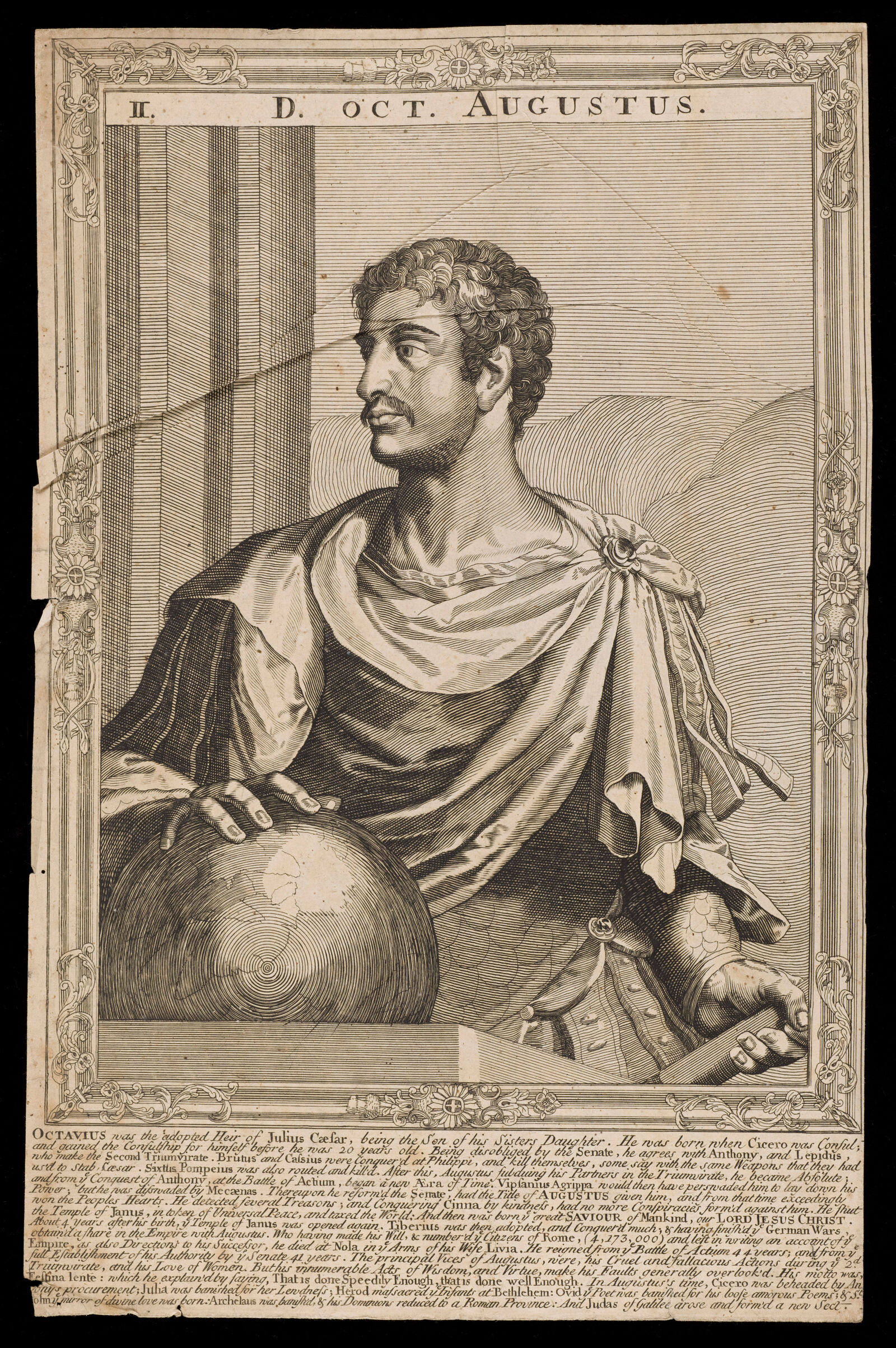
Line engraving of a curly-haired man in profile wearing a draped Roman cloak, one hand resting on a globe and the other holding a scroll, inside an ornate border. Title reads 'D. Oct. Augustus' with a text block below.Painting

Secondary source

Emperor Augustus with Globe

After Titian (engraving by A. Sadeler, after Titian) · between 1700 and 1799 (possibly 17th century)

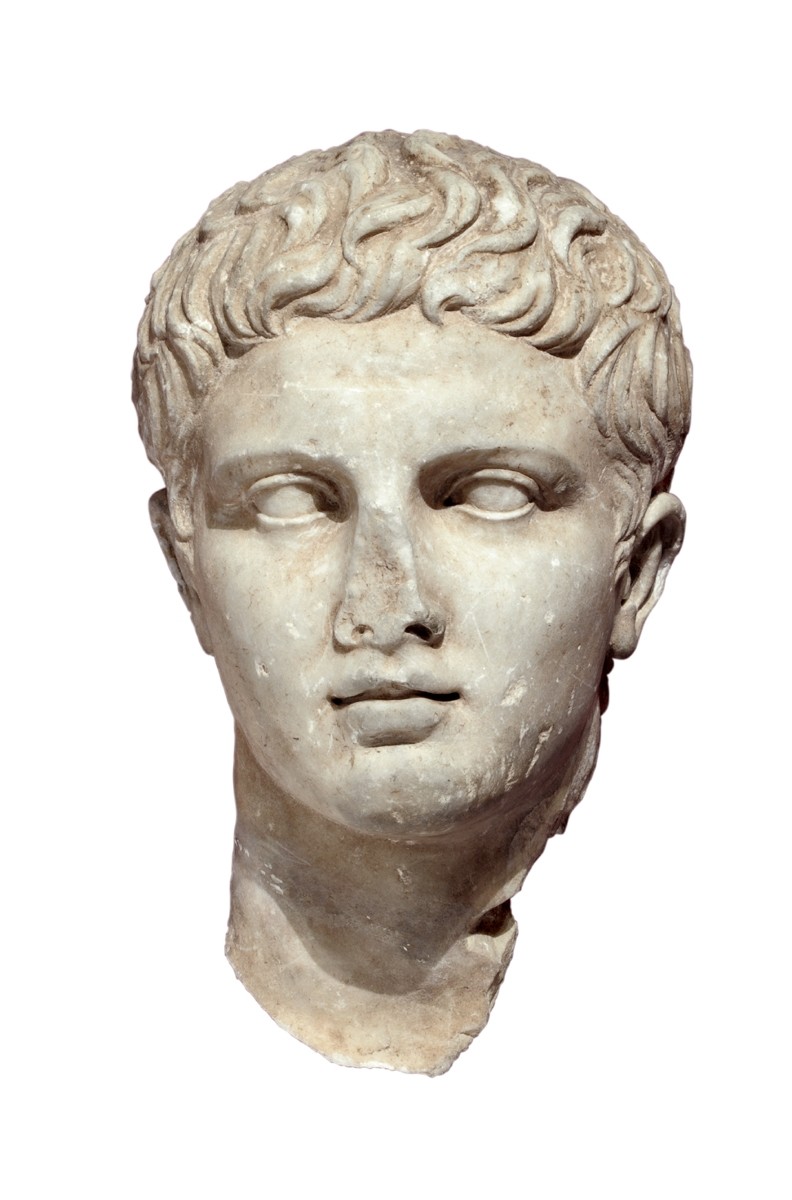
Photograph of a marble sculpted head on a white background. It has short, wavy hair carved in curling locks, large almond-shaped eyes with heavy lids, a straight nose, and a small closed mouth. The neck is broken off at the bottom.Sculpture

Primary source

Relief Head of the Young Augustus

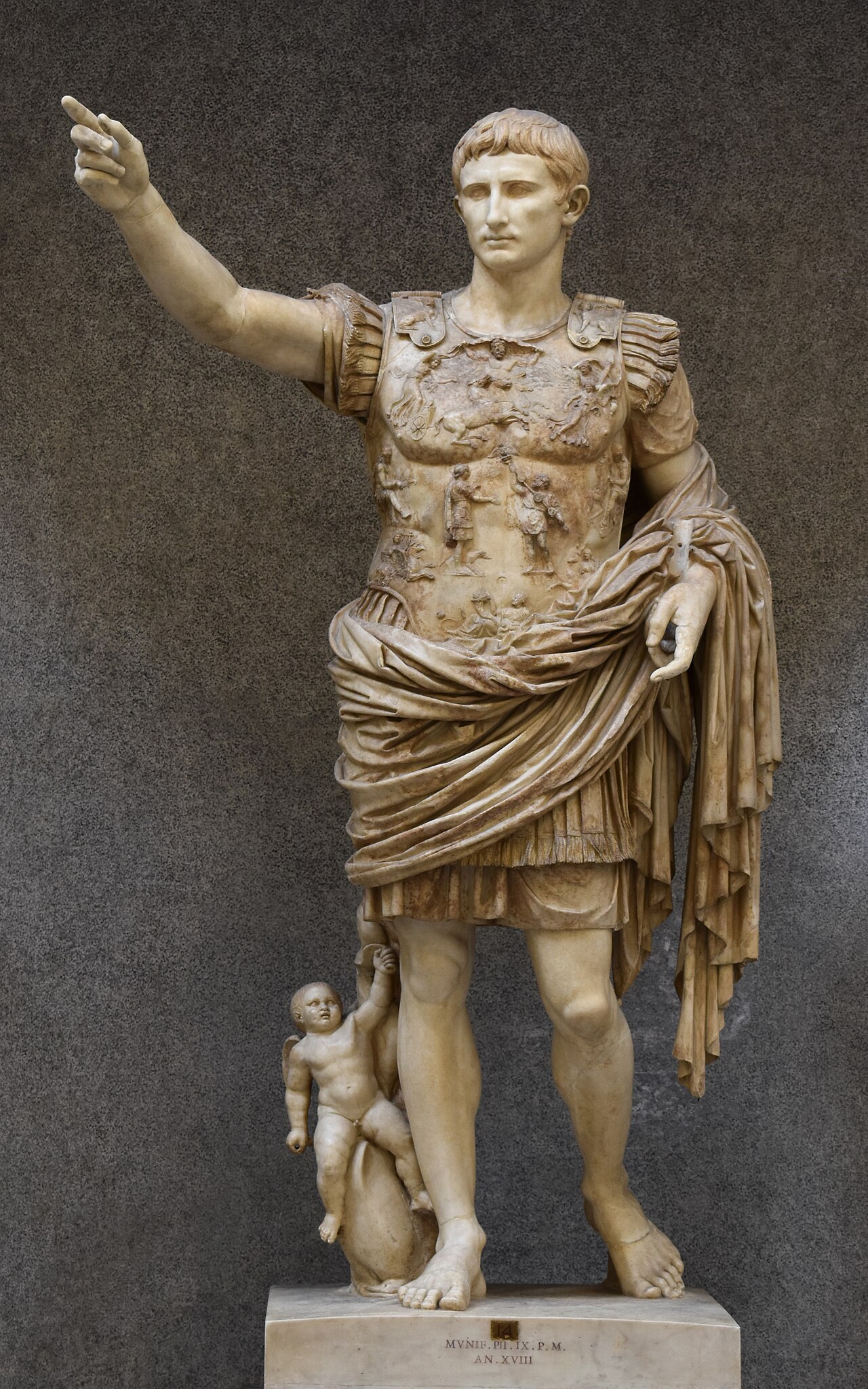
Marble statue of a standing man in armor, right arm raised pointing forward, with a draped cloak over his left arm. A small cupid-like figure with a dolphin stands beside his right leg. Plain dark grey background.Sculpture

Secondary source

Augustus of Prima Porta

c. 19 BCE or later

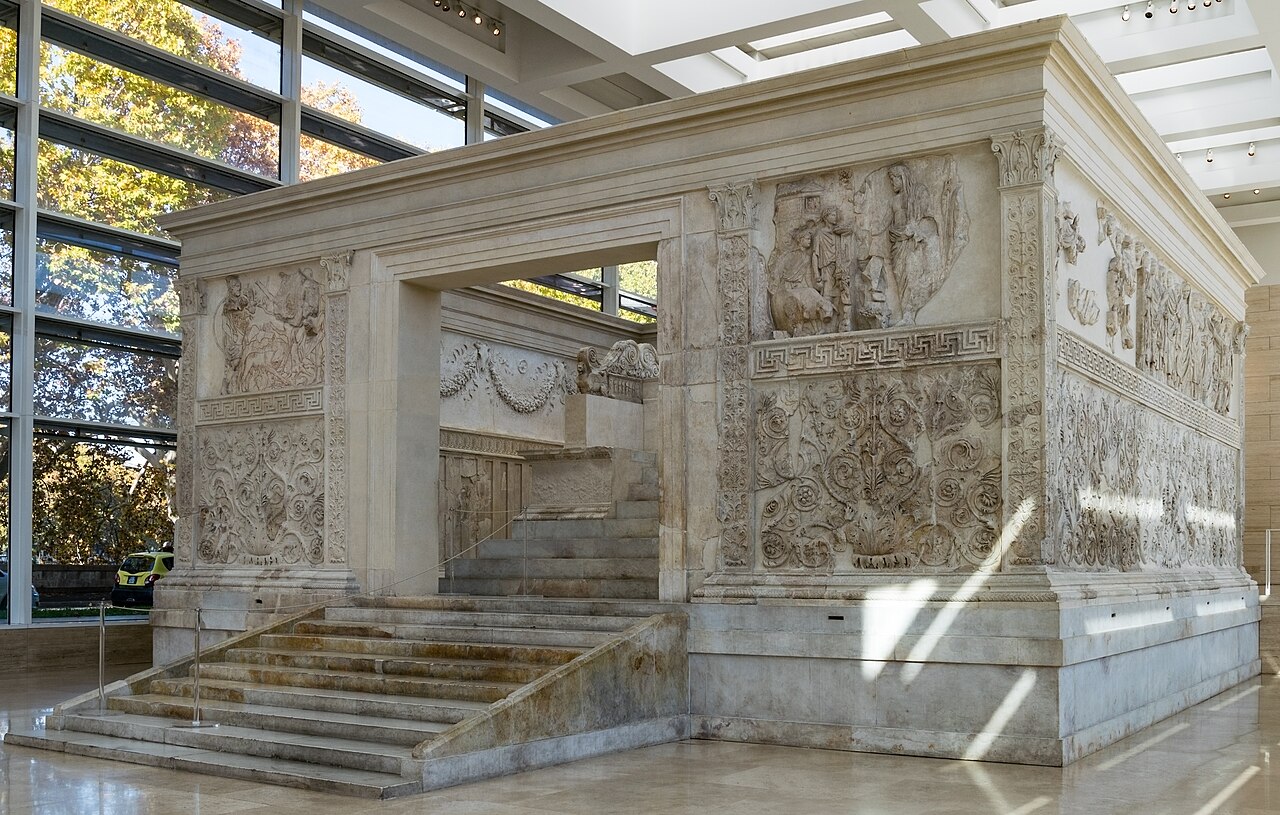
Marble enclosure of the Ara Pacis in a glass-walled museum hall, seen from the southwest. Carved relief panels decorate the walls, with a doorway and a stepped approach at the front.Artifact

Primary source

Ara Pacis

13-9 BCE

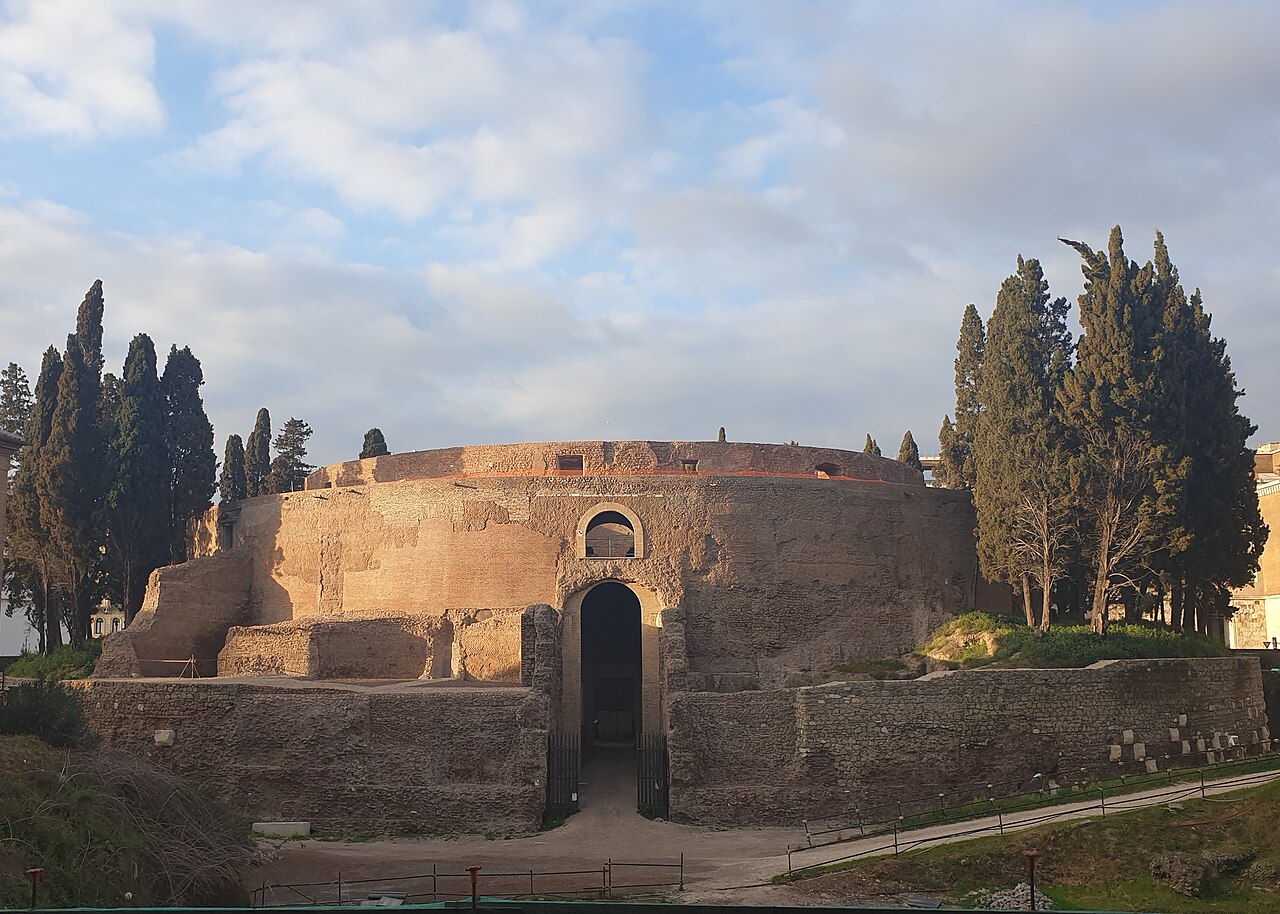
A large circular brick-and-concrete ruined mausoleum with a tall arched entrance at the front, a low walled courtyard in front, tall cypress trees on both sides, and a cloudy blue sky.Artifact

Primary source

Mausoleum of Augustus

28 BCE

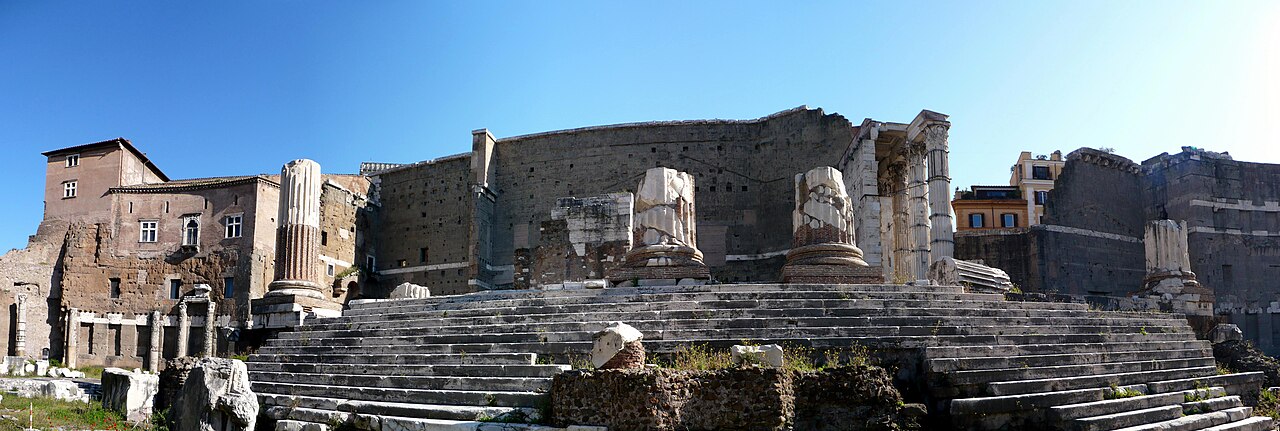
Panoramic view of the ruins of the Temple of Mars Ultor in Rome: a wide flight of stone steps leads up to a high platform with broken columns and statue bases, behind which rise massive brick-and-concrete walls under a clear blue sky.Artifact

Primary source

Temple of Mars Ultor

Augustus · vowed 42 BCE, dedicated 2 BCE

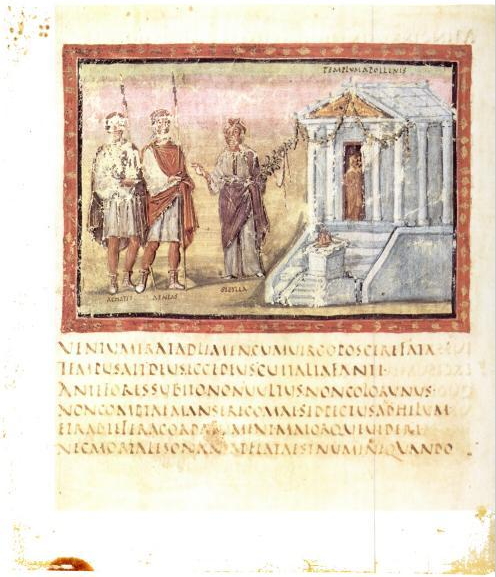
Illuminated manuscript page from a Virgil codex: a framed painting shows two armored men with spears and a woman in a violet robe gesturing toward a white temple with columns and garlands. Below is a block of Latin capital script in several lines.Book

Secondary source

Aeneid

Virgil · 29-19 BCE

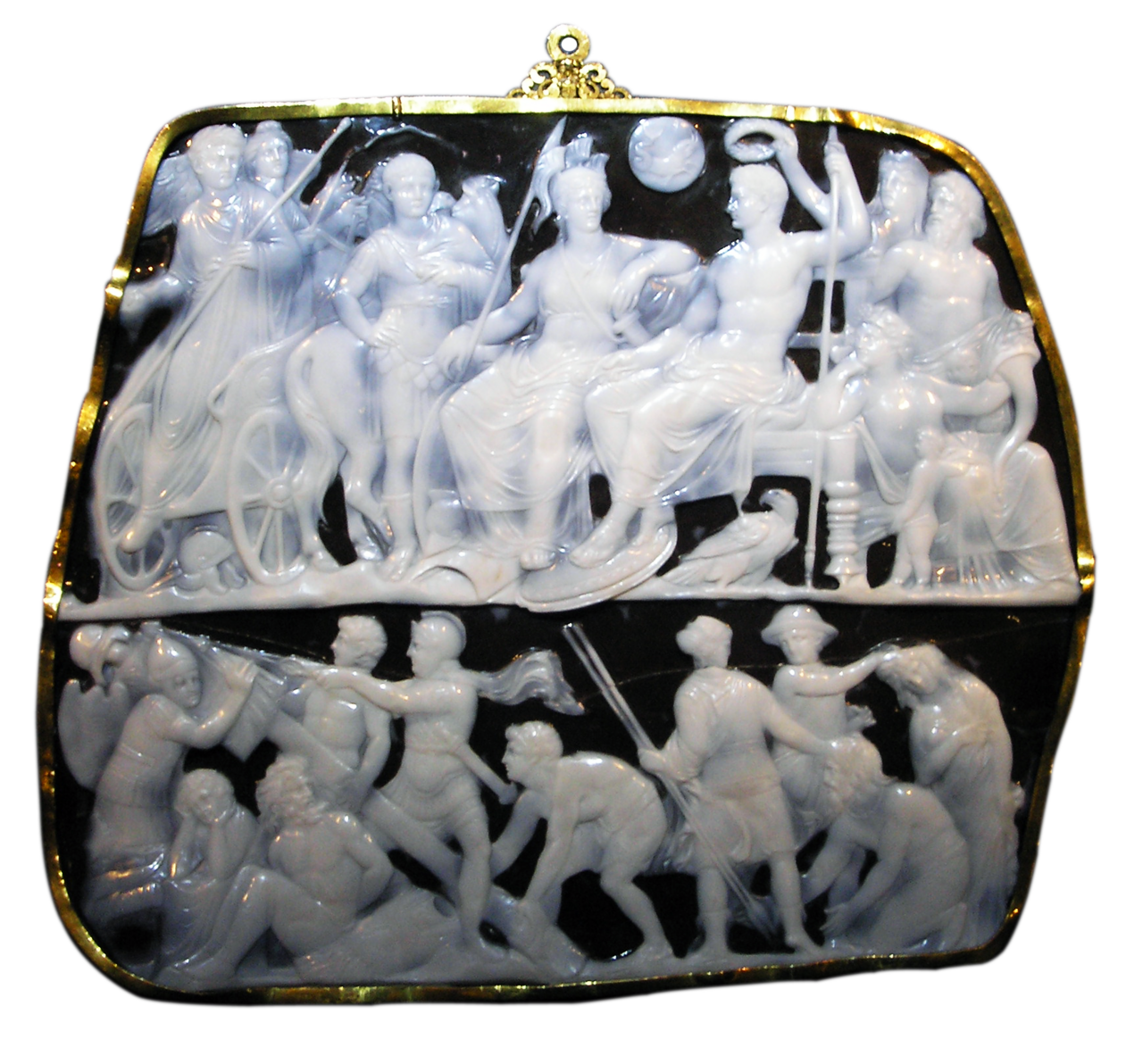
Photograph of the Gemma Augustea, a two-layered onyx cameo in a gold frame. Upper register: a seated figure with a spear-like staff, a standing figure with a wreath, an eagle at the seat, and figures in a chariot. Lower register: a crowd of struggling, armored and unarmed figures.Artifact

Primary source

Gemma Augustea

Dioscurides · c. AD 10

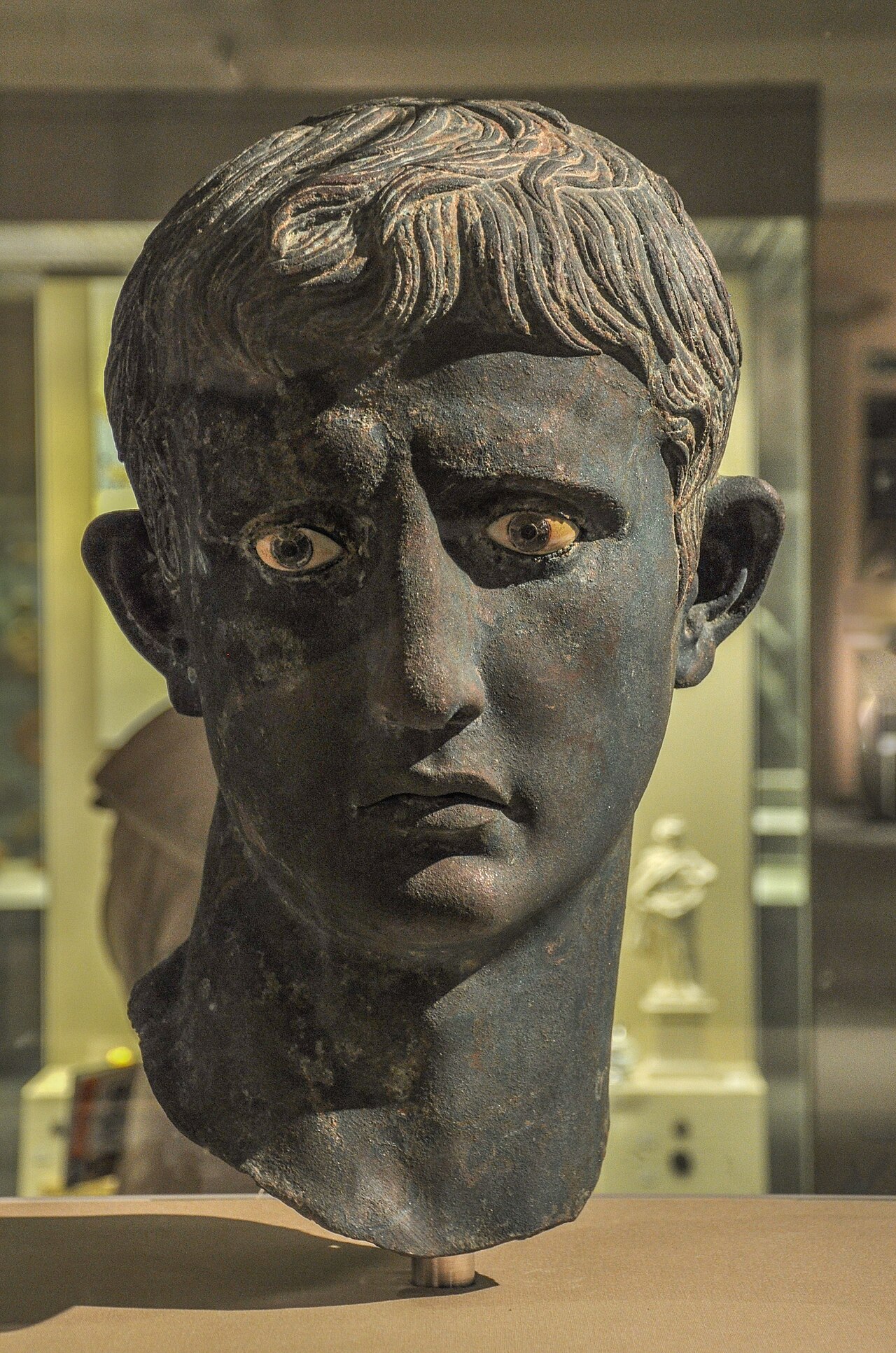
Dark bronze head of a young man with short, carved, wavy hair, inlaid glass or stone eyes, and a plain neck cut off at the base. It sits on a light brown display surface in a museum case.Sculpture

Primary source

Meroë Head

27-25 BC

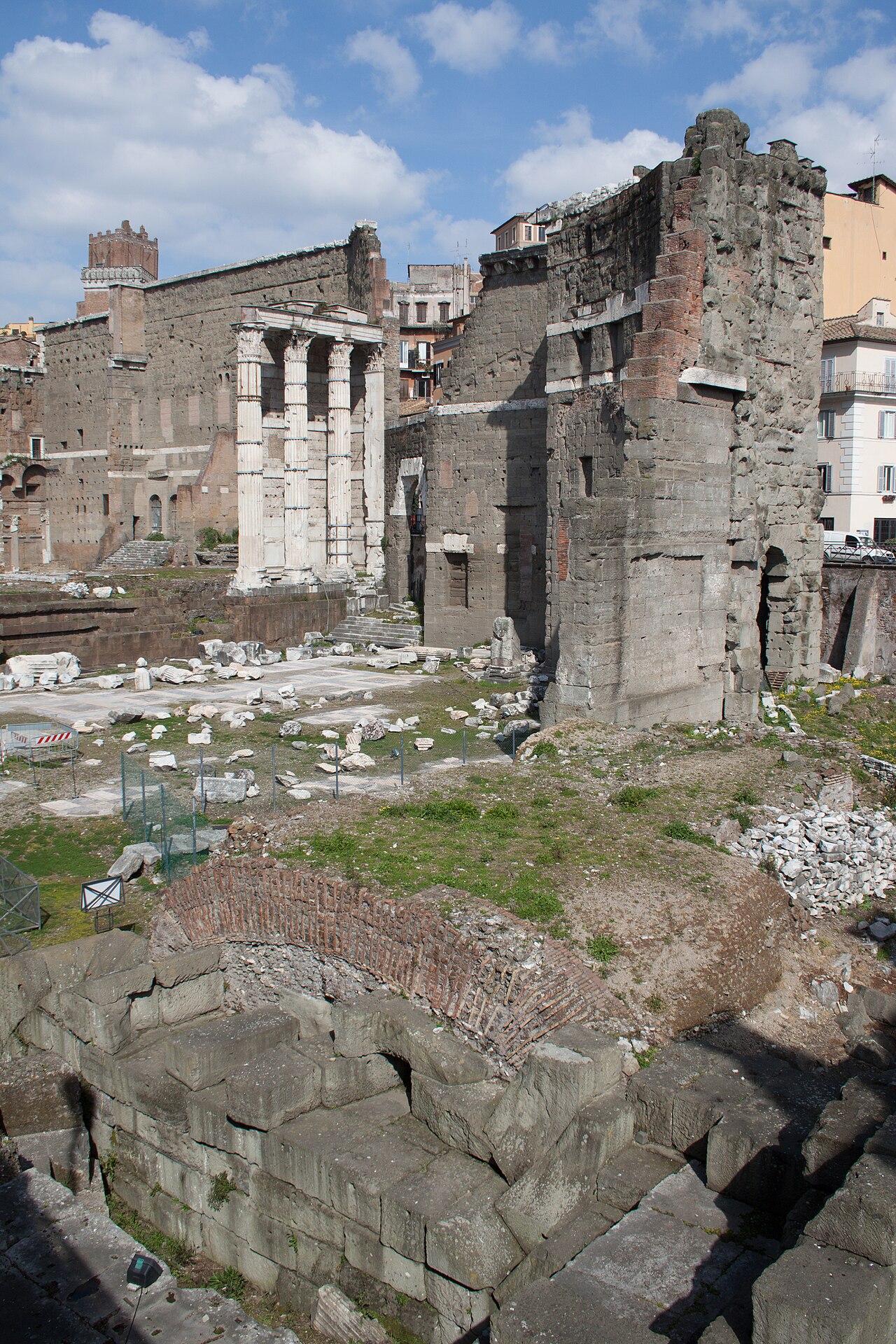
Ruins of the Forum of Augustus in Rome: three white marble columns with entablature standing at left, a tall brick-and-stone wall with pilasters at right, scattered marble fragments on the ground, and modern buildings and a blue sky behind.Artifact

Primary source

Forum of Augustus

Commissioned by Augustus · c. 42-2 BC, dedicated 2 BC

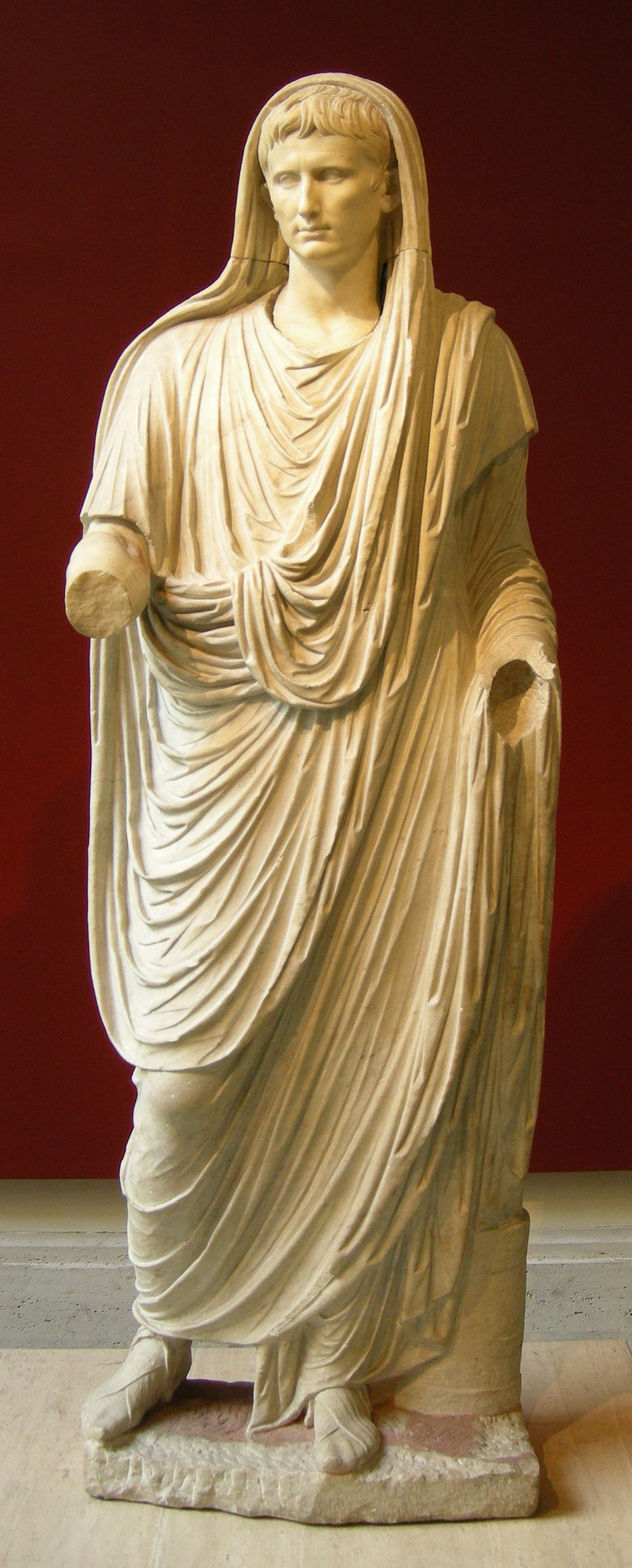
White marble statue of a standing man draped in a toga, with his head covered by a fold of the toga. His right arm is broken off at the forearm and his left arm is missing below the elbow. He wears laced shoes on a rectangular base.Sculpture

Primary source

Via Labicana Augustus

after 12 BC

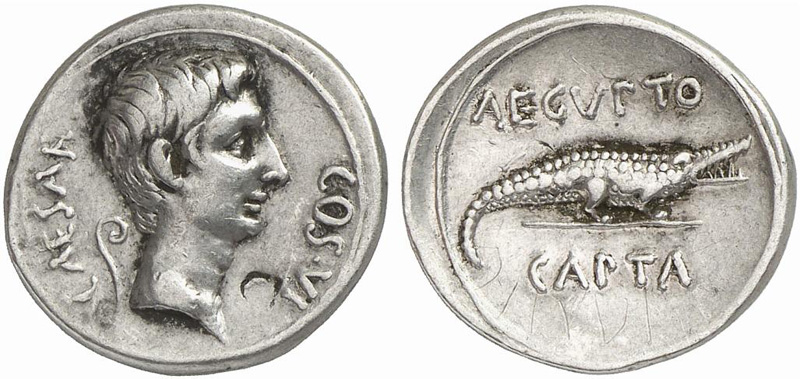
Silver denarius coin. Obverse: bare head of a young man facing right with the inscription CAESAR COS VI around the edge. Reverse: a crocodile facing right beneath the inscription AEGVPTO above and CAPTA below.Artifact

Primary source

Aegypto Capta Denarius of Octavian

Roman mint under Octavian · 28 BC

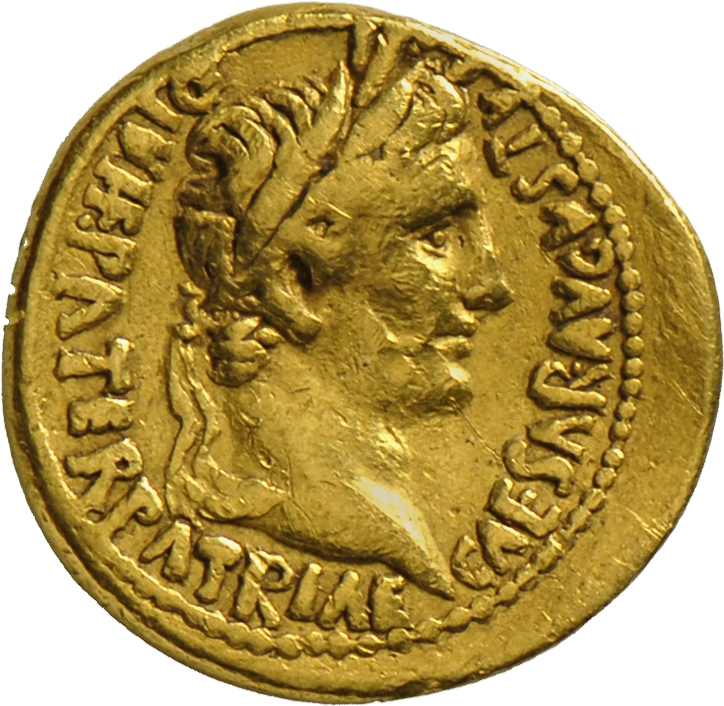
Gold aureus coin showing a laureate portrait bust of Augustus facing right, with Latin inscription around the edge reading CAESAR AVGVSTVS DIVI F PATER PATRIAE. Obverse side, shown on a plain background.Artifact

Primary source

Aureus RIC 206

1 BC

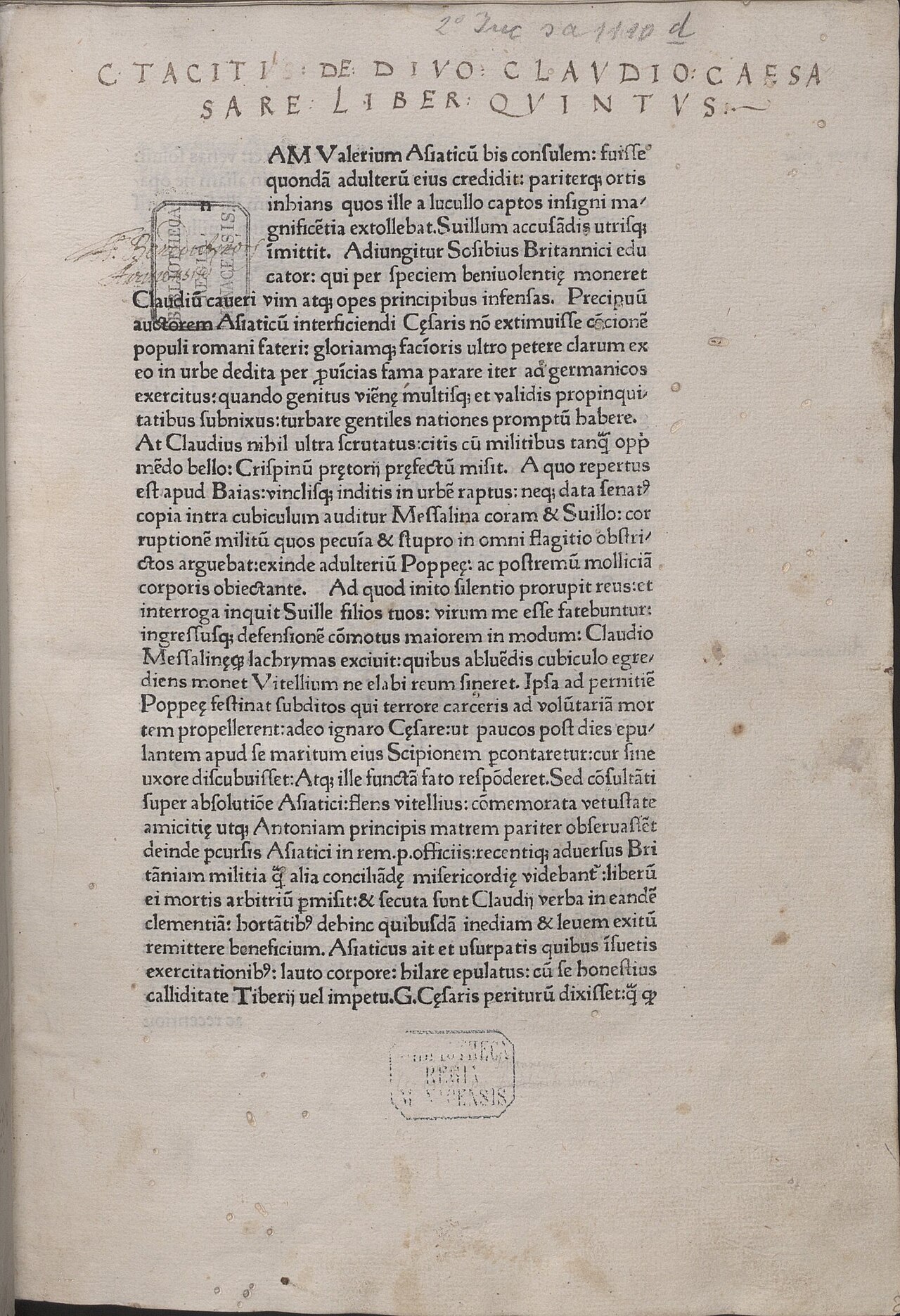
Scanned page of an early printed book, with a running heading reading 'C. Taciti de divo Claudio Caesare liber quintus' in capitals and dense black-letter Latin text in two columns of prose. Library stamps and a handwritten shelf mark appear at the top and on the page.Book

Secondary source

Annals

Tacitus · c. AD 116 or later

Dark red book cover with gold lettering reading 'The Students' Series of Latin Classics'. A white library label on the left reads 'PA 6111 .S8 V4 1893 Copy 1'. The faded title on the cover is hard to read.Book

Secondary source

Roman History

Velleius Paterculus · c. AD 30

Book

Primary source

Life of Augustus

Nicolaus of Damascus · c. 20 BCE

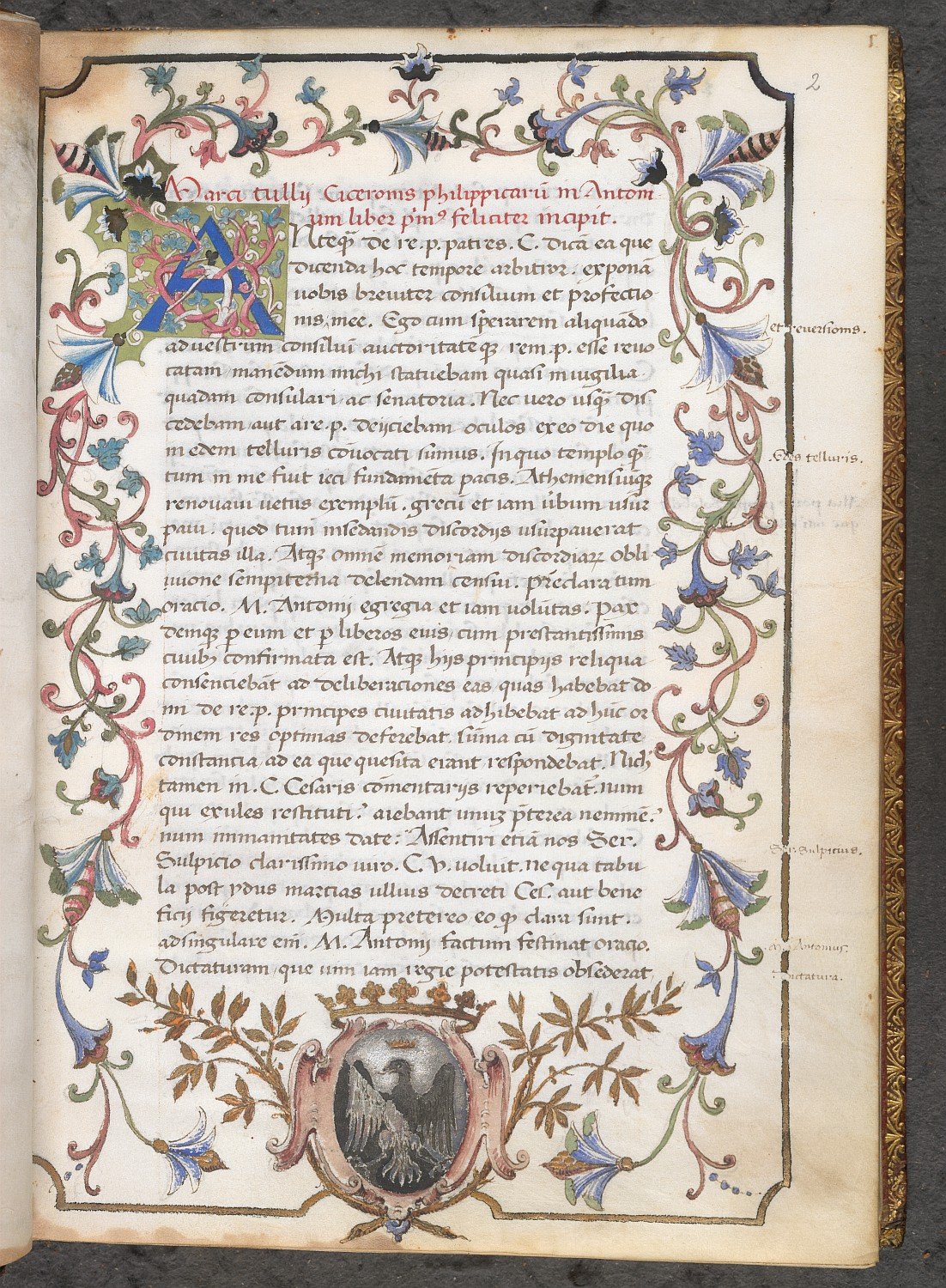
Folio 2 of an illuminated manuscript page with a Latin text block in two columns of script, a decorated initial letter A in blue and gold, and a floral border with a coat of arms at the bottom showing an eagle.Speech

Primary source

Philippics

Cicero · 44-43 BC

Dark green cloth book cover with a white library label reading UC-NRLF and barcode B 4 040 245. Faded gold title lettering on the cover is only partly legible.Speech

Primary source

Carmen saeculare

Horace · 17 BC

Front cover of a dark red bound book with several library labels: a handwritten octagonal paper label reading '768m t 1893 bk.3', a white UC-NRLF barcode label, a white call number label 'PA 6519 T8 A35 1893 MAIN', and a yellow label 'YB 55380'.Book

Primary source

Tristia

Ovid · AD 8–11

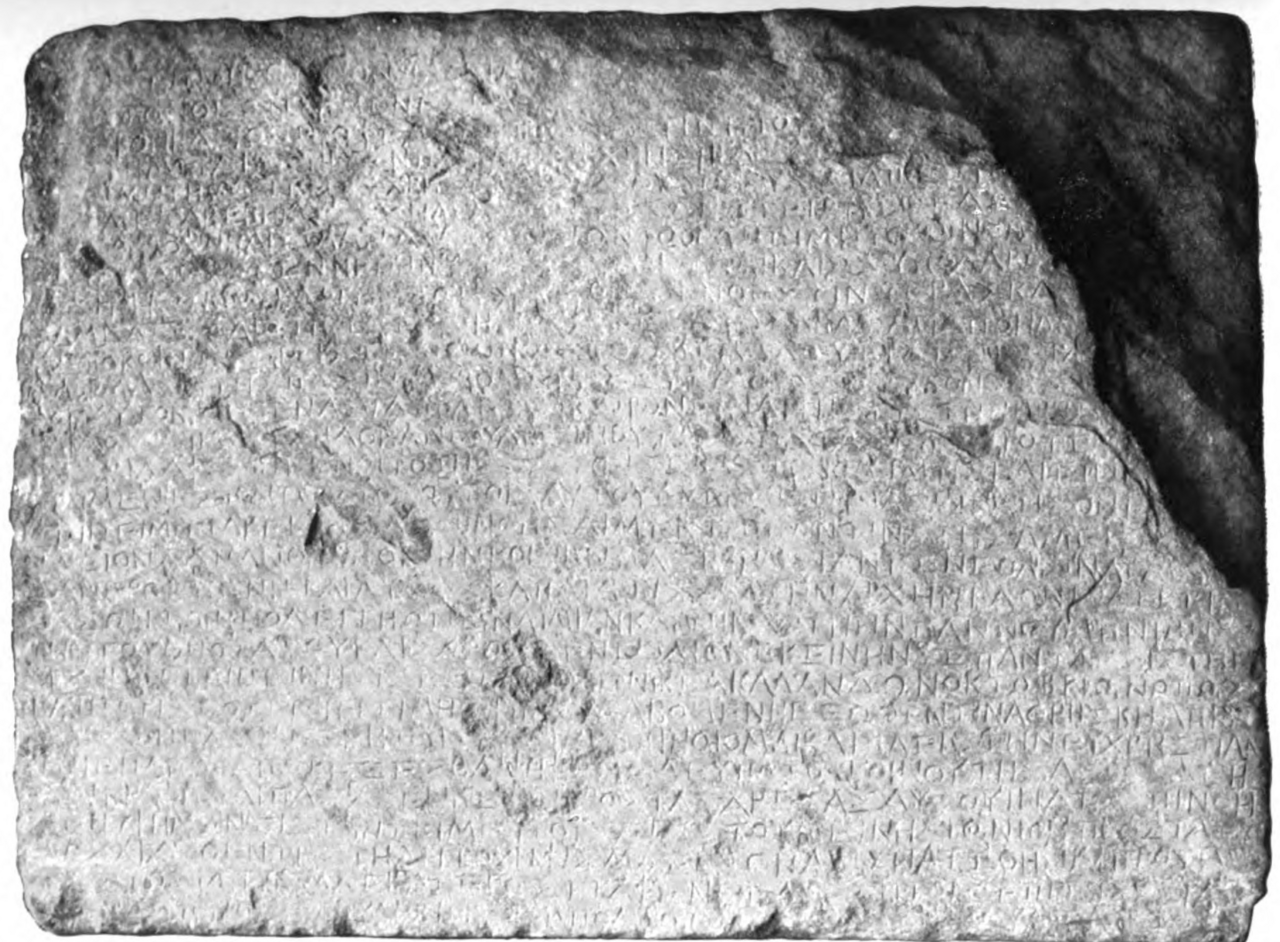
Black-and-white photograph of a rectangular stone block covered in closely carved Greek inscription lines in rows. The upper right corner is broken away and shadowed, and the surface shows weathering.Document

Primary source

Priene Calendar Inscription

Koinon of Asia · 9 BC

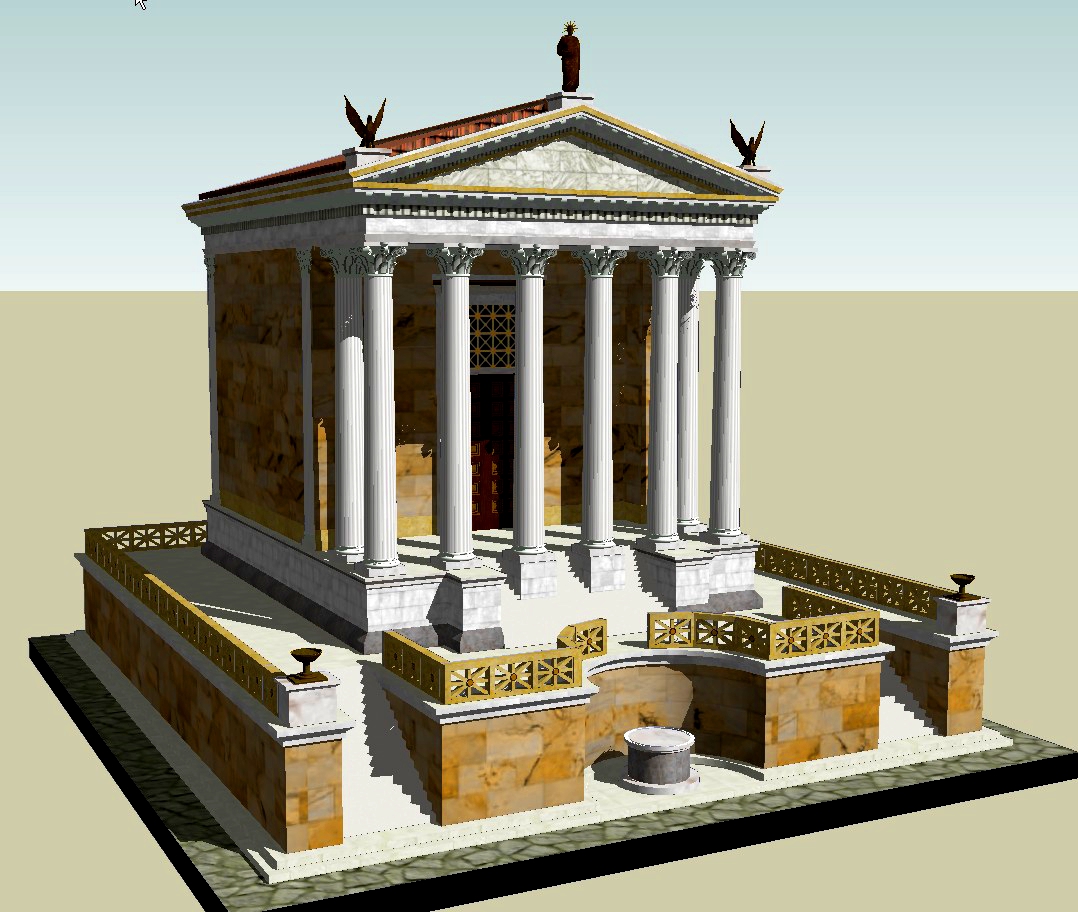
A computer-generated 3D model of a white marble Roman temple with a triangular pediment, a row of Corinthian columns across the front, a statue atop the roof, two bronze eagles at the roof corners, and gold railings on stepped terraces.Artifact

Secondary source

Temple of Caesar

Augustus · dedicated 29 BC

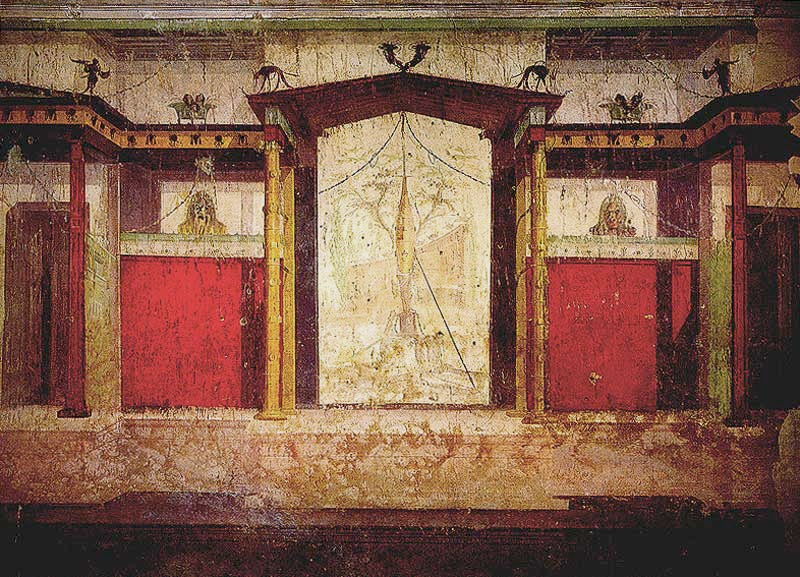
Painted wall fresco with architectural illusion: a central white panel with a tree and small structure between yellow columns, flanked by red panels, with small figures and decorative friezes above.Artifact

Primary source

House of Augustus

35 BC

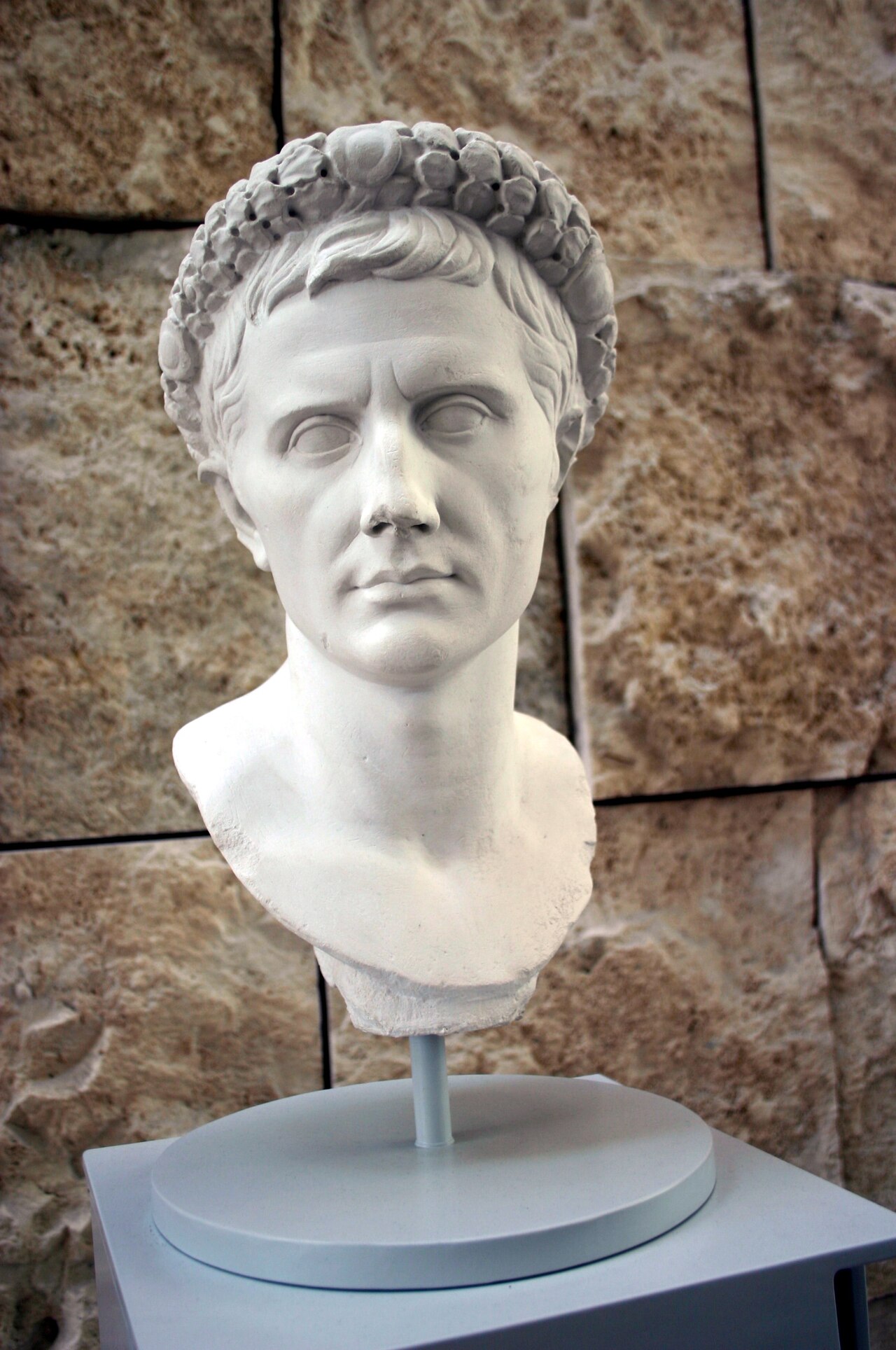
White plaster cast of a male bust with a laurel wreath in his hair, short curled hair, and a calm, serious expression, displayed on a round light-grey pedestal in front of a stone wall.Sculpture

Primary source

Bust of Augustus with Gemmed Crown

26 BC

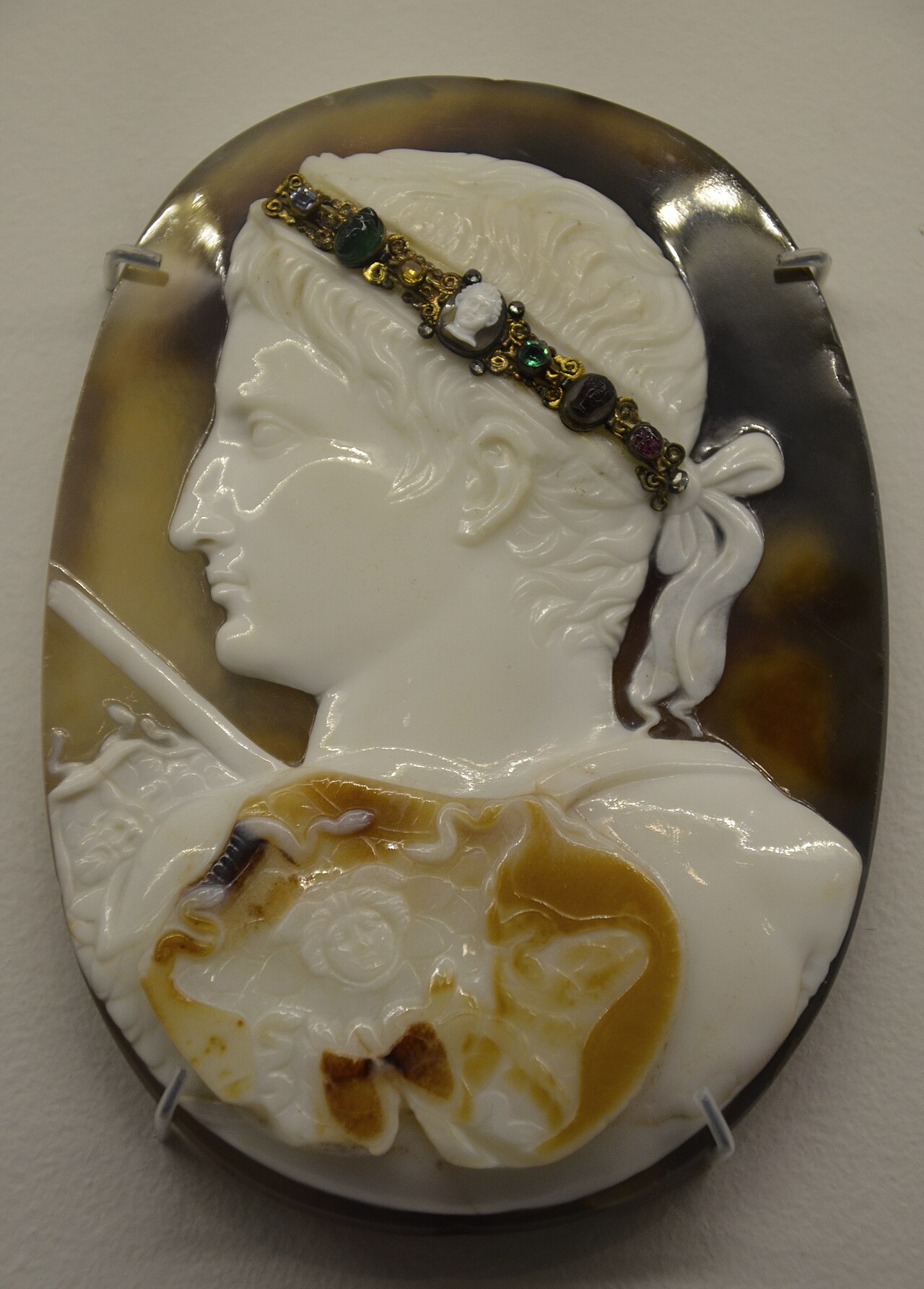
Photograph of the Blacas Cameo, an oval sardonyx carving in white and brown layers showing a male profile facing left with short curled hair, a gold headband set with gems and a small cameo, and a tied ribbon. A decorated shoulder area and a diagonal strap appear at lower left.Sculpture

Primary source

Blacas Cameo

Unknown gem-cutter · c. AD 14-20

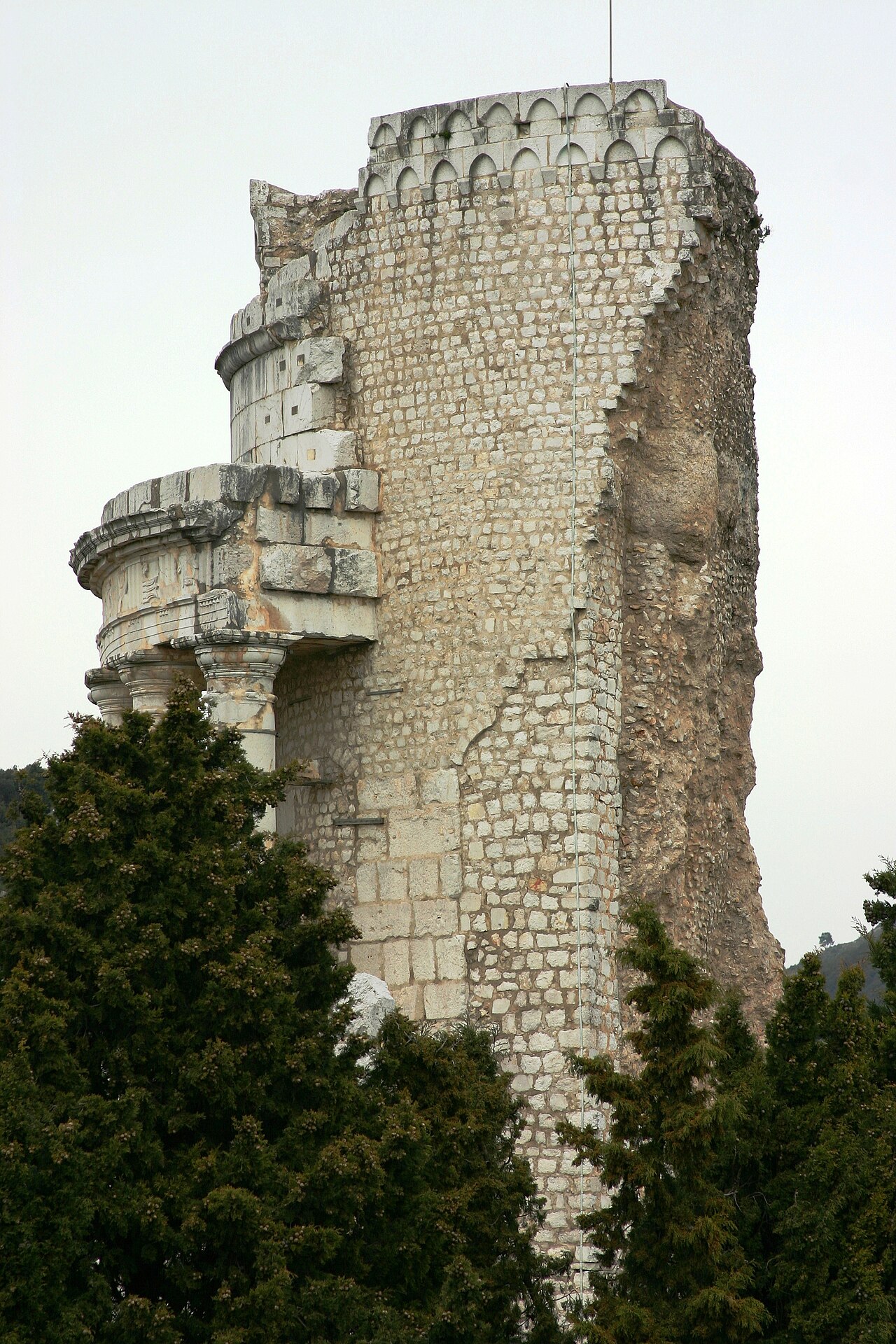
Ruined stone monument on a hilltop: a tall, weathered cylindrical tower of rough masonry with arched crenellation at the top, and a curved colonnade of pillars and carved architrave on its left side. Dark evergreen trees stand in front.Artifact

Secondary source

Trophy of Augustus

Roman Senate · 7-6 BC

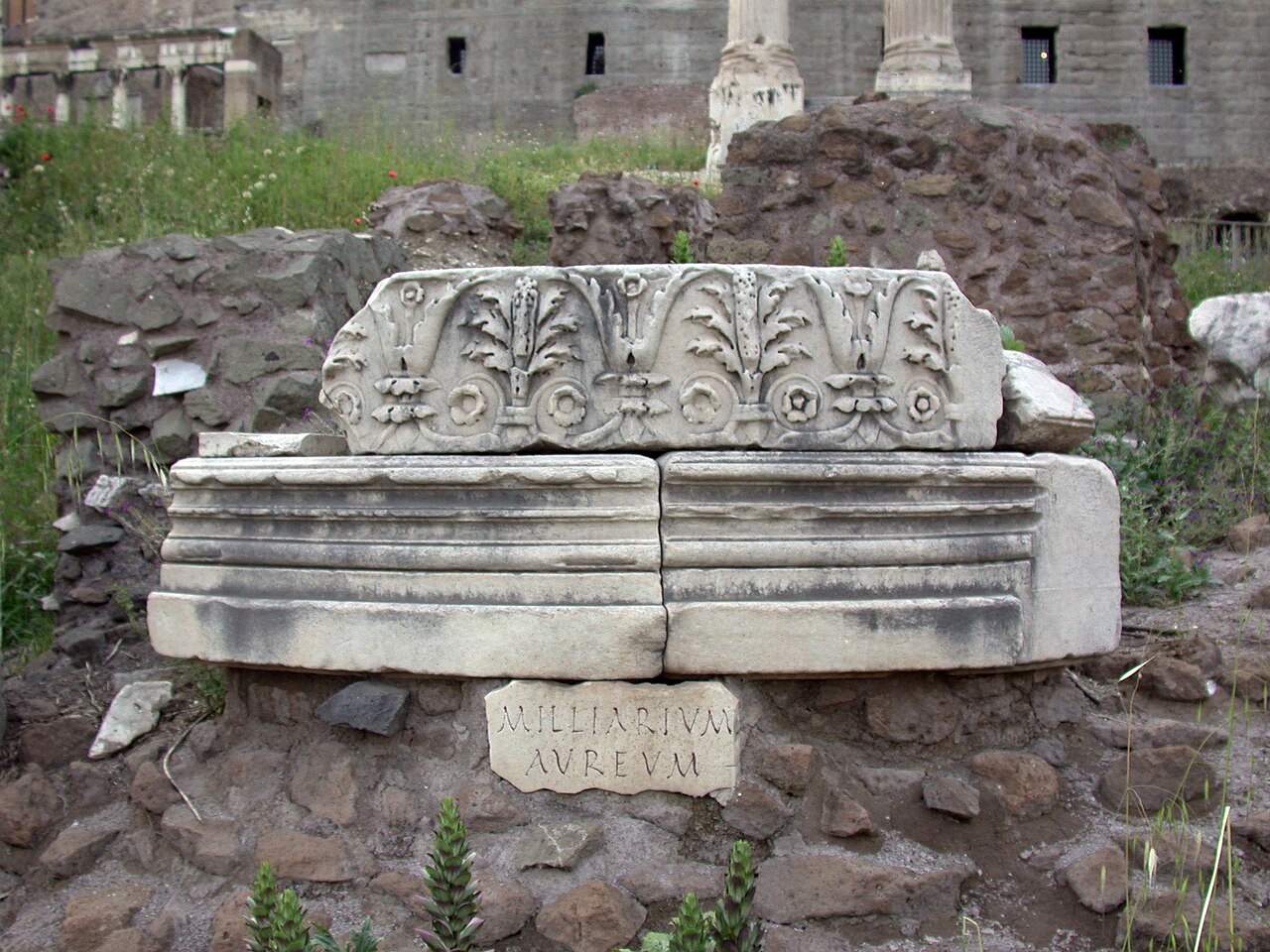
Ruins of the Milliarium Aureum in the Roman Forum: a weathered marble base with a carved frieze of acanthus leaves and rosettes sits on a stone base. A small inscribed plaque below reads MILLIARIVM AVREVM. Grass and stone ruins surround it.Artifact

Primary source

Milliarium Aureum

Augustus · 20 BCE

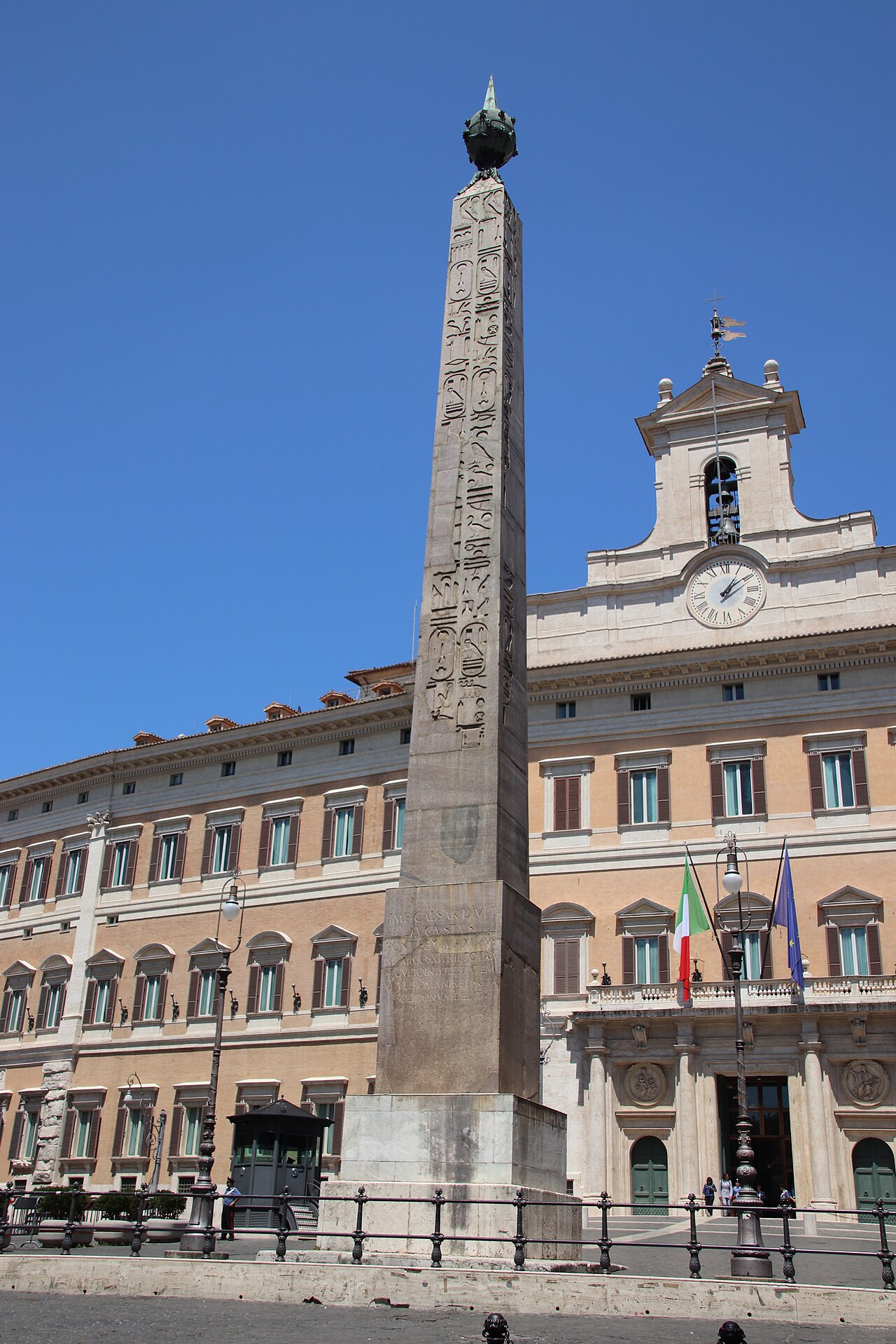
A tall granite obelisk covered in carved hieroglyphs stands in a paved square in Rome, with a bronze-tipped top. Behind it are a multi-storey ochre building with rows of windows, a clock tower, Italian and EU flags, and a blue sky.Artifact

Primary source

Obelisk of Montecitorio

c. 595-589 BCE (carved); re-erected in Rome 10 BCE

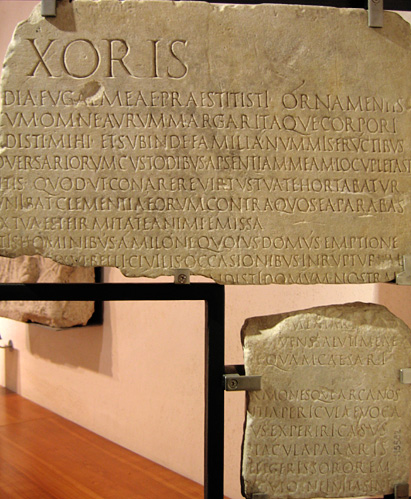
Large pale stone inscription slab with carved Latin capital letters in several lines, the top line reading XORIS, mounted on a wall in a museum. Below it is a second, smaller stone fragment with inscribed lines, and a dark metal display frame sits in front of a wooden floor.Document

Primary source

Laudatio Turiae

c. 9-6 BCE

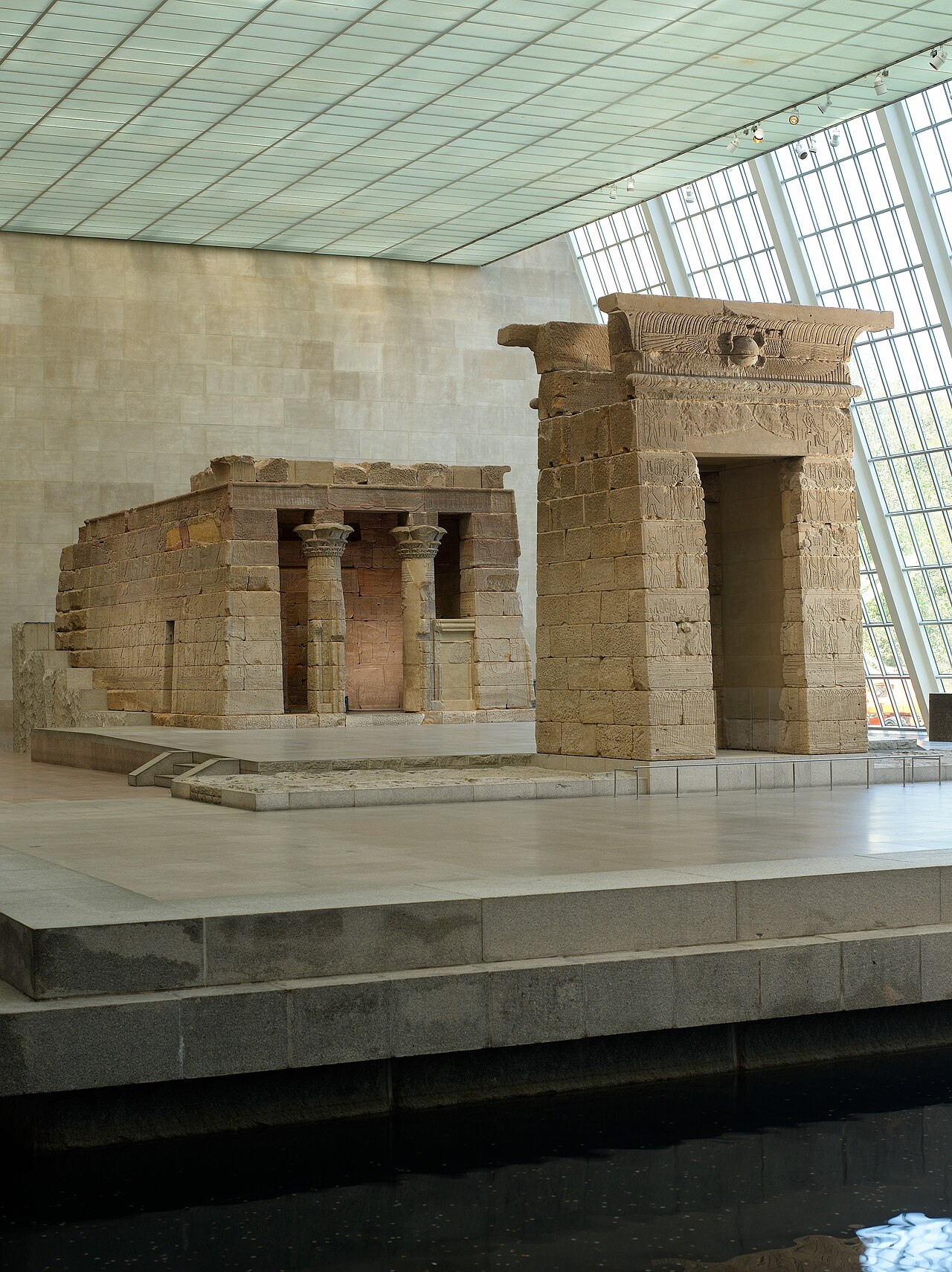
The Temple of Dendur, a sandstone Egyptian temple reassembled inside a glass-walled museum gallery, standing on a raised granite platform above a reflecting pool. A gateway with carved cornice is at right and a columned facade at left.Artifact

Primary source

Temple of Dendur

23-10 BCE

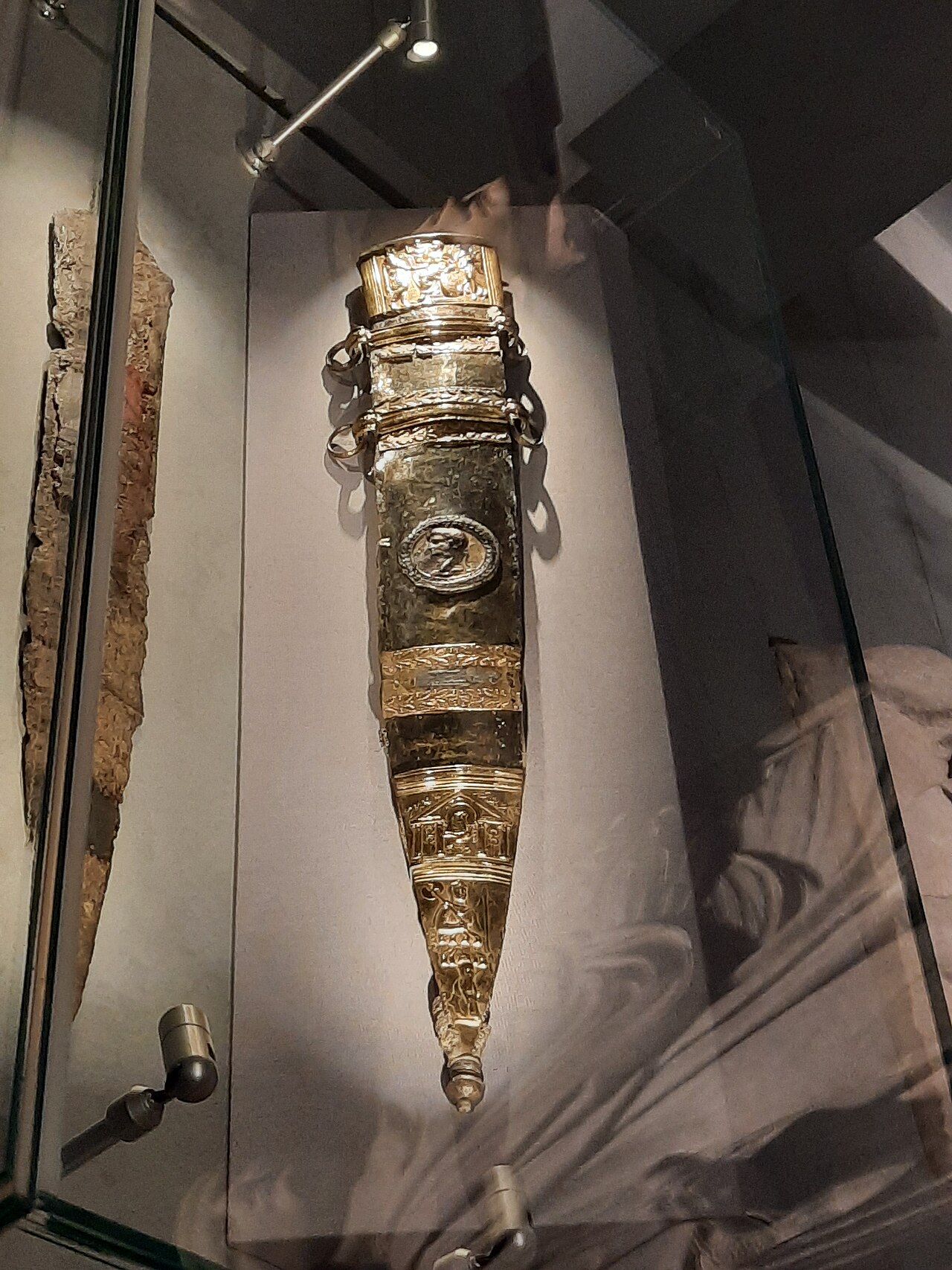
A gilded metal sword scabbard displayed upright in a glass case against a grey background. Its upper section has a ring-and-band fitting, a central oval medallion with a figure, and horizontal decorated bands. The lower tapering end shows relief scenes of figures and architecture, ending in a small knob. Another object is partly visible at the left.Artifact

Primary source

Sword of Tiberius

Roman workshop (Mainz) · c. AD 15

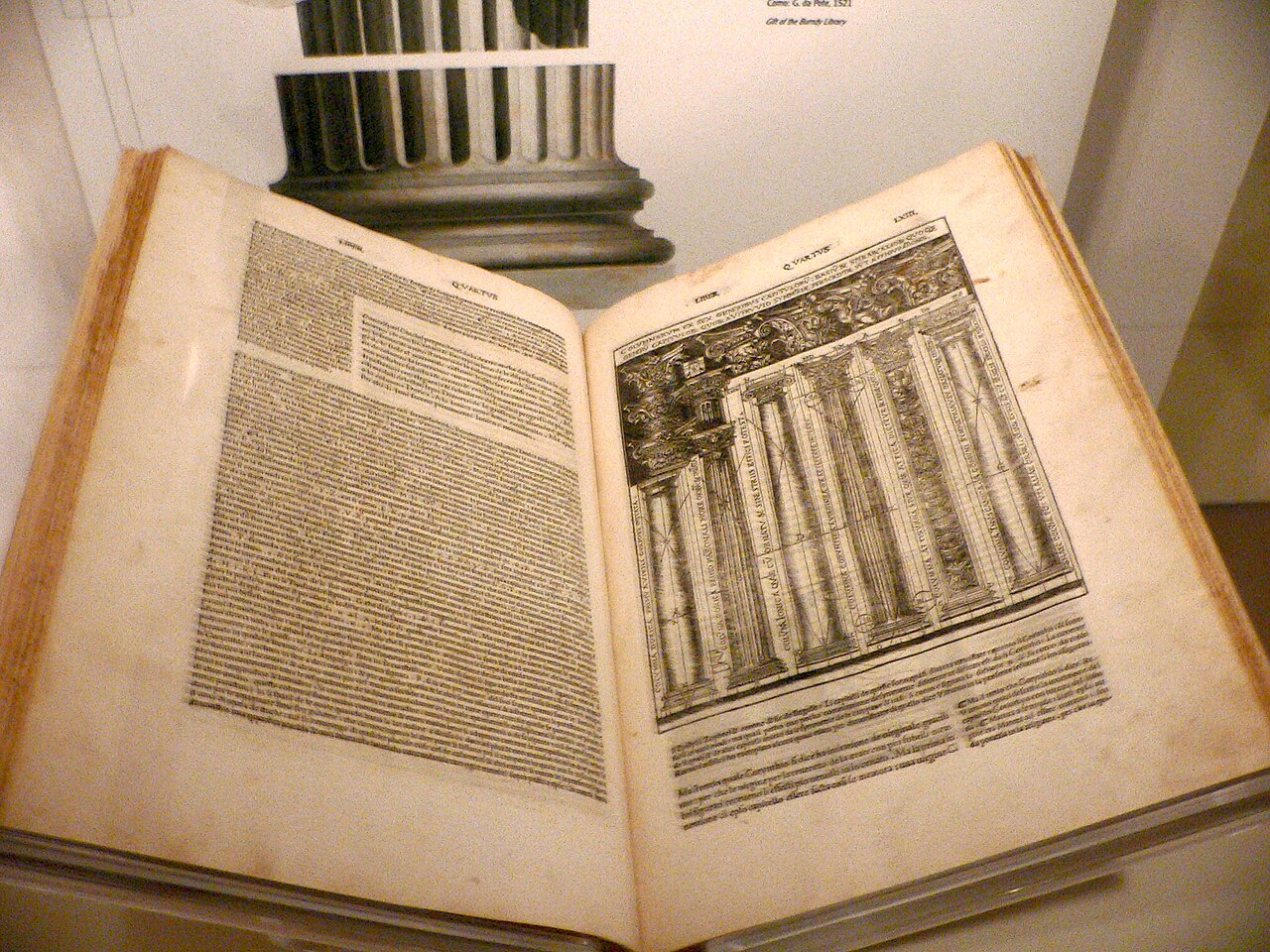
An open printed book on a display stand showing two pages: the left page is dense text, the right page has a woodcut illustration of classical columns and a decorated entablature. A column base photo stands behind it.Book

Primary source

De architectura

Vitruvius · c. 30-20 BCE

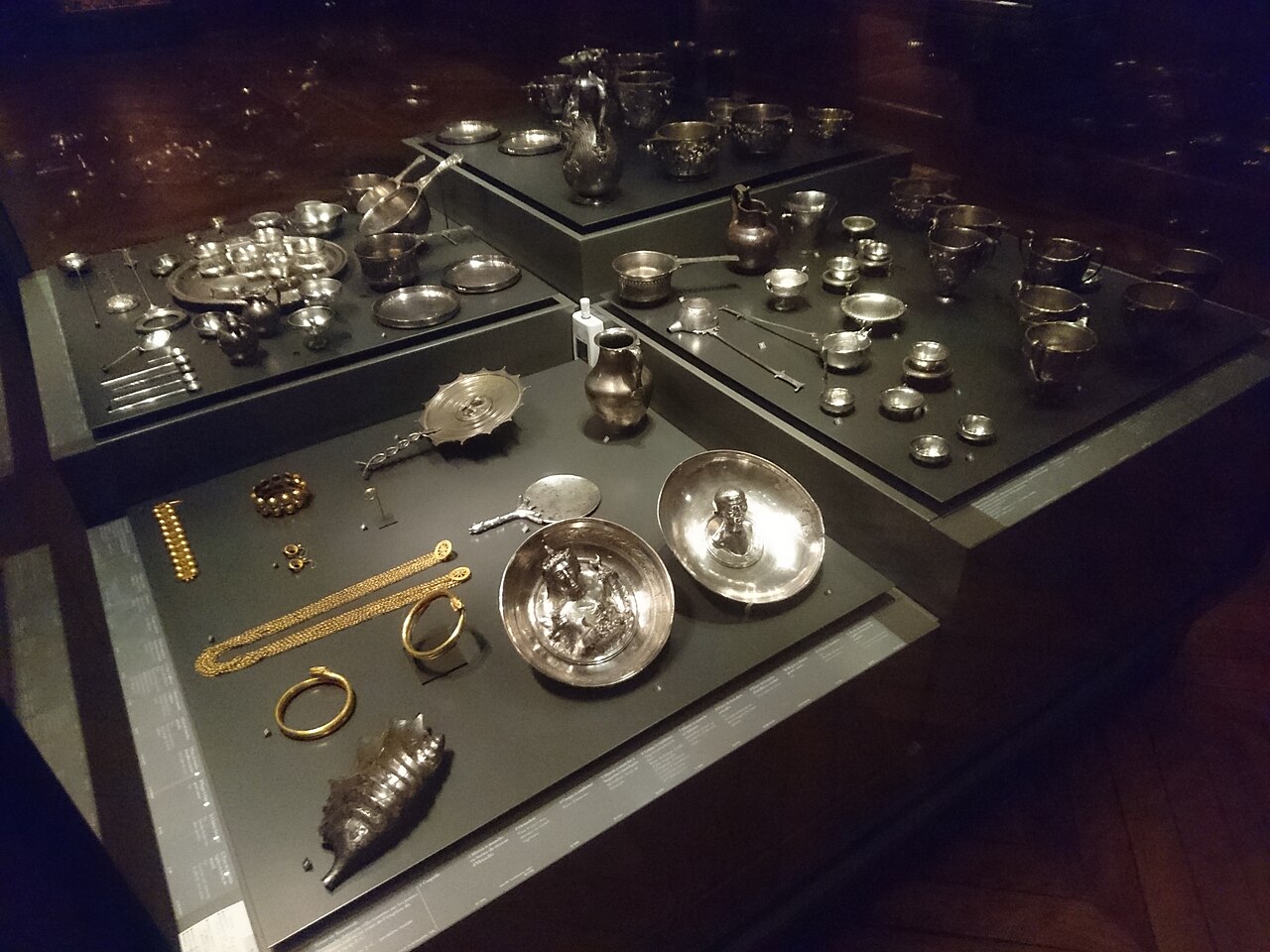
Silver and gold tableware and jewelry displayed on dark museum plinths under spotlights. Visible items include silver bowls with relief figures, a covered dish, a ladle, a ewer, cups, spoons, gold chains, and gold rings.Artifact

Primary source

Boscoreale Treasure

4th century BC – 1st century AD, buried AD 79

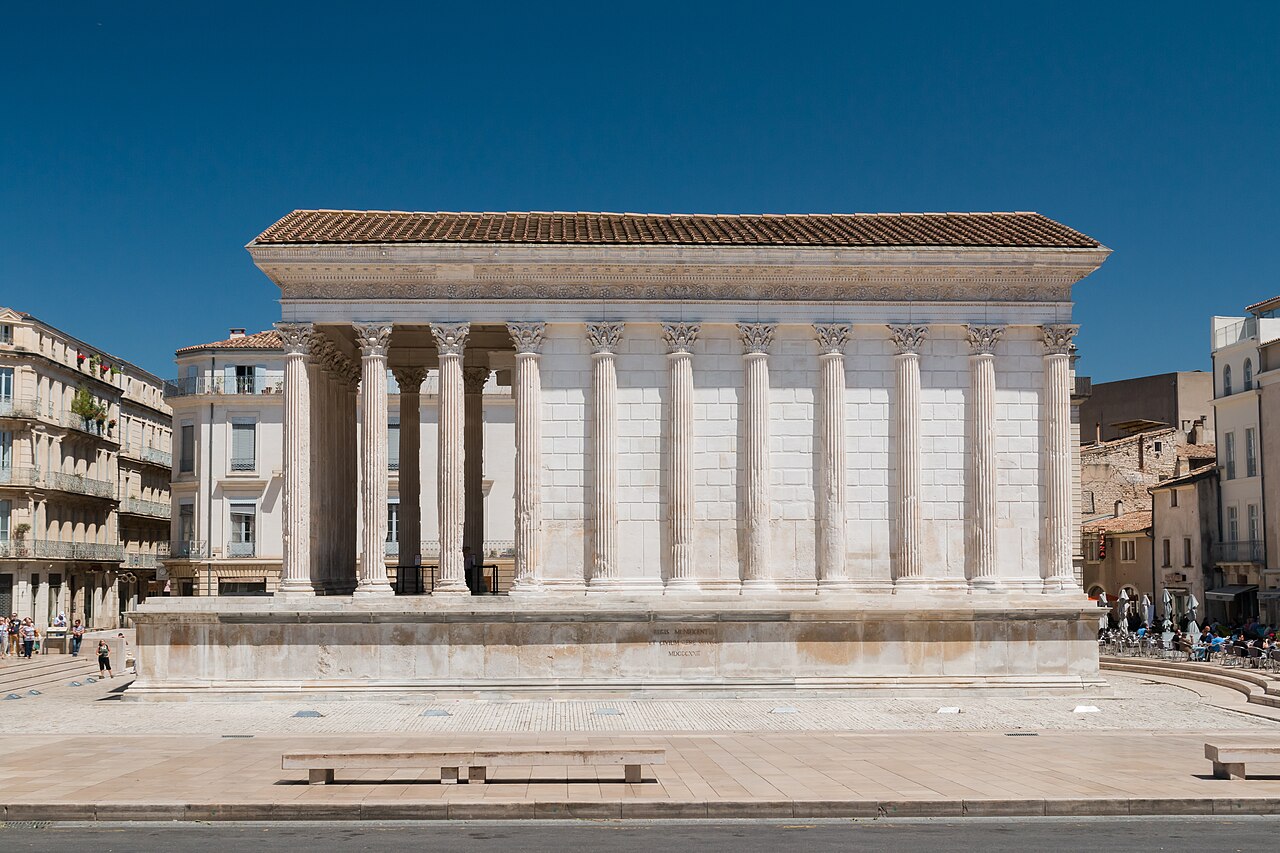
Front view of the Maison Carrée, a white stone Roman temple with a tiled roof, a row of tall fluted Corinthian columns across the front, and a raised podium. A paved square, benches, and European-style buildings surround it under a clear blue sky.Artifact

Primary source

Maison Carrée

c. 2 BC – AD 4

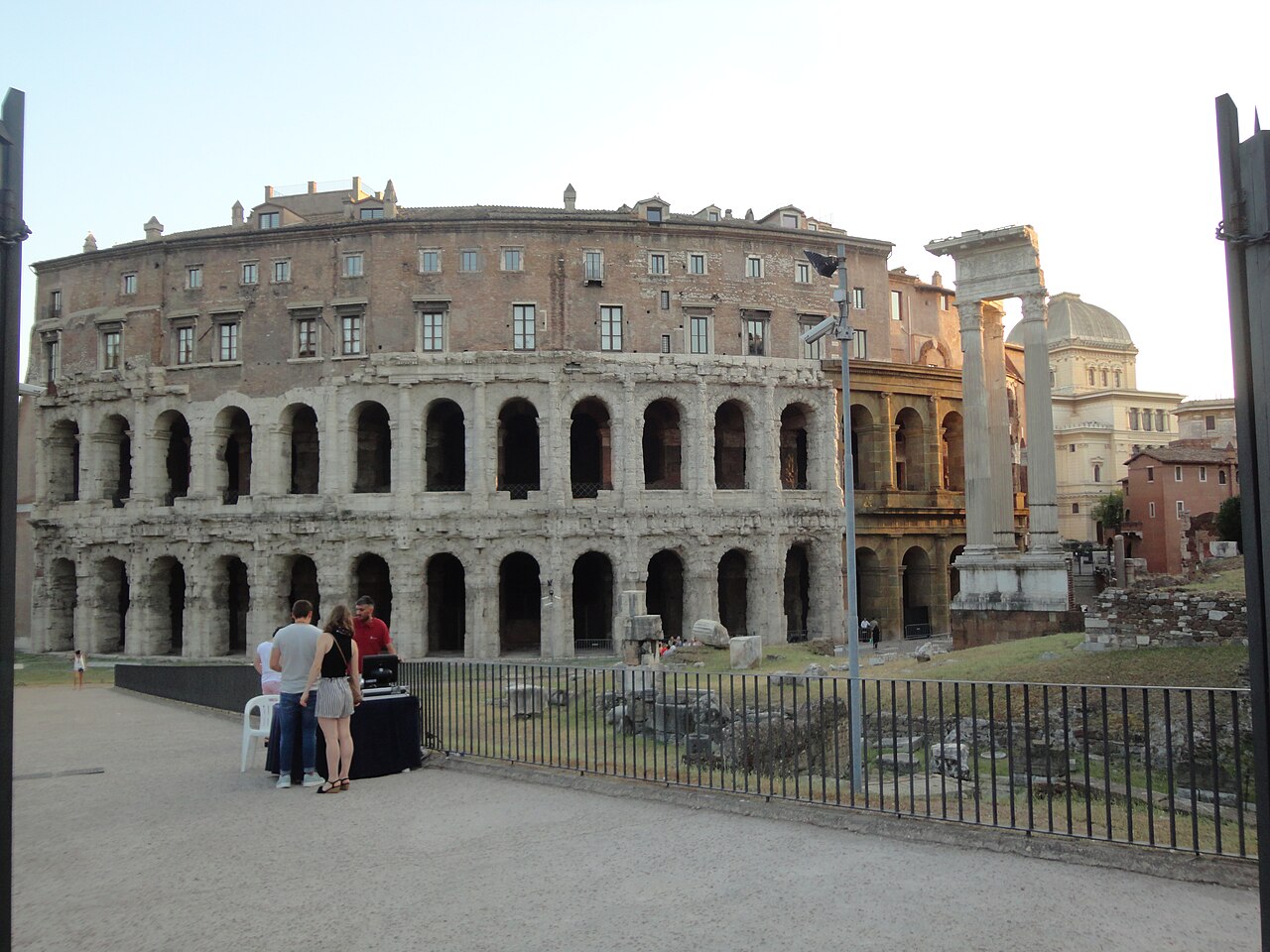
Photograph of the Theatre of Marcellus in Rome: a multi-tiered curved facade of arched stone arcades with brick upper storey and windows. Columns of a Roman temple stand at right, and a dome of a later building is visible behind. People stand near a black table in the foreground behind a metal railing.Artifact

Primary source

Theatre of Marcellus

Augustus · 13–11 BC

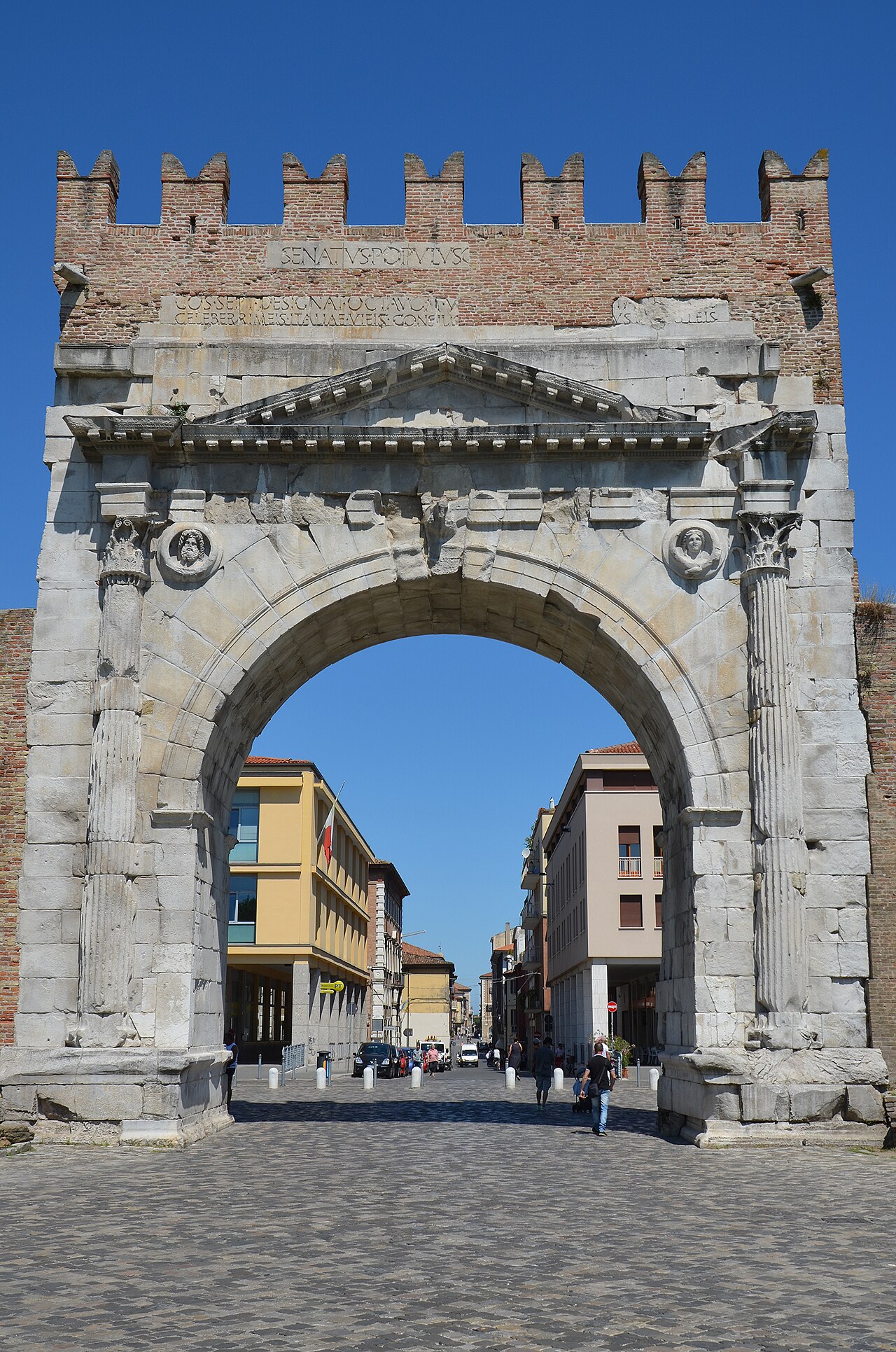
Photo of the Arch of Augustus in Rimini, a white stone Roman triumphal arch with a brick battlemented top bearing an inscription, flanked by fluted columns with Corinthian capitals and carved medallions. Cobbled street and modern buildings are visible through the arch.Artifact

Primary source

Arch of Augustus (Rimini)

Roman Senate · 27 BC

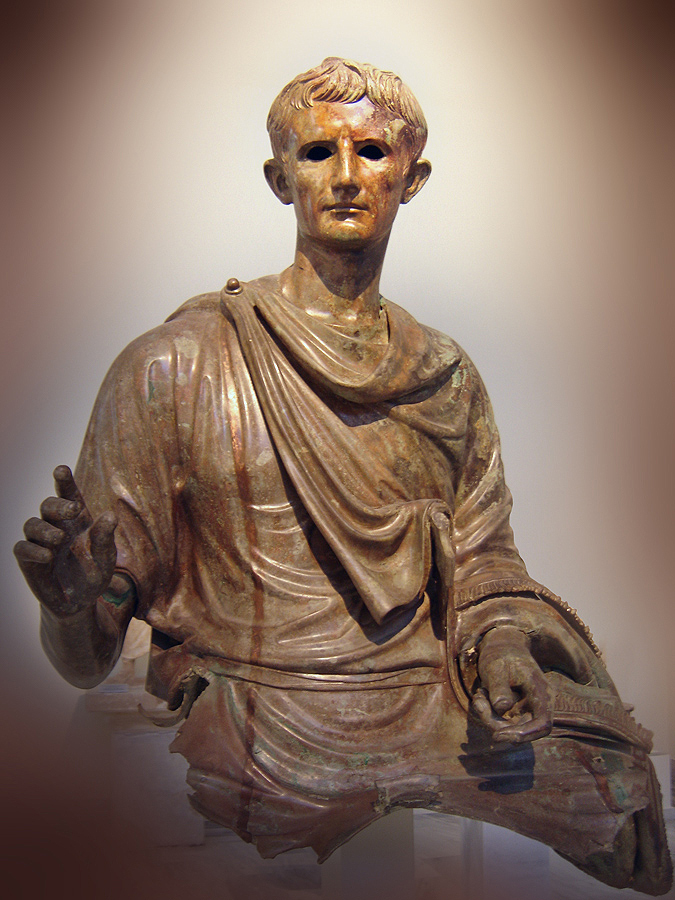
Photograph of a bronze statue of a man with short curly hair, empty eye sockets, and a draped toga or cloak over his shoulder. His right arm is raised with the hand open, and his left hand holds a fold of drapery. The statue is cut off at the lower body and displayed against a pale background.Sculpture

Primary source

Bronze Statue of Augustus (NAMA X 23322)

1st century BC

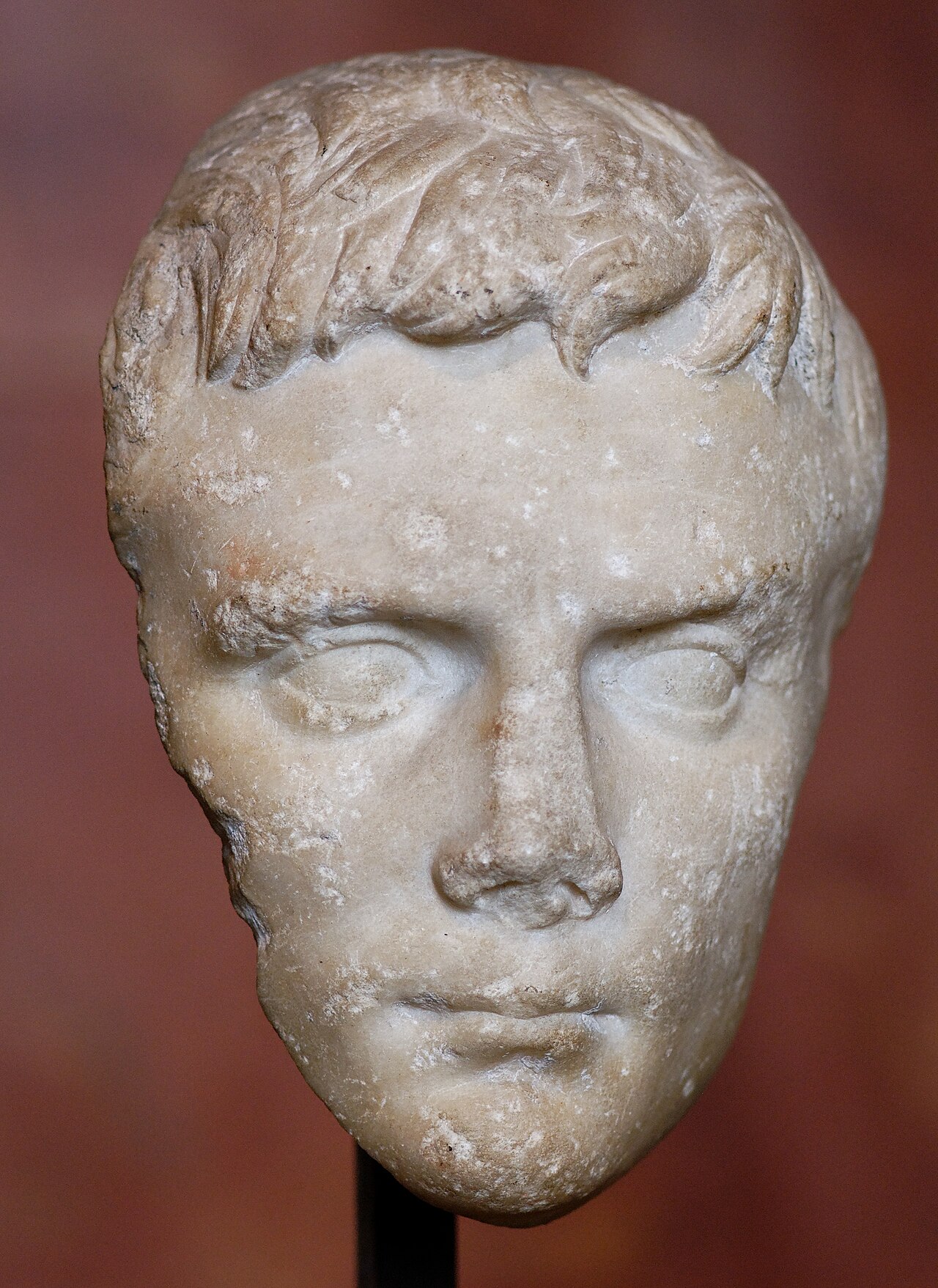
Marble head sculpture of a young man with short, layered hair combed forward over the forehead, straight nose, and calm, slightly downturned mouth. Weathered surface, mounted on a dark stand against a reddish background.Sculpture

Primary source

Portrait of Augustus as a Young Man

27-20 BC

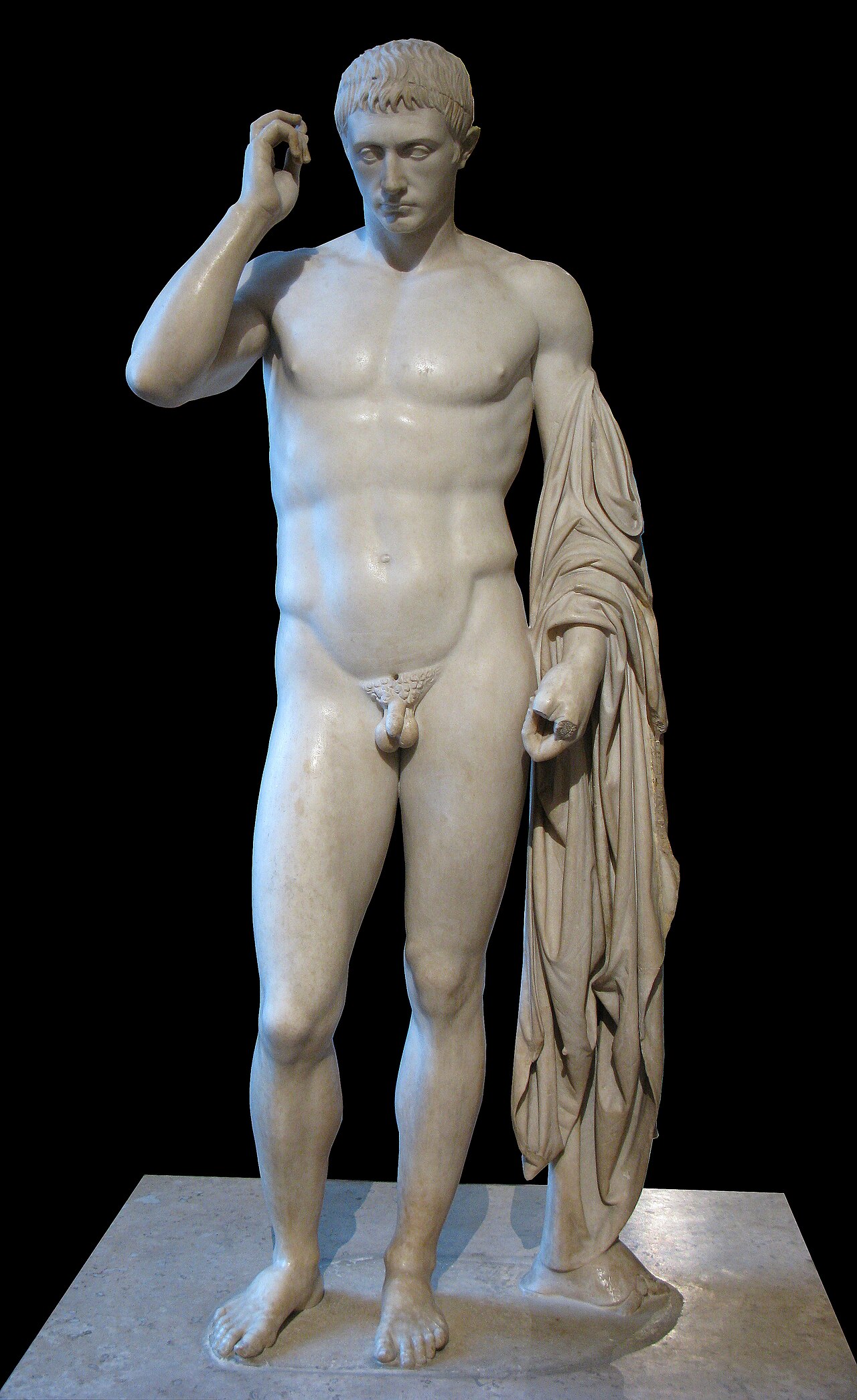
Photograph of a white marble statue of a nude standing male figure with a short-haired head, raised right hand near the head, and a draped cloth over the left arm, set on a pale stone plinth against a black background.Sculpture

Primary source

Marcellus as Hermes Logios

Cleomenes the Athenian · c. 20 BC

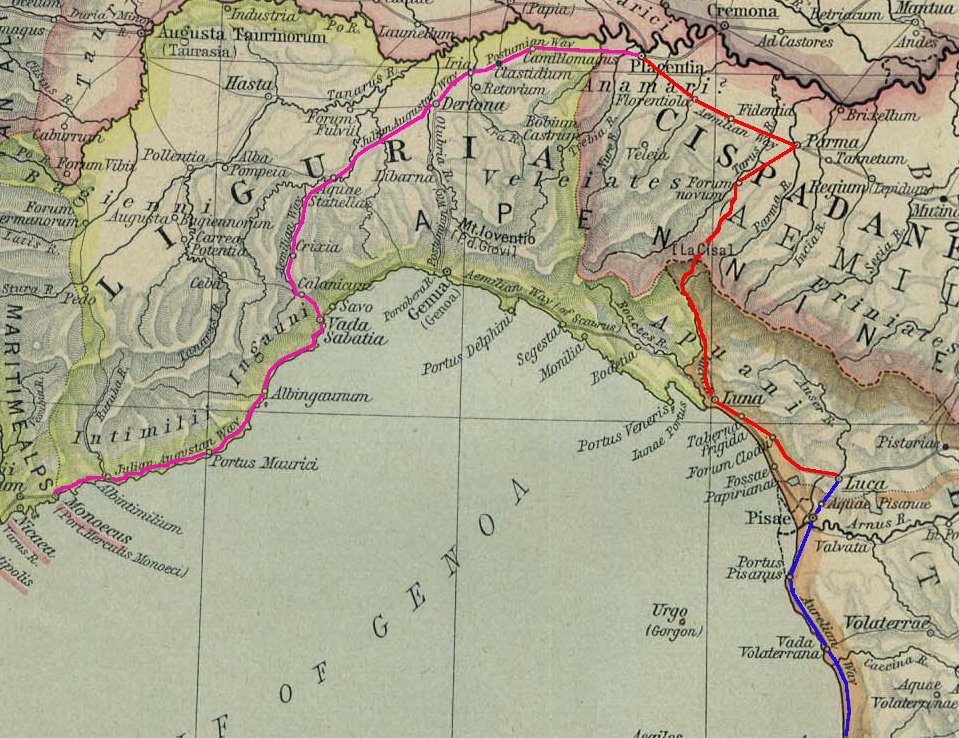
Historical colored map of northern Italy and the Ligurian coast showing Roman roads traced in colors: a purple line for the Via Julia Augusta running along the coast from Nicaea and Albintimilium through Albingaunum, Savo and Genua inland toward Dertona, a red line for the Via Aemilia Scauri from Luna and Pisae area northward to Placentia and Parma, and a blue line for the Via Aurelia running south along the coast past Pisae and Volaterrae. Place names are printed in small italic script over shaded terrain, with the Gulf of Genoa in the lower center.Artifact

Primary source

Via Julia Augusta

13 BC

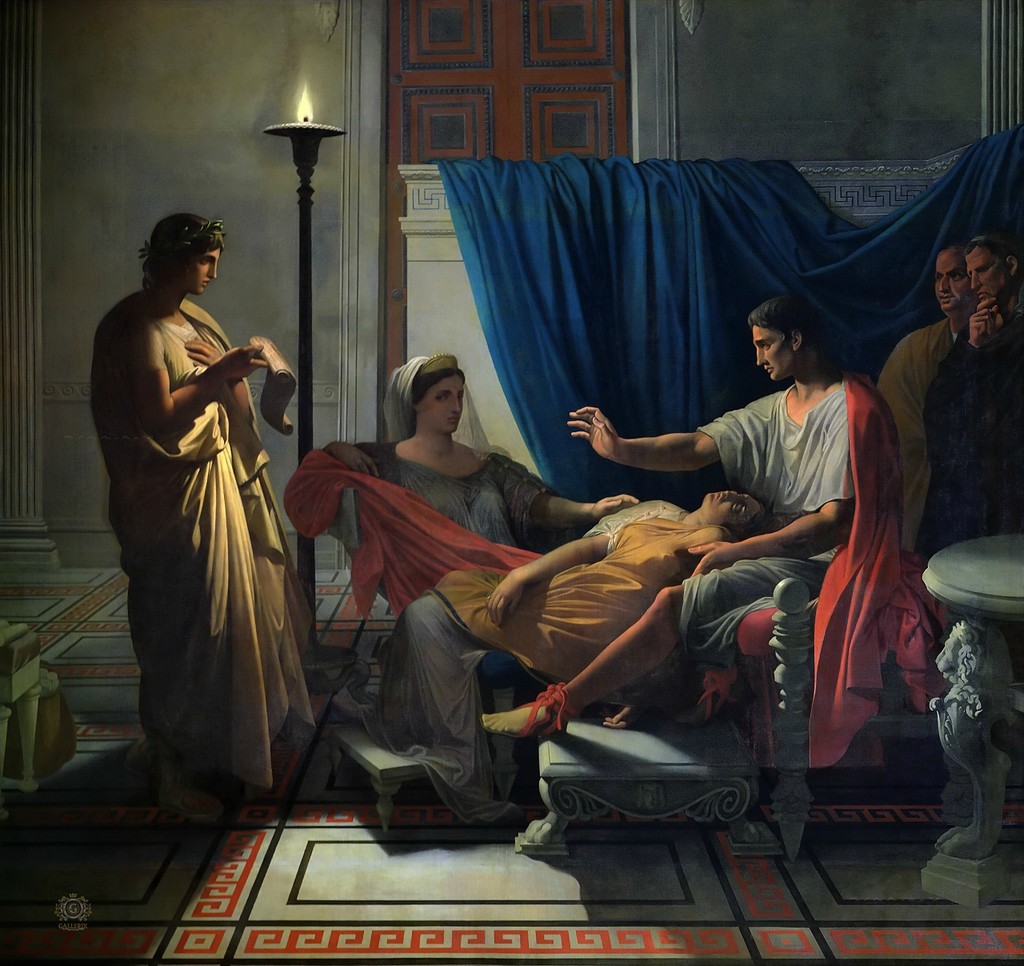
Painting of a laurel-crowned man holding a scroll beside a tall lamp. A young woman in a yellow dress faints back onto a stone bench as a man in a white tunic and red cloak gestures. A veiled woman sits nearby, and two men stand behind a blue drape.Painting

Secondary source

Virgil Reading The Aeneid before Augustus, Livia and Octavia

Jean-Auguste-Dominique Ingres · 1811-1812

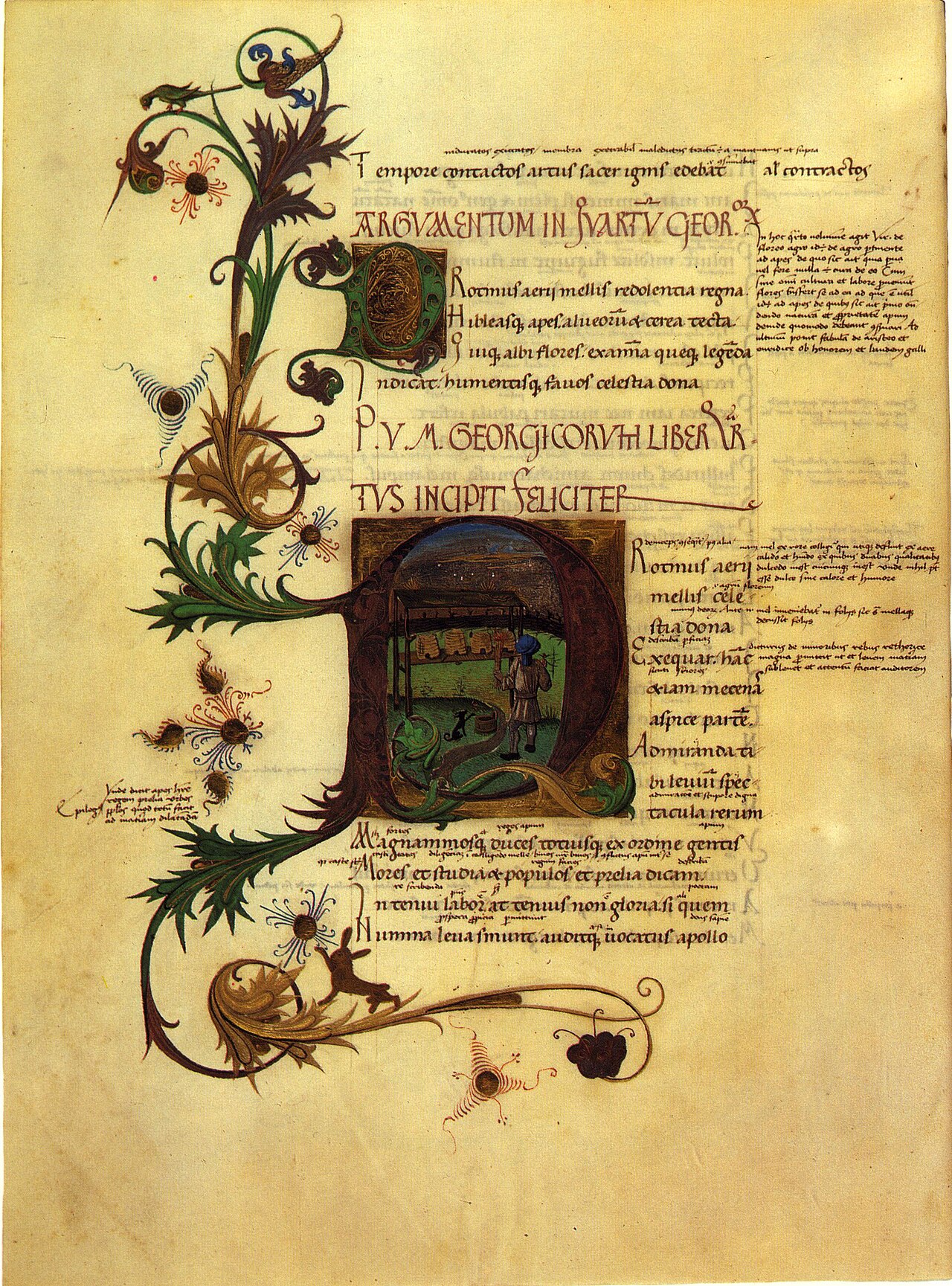
Illuminated manuscript page with a large decorated initial D containing a painted scene of a man in blue hat tending bees near hives under a tree, with green and gold foliage borders and columns of handwritten Latin text.Book

Primary source

Georgics

Virgil · c. 29 BC

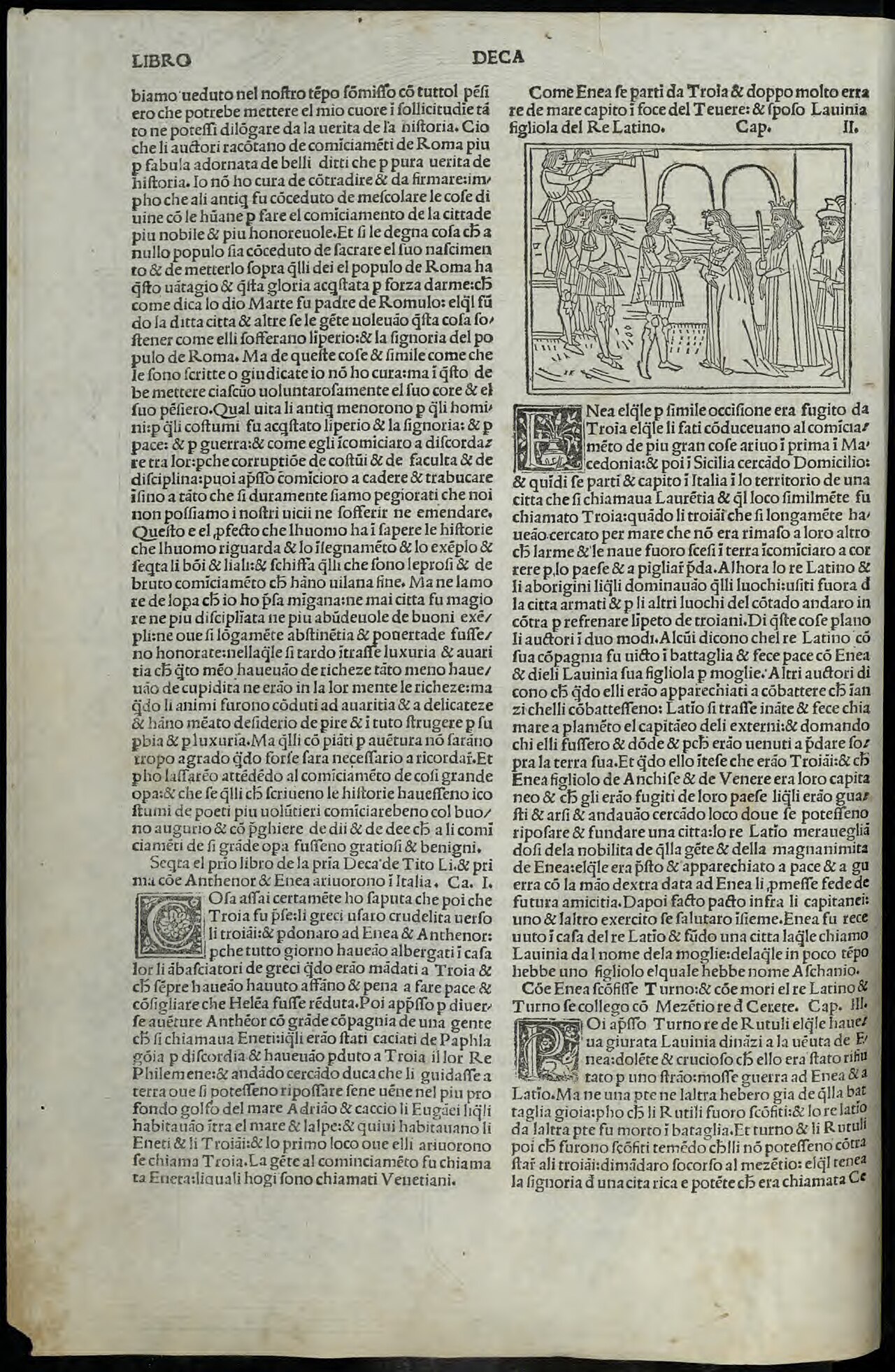
Scan of a printed page from a 1493 Venetian edition of Livy's Roman history, in Latin black-letter type with two woodcut illustrations. The left column reads 'LIBRO' and the right 'DECA' running heads. The top right woodcut shows figures in a scene with a bearded man and a woman.Book

Primary source

History of Rome

Titus Livius · 27-9 BC

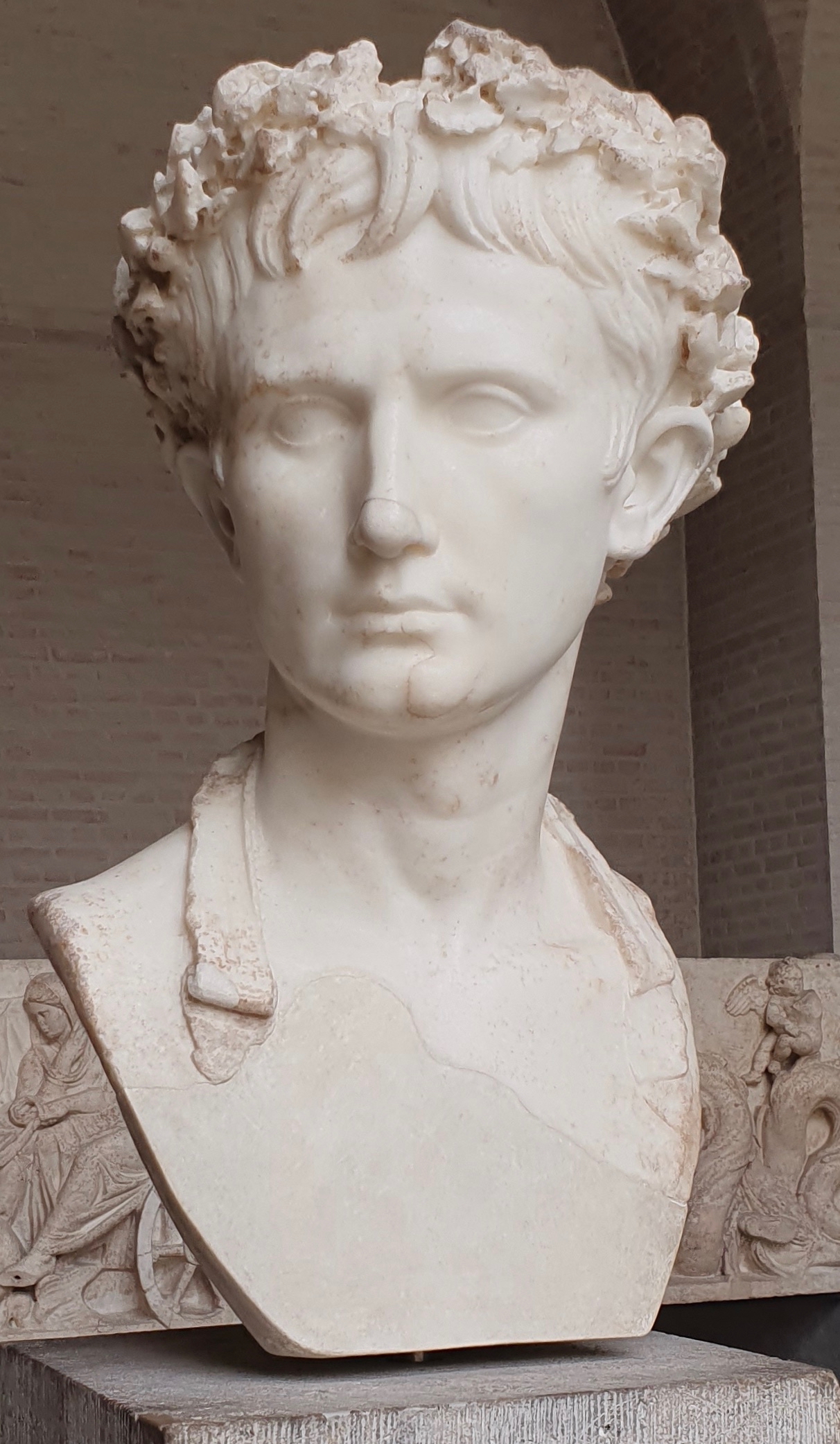
Marble bust of a young man with short, wavy hair and a wreath of leaves, shown from the front. The bust has a draped shoulder and a sculpted relief panel with figures behind it.Sculpture

Primary source

Augustus Bevilacqua

Unknown Roman sculptor · c. AD 14

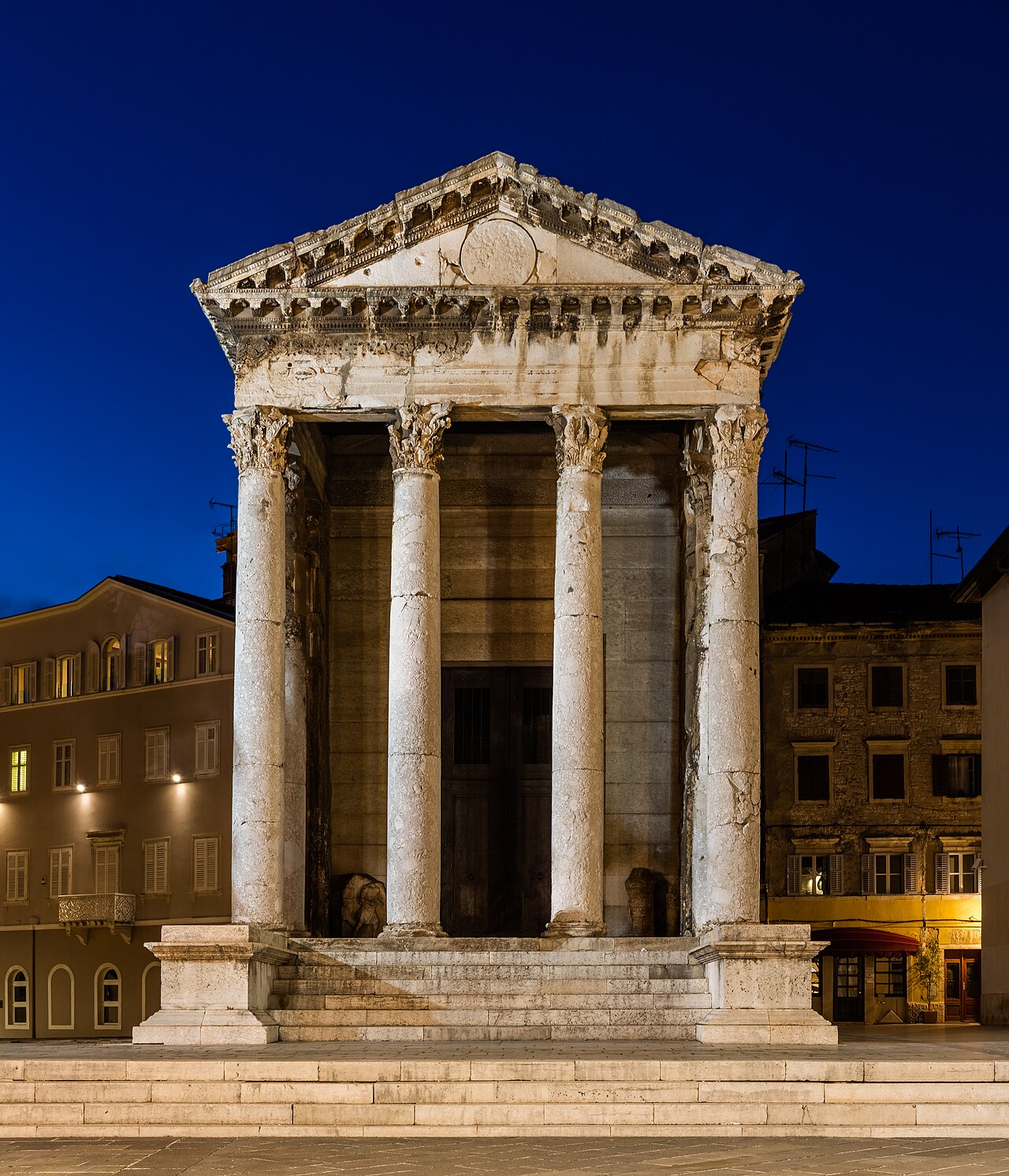
Night photo of the Temple of Augustus in Pula, a small white marble Roman temple with a triangular pediment, six Corinthian-style columns across the front, and a central doorway, lit by floodlights against a dark blue sky, with buildings on either side and a stepped base in the foreground.Artifact

Primary source

Temple of Augustus, Pula

Colonia Pietas Iulia Pola · c. 2 BC – AD 14

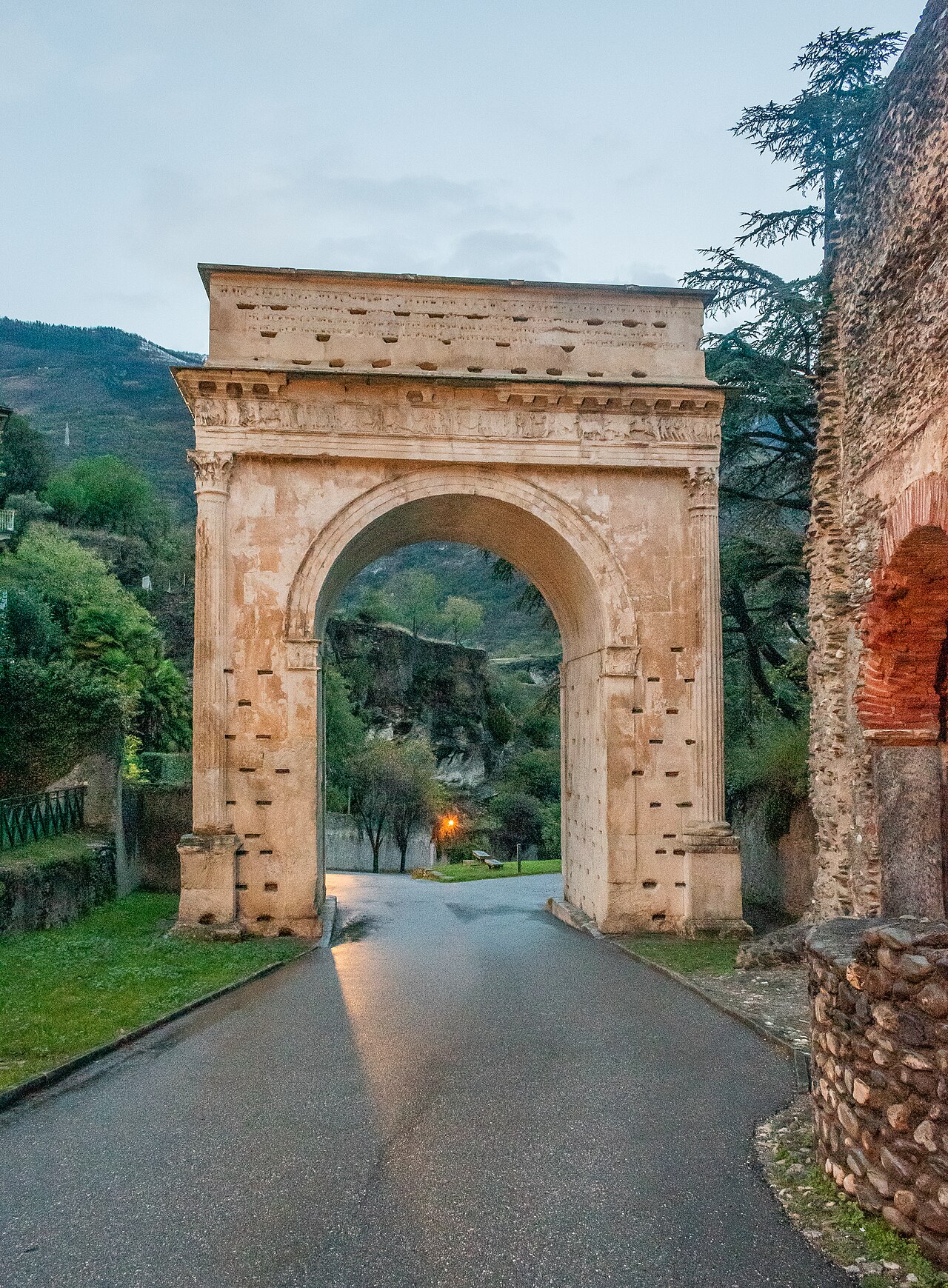
A tall, pale stone Roman triumphal arch with a single large central arch opening, flanked by fluted columns, with a carved frieze and an inscribed attic block on top. A paved road runs through it toward wooded mountains under a pale evening sky. Cedar trees and a stone wall stand to the right.Artifact

Primary source

Arch of Augustus (Susa)

Marcus Julius Cottius · 9–8 BC

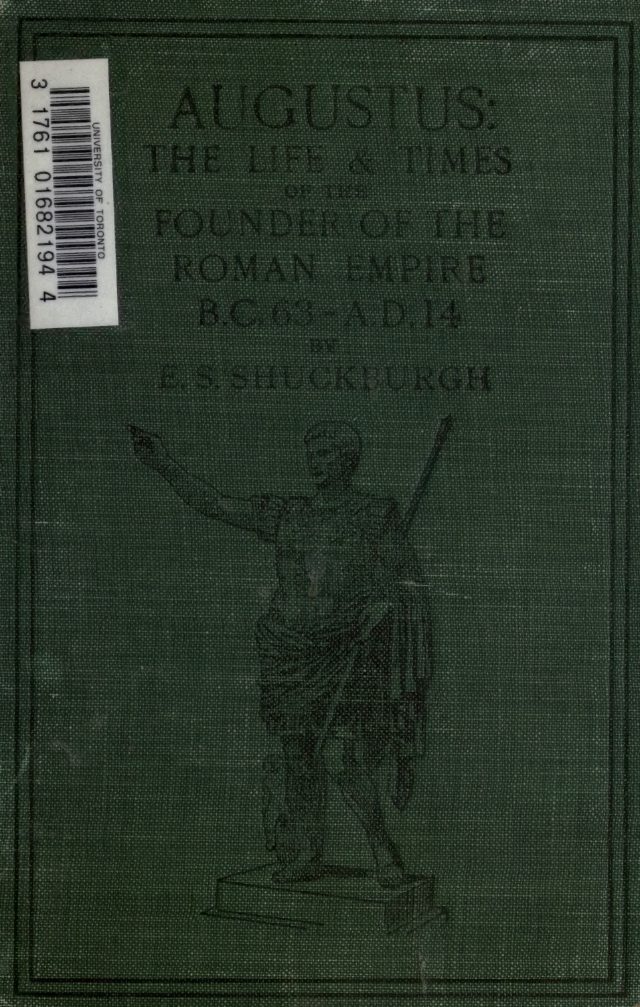
Augustus: The Life and Times of the Founder of the Roman EmpireBook

Secondary source

Augustus: The Life and Times of the Founder of the Roman Empire

Evelyn Shirley Shuckburgh · 1903

Book

Secondary source

The Annals: Opening Books on Augustus's Death

Tacitus · written early 2nd century AD; this translation 1906

Book

Secondary source

Roman History attributed to Ammianus Marcellinus

Cassius Dio

Document

Tertiary source

Augustus entry, Catholic Encyclopedia

Charles G. Herbermann and others · 1913

Document

Tertiary source

Augustus entry, Encyclopaedia Britannica, 9th edition

1875-1889

Front cover of a dark navy book with the title AUGUSTUS in gold capital letters across the top and a gold laurel wreath in the center. A pale blue label is on the left edge.Book

Secondary source

Augustus: His Life and His Work

René Francis

Documentary

Secondary source

Roman History: The Early Empire

William Wolfe Capes

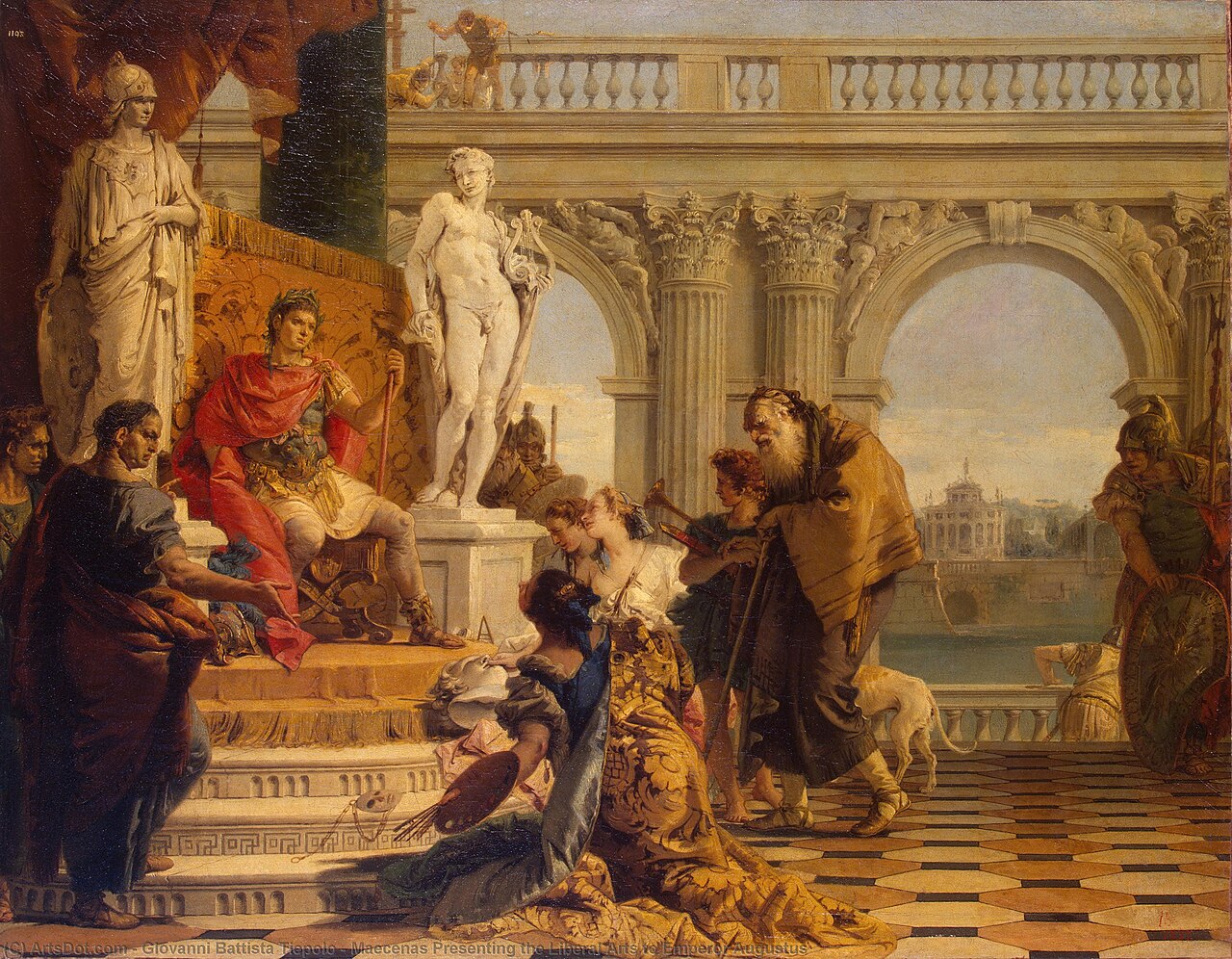
Painting of a classical scene: a seated emperor in red drapery on a golden throne on a raised dais, with a standing marble statue, robed figures, a bearded man in a yellow cloak, kneeling women, and a sculpted statue of a nude youth beside a colonnaded terrace with arches and a distant domed building.Painting

Secondary source

Maecenas Presenting the Liberal Arts to Emperor Augustus

Giovanni Battista Tiepolo · 1743

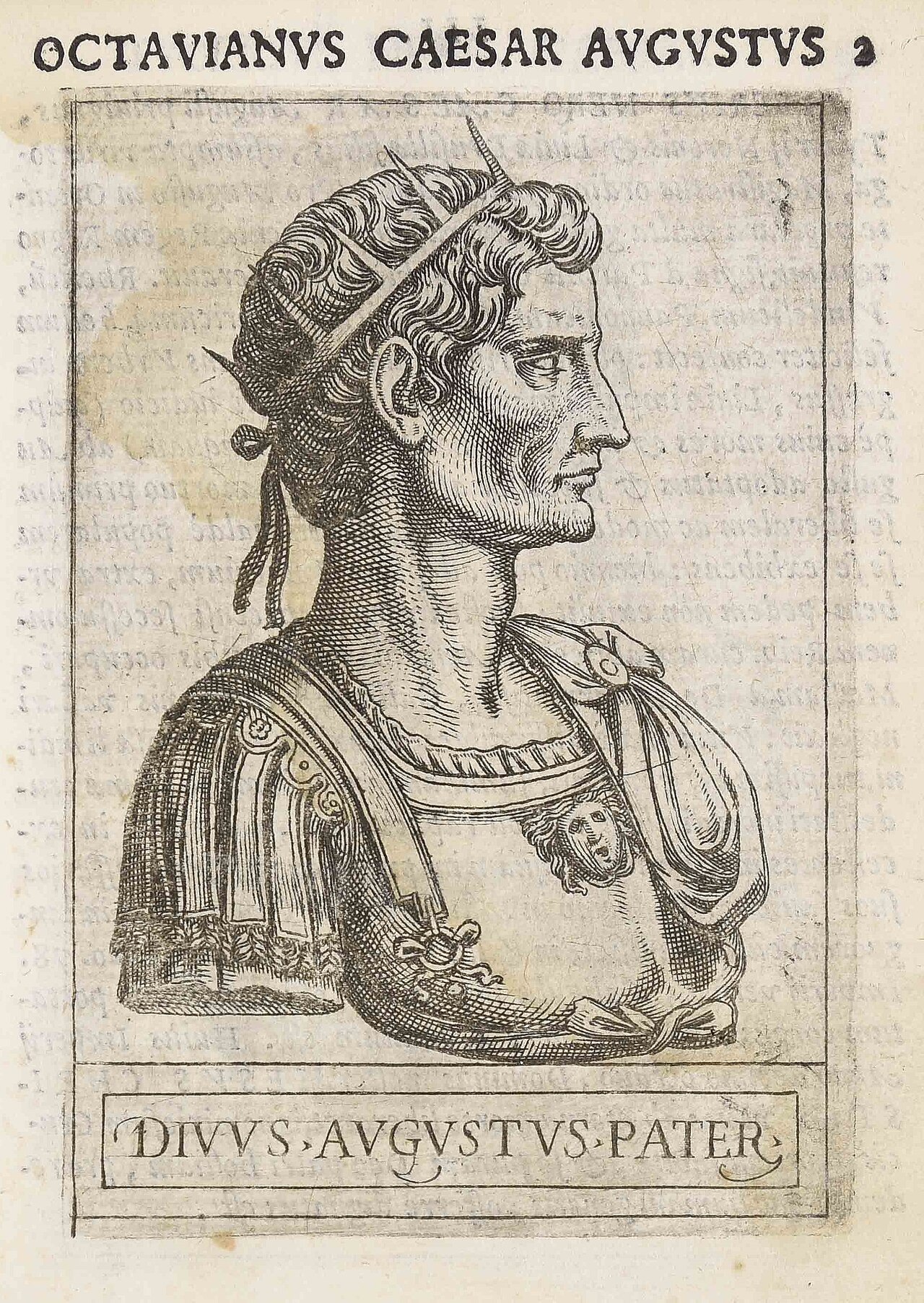
Black and white engraving of a bust of a man in profile facing right, wearing a laurel wreath, a cuirass decorated with a gorgon head, and a draped cloak over one shoulder. Above is the printed heading OCTAVIANUS CAESAR AUGUSTUS and below is the caption DIVVS AVGVSTVS PATER, on a printed page.Document

Secondary source

Octavianus Caesar Augustus

Giovanni Battista de'Cavalieri · 1583

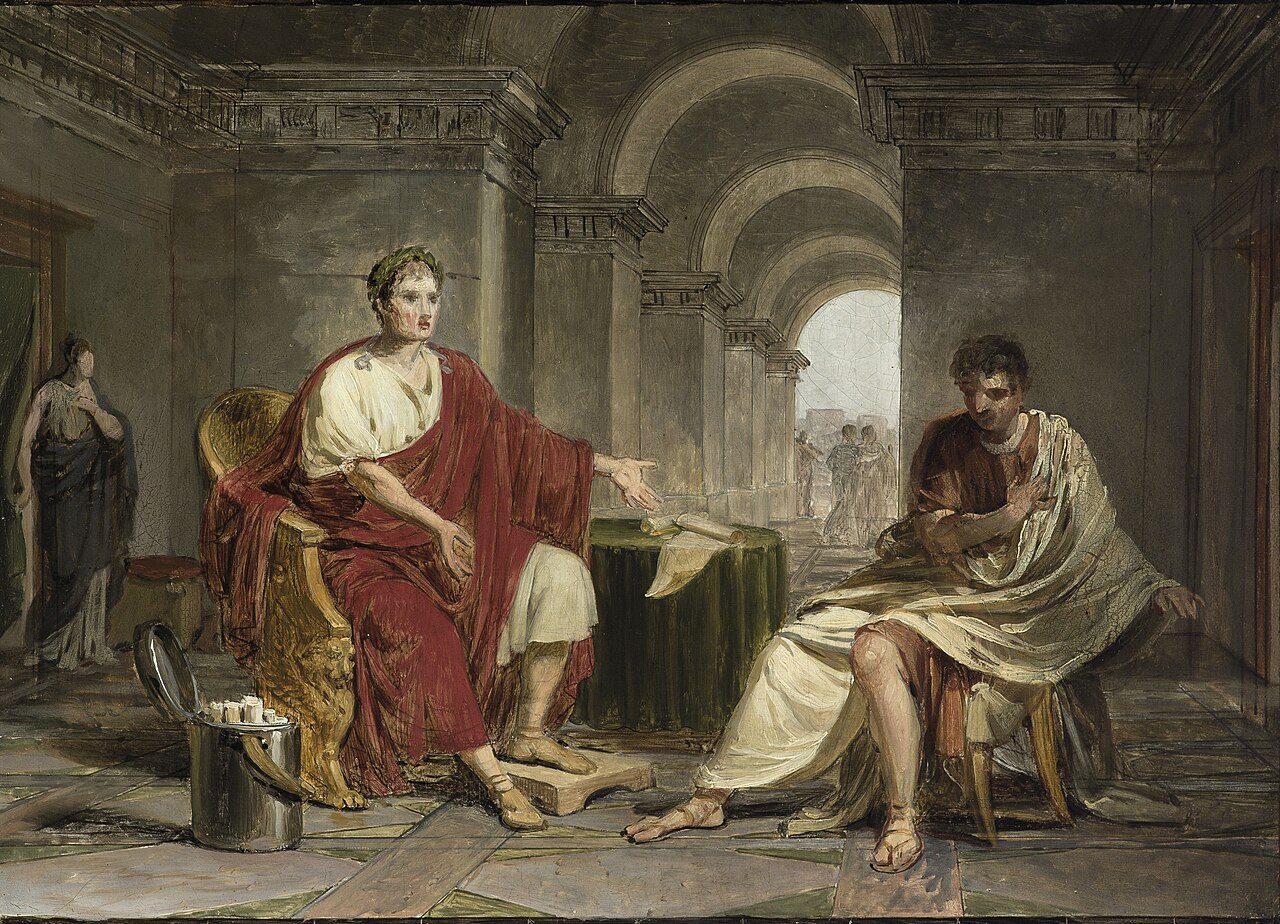
Oil sketch painting of a Roman-style interior with arched colonnades. A laurel-crowned man in a red cloak sits on a gilded chair, gesturing with one arm toward a seated man in a white draped toga who looks down. A small table holds a rolled scroll; a standing woman in the background and a silver bucket of scrolls sit at left.Painting

Secondary source

Augustus and Cinna

Louis-André-Gabriel Bouchet · before 1819

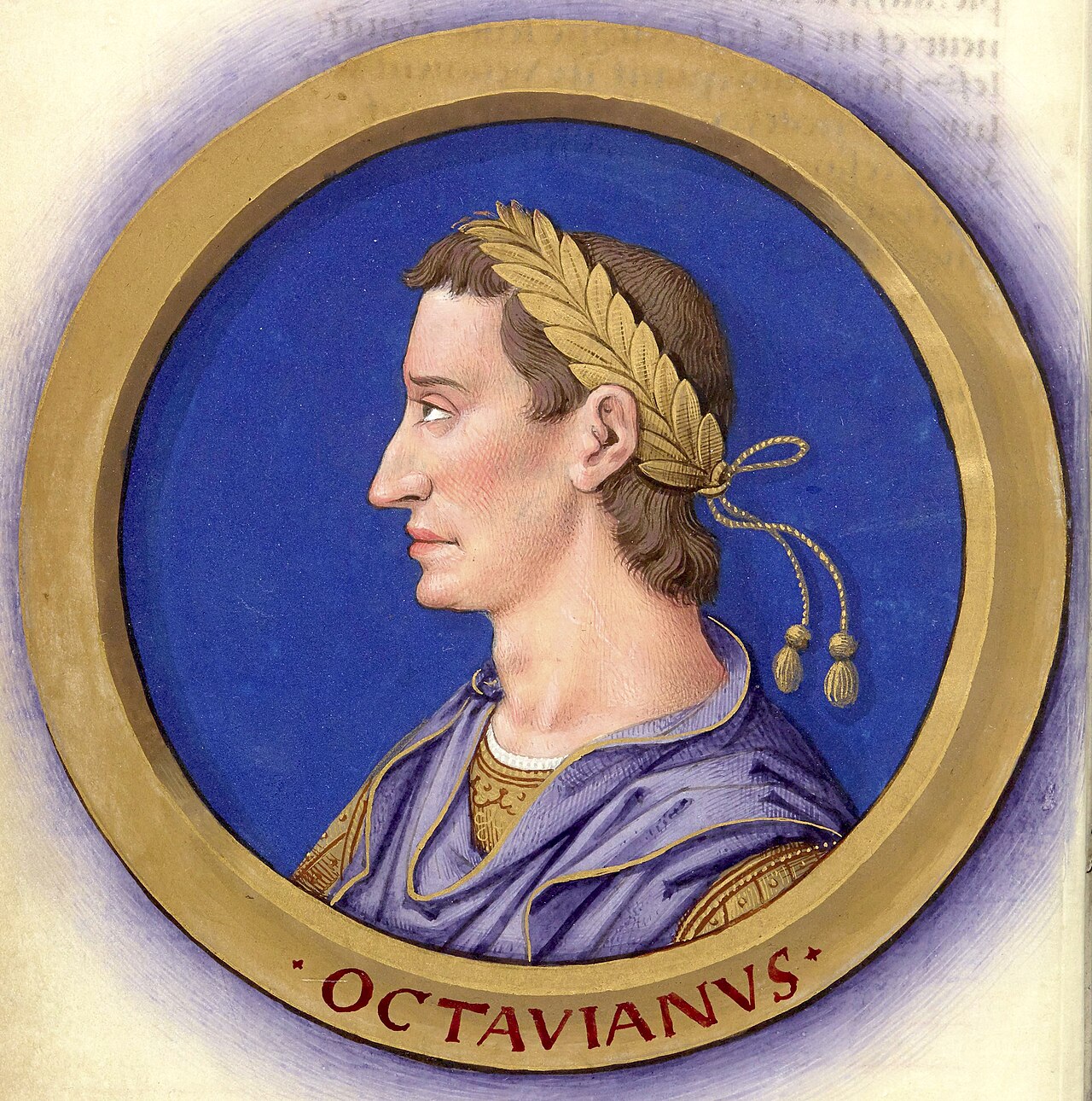
Painted profile portrait of a man facing left, wearing a gold laurel wreath with tied ribbons and a purple garment with gold trim. He is set in a blue circular medallion with a gold frame, and the label OCTAVIANUS appears in red capitals below.Painting

Secondary source

Augustus Portrait from the Twelve Caesars

Jean Bourdichon · c. 1515-1520

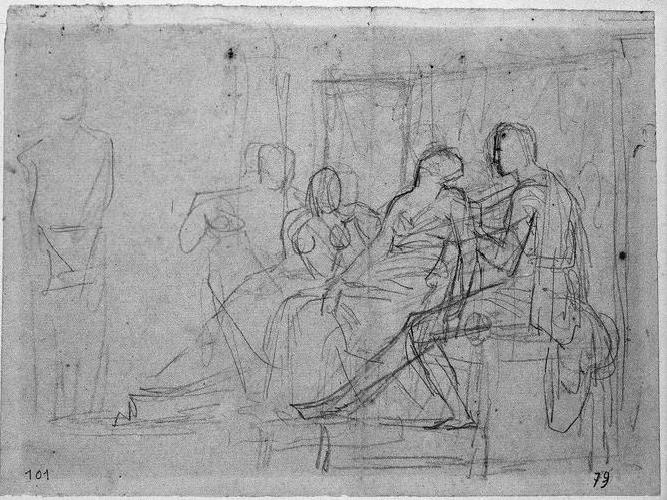
Pencil sketch on grey paper of a scene with several seated and standing figures in classical drapery, including a central reclining figure and a figure reading, with a standing nude figure at left. Numbers 101 and 79 appear in the corners.Painting

Secondary source

Virgil Reading the Aeneid

Jean-Auguste-Dominique Ingres

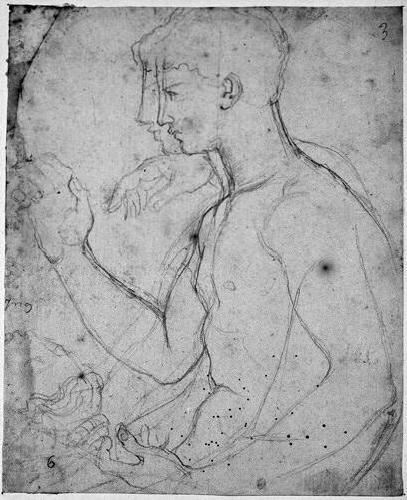
Graphite pencil sketch on grey paper of a man in profile facing left, with bare shoulders and upper back. His hand is raised near his chin. Faint studies of hands and a head appear at lower left, with numbers 3 and 6 in the corners.Painting

Secondary source

Study of Augustus

Jean-Auguste-Dominique Ingres

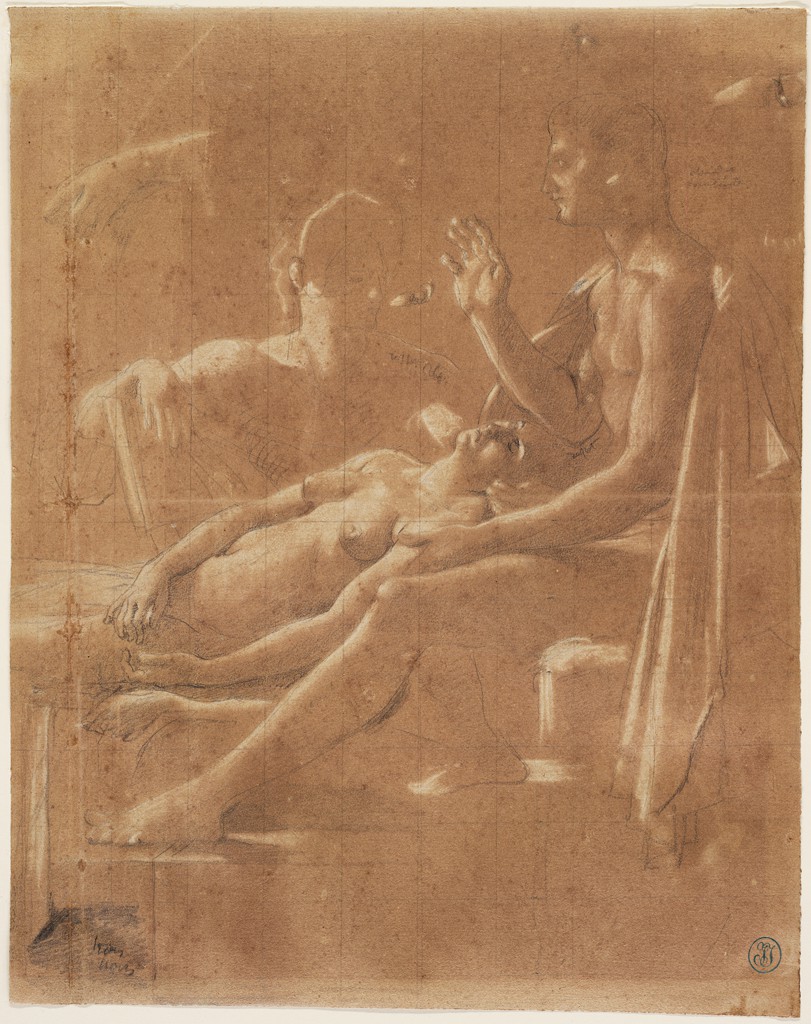
Pencil and white chalk drawing on tan paper showing a study of a seated standing man gesturing toward a reclining nude woman, with a sketched figure in the background and faint grid lines. A signature appears lower left.Painting

Secondary source

Study for Virgil Reading the Aeneid to Augustus

Jean-Auguste-Dominique Ingres

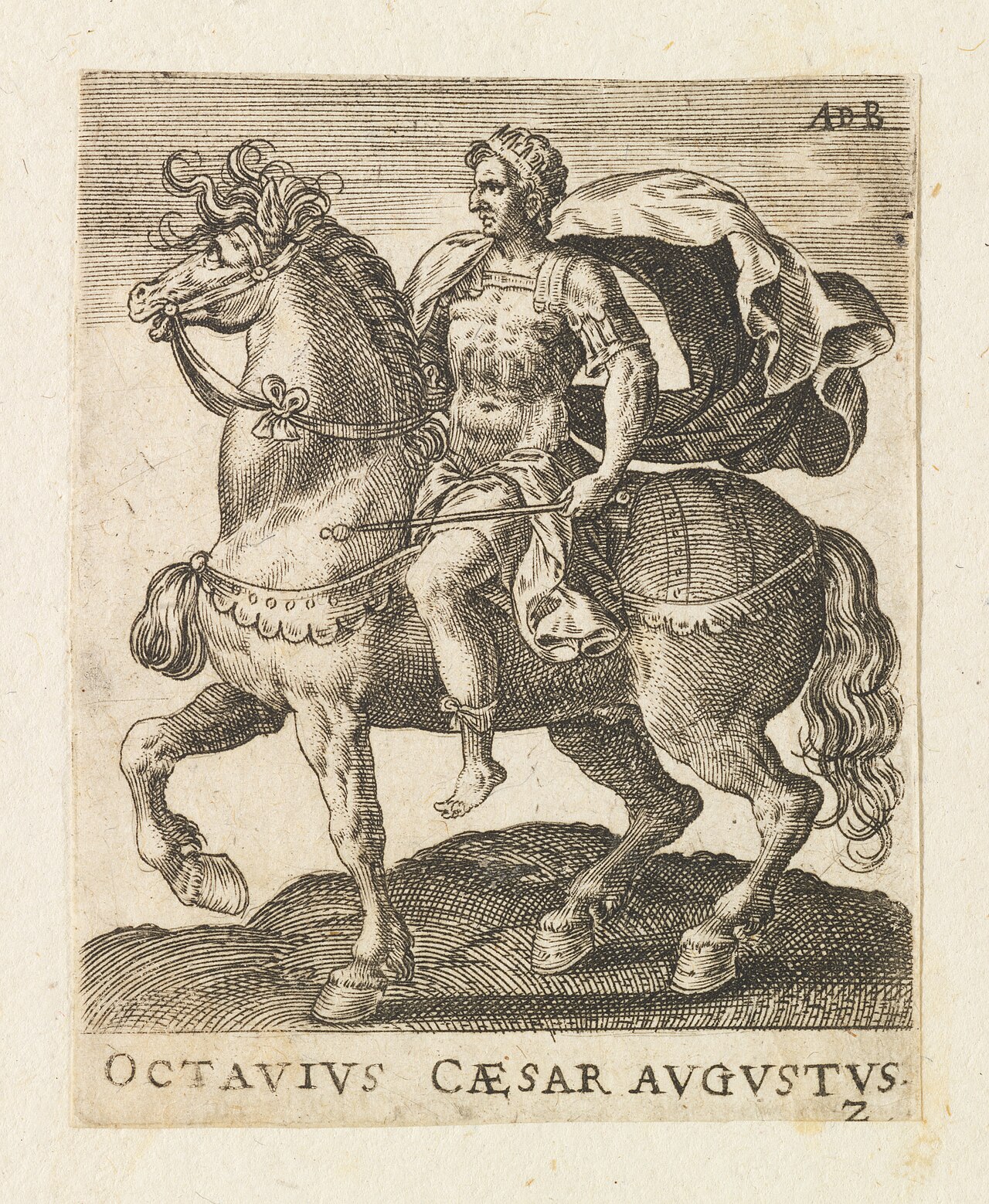
Engraved print of a crowned, bare-chested man on a rearing horse, looking to the side with a cloak billowing behind him. The horse's tail and mane are curly and it stands on a mound. Inscription below reads OCTAVIVS CAESAR AVGVSTVS, with monogram AB and the letter Z in the corners.Painting

Secondary source

Octavius Caesar Augustus

Abraham de Bruyn · c. 1565

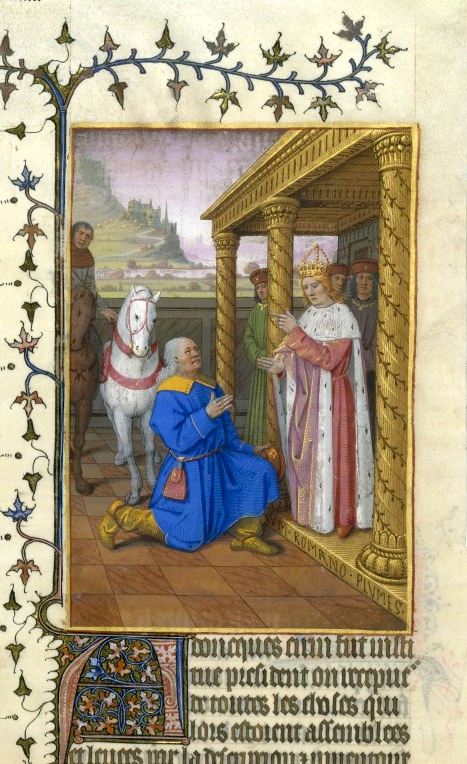
Illuminated manuscript miniature: a kneeling man in a blue robe with a gold collar, hands clasped, faces a crowned emperor in ermine-trimmed red and purple robes on a gilded dais. Attendants stand behind; a white horse and a castle on a hill appear at left. Gold-leaf border and gothic text below.Painting

Secondary source

Augustus Appointing Quirinius Governor of Syria

Jean Bourdichon · c. 1470

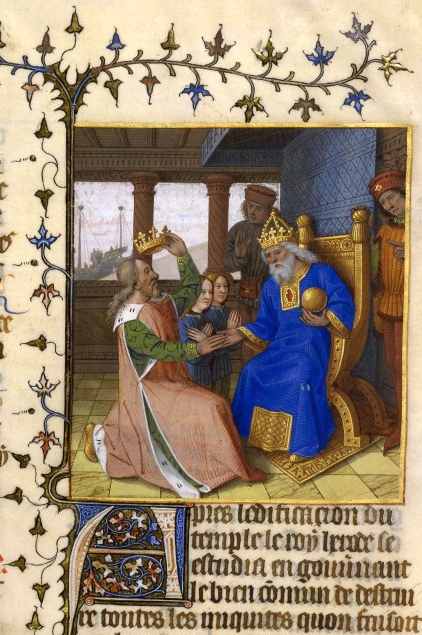
Medieval manuscript miniature: a crowned, kneeling man in a pink robe and green collar offers his hands to a bearded, crowned king in blue robe seated on a gold throne holding an orb. Behind them stand attendants and a column-lined hall. Gothic French text in columns below.Painting

Secondary source

Herod the Great's Homage to Augustus

Jean Bourdichon · c. 1470

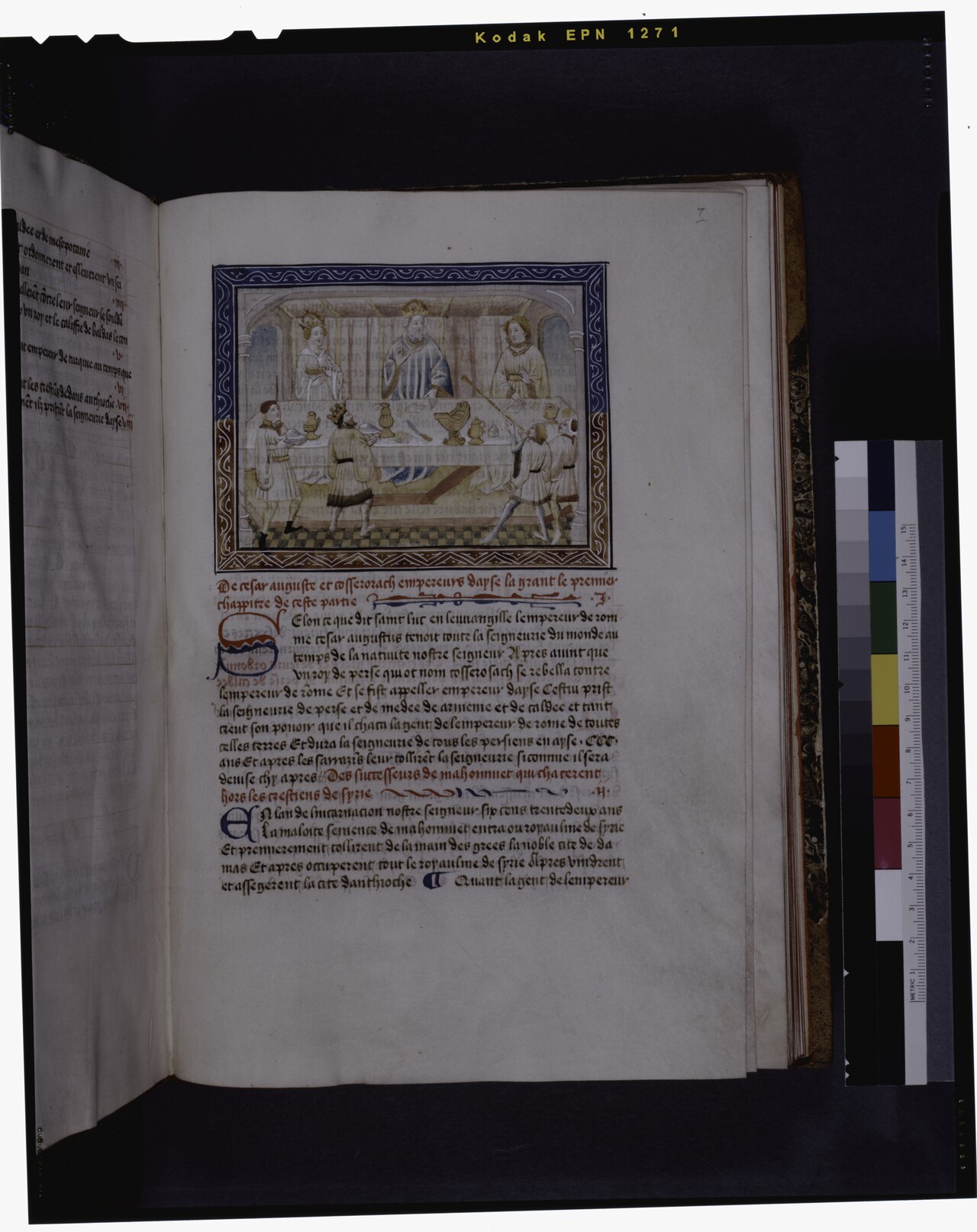
Scan of a manuscript page with a painted miniature in a blue and gold border showing a banquet: a seated king and two attendants at a table with gold vessels, and figures in the foreground. Below is a block of Gothic script with decorated initials and rubrics. A color scale and 'Kodak EPN 1271' target appear at the edges.Painting

Secondary source

Augustus, his Wife and Son Receive Homage from King Cosserosach

14th century (manuscript)

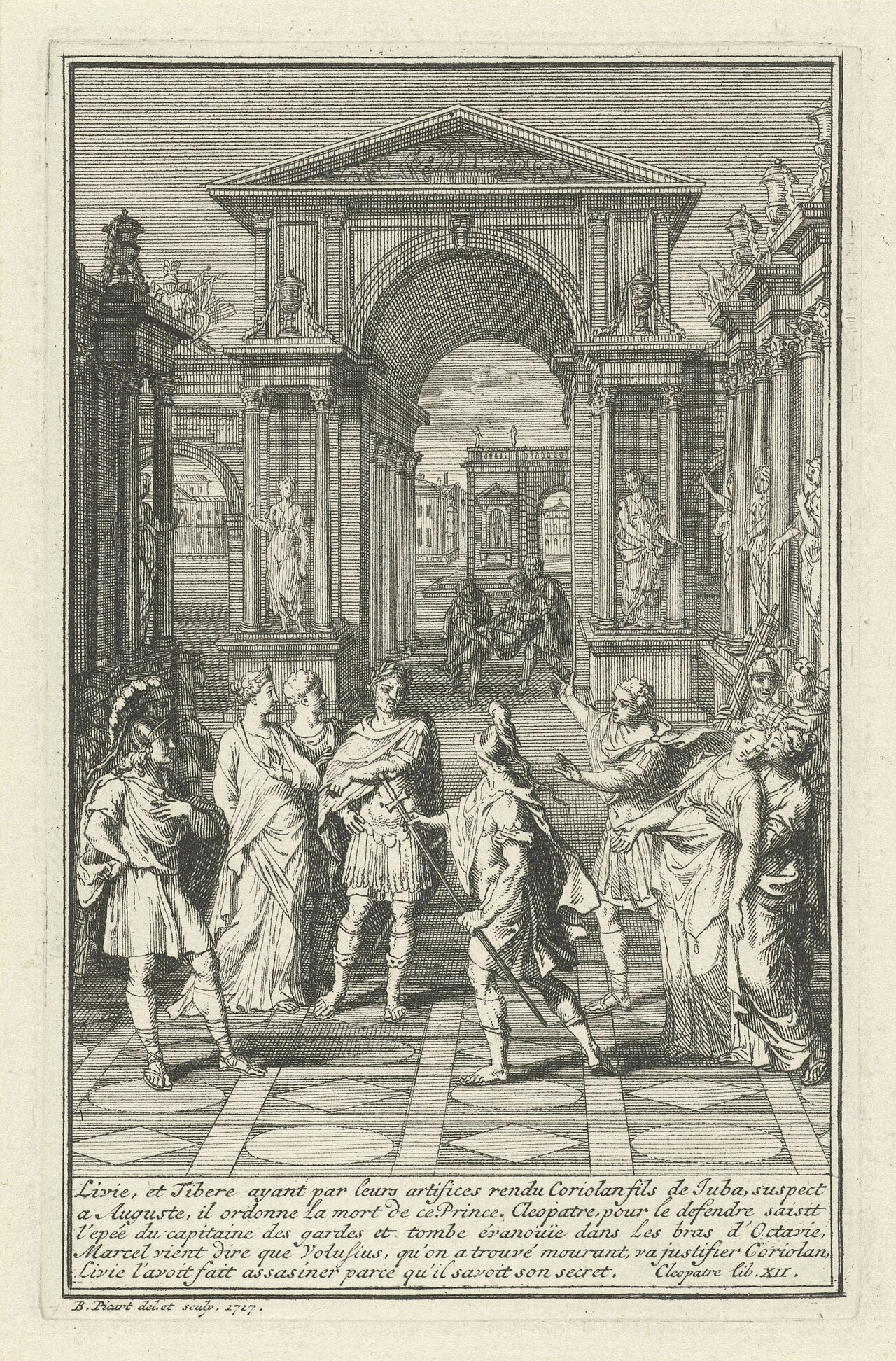
Engraved print of a Roman-style scene before a triumphal arch with columns and statues. A group of figures stands on a tiled floor: a helmeted soldier at left, a woman in a long robe, a man in a tunic with a sword, a figure in a cloak with a sword drawn, and a fainting woman supported by others at right. Two figures stand in the arch background. A caption in French is printed below, with the signature B. Picart 1717.Painting

Secondary source

Livia and Tiberius Address Emperor Augustus

Bernard Picart · 1717

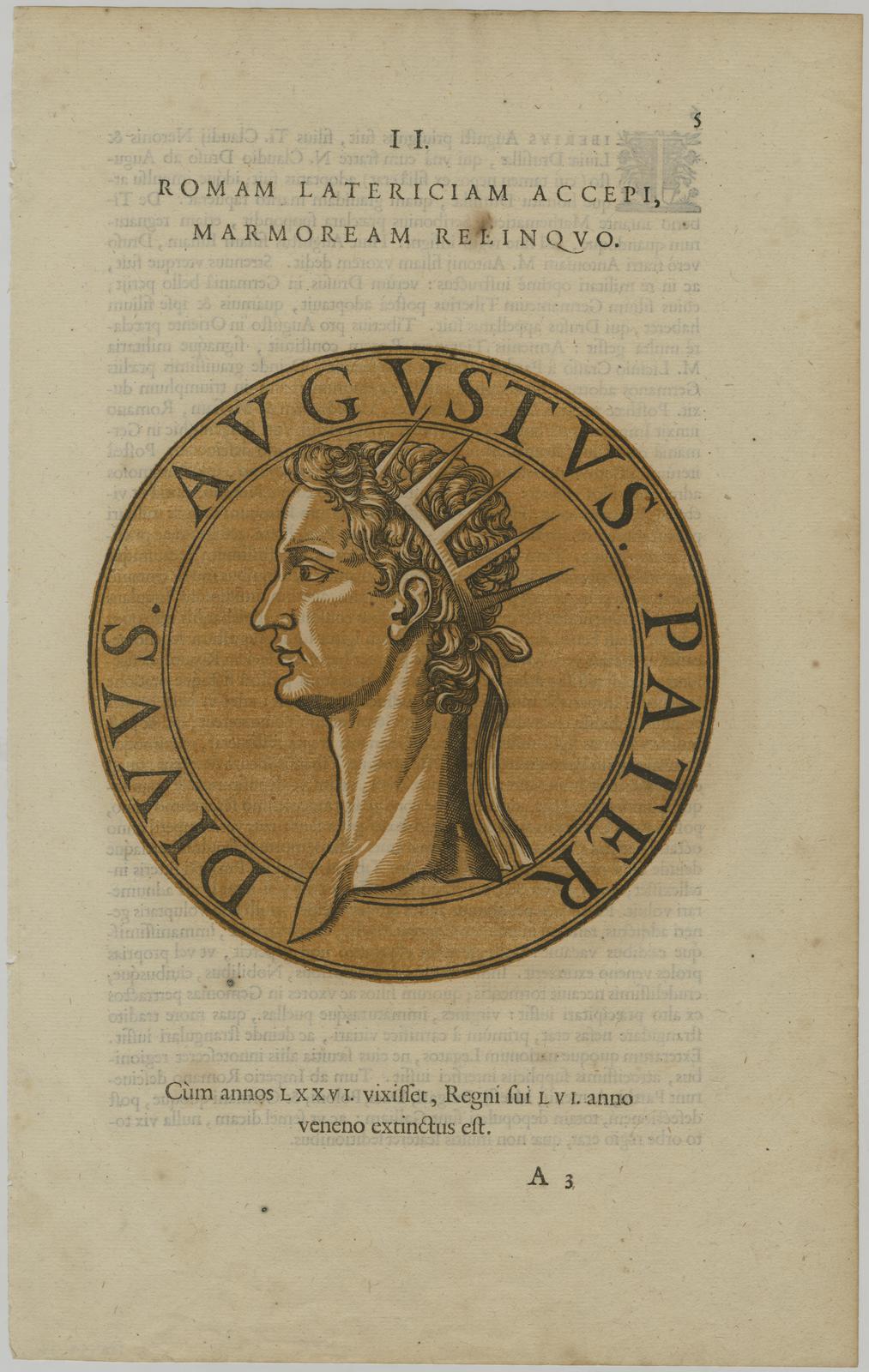
Printed page with a large circular ochre-and-black woodcut medallion of Augustus in left profile, wearing a spiked crown and with laurel-like curls. Inscription around the rim reads AVGVSTVS and DIVVS PATER. Latin text above and below.Painting

Secondary source

Profile Portrait of Augustus

Christoffel Jegher · circa 1645

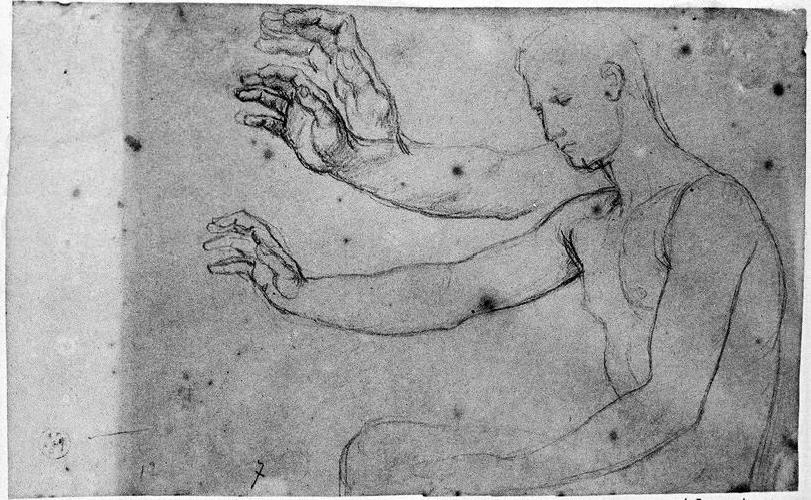
Grey-toned scan of a pencil drawing on paper showing a figure in profile facing left, with two outstretched arms and hands, one arm raised at top and one lower; the torso and shoulder are sketched on the right.Painting

Secondary source

Study of Augustus

Jean-Auguste-Dominique Ingres

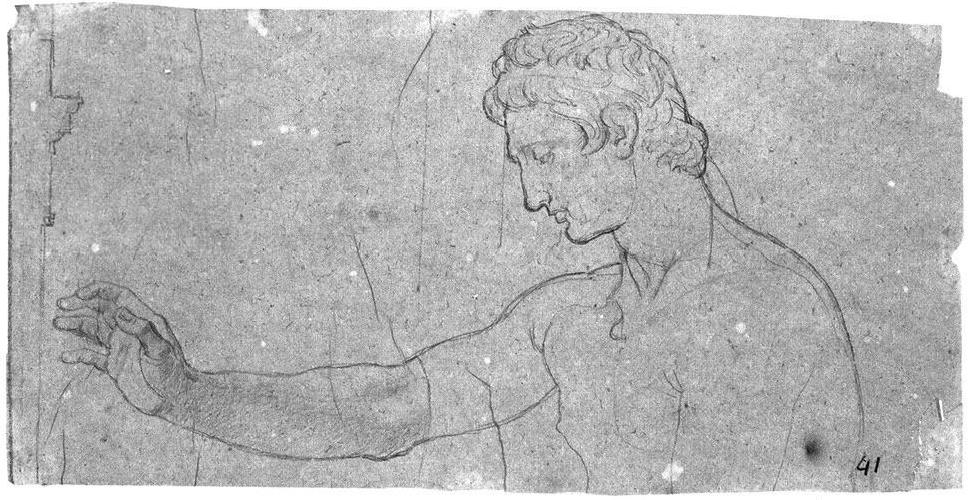
Pencil sketch on grey paper of a classical-style male head in profile facing left, with curly hair and a raised outstretched arm with hand at left. Number 41 in the lower right corner.Painting

Secondary source

Drawing of Augustus

Jean-Auguste-Dominique Ingres

Document

Secondary source

Augustus entry, Encyclopaedia Britannica, 11th edition

1911

Document

Secondary source

Augustus entry, The New Student's Reference Work

1914

Book

Primary source

The Odes and Carmen Saeculare

Horace · 1882

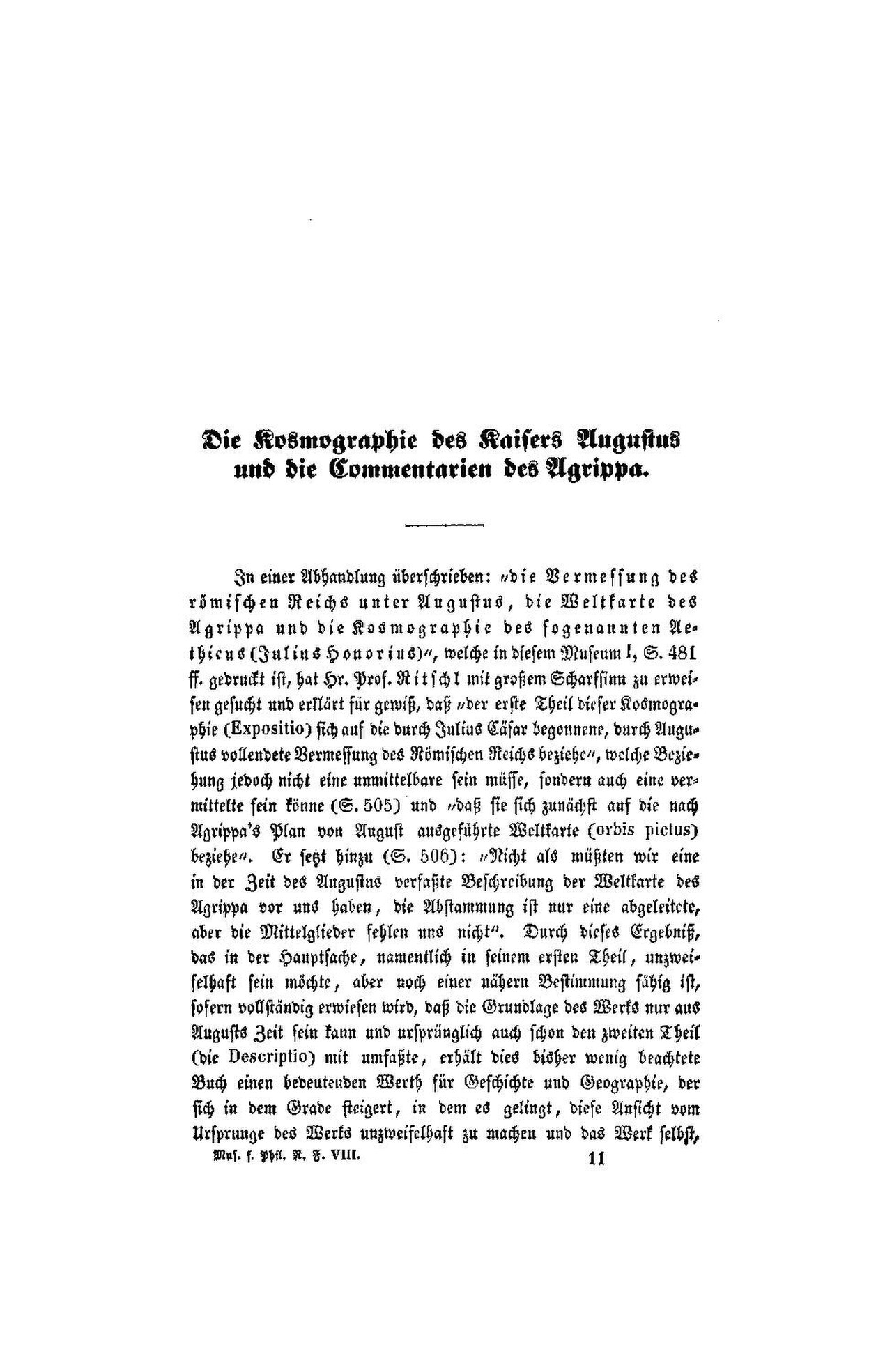
First page of a German scholarly article in Fraktur type titled 'Die Kosmographie des Kaisers Augustus und die Commentarien des Agrippa', with body text in German and the running header 'Rhein. Mus. f. Phil. N. F. VIII' and page number 11 at the bottom.Document

Secondary source

The Cosmography of Emperor Augustus and Agrippa's Commentaries

Chr. Petersen

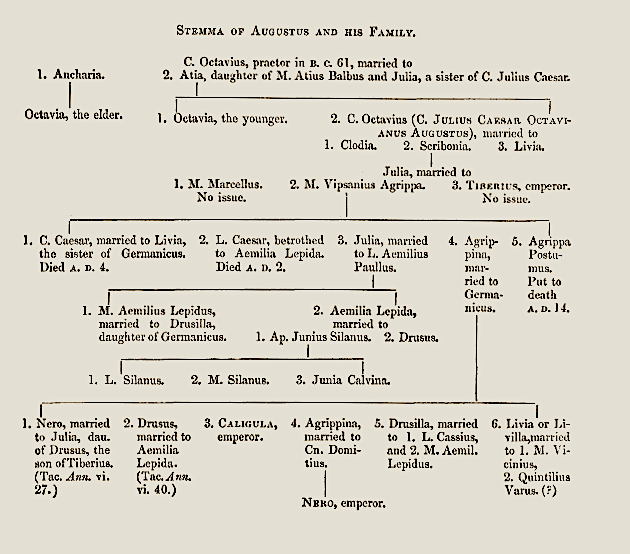
Printed genealogical chart titled 'Stemma of Augustus and his Family'. Branching lines connect names and dates, starting with C. Octavius and Atia at top, descending through Octavia, Octavius Augustus, Julia, Tiberius, and later generations of the Julio-Claudian line.Document

Secondary source

Stemma of Augustus and His Family

William Smith · 1867

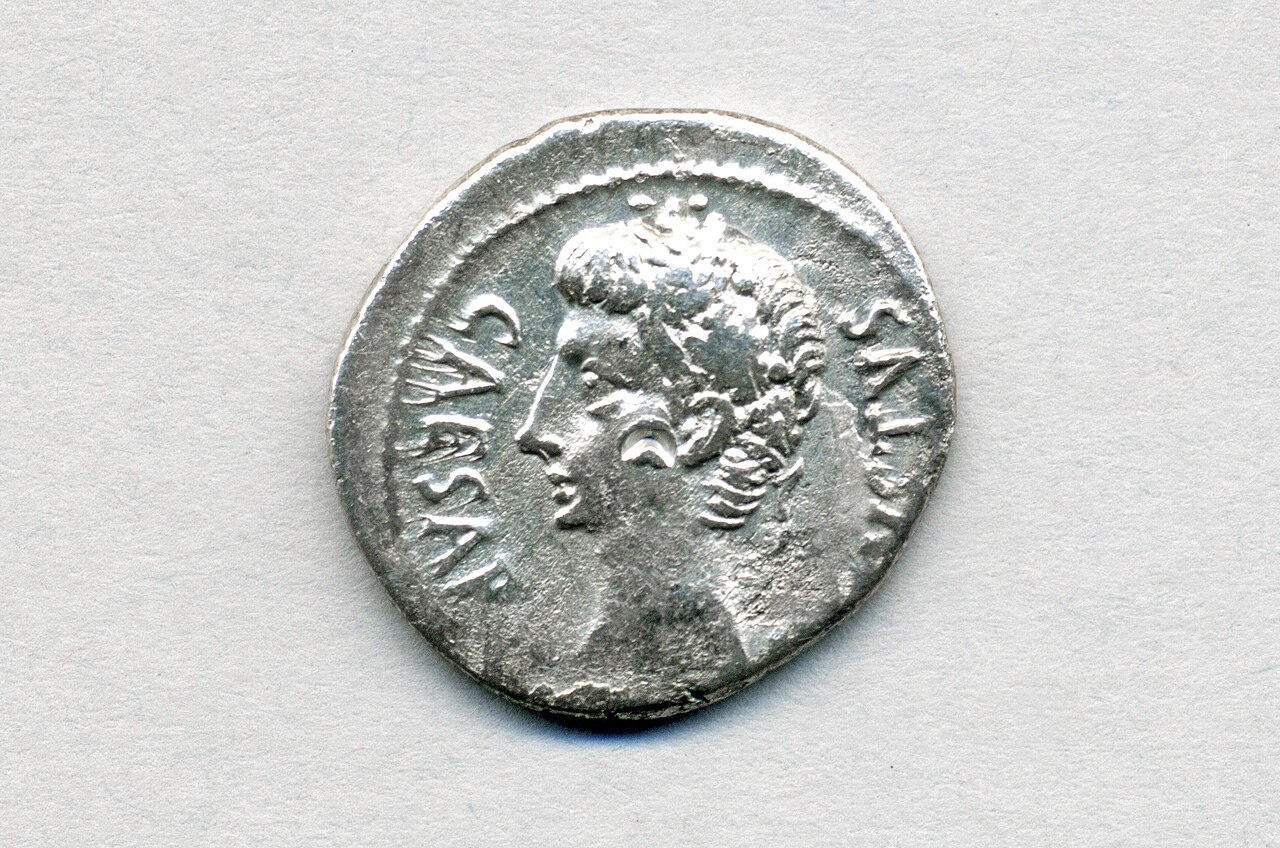
Photo of a silver Roman denarius coin on a light gray background. It shows a profile portrait of a laureled or bare-headed male figure facing left, with inscribed letters CAESAR around the left edge and AUG around the right.Document

Primary source

Roman Denarius with the Head of Caesar Augustus

Caesaraugusta Mint · 19-18 BCE

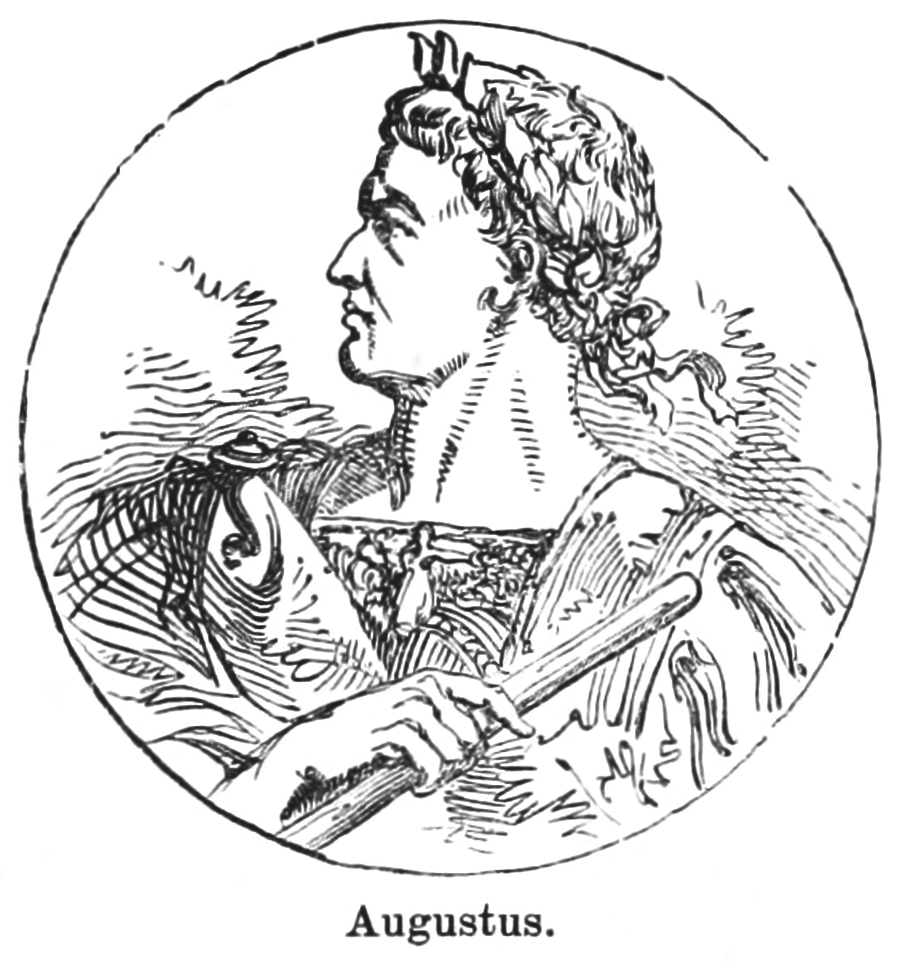
Engraved line drawing of a man in right-facing profile, with curly hair and a laurel wreath, holding a staff, inside a circular frame. The caption below reads 'Augustus.'Painting

Secondary source

Augustus, from Church's 1892 Book

1892

Want the full shelf? Chat with Augustus in the app and open the Sources panel — every quote links back to the original.

Use Augustus in class

1 collection

A ready-made collection from the Humy team that features Augustus. Preview it, then try it free.

Trusted by educators worldwide

Conversations
375,000+
Real exchanges between students and historical figures
Messages exchanged
4,142,000+
Across every figure, classroom and language
Historical figures
100,000+
Each informed by a curated biography and selected sources
Languages supported
50+
From English and Spanish to Arabic and Korean

Paying customers

Used by 98 schools and universities

Partner school logo
Tecnológico de Monterrey logo
Hyper Island logo
Partner school logo
Chambersburg Area School District logo
Broward County Public Schools logo
Nebo School District logo
National Louis University logo
South Florida PBS logo
Punahou School logo
University of Wisconsin–River Falls logo
Partner school logo
Partner school logo
Archbishop Mitty High School logo
Kingsburg High School logo
Norwalk Public Schools logo
Partner school logo
Connections logo
Partner school logo
Moore Public Schools logo
Partner school logo
Partner school logo
Partner school logo
Partner school logo
Robbinsville Public Schools logo
Partner school logo
Partner school logo
Partner school logo
Tecnológico de Monterrey logo
Hyper Island logo
Partner school logo
Chambersburg Area School District logo
Broward County Public Schools logo
Nebo School District logo
National Louis University logo
South Florida PBS logo
Punahou School logo
University of Wisconsin–River Falls logo
Partner school logo
Partner school logo
Archbishop Mitty High School logo
Kingsburg High School logo
Norwalk Public Schools logo
Partner school logo
Connections logo
Partner school logo
Moore Public Schools logo
Partner school logo
Partner school logo
Partner school logo
Partner school logo
Robbinsville Public Schools logo
Partner school logo
Partner school logo

What educators are saying

“We enjoyed the program last year and used it frequently.”
“My students say it’s a welcome change of pace. I’m not a fan of the “sage on the stage” model, so I try to incorporate research-oriented and self-paced activities. With Humy, students have to take charge of their learning. They’ve become more adept at critical thinking, forming better questions, and improving their reading comprehension. The interview feature has been my go-to tool. I create assignments where students must ask historical figures a set number of questions, then summarize the responses to ensure they’re truly absorbing the material. This approach lets them actively explore the past rather than passively consuming information.”
“Humy has helped me bring historical figures, sometimes long past, to life. When my students interact with these figures in real-time, it eliminates some of the perceived “ancient” characteristics of my curriculum. This has shifted my students’ thinking away from viewing history as abstract or irrelevant. Real-time interactions make historical figures relatable, even allowing students to ask off-topic questions that help put historical lives in a more relevant context for 13-year-olds. The feature I use the most is the interview feature. After teaching a topic, most recently Gandhi and Joan of Arc, I have the students ask pointed, focused questions. We practice good conversation techniques beforehand, teaching them to listen (or read) carefully and formulate thoughtful follow-up questions rather than just interrogating. It helps students practice effective conversation skills.”

FAQ

Frequently asked questions

Who is Augustus?
First Roman emperor. Also known as Octavian. On Humy.ai you can chat with an AI version of Augustus that draws on a short biography and 75 historical sources during the conversation — by text or voice, in 42 languages.
Is Augustus AI free?
Augustus is part of Humy's full library of more than 100,000 figures, which comes with a paid plan. A free account (no credit card) includes 20 messages a month with the free library's figures, so you can try how the conversations work first.
What sources does the Augustus AI use?
It draws on a short biography and 75 historical sources (artifacts, paintings and books), including “Res Gestae Divi Augusti”, “Emperor Augustus with Globe” and “Relief Head of the Young Augustus”. Each source has its own page on Humy.ai.
How historically accurate is the AI version of Augustus?
Each figure uses a short biography and a small set of selected historical sources as context (retrieval-augmented generation), so answers stay closer to known material than the model's general knowledge alone. It isn't a citation-grade research tool — like any LLM, the AI can get details wrong or extrapolate. Treat it as a strong starting point for inquiry and cross-reference important claims.
Can I talk to Augustus by voice?
Yes. In addition to text chat, you can call Augustus and hear their voice respond in real time — useful for auditory learners, interview practice and Socratic dialogue.
Is Humy.ai safe and compliant for schools?
Yes. Humy.ai is used by more than 100 schools, universities and organisations. The platform is FERPA- and GDPR-aligned, supports SSO, and offers an IT-approval pack tailored for school procurement teams.

Ready when you are

Start chatting with Augustus now.

20 messages free · No credit card · Available in 50+ languages.