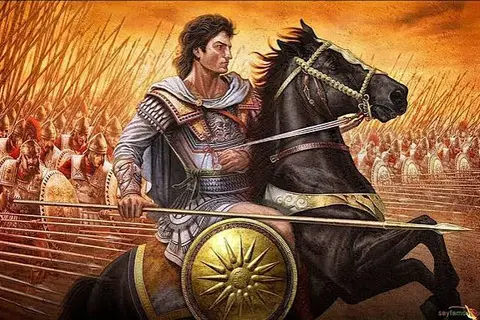

Portrait of Alexander the Great

AI Historical Figure

Alexander the Great

Sensitive

Macedonian king and military conqueror who created one of the largest empires in ancient history.

Chat with Alexander the Great via text or voice — in 42 languages, drawing on a curated biography and 88 historical sources. Available 24/7.

Start chatting with Alexander the Great20 messages free · No credit card
Lived
356–323 BCE
From
Greece
Known for
Rulers & royaltyPolitics & government
Alexander the Great

Alexander the Great

Online · responds in seconds

Hello — I'm Alexander the Great. Macedonian king and military conqueror who created one of the largest empires in ancient history. What would you like to ask me?

20 messages free · No credit card · Powered by Humy.ai

Live preview · Switch between 42 languages above · Send a message to continue in the app

Multilingual

Talk to Alexander the Great in 42 languages

Ask Alexander the Great questions in any language below, and the rest of Humy's app speaks it too. Pick yours to open the chat in that language.

Also in German (Austria), German (Switzerland), English (UK), English (Australia), English (Canada).

The sources behind this AI

88 sources · 29 books · 27 paintings · 16 artifacts · 8 sculptures · 5 documents · 1 speech · 1 documentary · 1 newspaper article

Alexander the Great doesn’t improvise from thin air. The AI is grounded in 88 curated historical sources students can inspect. Open any of them to see what informs the conversation.

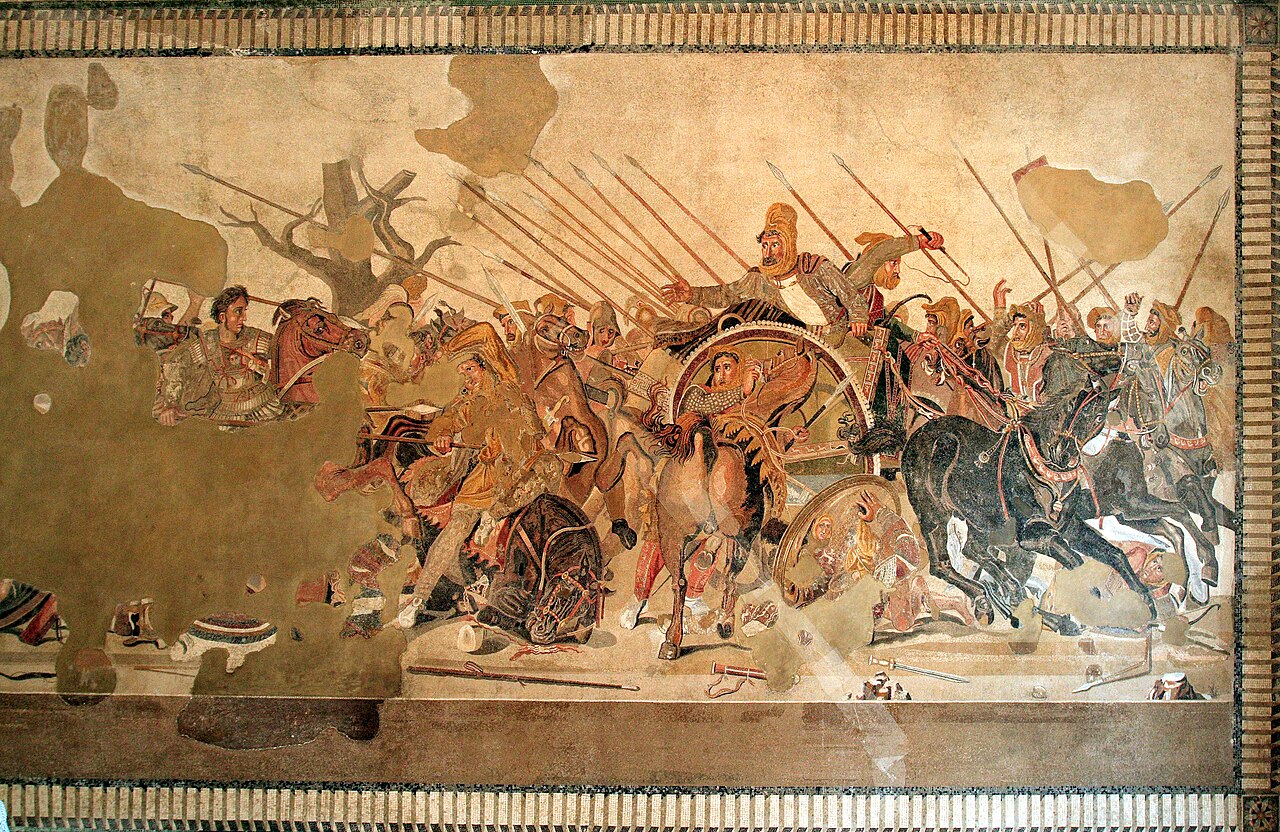
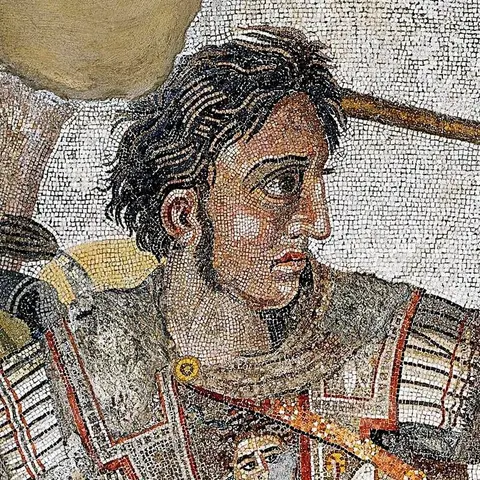
Detail of the Alexander Mosaic: a large ancient mosaic of a battle scene, with riders on horseback, spears raised, and fallen figures, in warm earth tones with a decorative border.Artifact

Secondary source

Alexander Mosaic

Philoxenus of Eretria · c. 120-100 BCE (copy of an earlier Hellenistic painting)

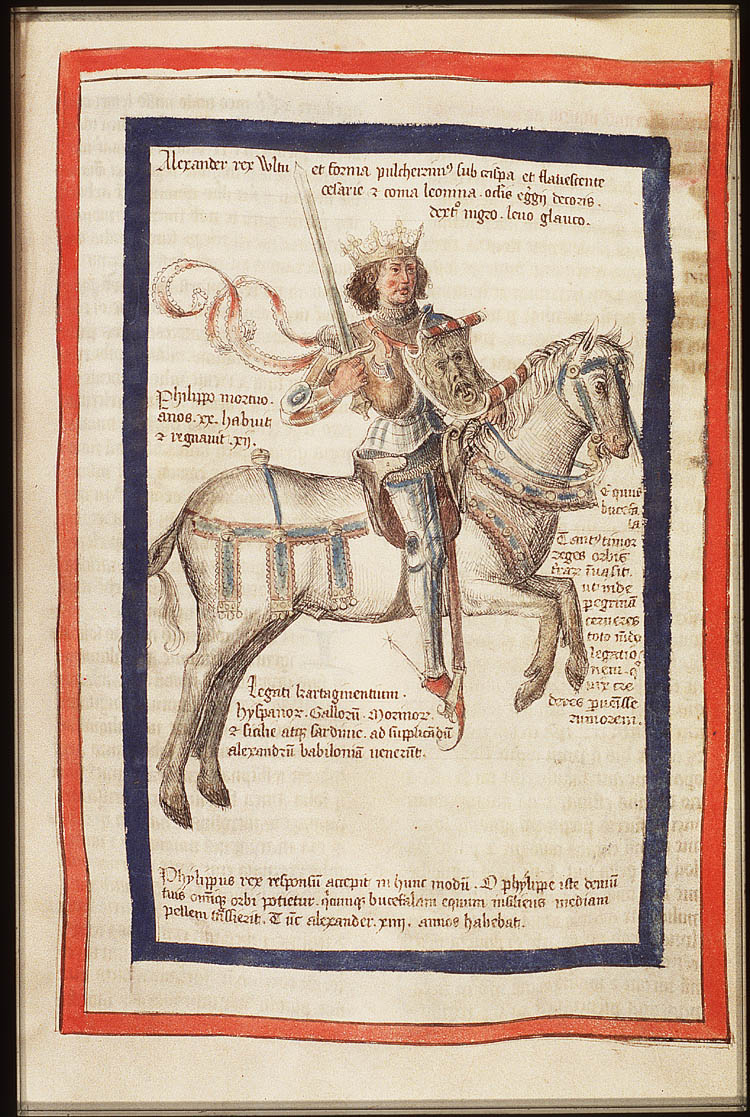
Medieval manuscript page with a pen-and-ink drawing in a blue and red border of a crowned rider on a horse, holding a raised sword, with Latin text above, beside and below the image.Painting

Secondary source

Alexander the Great riding Bucephalus

1460

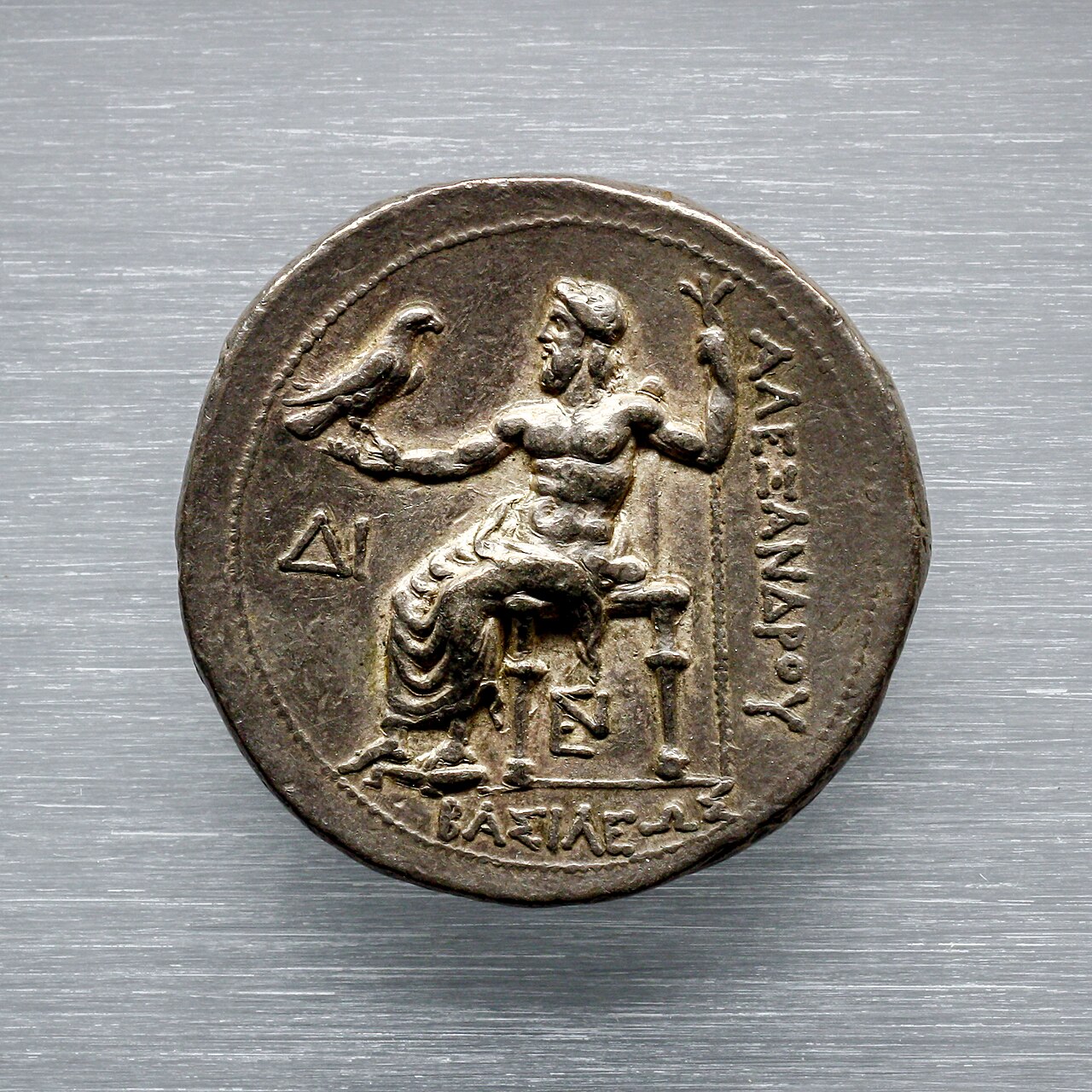
Reverse side of a silver coin showing a seated Zeus holding an eagle on his outstretched left hand and a scepter in his right, with the inscription ΑΛΕΞΑΝΔΡΟΥ on the right and ΒΑΣΙΛΕΩΣ below.Artifact

Primary source

Silver Tetradrachm of Alexander the Great

Royal mints of Alexander III · c. 336-323 BCE

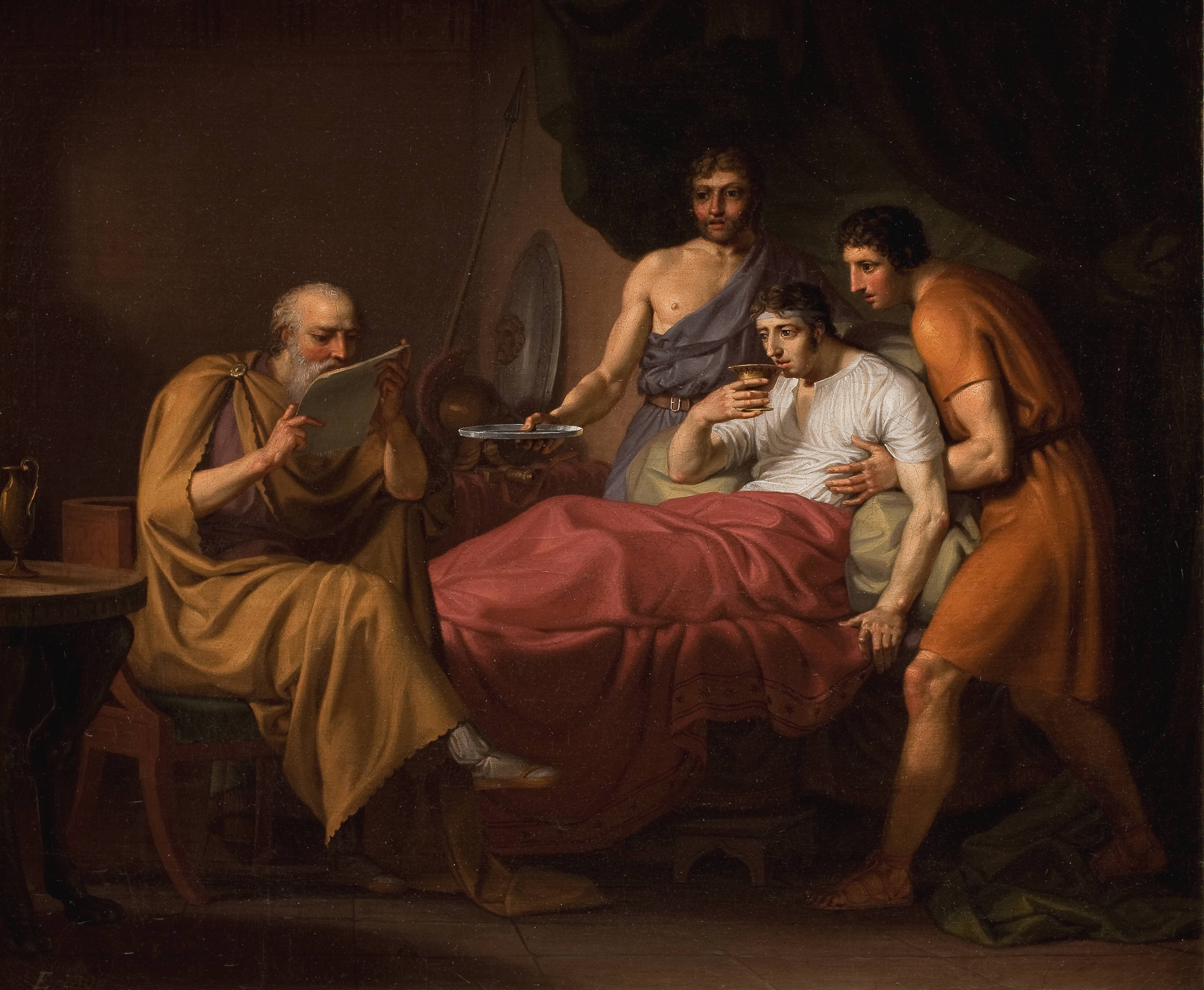
Oil painting of a reclining young man in a white tunic and red blanket, drinking from a gold cup held by an attendant. An older bearded man in a yellow cloak reads a scroll at left, and two standing men, one shirtless with a blue cloak, one in an orange tunic, look on. A spear, shield and helmet hang on the wall.Painting

Secondary source

Alexander the Great on his Sickbed

1806

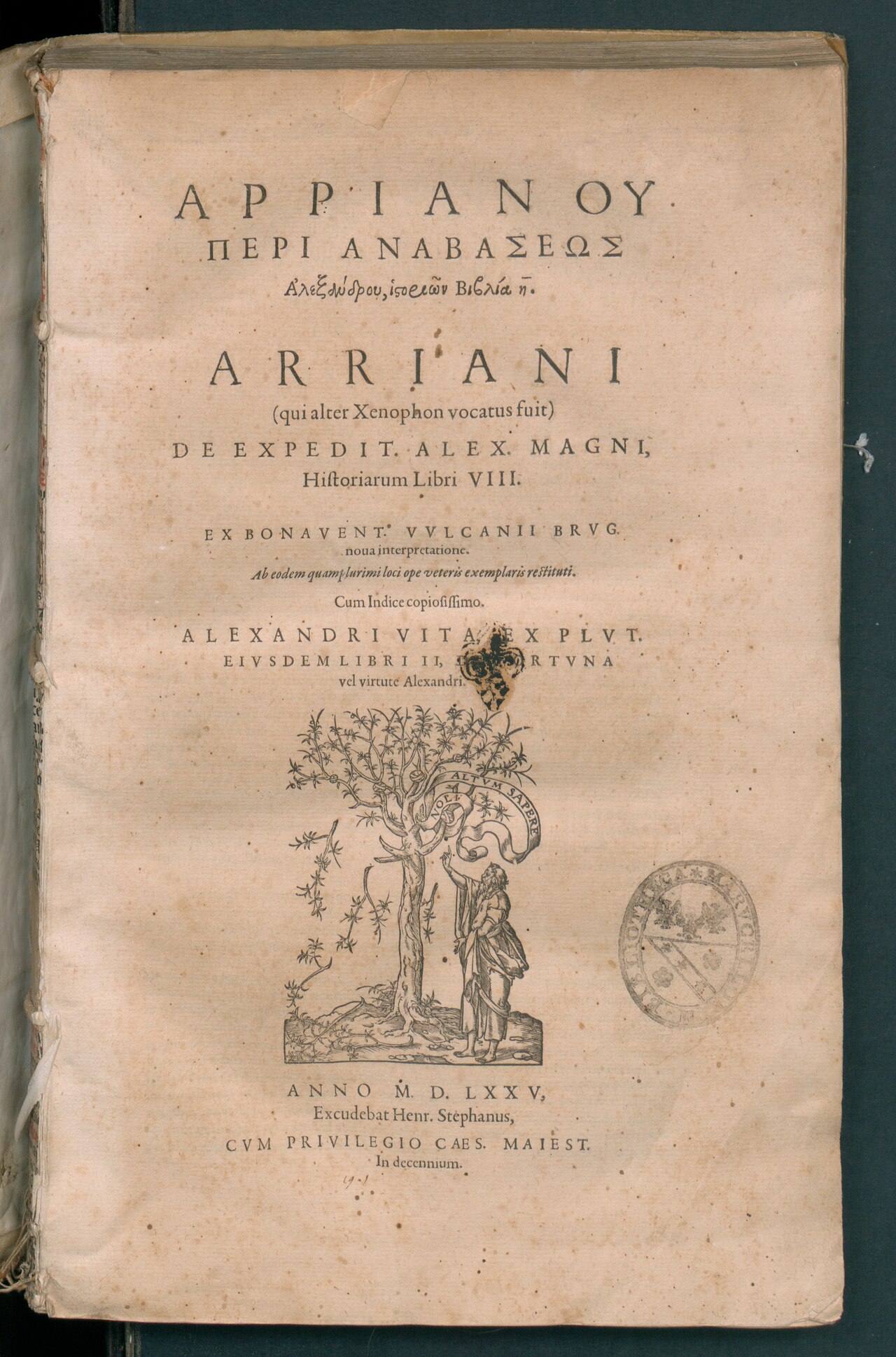
Title page of a 1575 printed edition of Arrian's Anabasis of Alexander, in Greek and Latin. Title lines read Arrianou peri anabaseos Alexandrou, with Arriani De expedit. Alex. Magni, Historiarum Libri VIII. Woodcut of a man beneath a tree with a banner reading Nolo Altum Sapere.Book

Secondary source

Anabasis of Alexander

Arrian · c. 150 AD

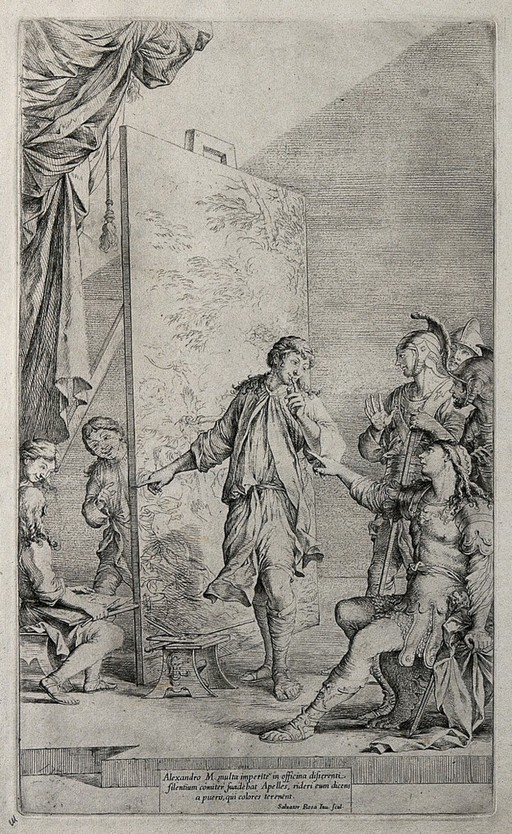
Etching of a painter's studio: a standing man with a hand to his chin studies a large canvas on an easel while a helmeted warrior seated at right gestures toward it, with other figures and a Latin inscription below.Painting

Secondary source

Alexander the Great in the Studio of Apelles

Salvator Rosa

Book

Secondary source

Life of Alexander the Great

Plutarch

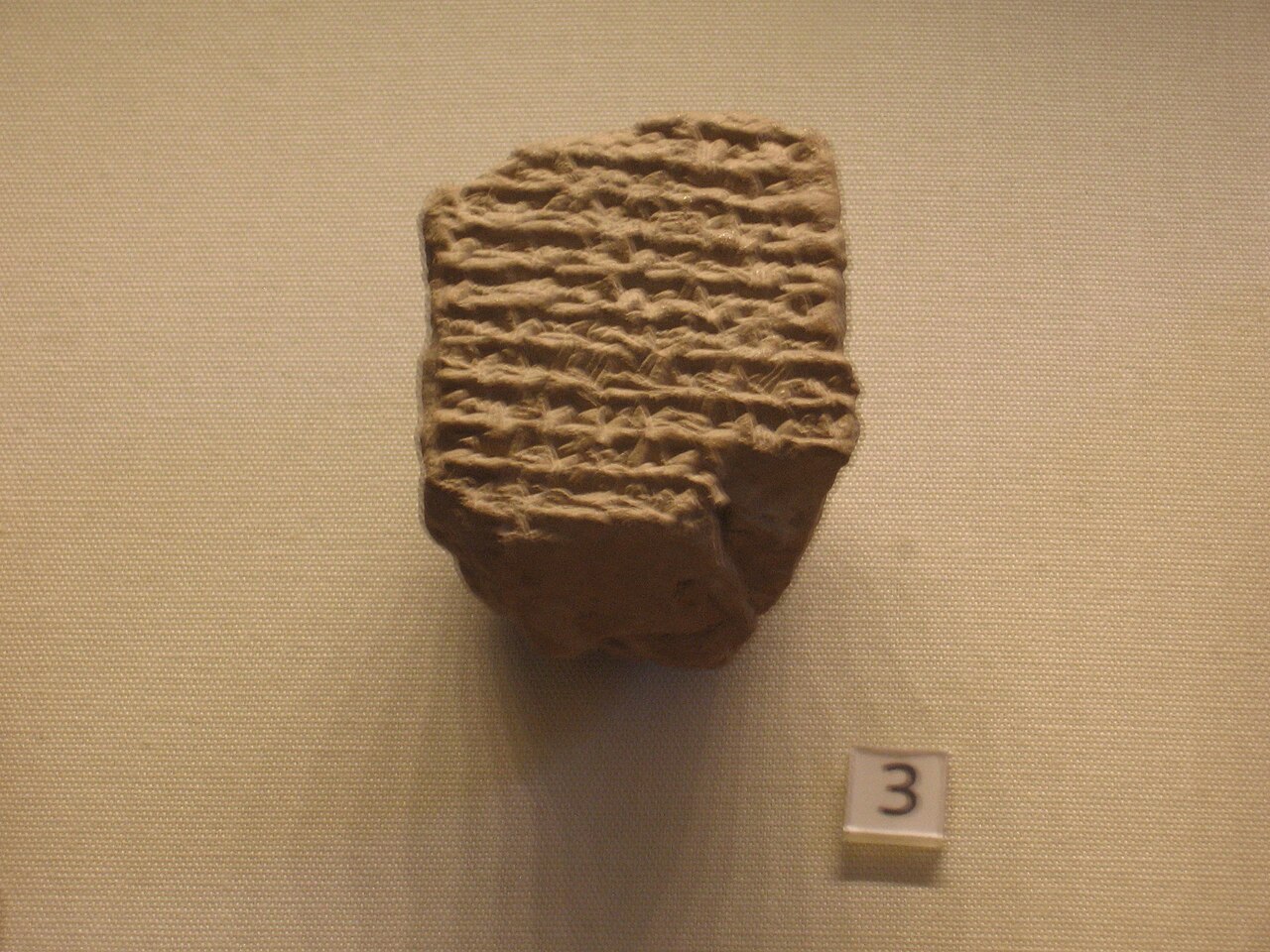
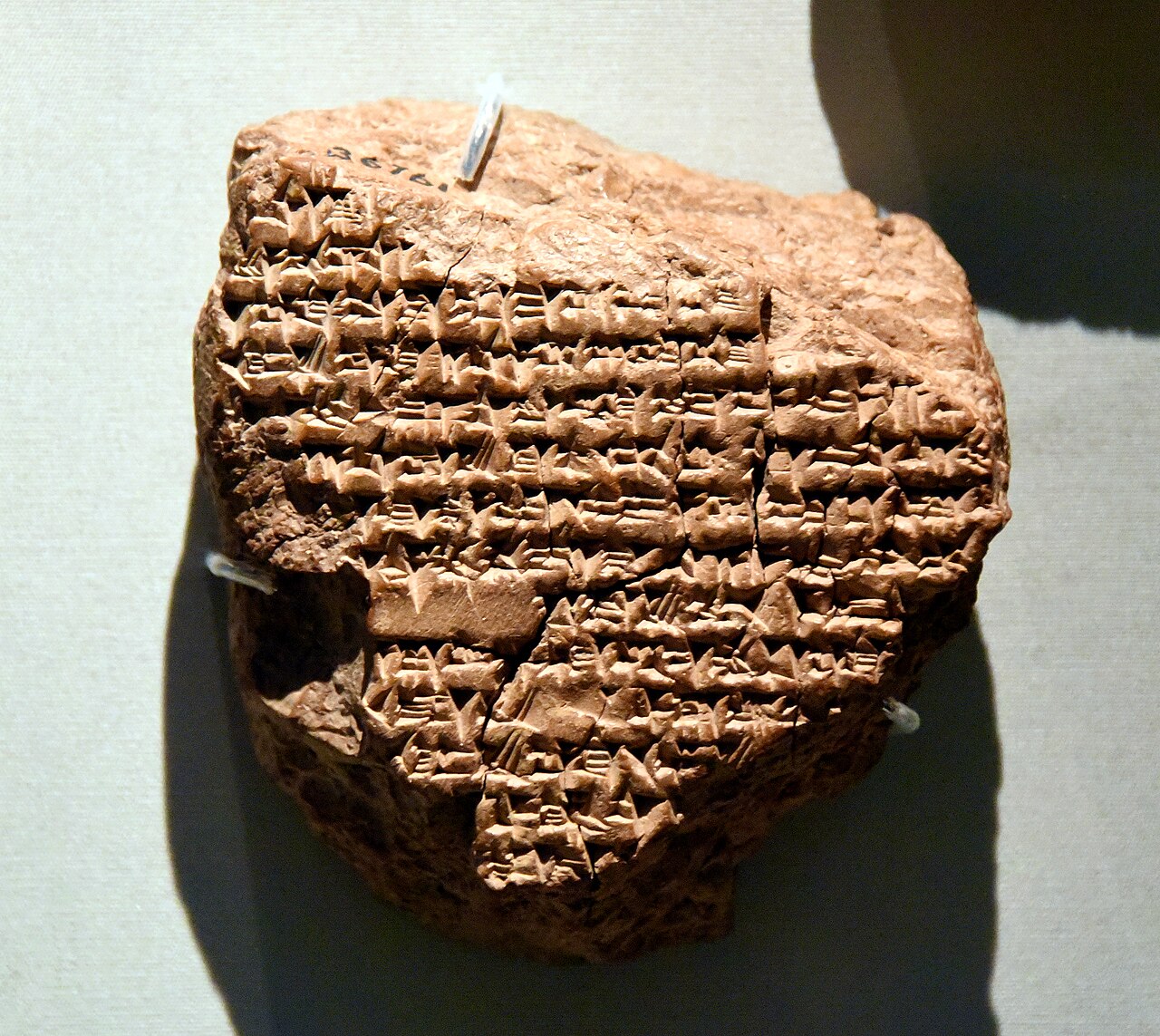
A small, irregular clay tablet covered with rows of cuneiform wedge-shaped writing, displayed on a pale beige background in a museum case. A white numbered label reading 3 sits beside it.Document

Primary source

Babylonian Astronomical Diary Recording the Death of Alexander

Babylonian astronomers · 323 BCE

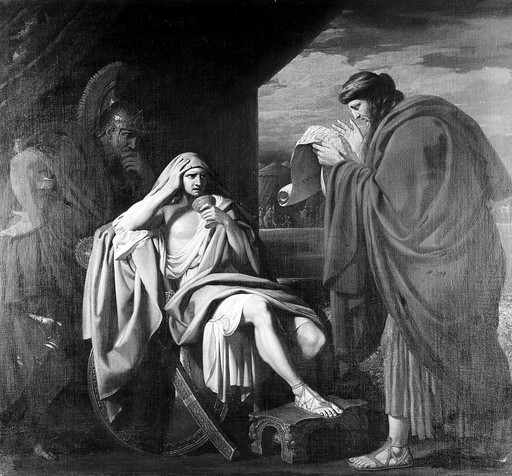
Black and white reproduction of a painting: a seated man in classical robes clutches his head and holds a cup while a standing man in a long cloak reads a letter. Helmeted soldiers stand behind the seated figure.Painting

Secondary source

Alexander's Confidence in His Physician Philip

Benjamin West

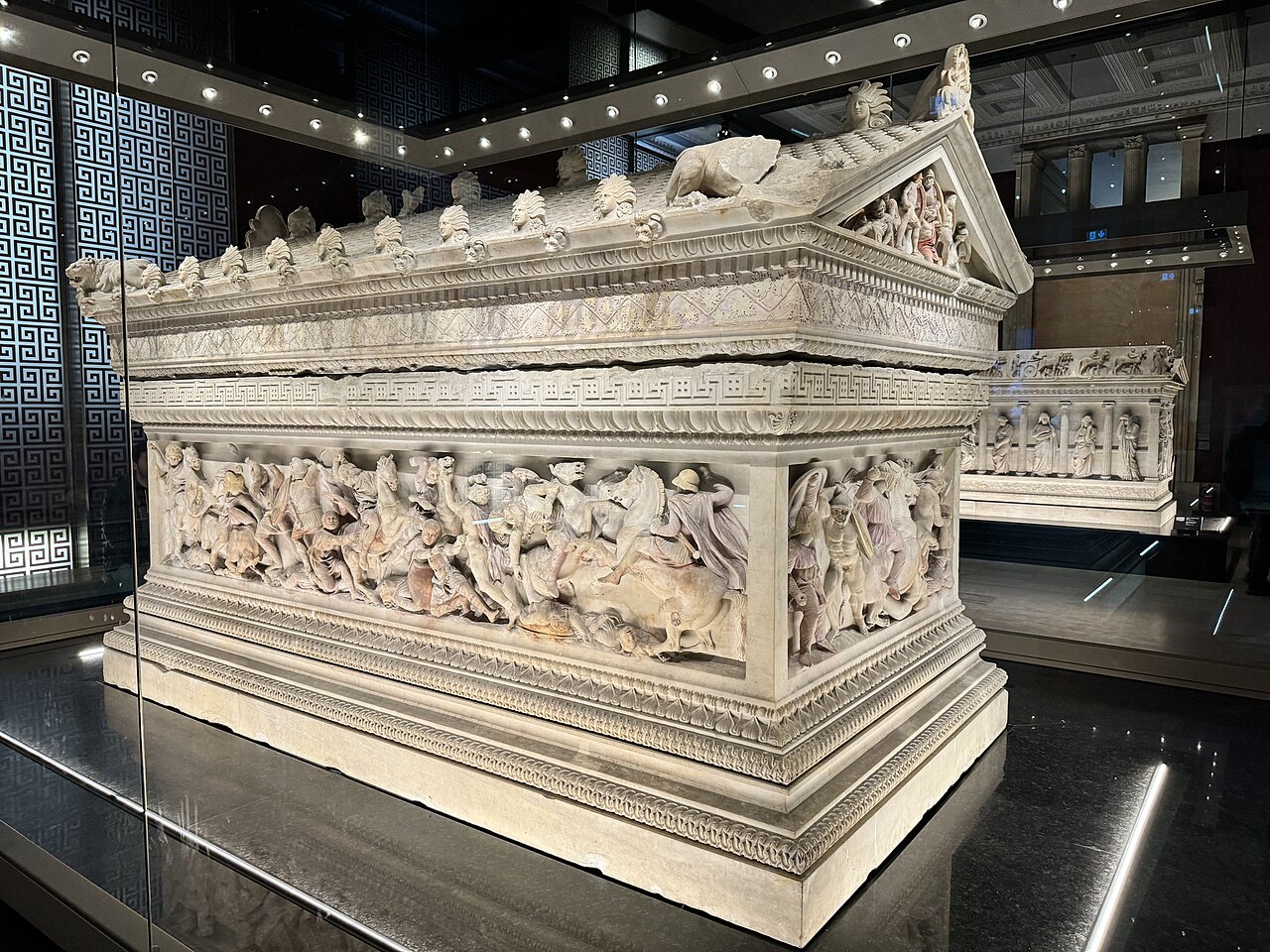
A white marble sarcophagus in a museum display case, with a pitched lid topped by lion and figure sculptures. Its side panels carry carved relief scenes of mounted riders and combat, with a smaller relief panel visible at the end.Sculpture

Primary source

Alexander Sarcophagus

late 4th century BCE

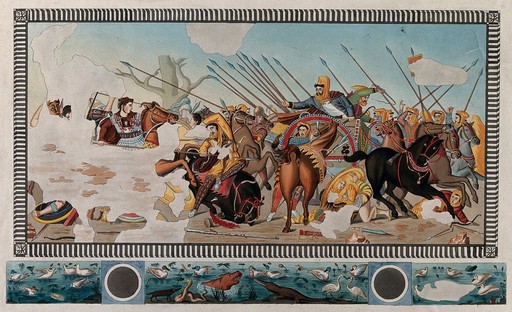
Colored etching in a decorative border showing a battle scene: mounted soldiers with spears charge over a field, a chariot with a driver and figure flees at left, and dead or fallen men lie on the ground. A mosaic-like border of shells or sea creatures runs along the bottom.Painting

Secondary source

Battle at Issus, 333 BC: Alexander Chasing Darius III

333 BC (depicted event)

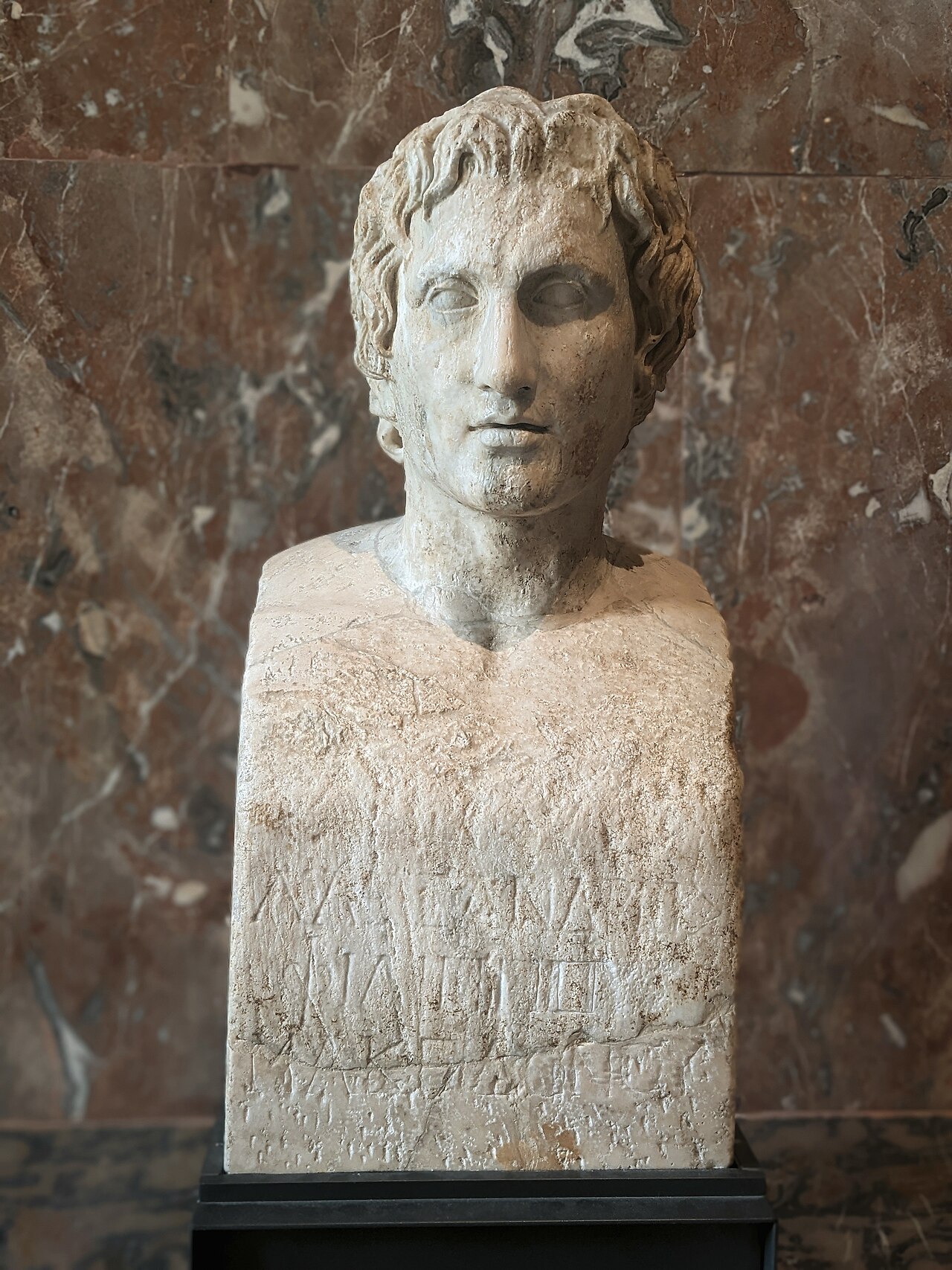
Photograph of a white marble herm bust of a young man with wavy hair and a plain face, on a dark stone base. Carved Greek inscription lines appear on the rectangular block below the bust. Reddish-brown marble wall behind.Sculpture

Secondary source

Azara Herm

c. 100 AD

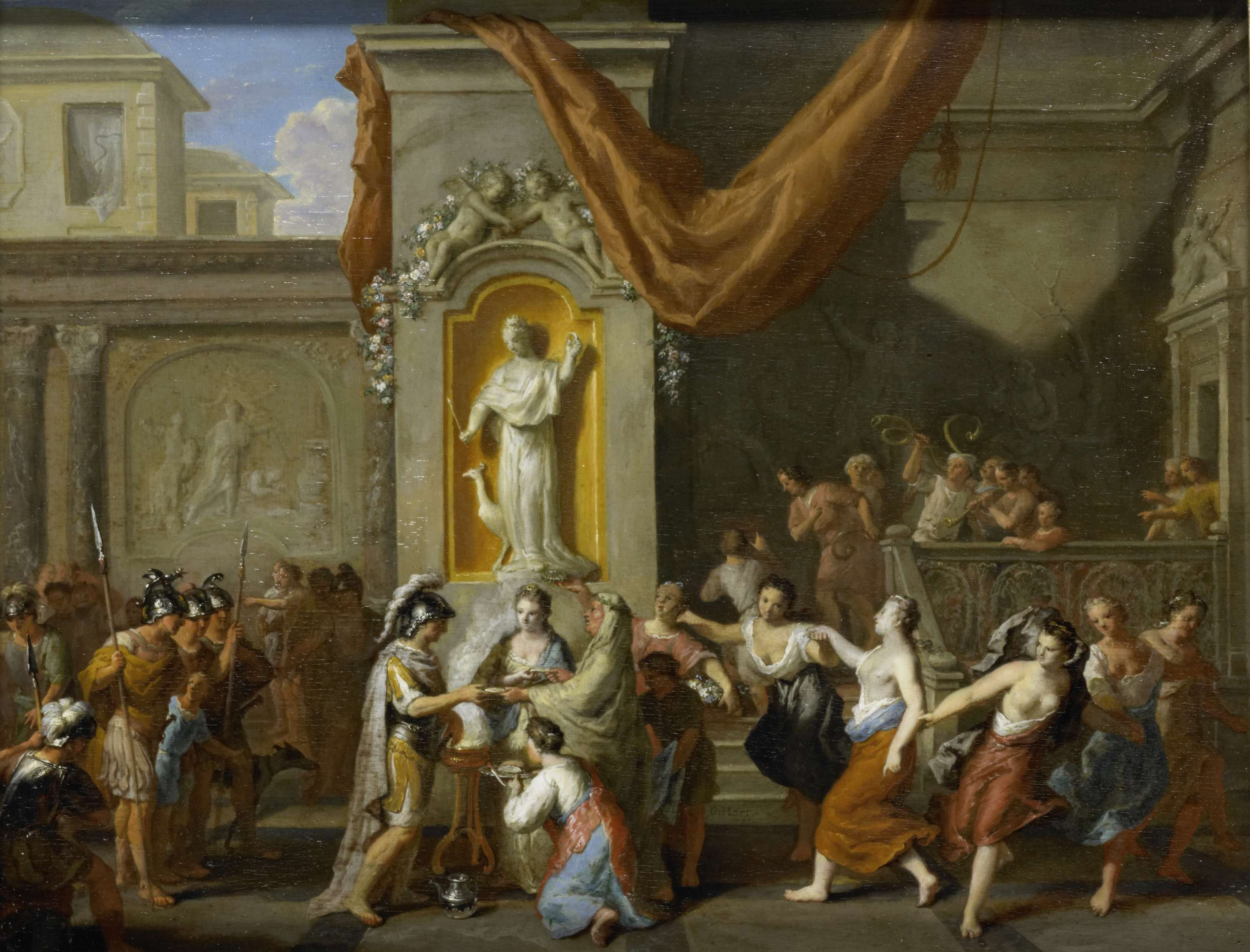
Painting of a classical scene: a helmeted soldier in gold-trimmed armor offers a bowl to a seated woman in blue and yellow robes, while an attendant kneels with a dish. Women in loose garments dance in the foreground, and armed soldiers stand at left. A white statue of a woman stands in a lit niche beneath draped red curtains, and musicians play on a balcony at right.Painting

Secondary source

The Marriage of Alexander the Great and Roxane of Bactria

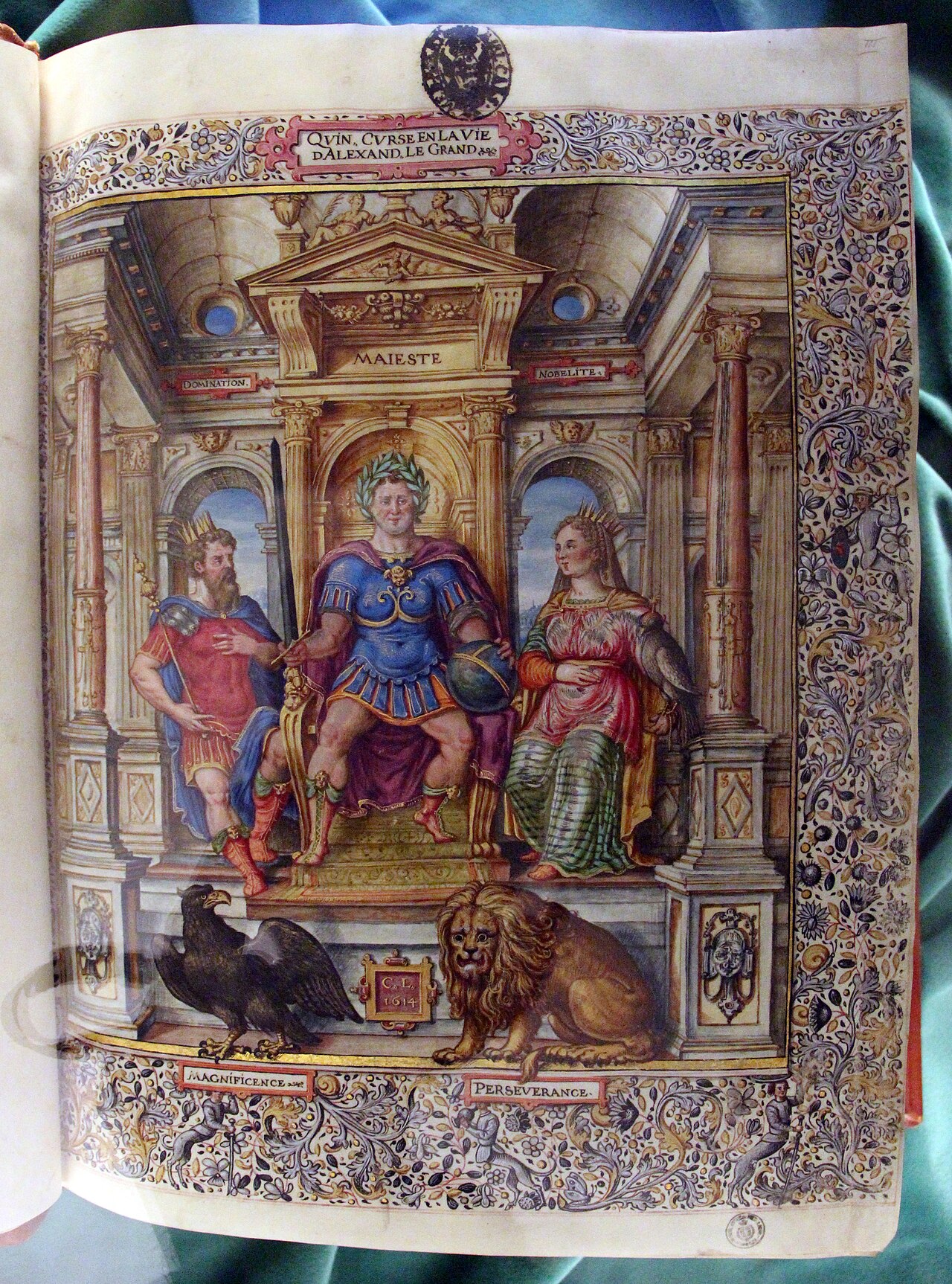
Illuminated manuscript page with a painted architectural frame. A laurel-crowned man in blue armor sits on a throne holding a globe, flanked by a crowned bearded man and a crowned woman. A lion and an eagle sit below. Title text is at top.Book

Secondary source

Histories of Alexander the Great

Quintus Curtius Rufus · 1st century AD

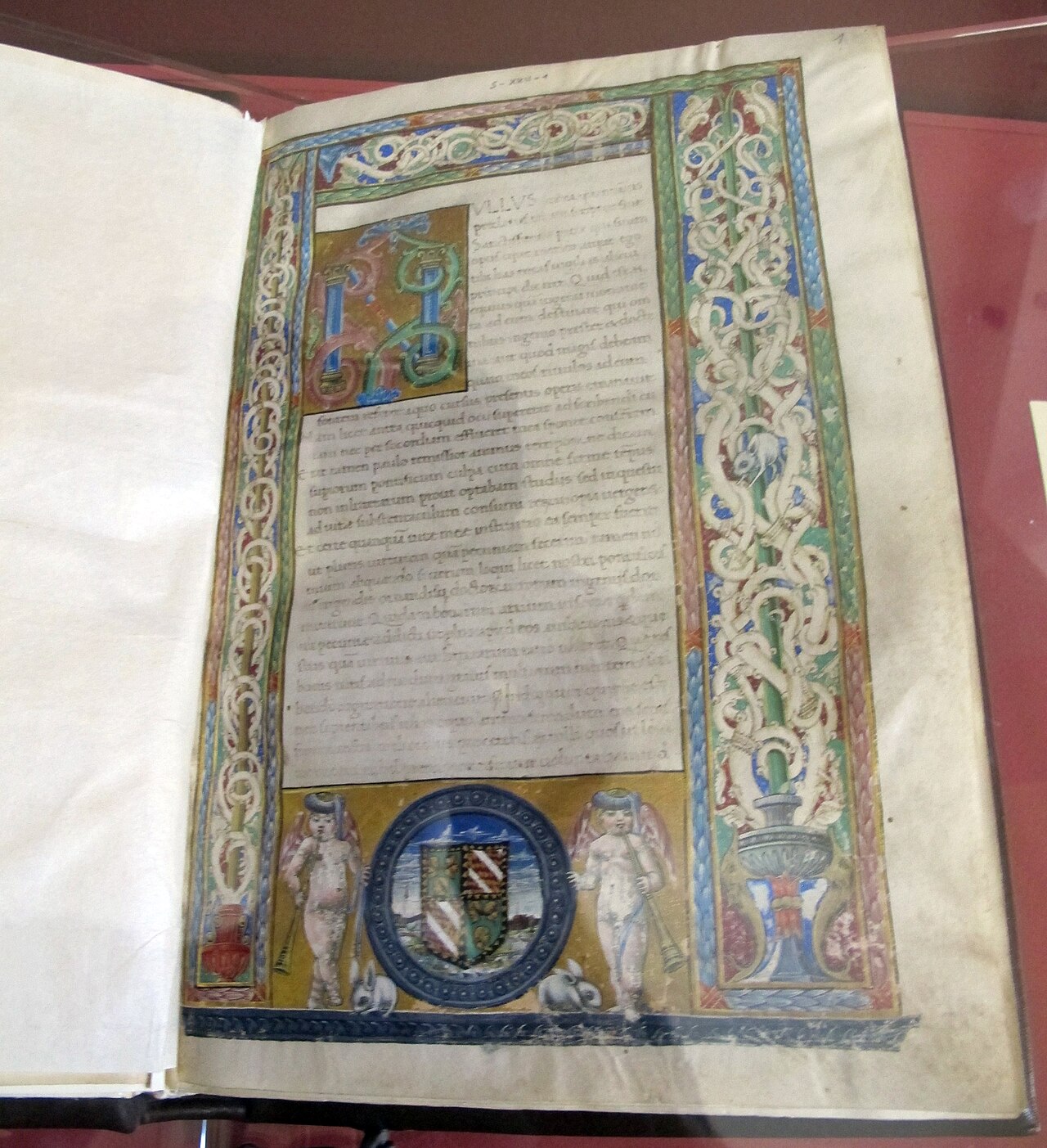
Open illuminated manuscript page on vellum in a display case, with a decorative border of foliage and interlace, a historiated initial, and a central text block in Latin script. A circular coat of arms with angels and rabbits appears at the bottom.Book

Secondary source

Bibliotheca Historica

Diodorus Siculus · 1st century BCE

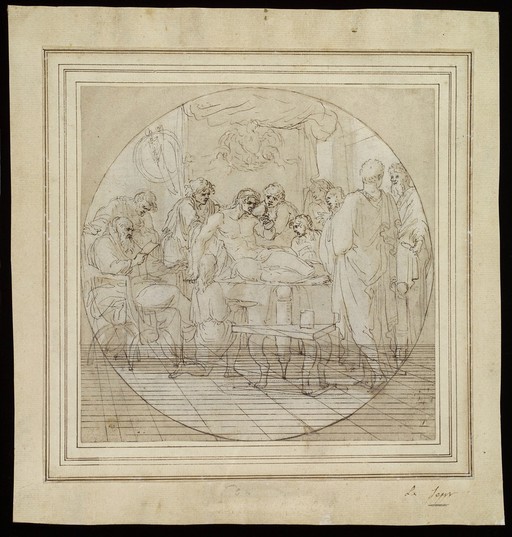
Pen and brown ink drawing on paper, framed by a double-ruled border, of a circular composition: a man reclines on a bed while figures gather around him, one in a robe standing at right, and a table with a cup sits in the foreground over a tiled floor.Painting

Secondary source

Alexander Drinks Philip's Draught

Eustache Le Sueur

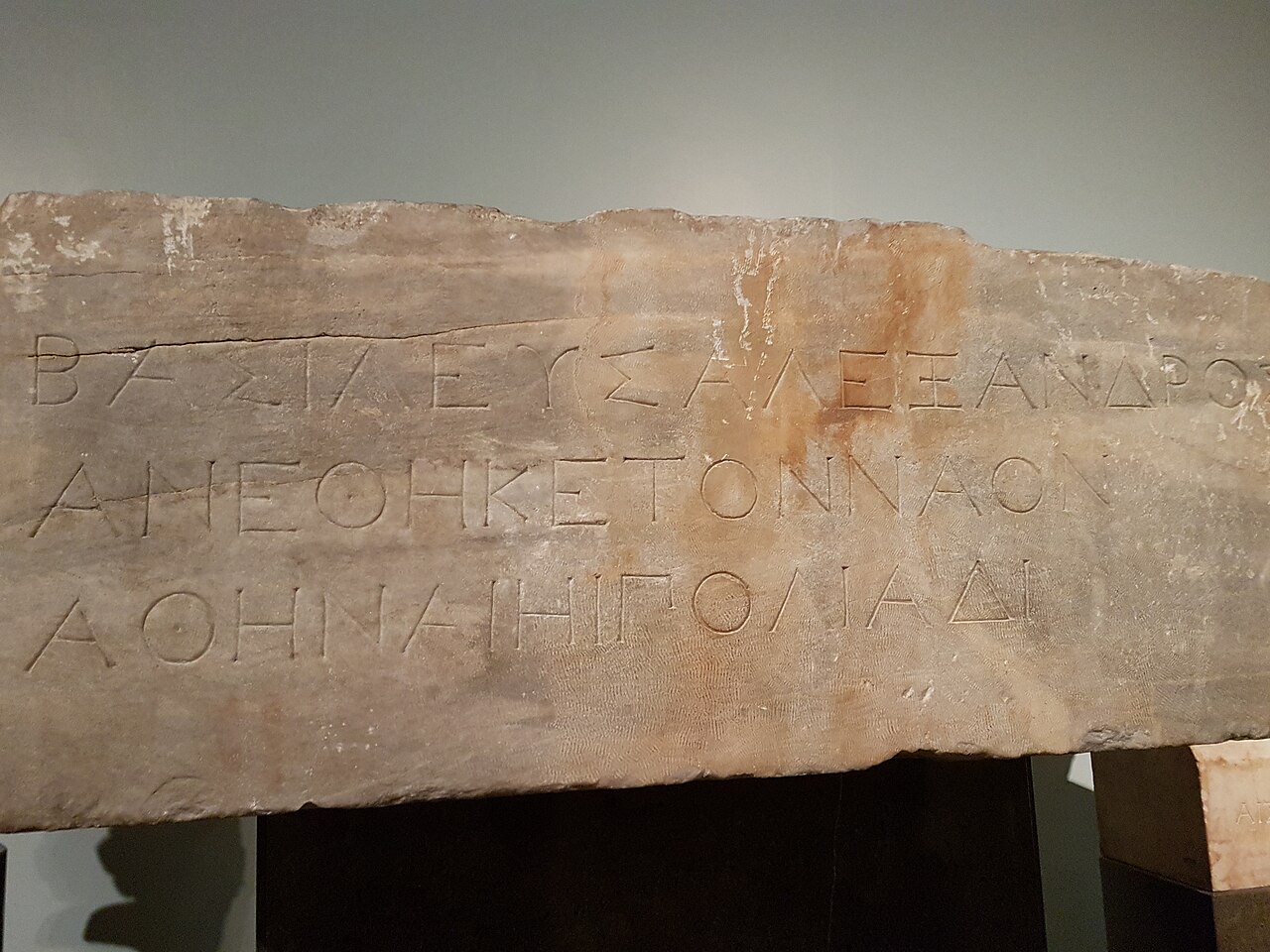
Photograph of a weathered marble block inscribed with three lines of carved Greek capital letters, lit against a grey wall in a museum. The text reads 'Basileus Alexandros' at the top line's start, followed by further inscribed letters.Document

Primary source

Priene Inscription

Alexander the Great · c. 330 BC

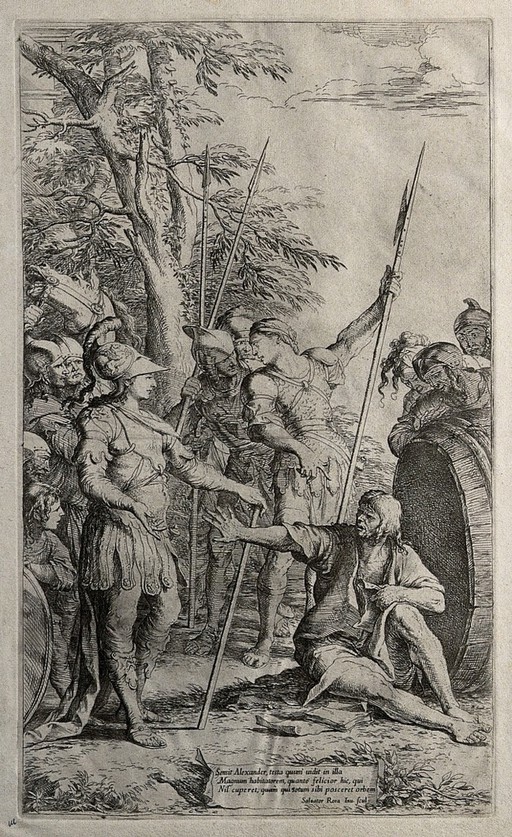
Etching of Diogenes seated by his barrel, being offered anything he wants by Alexander the Great, as Diogenes asks him to step aside so he can see the sun.Painting

Secondary source

Diogenes and Alexander the Great

Salvator Rosa

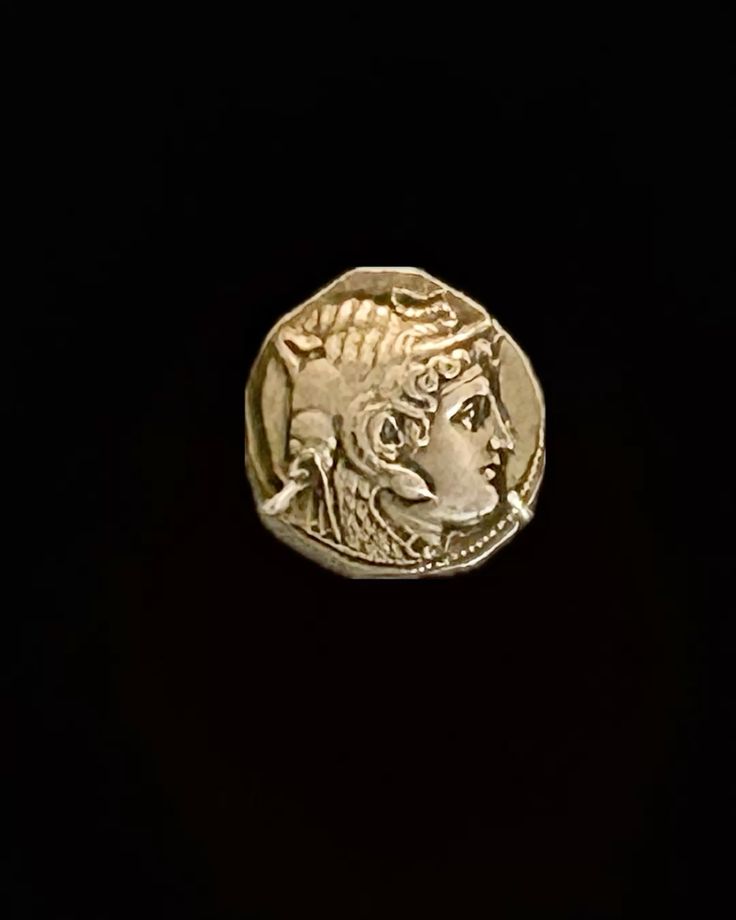
Photograph of a small gold-toned coin against a black background, showing a profile portrait of a helmeted or capped male figure facing right, with curled hair and a detailed neck and shoulder area.Artifact

Secondary source

Tetradrachm of Ptolemy I showing Alexander the Great

c. 320 BC or after

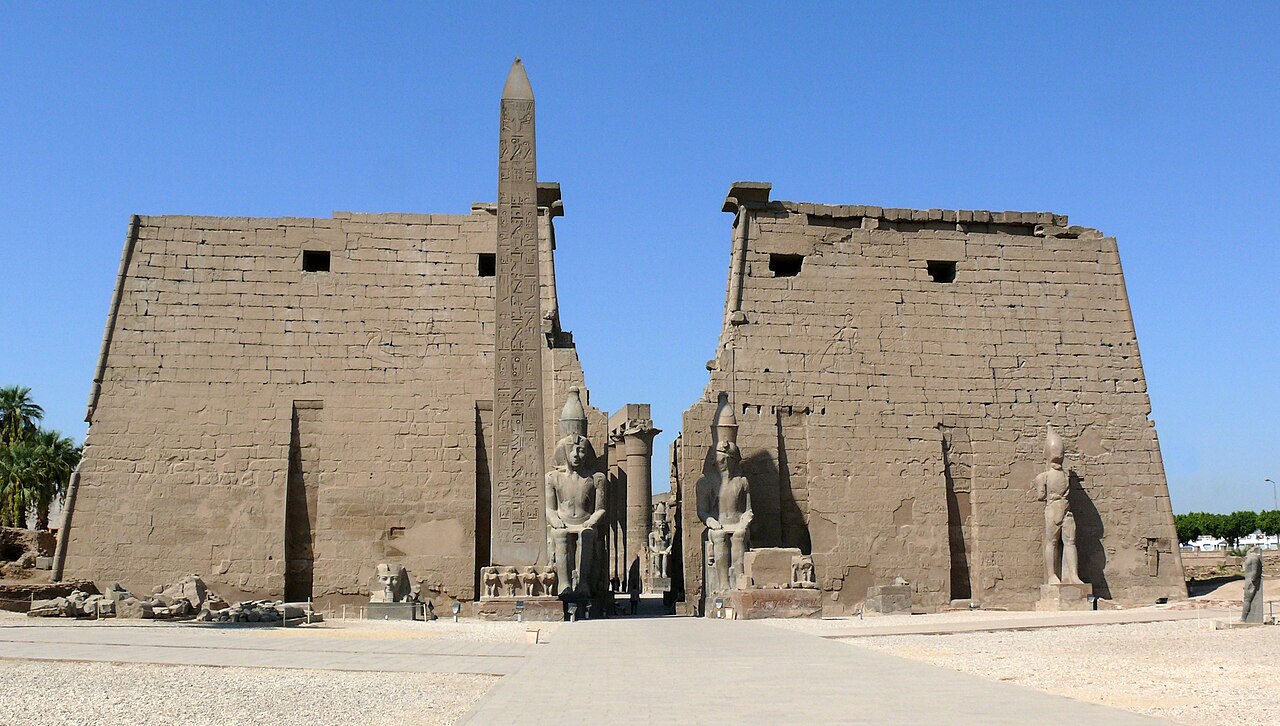
Front view of the pylon gateway of Luxor Temple under a clear blue sky: two massive sandstone towers with a tall carved obelisk on the left, two seated statues flanking the central entrance, and a standing statue on the right tower's side. Sandy ground and a paved path lead to the entrance.Artifact

Primary source

Luxor Temple

c. 1399 BCE

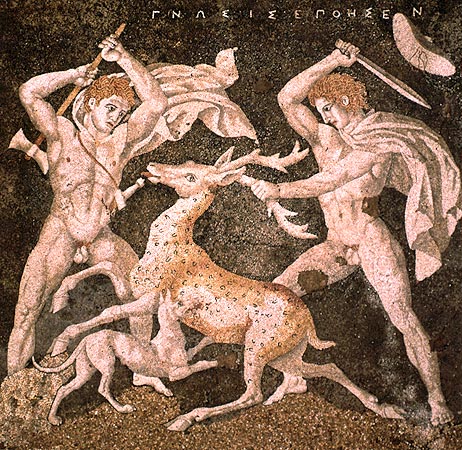
Detail of an ancient mosaic floor showing two nude male hunters with swords and a spear attacking a spotted stag and a dog. Greek inscription runs across the top, reading Gnosis made it. Mosaic tesserae in pinks, browns and tans.Artifact

Secondary source

Stag Hunt Mosaic

Gnosis · c. 300 BC

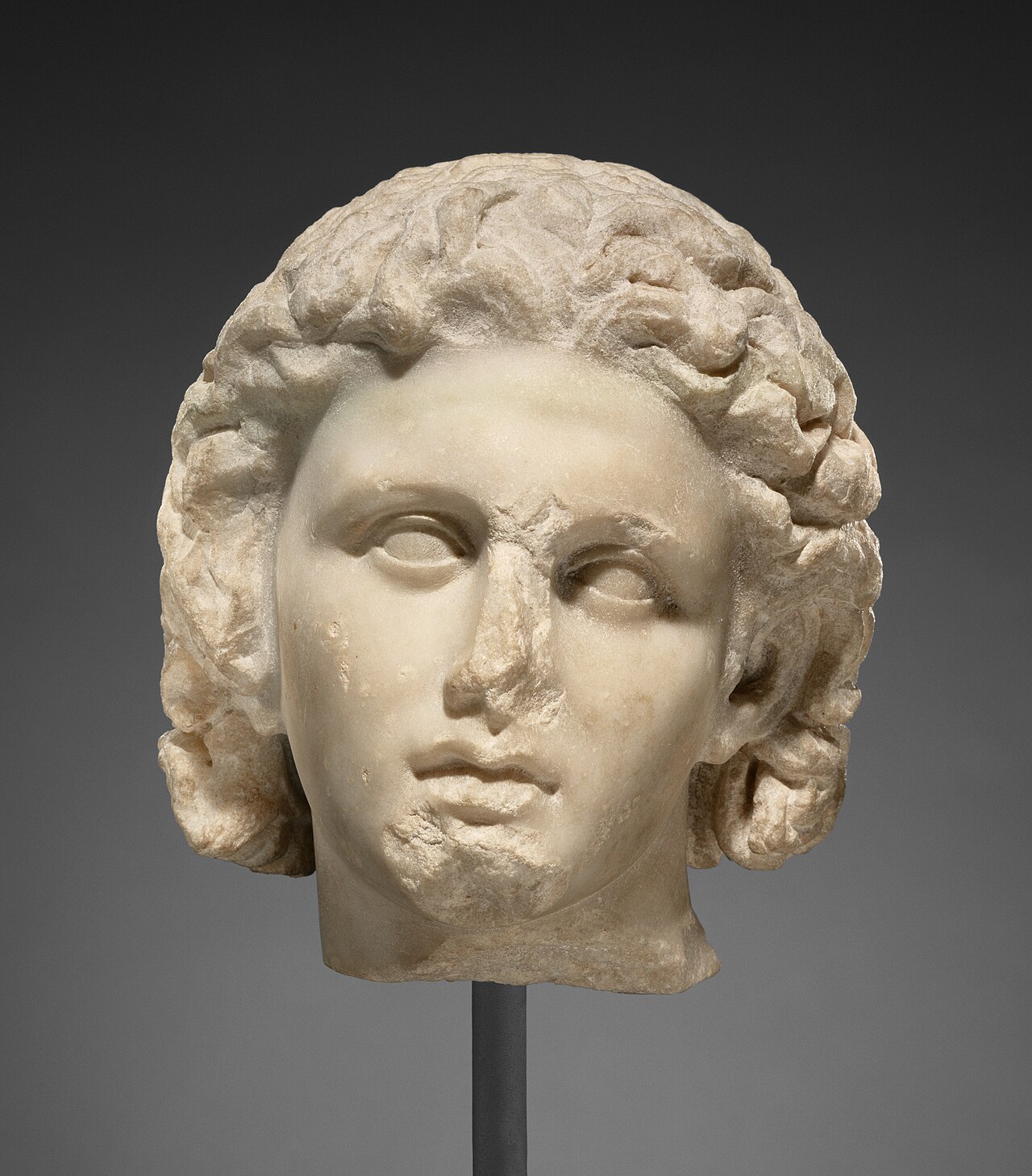
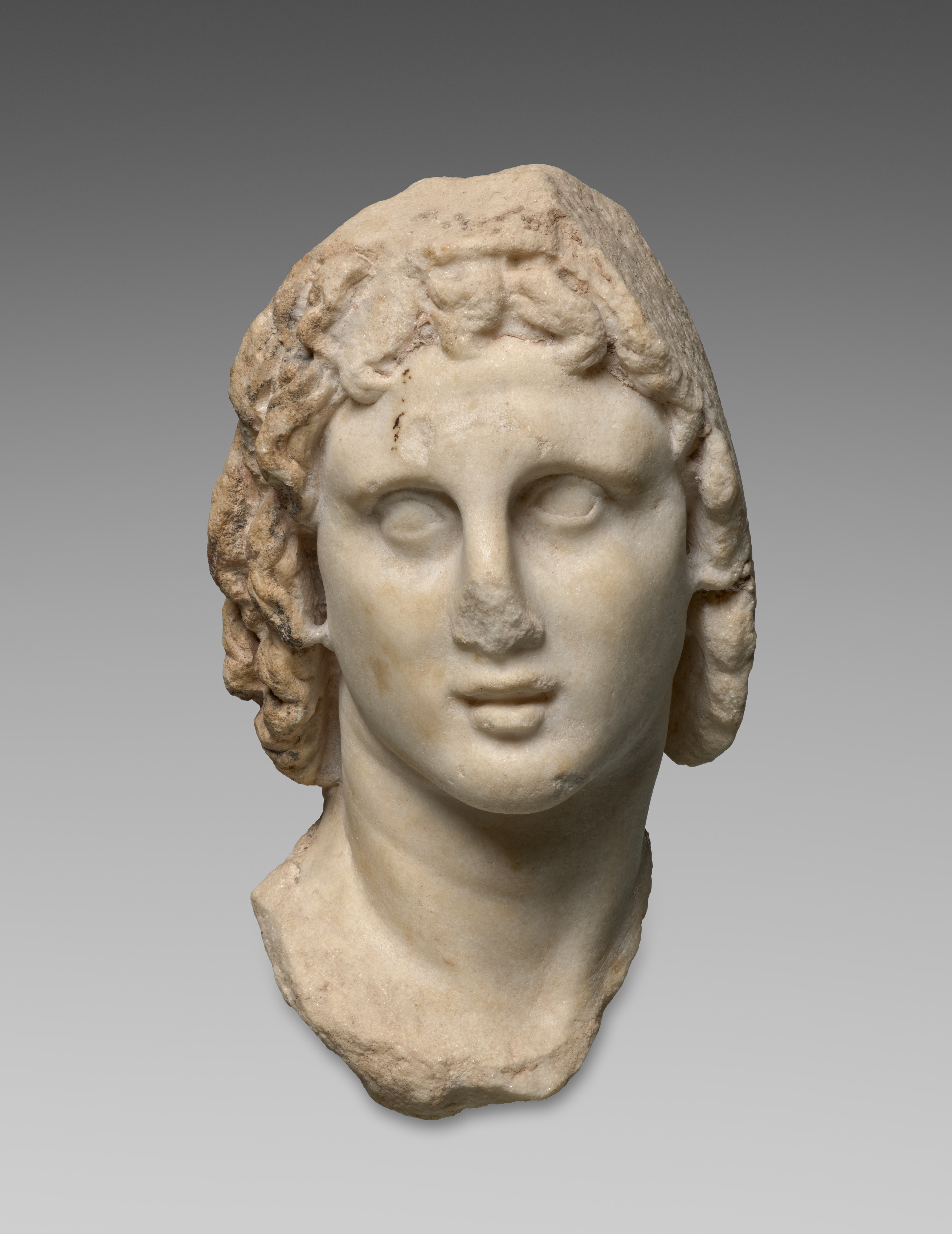
Marble head sculpture of a young man with curly, wavy hair swept back over the head, large almond-shaped eyes, a straight nose, and a small mouth, mounted on a dark metal stand against a grey background.Sculpture

Secondary source

Portrait of Alexander the Great

319 BC

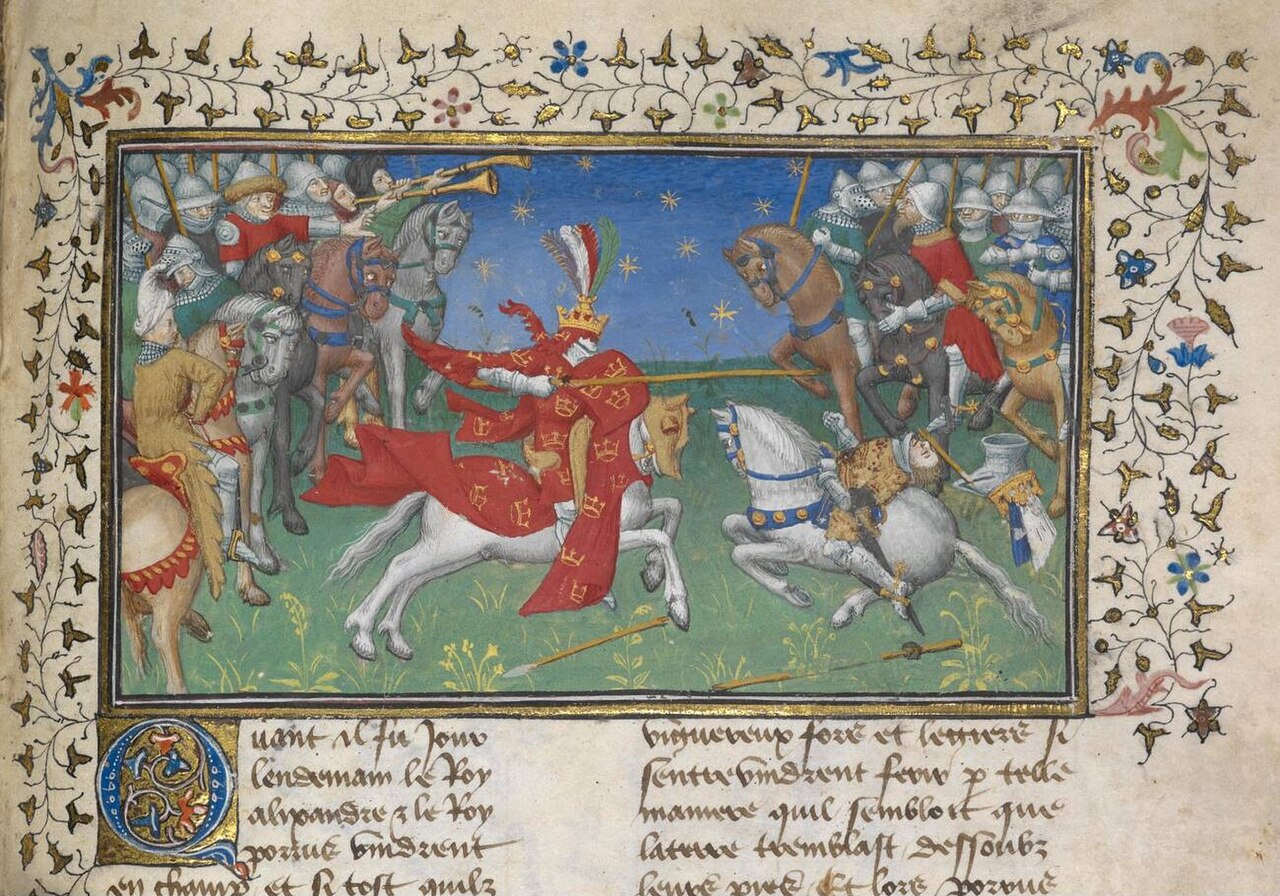
Illuminated manuscript miniature of a medieval battle on a green field under a blue sky with gold stars. In red robes and a crown, a mounted knight with a feathered helmet strikes another rider who has fallen from his white horse. Armoured soldiers with lances and a trumpeter stand behind. Decorated gold border and French text below.Book

Secondary source

Alexander Romance

Pseudo-Callisthenes · before 338 AD (manuscript shown: early 15th century)

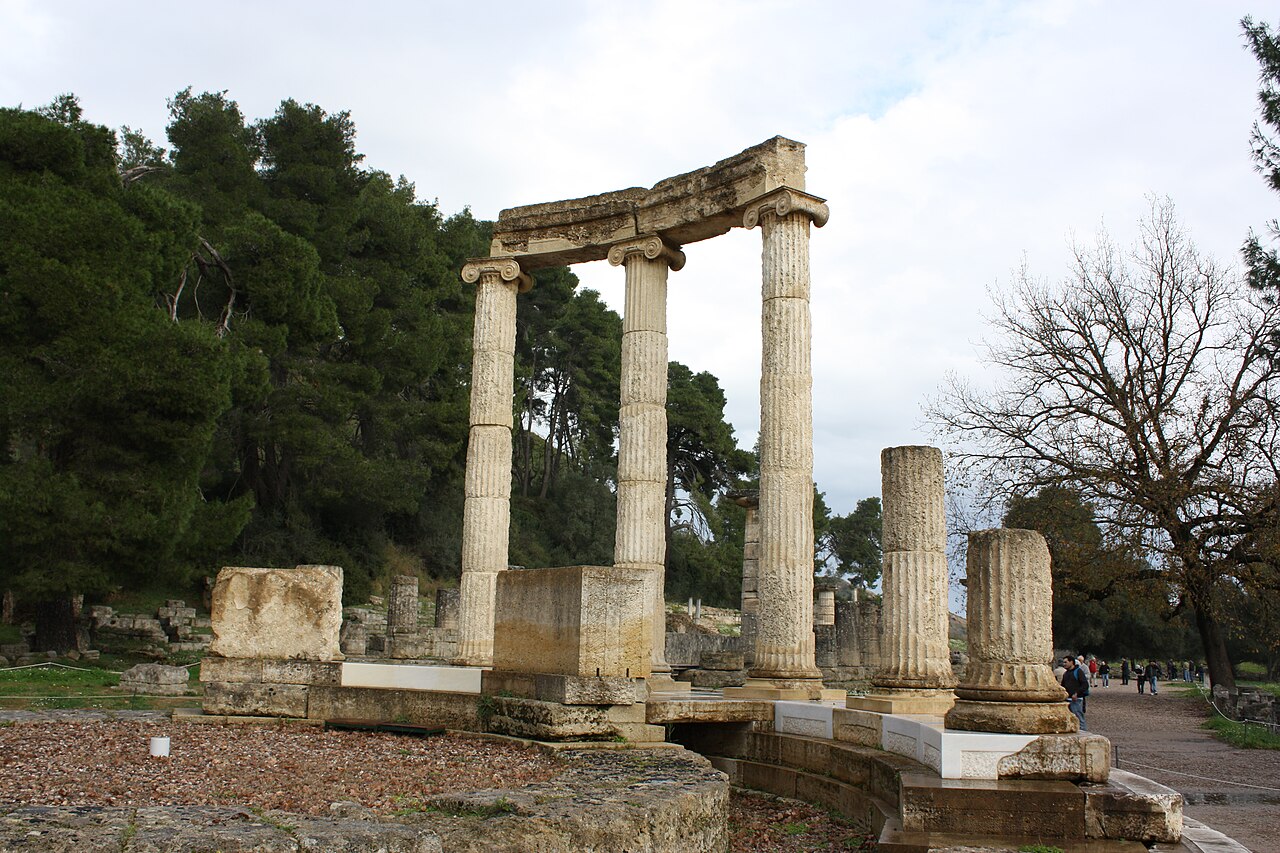
Ruins of the Philippeion at Olympia: a partly reconstructed Ionic colonnade of tall fluted marble columns with a surviving architrave, set on a stone base, with pine trees, bare trees, and visitors on a path behind.Artifact

Primary source

Philippeion

Leochares · begun 338/337 BC, completed under Alexander

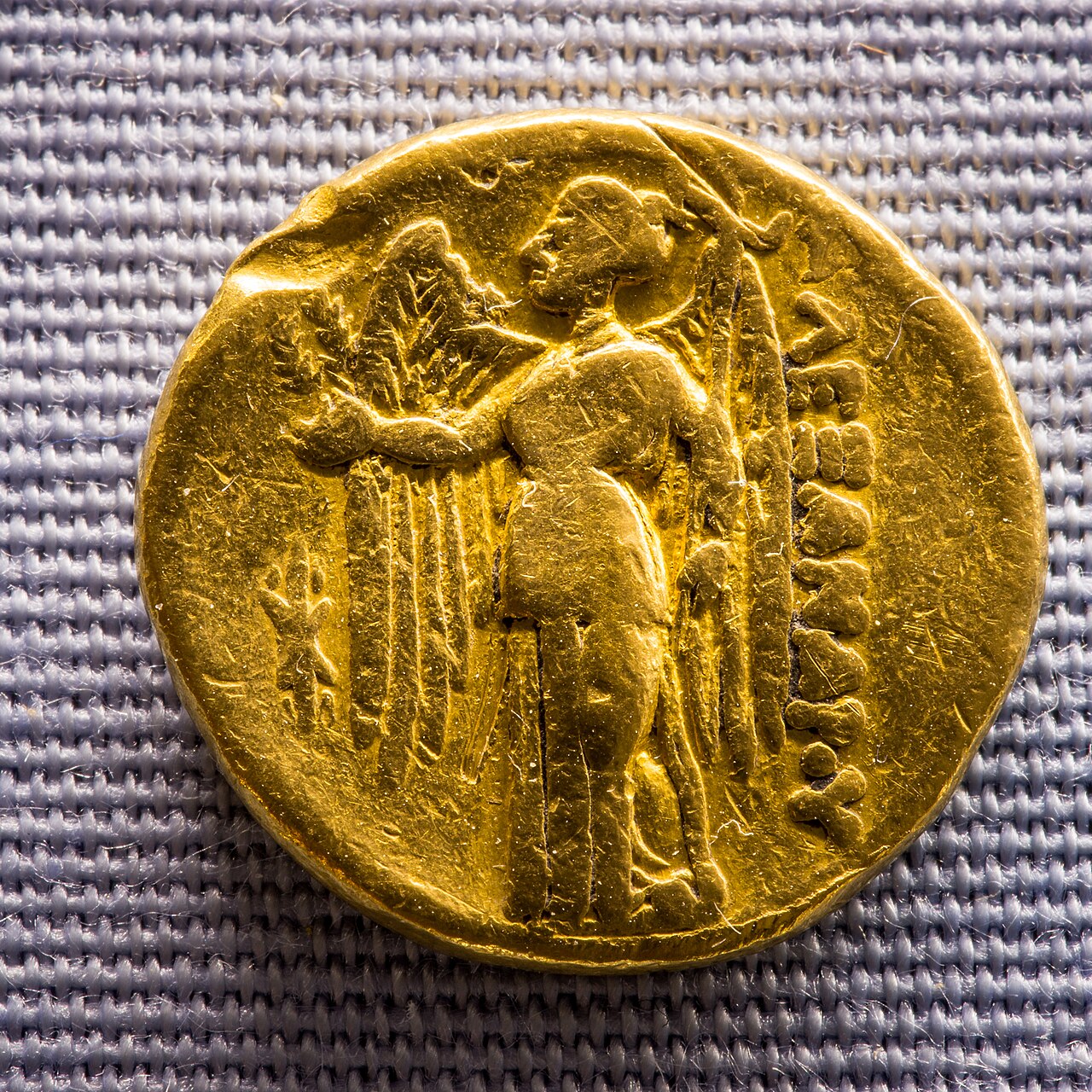
Close-up photo of a gold coin resting on a woven grey fabric. The coin shows a standing winged female figure holding a wreath and a stylis, with the inscription ΑΛΕΞΑΝΔΡΟΣ running down the right side and a monogram on the left.Artifact

Primary source

Gold Stater of Alexander the Great (Athena / Nike Type)

c. 330–320 BC

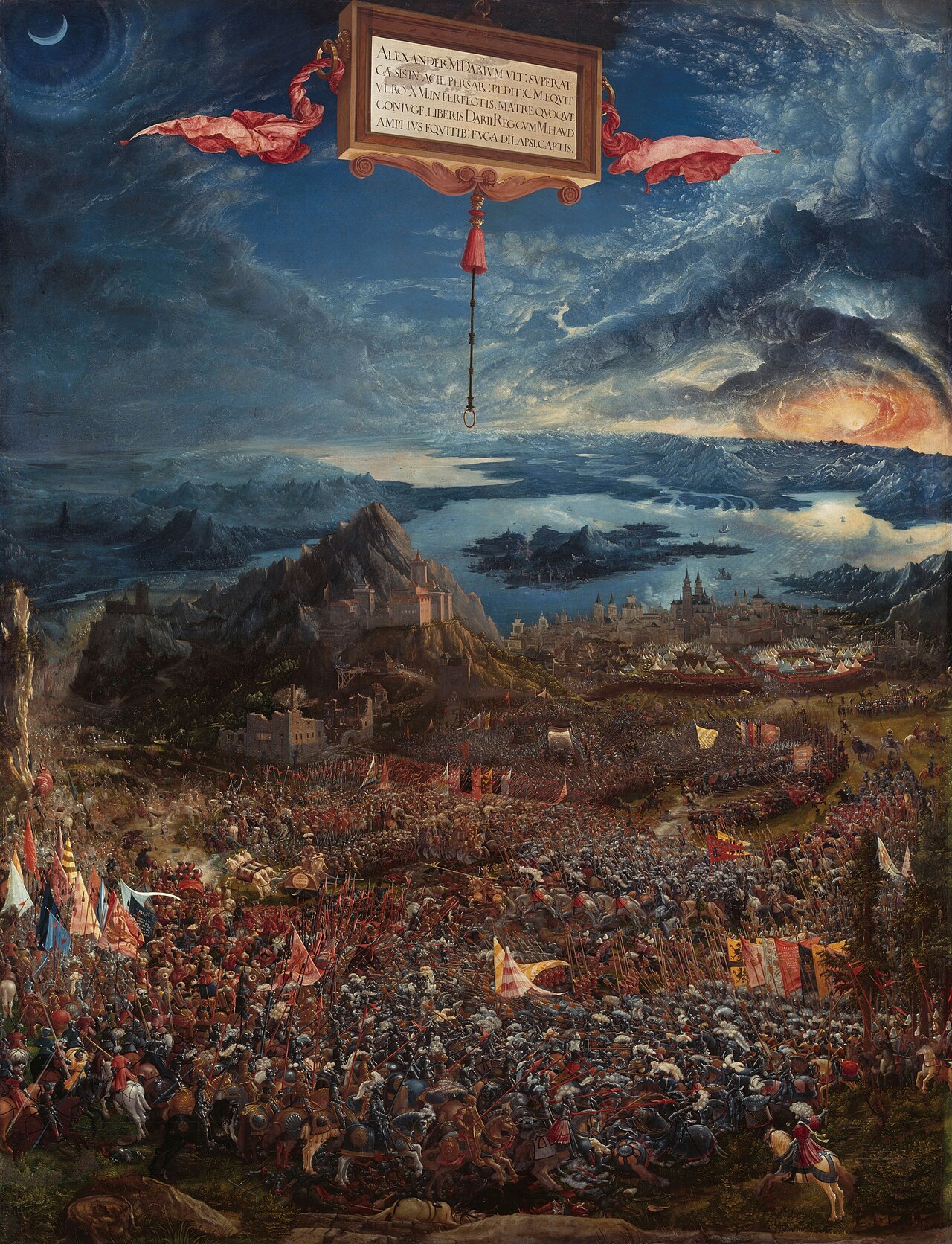
A large Renaissance oil painting of a vast battle between armies on a plain, with a city and mountains in the background, a stormy sky with a red sunset glow, and a cartouche with Latin inscription hanging at top.Painting

Secondary source

The Battle of Alexander at Issus

Albrecht Altdorfer · 1529

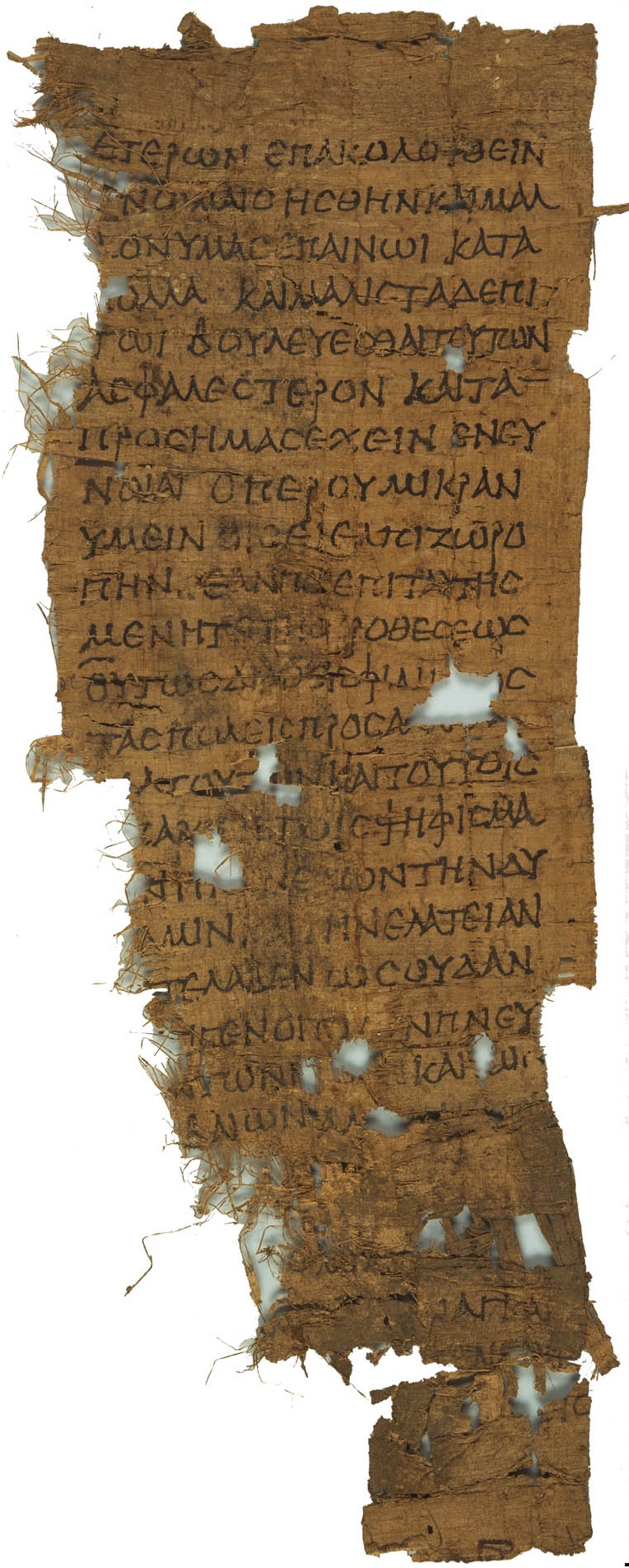
Photograph of a damaged brown papyrus fragment, tall and narrow, with rows of black Greek uncial script. Holes and tears are visible, and the bottom section is fragmentary with little legible text.Speech

Primary source

On the Crown

Demosthenes · 330 BCE

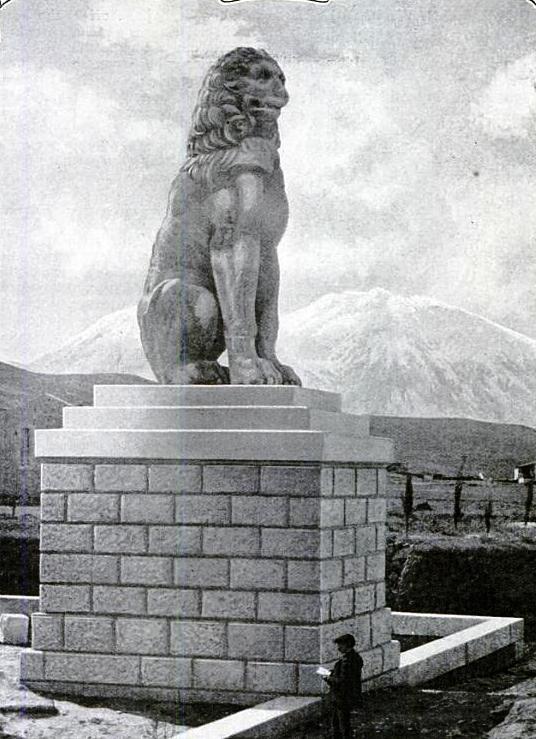
Black-and-white photograph of a large stone lion statue seated on a tiered, brick-faced pedestal, with snowy mountains behind it. A man in a cap stands at the lower right beside the base.Sculpture

Secondary source

Lion of Chaeronea

c. 330 BCE

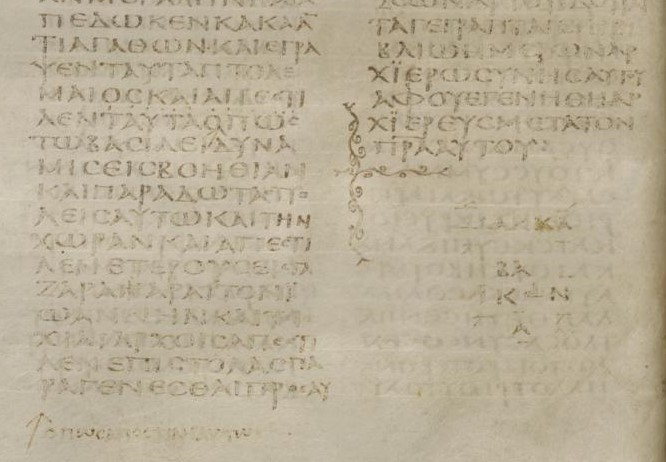
Close-up of a page of Greek uncial manuscript text in two columns, with ink lettering on pale parchment. A decorative ornamental flourish and a small coronis mark the end of a section, with a short title line written at the bottom.Book

Secondary source

1 Maccabees

c. 2nd century BCE

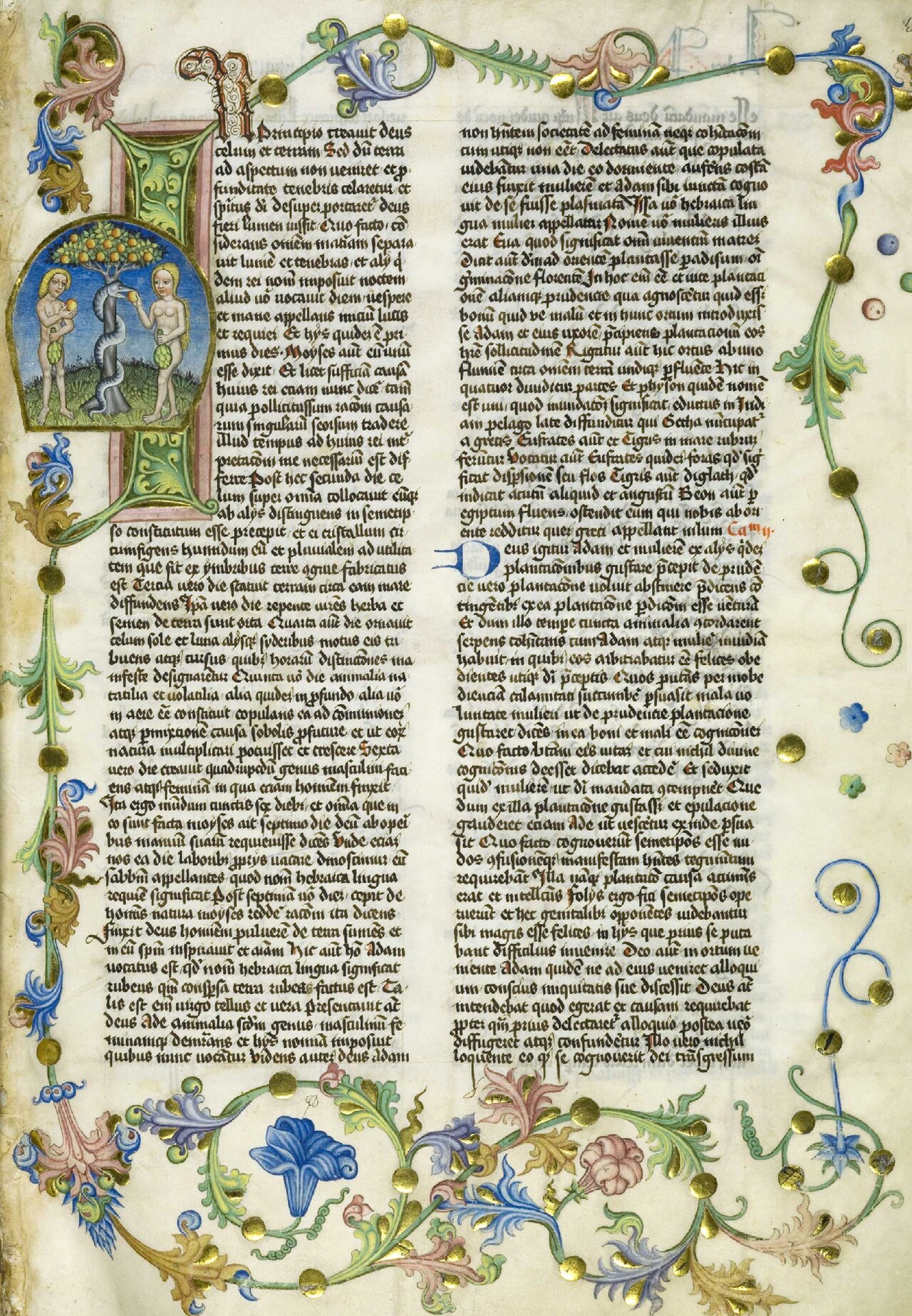
Illuminated medieval manuscript page in Latin with two columns of black gothic text, decorated with gold and colored foliage borders. A miniature in the left margin shows Adam and Eve beside the tree with a serpent, holding fruit.Book

Secondary source

Antiquities of the Jews

Josephus · 94 CE

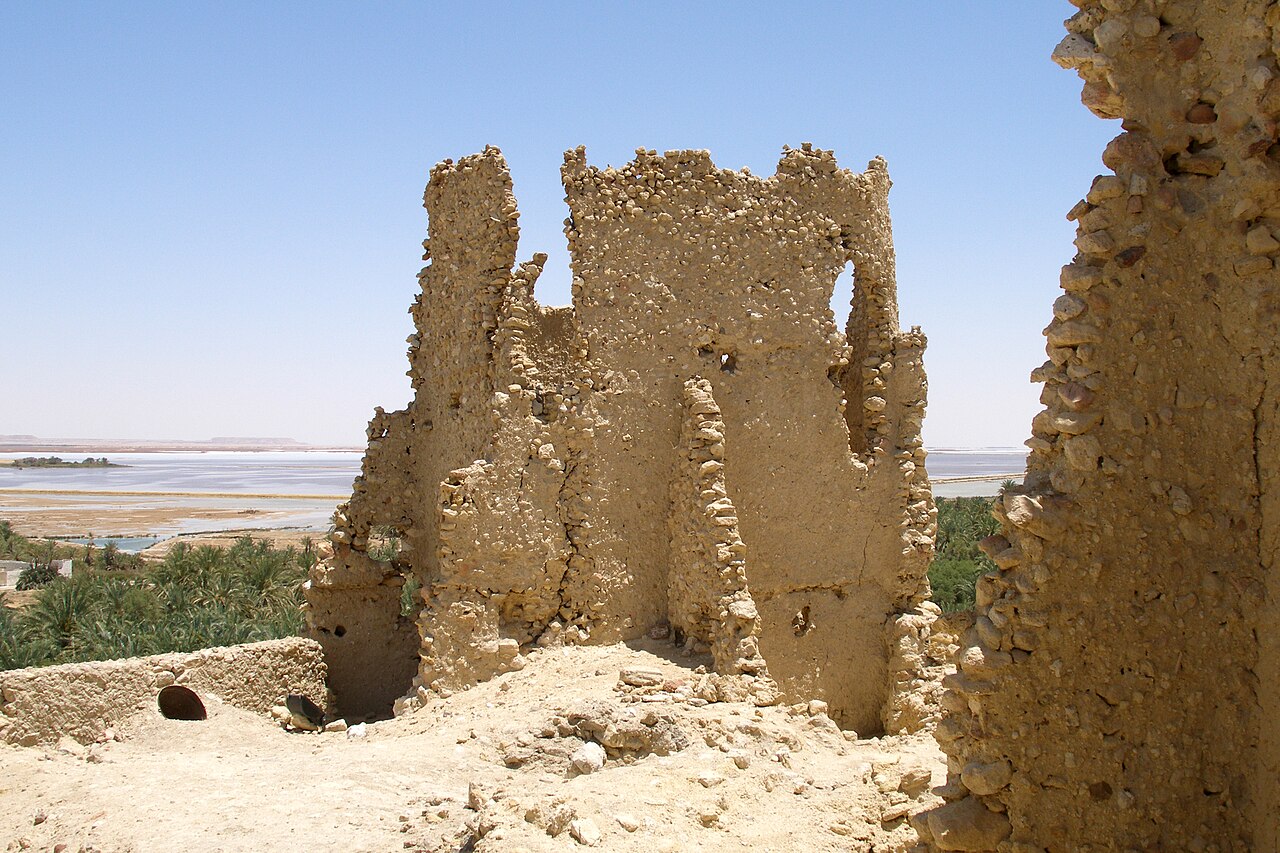
Crumbling ruins of a thick mud-brick and rubble-stone structure on sandy ground, with a tall stone-faced wall on the right. Behind, a pale lake or salt flat, a small island, and green palm trees under a clear blue sky.Artifact

Secondary source

Temple of the Oracle of Amun, Siwa

6th century BCE

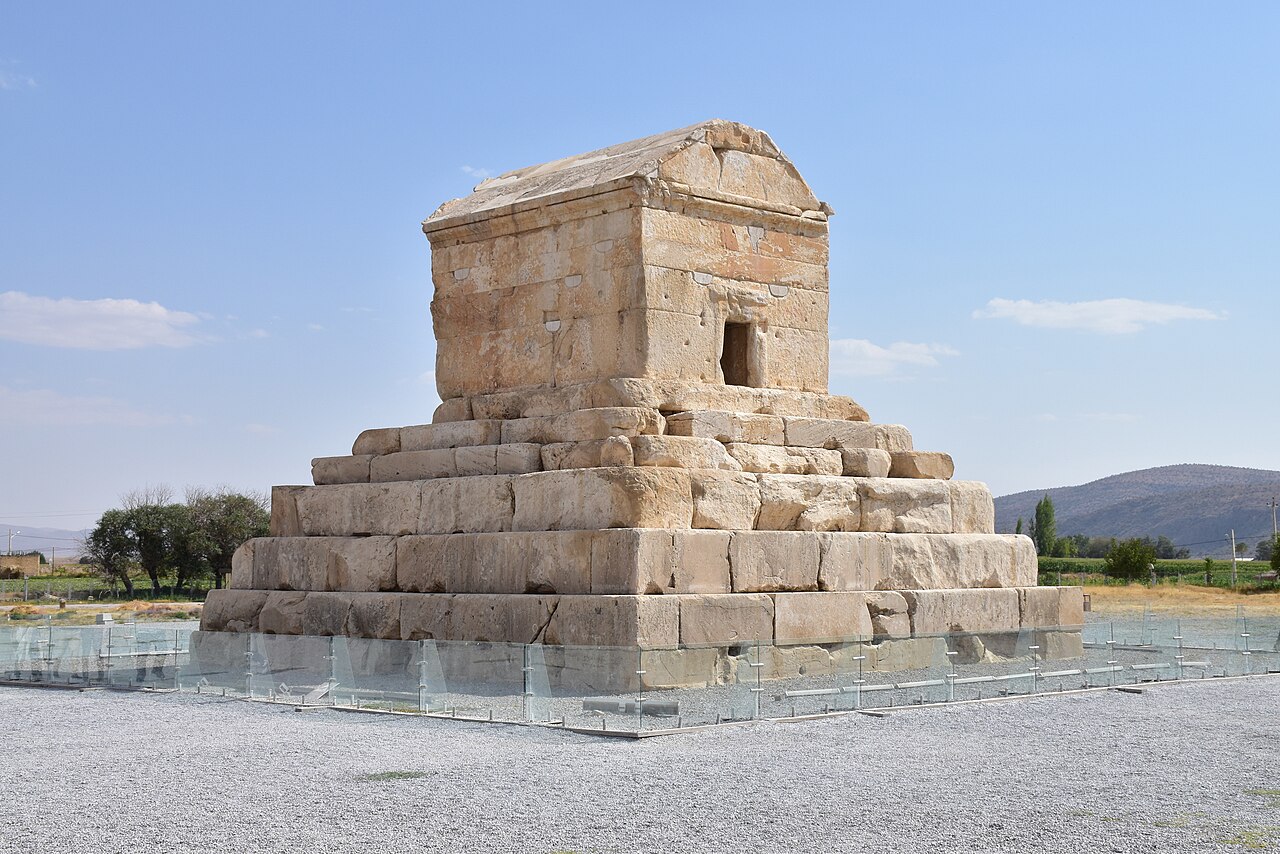
Photo of the Tomb of Cyrus the Great at Pasargadae, Iran: a stepped limestone base of several tiers supporting a small stone chamber with a gabled roof and a narrow doorway, set on gravel behind a low glass barrier, under a clear blue sky.Artifact

Secondary source

Tomb of Cyrus the Great

c. 529 BCE

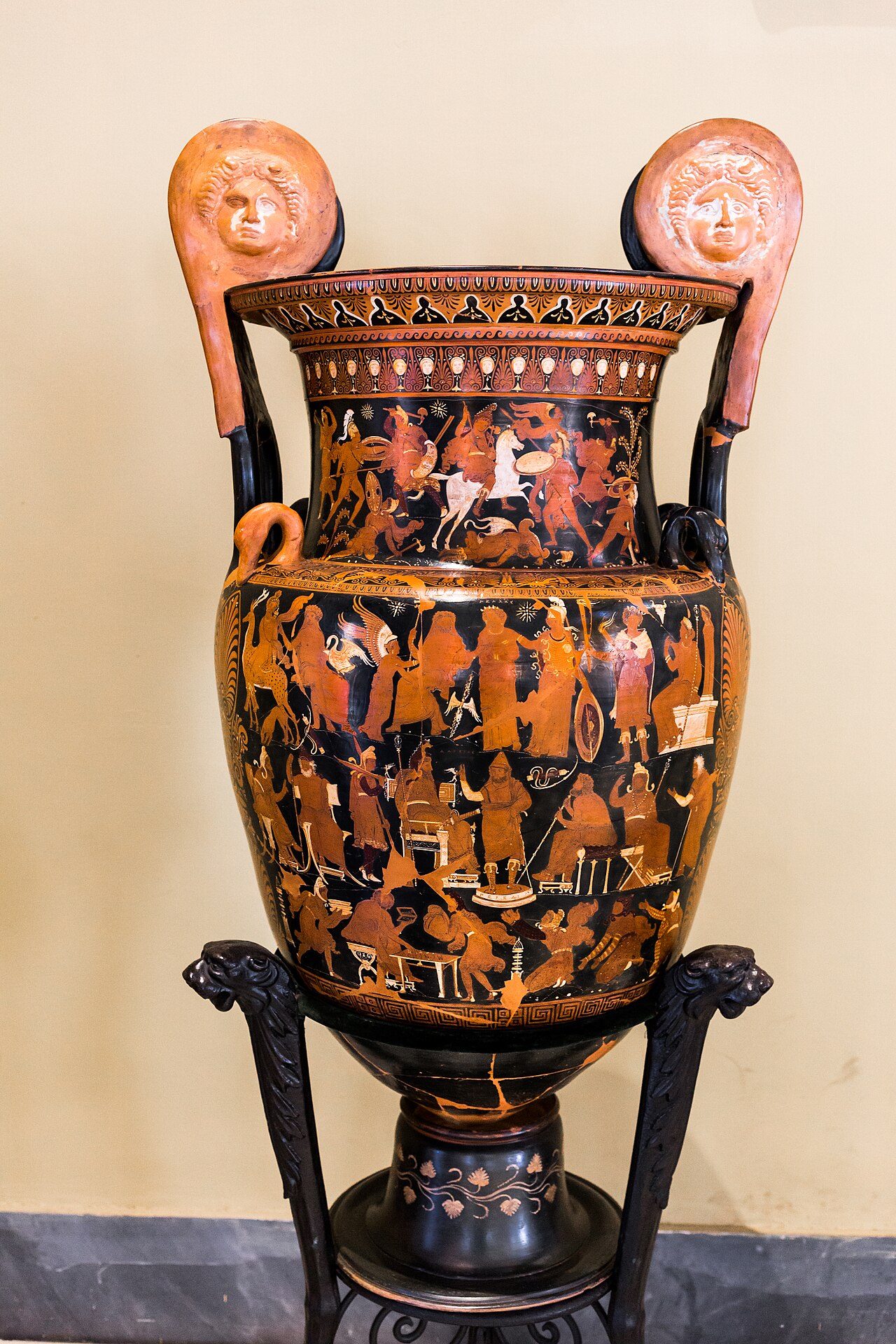
Photograph of a large red-figure volute krater vase with black background, standing on a black metal stand with ram-head supports. Two handles end in mask-like heads. The body is covered with painted figures in rows, including a central enthroned figure surrounded by standing people, and a Greek key border at the base.Artifact

Secondary source

Darius Vase

Darius Painter · c. 340-320 BCE

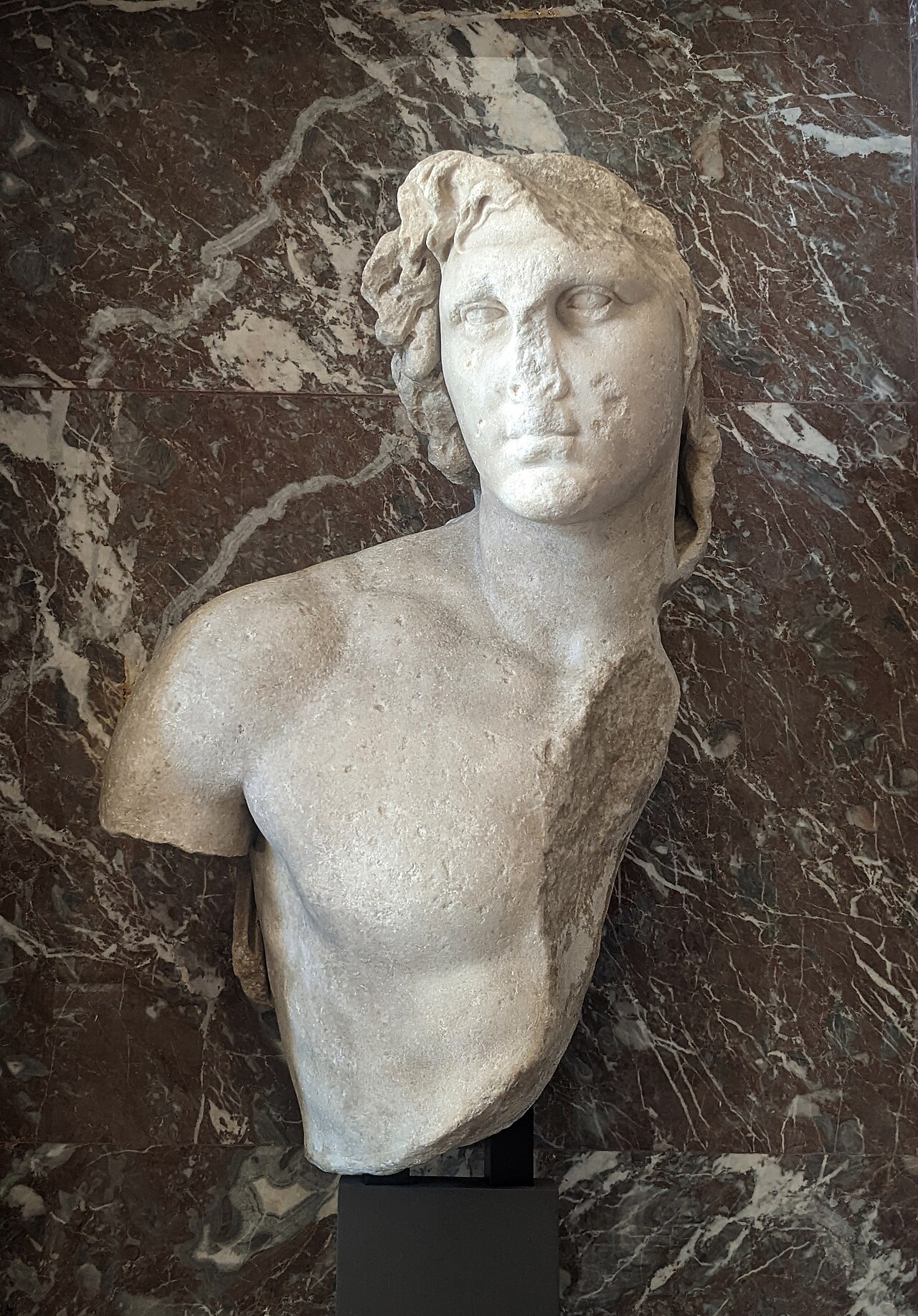
Photograph of a white marble bust of a young man with curly hair swept back, shown from the chest up with the left shoulder and upper torso broken away. It is displayed against a dark brown and white veined marble wall.Sculpture

Secondary source

Bust of Alexander the Great, known as the "Inopos"

c. 100 BCE

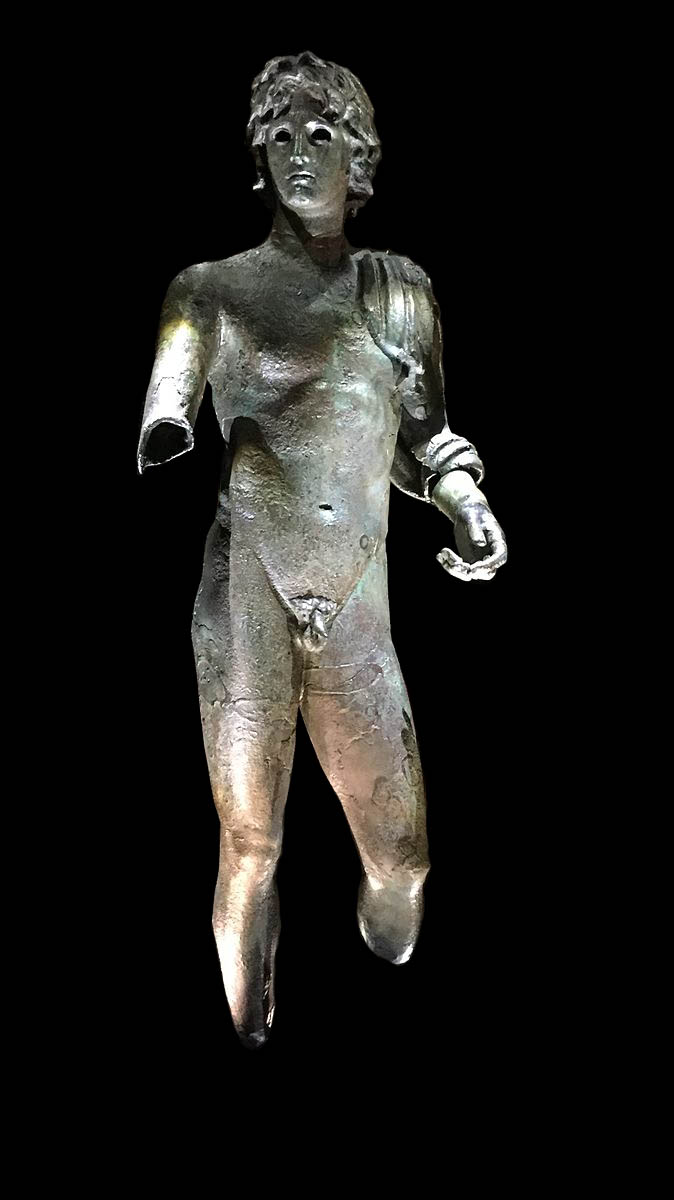
Photograph of a bronze statue of a nude young man against a black background. The figure stands with weight on one leg, head turned slightly, with curly hair and hollow eyes. One arm is broken off at the upper part, the other is bent with the hand raised near the chest. Dark green-brown patina with lighter highlights.Sculpture

Secondary source

The Youth of Agde

2nd century BCE

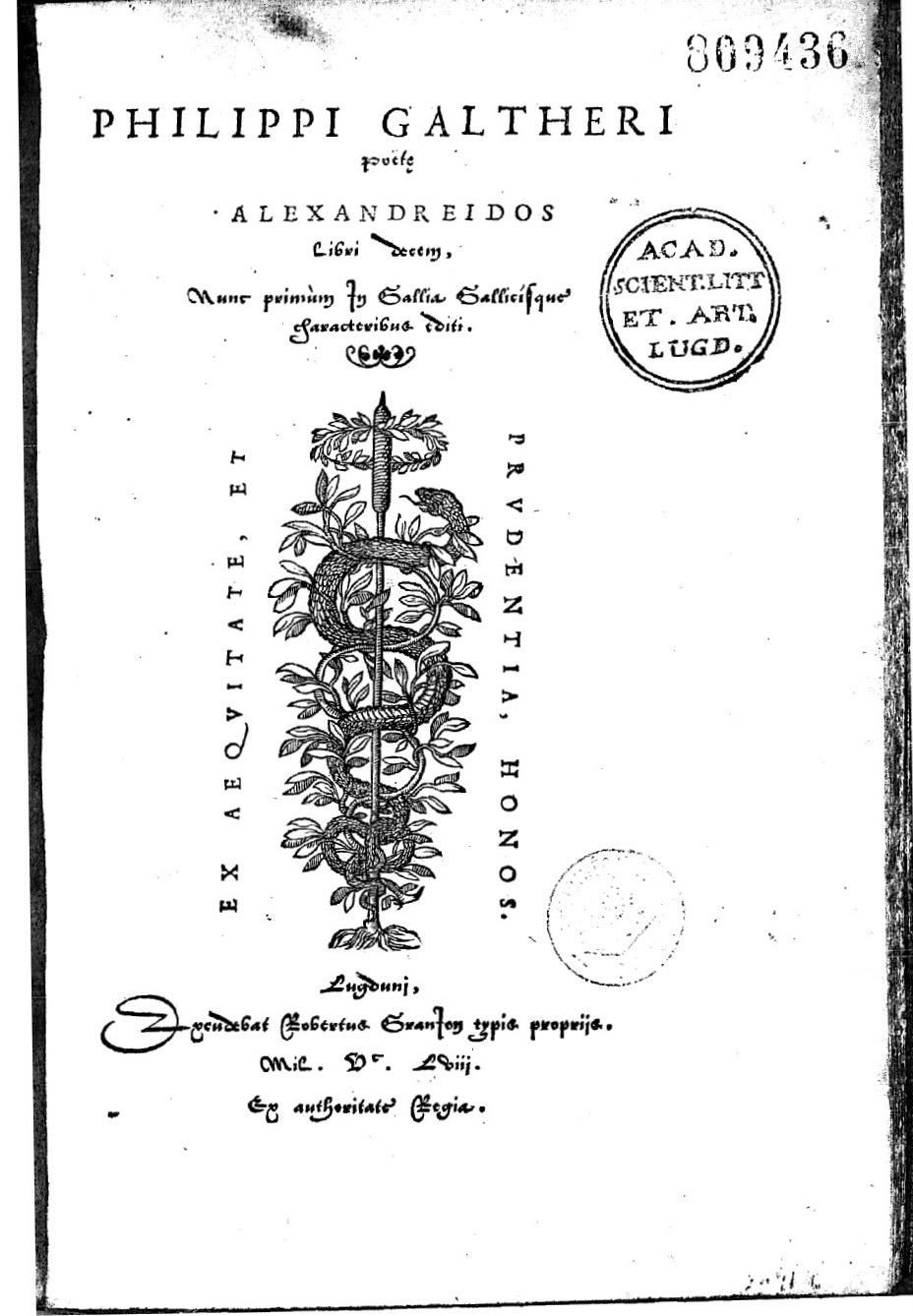
Title page of a 1558 Lyon edition of Philippi Galtheri poetae Alexandreidos, Libri decem, printed by Robertus Granjon. Engraved emblem of a staff entwined with snakes and leaves, with Latin mottos on each side, and a Lugduni imprint with date MDLVIII. Round library stamp reads ACAD. SCIENTIARUM ET ART. LUGD.Book

Secondary source

Alexandreis

Walter of Châtillon · 1176-1182

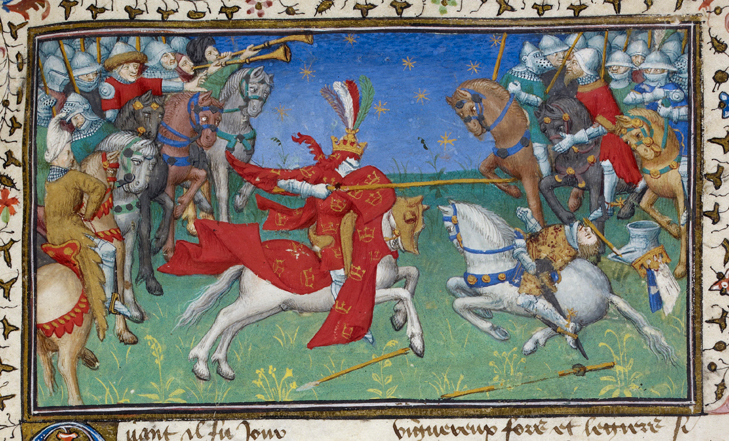
Manuscript miniature of a medieval battle: a crowned rider in a red robe with a feathered crest, lance raised, strikes a mail-armored rider on a grey horse, who is falling. Mounted knights with lances and a trumpeter fill the background under a blue sky with gold stars.Book

Secondary source

Roman d'Alexandre

Alexander of Paris · c. 1130

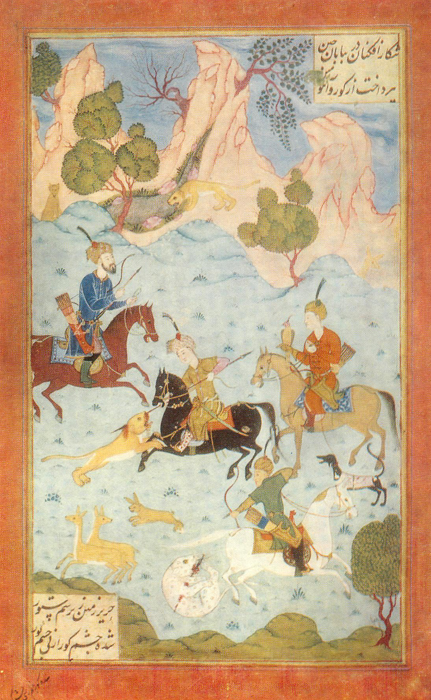
Persian miniature painting of mounted hunters on a hunt in a rocky landscape with pink cliffs and green trees. Three horsemen in colorful robes shoot arrows at fleeing animals: a leopard or lion leaps in the upper left, deer and a hare run across the bottom, and a rider on a white horse gallops at lower right. Persian calligraphy runs along the top and bottom margins within an orange border.Book

Secondary source

Iskandarnama

Nizami Ganjavi · 1194

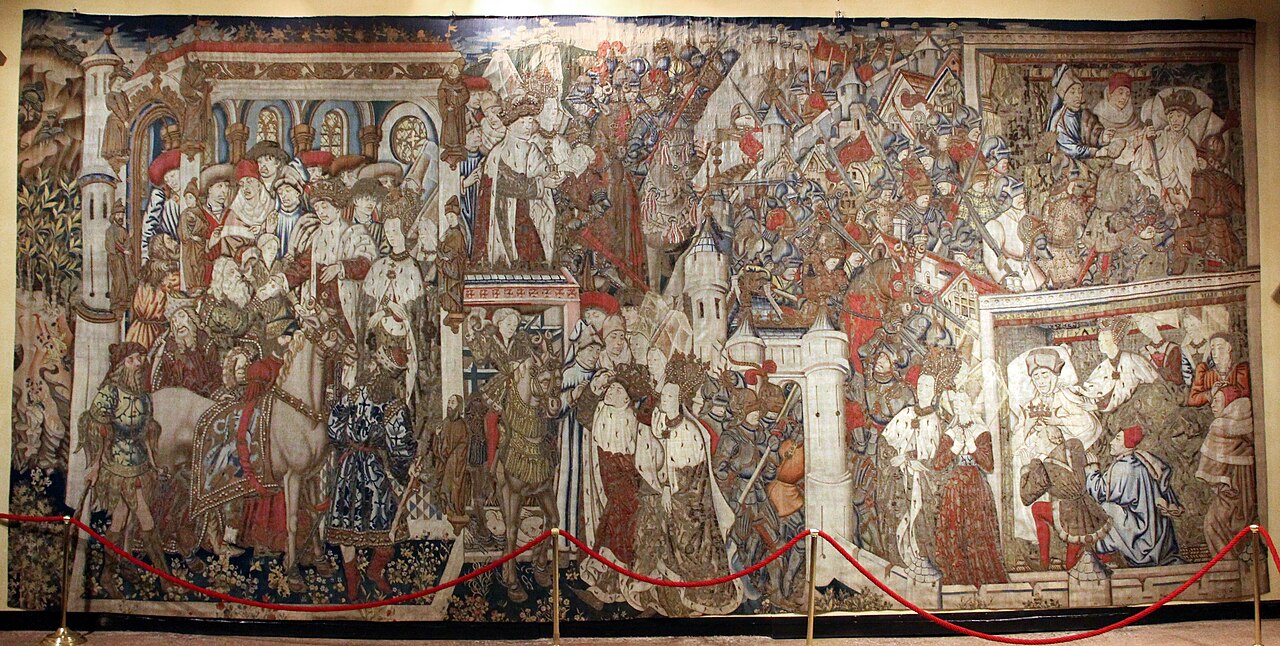
Large medieval tapestry displayed behind red velvet rope barriers. It shows crowded scenes of armored horsemen, soldiers with banners, a crowned figure, richly dressed courtiers, towers, and a city, with a kneeling figure at lower right.Artifact

Secondary source

Tapestries of Alexander the Great

Tournai tapestry workshops · c. 1460

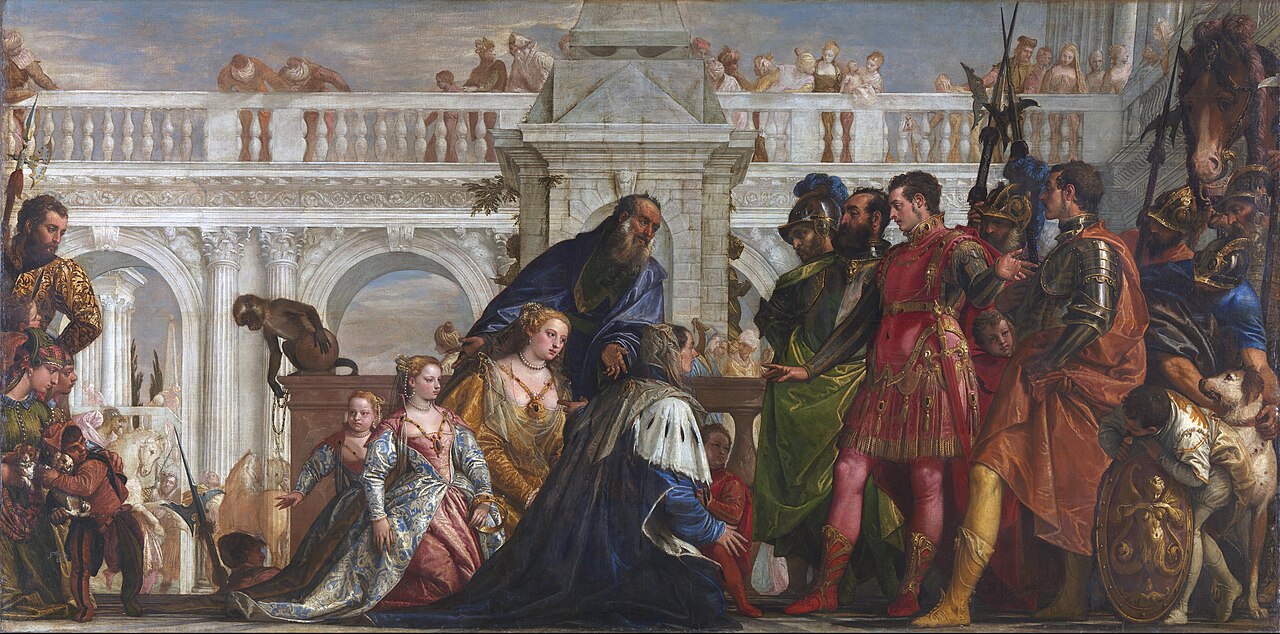
Large Renaissance painting of a crowded palace scene. Kneeling in dark blue robes at center-right, a woman bows before a standing man in red and gold armor. Behind them, women in ornate gowns and an elderly bearded man in blue stand near a balcony with a crowd of onlookers. A monkey sits on a ledge at left, and armored soldiers and a horse fill the right side under a classical arcade.Painting

Secondary source

The Family of Darius Before Alexander

Paolo Veronese · c. 1565-1570

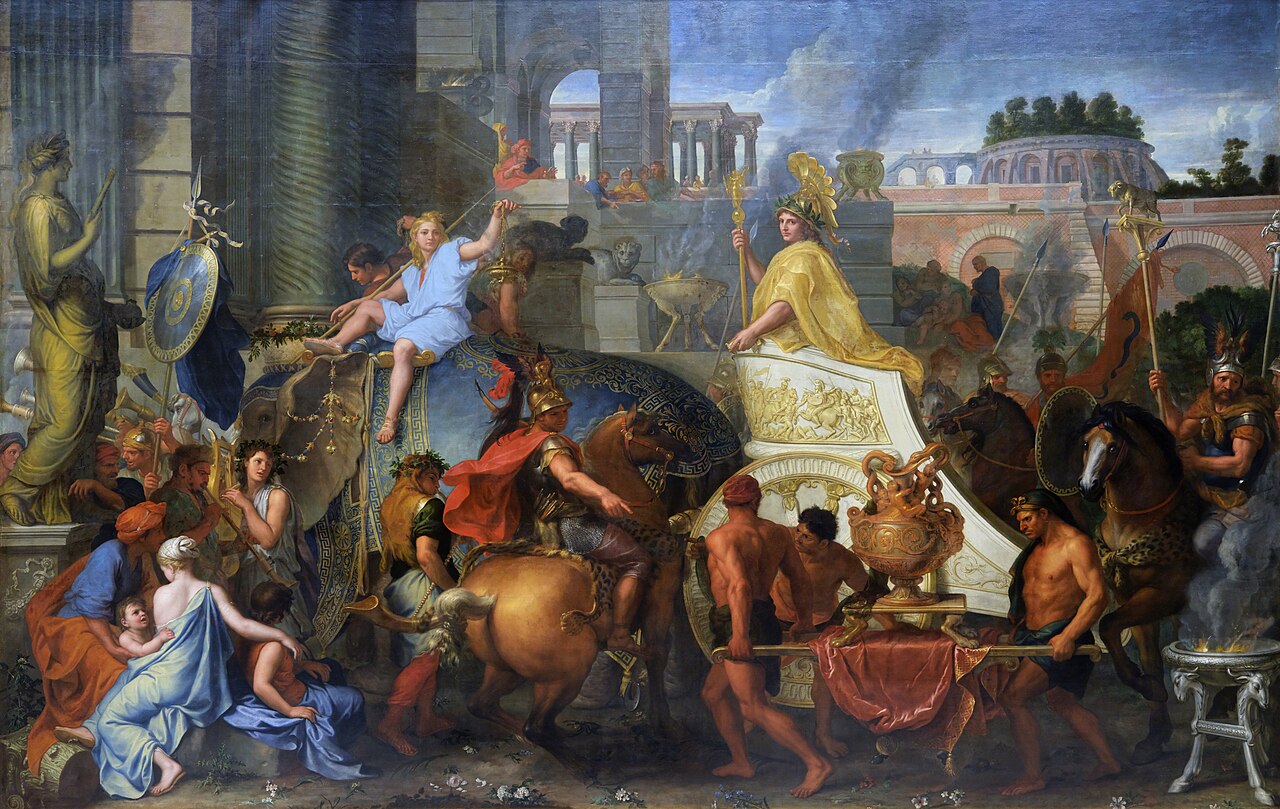
Large Baroque painting of a triumphal procession: a gilded chariot carrying a crowned figure in yellow robes is pulled by attendants past a classical palace, with horses, soldiers, women and children, and a smoking brazier in the foreground.Painting

Secondary source

Alexander Entering Babylon

Charles Le Brun · 1664

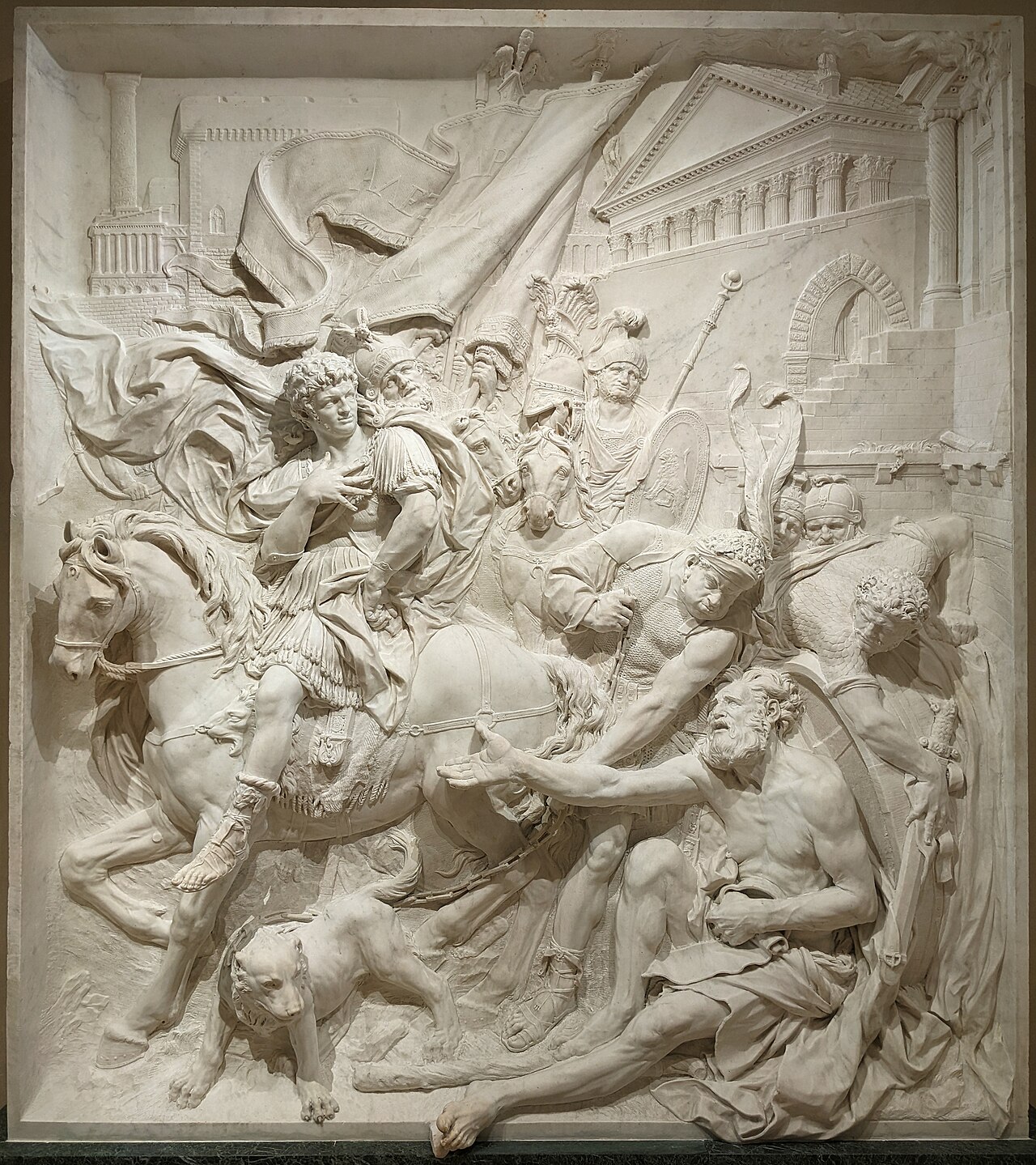
White marble relief of a mounted rider with a flowing cloak, reaching toward an elderly bearded man reclining nude on the ground at lower right. Soldiers, a horse, a dog, and a classical temple and arch appear in the background.Sculpture

Secondary source

Alexandre et Diogène

Pierre Puget · 1670

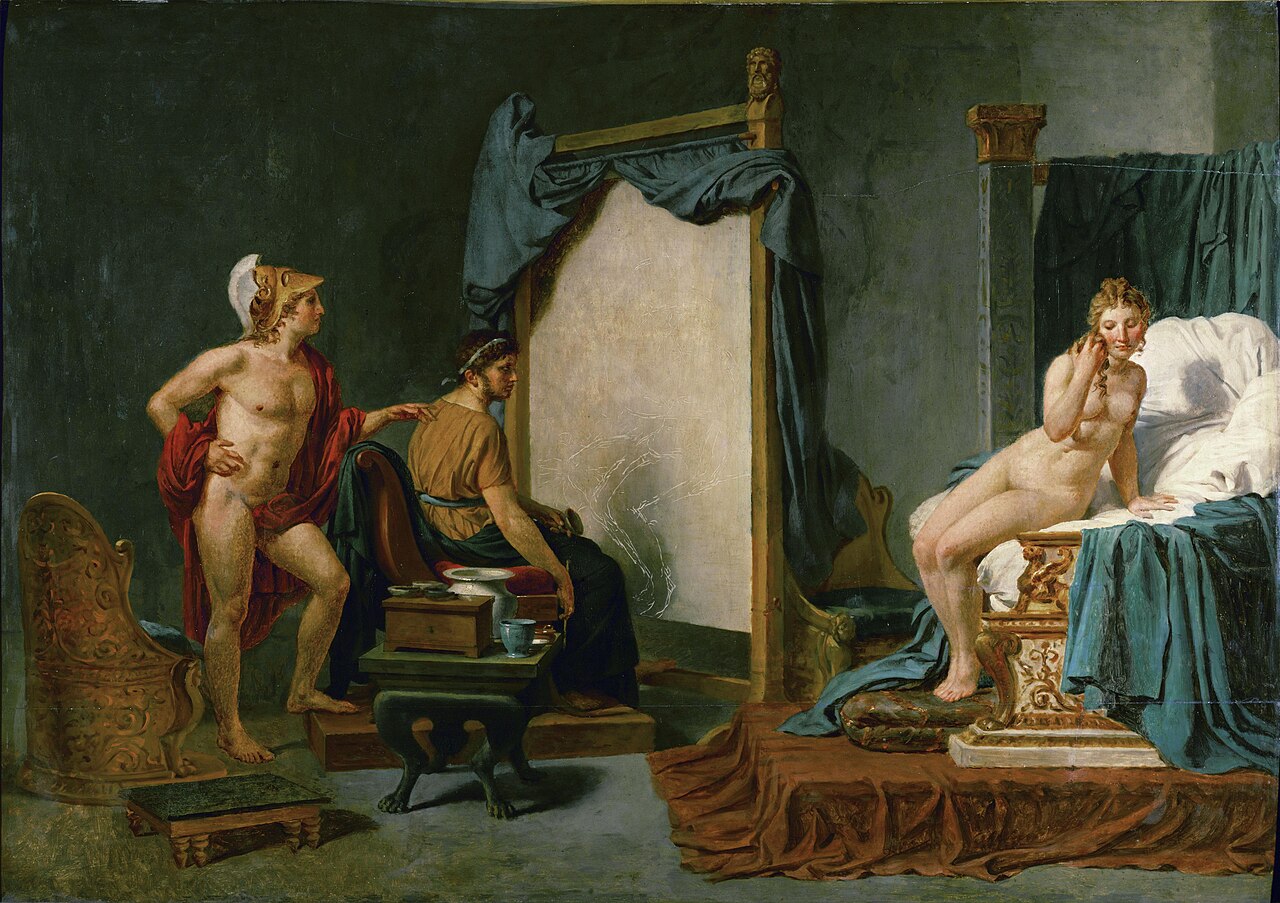
Neoclassical painting of an interior: a nude young man in a helmet and red drapery stands at left beside a seated painter at an easel. At right, a nude woman sits on a draped bed-platform beside a canopied bed.Painting

Secondary source

Apelles Painting Campaspe in the Presence of Alexander the Great

Jacques-Louis David · c. 1814

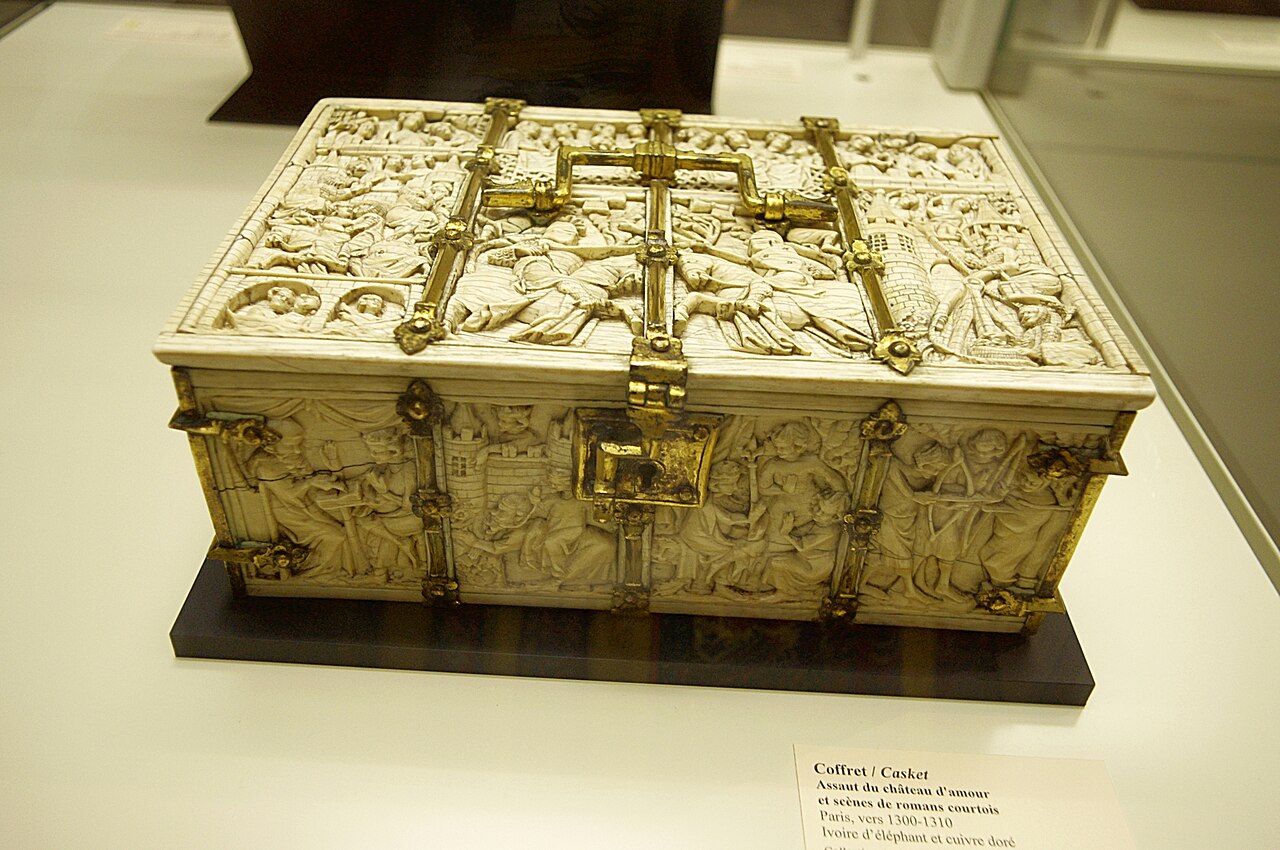
An ivory casket with gilded metal bands and hinges, carved on its lid and front panels with scenes of medieval figures, displayed on a dark base in a museum case. A museum label is visible in the lower right.Artifact

Secondary source

Casket with Scenes of Romances

c. 1300

Arrian's Anabasis of Alexander (Greek and English Edition)Book

Secondary source

Arrian's Anabasis of Alexander (Greek and English Edition)

Arrian · 1929

The Invasion of India by Alexander the GreatBook

Secondary source

The Invasion of India by Alexander the Great

John Watson M'Crindle · 1896

Book

Secondary source

Alexander: A History of the Origin and Growth of the Art of War

Theodore Ayrault Dodge · 1890

Book

Secondary source

The Anabasis of Alexander

Arrian · 1893

Book

Secondary source

Alexander the Great: Makers of History

Jacob Abbott · 1902 (first published 1876)

La leggenda di Alessandro MagnoBook

Secondary source

La leggenda di Alessandro Magno

Dario Carraroli · 1892

The Life of Alexander the GreatBook

Secondary source

The Life of Alexander the Great

John Williams · 1902

Photograph of a white marble sculpted head against a grey gradient backdrop. The head has wavy hair carved in layered locks, a smooth oval face with deep-set eyes, a straight nose, and a small mouth. The neck ends in a rough, unfinished base.Sculpture

Secondary source

Head of Alexander the Great

c. 300–200 BCE

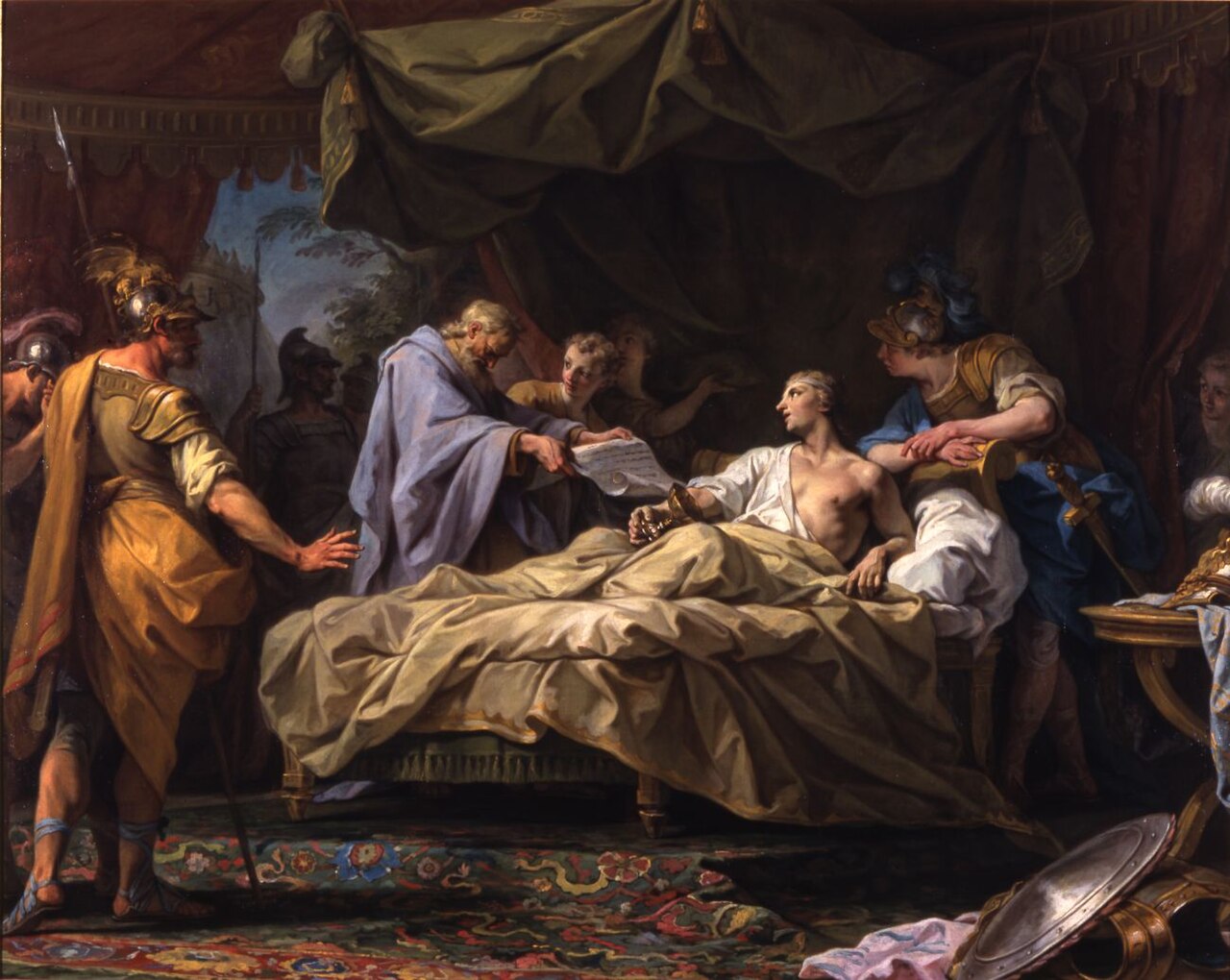
Painting of a sick, bare-chested man lying in a draped bed with a sheet pulled over his legs, holding a cup-like object and looking up at an elderly bearded man in a blue robe who holds out a letter. Two armored soldiers in gold and blue stand nearby, and a helmet and shield lie on the floor.Painting

Secondary source

Alexandre malade reçoit le breuvage de son médecin Philippe

Jean Restout · 1747

Plain dark red cloth book cover with a fine woven texture, a lighter band along the top edge and a slight diagonal sheen in the upper right corner. No title or text is visible.Book

Secondary source

Alexander: A History of the Art of War to 301 BC

Theodore Ayrault Dodge · 1890

Philip and Alexander of Macedon: Two Essays in BiographyBook

Secondary source

Philip and Alexander of Macedon: Two Essays in Biography

D. G. Hogarth · 1897

Document

Tertiary source

Alexander III entry, Encyclopaedia Britannica, 11th edition

1911

Book

Secondary source

Alexander the Great by Jacob Abbott

Jacob Abbott · 1902 edition

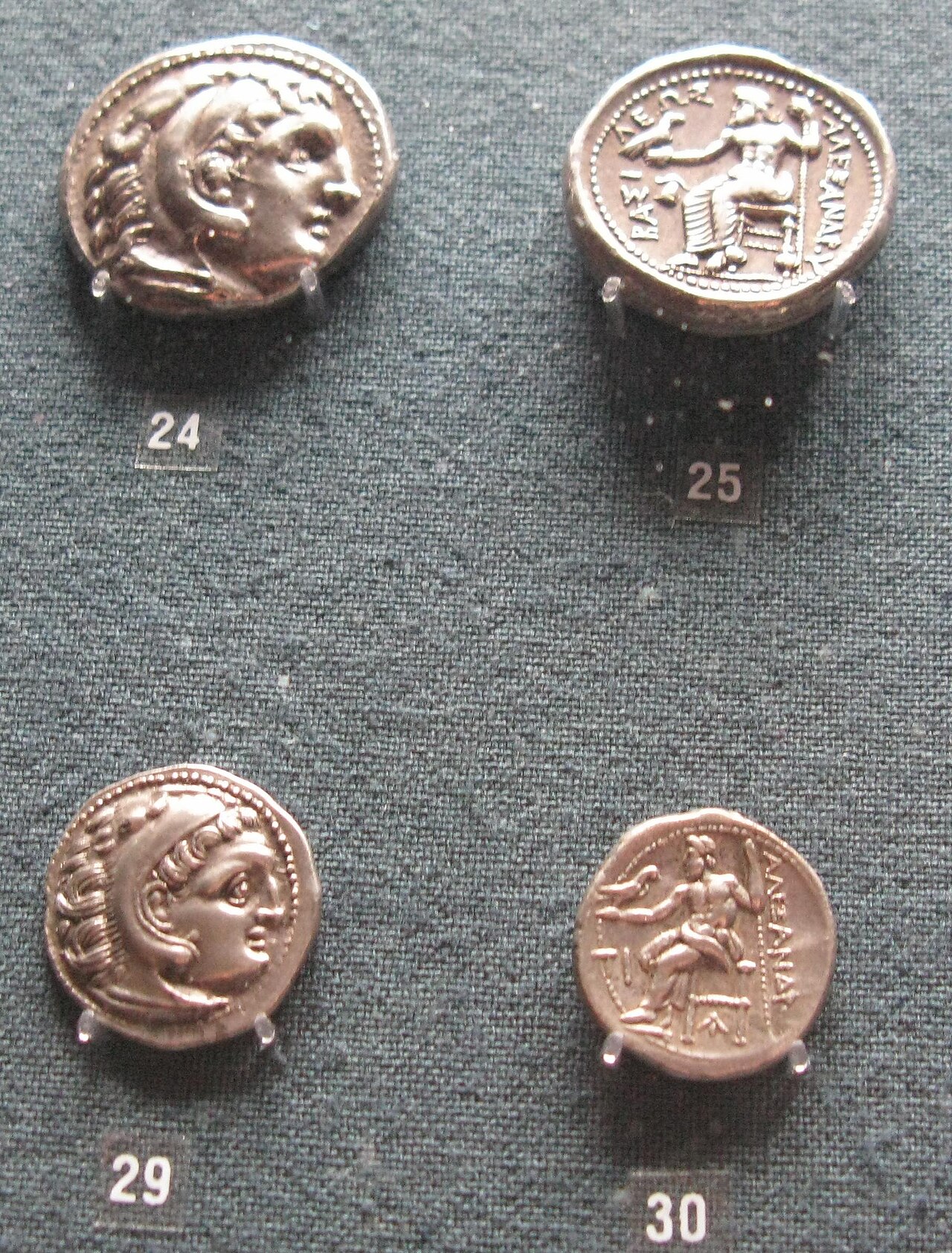
Four silver coins on a dark display cloth, labeled 24, 25, 29 and 30. Coins 24 and 29 show a laureate or helmeted male head in profile. Coins 25 and 30 show a seated figure holding a staff, with Greek lettering around the edge.Artifact

Primary source

Coins of Alexander the Great

A brownish clay tablet covered in rows of cuneiform wedge-shaped script, displayed against a pale grey background. A small paper label with handwritten marks is attached at the top left, and the tablet has a rough, broken edge at the bottom.Document

Primary source

Clay tablet recording Alexander's victory and entry into Babylon

c. 331 BCE or later

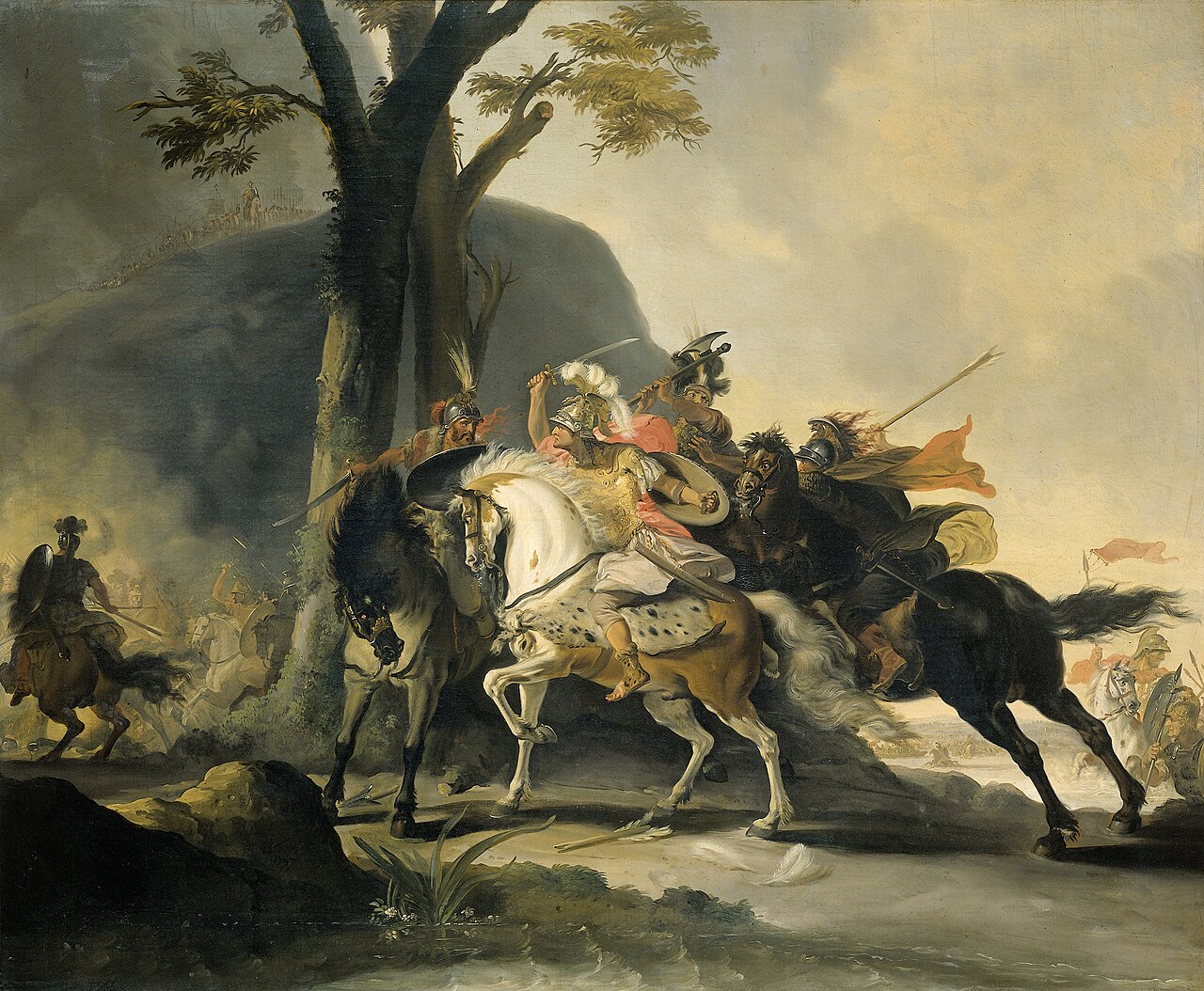
Painting of a cavalry battle: a helmeted rider with a white plume on a white dappled horse wields a sword amid armored horsemen, one with a raised spear and red banner, beside a large tree and rocky hill.Painting

Secondary source

Alexander the Great at the Battle of the Granicus

Cornelis Troost · 1737

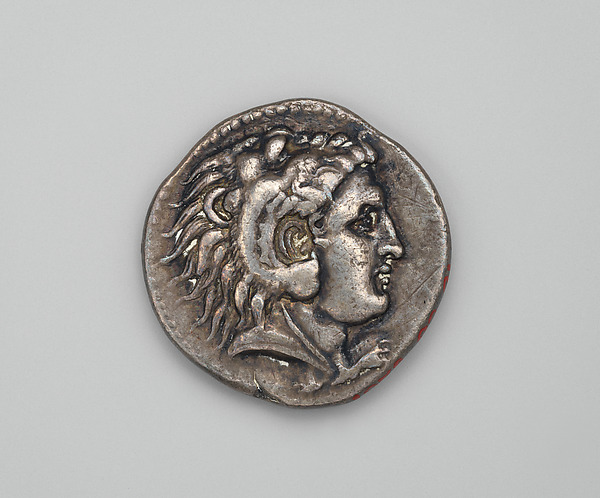
Photo of a silver tetradrachm coin on a light gray background. The coin shows a profile portrait of a helmeted male figure facing right, with a lion skin headdress, and a worn, slightly irregular rim.Artifact

Primary source

Tetradrachm of Alexander the Great (Seleucid Issue, c. 325-319 BCE)

ca. 325–319 BCE

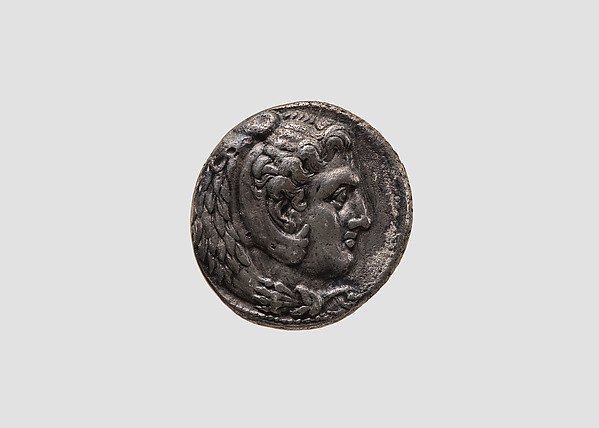
Photograph of a silver-toned ancient coin on a light grey background. The coin shows a profile portrait of a man with curly hair wearing a lion-skin headdress, facing right, with a laurel wreath border along the edge.Artifact

Primary source

Tetradrachm of Alexander the Great (c. 318-316 BCE)

ca. 318–316 BCE

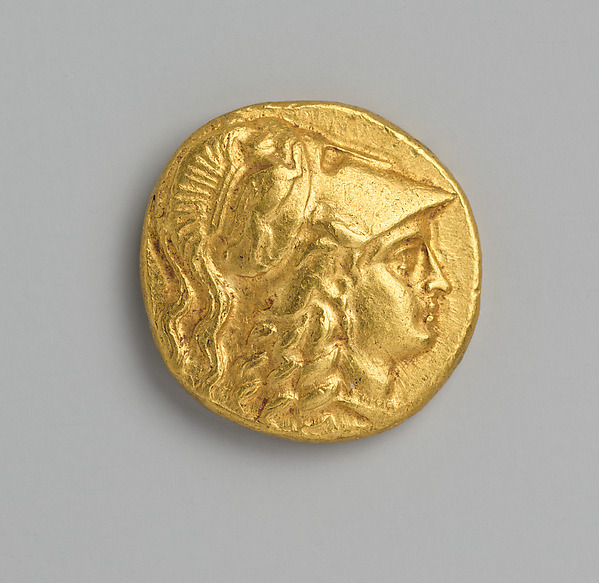
Photograph of a round gold coin on a grey background. The obverse shows a helmeted profile head of a figure facing right, with a lion skin draped over the head and a wreath or helmet crest; the surface is shiny and worn at the edges.Artifact

Primary source

Gold Stater of Alexander the Great

336–323 BCE

Nearly all-black image, apparently a dark book cover or scanned front page of a bound volume. A faint vertical spine edge with raised bands runs along the left side; a lighter grey area appears at the lower left and bottom right corners. No legible text is visible.Book

Secondary source

Hanes Alexander Fawr

Hugh Humphreys · 1890

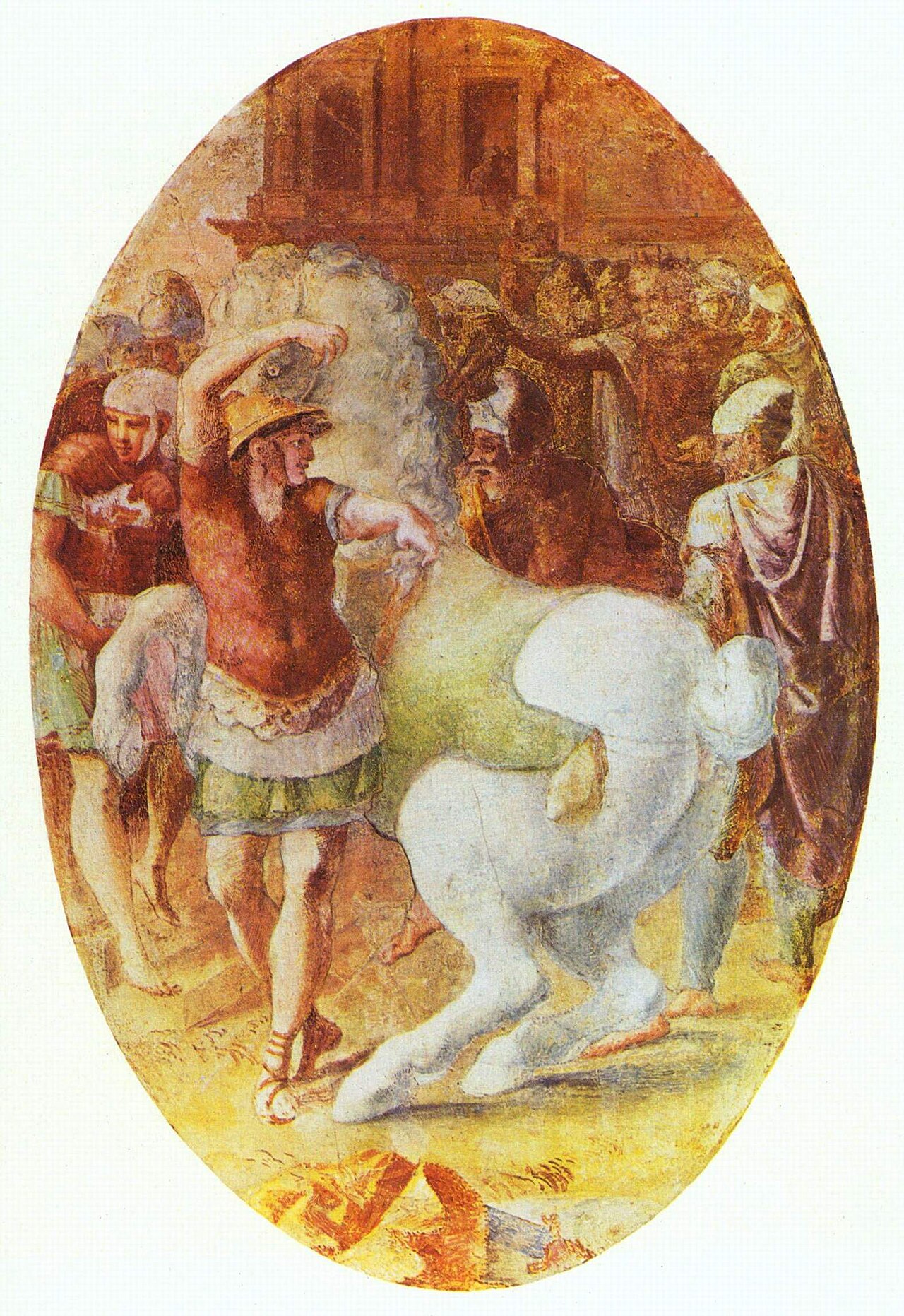
Oval painting of a helmeted youth in red tunic and green skirt raising his arm beside a white horse, while onlookers in armor and robes watch in a columned courtyard with a fiery ground below.Painting

Secondary source

Alexander Taming Bucephalus

Francesco Primaticcio · Mid-16th century

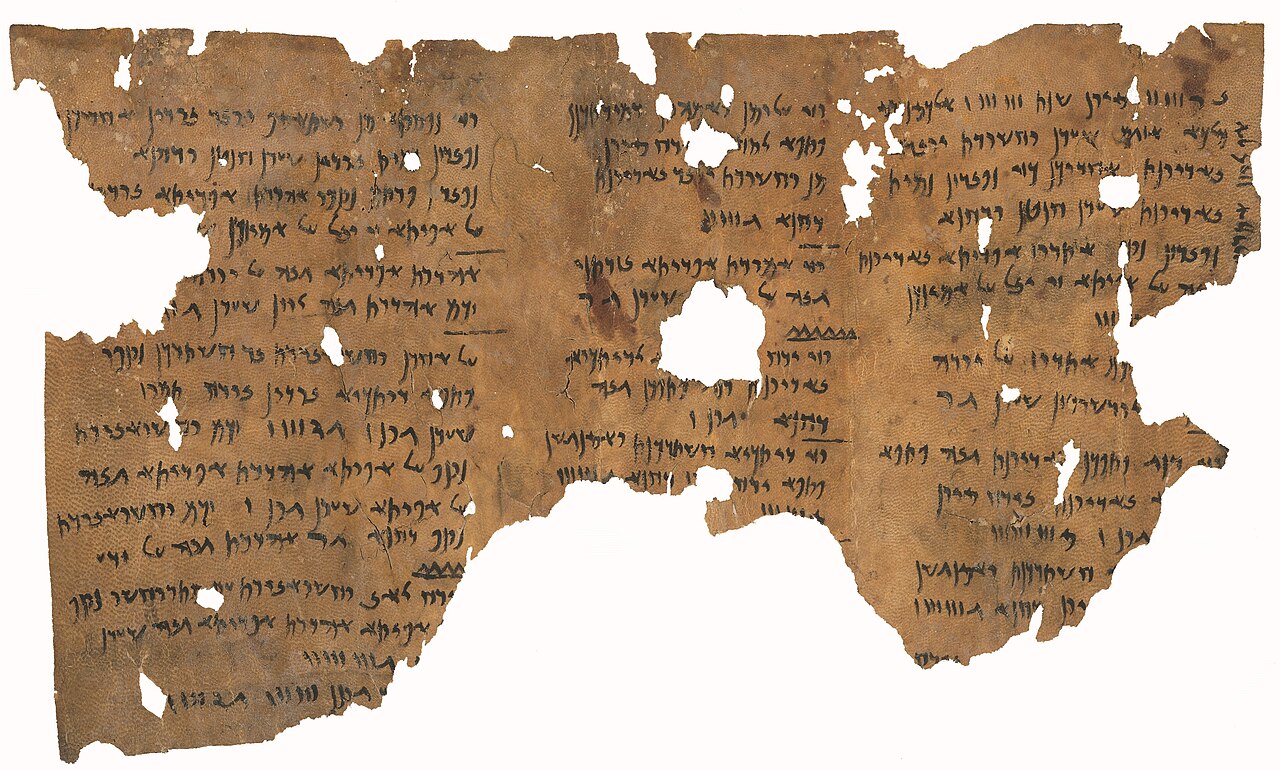
Photograph of a torn, brownish leather document with black Aramaic script written in horizontal lines across its surface, with several holes and ragged edges visible.Document

Primary source

Aramaic Supply Document, Year 7 of Alexander

8 June 324 BC

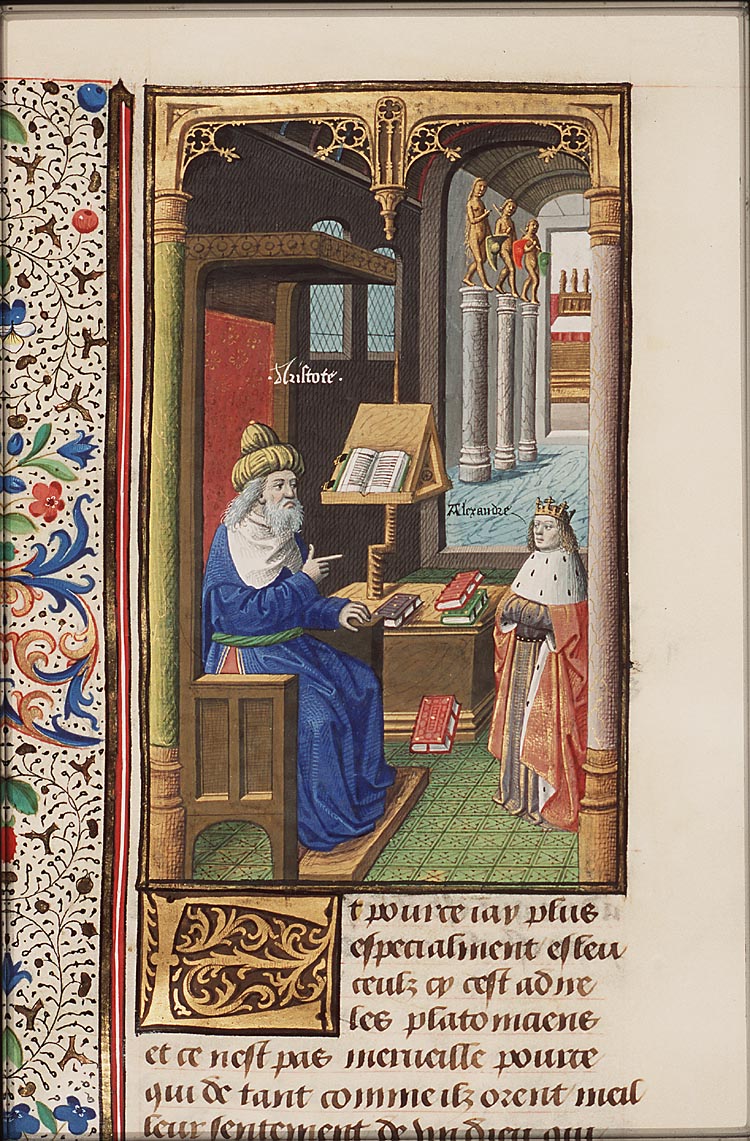
Illuminated manuscript miniature: a bearded man in a blue robe and yellow turban sits at a lectern with an open book, gesturing, labeled Aristotle. Before him a crowned young king in a white ermine-trimmed red robe stands, labeled Alexandre. Gilded columns and a painted interior frame the scene; text in Gothic script runs below.Painting

Secondary source

Alexander the Great Receives Instruction from Aristotle

Maïtre François

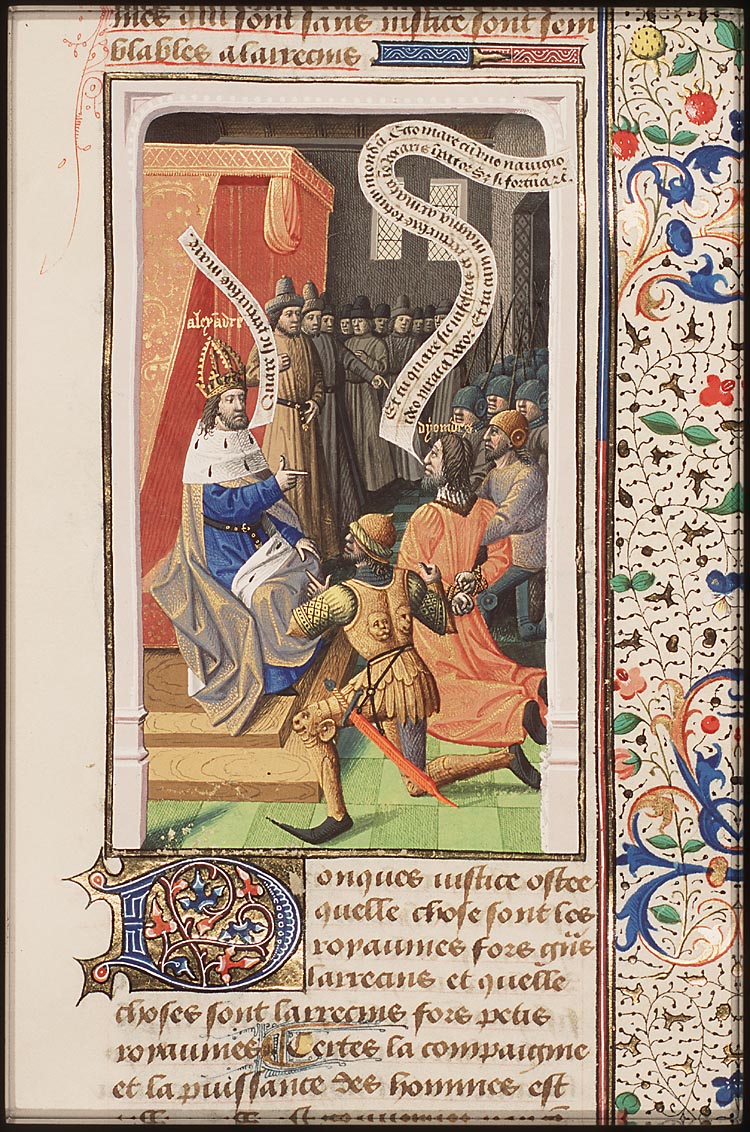
Manuscript miniature in a framed panel: a crowned, bearded king in blue robes sits on a throne under a red canopy, holding a scroll labeled Alixandre. Before him a kneeling bearded man in an orange robe, labeled Dyonides, is held by an armored soldier with a sword. Other armed men stand behind. A long decorated scroll with text winds through the scene. Text in French columns fills the lower page with a decorated initial.Painting

Secondary source

The captured pirate Dyonides before Alexander the Great

Maïtre François

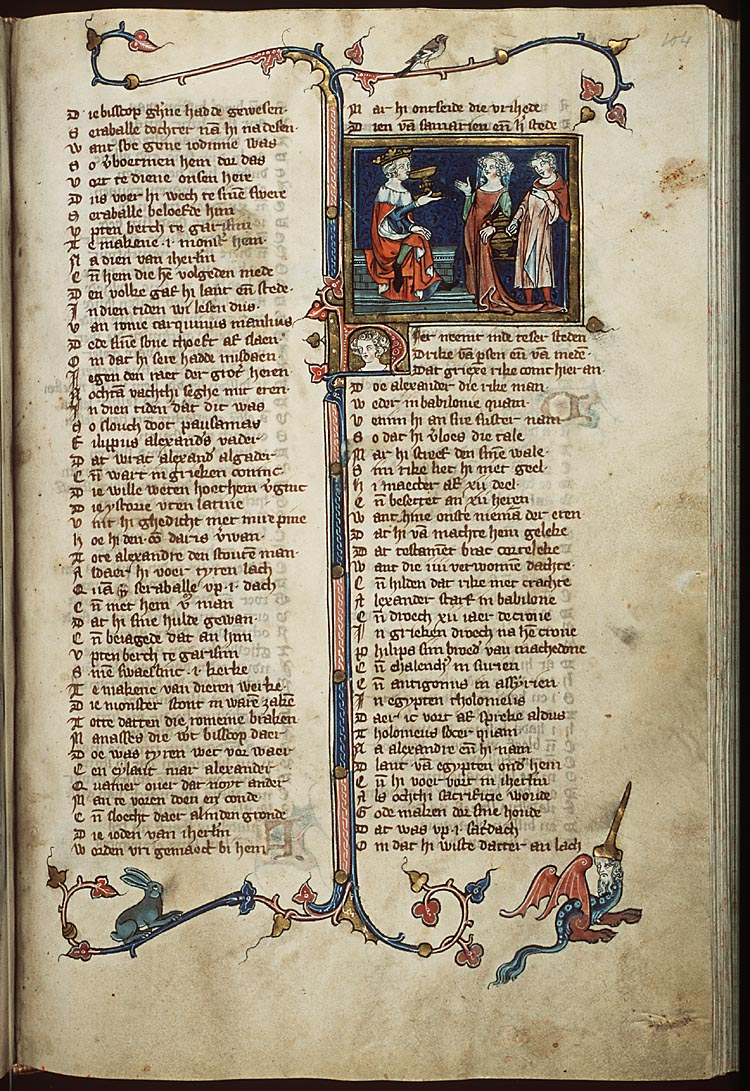
Medieval manuscript page in two columns of Middle Dutch gothic script with an illuminated initial and a framed miniature showing three figures in a courtly interior, marginal vine decoration and grotesque creatures including a rabbit and a winged dragon-like figure.Painting

Secondary source

The poisoning of Alexander the Great by his sister(?)

Michiel van der Borch · 1332

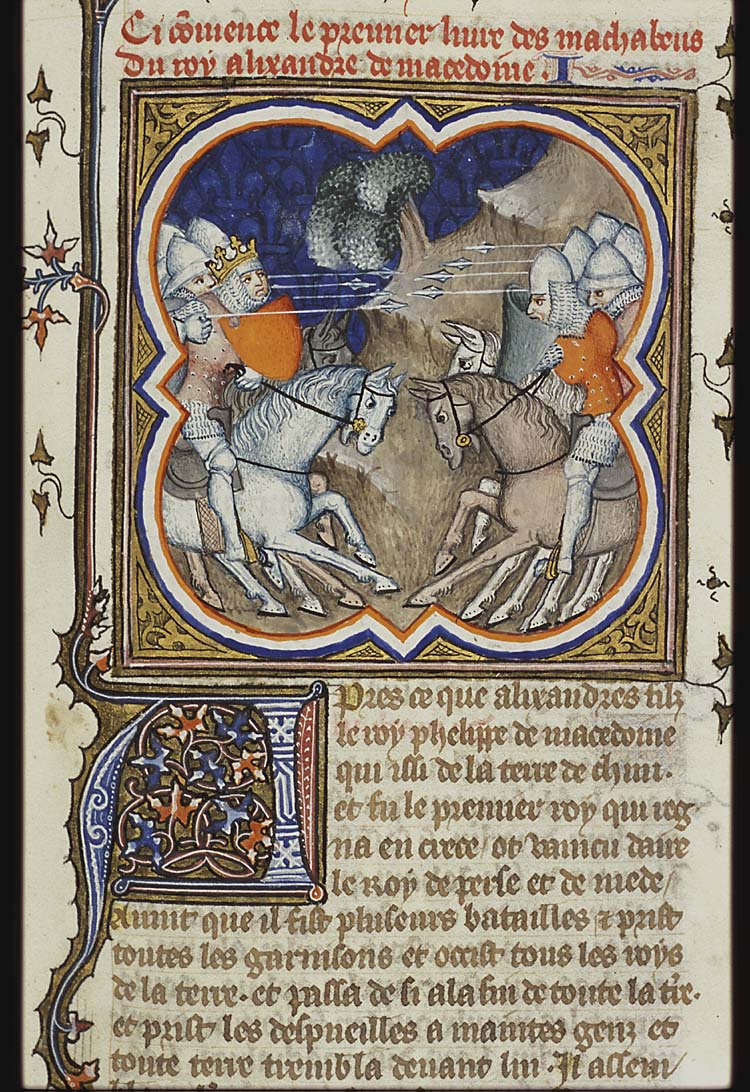
Illuminated manuscript page with a miniature in a quatrefoil frame showing two armies on horseback in battle, with arrows flying between them against a blue background. Red decorated heading text above and a historiated initial with columns of gothic script text below.Painting

Secondary source

The battle of Alexander the Great against the Persians (Darius)

Jean Bondol · 1372

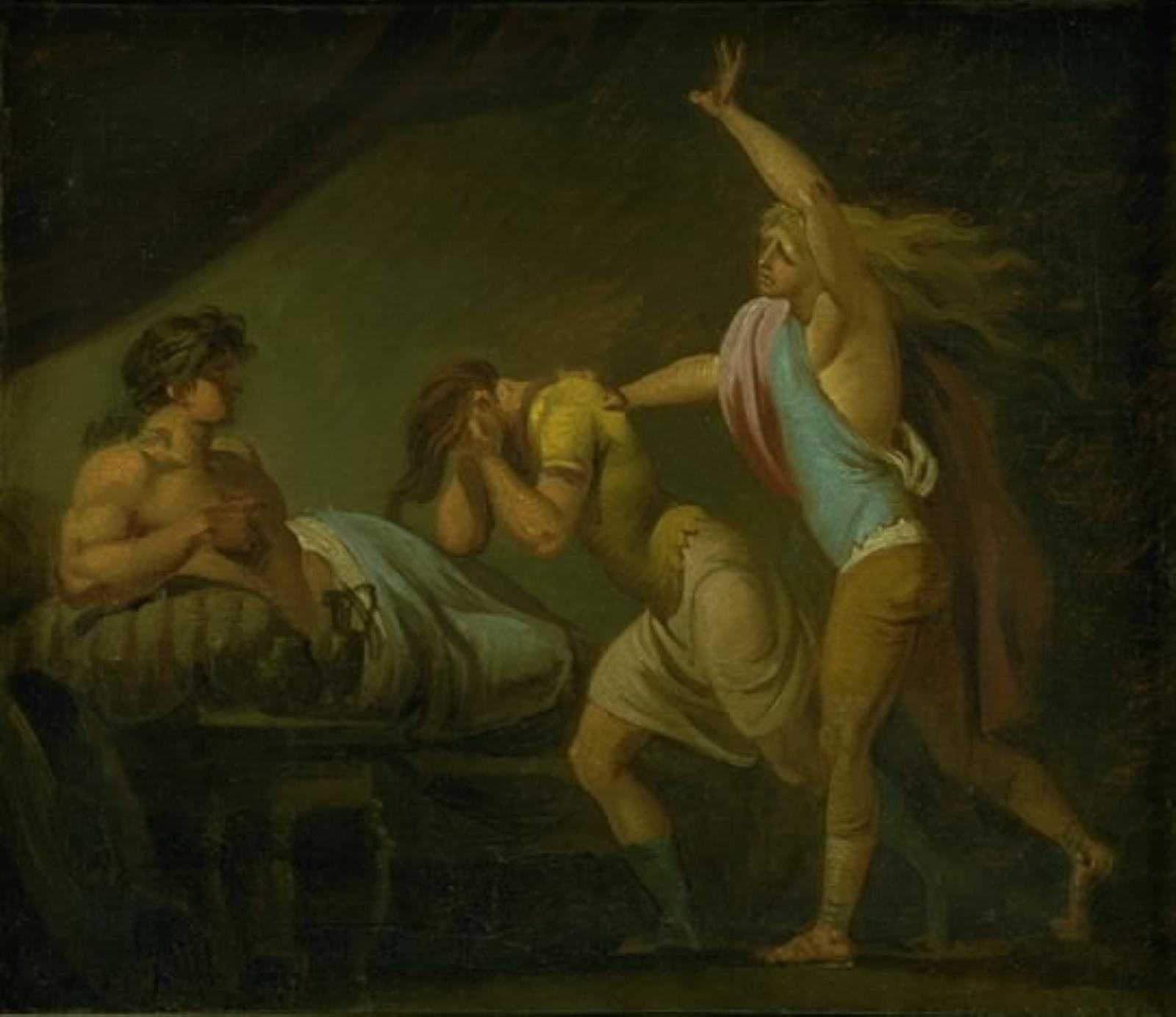
Painting of a dimly lit room. On the left, a seated shirtless man with short hair looks toward a bed. In the center, a young man in a yellow tunic covers his face with his hands while another figure in a pale robe leans toward him. On the right, a figure with flowing blond hair and a pink and blue drape raises one arm high.Painting

Secondary source

Two Young Men Confessing to Alexander the Great their Conspiracy

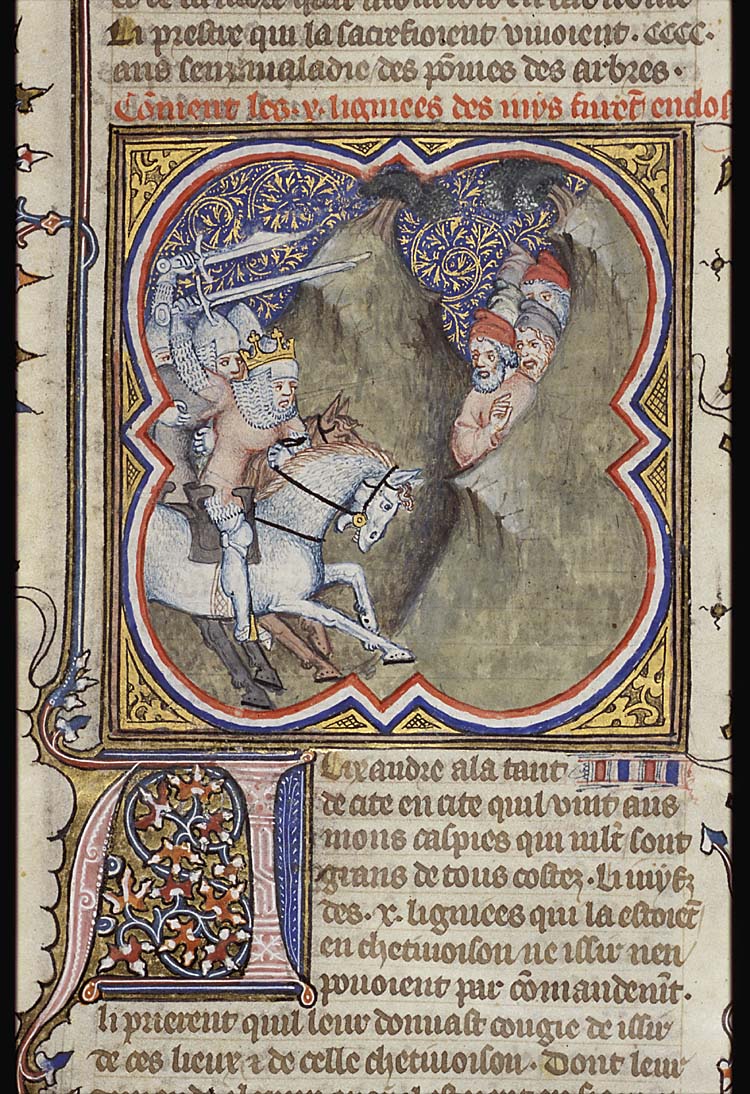
Illuminated manuscript page with a miniature in a red, blue and gold framed panel: a crowned rider on a white horse, with a raised sword, faces a group of bearded hermits in red caps emerging from a rocky mountain. Gold foliate background and decorated historiated initial with Gothic text below.Painting

Secondary source

Alexander the Great encounters the ten hermits of Mount Caspius

Jean Bondol · 1372

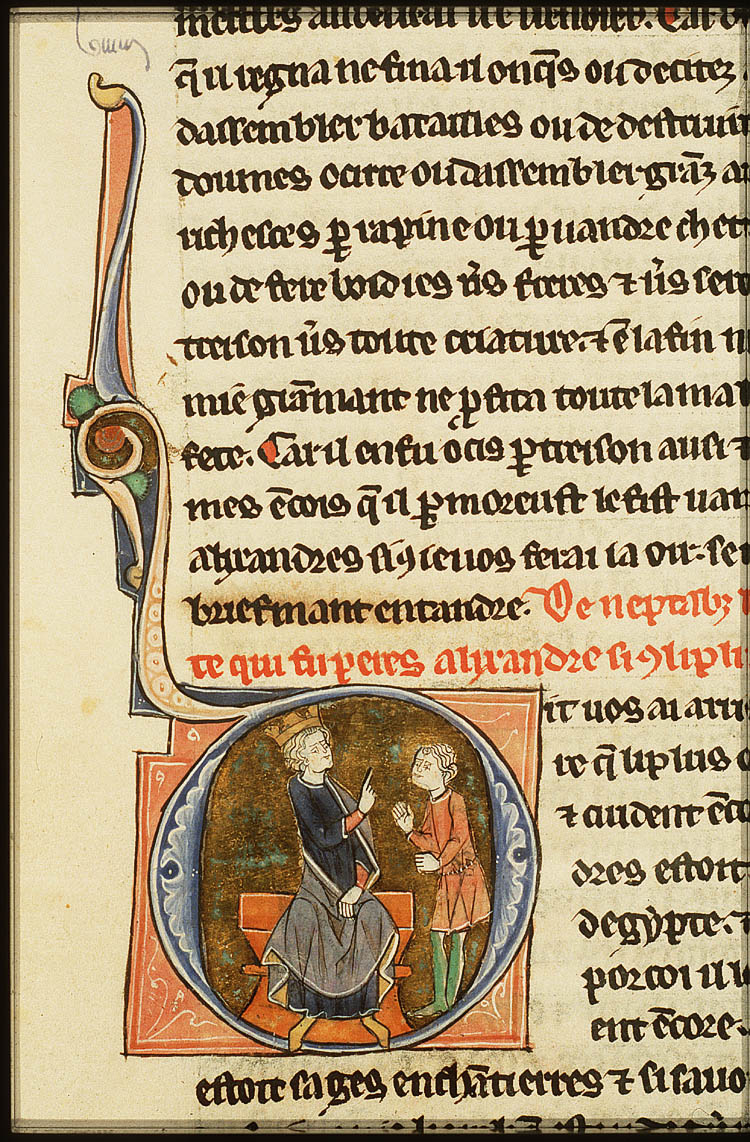
Manuscript page in black gothic blackletter text with red highlights. A large decorated initial O contains a painting of a crowned, seated king pointing upward, facing a standing young boy in red tunic with hands clasped.Painting

Secondary source

Nectanebus, Egyptian king and father of Alexander in the romance

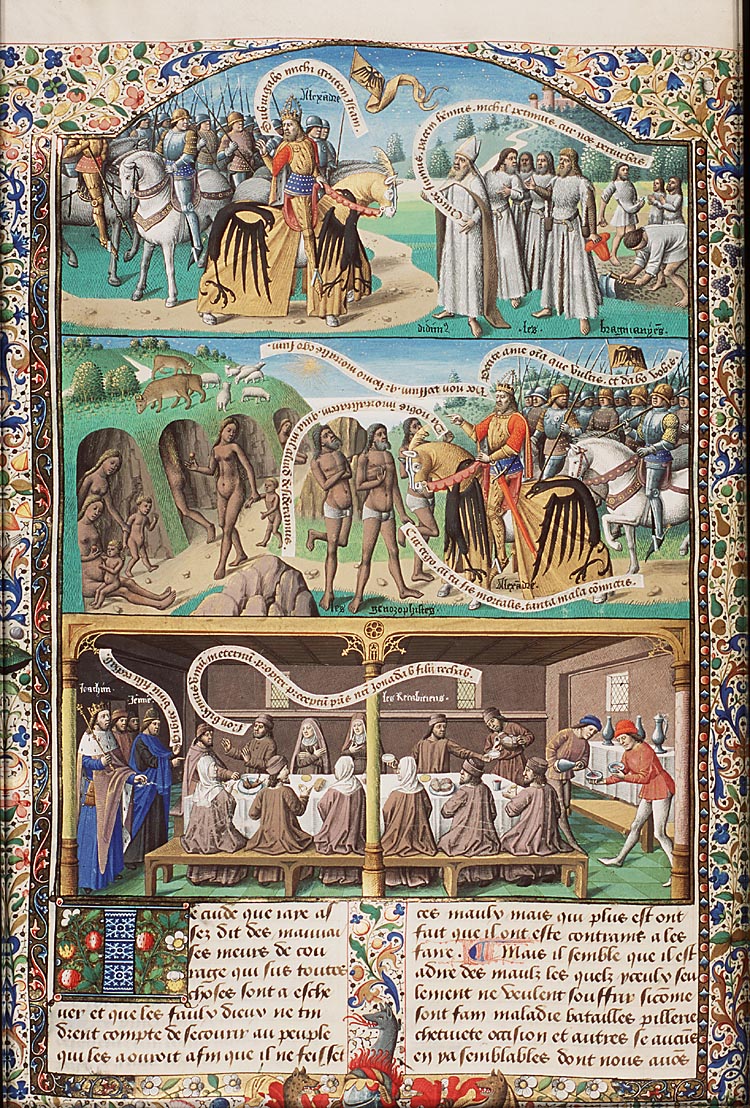
Illuminated manuscript page with three stacked painted scenes framed by floral borders. Top scene: a crowned king in gold robes with mounted armored soldiers meets robed figures in white on a green hillside. Middle scene: naked figures in rocky caves beside a crowned king on horseback with armored troops. Bottom scene: a banquet with seated figures at long tables under an arched hall. Columns of French text appear below.Painting

Secondary source

Alexander the Great meeting the Brahmanes

Maïtre François

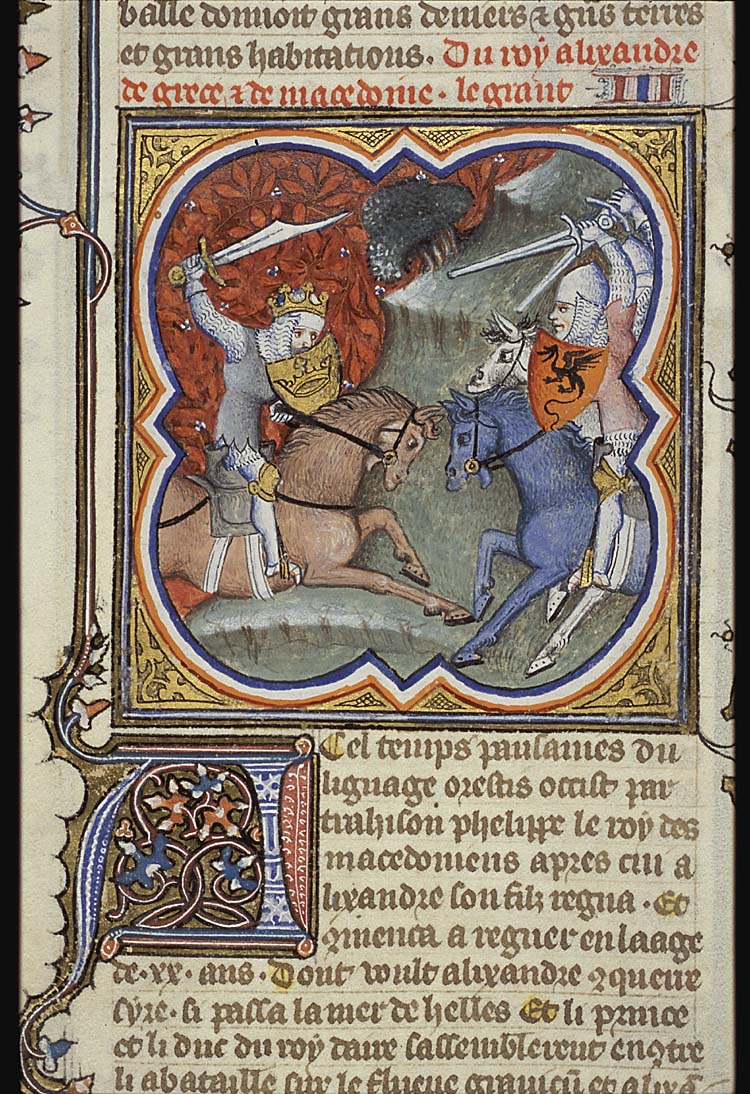
Illuminated manuscript page with a miniature painting of two mounted knights in armour fighting with swords. On the left, a crowned knight on a brown horse raises a sword against a knight on a blue-grey horse on the right, whose shield bears a red dragon. Gold border surrounds the scene; French text in columns runs below and above.Painting

Secondary source

Alexander fights Darius's nobles at the river Granicus, 1372

Jean Bondol · 1372

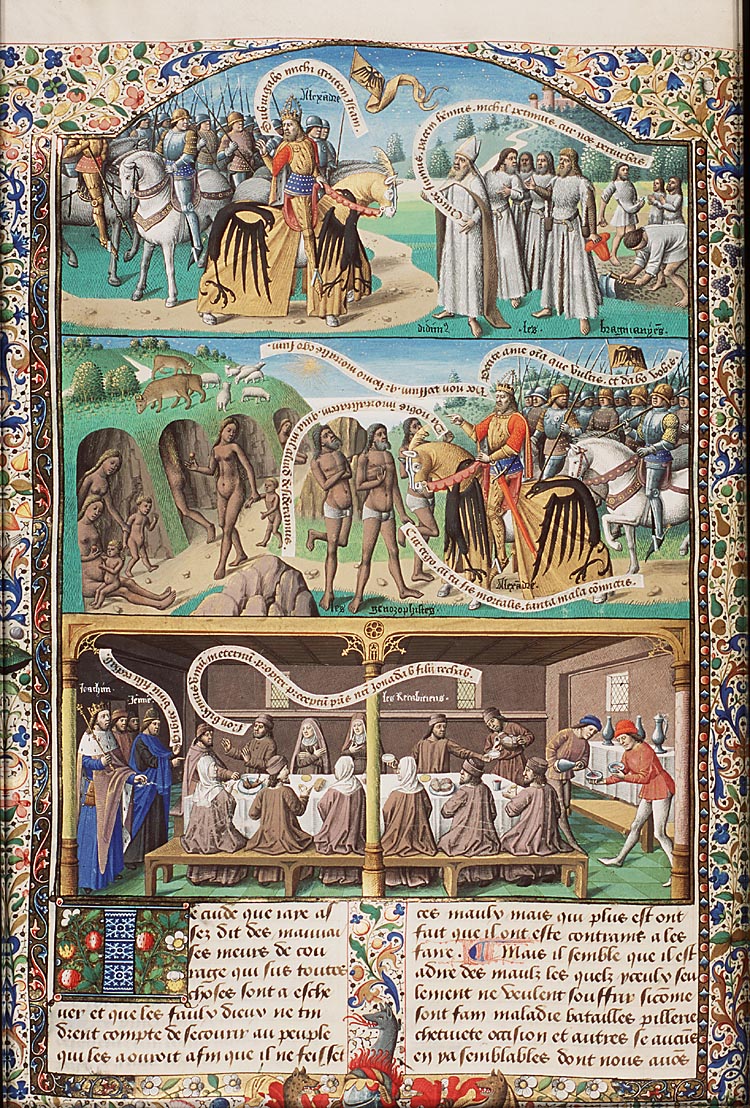
Illuminated manuscript page with three painted scenes separated by horizontal bands, framed by decorative borders with gold and floral motifs. The middle scene shows a crowned king on horseback with armored soldiers facing naked figures seated and standing among rocky caves and animals. Below is a dining hall scene with people at tables and a text block in French below.Painting

Secondary source

Alexander the Great meeting the Gymnosophists

Maïtre François

Book

Tertiary source

Alexander entry, Catholic Encyclopedia, 1913

1913

Book

Tertiary source

Alexander the Great entry, The New Student's Reference Work, 1914

1914

Alexandre le Grand dans la littérature française du moyen âgeBook

Secondary source

Alexandre le Grand dans la littérature française du moyen âge

Paul Meyer · 1886

Alessandro e Bucefalo: study of the Pompeian Alexander reliefBook

Secondary source

Alessandro e Bucefalo: study of the Pompeian Alexander relief

Domenico de Guidobaldi · 1851

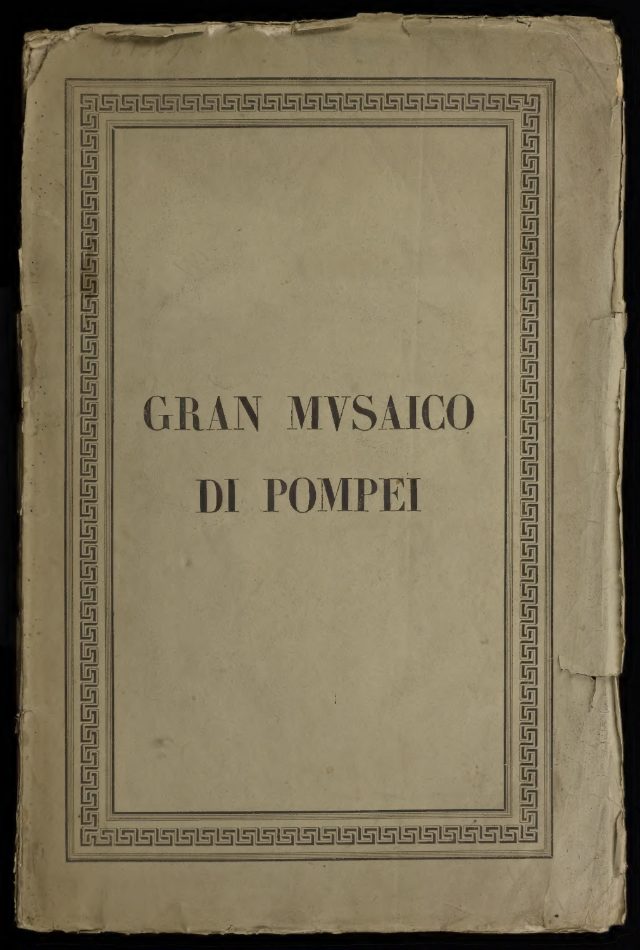
Description of the Pompeii mosaic discovered in 1831Book

Secondary source

Description of the Pompeii mosaic discovered in 1831

Antonio Niccolini · 1832

Il gran musaico Pompeiano, explained with critical observationsBook

Secondary source

Il gran musaico Pompeiano, explained with critical observations

Giuseppe Sanchez · 1853

Discourse on the great Pompeii mosaicBook

Secondary source

Discourse on the great Pompeii mosaic

Luigi Vescovali · 1832

Documentary

Secondary source

Parallel Lives of the Noble Greeks and Romans, Vol. 7

Plutarch

Book

Secondary source

History of Greece, Volume 7

George Grote · nineteenth century

Newspaper article

Secondary source

The Sidon Sarcophagi

Canon C. G. Curtis · 1894

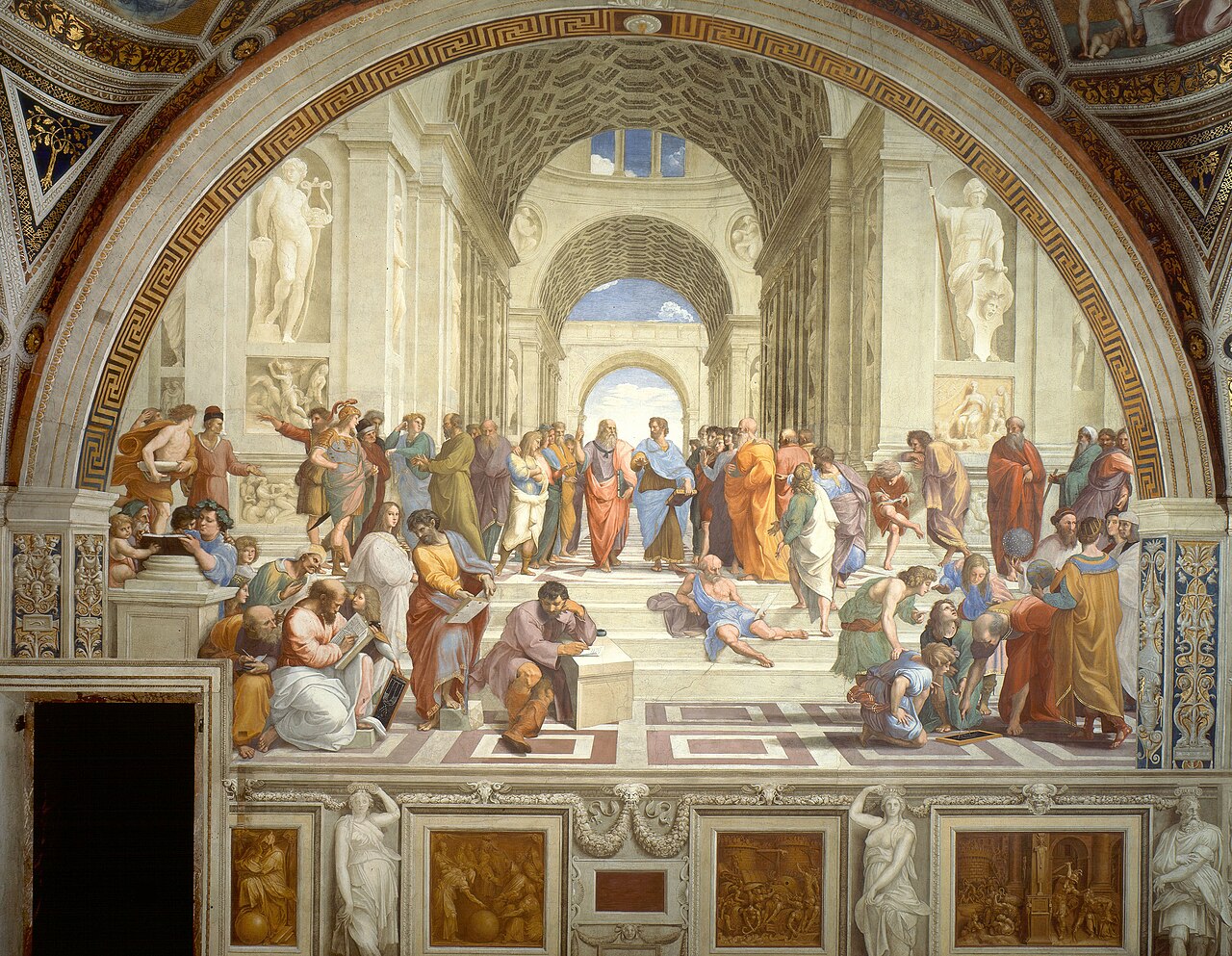
Raphael's fresco The School of Athens: a large Renaissance hall with arched ceiling and statues, filled with robed philosophers and scholars gathered on steps and a tiled floor. Two central figures in red and blue robes walk toward the viewer.Painting

Secondary source

The School of Athens

Raphael · 1509-1511

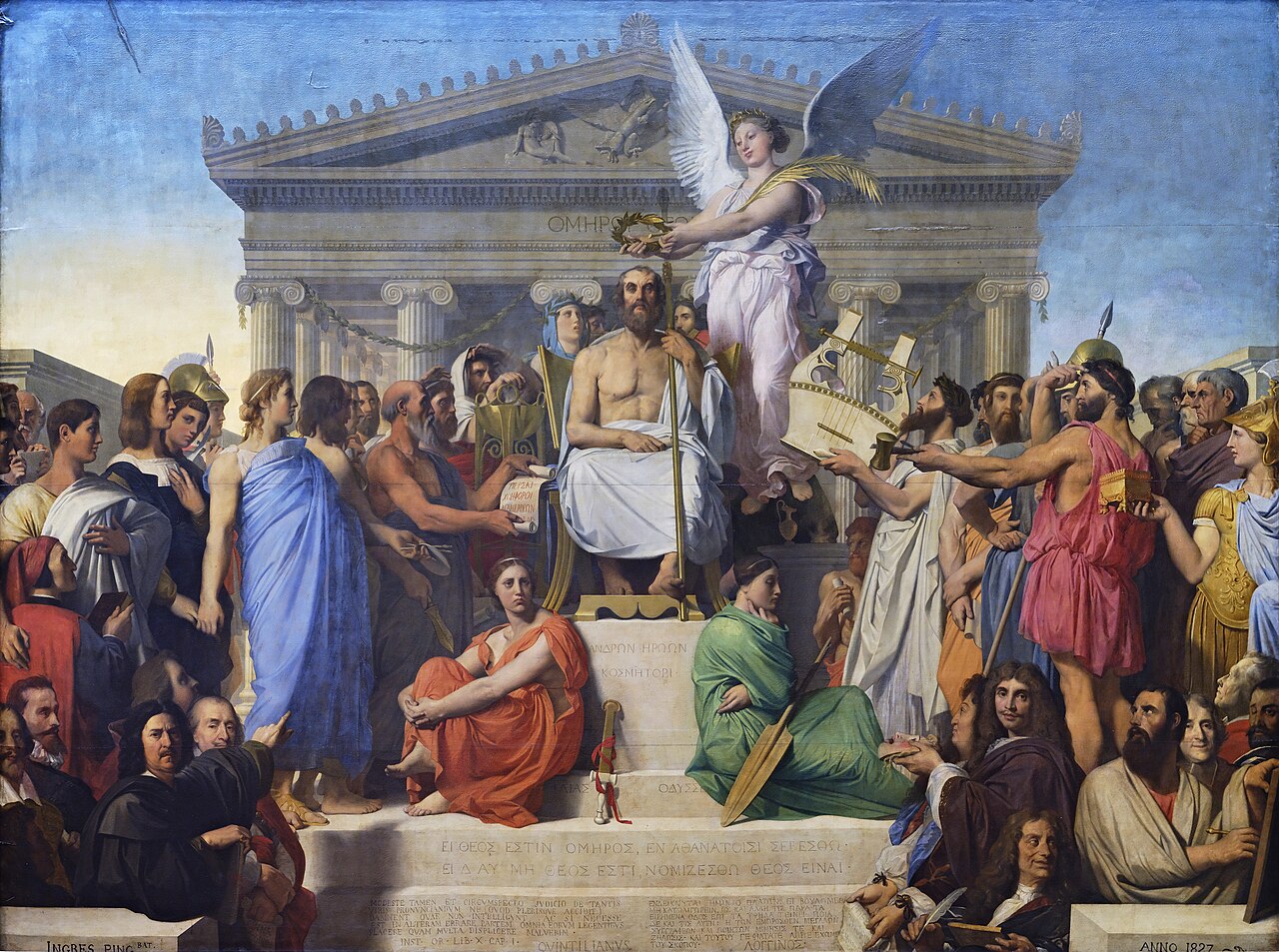
Ingres's painting The Apotheosis of Homer: a seated, bare-chested figure of Homer with a scepter at center, crowned by a winged Victory on a temple facade, surrounded by a crowd of figures from antiquity and later eras, with inscriptions on a stone pedestal below.Painting

Secondary source

The Apotheosis of Homer

Jean-Auguste-Dominique Ingres · 1827

Want the full shelf? Chat with Alexander the Great in the app and open the Sources panel — every quote links back to the original.

Trusted by educators worldwide

Conversations
375,000+
Real exchanges between students and historical figures
Messages exchanged
4,142,000+
Across every figure, classroom and language
Historical figures
100,000+
Each informed by a curated biography and selected sources
Languages supported
50+
From English and Spanish to Arabic and Korean

Paying customers

Used by 98 schools and universities

Partner school logo
Tecnológico de Monterrey logo
Hyper Island logo
Partner school logo
Chambersburg Area School District logo
Broward County Public Schools logo
Nebo School District logo
National Louis University logo
South Florida PBS logo
Punahou School logo
University of Wisconsin–River Falls logo
Partner school logo
Partner school logo
Archbishop Mitty High School logo
Kingsburg High School logo
Norwalk Public Schools logo
Partner school logo
Connections logo
Partner school logo
Moore Public Schools logo
Partner school logo
Partner school logo
Partner school logo
Partner school logo
Robbinsville Public Schools logo
Partner school logo
Partner school logo
Partner school logo
Tecnológico de Monterrey logo
Hyper Island logo
Partner school logo
Chambersburg Area School District logo
Broward County Public Schools logo
Nebo School District logo
National Louis University logo
South Florida PBS logo
Punahou School logo
University of Wisconsin–River Falls logo
Partner school logo
Partner school logo
Archbishop Mitty High School logo
Kingsburg High School logo
Norwalk Public Schools logo
Partner school logo
Connections logo
Partner school logo
Moore Public Schools logo
Partner school logo
Partner school logo
Partner school logo
Partner school logo
Robbinsville Public Schools logo
Partner school logo
Partner school logo

What educators are saying

“We enjoyed the program last year and used it frequently.”
“My students say it’s a welcome change of pace. I’m not a fan of the “sage on the stage” model, so I try to incorporate research-oriented and self-paced activities. With Humy, students have to take charge of their learning. They’ve become more adept at critical thinking, forming better questions, and improving their reading comprehension. The interview feature has been my go-to tool. I create assignments where students must ask historical figures a set number of questions, then summarize the responses to ensure they’re truly absorbing the material. This approach lets them actively explore the past rather than passively consuming information.”
“Humy has helped me bring historical figures, sometimes long past, to life. When my students interact with these figures in real-time, it eliminates some of the perceived “ancient” characteristics of my curriculum. This has shifted my students’ thinking away from viewing history as abstract or irrelevant. Real-time interactions make historical figures relatable, even allowing students to ask off-topic questions that help put historical lives in a more relevant context for 13-year-olds. The feature I use the most is the interview feature. After teaching a topic, most recently Gandhi and Joan of Arc, I have the students ask pointed, focused questions. We practice good conversation techniques beforehand, teaching them to listen (or read) carefully and formulate thoughtful follow-up questions rather than just interrogating. It helps students practice effective conversation skills.”

FAQ

Frequently asked questions

Who is Alexander the Great?
Macedonian king and military conqueror who created one of the largest empires in ancient history. On Humy.ai you can chat with an AI version of Alexander the Great that draws on a short biography and 88 historical sources during the conversation — by text or voice, in 42 languages.
Is Alexander the Great AI free?
Alexander the Great is part of Humy's full library of more than 100,000 figures, which comes with a paid plan. A free account (no credit card) includes 20 messages a month with the free library's figures, so you can try how the conversations work first.
What sources does the Alexander the Great AI use?
It draws on a short biography and 88 historical sources (books, paintings and artifacts), including “Alexander Mosaic”, “Alexander the Great riding Bucephalus” and “Silver Tetradrachm of Alexander the Great”. Each source has its own page on Humy.ai.
How historically accurate is the AI version of Alexander the Great?
Each figure uses a short biography and a small set of selected historical sources as context (retrieval-augmented generation), so answers stay closer to known material than the model's general knowledge alone. It isn't a citation-grade research tool — like any LLM, the AI can get details wrong or extrapolate. Treat it as a strong starting point for inquiry and cross-reference important claims.
Can I talk to Alexander the Great by voice?
Yes. In addition to text chat, you can call Alexander the Great and hear their voice respond in real time — useful for auditory learners, interview practice and Socratic dialogue.
Is Humy.ai safe and compliant for schools?
Yes. Humy.ai is used by more than 100 schools, universities and organisations. The platform is FERPA- and GDPR-aligned, supports SSO, and offers an IT-approval pack tailored for school procurement teams.

Cross-reference Alexander the Great

Like any LLM, the AI version of Alexander the Great can get details wrong. Open one of these sources in a new tab to verify what you’ve read.

Ready when you are

Start chatting with Alexander the Great now.

20 messages free · No credit card · Available in 50+ languages.