


Primary sourcePainting1668
Illustration from Renati Descartes Epistolae
René Descartes · 1668
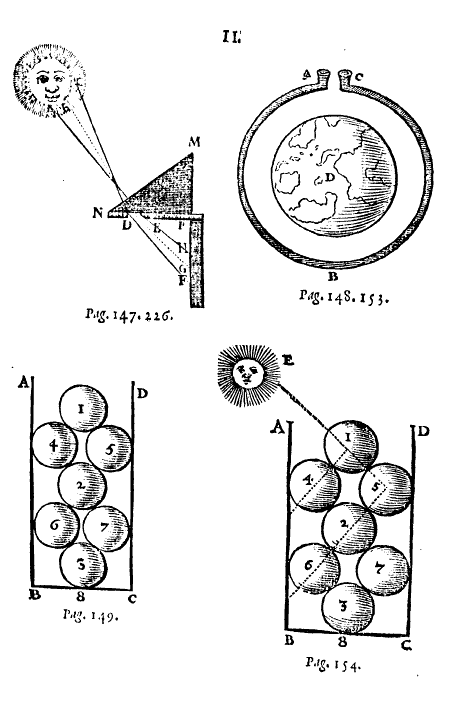
A diagram from the 1668 London edition of Descartes's Latin letters, showing his mechanical view of light and the cosmos.
This diagram from Descartes's published letters illustrates his mechanical philosophy of the physical world.
About this source
What it is
This illustration appears in the Renati Descartes Epistolae, a 1668 Latin edition of René Descartes's letters printed in London. The page contains diagrams including a sun with rays striking a prism-like shape, a globe, and circles arranged in grids, used to explain his philosophical and physical ideas.
Why it matters
Descartes argued that the world could be explained through matter and motion rather than invisible spiritual forces — an idea captured in the description of this page as showing "a soulless world made of tiny little spheres." His letters, published after his death, spread these ideas across Europe.
Look closer
- What do the diagrams of circles and the sun seem to be trying to explain?
- Why might publishers have included diagrams alongside Descartes's letters?
- What does the phrase describing this world as "soulless" suggest about how Descartes saw nature?
This painting is part of the curated material that grounds the AI version of Rene Descartes on Humy.ai — when students ask about related events, the AI can quote it and cite it.
More Rene Descartes sources
Meet the AI Rene Descartes → Book
Primary source
Discourse on the Method
René Descartes · 1637
 Book
Primary source
Meditations on First Philosophy
René Descartes · 1641
 Document
Primary source
La Géométrie
René Descartes · 1637
 Painting
Primary source
Portrait of René Descartes
Frans Hals · 1649
 Book
Primary source
Principles of Philosophy
René Descartes · 1644
Ready when you are
Start chatting with Rene Descartes now.
20 messages free · No credit card · Available in 50+ languages.