


Secondary sourceBookoral from 5th century BCE; written c. 29 BCE
Pali Canon (Tipitaka)
Early Buddhist sangha · oral from 5th century BCE; written c. 29 BCE
The Pali Canon is the fullest surviving collection of the Buddha's discourses and monastic rules, preserved by the early Buddhist community.
This is the fullest surviving record of the Buddha's own discourses and the monastic rules attributed to him.
About this source
What it is
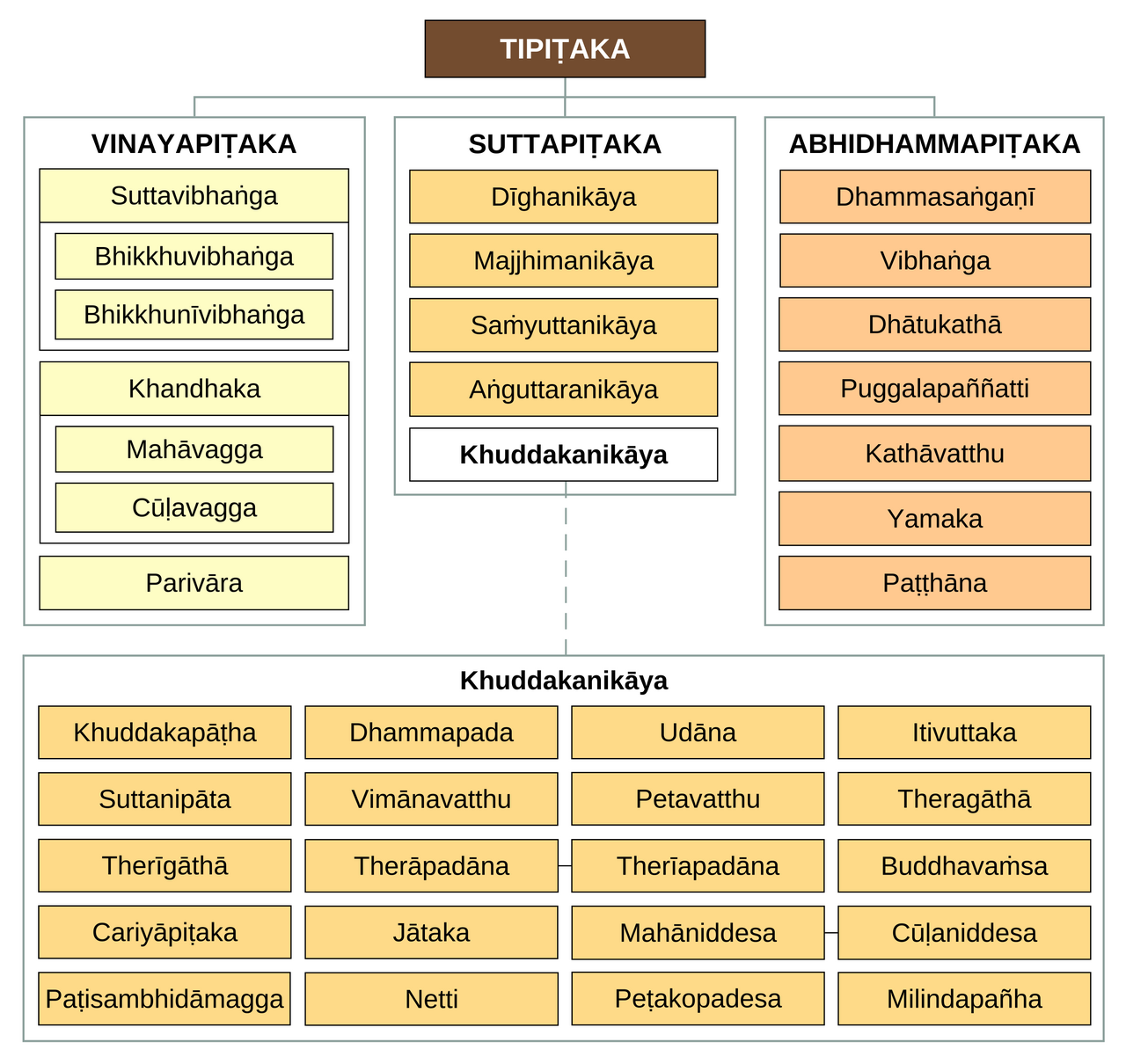
The Tipitaka, or Pali Canon, is a collection of texts preserved orally from the 5th century BCE by the early Buddhist sangha (community) and written down in Sri Lanka around 29 BCE. It is organised into three baskets: the Vinaya (monastic rules), the Sutta (discourses), and the Abhidhamma (philosophical analysis). The diagram shows this structure.
Why it matters
The Pali Canon is the most complete surviving record of what the Buddha is said to have taught and how the early monastic community he founded was meant to live. Because it was passed down orally for centuries before being written, it reflects both the Buddha's teaching and generations of monks who memorised and transmitted it.
Look closer
- What problems can arise from passing texts down by memory for centuries before writing them?
- Why might the early community have organised the teachings into three distinct sections?
- How might our understanding of the Buddha differ if this record did not survive?
This book is part of the curated material that grounds the AI version of Buddha on Humy.ai — when students ask about related events, the AI can quote it and cite it.
More Buddha sources
Meet the AI Buddha → Book
Secondary source
Dhammapada
Attributed to the Buddha · c. 3rd century BCE compilation
 Painting
Secondary source
Buddha in Dhyana, Perfection of Wisdom Sutra Manuscript
1074
 Sculpture
Secondary source
Head of the Buddha, Gandhara style
 Document
Secondary source
Life of the Buddha
19th century
 Painting
Secondary source
The Life of the Buddha Shakyamuni
Unknown Tibetan painter
Ready when you are
Start chatting with Buddha now.
20 messages free · No credit card · Available in 50+ languages.