


Primary sourceArtifact1637
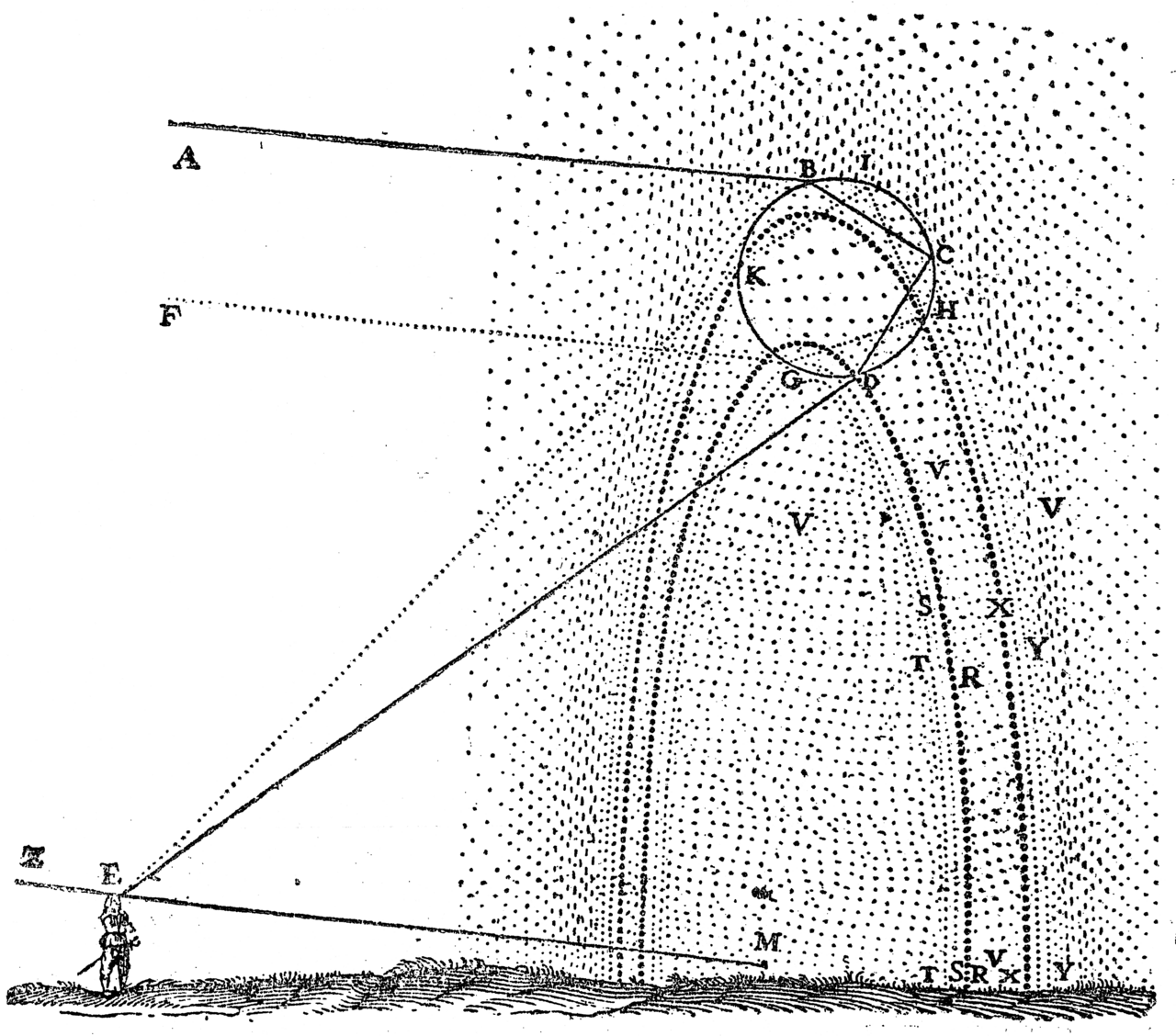
Sketch of how a rainbow forms
René Descartes · 1637
Descartes's own diagram explaining how light forms a rainbow, drawn for his 1637 scientific essays.
Descartes drew this diagram himself to explain his scientific theory of how rainbows form.
About this source
What it is
This is a diagram drawn by René Descartes showing how a rainbow forms, published as part of his scientific essays in 1637. It shows a large droplet, labeled with letters, with light rays entering and reflecting inside it, along with a small figure observing the effect.
Why it matters
This diagram is part of Descartes's work in optics, where he tried to explain natural phenomena like rainbows using geometry and the behavior of light. It shows how he combined careful observation with mathematical reasoning, a method central to his approach to science.
Look closer
- Why might Descartes use letters and labeled points rather than just words to explain the rainbow?
- What does the small standing figure in the diagram suggest about how he wanted to show the viewer's perspective?
- What does this diagram reveal about how light and droplets interact, and what might it simplify or leave out?
This artifact is part of the curated material that grounds the AI version of Rene Descartes on Humy.ai — when students ask about related events, the AI can quote it and cite it.
More Rene Descartes sources
Meet the AI Rene Descartes → Book
Primary source
Discourse on the Method
René Descartes · 1637
 Book
Primary source
Meditations on First Philosophy
René Descartes · 1641
 Document
Primary source
La Géométrie
René Descartes · 1637
 Painting
Primary source
Portrait of René Descartes
Frans Hals · 1649
 Book
Primary source
Principles of Philosophy
René Descartes · 1644
Ready when you are
Start chatting with Rene Descartes now.
20 messages free · No credit card · Available in 50+ languages.