


Primary sourceBook1870
The Eternal Husband
Fyodor Dostoyevsky · 1870
A novella by Dostoyevsky, first published in 1870, about a jealous widower and the nobleman who was once his wife's lover. It is a tightly built story of jealousy.
This novella is one of Dostoyevsky's own works, showing his interest in jealousy, guilt and the damaged lives left by a secret affair.
About this source
What it is
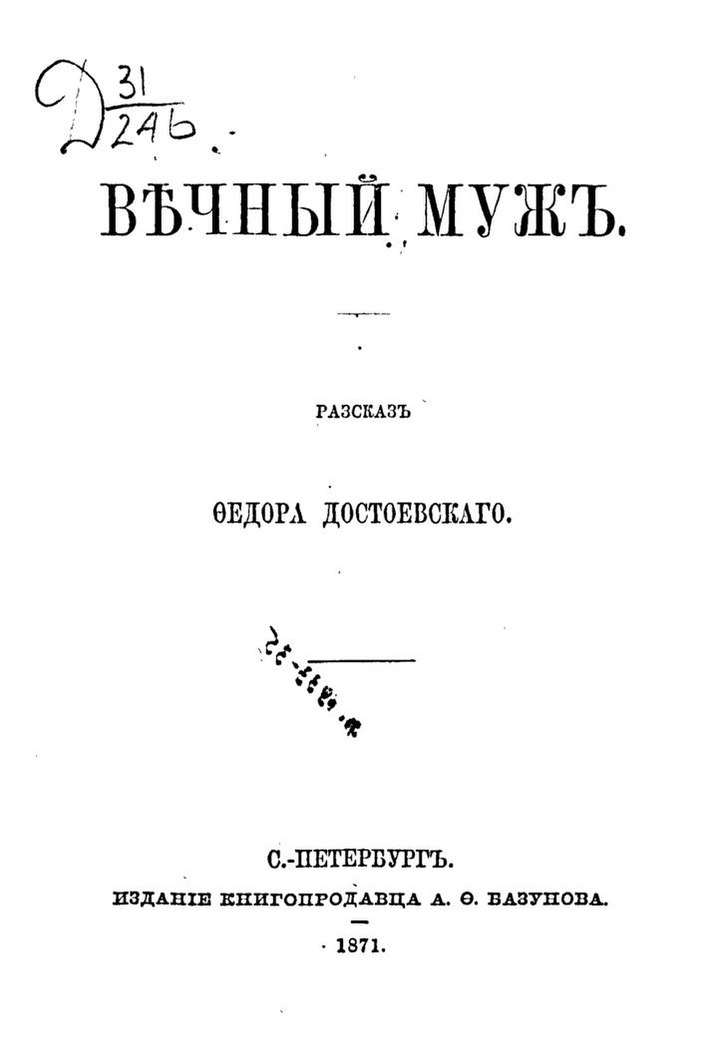
This is a novella by Fyodor Dostoyevsky, first published in 1870 in the magazine Zarya. It follows the nobleman Velchaninov and the widower Trusotsky, whose dead wife was once Velchaninov's lover. The image shows a scanned title page of a Russian book edition printed in Saint Petersburg and published by A. F. Bazunov in 1871, not the 1870 magazine printing itself.
Why it matters
Critics count The Eternal Husband among Dostoyevsky's most carefully built works, although it is one of his lesser-known novels. The story mixes tragedy, the death of an eight-year-old girl, with comedy in the figure of Trusotsky, a man who seems destined to repeat the role of the cuckold. The American novelist Henry Miller named it his favourite of Dostoyevsky's works. The novella shows how one past affair can shape the lives of several people years later.
Look closer
- What does the title page tell you about how this book reached readers in 1871, and what might the handwritten marks suggest about who owned it?
- Why might the story begin in the middle of events, and how does that change what you expect of Velchaninov?
- Which characters does the story seem to treat with sympathy, and which does it mock?
This book is part of the curated material that grounds the AI version of Fyodor Dostoevsky on Humy.ai — when students ask about related events, the AI can quote it and cite it.
More Fyodor Dostoevsky sources
Meet the AI Fyodor Dostoevsky → Book
Primary source
Crime and Punishment
Fyodor Dostoyevsky · 1866
 Book
Primary source
The Brothers Karamazov
Fyodor Dostoyevsky · 1879-1880
Primary source
The Grand Inquisitor
Fyodor Dostoyevsky · 1879
 Book
Primary source
Notes from Underground
Fyodor Dostoyevsky · 1864
 Book
Primary source
The House of the Dead
Fyodor Dostoyevsky · 1860-1862
Ready when you are
Start chatting with Fyodor Dostoevsky now.
20 messages free · No credit card · Available in 50+ languages.