Portrait of Fyodor Dostoevsky

AI Historical Figure

Fyodor Dostoevsky

Influential Russian novelist and philosopher.

Chat with Fyodor Dostoevsky via text or voice — in 42 languages, drawing on a curated biography and 93 historical sources. Available 24/7.

Start chatting with Fyodor Dostoevsky20 messages free · No credit card
Lived
1821–1881
From
Russia
Known for
PhilosophyLiterature & writing
Fyodor Dostoevsky

Fyodor Dostoevsky

Online · responds in seconds

Hello — I'm Fyodor Dostoevsky. Influential Russian novelist and philosopher. What would you like to ask me?

20 messages free · No credit card · Powered by Humy.ai

Live preview · Switch between 42 languages above · Send a message to continue in the app

Multilingual

Talk to Fyodor Dostoevsky in 42 languages

Ask Fyodor Dostoevsky questions in any language below, and the rest of Humy's app speaks it too. Pick yours to open the chat in that language.

Also in German (Austria), German (Switzerland), English (UK), English (Australia), English (Canada).

The sources behind this AI

93 sources · 56 books · 15 documents · 6 newspaper articles · 4 paintings · 3 artifacts · 3 letters · 2 photographs · 2 documentaries · 1 speech · 1 sculpture

Fyodor Dostoevsky doesn’t improvise from thin air. The AI is grounded in 93 curated historical sources students can inspect. Open any of them to see what informs the conversation.

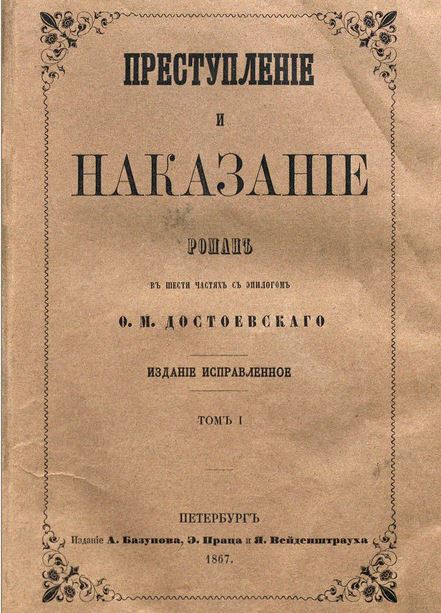
Title page of the 1867 Russian edition of Crime and Punishment, volume 1, on tan paper with ornate black borders. Large Cyrillic title reads Преступление и наказание, with Роман, Ф. М. Достоевского, Издание исправленное, Том I, and Петербург, published by A. Bazunov, E. Prats and Ya. Veidenshtraukh, 1867.Book

Primary source

Crime and Punishment

Fyodor Dostoyevsky · 1866

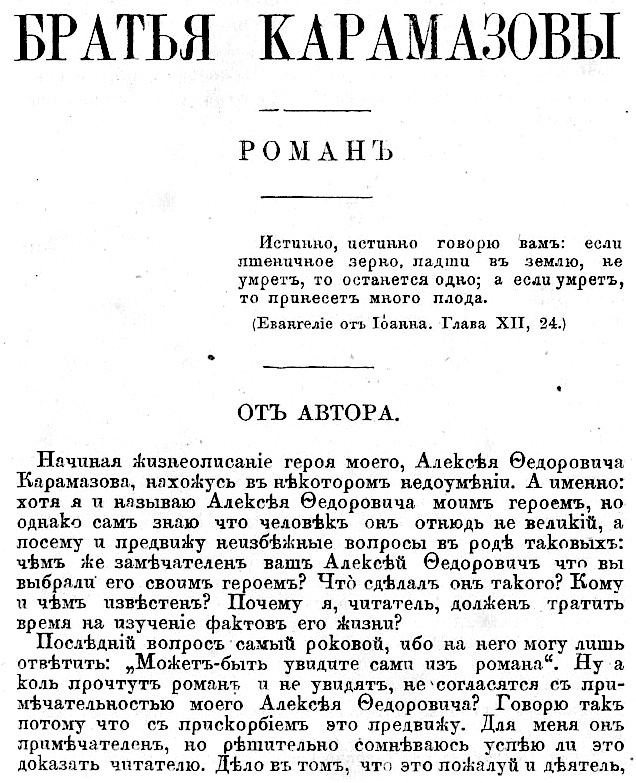
Scan of the title page of the first edition of The Brothers Karamazov in Russian. Large heading reads 'Братья Карамазовы', below it 'Роман', then an epigraph from the Gospel of John chapter 12 verse 24, then the heading 'От автора' and the opening paragraphs of the author's preface in Cyrillic print.Book

Primary source

The Brothers Karamazov

Fyodor Dostoyevsky · 1879-1880

Book

Primary source

The Grand Inquisitor

Fyodor Dostoyevsky · 1879

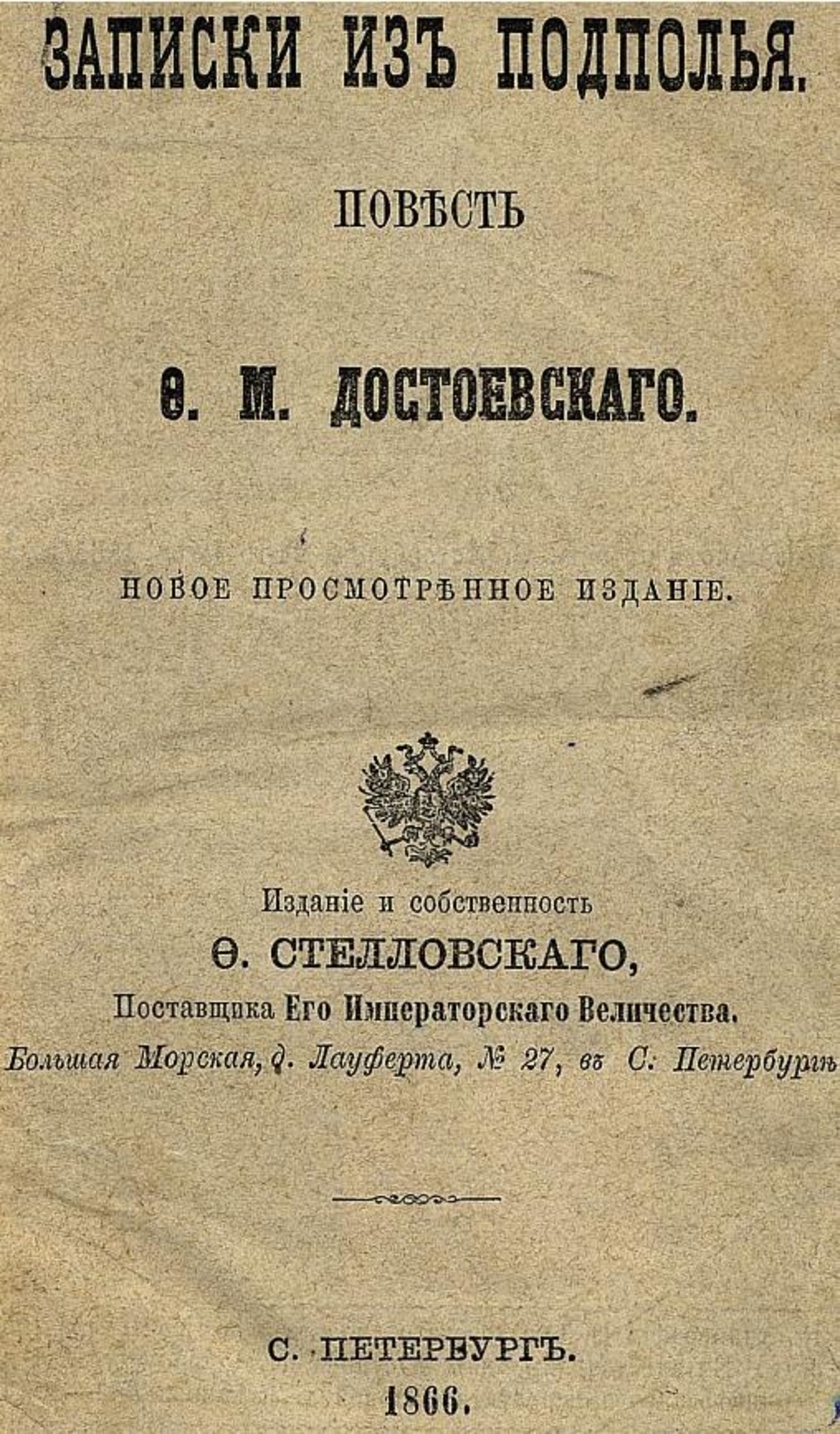
Title page of the 1866 Russian edition of Notes from Underground by F. M. Dostoevsky, printed in Cyrillic with a double-headed eagle emblem, publisher F. Stellovsky, St. Petersburg, 1866.Book

Primary source

Notes from Underground

Fyodor Dostoyevsky · 1864

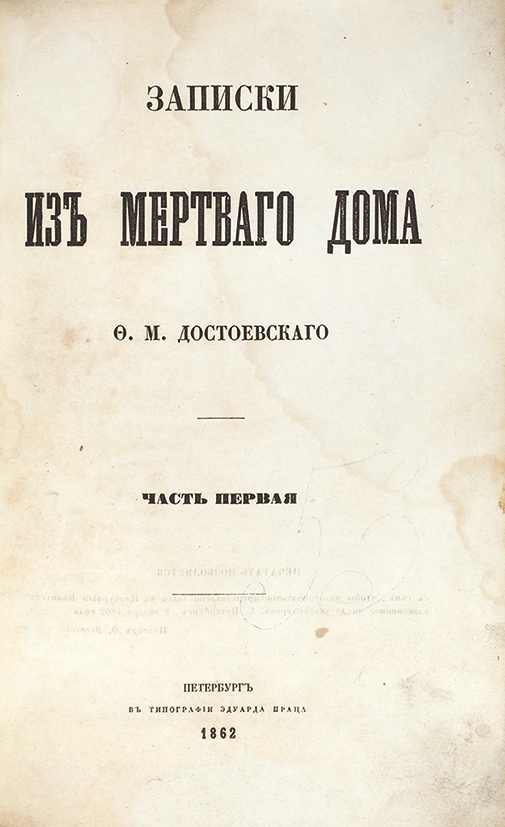
Title page of the 1862 first separate edition of Dostoevsky's Записки из мертвого дома (Notes from a Dead House), in Russian Cyrillic. Printed title reads Записки из мертвого дома, Ф. М. Достоевскаго, Часть первая, Петербургъ, в типографии Эдуарда Праца, 1862. Yellowed paper with faint stains.Book

Primary source

The House of the Dead

Fyodor Dostoyevsky · 1860-1862

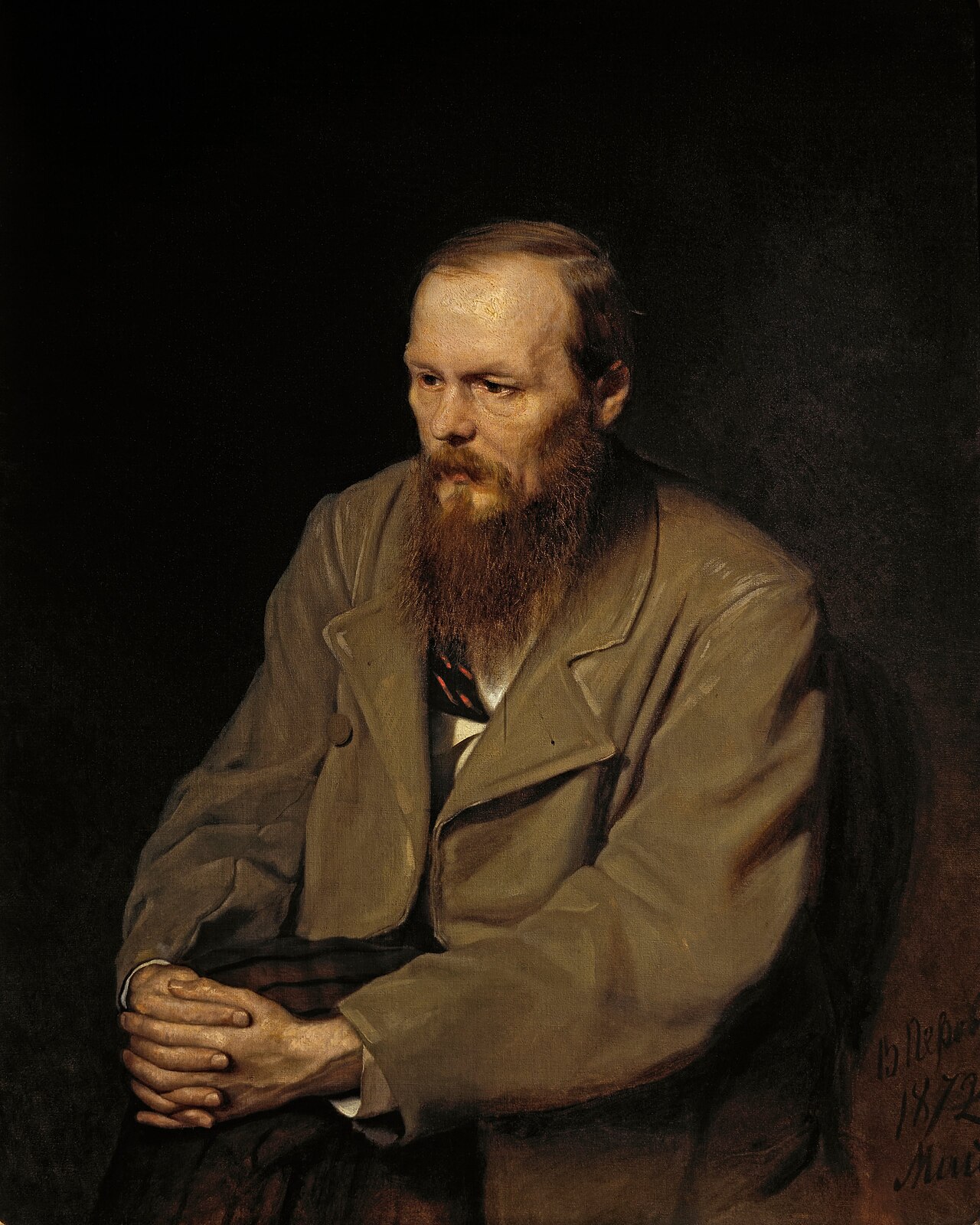
Oil painting of a bearded man seated in a brown overcoat with his hands clasped, gazing to the left against a dark background. The signature and the date 1872 are visible in the lower right corner.Painting

Primary source

Portrait of Fyodor Dostoyevsky

Vasily Perov · 1872

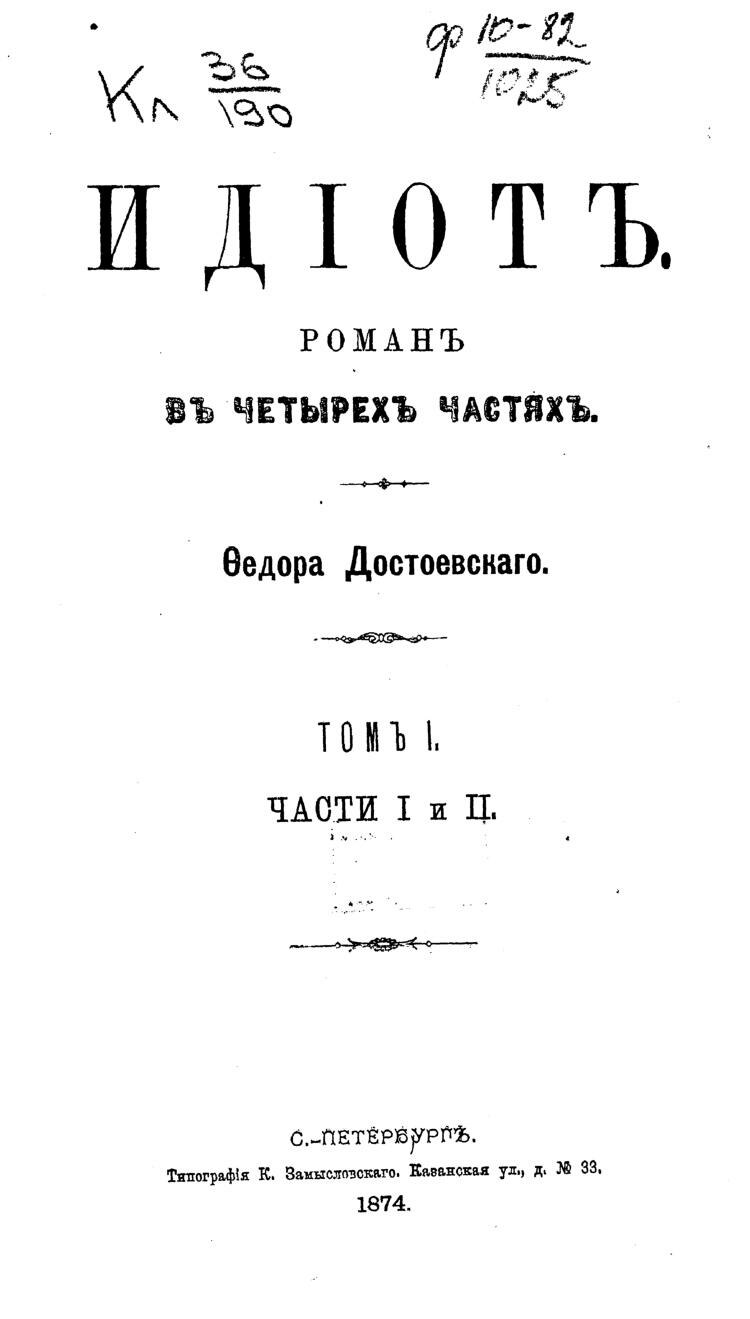
Title page of the Russian novel Idiot by Fyodor Dostoevsky, in four parts, Tom I, Parts I and II, printed in St. Petersburg by K. Zamyslovsky in 1874. Handwritten library shelf marks appear in the top corners.Book

Primary source

The Idiot

Fyodor Dostoyevsky · 1867-1869

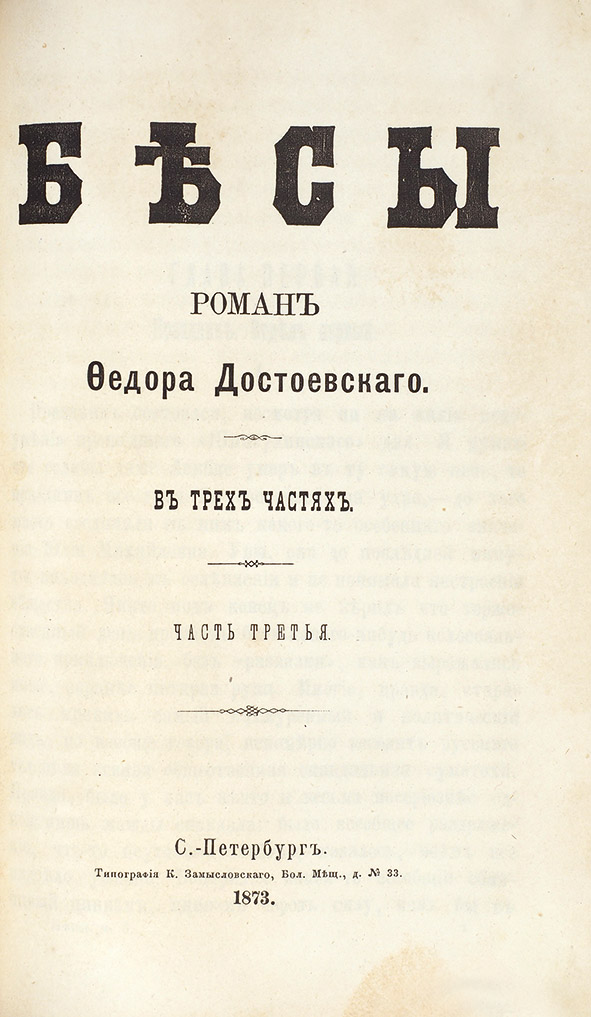
Title page of the 1873 first separate edition of Dostoevsky's novel Demons. Large black Cyrillic letters read БЕСЫ across the top, followed by ROMAN (novel) by Fyodor Dostoevsky, In Three Parts, Part Three, and the imprint S.-Petersburg, printer K. Zamyslovsky, 1873. Yellowed paper with faint text ghosting through from the reverse side.Book

Primary source

Demons

Fyodor Dostoyevsky · 1871-1872

Speech

Secondary source

Dostoyevsky's Pushkin Speech

Fyodor Dostoyevsky · 8 June 1880 (O.S.)

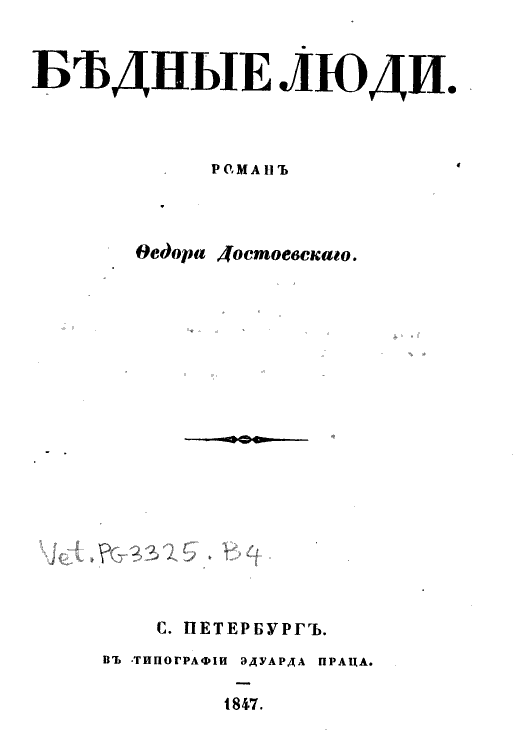
Title page of the 1847 first edition of the novel Poor Folk in Russian. Large heading 'Бедные люди.' with 'Роман' below and 'Федора Достоевскаго' in italics. Bottom lists 'С. Петербургъ', printer 'Типографии Эдуарда Праца', and the year 1847. Faded library call number stamp in the middle.Book

Primary source

Poor Folk

Fyodor Dostoyevsky · 1844-1846

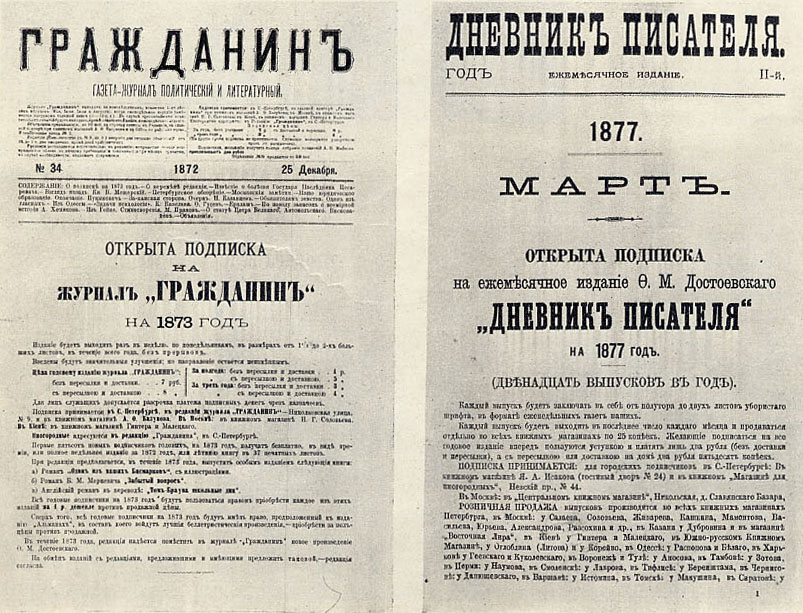
Two side-by-side 19th-century Russian newspaper or journal pages. Left: masthead of 'Гражданин' (The Citizen), dated 25 December 1872, with a subscription announcement for 1873. Right: masthead of 'Дневник писателя' (A Writer's Diary), 1877, March issue, with a subscription announcement for 1877 in Cyrillic print.Newspaper article

Primary source

A Writer's Diary

Fyodor Dostoyevsky · 1873-1881

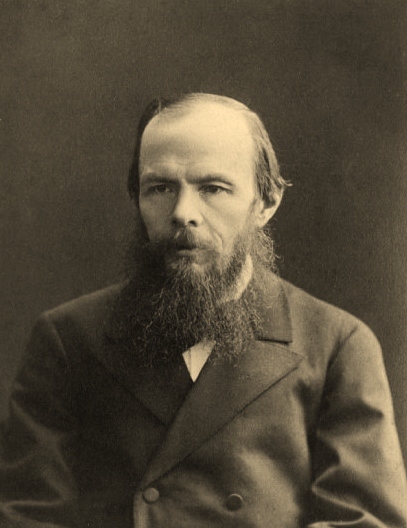
Sepia-toned studio portrait of a bearded man with receding hair, wearing a dark double-breasted coat and white collar, looking directly at the camera against a dark background.Photograph

Primary source

Photograph of Dostoevsky by Konstantin Shapiro

Konstantin Shapiro · 1879

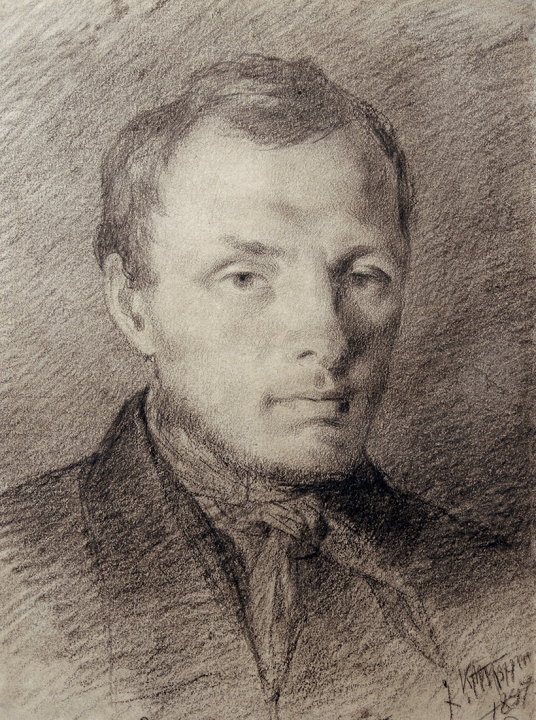
Charcoal or pencil portrait drawing of a young man with short dark hair, shown from the shoulders up, turned slightly to the viewer, wearing a dark coat and cravat against a shaded background. A signature and date, 1847, appear in the lower right corner.Painting

Primary source

Portrait Drawing of Dostoevsky by Trutovsky

Konstantin Trutovsky · 1847

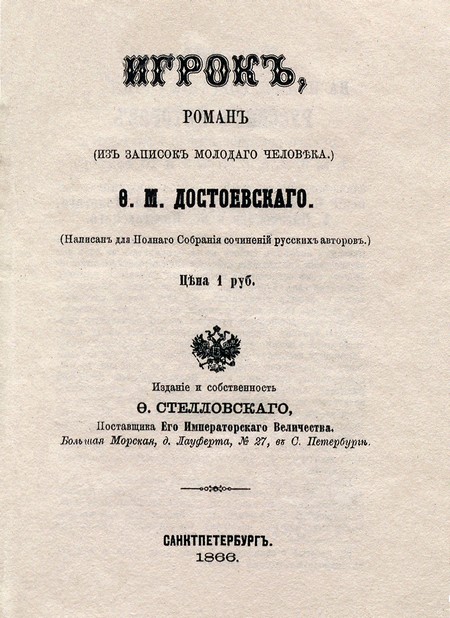
Title page of the 1866 first edition of Dostoyevsky's novel 'The Gambler' in Russian. Large decorative heading 'ИГРОК', with 'Роман', 'Ф. М. Достоевского', a price of 1 rub, a double-headed eagle emblem, publisher F. Stellovsky, and 'Санктпетербург 1866' at the bottom.Book

Primary source

The Gambler

Fyodor Dostoyevsky · 1866

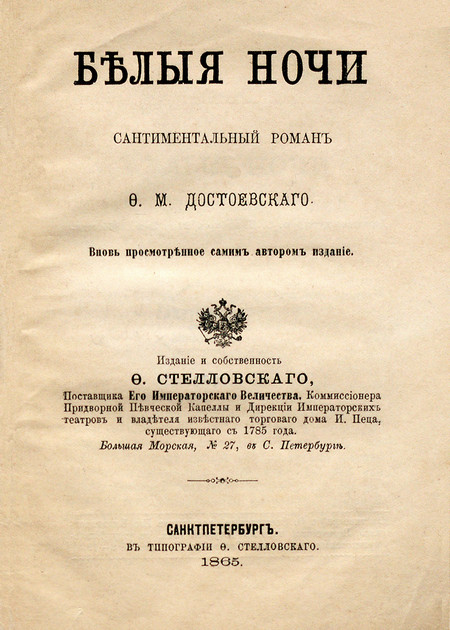
Title page of a Russian book in Cyrillic: 'Белыя ночи, сентиментальный роман Ф. М. Достоевскаго', with a double-headed imperial eagle emblem, publisher's notice, and imprint 'Санктпетербургъ, 1865' at the bottom.Book

Primary source

White Nights

Fyodor Dostoyevsky · 1848

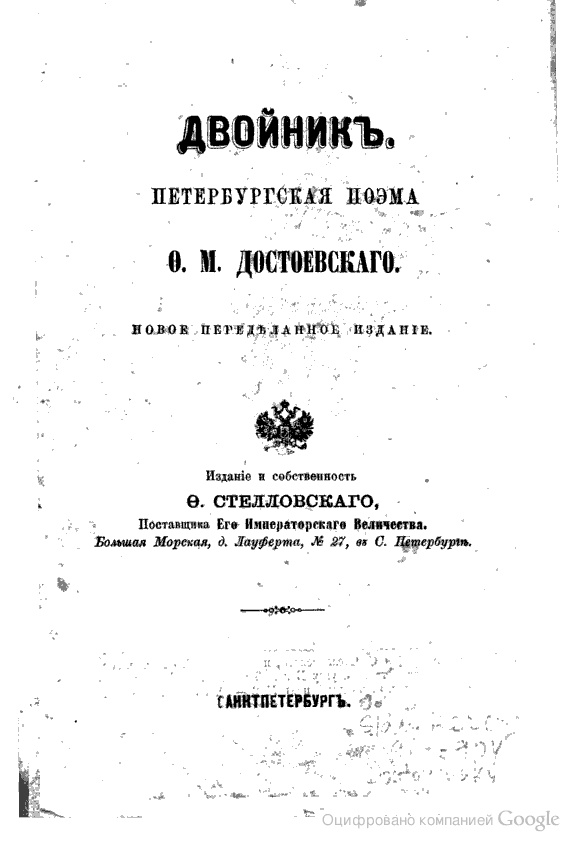
Title page of a Russian edition of Dostoevsky's novella Dvoinik, Petersburg Poem, by F. M. Dostoevsky, new revised edition, published by F. Stellovsky, Saint Petersburg, with an imperial double-headed eagle emblem. Scanned, with a Google watermark at bottom.Book

Primary source

The Double

Fyodor Dostoyevsky · 1845

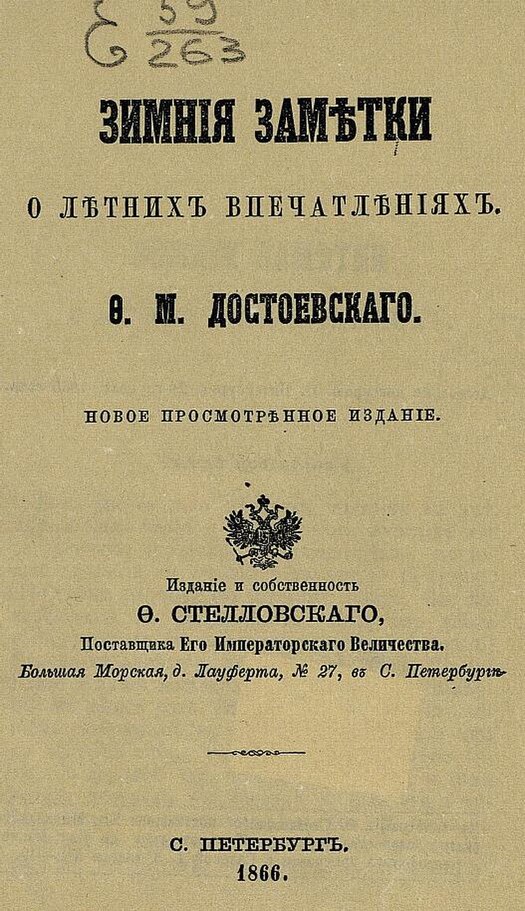
Title page of an 1866 Russian edition of Dostoevsky's Winter Notes on Summer Impressions. Cyrillic title text reads Зимние заметки о летних впечатлениях, with the author's name, a double-headed eagle emblem, publisher details, and the place and year S. Petersburg 1866 at the bottom. A library call number is handwritten in the top left corner.Book

Primary source

Winter Notes on Summer Impressions

Fyodor Dostoyevsky · 1862

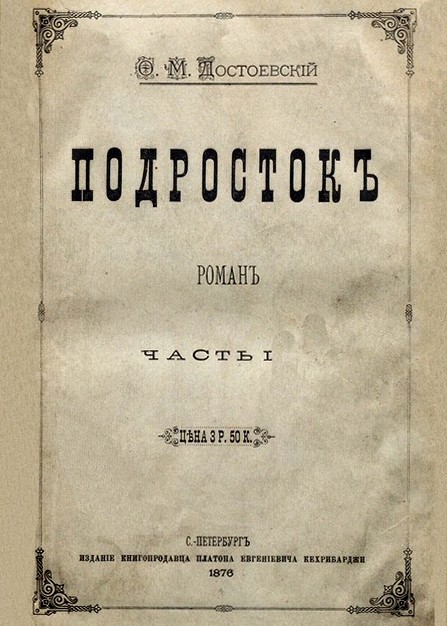
Title page of the first separate edition of the novel Podrostok (The Adolescent) by F. M. Dostoevsky. Cream-colored page with ornamental corners, Cyrillic text reading the author's name, the title, 'Roman', 'Chasti I', a price of 3 rubles 50 kopeks, and publication details: St. Petersburg, bookseller Platon Kekhribardzhi, 1876.Book

Primary source

The Adolescent

Fyodor Dostoyevsky · 1874

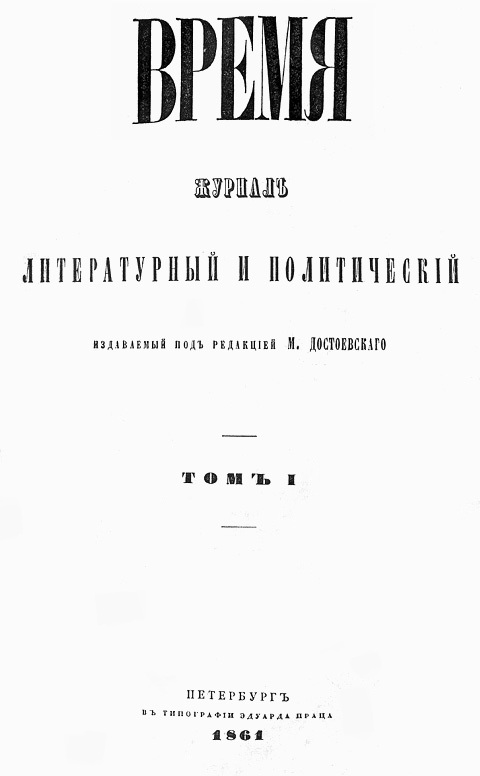
Title page of the first volume of the Russian periodical Vremya (1861). Large Cyrillic masthead reads 'Время', with the subtitle 'журнал литературный и политический, издаваемый под редакцией М. Достоевского', 'Том I', and 'Петербургъ, в типографии Эдуарда Праца, 1861' at the bottom.Newspaper article

Primary source

Vremya

Fyodor Dostoyevsky and Mikhail Dostoyevsky · 1861

Book

Primary source

The Dream of a Ridiculous Man

Fyodor Dostoyevsky · 1877

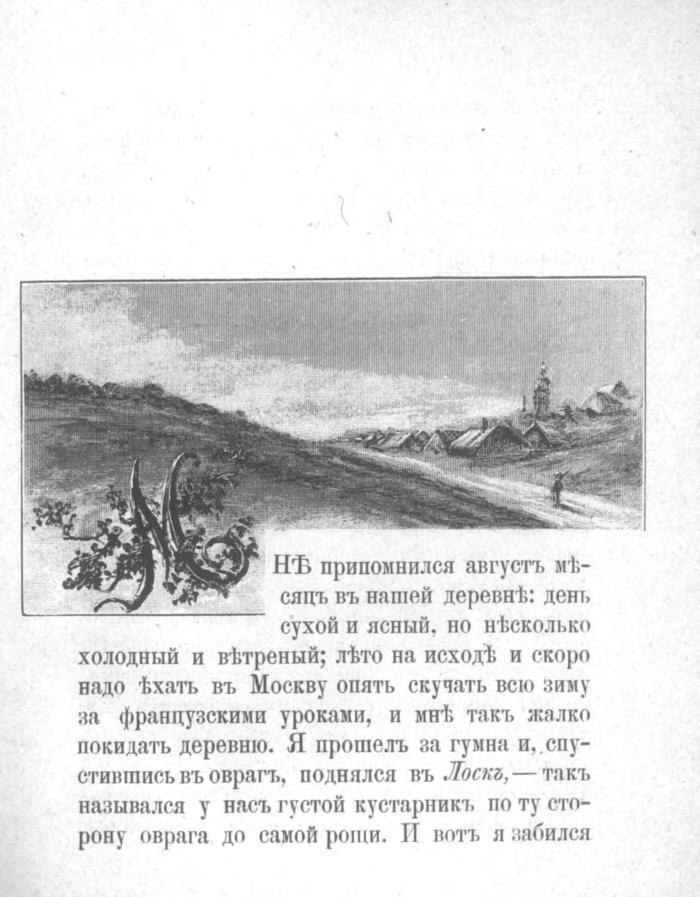
Scanned first page of a Russian book. At top is an engraved illustration of a rolling hilly landscape with a road, a village of low houses, a church tower, and a figure on the road. Below is Cyrillic text beginning with a large decorative initial letter.Book

Primary source

The Peasant Marey

Fyodor Dostoyevsky · 1876

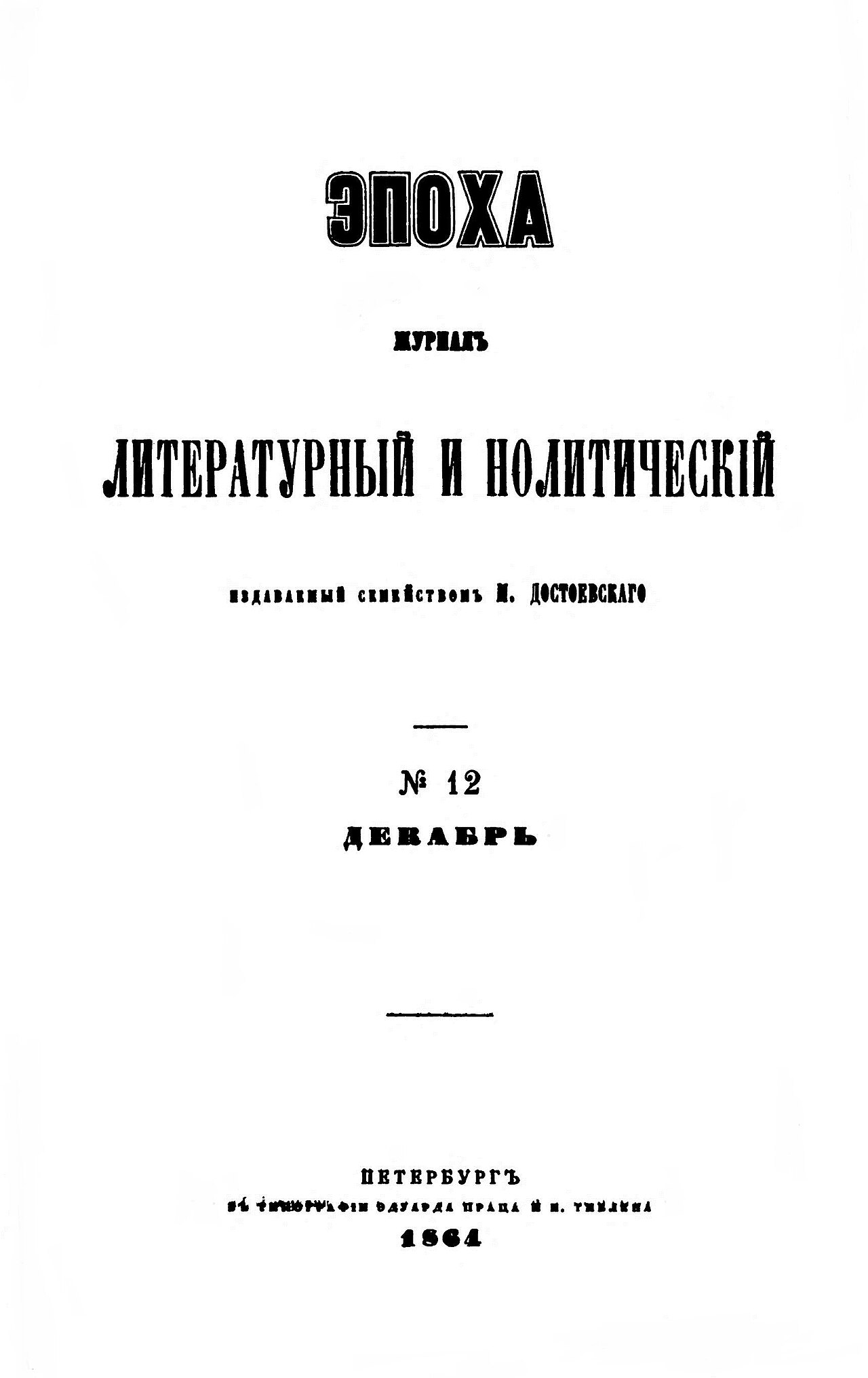
Title page of the Russian magazine Epoha (Эпоха), a literary and political journal published by the Dostoevsky brothers. Large heading reads Эпоха, followed by Журнал литературный и политический, издаваемый семейством М. Достоевского. Issue No. 12, Декабрь, and Петербург, 1864 at the bottom.Newspaper article

Primary source

Epoch

Fyodor Dostoyevsky and Mikhail Dostoyevsky · 1864

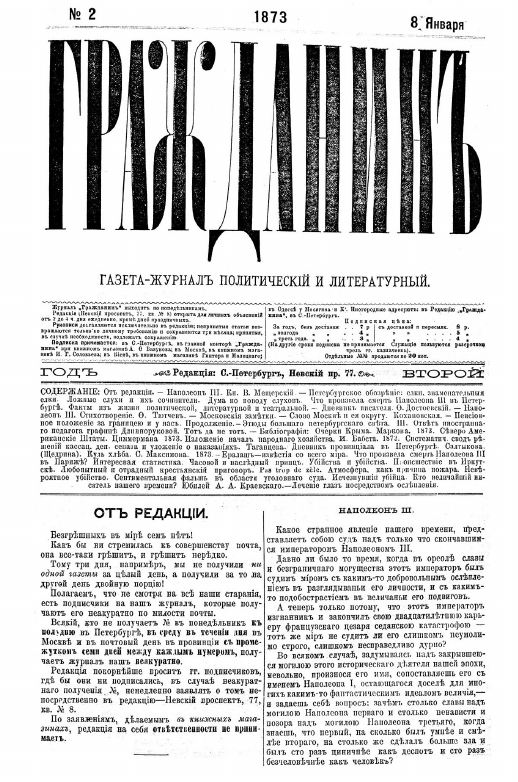
Front page of the Russian newspaper-journal Grazhdanin, issue No. 2, dated 8 January 1873 (Russian calendar), second year. Large masthead reads Гражданин with the subtitle 'Газета-журналъ политический и литературный'. Below is a dense two-column layout of Russian text with section headings, including 'От редакции' (From the editors) and 'Наполеон III' in the right column.Newspaper article

Primary source

Grazhdanin

Vladimir Meshchersky (founder); edited by Fyodor Dostoyevsky · 1872

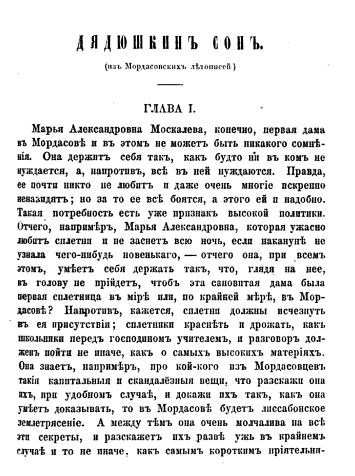
Scan of the first page of the 1859 magazine publication of Dostoyevsky's story 'Uncle's Dream', printed in Russian with a centered title and chapter heading 'Глава I' above dense columns of Cyrillic text.Book

Primary source

Uncle's Dream

Fyodor Dostoyevsky · 1859

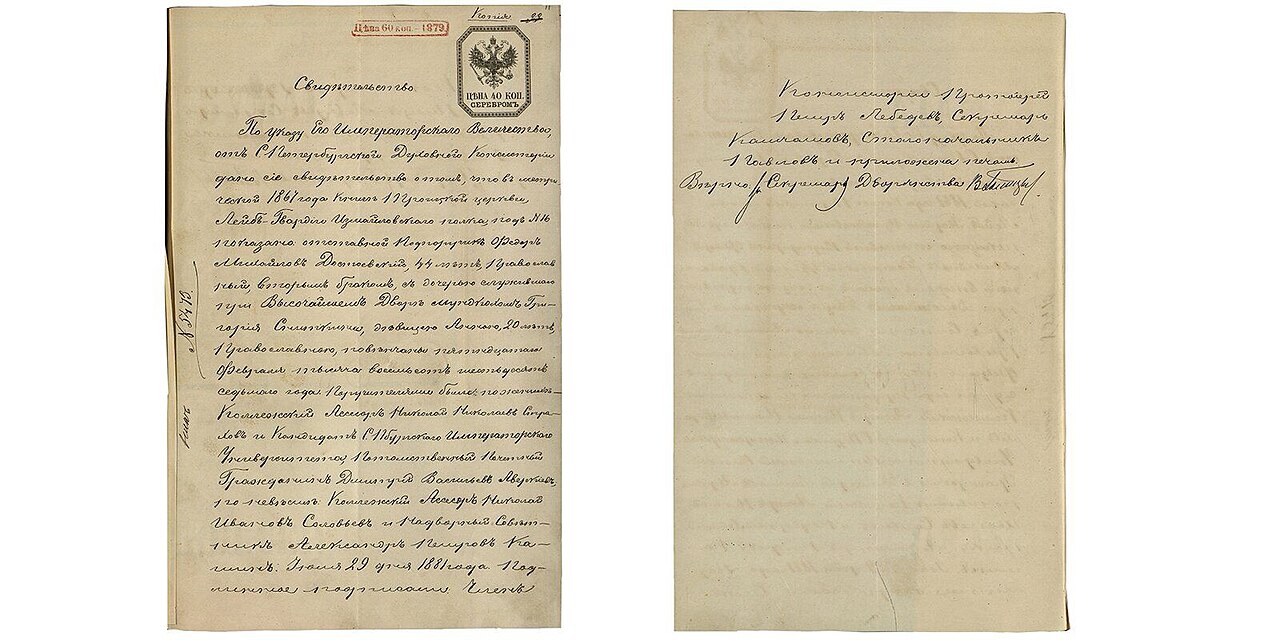
Two scanned pages of a handwritten Russian certificate on aged paper. The left page has a red-and-gold 1872 revenue stamp with a double-headed eagle at top right and dense cursive script. The right page is mostly blank with a few lines of cursive signatures near the top.Document

Primary source

Marriage Certificate of Fyodor Dostoyevsky and Anna Snitkina

St Petersburg Ecclesiastical Consistory · 29 July 1881 (recording a marriage of 15 February 1867)

Book

Primary source

A Gentle Creature

Fyodor Dostoyevsky · November 1876

Painting of the naked body of a dead man laid out horizontally on a white shroud, with a dark background. The head is at left, the feet at right, and the arms lie along the sides with the hands at the hip. The figure is pale, gaunt, with visible wounds on the hands and feet.Painting

Primary source

The Body of the Dead Christ in the Tomb

Hans Holbein the Younger · c. 1520-1522

Front cover of a paperback edition of Eugénie Grandet by Honoré de Balzac, published by Reclam in Leipzig. Cream background with large italic title and author name, and bold black series labels reading Universal and Bibliothek.Book

Primary source

Eugénie Grandet

Honoré de Balzac · 1833

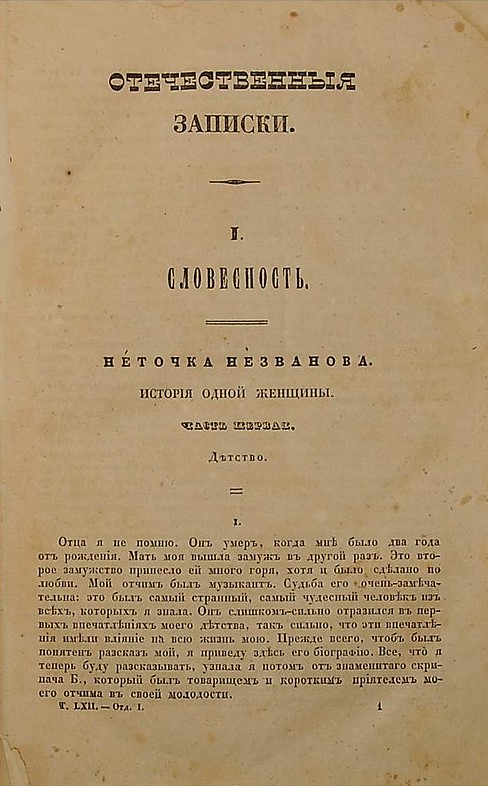
Scanned title page and first page of the 1849 Russian journal Otechestvennye Zapiski, Part I Literature, opening the serialized story Netochka Nezvanova: history of one woman, Part One, Childhood, with the first paragraph of text in Russian below.Book

Primary source

Netochka Nezvanova

Fyodor Dostoyevsky · 1849

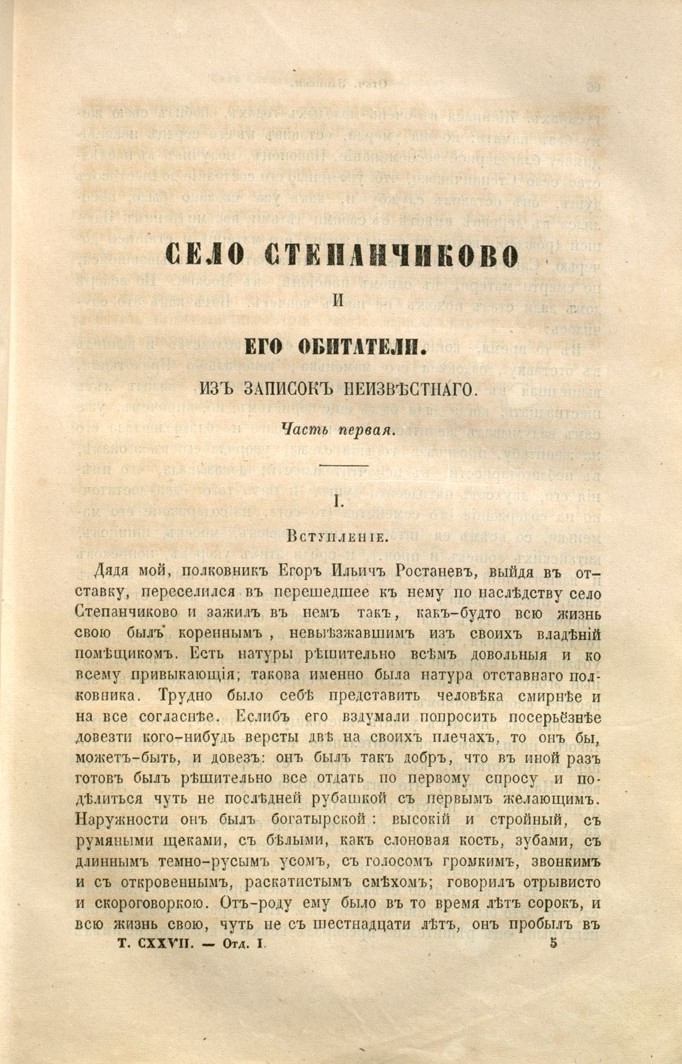
Scanned first printed page of the Russian story 'Село Степанчиково и его обитатели' (The Village of Stepanchikovo and Its Inhabitants), from a journal issue marked T. CXXVII, Part I, page 5. Printed Cyrillic text in two columns with a chapter heading 'I. Вступление'.Book

Primary source

The Village of Stepanchikovo and Its Inhabitants

Fyodor Dostoyevsky · 1859

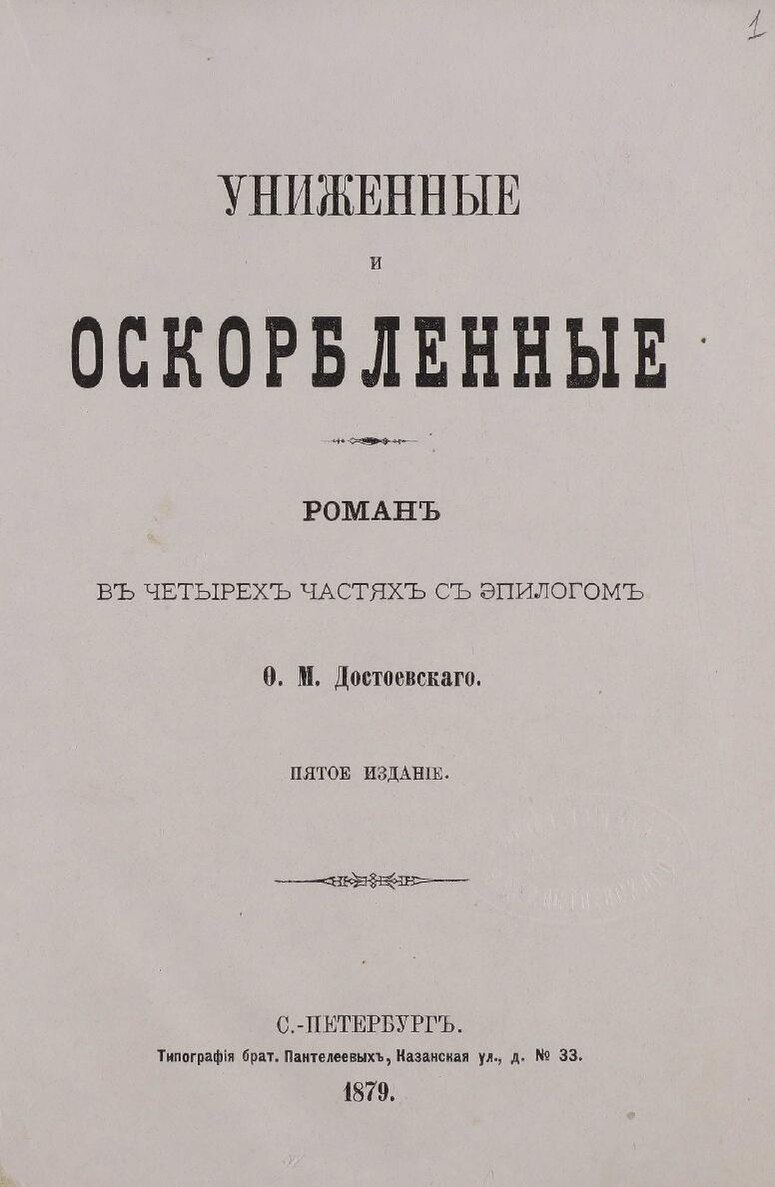
Title page of a Russian book: large heading 'Униженные и оскорбленные', 'роман в четырех частях с эпилогом', author 'Ф. М. Достоевского', 'пятое издание', publisher 'С.-Петербург, Типография брат. Пантелеевых, Казанская ул., д. No 33, 1879'. Plain cream paper with black serif type and ornamental dividers.Book

Primary source

Humiliated and Insulted

Fyodor Dostoyevsky · 1861

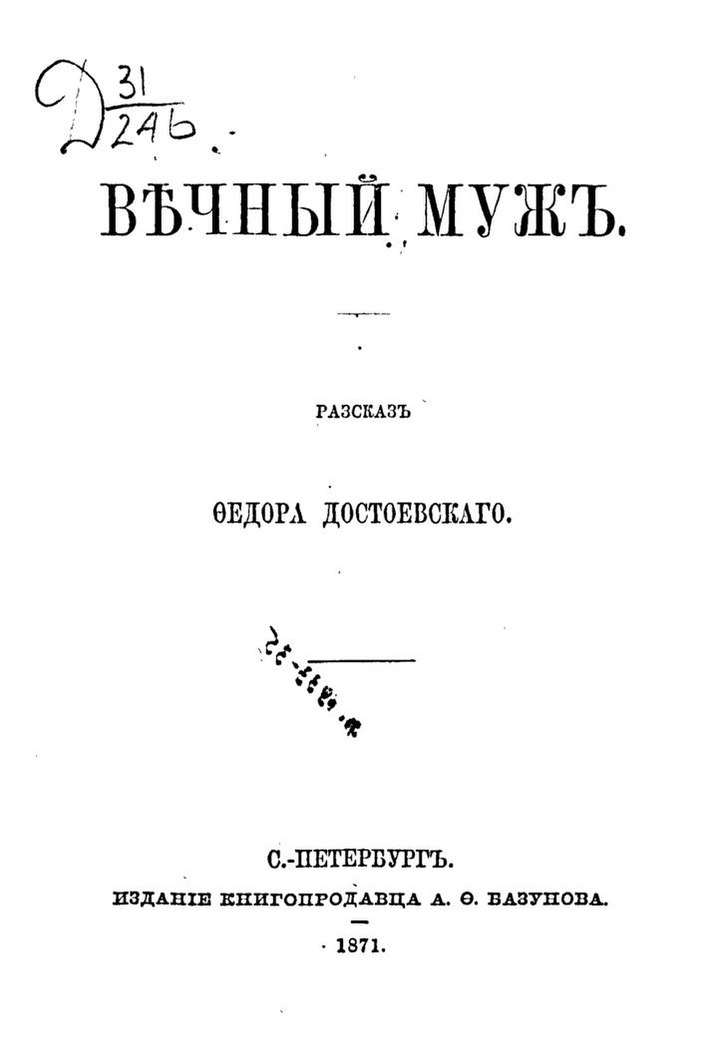
Scanned title page of the Russian book 'Вечный муж' (The Eternal Husband), a story by Fyodor Dostoevsky. Printed in Saint Petersburg, published by bookseller A. F. Bazunov, 1871. Handwritten marks appear in the upper left and center.Book

Primary source

The Eternal Husband

Fyodor Dostoyevsky · 1870

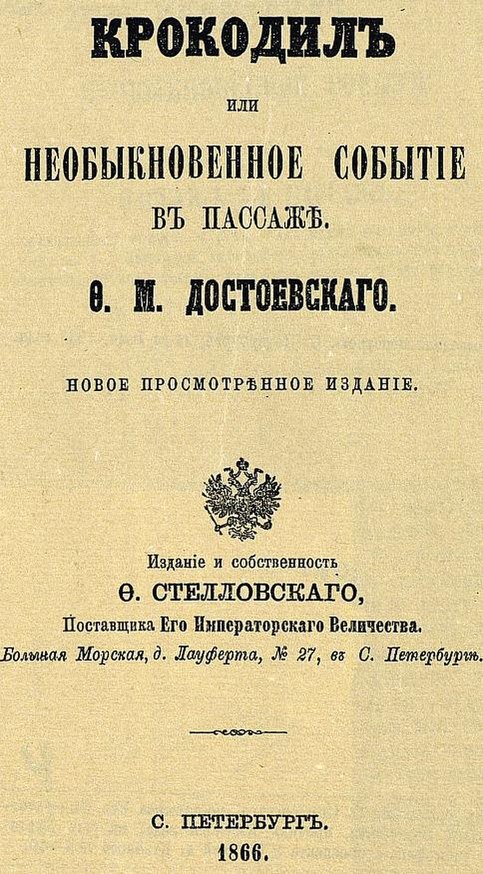
Title page of a Russian book in Cyrillic old orthography, reading 'Крокодил, или Необыкновенное событие в пассаже Ф. М. Достоевского' with 'Новое просмотренное издание', a double-headed eagle emblem, publisher Ф. Стелловского, and 'С. Петербург, 1866' at the bottom.Book

Primary source

The Crocodile

Fyodor Dostoyevsky · 1864

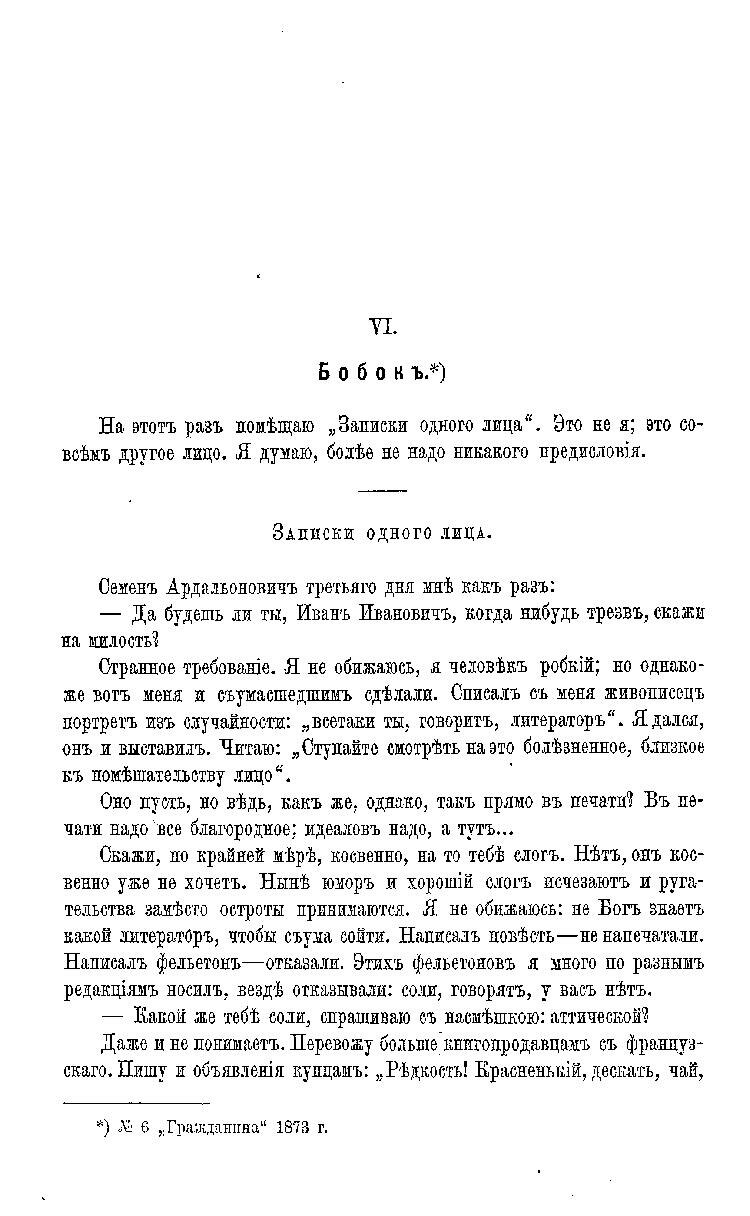
Scanned page of the Russian 19th-century printed text of Dostoyevsky's story 'Bobok', with chapter heading VI, the title 'Бобок', and the opening paragraphs in Cyrillic type. A footnote cites Гражданин, 1873.Book

Primary source

Bobok

Fyodor Dostoyevsky · 1873

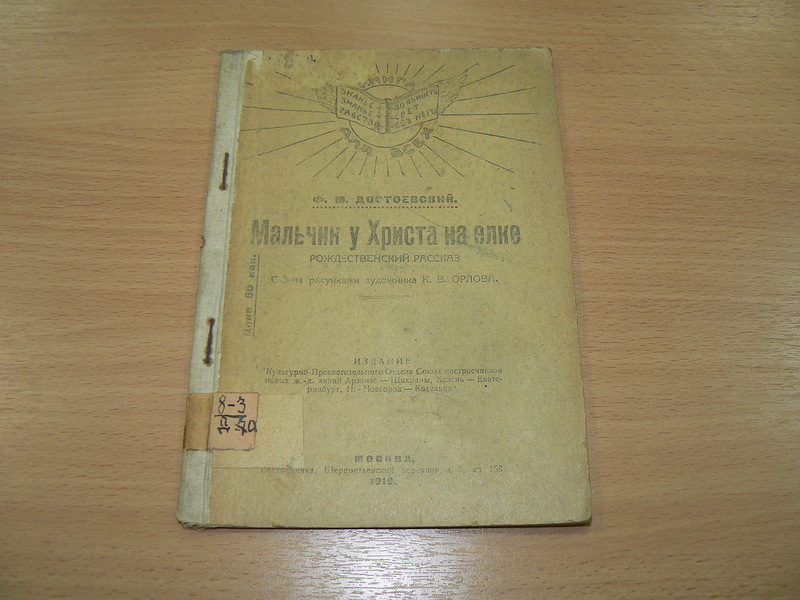
Photo of a worn yellowish paper booklet lying on a wooden table. Cover reads in Russian: Ф.М. Достоевский, Мальчик у Христа на ёлке, Рождественский рассказ, with a line drawing of a sunburst and an ornate title. Printed publisher info and Москва 1919 at bottom; a library label is on the left edge.Book

Primary source

The Beggar Boy at Christ's Christmas Tree

Fyodor Dostoyevsky · 1876

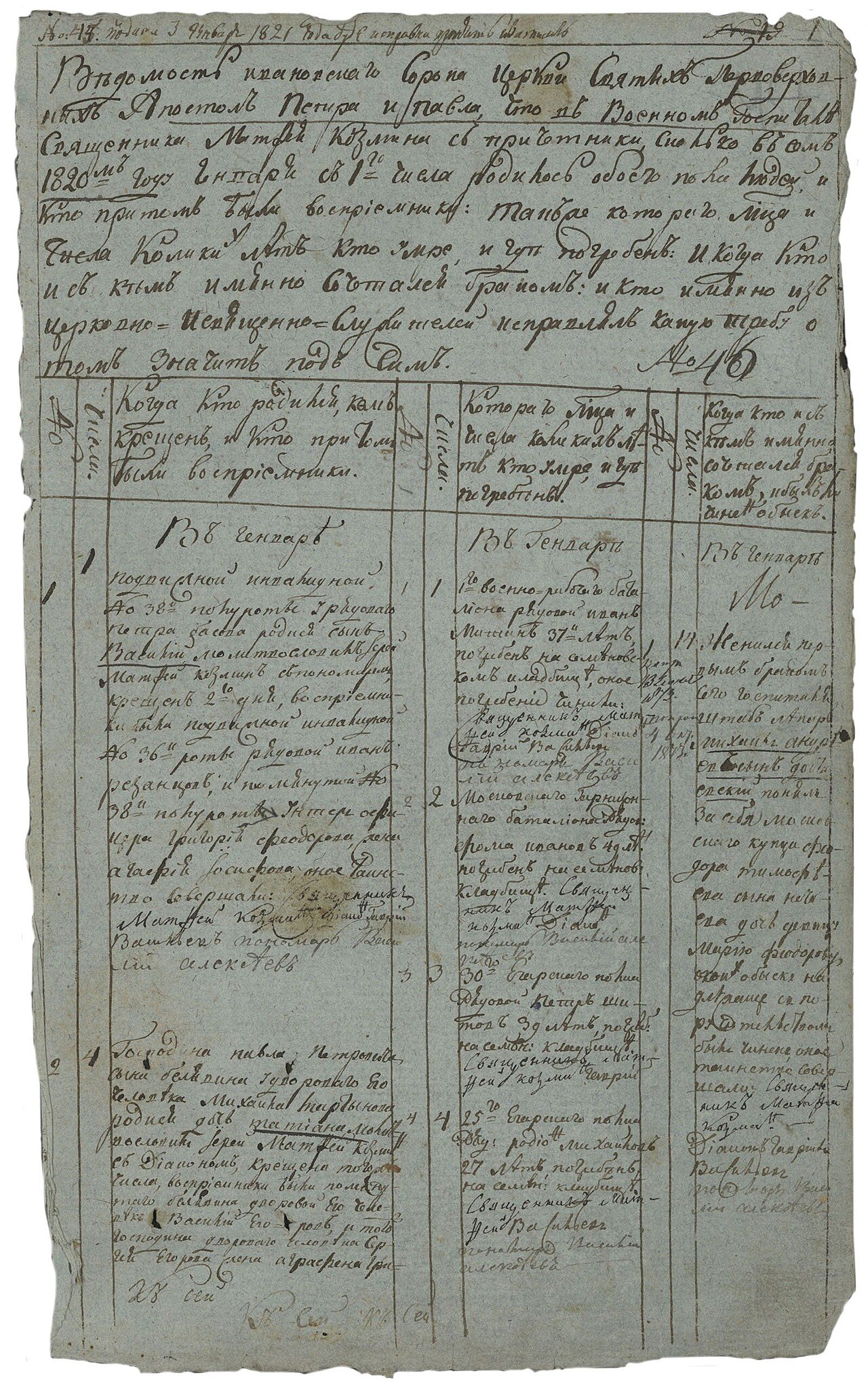
Handwritten Russian metric book page in faded brown ink on grey-blue paper, with a title block at top and columns of entries in Cyrillic script, dated 1821 in the header. Torn edges visible.Document

Primary source

Metric book entry recording the birth of Fyodor Dostoyevsky

30 October 1821

Black handwritten cursive signature on a white background, written in flowing strokes with a long looping underline extending to the right. The signature appears to read Fyodor Dostoevsky in Cyrillic.Document

Primary source

Signature of Fyodor Dostoyevsky

Fyodor Dostoyevsky

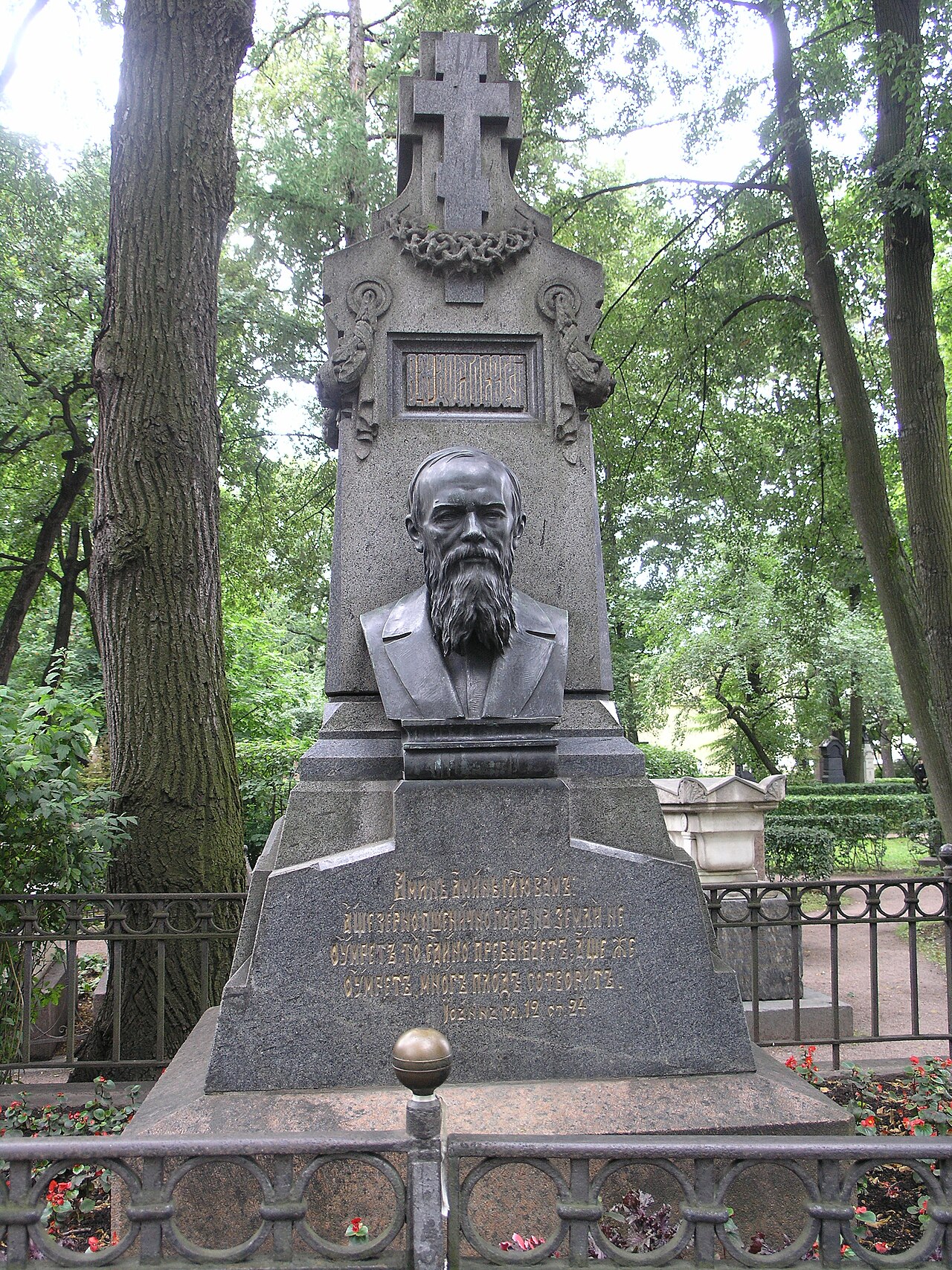
A dark granite grave monument topped by a cross, with a bronze bust of a bearded man in a jacket on its front, a carved inscription panel below, and an iron railing in a shaded green park setting.Artifact

Secondary source

Grave of Fyodor Dostoevsky

1881

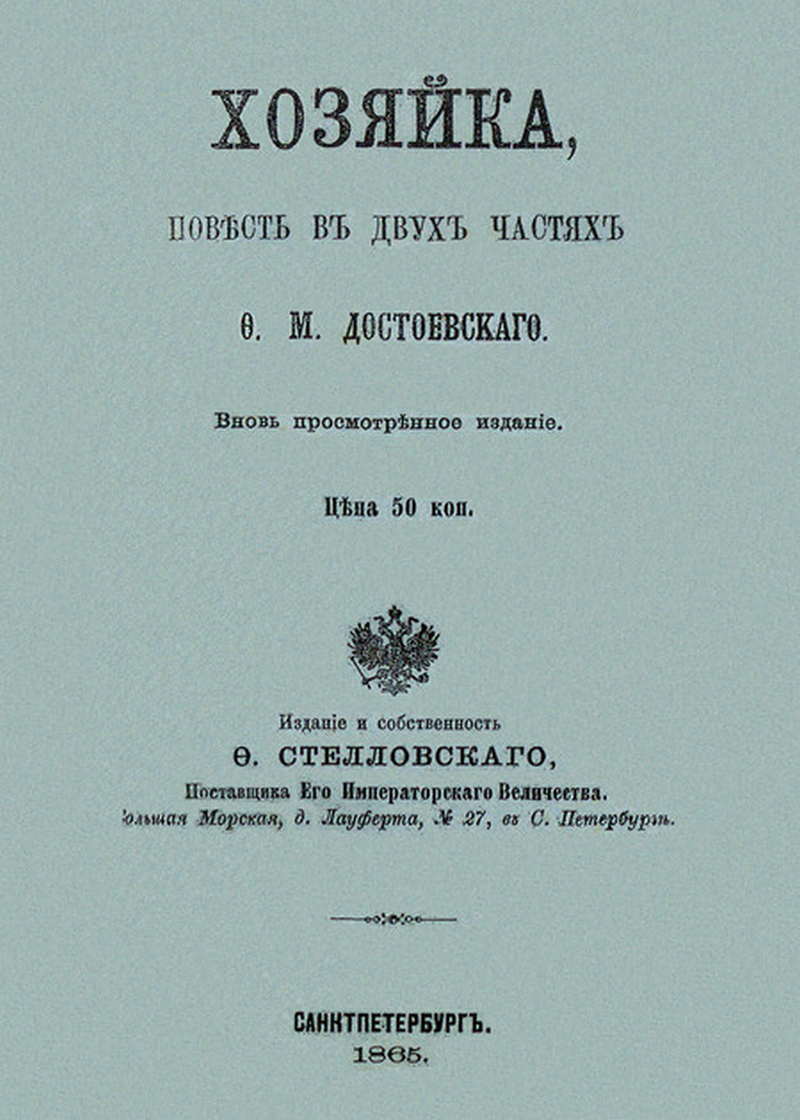
Title page of the Russian book Хозяйка, повесть в двух частях Ф. М. Достоевского, a revised 1865 edition printed in St. Petersburg by F. Stellovsky, with a double-headed eagle emblem and a price of 50 kopecks.Book

Primary source

The Landlady

Fyodor Dostoevsky · 1847

Book

Primary source

A Nasty Story

Fyodor Dostoevsky · 1862

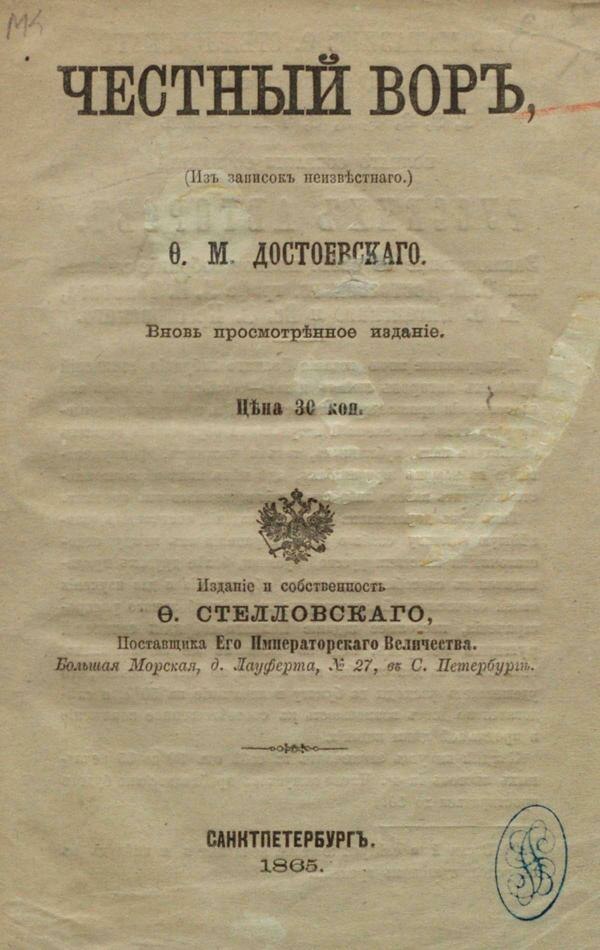
Title page of an 1865 Russian edition of 'An Honest Thief' in Cyrillic type. Text reads 'Честный вор' with 'Из записок неизвестного' and 'Ф. М. Достоевского', plus 'Вновь просмотренное издание', price 30 kop., publisher Ф. Стелловского, and 'Санкт-Петербург 1865'. A double-headed eagle emblem appears in the middle, and a blue oval library stamp is in the lower right.Book

Primary source

An Honest Thief

Fyodor Dostoevsky · 1848

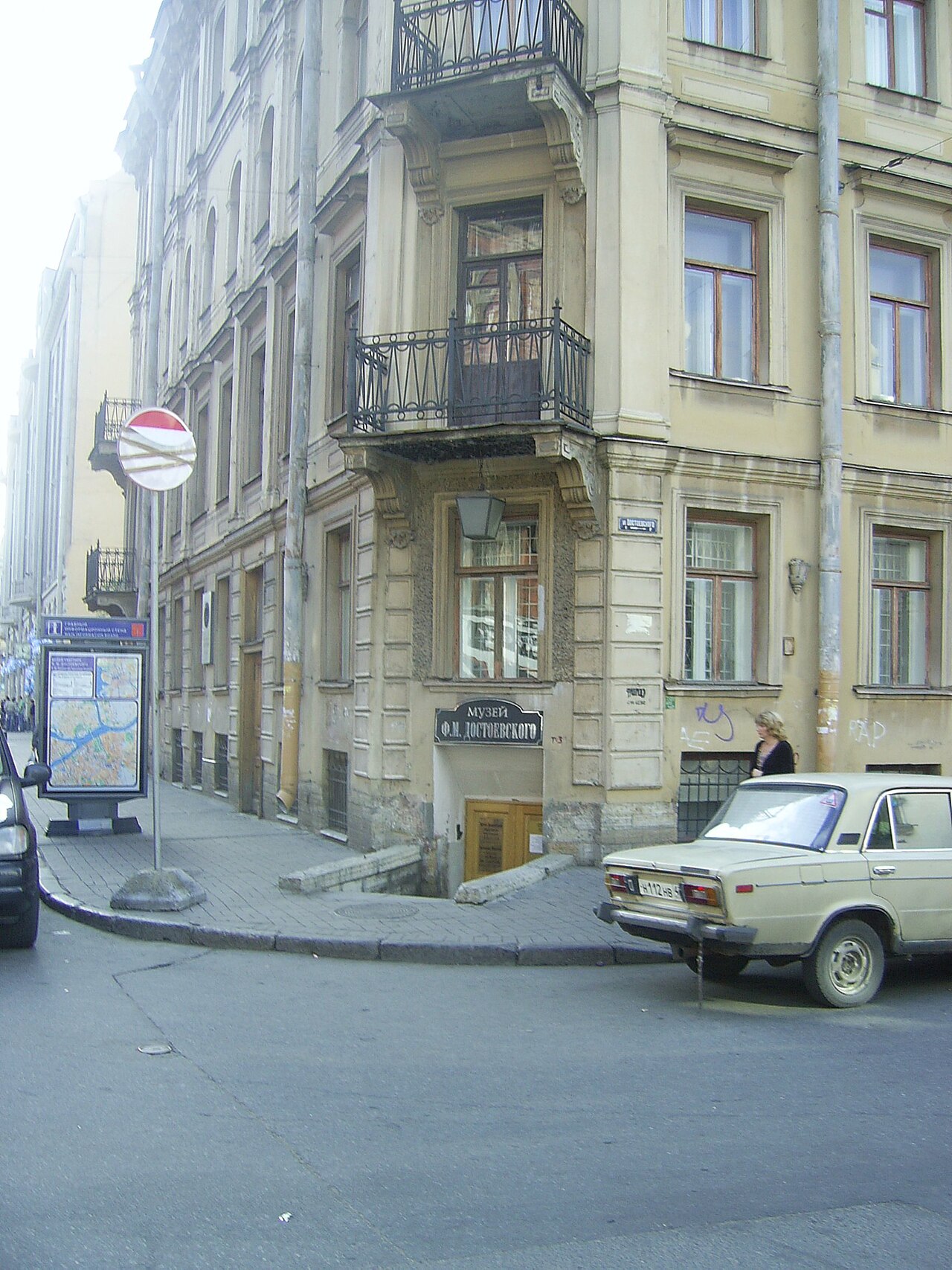
Street corner view of a cream-colored multi-story building with wrought-iron balconies. A sign reading 'Музей Ф.М. Достоевского' (Museum of F.M. Dostoevsky) marks a basement-level entrance with wooden doors. A beige Soviet-era sedan is parked at right, a bus-stop map board stands on the left, and a woman walks on the sidewalk.Artifact

Tertiary source

Dostoevsky Museum

1971

Letters of Fyodor Dostoyevsky to His Family and FriendsLetter

Primary source

Letters of Fyodor Dostoyevsky to His Family and Friends

Fyodor Dostoyevsky · 1917 (English translation; letters written during Dostoevsky's lifetime)

Book

Primary source

Poor Folk

Fyodor Dostoyevsky · 1846

Book

Primary source

The Idiot

Fyodor Dostoyevsky · 1869

Book

Primary source

White Nights

Fyodor Dostoyevsky · 1848

Book

Primary source

The House of the Dead

Fyodor Dostoyevsky · 1860-1862

Book

Primary source

Notes from Underground

Fyodor Dostoyevsky · 1864

Dostoevsky: Letters and ReminiscencesLetter

Primary source

Dostoevsky: Letters and Reminiscences

Fyodor Dostoyevsky · 1923

Seven Short Stories by Fyodor DostoevskyBook

Primary source

Seven Short Stories by Fyodor Dostoevsky

Fyodor Dostoyevsky · 1870

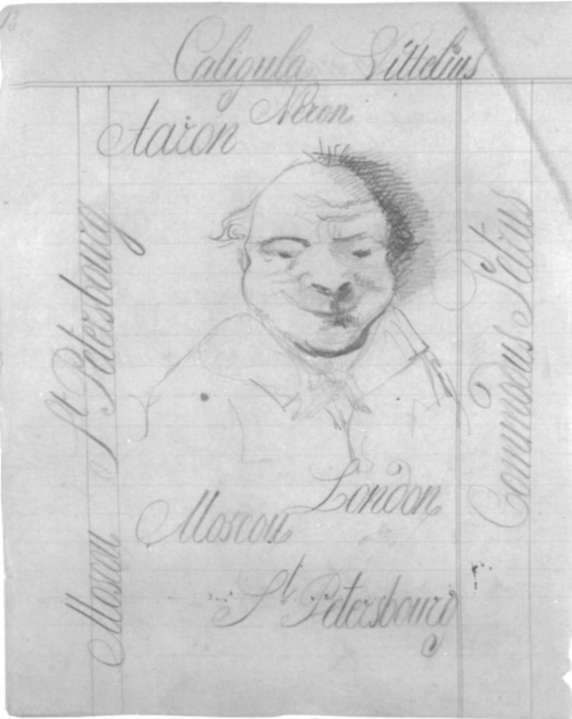
Scanned page of handwritten notes and a pencil sketch in a notebook, from Dostoevsky's 1867 manuscript. A caricature-like head with a bald crown, a smirking face, and a shirt collar is drawn at centre. Cursive words surround it, including Caligula, Nero, Sittelius, Saint Petersburg, Moscow, London, and Cannes or similar place names.Document

Primary source

Dostoevsky's Manuscript and Drawings for The Idiot

Fyodor Dostoyevsky · 1867

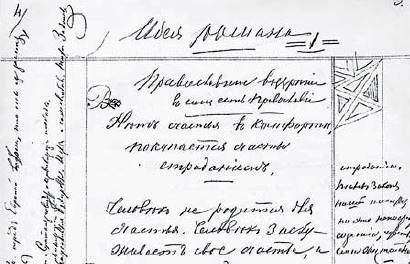
Handwritten manuscript page in Cyrillic script, dark ink on pale paper, with a heading underlined and a large scribbled marking at top. Several lines of handwritten Russian text are visible, with fragments of sketched notes and marginal writing at the edges.Document

Primary source

Notebook Page Outlining Crime and Punishment

Fyodor Dostoyevsky · 1865

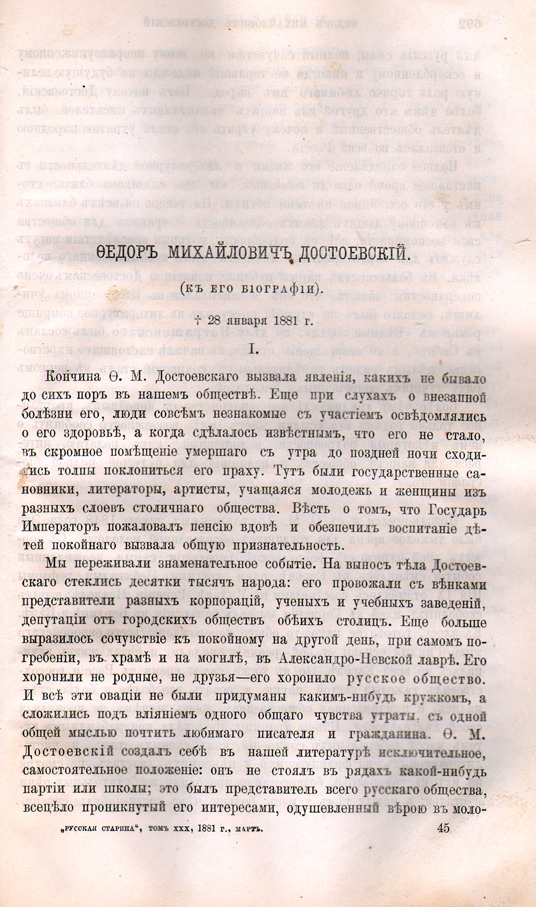
Scanned page 45 of the journal Russkaya Starina, volume XXX, 1881, March. The page has a heading in Russian reading 'Федор Михайлович Достоевский (к его биографии)' and dated 28 January 1881, with two columns of printed Cyrillic text.Newspaper article

Primary source

Dostoevsky: Towards His Biography

Alexandr Milyukov · 1881

Book

Primary source

Crime and Punishment

Fyodor Dostoyevsky · 1866

Book

Primary source

The Brothers Karamazov

Fyodor Dostoyevsky · 1880

Book

Primary source

The Insulted and Injured

Fyodor Dostoyevsky · 1861

Book

Primary source

The Gambler

Fyodor Dostoyevsky · 1866

Book

Primary source

The Village of Stepanchikovo

Fyodor Dostoyevsky · 1859

Book

Primary source

Mr. Prohartchin

Fyodor Dostoyevsky · 1846

Book

Secondary source

Dostoyevsky and His Message to the World

Zinaida Vengerova · June 1916

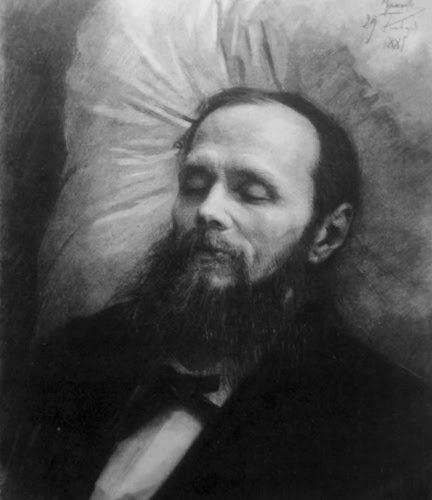
Black and white drawing of a bearded man lying on a pillow with his eyes closed, head turned slightly, wearing a dark jacket and white shirt. Handwritten date and signature appear in the upper right corner.Painting

Primary source

Dostoevsky on His Deathbed

Ivan Kramskoi · 29 January 1881

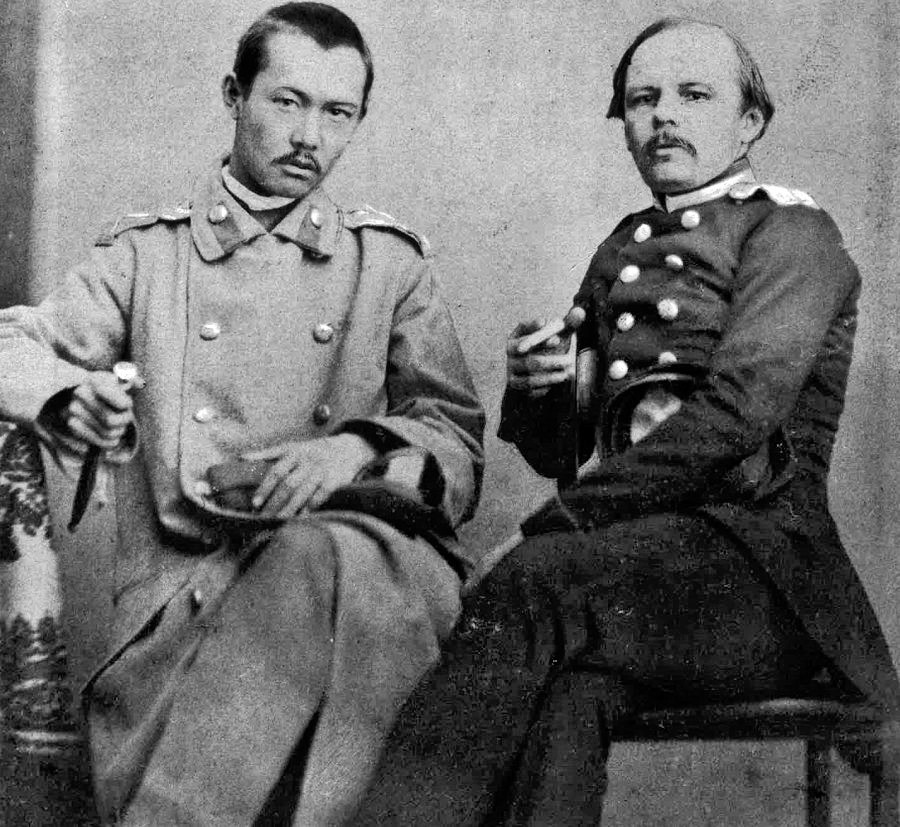
Black-and-white photograph of two men in military-style uniforms seated side by side. The man on the left wears a long double-breasted greatcoat with shoulder boards and holds a cigarette holder; the man on the right wears a dark uniform with a row of buttons and a high collar, with his hands resting near a sword hilt. Plain backdrop.Photograph

Primary source

Valikhanov and Dostoevsky

N. Leybin · 1858

The Novels of Fyodor Dostoevsky, 1912 editionBook

Primary source

The Novels of Fyodor Dostoevsky, 1912 edition

Fyodor Dostoevsky · 1912

Leo Tolstoy and Dostoevsky, Life and Work, Vol. 1Book

Secondary source

Leo Tolstoy and Dostoevsky, Life and Work, Vol. 1

Dmitry Sergeyevich Merezhkovsky · 1903

The Russian NovelistsBook

Primary source

The Russian Novelists

Eugène-Melchior de Vogüé · 1887

Blue marbled paper with dark navy veining and cream-colored streaks covering the whole image, with a black strip along the left edge and a dark corner at the top right. It looks like a book cover endpaper, with no title or text visible.Book

Primary source

Complete Works of F. M. Dostoevsky, Volume 3

Fyodor Dostoyevsky · 1905

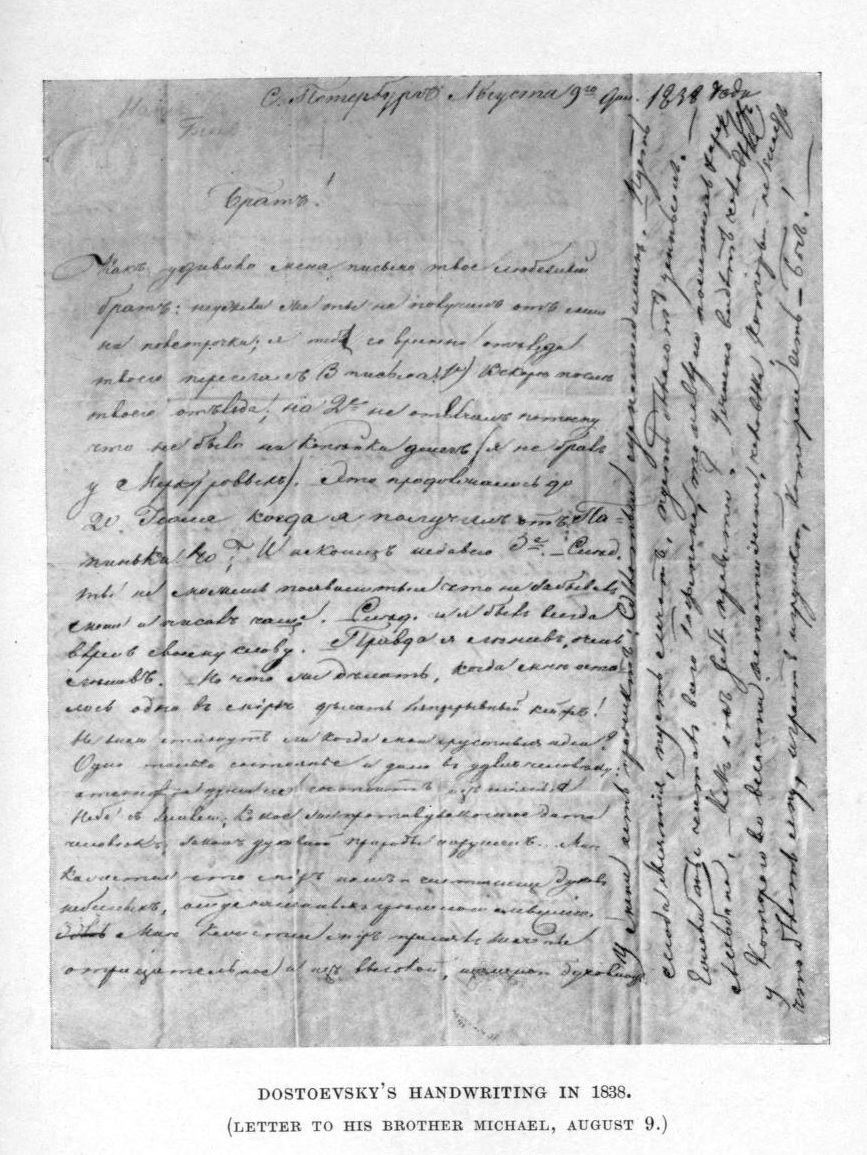
Scan of a handwritten letter in Cyrillic script dated St. Petersburg, August 9, 1838, written in cursive ink on aged paper. Caption below reads: Dostoevsky's handwriting in 1838, letter to his brother Michael, August 9.Letter

Primary source

Letter to His Brother Michael

Fyodor Dostoyevsky · 9 August 1838

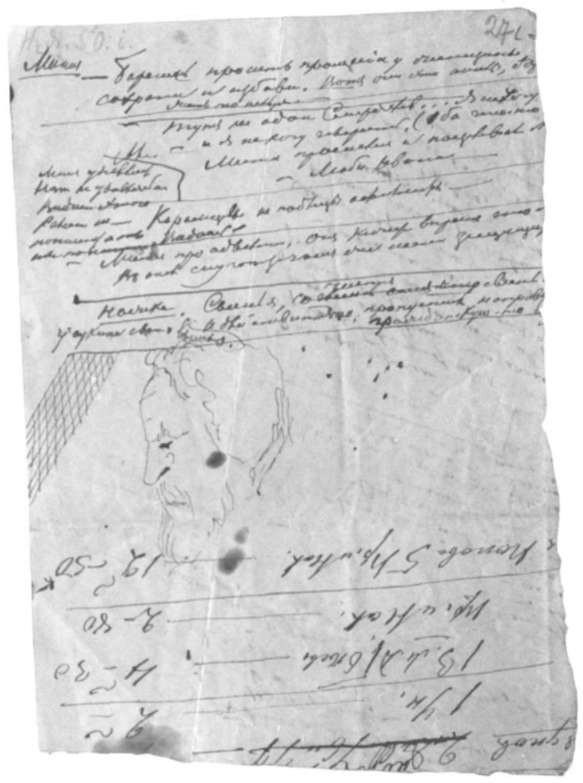
Scanned handwritten manuscript page in Russian, with a pen-and-ink sketch of a bearded man's profile in the lower center and a hatched area at the left edge. Several lines of handwriting and scribbled notes are visible, with faded numbers and marks along the bottom and blots on the page.Document

Primary source

Manuscript and Drawings for The Brothers Karamazov

Fyodor Dostoyevsky · 1880

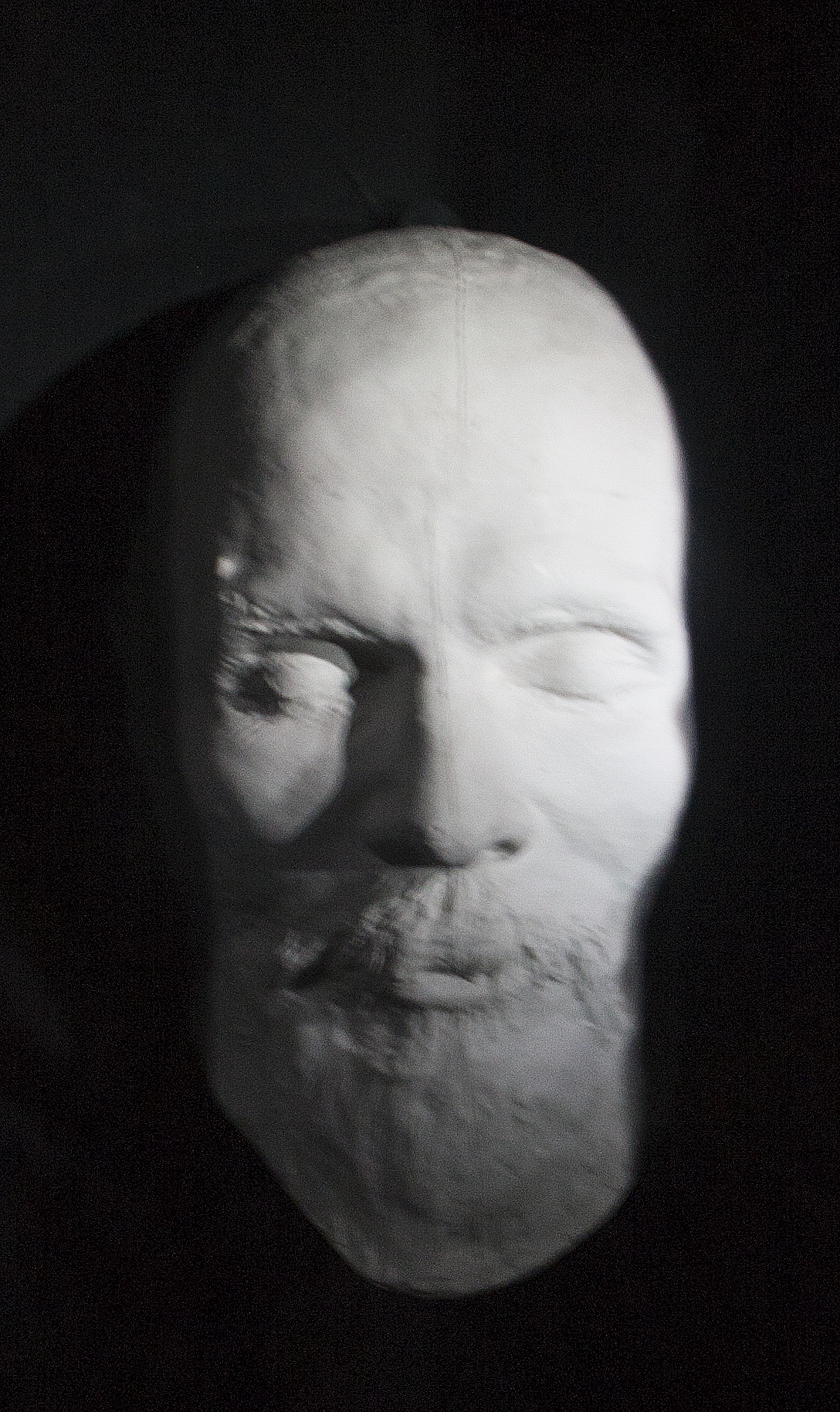
Black-and-white photograph of a pale plaster death mask of a bearded man's face against a dark background, lit from the left, showing closed eyes, a furrowed brow, a mustache and a full beard.Artifact

Primary source

Funerary Mask of Dostoevsky

1881 (cast); photographed 2016

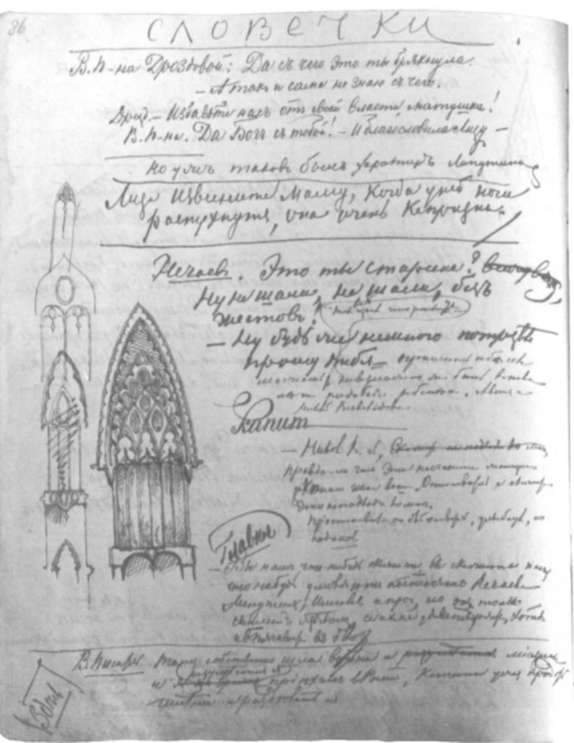
Handwritten manuscript page in Cyrillic script with the heading 'СЛОВЕЧКИ' at top, dialogue lines in pencil and ink, and two pen-and-ink sketches of Gothic pointed-arch window tracery on the left and center of the page.Book

Primary source

Manuscript and Drawings for Demons

Fyodor Dostoyevsky · 1871

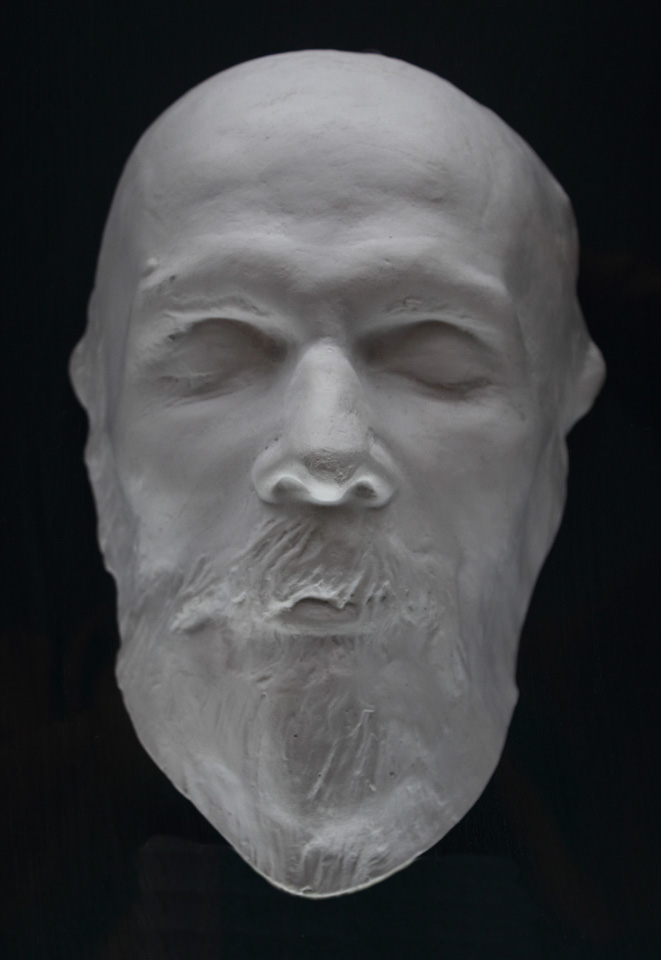
White plaster death mask of a bearded man with closed eyes, bald forehead, prominent nose and full beard, set against a dark black background.Sculpture

Primary source

Death Mask of Fyodor Dostoevsky

1881 (cast); photographed 2011

Fyodor Dostoevsky, a Critical StudyBook

Secondary source

Fyodor Dostoevsky, a Critical Study

John Middleton Murry · 1923

Book

Secondary source

Fyodor Dostoyevsky, a Study

Lyubov Fedorovna Dostoevskaya · 1922

Penultimate Words and Other EssaysBook

Secondary source

Penultimate Words and Other Essays

Lev Shestov · 1916

Dostoevsky: Towards a Critique of PersonalityBook

Secondary source

Dostoevsky: Towards a Critique of Personality

Otto Kaus · 1916

Dostoevsky, His Life and Literary ActivityBook

Secondary source

Dostoevsky, His Life and Literary Activity

Evgenii Andreevich Solovyov · 1916

The Soul of Dostoevsky, Prophet of the Russian RevolutionBook

Secondary source

The Soul of Dostoevsky, Prophet of the Russian Revolution

Dmitry Sergeyevich Merezhkovsky · 1922

Three Men: Pascal, Ibsen, DostoevskyBook

Secondary source

Three Men: Pascal, Ibsen, Dostoevsky

André Suarès · 1913

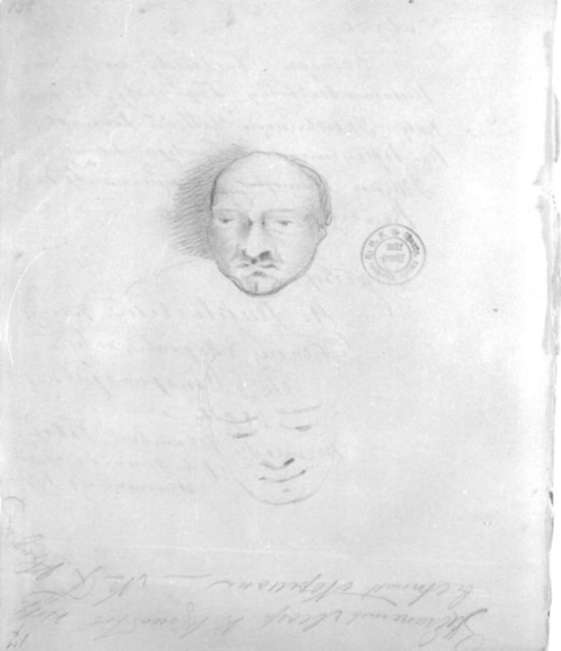
Pencil sketch on aged paper showing a bald man with a mustache, drawn in profile-like front view, above a faint second sketched face in lower half, with a round ink stamp at right and faint handwritten text in the background and bottom margin.Book

Primary source

Manuscript and Drawing of a Wax Cast of Peter the Great

Fyodor Dostoyevsky · 1865

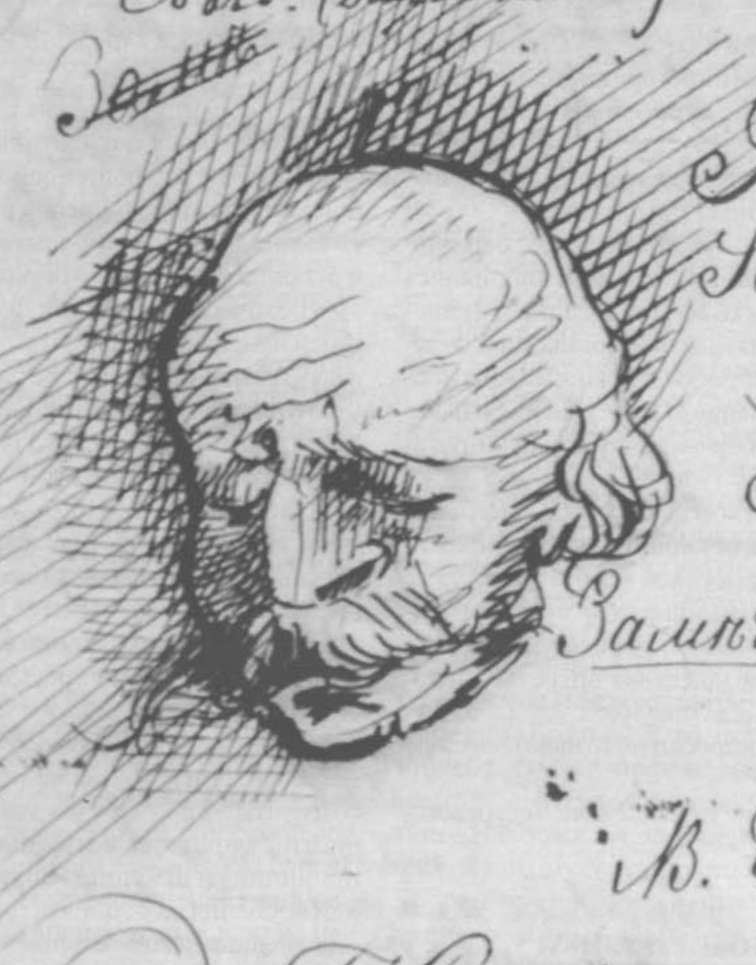
Pen-and-ink sketch of an elderly balding man's head in profile facing right, with cross-hatched shading behind it, a prominent nose and drooping jaw, and handwritten Cyrillic inscriptions in the margins of a manuscript page.Book

Primary source

Manuscript and Drawing of General Epanchin from The Idiot

Fyodor Dostoyevsky · 1868

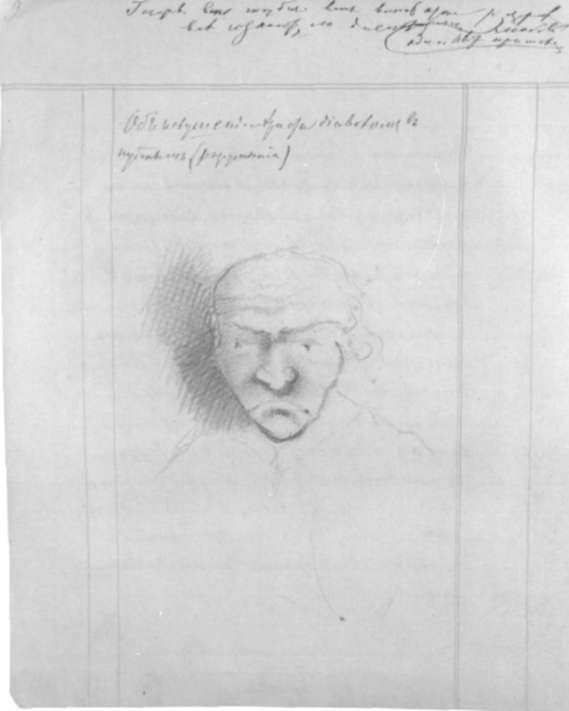
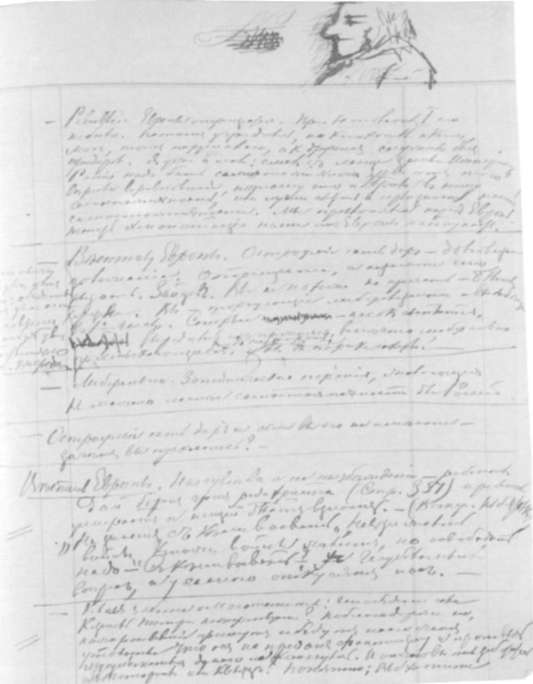
Pencil sketch on a ruled manuscript page showing a man's face in three-quarter view with a furrowed brow, heavy eyes, a prominent nose, and a downturned mouth. Handwritten Cyrillic notes appear above and below the drawing.Document

Primary source

Manuscript Notes for The Idiot

Fyodor Dostoyevsky · 1867

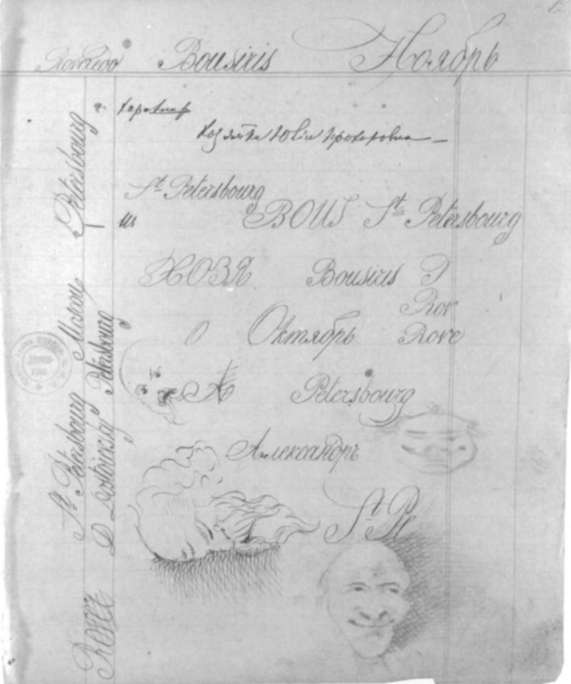
Grayscale scan of a handwritten manuscript page in Russian cursive, with headings and dates such as 'Ноябрь' and 'Октябрь', alongside pencil sketches of a face, a smoky or cloud-like shape, and a small scribbled figure.Document

Primary source

Manuscript Notes for The Idiot, Second Sheet

Fyodor Dostoyevsky · 1867

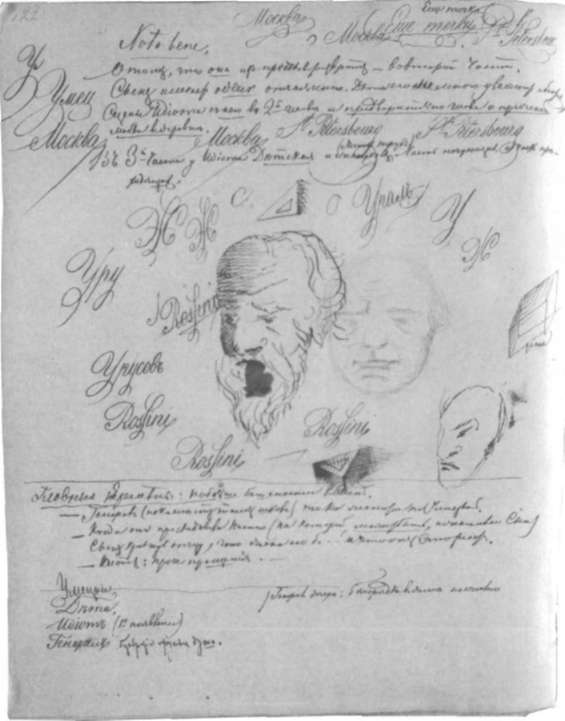
Pencil-and-ink manuscript page with handwritten Cyrillic notes at top and bottom, and several sketched faces in the center: a bearded old man in profile with a wide-open mouth, a smaller face at right, and a profile face at lower right, with scattered Cyrillic and Latin script words such as 'Rossini' around them. Some words are repeated in large cursive lettering.Document

Primary source

Manuscript Page with Self-Portrait and Sketch of Rossini

Fyodor Dostoyevsky · 1868

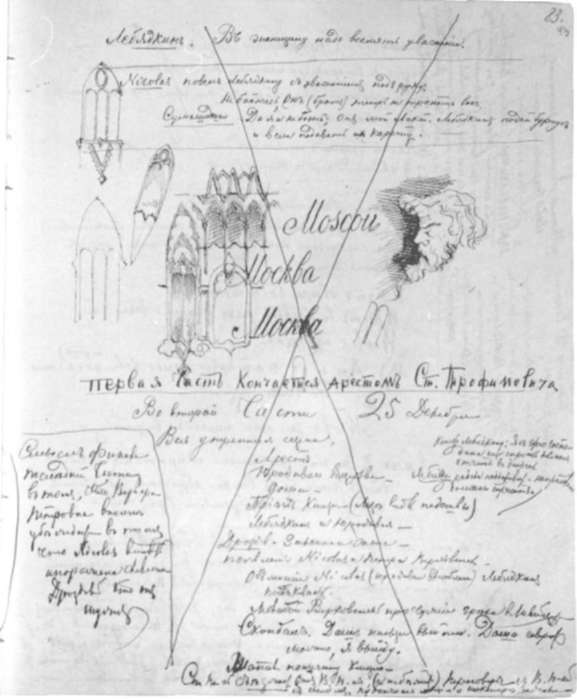
Black-and-white scan of a handwritten Russian manuscript page with pencil sketches: Gothic arch and window drawings on the left, a caricature-like profile head on the right, and the words Москва and Москва written in a stylized script. Diagonal crossing-out lines run across the page, and dense handwritten notes fill the lower half.Document

Primary source

Manuscript with Gothic Sketches for Demons

Fyodor Dostoyevsky · 1871

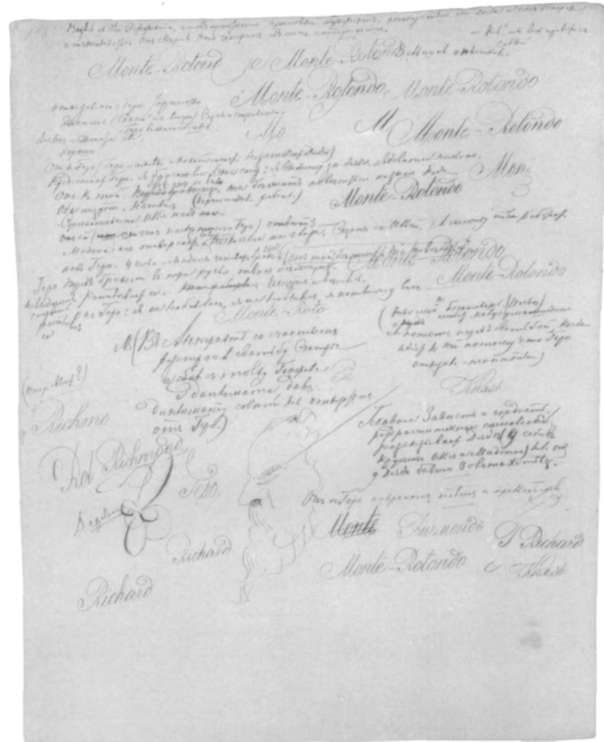
Scan of a handwritten manuscript page in faded grey ink. Cursive lines of text are repeated across the sheet, with several sketched figures and a few scribbled marks in the lower half.Document

Primary source

Manuscript and Drawing on the Figure of the Elder

Fyodor Dostoyevsky · 1868

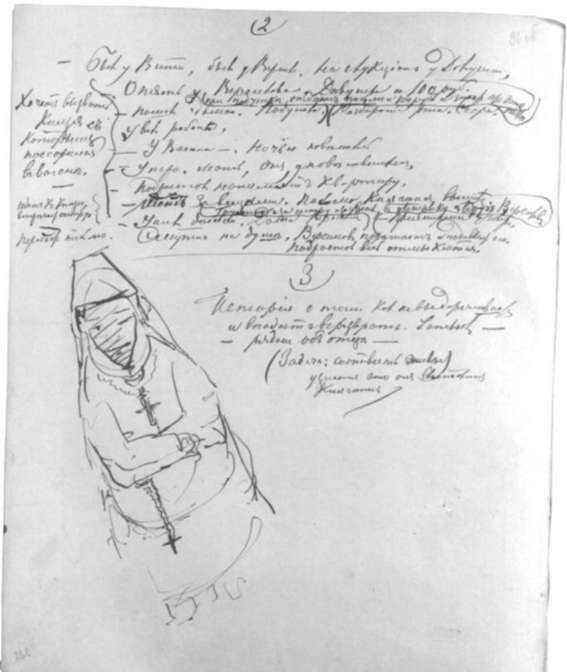
Scan of a handwritten manuscript page in Cyrillic script with notes and marginal annotations, and a pencil sketch below of a monk in a hooded robe with a cross and rosary, drawn by Dostoevsky for The Adolescent.Document

Primary source

Manuscript and Drawing of a Monk for The Adolescent

Fyodor Dostoyevsky · 1875

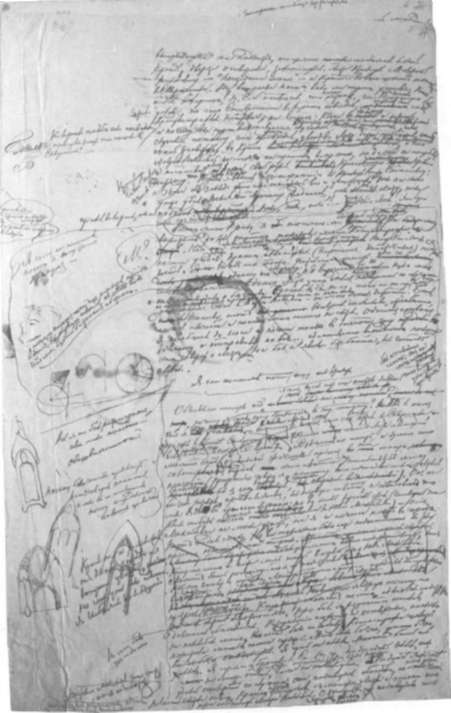
Scan of a densely handwritten manuscript page in faded ink, with marginal sketches of arches, a circle and a face-like outline on the left side. Pen strokes cross the text in places.Document

Primary source

Manuscript Page with Drawings from the Demons Notebooks

Fyodor Dostoyevsky · 1872

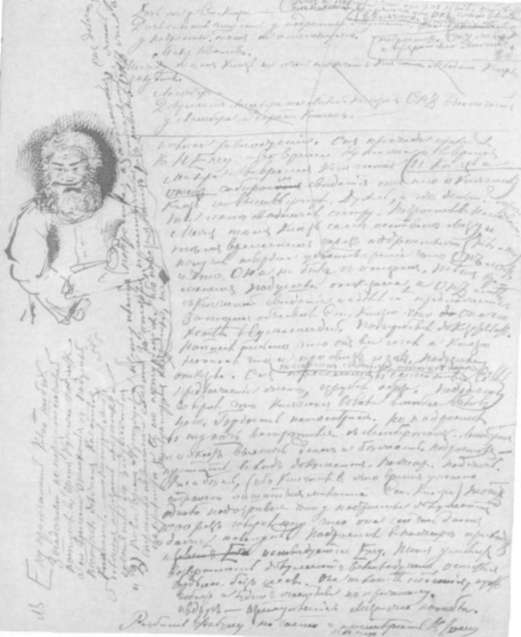
Scanned manuscript page with handwritten Russian text in dense lines and marginal notes, plus a pen-and-ink sketch in the upper left of a bearded old man with a fur-trimmed collar, seen in three-quarter view. Faint ink lines and crossed-out words fill the page.Document

Primary source

Manuscript Drawing of Makar Dolgoruky for The Adolescent

Fyodor Dostoyevsky · 1874

Scanned page of handwritten Russian manuscript in cursive, with crossed-out lines and marginal marks. A pen sketch of a man's profile, with a hatched shadow, appears at the top right.Document

Primary source

Manuscript Page with Drawing for A Writer's Diary

Fyodor Dostoyevsky · 1877

Documentary

Tertiary source

The Brothers Karamazov, LibriVox audiobook (English, Garnett translation)

Fyodor Dostoyevsky

Documentary

Tertiary source

Crime and Punishment, LibriVox audiobook (Garnett translation)

Fyodor Dostoyevsky

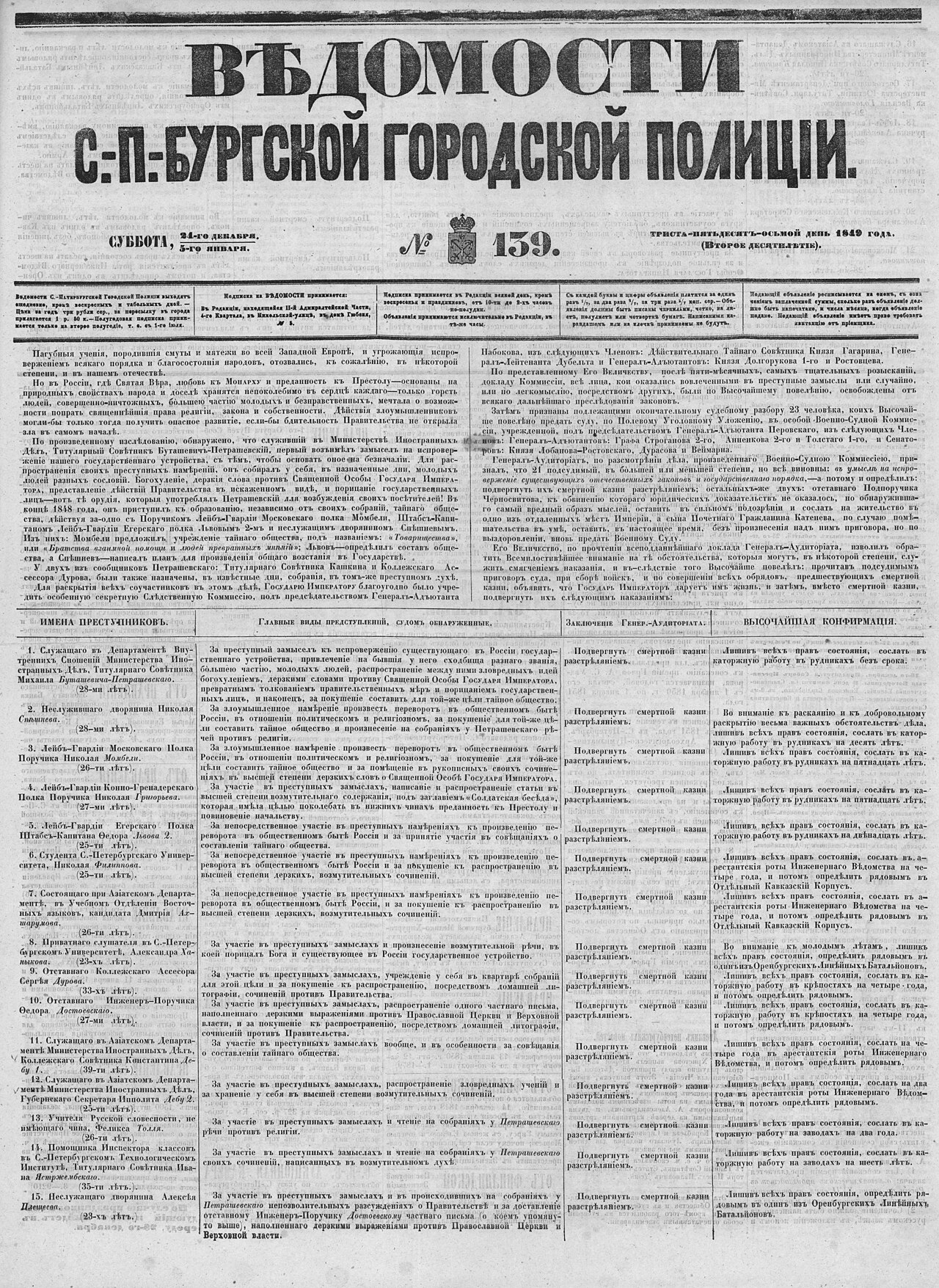
Scanned front page of the Vedomosti St Petersburg City Police newspaper, dated 24 December 1849 (Saturday, 24th December, 5th January). Large Cyrillic masthead above dense columns of text, with a headed table listing names of offenders, main crimes, sentences, and the Supreme confirmation.Newspaper article

Primary source

St Petersburg Police Gazette, 24 December 1849: Petrashevsky Circle sentence

24 December 1849

Book

Secondary source

The Idiot (LibriVox audiobook, Parts 1 and 2)

Fyodor Dostoyevsky

Want the full shelf? Chat with Fyodor Dostoevsky in the app and open the Sources panel — every quote links back to the original.

Use Fyodor Dostoevsky in class

1 collection

A ready-made collection from the Humy team that features Fyodor Dostoevsky. Preview it, then try it free.

Trusted by educators worldwide

Conversations
375,000+
Real exchanges between students and historical figures
Messages exchanged
4,142,000+
Across every figure, classroom and language
Historical figures
100,000+
Each informed by a curated biography and selected sources
Languages supported
50+
From English and Spanish to Arabic and Korean

Paying customers

Used by 98 schools and universities

Partner school logo
Tecnológico de Monterrey logo
Hyper Island logo
Partner school logo
Chambersburg Area School District logo
Broward County Public Schools logo
Nebo School District logo
National Louis University logo
South Florida PBS logo
Punahou School logo
University of Wisconsin–River Falls logo
Partner school logo
Partner school logo
Archbishop Mitty High School logo
Kingsburg High School logo
Norwalk Public Schools logo
Partner school logo
Connections logo
Partner school logo
Moore Public Schools logo
Partner school logo
Partner school logo
Partner school logo
Partner school logo
Robbinsville Public Schools logo
Partner school logo
Partner school logo
Partner school logo
Tecnológico de Monterrey logo
Hyper Island logo
Partner school logo
Chambersburg Area School District logo
Broward County Public Schools logo
Nebo School District logo
National Louis University logo
South Florida PBS logo
Punahou School logo
University of Wisconsin–River Falls logo
Partner school logo
Partner school logo
Archbishop Mitty High School logo
Kingsburg High School logo
Norwalk Public Schools logo
Partner school logo
Connections logo
Partner school logo
Moore Public Schools logo
Partner school logo
Partner school logo
Partner school logo
Partner school logo
Robbinsville Public Schools logo
Partner school logo
Partner school logo

What educators are saying

“We enjoyed the program last year and used it frequently.”
“My students say it’s a welcome change of pace. I’m not a fan of the “sage on the stage” model, so I try to incorporate research-oriented and self-paced activities. With Humy, students have to take charge of their learning. They’ve become more adept at critical thinking, forming better questions, and improving their reading comprehension. The interview feature has been my go-to tool. I create assignments where students must ask historical figures a set number of questions, then summarize the responses to ensure they’re truly absorbing the material. This approach lets them actively explore the past rather than passively consuming information.”
“Humy has helped me bring historical figures, sometimes long past, to life. When my students interact with these figures in real-time, it eliminates some of the perceived “ancient” characteristics of my curriculum. This has shifted my students’ thinking away from viewing history as abstract or irrelevant. Real-time interactions make historical figures relatable, even allowing students to ask off-topic questions that help put historical lives in a more relevant context for 13-year-olds. The feature I use the most is the interview feature. After teaching a topic, most recently Gandhi and Joan of Arc, I have the students ask pointed, focused questions. We practice good conversation techniques beforehand, teaching them to listen (or read) carefully and formulate thoughtful follow-up questions rather than just interrogating. It helps students practice effective conversation skills.”

FAQ

Frequently asked questions

Who is Fyodor Dostoevsky?
Influential Russian novelist and philosopher. On Humy.ai you can chat with an AI version of Fyodor Dostoevsky that draws on a short biography and 93 historical sources during the conversation — by text or voice, in 42 languages.
Is Fyodor Dostoevsky AI free?
Fyodor Dostoevsky is part of Humy's full library of more than 100,000 figures, which comes with a paid plan. A free account (no credit card) includes 20 messages a month with the free library's figures, so you can try how the conversations work first.
What sources does the Fyodor Dostoevsky AI use?
It draws on a short biography and 93 historical sources (books, documents and newspaper articles), including “Crime and Punishment”, “The Brothers Karamazov” and “The Grand Inquisitor”. Each source has its own page on Humy.ai.
How historically accurate is the AI version of Fyodor Dostoevsky?
Each figure uses a short biography and a small set of selected historical sources as context (retrieval-augmented generation), so answers stay closer to known material than the model's general knowledge alone. It isn't a citation-grade research tool — like any LLM, the AI can get details wrong or extrapolate. Treat it as a strong starting point for inquiry and cross-reference important claims.
Can I talk to Fyodor Dostoevsky by voice?
Yes. In addition to text chat, you can call Fyodor Dostoevsky and hear their voice respond in real time — useful for auditory learners, interview practice and Socratic dialogue.
Is Humy.ai safe and compliant for schools?
Yes. Humy.ai is used by more than 100 schools, universities and organisations. The platform is FERPA- and GDPR-aligned, supports SSO, and offers an IT-approval pack tailored for school procurement teams.

Cross-reference Fyodor Dostoevsky

Like any LLM, the AI version of Fyodor Dostoevsky can get details wrong. Open one of these sources in a new tab to verify what you’ve read.

Ready when you are

Start chatting with Fyodor Dostoevsky now.

20 messages free · No credit card · Available in 50+ languages.