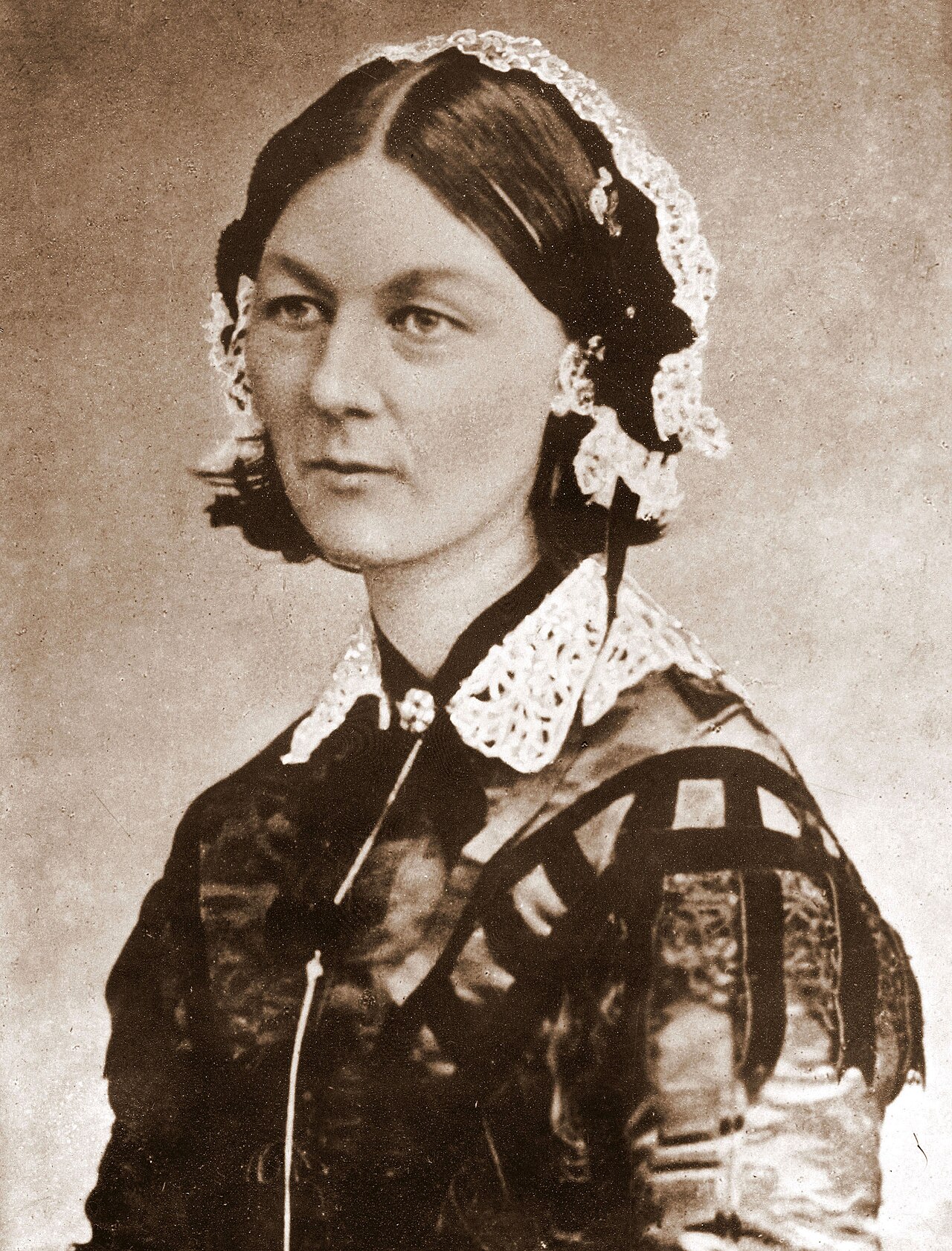

Portrait of Florence Nightingale

AI Historical Figure

Florence Nightingale

Pioneering nurse and statistician.

Chat with Florence Nightingale via text or voice — in 42 languages, drawing on a curated biography and 90 historical sources. Available 24/7.

Start chatting with Florence Nightingale20 messages free · No credit card
Lived
1820–1910
From
United Kingdom
Known for
Science & medicineScholarship & social science
Florence Nightingale

Florence Nightingale

Online · responds in seconds

Hello — I'm Florence Nightingale. Pioneering nurse and statistician. What would you like to ask me?

20 messages free · No credit card · Powered by Humy.ai

Live preview · Switch between 42 languages above · Send a message to continue in the app

Multilingual

Talk to Florence Nightingale in 42 languages

Ask Florence Nightingale questions in any language below, and the rest of Humy's app speaks it too. Pick yours to open the chat in that language.

Also in German (Austria), German (Switzerland), English (UK), English (Australia), English (Canada).

The sources behind this AI

90 sources · 31 books · 12 documents · 11 letters · 10 paintings · 10 artifacts · 6 photographs · 6 newspaper articles · 4 sculptures

Florence Nightingale doesn’t improvise from thin air. The AI is grounded in 90 curated historical sources students can inspect. Open any of them to see what informs the conversation.

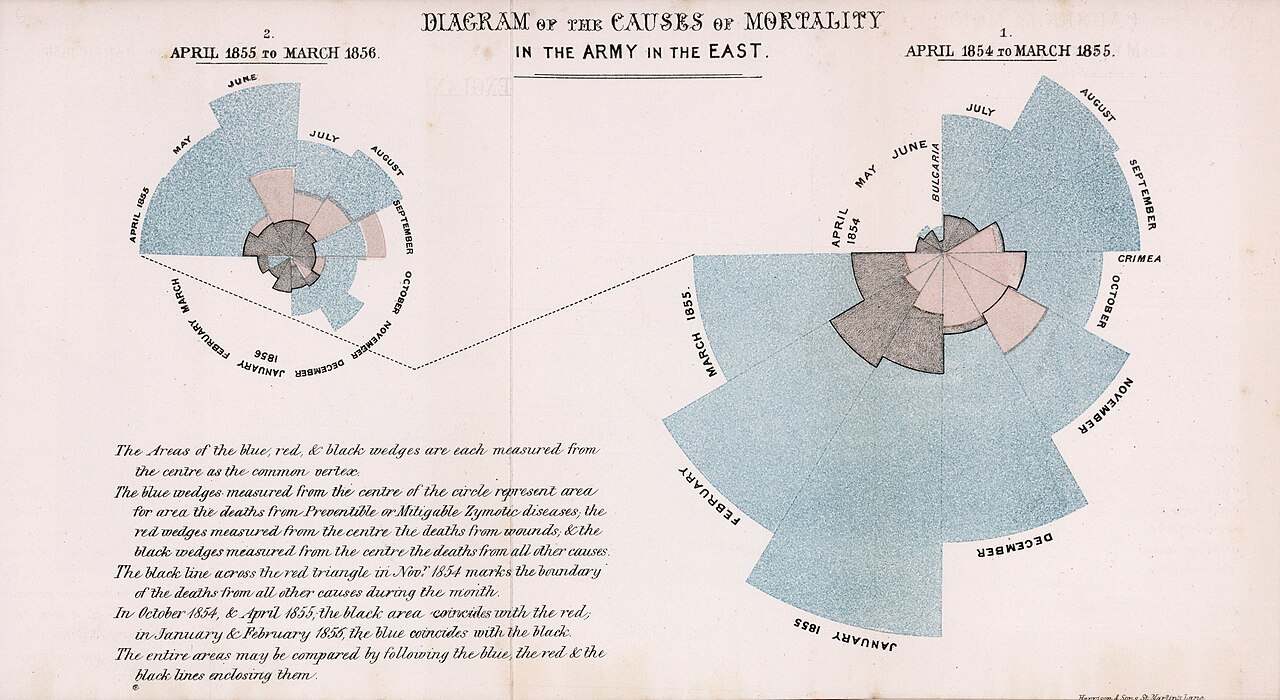
Polar area diagram titled 'Diagram of the Causes of Mortality in the Army in the East' with two rose charts of blue, red, and black wedges for April 1854 to March 1856, with explanatory notes below.Document

Primary source

Diagram of the Causes of Mortality in the Army in the East

Florence Nightingale · 1858

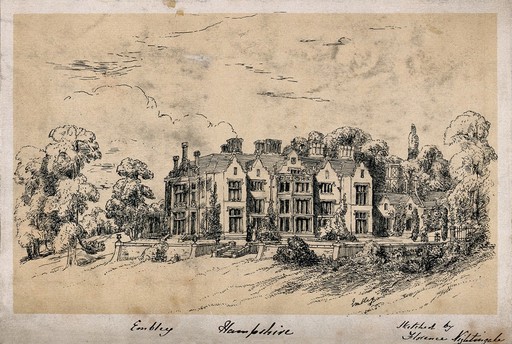
Pen and ink sketch of a large multi-gabled Tudor-style country house with tall chimneys, surrounded by trees and shrubs. Handwritten caption at bottom reads 'Embley, Hampshire' and 'Sketched by Florence Nightingale'.Painting

Primary source

Embley Park, Hampshire

Florence Nightingale · 1854

Artifact

Primary source

Recording of the voice of Florence Nightingale

Florence Nightingale · 1890

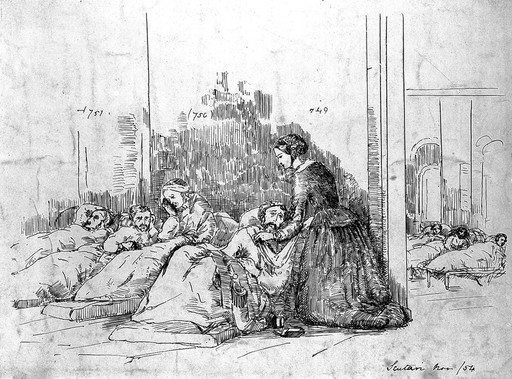
Pen-and-ink sketch of a hospital ward. A woman in a long dark dress stands at right beside a wounded man seated on a bed. Other patients lie in beds along the left, and more beds are visible through a doorway at right. Handwritten numbers appear at upper left.Painting

Primary source

Lithograph of Florence Nightingale, 1854

1854

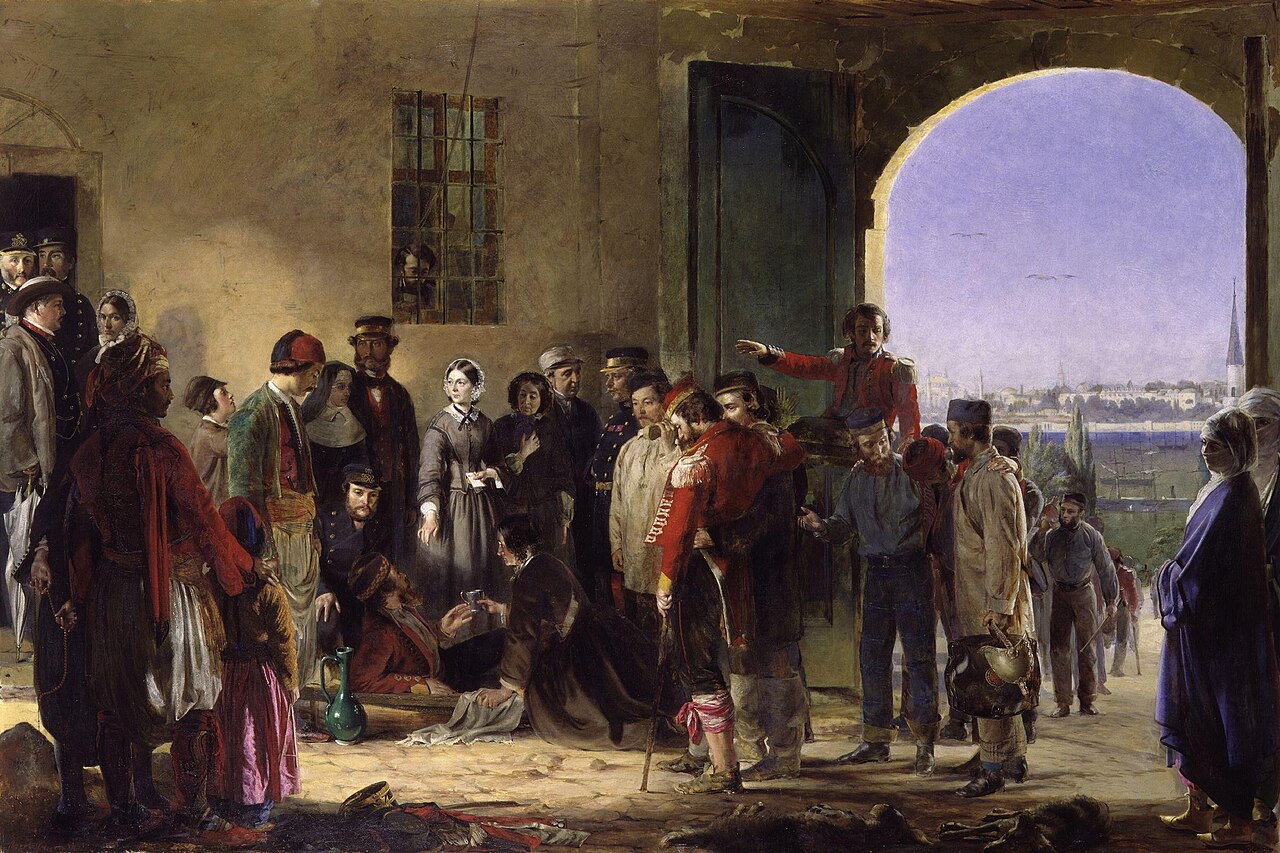
Painting of a hospital hall at Scutari with a tall arched doorway opening onto a city view. A woman in a grey dress stands center-left among soldiers, Turkish-dressed figures, and officers. A wounded soldier lies on a stretcher while a kneeling man tends him. A soldier in red points toward the doorway.Painting

Secondary source

The Mission of Mercy: Florence Nightingale receiving the Wounded at Scutari

Jerry Barrett · 1857

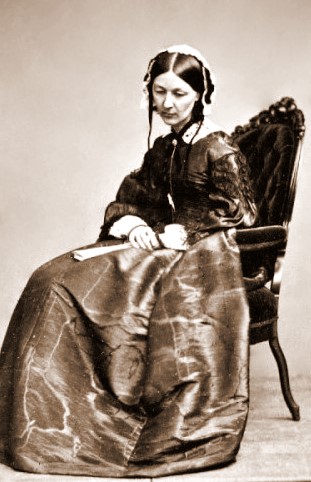
Sepia-toned photograph of a seated woman in a dark dress with a light-colored collar and a white lace cap, looking down toward her hands resting on a book or paper on her lap. She sits in an ornate carved wooden chair against a plain backdrop.Photograph

Primary source

Florence Nightingale by Kilburn c1854

Kilburn · c. 1854

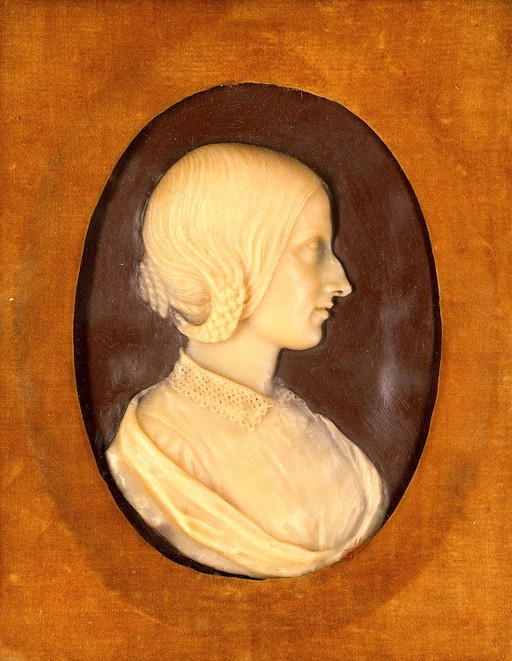
Oval wax relief portrait in profile of a young woman facing right, with hair pulled back into a braided knot, a lace-trimmed collar, and draped garment, set on a brown oval background within an orange velvet frame.Sculpture

Primary source

Wax Relief Portrait of Florence Nightingale

Book

Primary source

Wonderful Adventures of Mrs. Seacole in Many Lands

Mary Seacole · 1857

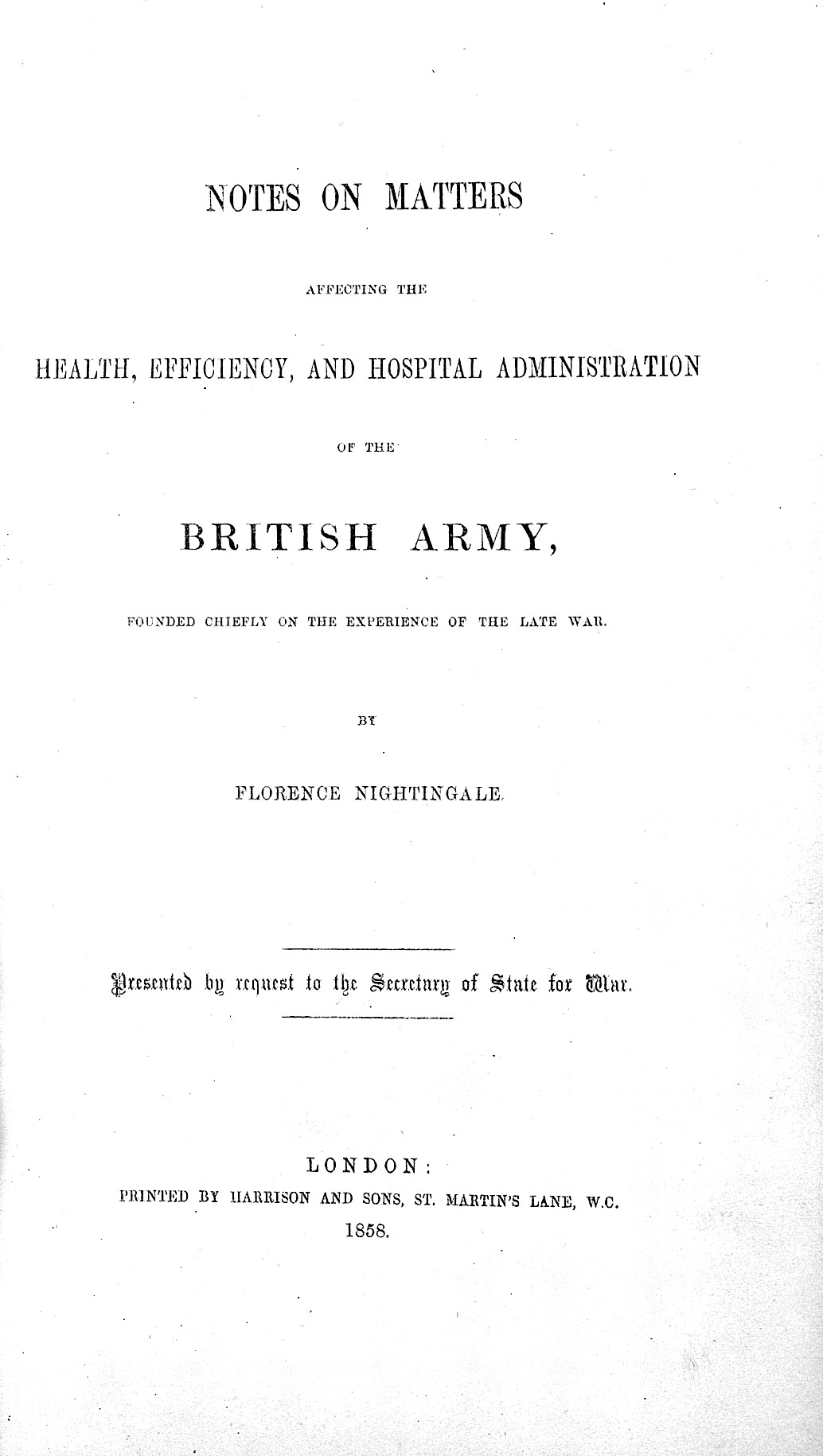
Title page of the 1858 book 'Notes on Matters Affecting the Health, Efficiency, and Hospital Administration of the British Army', founded chiefly on the experience of the late war, by Florence Nightingale. Printed text in black on white, with a note 'Presented by request to the Secretary of State for War' and the imprint London: Printed by Harrison and Sons, St. Martin's Lane, W.C. 1858.Document

Primary source

Notes on Matters Affecting the Health, Efficiency, and Hospital Administration of the British Army

Florence Nightingale · 1858

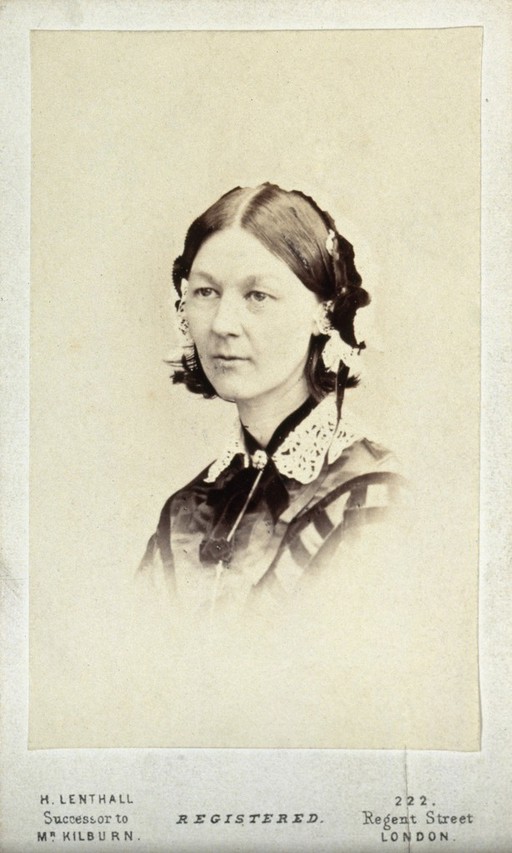
Sepia carte-de-visite portrait of a woman with dark hair parted in the middle and curled at the sides, wearing a lace collar and a dark dress with a brooch. Printed text at the bottom reads H. Lenthall, Successor to Mr Kilburn, 222 Regent Street, London.Photograph

Primary source

Florence Nightingale, Photograph by H. Lenthall

H. Lenthall

Front cover of a bound volume with dark brown leather spine on the left and marbled paper boards in yellow, red, black and grey covering the rest. Faint white pencil marks are visible on the cover.Document

Primary source

Report of the Royal Commission on the Sanitary State of the Army

Royal Commission on the Sanitary State of the Army (chaired by Sidney Herbert) · 1858

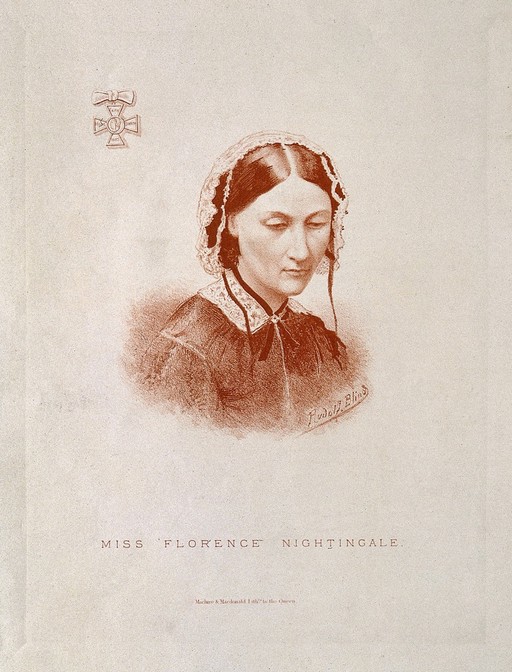
Sepia-toned lithograph portrait of a woman in a lace-trimmed bonnet and dark high-necked dress with a lace collar, head turned slightly downward. A small cross emblem appears in the upper left. Caption below reads 'Miss Florence Nightingale'; signed 'R. Blind' at lower right.Painting

Primary source

Florence Nightingale, Lithograph by R. Blind

R. Blind

Red cover of a book with a cream label framed by double rules. Title reads: Observations on the Sanitary State of the Army in India, with illustrations, by Florence Nightingale. Price Half-a-Crown.Document

Primary source

Observations on the Evidence Contained in the Stational Reports Submitted to Her by the Royal Commission on the Sanitary State of the Army in India

Florence Nightingale · 1863

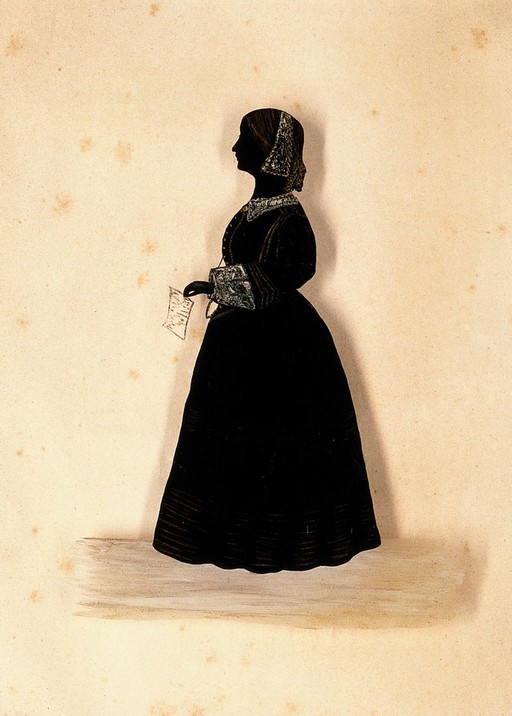
Full-length black silhouette of a woman in profile facing left, wearing a black dress with a lace cap and collar, holding a small bag and a folded paper. Painted on a pale cream background with a grey ground line.Artifact

Primary source

Florence Nightingale in Silhouette

Plain red cloth book cover with a woven texture, shaded darker on the right side. No title or text is visible.Book

Primary source

Notes on Hospitals

Florence Nightingale · 1859

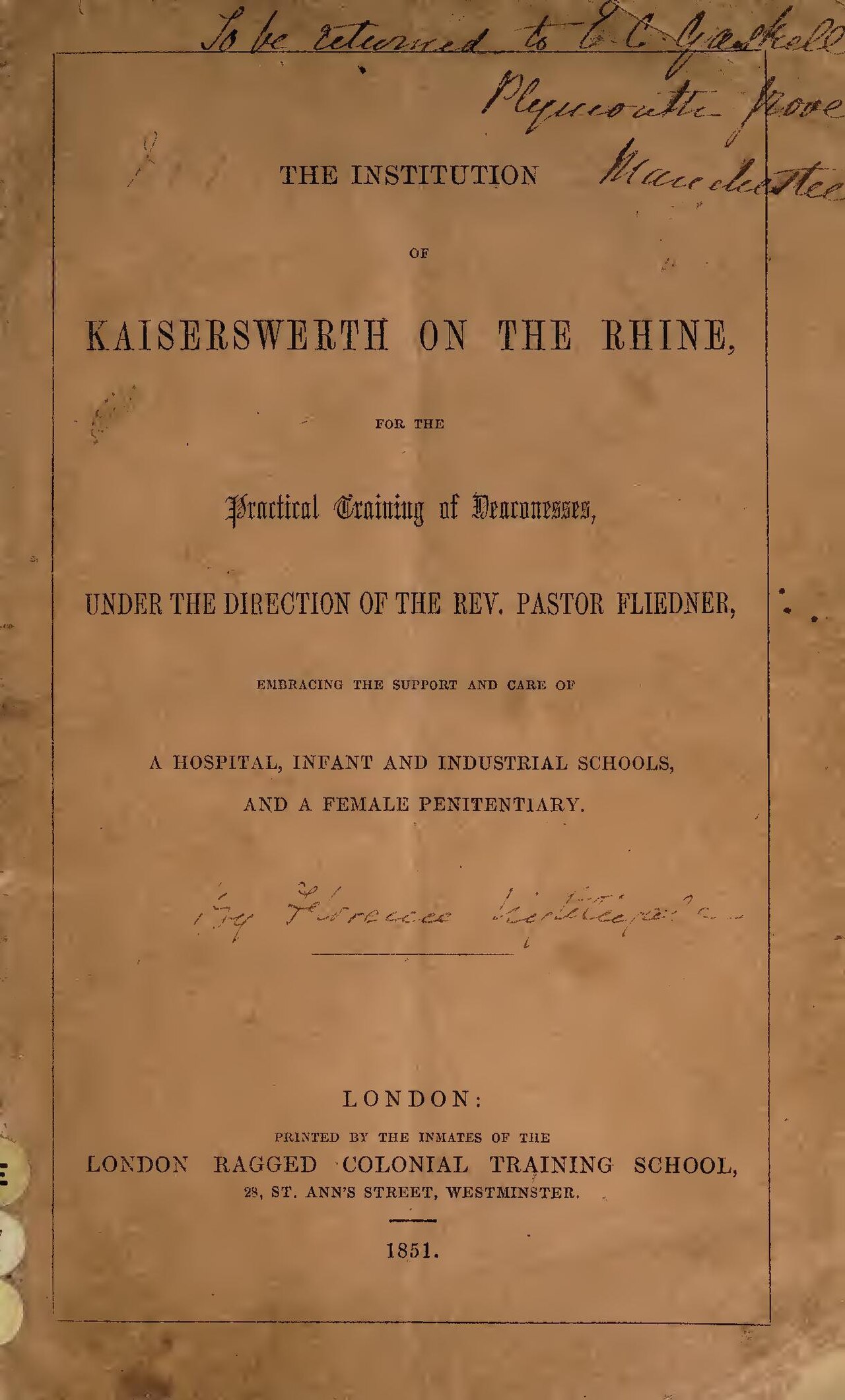
Title page of a printed booklet: 'The Institution of Kaiserswerth on the Rhine, for the Practical Training of Deaconesses, under the direction of the Rev. Pastor Fliedner'. Handwritten inscriptions in ink at the top and right edge, and a handwritten note near the bottom. Printed in London in 1851 by the London Ragged Colonial Training School.Book

Primary source

The Institution of Kaiserswerth on the Rhine, for the Practical Training of Deaconesses

Florence Nightingale · 1851

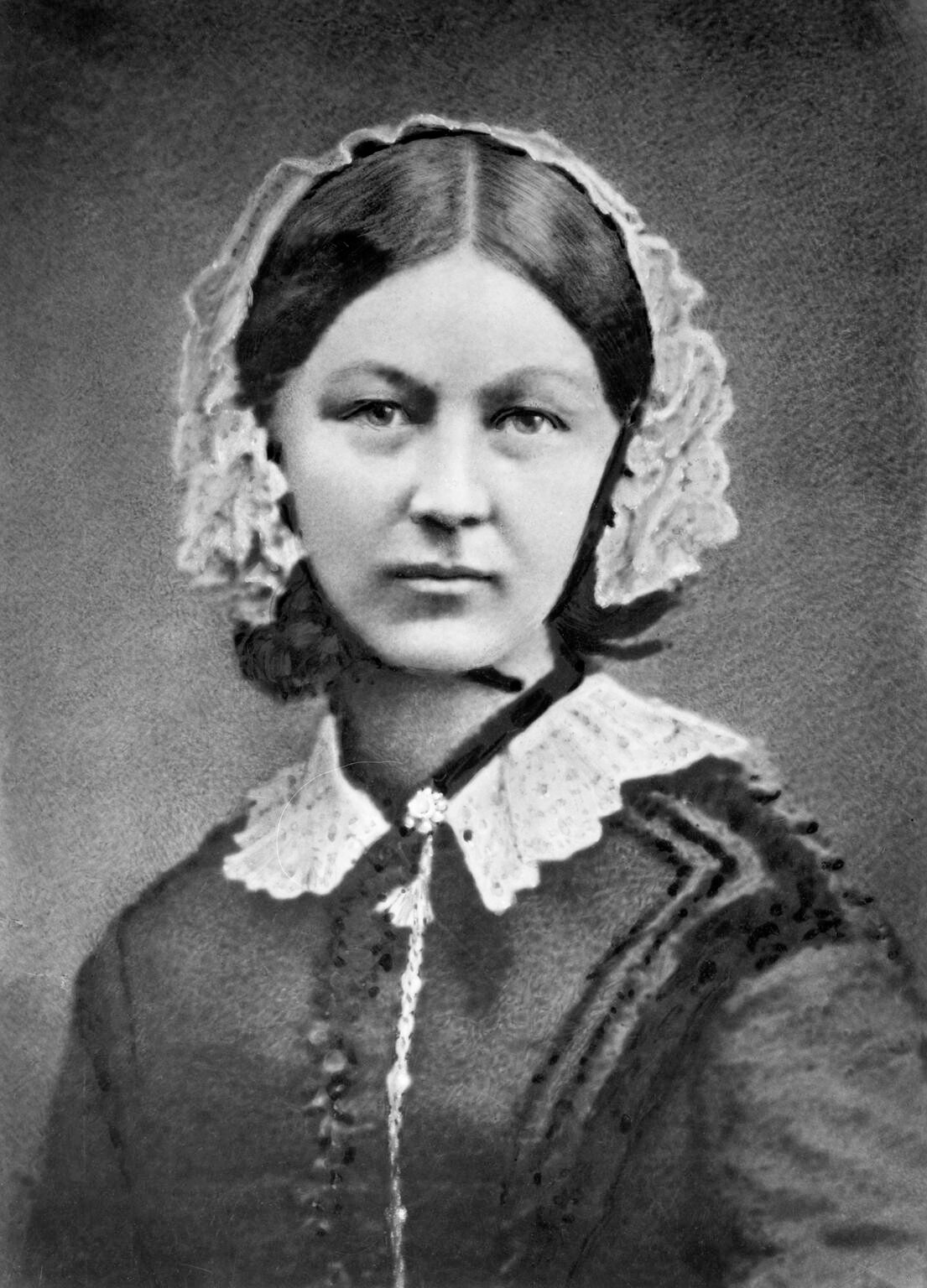
Black-and-white studio portrait of a young woman with dark hair parted in the center, wearing a light lace cap and a high dark dress with a white lace collar and a small brooch. She faces the camera with a serious expression.Photograph

Primary source

Portrait of Florence Nightingale

Henry Hering · c. 1856-1857

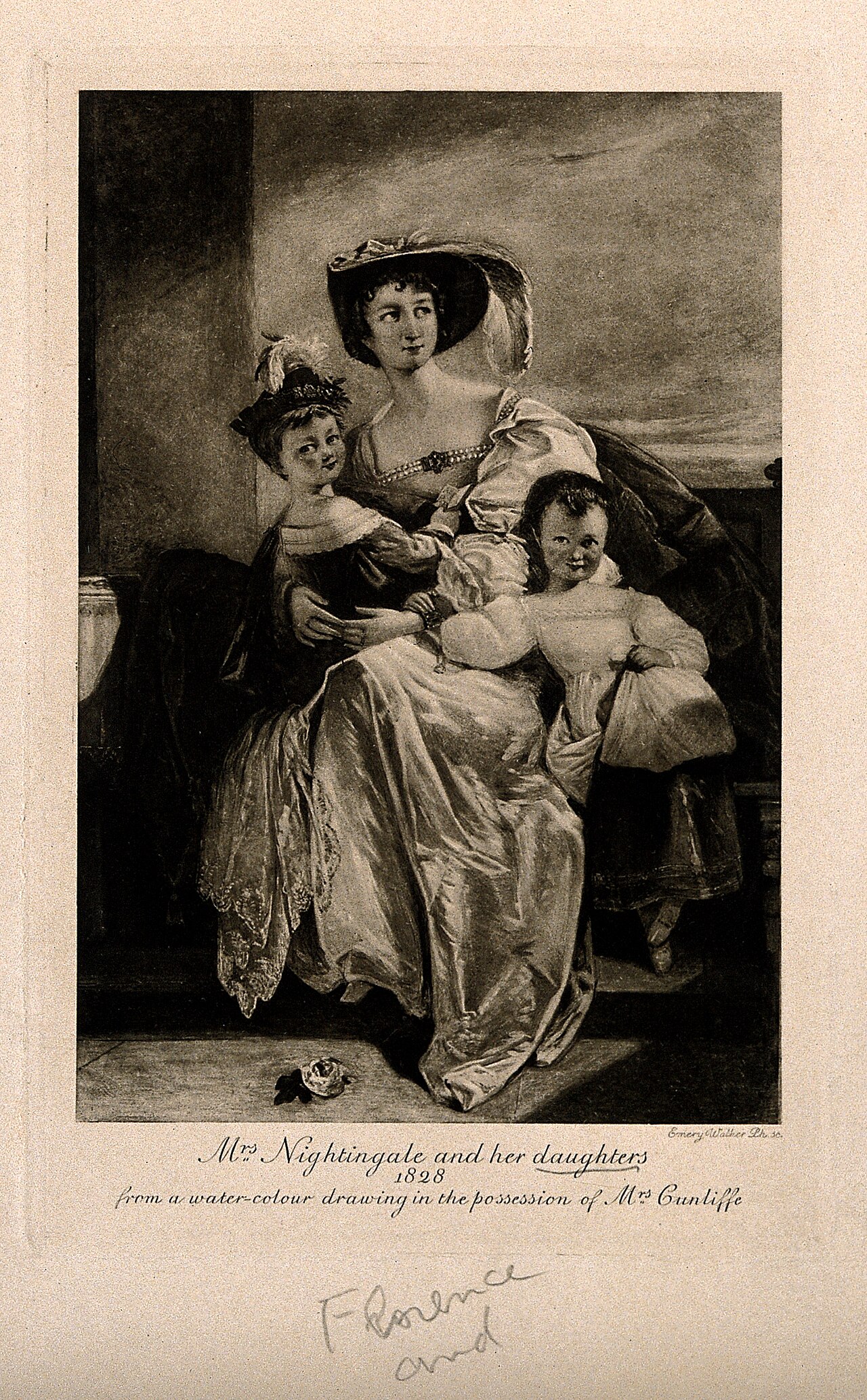
Sepia photogravure of a seated woman in a feathered hat with two young girls, one standing at left in a feathered bonnet and one seated at right in a white dress. Caption reads 'Mrs Nightingale and her daughters 1828'. Handwritten note at bottom reads 'Florence and'.Painting

Primary source

Frances Parthenope Nightingale and Florence Nightingale

William White · c. 1836

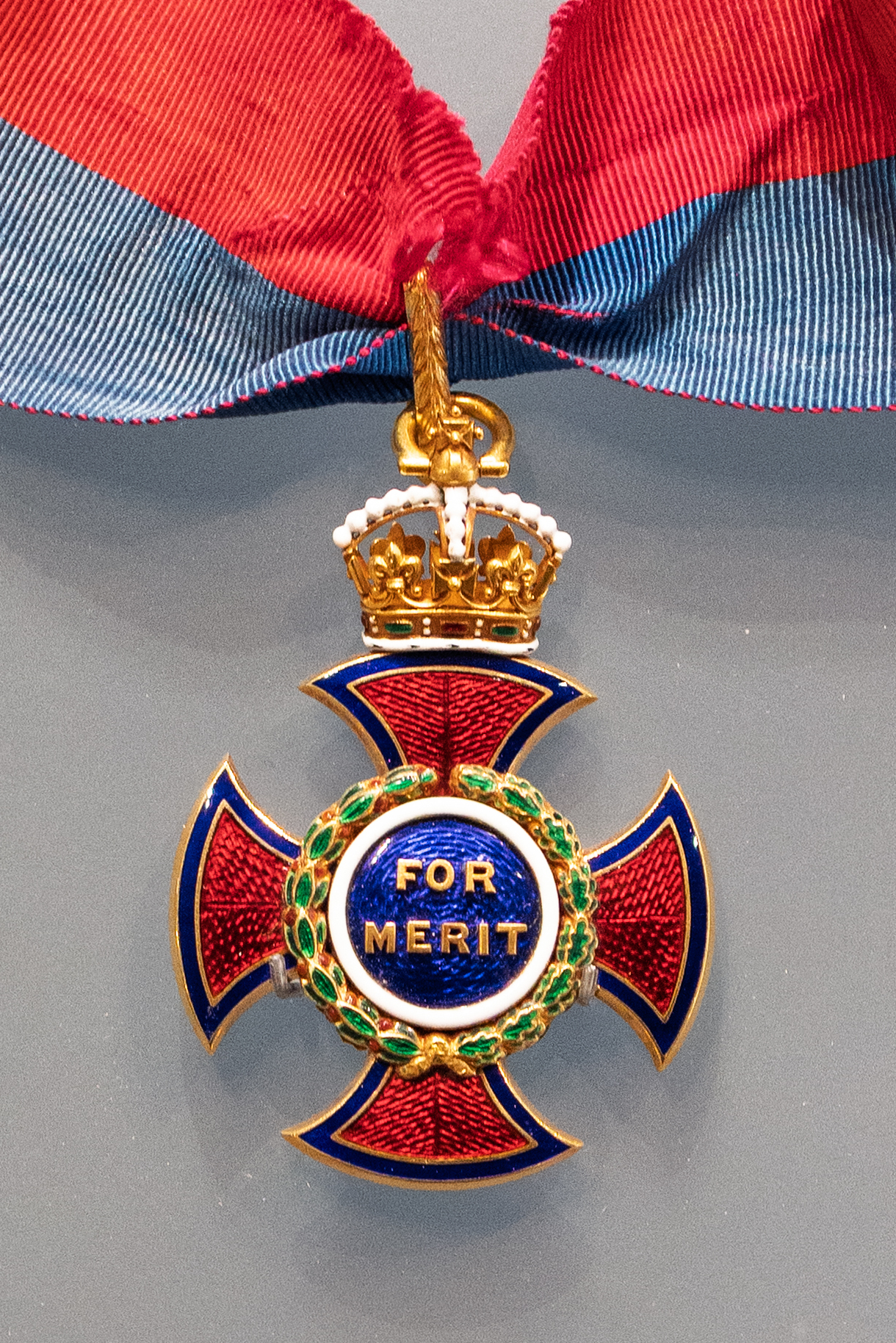
Photo of a gold and enamel cross medal with red and blue enamel arms, a central blue disc reading FOR MERIT in gold letters within a white ring and green laurel wreath, topped by a gold crown, hanging from a red and blue striped ribbon against a grey background.Artifact

Primary source

Order of Merit awarded to Florence Nightingale

1907

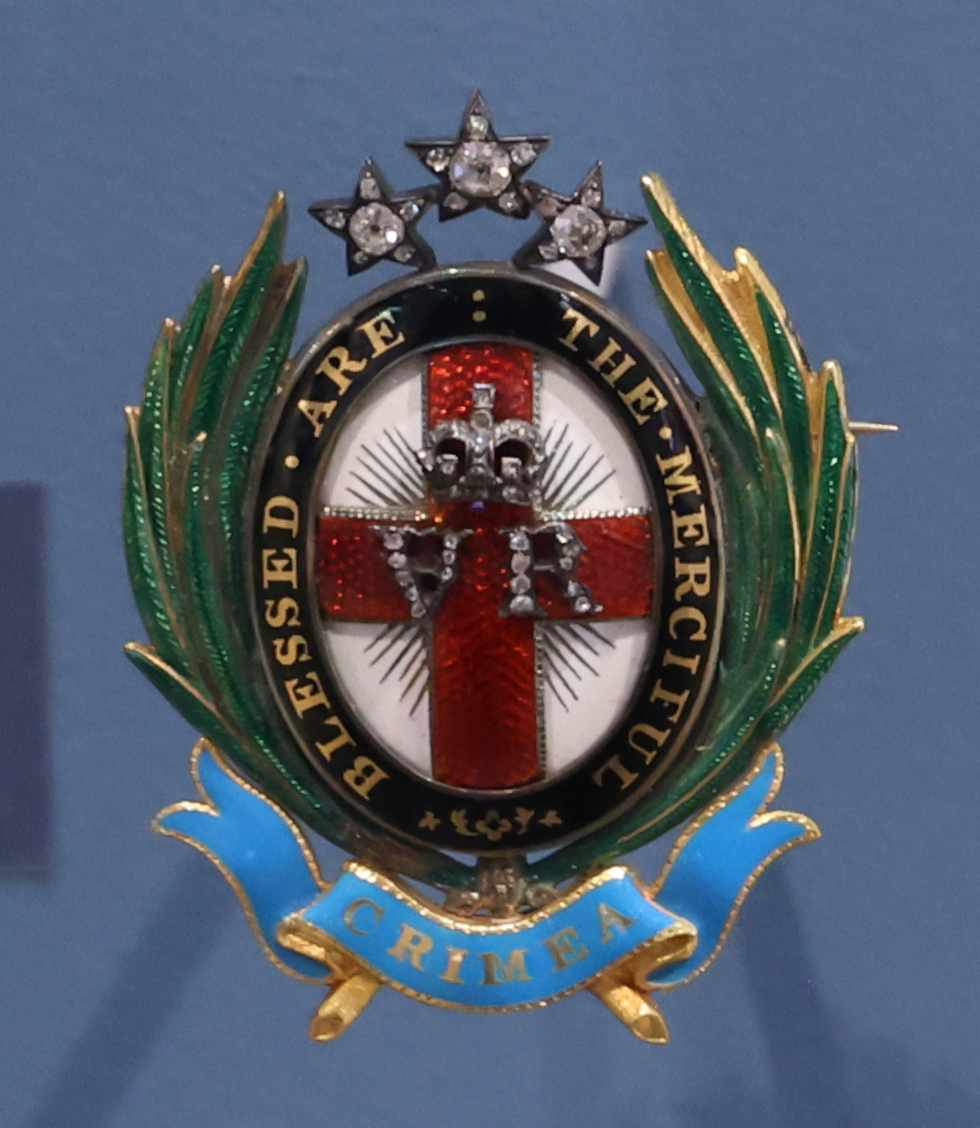
Photo of an ornate brooch on a blue background: a black oval band reading 'BLESSED ARE THE MERCIFUL' surrounds a white and red enamel cross with a crown and VR monogram in diamonds. Three diamond stars sit atop, green enamel leaves frame the sides, and a blue ribbon labeled 'CRIMEA' lies at the bottom.Artifact

Primary source

Nightingale Jewel

Prince Albert · 1855

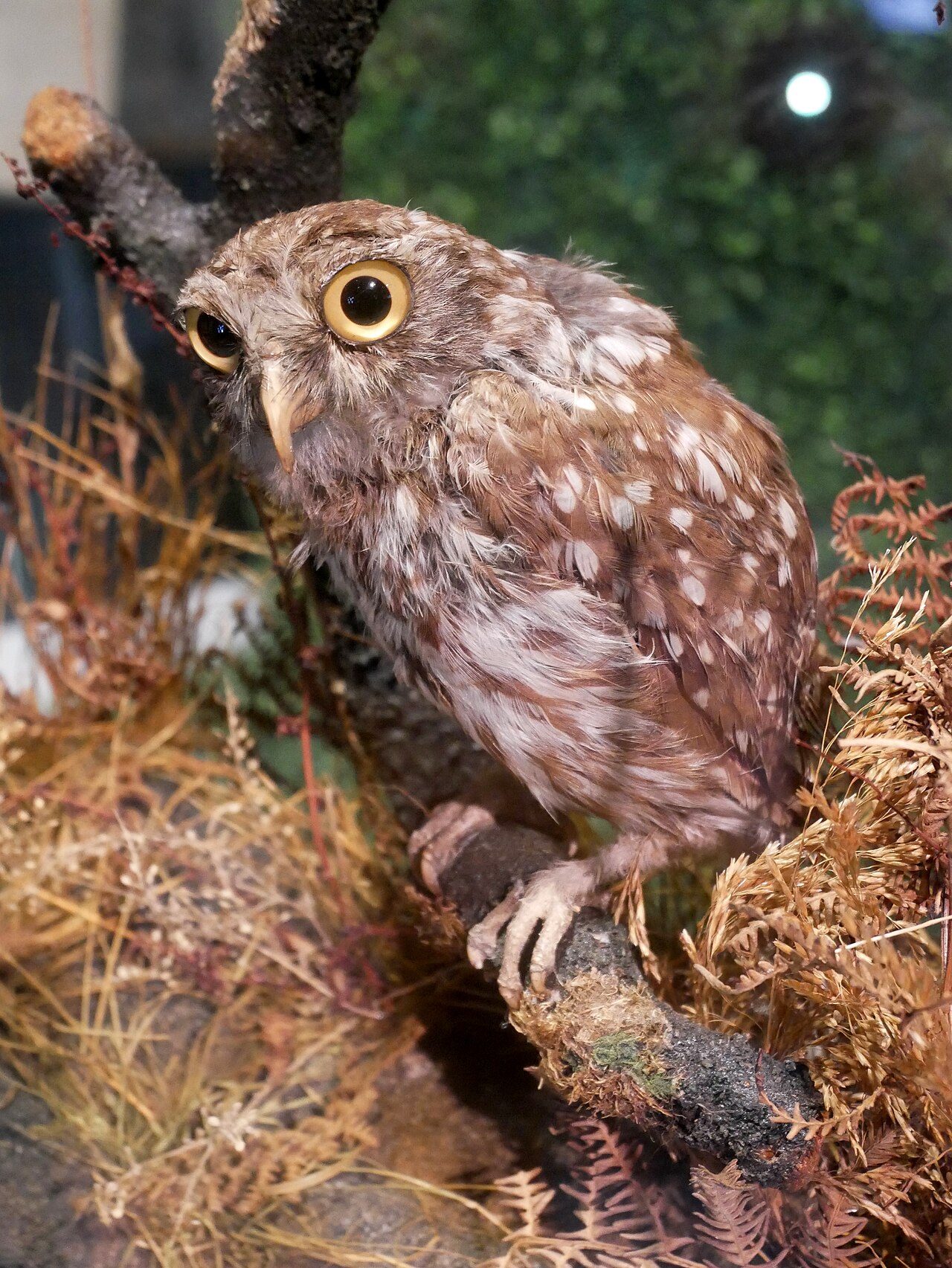
A stuffed owl with large amber-rimmed glass eyes and mottled brown and white speckled plumage, perched on a branch among dried brown grass and ferns in a museum display.Artifact

Primary source

Athena the Owl

Cover of a bound volume with a brown cloth board and red spine. A paper label reads 7689 and a10 near the top left. Faint text 'Digitized by Google' appears at the bottom right.Letter

Primary source

On Trained Nursing for the Sick Poor

Florence Nightingale · 14 April 1876

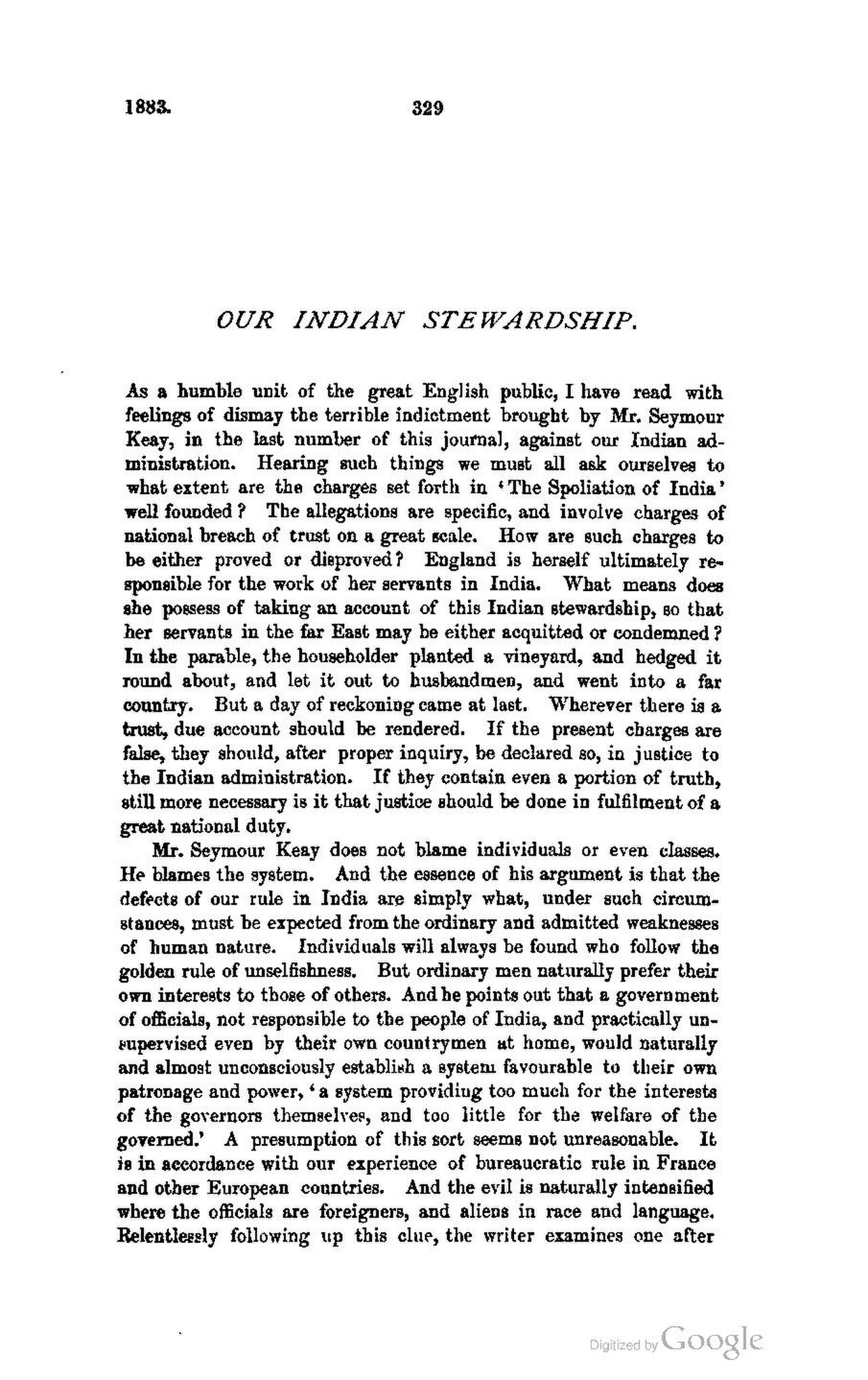
Scanned page 329 of the journal The Nineteenth Century, 1883, showing the start of the article titled 'Our Indian Stewardship' in italic capitals, followed by body text in two-column-width printed paragraphs.Newspaper article

Primary source

Our Indian Stewardship

Florence Nightingale · August 1883

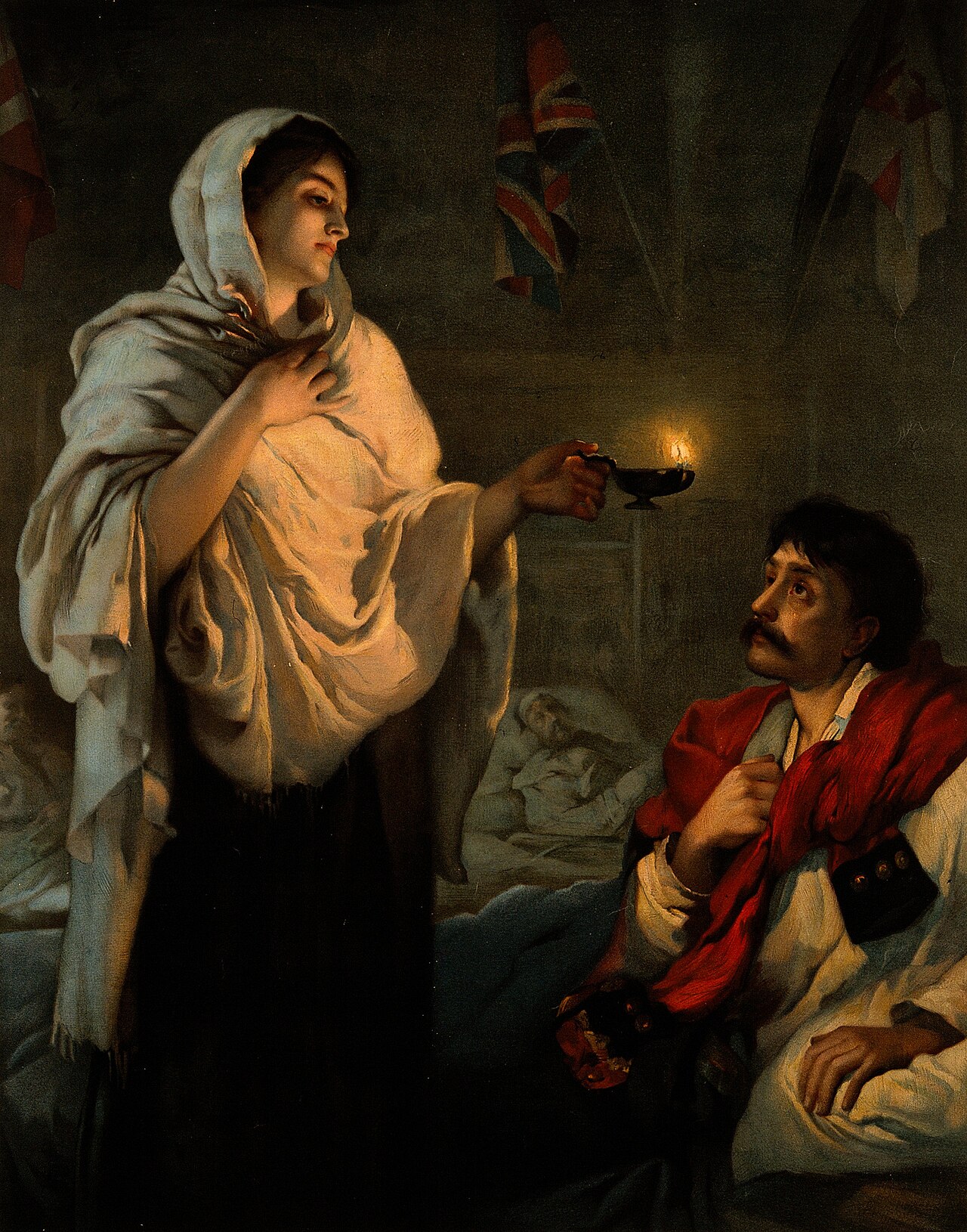
Painting of a woman in a white hooded shawl holding an oil lamp toward a seated, mustached soldier in a red sash. Behind them, patients lie in beds in a dim ward, and British-style flags hang on the wall.Painting

Secondary source

Miss Nightingale at Scutari, 1854

Henrietta Rae · 1891

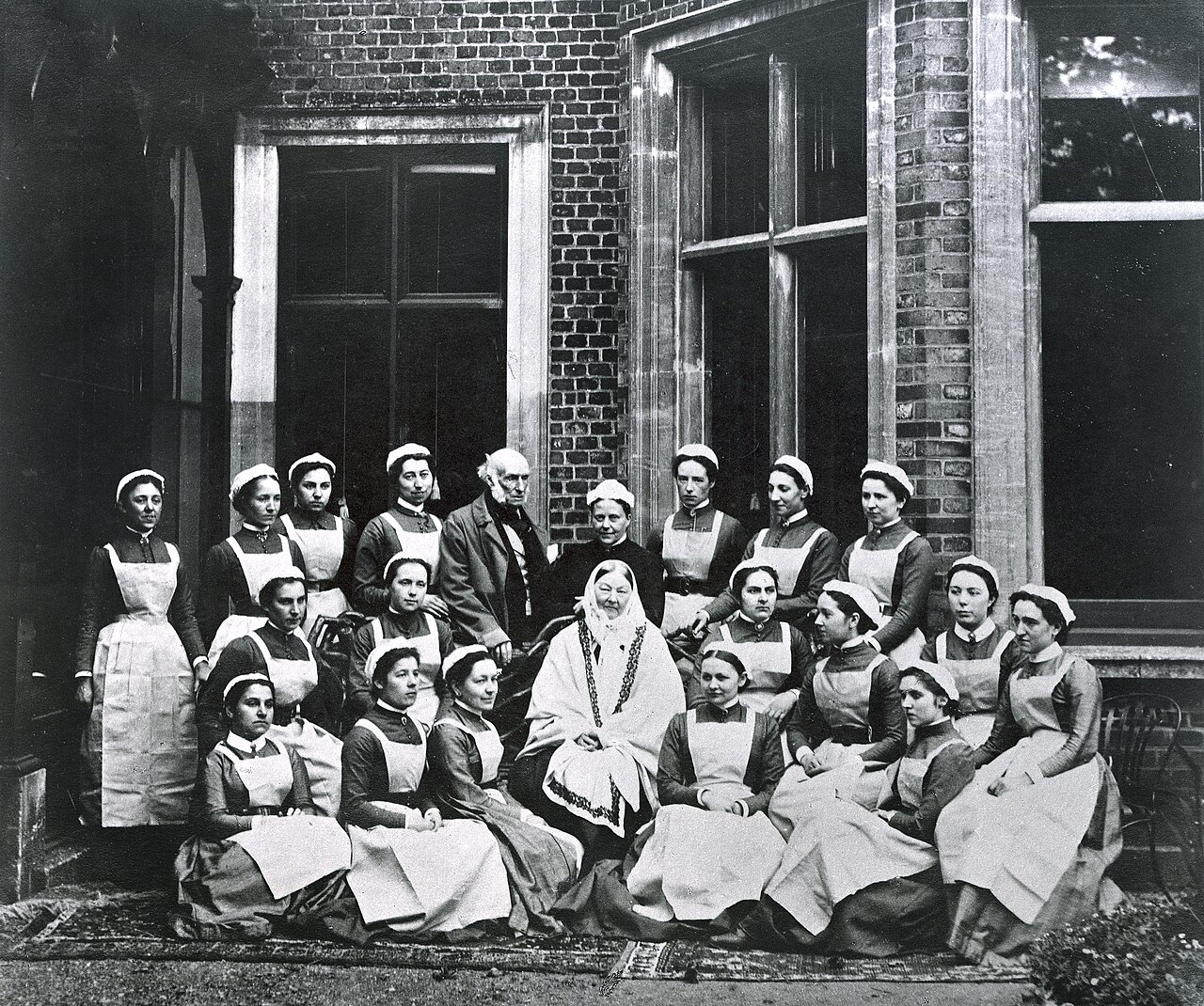
Black and white photograph of a group of about twenty nurses in white caps and aprons posing outside a brick building with large windows. An elderly woman in a white shawl sits in the center front, and an older man in a dark suit stands behind her among the nurses.Photograph

Primary source

F. Nightingale and Sir H. Verney with Nurses at Claydon House

Book

Secondary source

Santa Filomena

Henry Wadsworth Longfellow · 1857

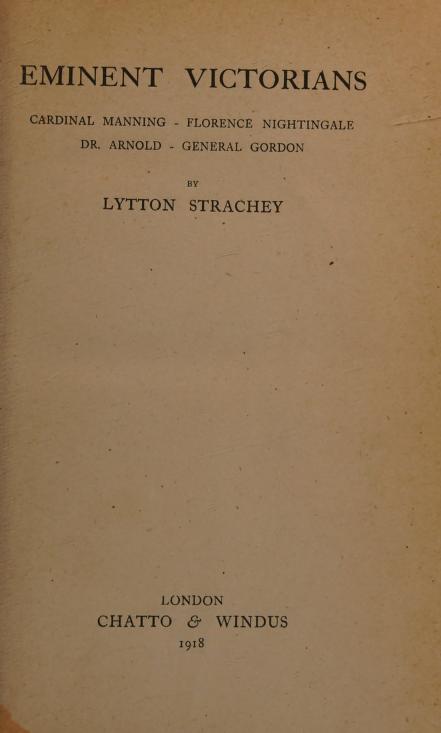
Title page of the book Eminent Victorians. Large heading reads EMINENT VICTORIANS, followed by subtitle lines CARDINAL MANNING - FLORENCE NIGHTINGALE and DR. ARNOLD - GENERAL GORDON. Below, BY LYTTON STRACHEY. At the bottom: LONDON, CHATTO & WINDUS, 1918. Cream-colored paper.Book

Secondary source

Eminent Victorians

Lytton Strachey · 1918

Book

Primary source

Army Sanitary Administration and Its Reform Under the Late Lord Herbert

Florence Nightingale · 1862

Small low-resolution photo of a handwritten letter in blue ink on lined paper, with a few lines of cursive text visible, including a sentence beginning 'We have been good to think of' and a salutation near the top.Letter

Primary source

Letter from Florence Nightingale to Mary Mohl

Florence Nightingale · 2 November 1881

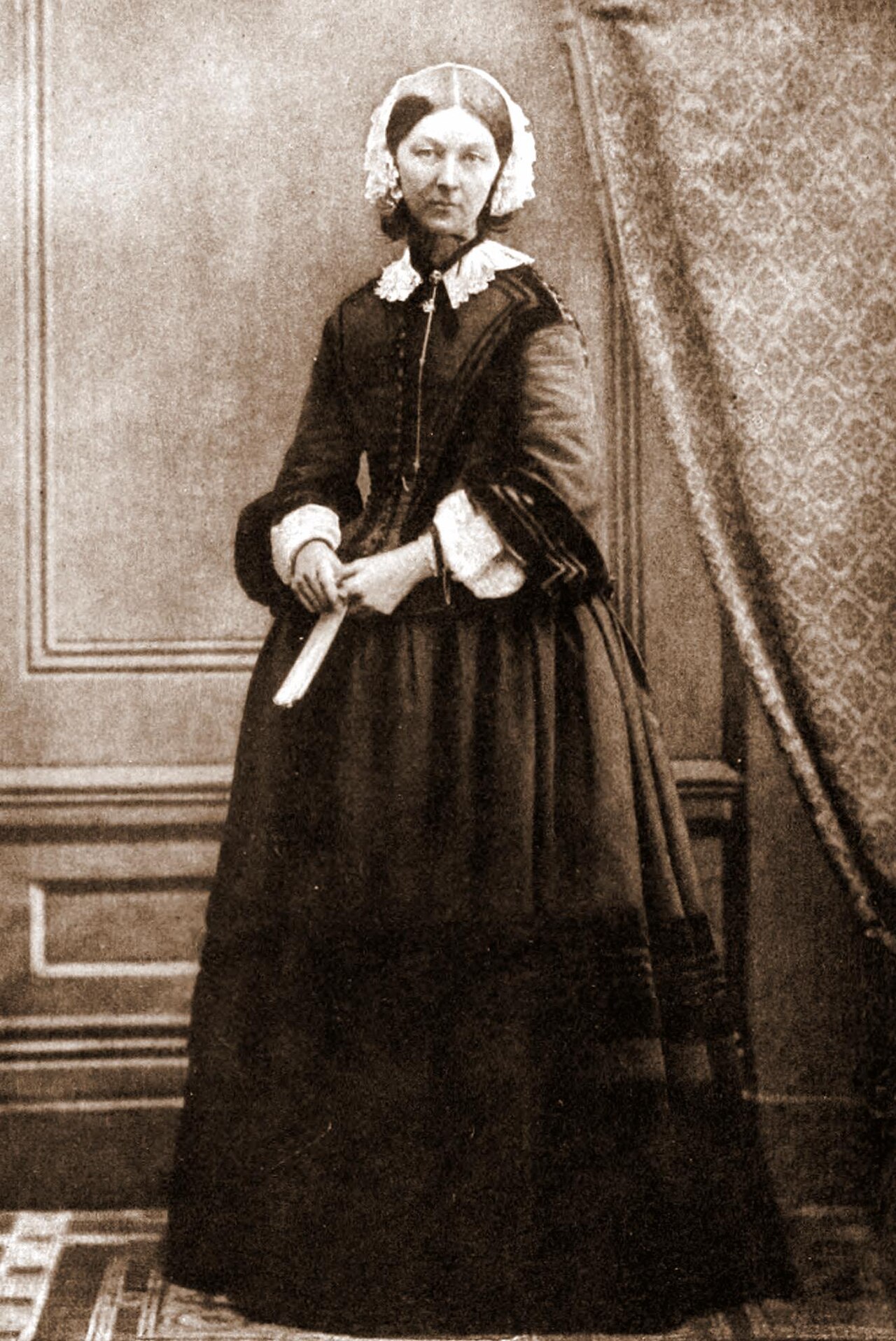
Sepia-toned full-length portrait of a woman standing before a paneled wall and a patterned drape. She wears a dark dress with a white lace collar and cuffs, a white lace cap, and holds a folded paper or handkerchief in her hands.Photograph

Primary source

Photograph of Florence Nightingale

Henry Hering · c. 1856–1857

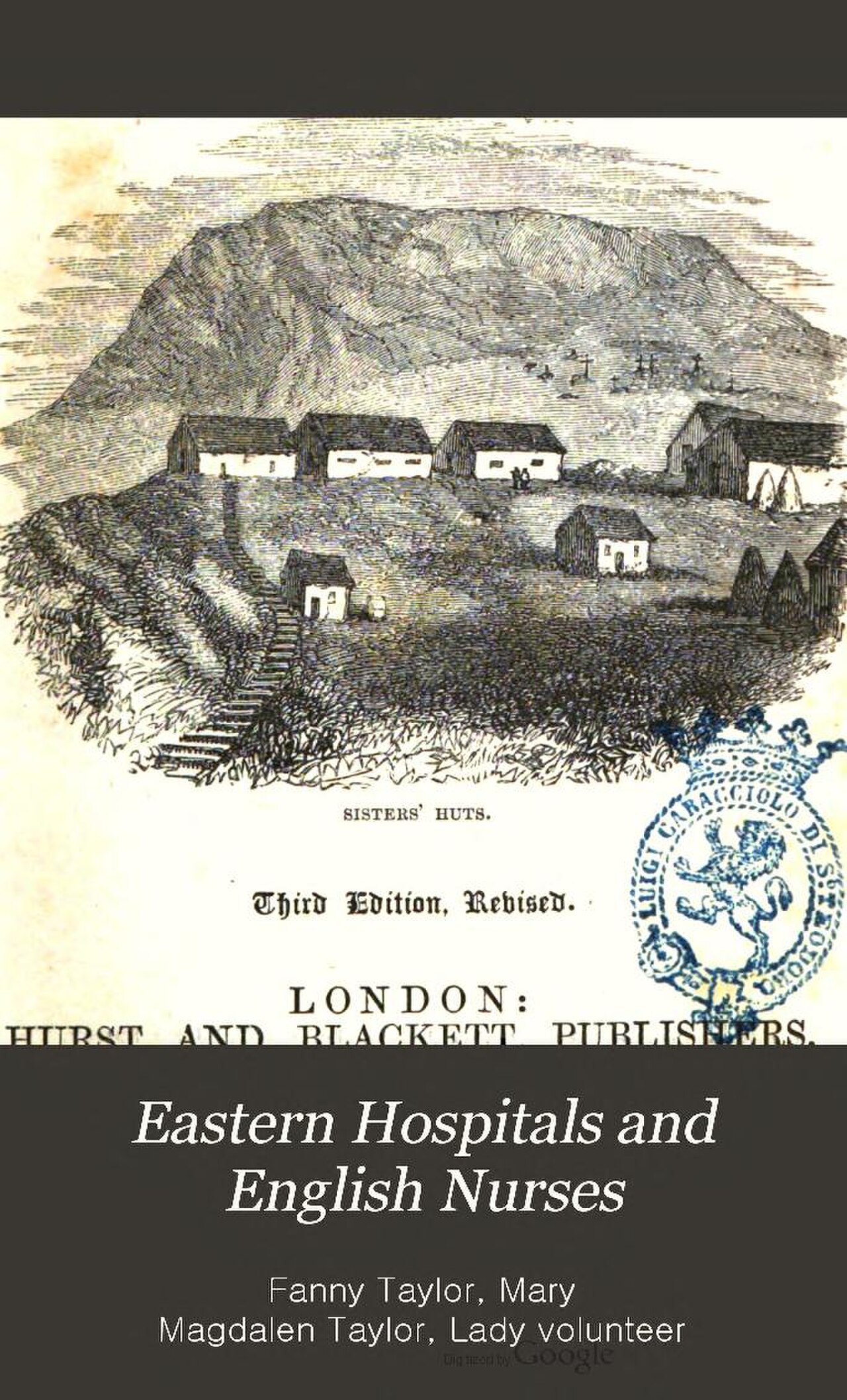
Title page of the book Eastern Hospitals and English Nurses, with an engraving of wooden huts on a hillside labelled Sisters' Huts, the text 'Third Edition, Revised', 'LONDON: HURST AND BLACKETT, PUBLISHERS', and a blue stamp of a crowned lion. Title and author names are printed below.Book

Primary source

Eastern Hospitals and English Nurses

Frances Margaret Taylor · 1856

Front cover of a blue cloth book with a gold-stamped emblem of cooking utensils, bread, and a flag, arched by the words 'A CULINARY CAMPAIGN' and below it 'BY A. SOYER'. A white Boston Public Library barcode label sits at the top.Book

Primary source

A Culinary Campaign

Alexis Soyer · 1857

Front cover of a light blue printed paper wrapper reading 'Subsidiary Notes as to the Introduction of Female Nursing into Military Hospitals in Peace and in War', presented by request to the Secretary of State for War, London, Harrison and Sons, 1858. A yellow library label at top left reads 'BIOMED AC 8 N5 B 1858a Rare'.Document

Primary source

Subsidiary Notes as to the Introduction of Female Nursing into Military Hospitals

Florence Nightingale · 1858

Book

Primary source

Workhouse Nursing: The Story of a Successful Experiment

Florence Nightingale · 1867

Newspaper article

Primary source

A Note on Pauperism

Florence Nightingale · 1869

Book

Primary source

Una and the Lion

Florence Nightingale · 1871

Book

Primary source

Rural Hygiene

Florence Nightingale · 1894

Front cover of a bound book in brown embossed cloth, with a vertical striped and diagonal textured pattern and a central ornate embossed panel with scrollwork motifs. A white library label with the call number M19856 sits at the lower left.Book

Primary source

Introductory Notes on Lying-In Institutions

Florence Nightingale · 1871

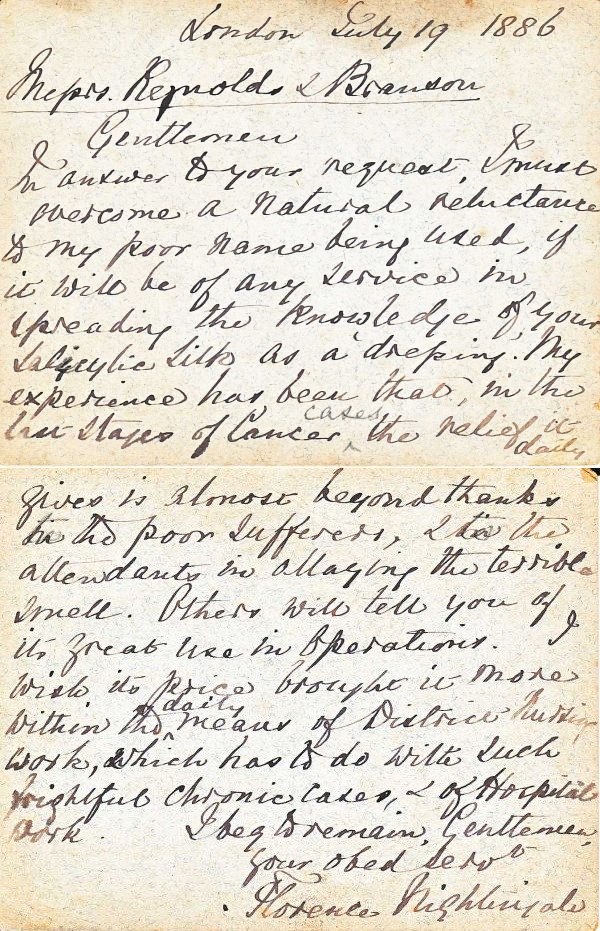
Scan of a handwritten letter dated London, July 19, 1886, addressed to Messrs. Reynolds & Brandon, signed Florence Nightingale, discussing salicylic silk dressings. Shown on two stacked pages.Letter

Primary source

Letter on Salicylic Silk Dressings

Florence Nightingale · 19 July 1886

Newspaper article

Secondary source

Representative Women: The Free Nurse: Catherine Mompesson, Mary Pickard, Florence Nightingale

Harriet Martineau · 1860

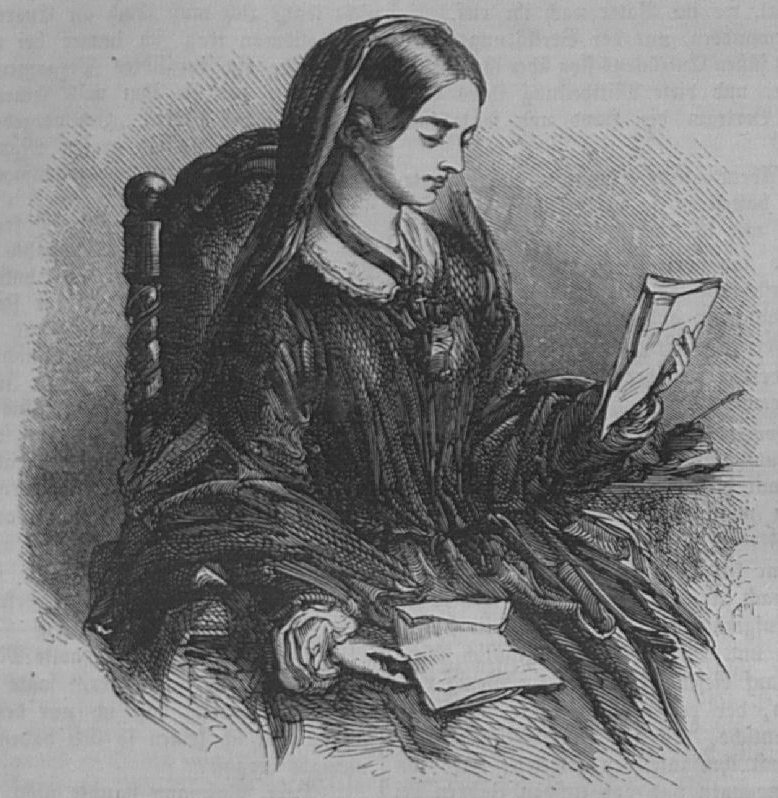
Black-and-white engraving of a woman seated in a carved wooden chair, wearing a dark dress with a white collar, a cross pendant, and a dark head covering. She holds an open letter in one hand and looks down at it. A book rests on her lap, and an inkwell and pen sit on a table to the right.Newspaper article

Secondary source

Hospital-Scenen vom Kriegsschauplatze

1855

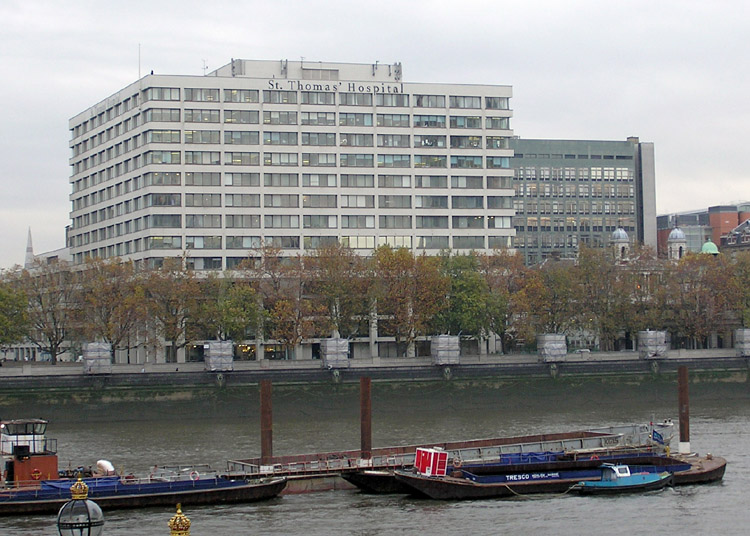
A large multi-storey grey concrete hospital building with many rows of windows, with the sign 'St Thomas' Hospital' on its roof, beside the River Thames with trees, barges and a grey sky.Artifact

Secondary source

St Thomas' Hospital

rebuilt 1871 (founded c. 1100s)

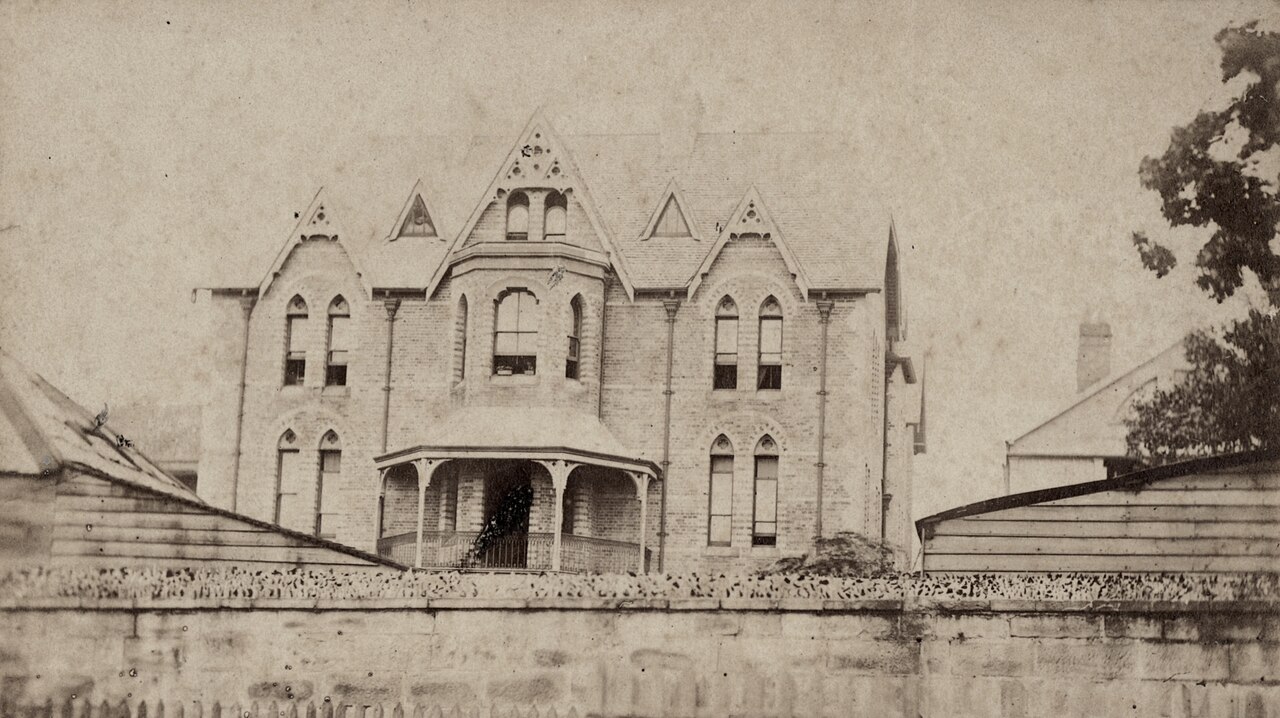
Sepia photograph of a three-storey Victorian Gothic stone building with steep gabled roofs, pointed arched windows, and a front veranda with arched supports. A high stone wall runs across the foreground, with smaller buildings at the sides and trees on the right.Artifact

Secondary source

Nightingale Wing, Sydney Infirmary, Macquarie Street, Sydney

1869

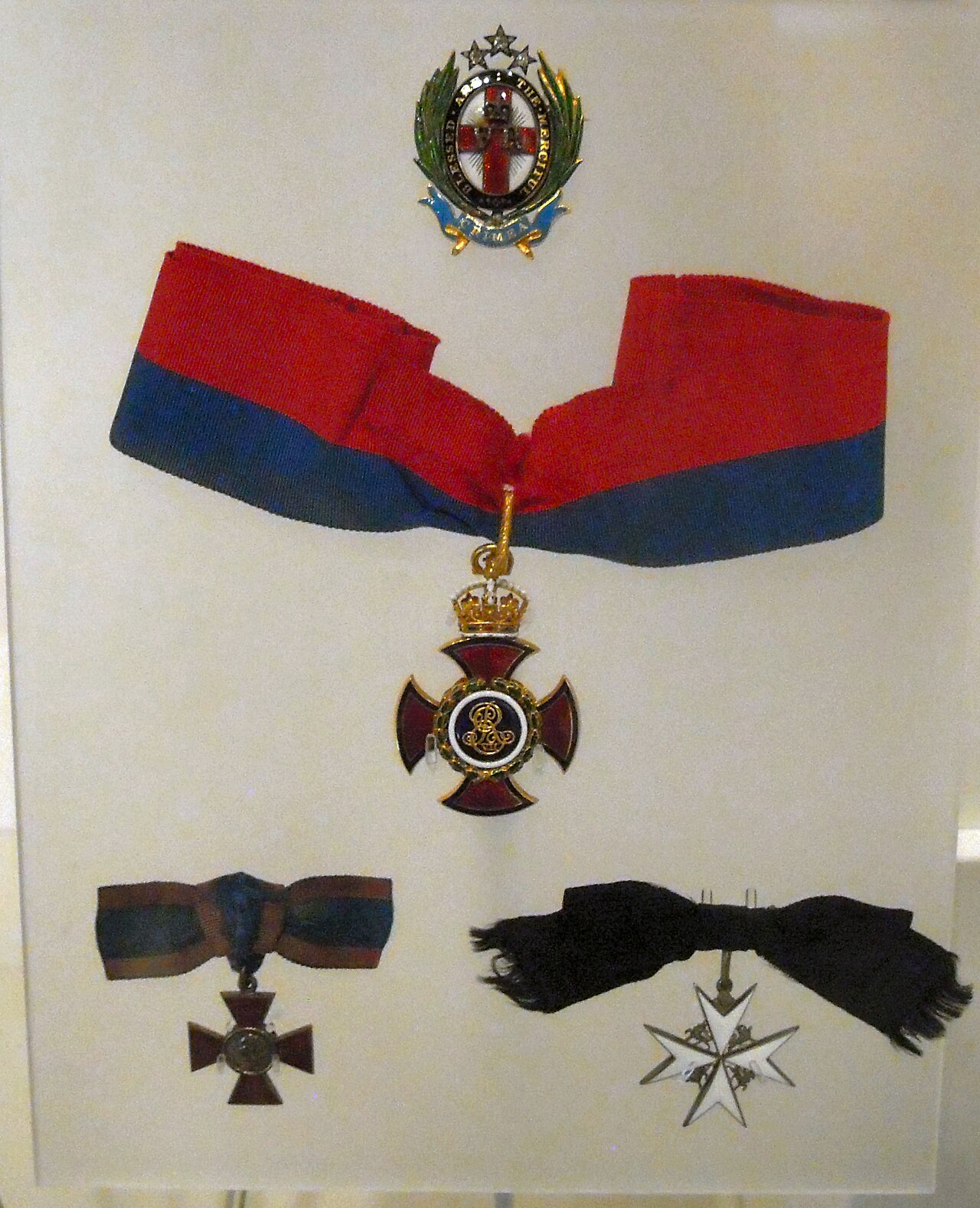
Photo of a display case showing Florence Nightingale's medals on a light background: at top, a red cross badge with a crown-like enamel emblem and the words 'Pro Patria' and 'Pro Mente'; in the center, a red and blue ribbon with a crimson cross medal topped by a gold crown and a central gold monogram; at bottom left, a red cross medal on a blue and brown ribbon bow; at bottom right, a white Maltese-style cross on a black ribbon.Artifact

Primary source

Florence Nightingale medals

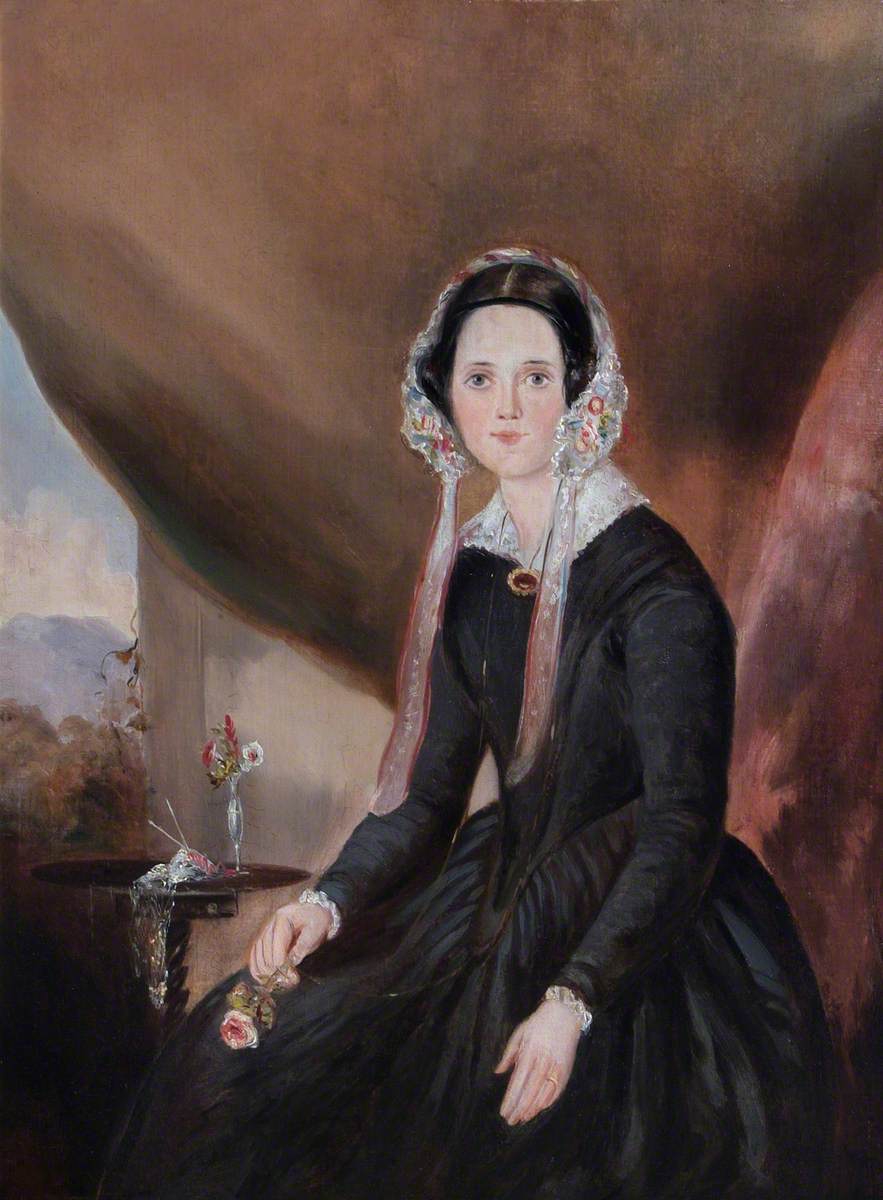
Painting of a seated woman in a dark black dress with a lace bonnet trimmed with small flowers, a brooch at her collar, and a small flower in her hand. A draped brown curtain and a side table with a vase of flowers stand behind her.Painting

Primary source

Florence Nightingale (1855 portrait)

British School · 1855

Black handwritten cursive signature reading 'Florence Nightingale' on a white background, with large looping capital F and N.Document

Primary source

Signature of Florence Nightingale

Florence Nightingale

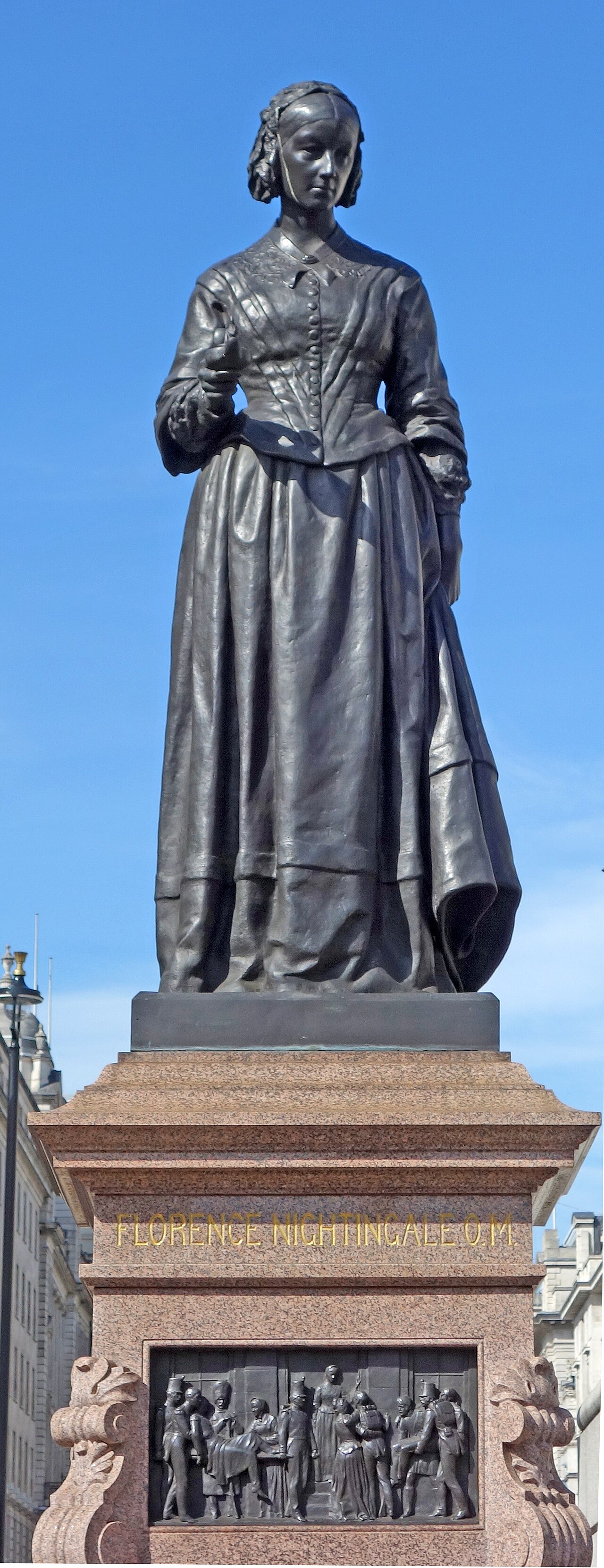
Bronze statue of Florence Nightingale standing on a pink granite pedestal. She wears a long dress, a shawl, and a cap, with one hand raised. The pedestal reads FLORENCE NIGHTINGALE O.M. and has a relief of soldiers and nurses. Blue sky behind.Sculpture

Secondary source

Statue of Florence Nightingale

Arthur George Walker · 1915

Book

Tertiary source

Nightingale, Florence

Stephen Paget

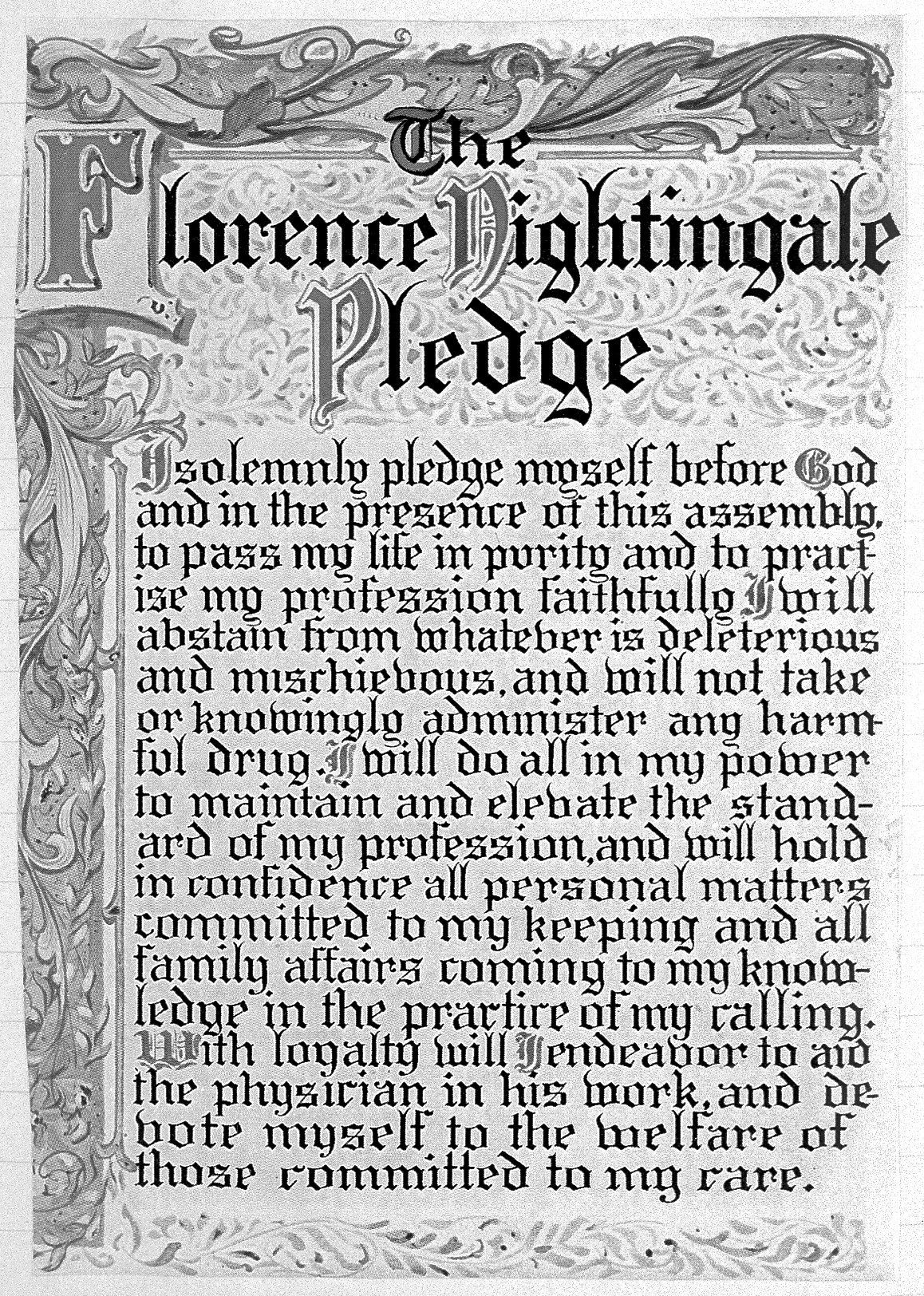
Black-and-white scan of an illuminated manuscript titled 'The Florence Nightingale Pledge', with decorative gothic lettering, ornate floral borders, and a large illuminated initial F. The pledge text is written in calligraphy below.Document

Secondary source

The Florence Nightingale Pledge

1893

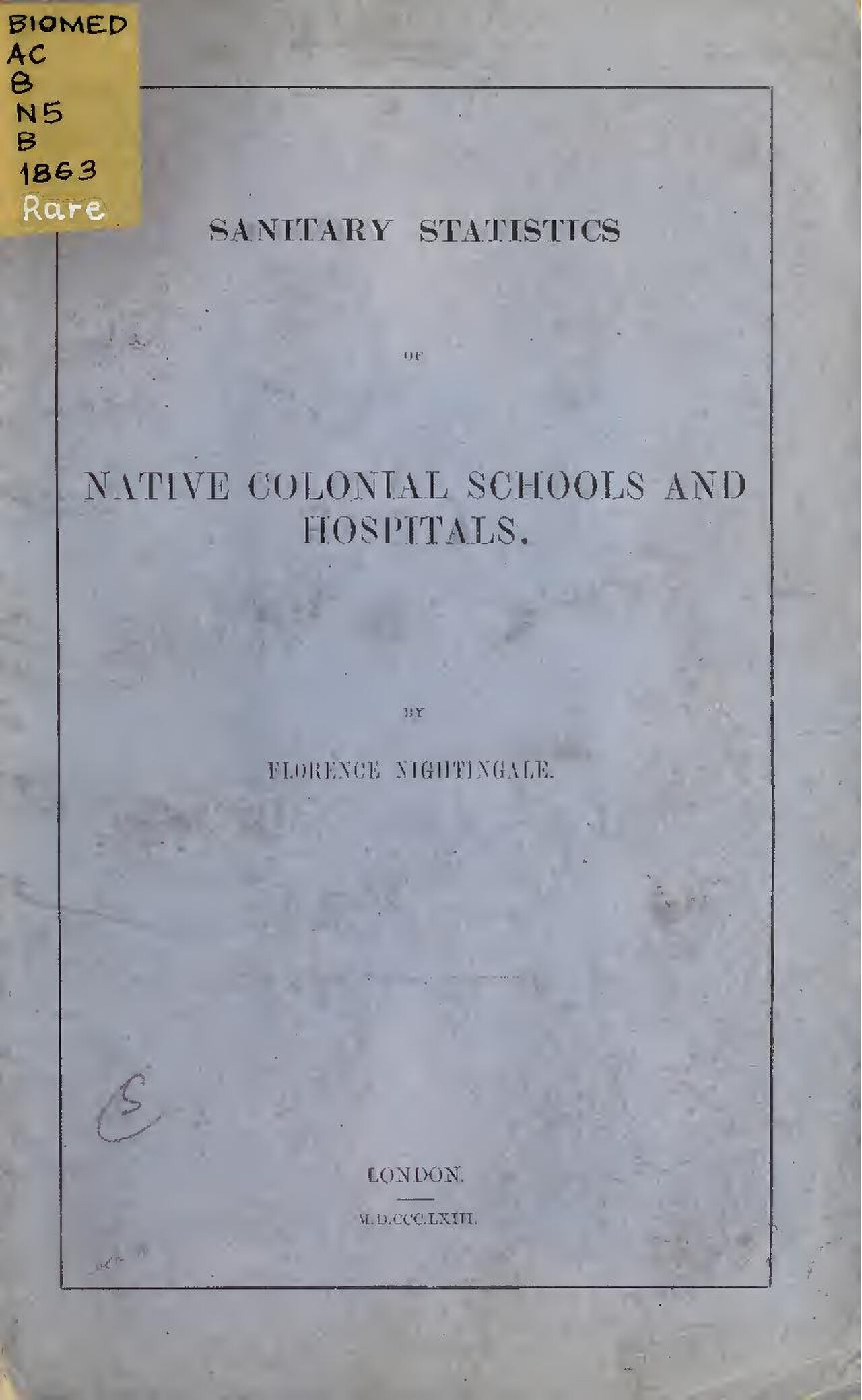
Title page of a book reading 'Sanitary Statistics of Native Colonial Schools and Hospitals, by Florence Nightingale, London, MDCCCLXIII.' A yellow library label at top left reads 'BIOMED AC B N5 B 1863 Rare'.Book

Primary source

Sanitary Statistics of Native Colonial Schools and Hospitals

Florence Nightingale · 1863

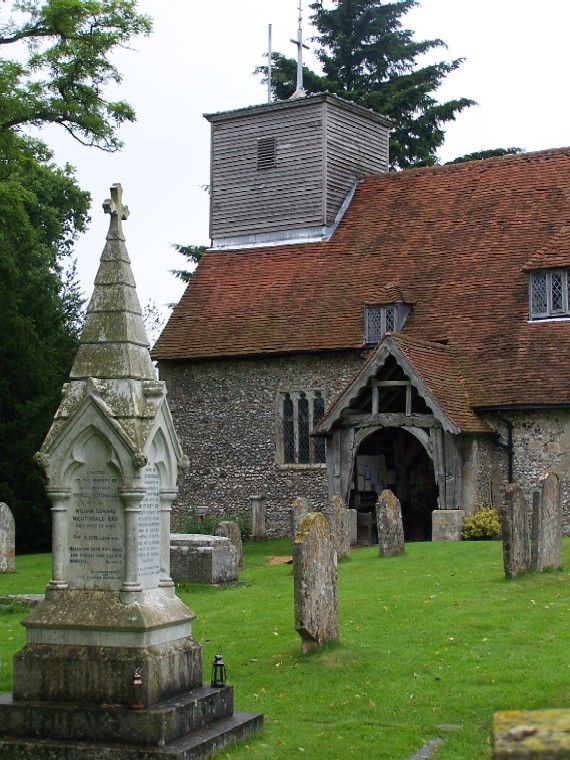
A tall, pinnacled stone memorial with a cross on top and an inscribed panel, standing in a grassy churchyard. Behind it is a flint church with a red tiled roof, a wooden bell turret, and a timber-framed porch.Artifact

Secondary source

Grave of Florence Nightingale

1910

Florence Nightingale to Her Nurses: Addresses to ProbationersBook

Primary source

Florence Nightingale to Her Nurses: Addresses to Probationers

Florence Nightingale · 1914

Directions for Cooking by Troops in Camp and HospitalBook

Primary source

Directions for Cooking by Troops in Camp and Hospital

Florence Nightingale · 1861

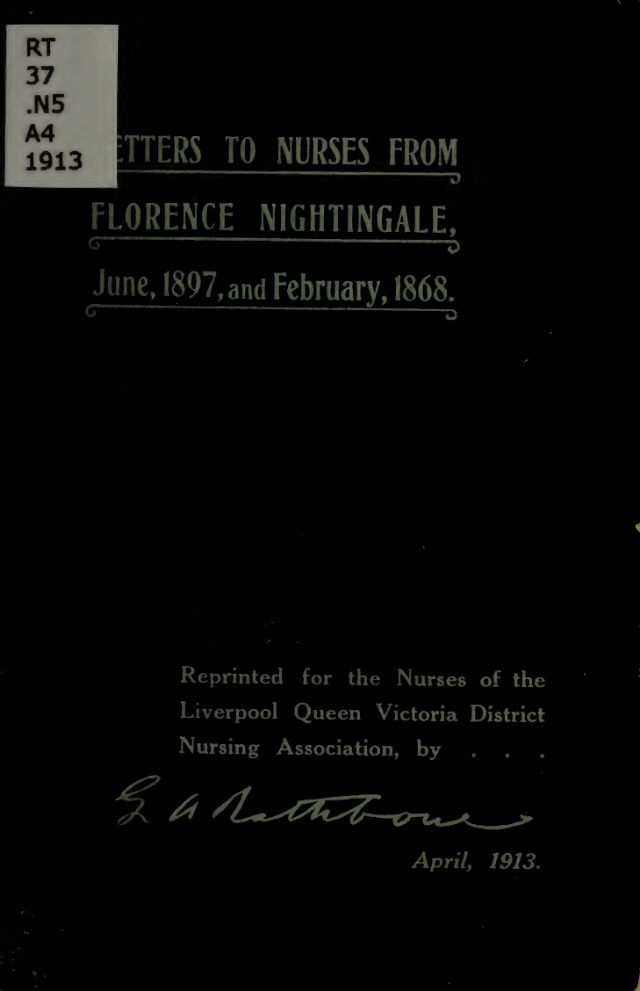
Letters to Nurses from Florence NightingaleLetter

Primary source

Letters to Nurses from Florence Nightingale

Florence Nightingale · 1868 and 1897, reprinted 1913

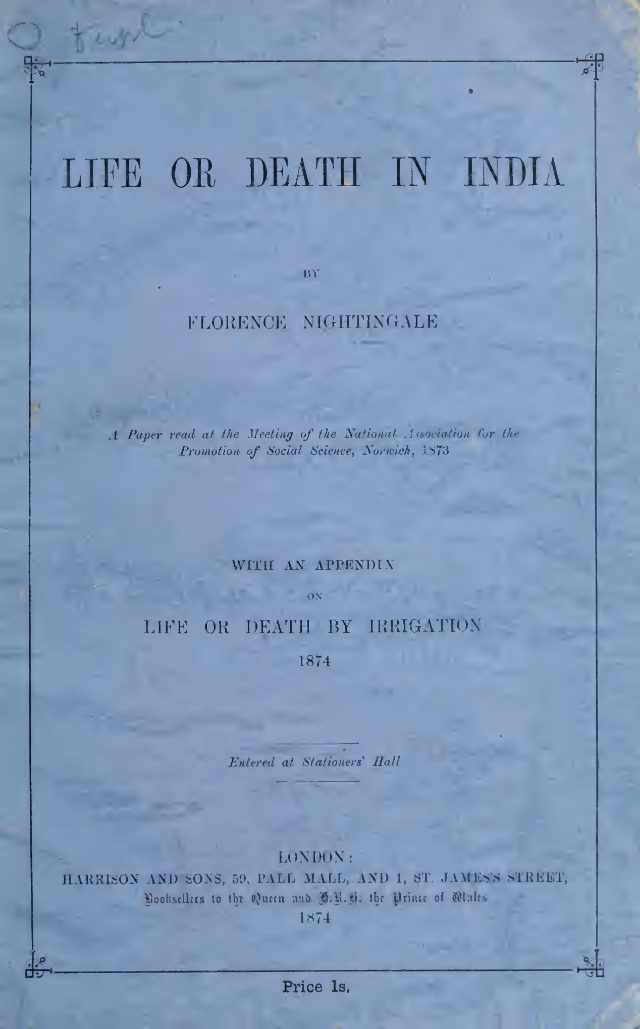
Life or Death in IndiaDocument

Primary source

Life or Death in India

Florence Nightingale · 1873 (read), 1874 (published)

Book

Secondary source

The Life of Florence Nightingale

Sir Edward Tyas Cook · 1913

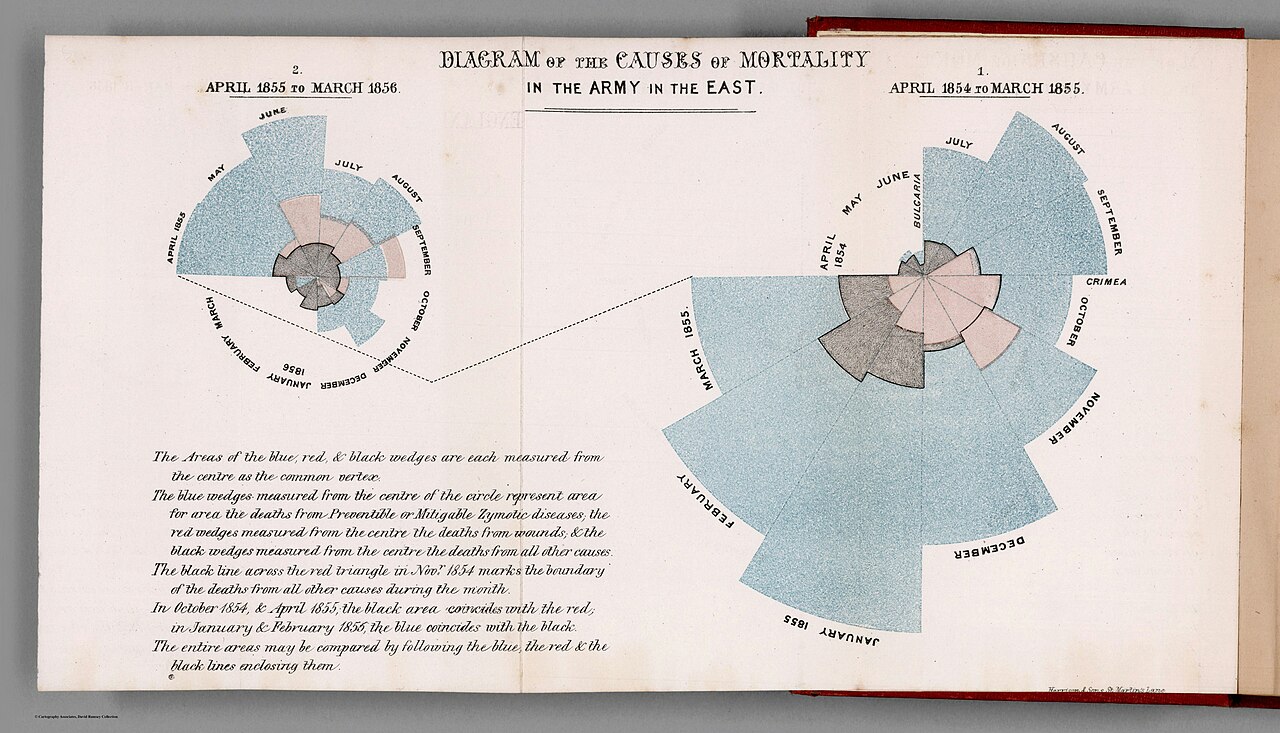
Scanned page of Florence Nightingale's coxcomb-style polar area diagram titled Diagram of the Causes of Mortality in the Army in the East. Two rose charts with blue, red, and black wedges by month, April 1854 to March 1856, with explanatory text beneath and a dashed connecting line between the two charts.Artifact

Primary source

Diagram of the Causes of Mortality in the Army in the East

Florence Nightingale and William Farr · 1858

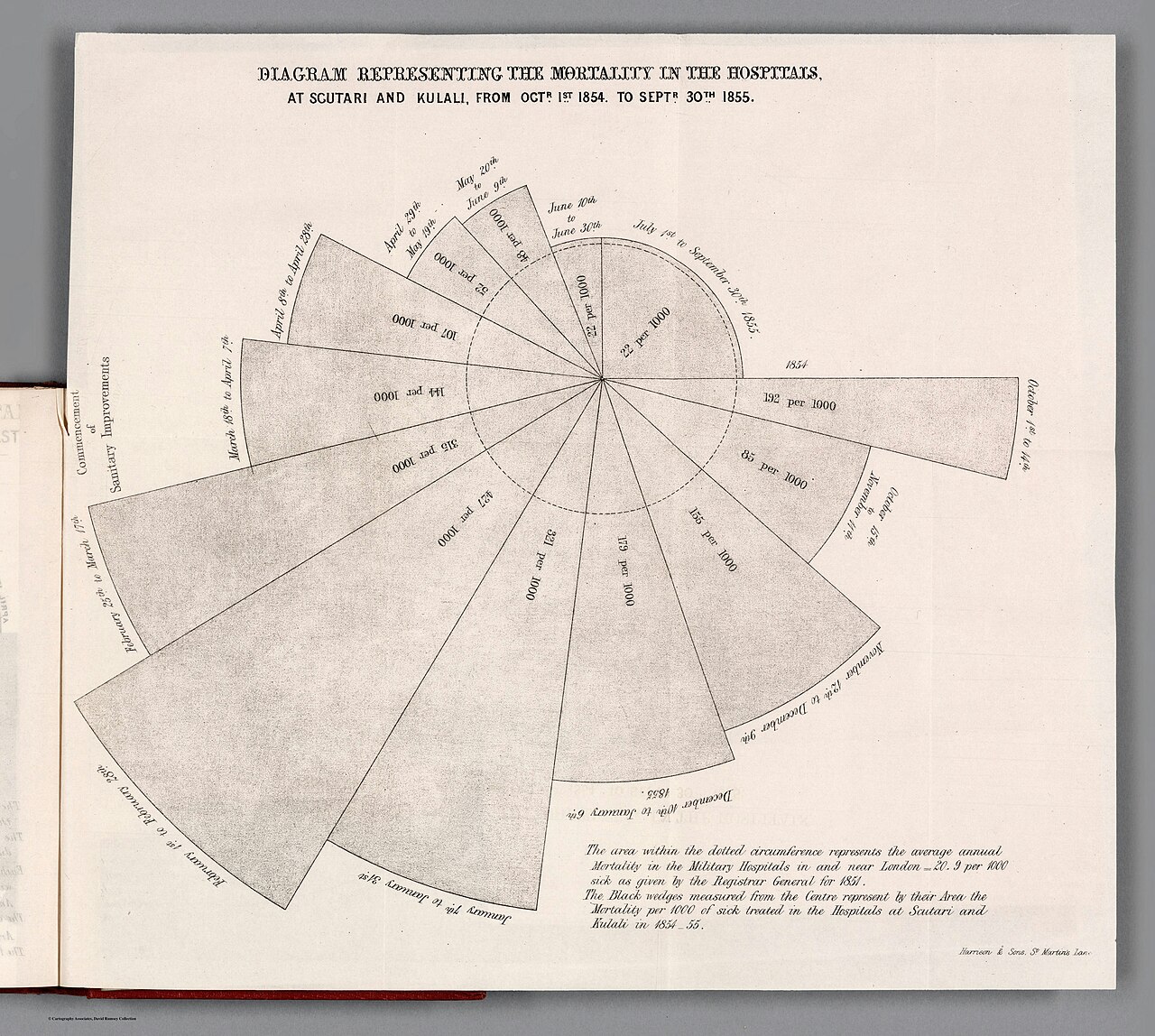
Scan of a printed polar-area diagram titled 'Diagram Representing the Mortality in the Hospitals at Scutari and Kulali, from Oct 1st 1854 to Sept 30th 1855'. Wedges radiate from a center, each labeled with a month and a per-1000 mortality figure, with a dashed circle and explanatory notes at the bottom.Document

Primary source

Diagram Representing the Mortality in the Hospitals

Florence Nightingale and Harriet Martineau · 1858

Document

Primary source

How People May Live and Not Die in India

Florence Nightingale · 1864

Book

Secondary source

The Life of Florence Nightingale, Volume 1

Edward Tyas Cook · 1913

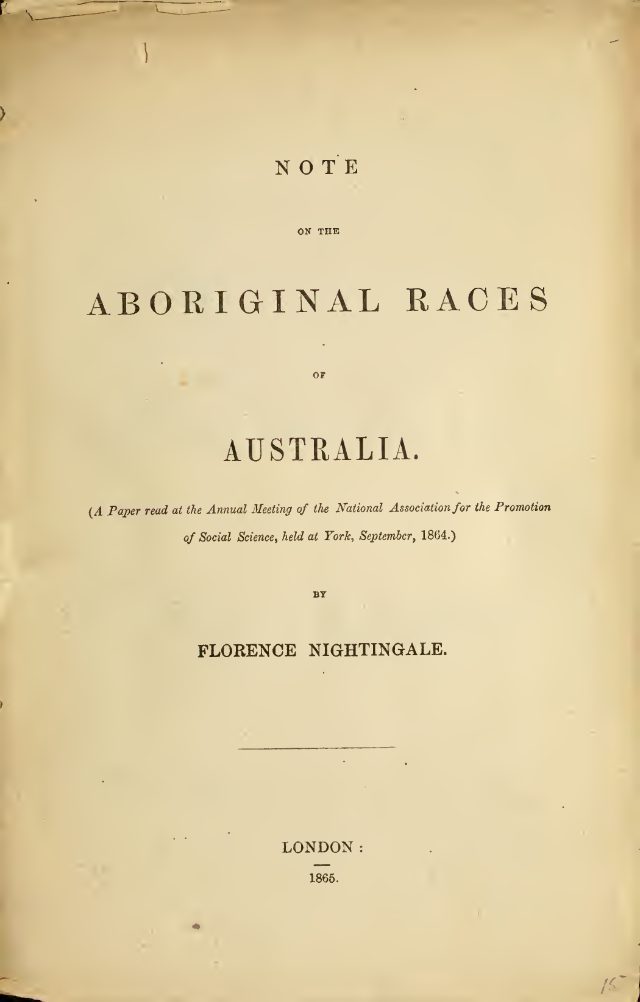
Note on the Aboriginal Races of AustraliaBook

Primary source

Note on the Aboriginal Races of Australia

Florence Nightingale · 1865

The Madras Famine, with an Appendix Containing a Letter from Florence NightingaleBook

Primary source

The Madras Famine, with an Appendix Containing a Letter from Florence Nightingale

Arthur Cotton · 1877

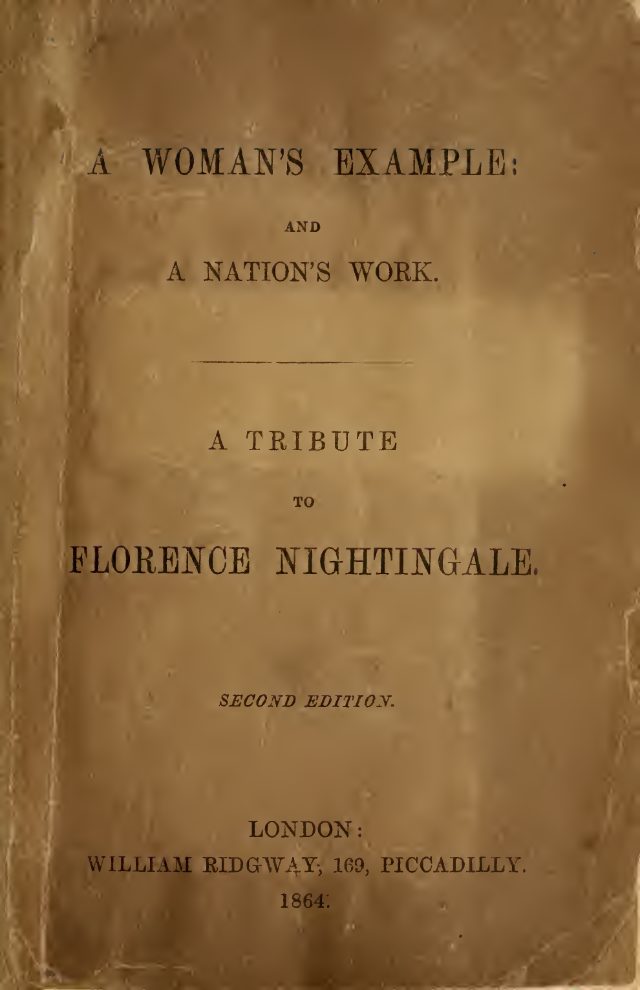
A Woman's Example, and a Nation's Work: A Tribute to Florence NightingaleBook

Primary source

A Woman's Example, and a Nation's Work: A Tribute to Florence Nightingale

Frederick Milnes Edge · 1864

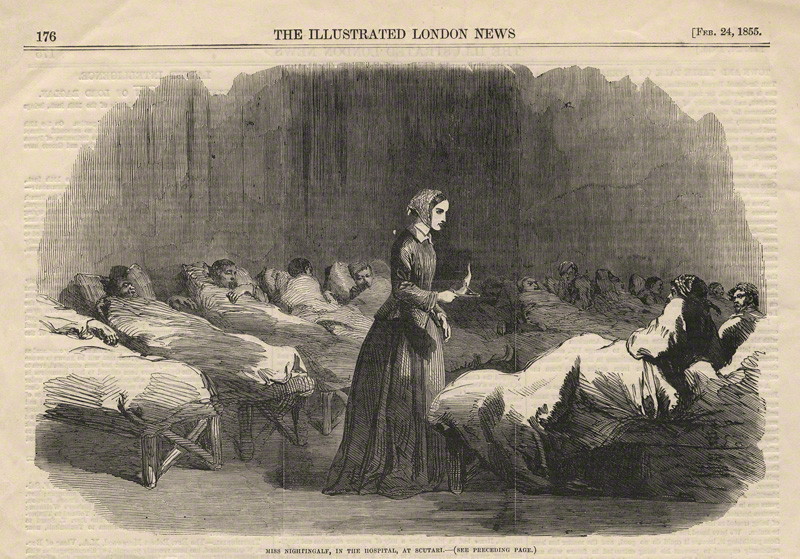
Wood-engraved illustration from The Illustrated London News, 24 February 1855, page 176, showing Florence Nightingale in a long dress and head covering walking between rows of wounded soldiers lying on cots in a dim hospital ward. Caption at bottom reads Miss Nightingale, in the Hospital, at Scutari.Painting

Primary source

Miss Nightingale in the Hospital at Scutari

Unknown artist, Illustrated London News staff · 24 February 1855

Florence Nightingale: A BiographyBook

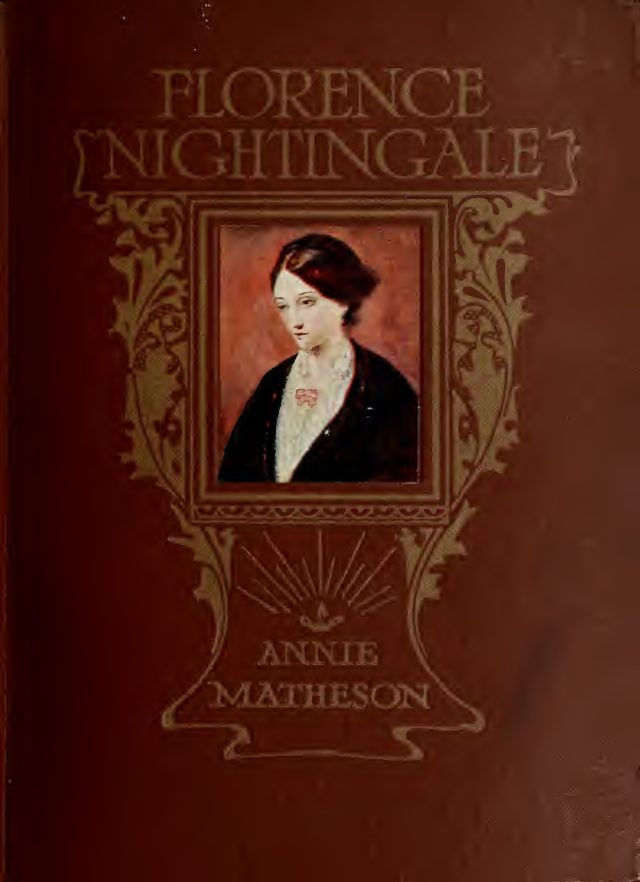
Secondary source

Florence Nightingale: A Biography

Annie Matheson · c. 1913

The Life of Florence NightingaleBook

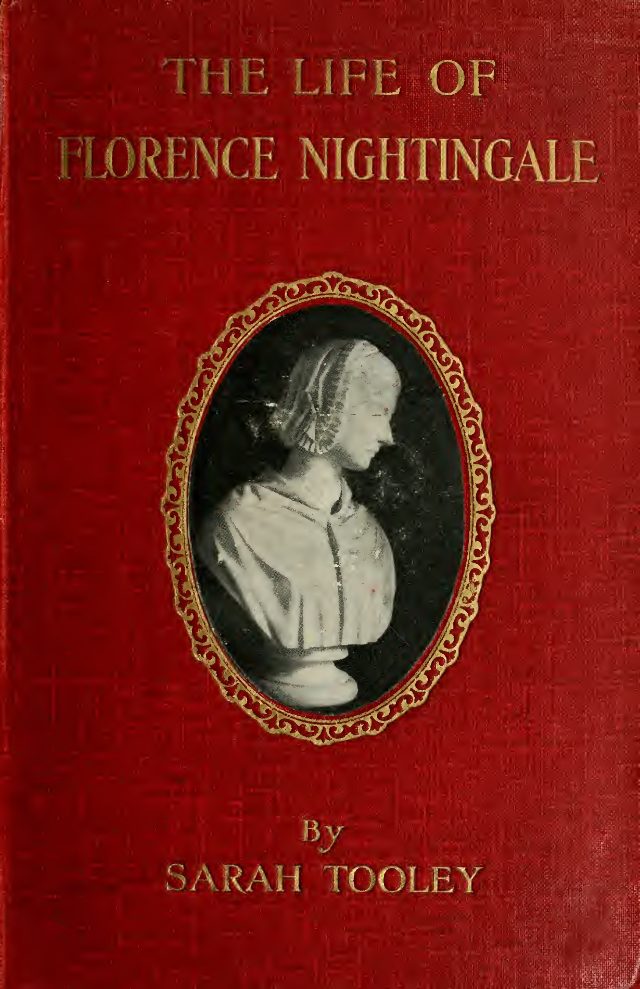
Secondary source

The Life of Florence Nightingale

Sarah A. Southall Tooley · 1916

Florence Nightingale as Seen in Her PortraitsBook

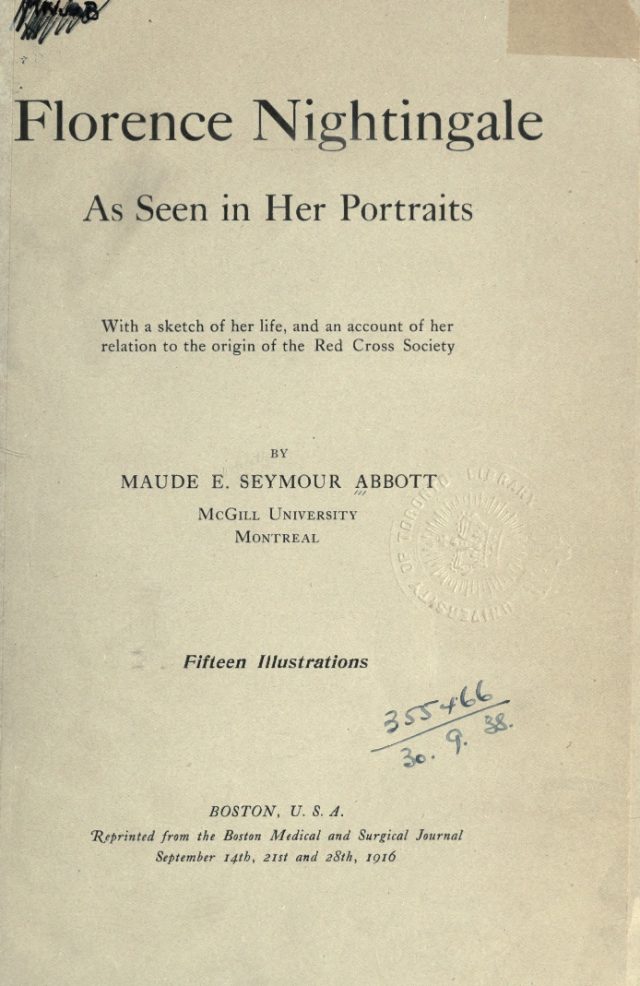
Secondary source

Florence Nightingale as Seen in Her Portraits

Maude Elizabeth Abbott · 1916

Florence Nightingale: The Wounded Soldier's FriendBook

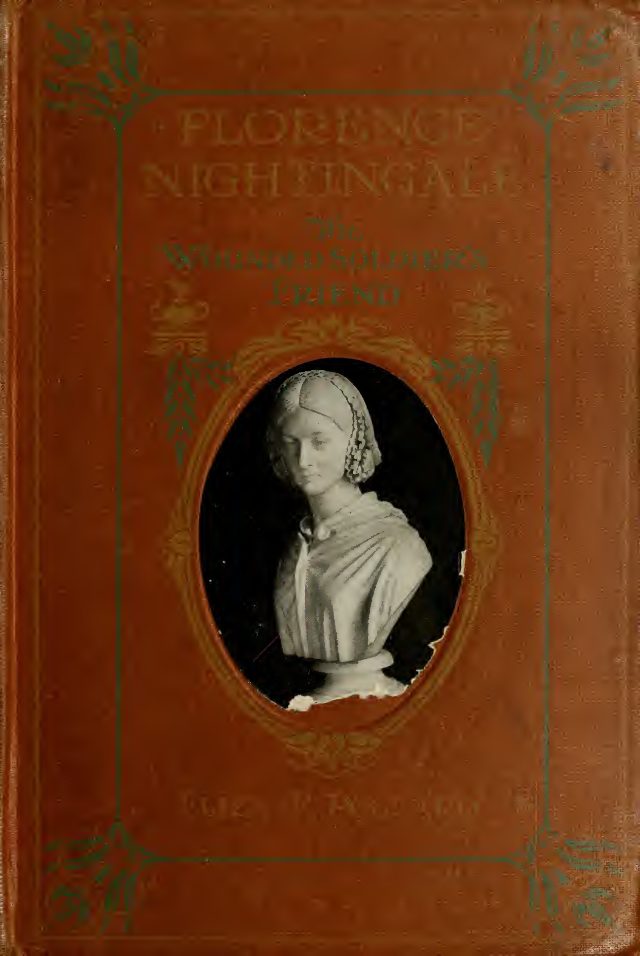
Secondary source

Florence Nightingale: The Wounded Soldier's Friend

Eliza F. Pollard · 1911

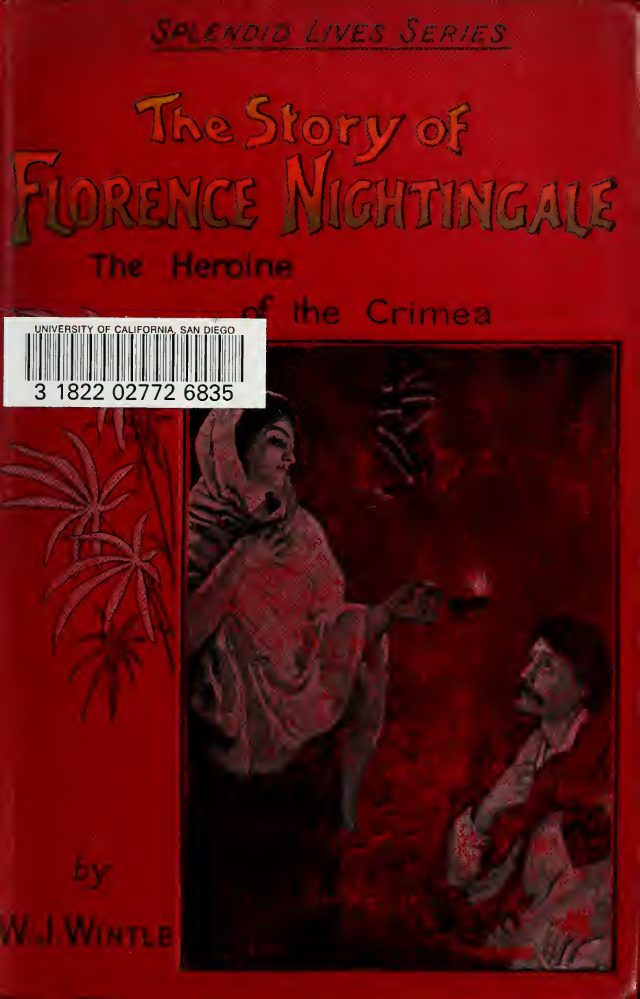
The Story of Florence Nightingale: The Heroine of the CrimeaBook

Secondary source

The Story of Florence Nightingale: The Heroine of the Crimea

W. J. Wintle · 1900

Florence Nightingale, the Angel of the Crimea: A Story for Young PeopleBook

Secondary source

Florence Nightingale, the Angel of the Crimea: A Story for Young People

Laura Elizabeth Howe Richards · 1909

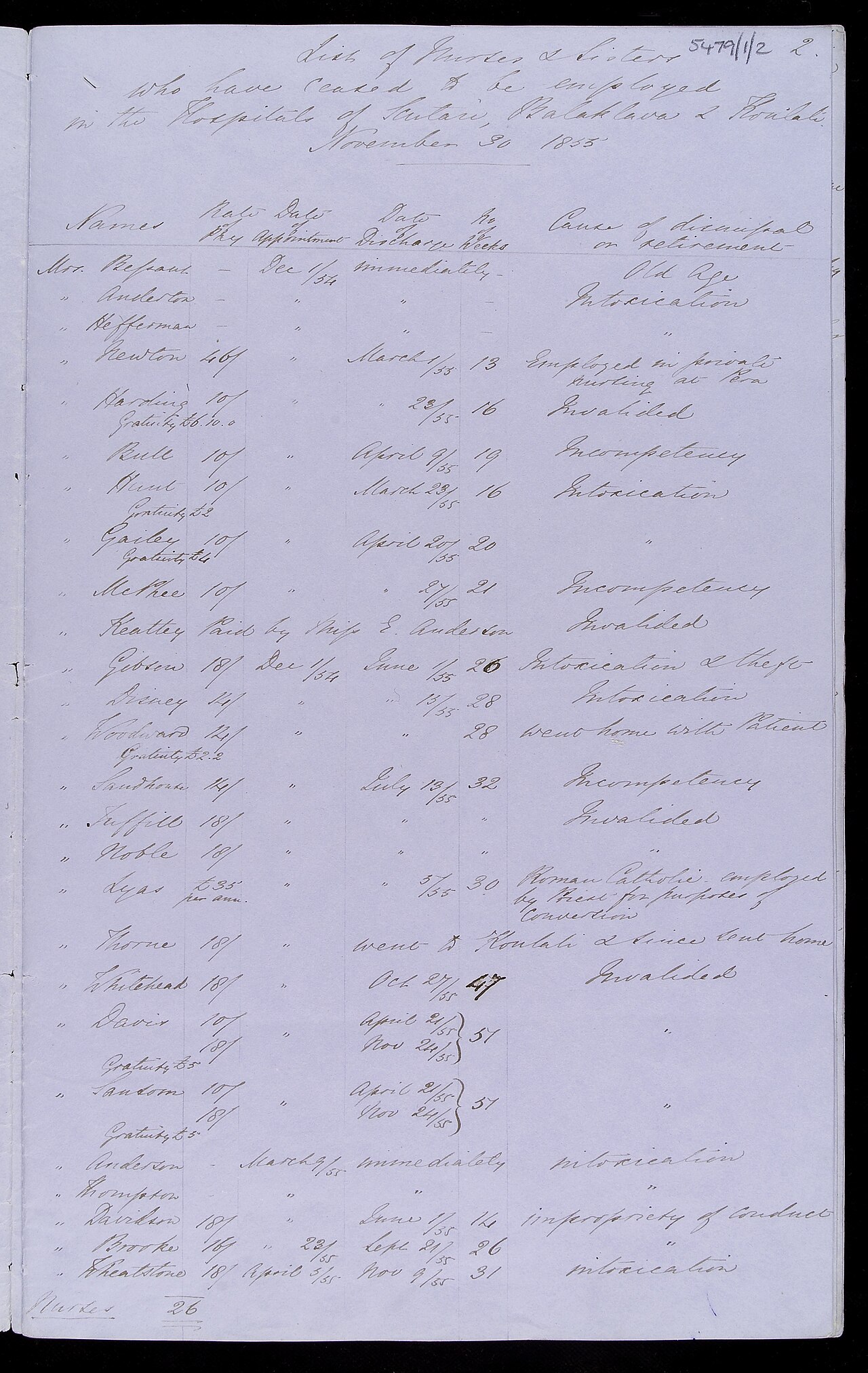
Handwritten manuscript list on lavender-tinted paper headed 'List of Nurses & Sisters who have offered to be employed in the Hospitals of Scutari, Balaklava & Koulali, November 30, 1855'. Columns record names, rate of pay, dates of appointment and discharge, weeks, and cause of discharge or retirement, such as old age, intoxication, or invalided.Document

Primary source

List of Nurses and Sisters Employed at Scutari and Balaklava

30 November 1855

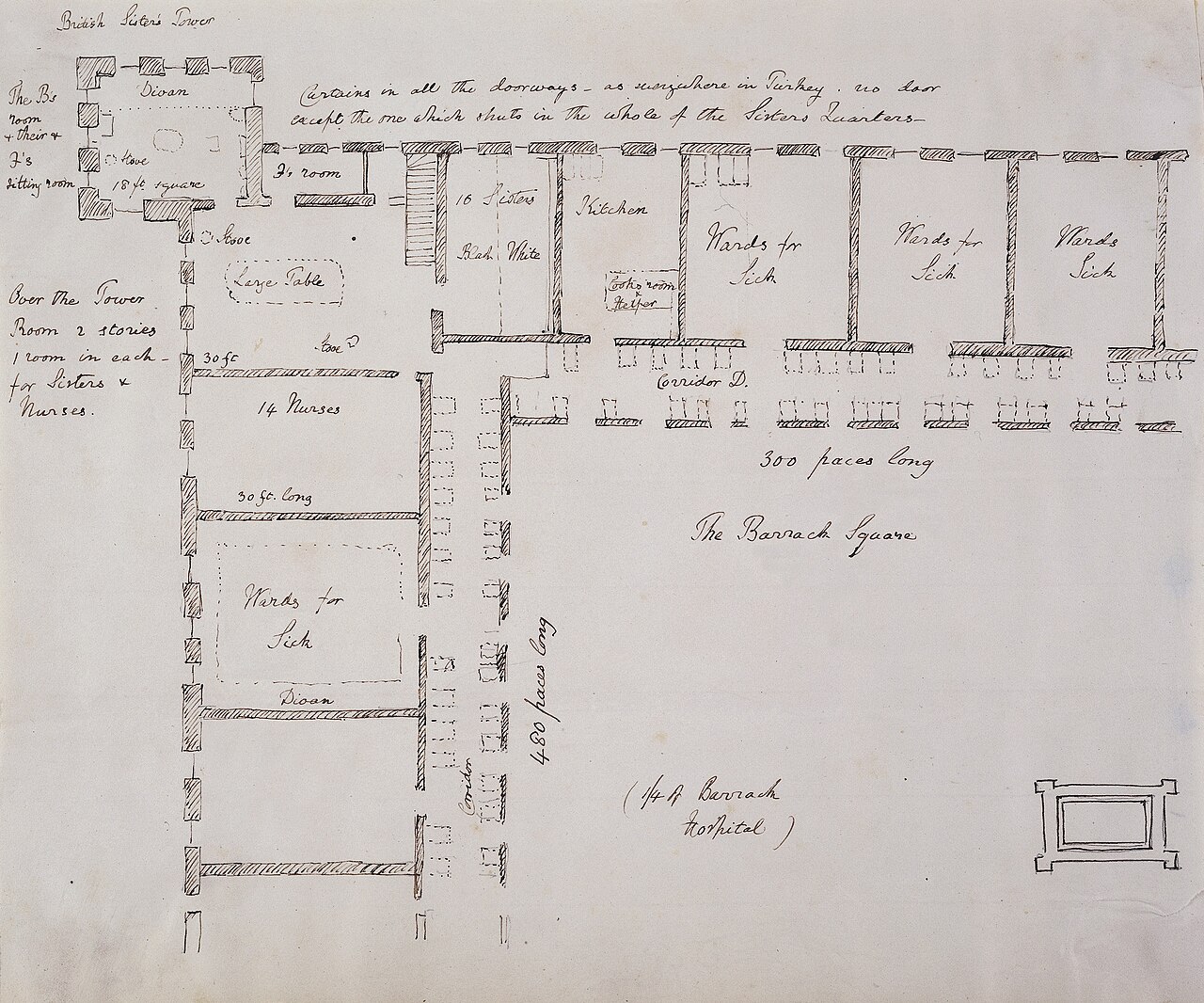
Hand-drawn ink plan on aged paper of the Barrack Hospital at Scutari, with handwritten labels for wards for sick, nurses' and sisters' quarters, kitchen, corridor, dimensions such as 300 paces long and 480 paces long, and a notes on doorways and the tower. A small inset sketch of a rectangle appears at lower right.Document

Primary source

Plan of the Barrack Hospital, Scutari

Florence Nightingale · c. 1855

Sepia-toned studio portrait of a woman with dark hair parted in the center, wearing a white lace cap and lace collar, a dark patterned dress with a brooch at the neck. She looks to the side with a calm expression.Photograph

Primary source

Florence Nightingale carte de visite

H. Lenthall · c. 1850

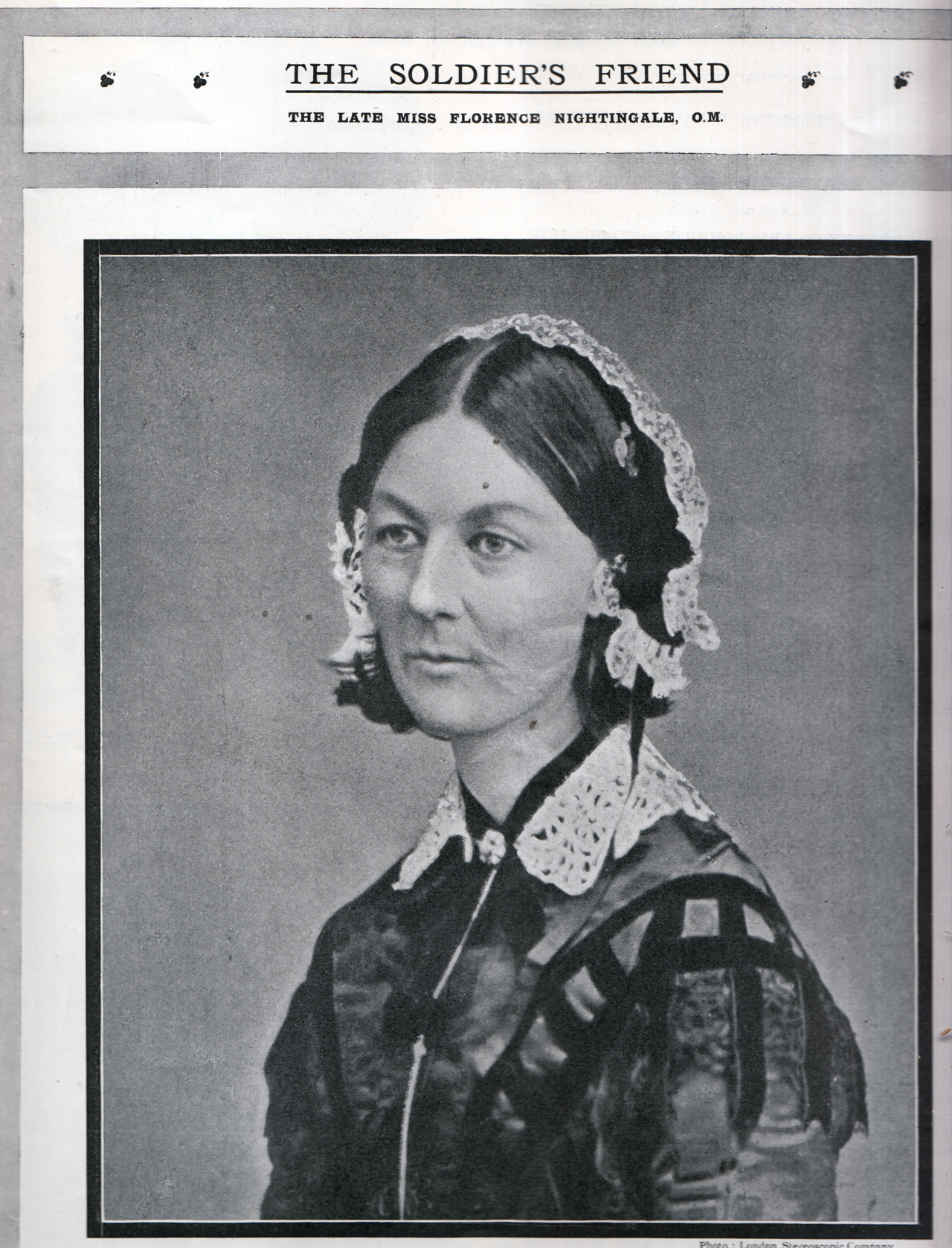
Black-and-white magazine page headed 'The Soldier's Friend, the late Miss Florence Nightingale, O.M.' above a framed studio portrait of a woman in a lace cap and dark dress, turned to the side.Newspaper article

Primary source

Florence Nightingale photo published after her death, 1910

26 August 1910

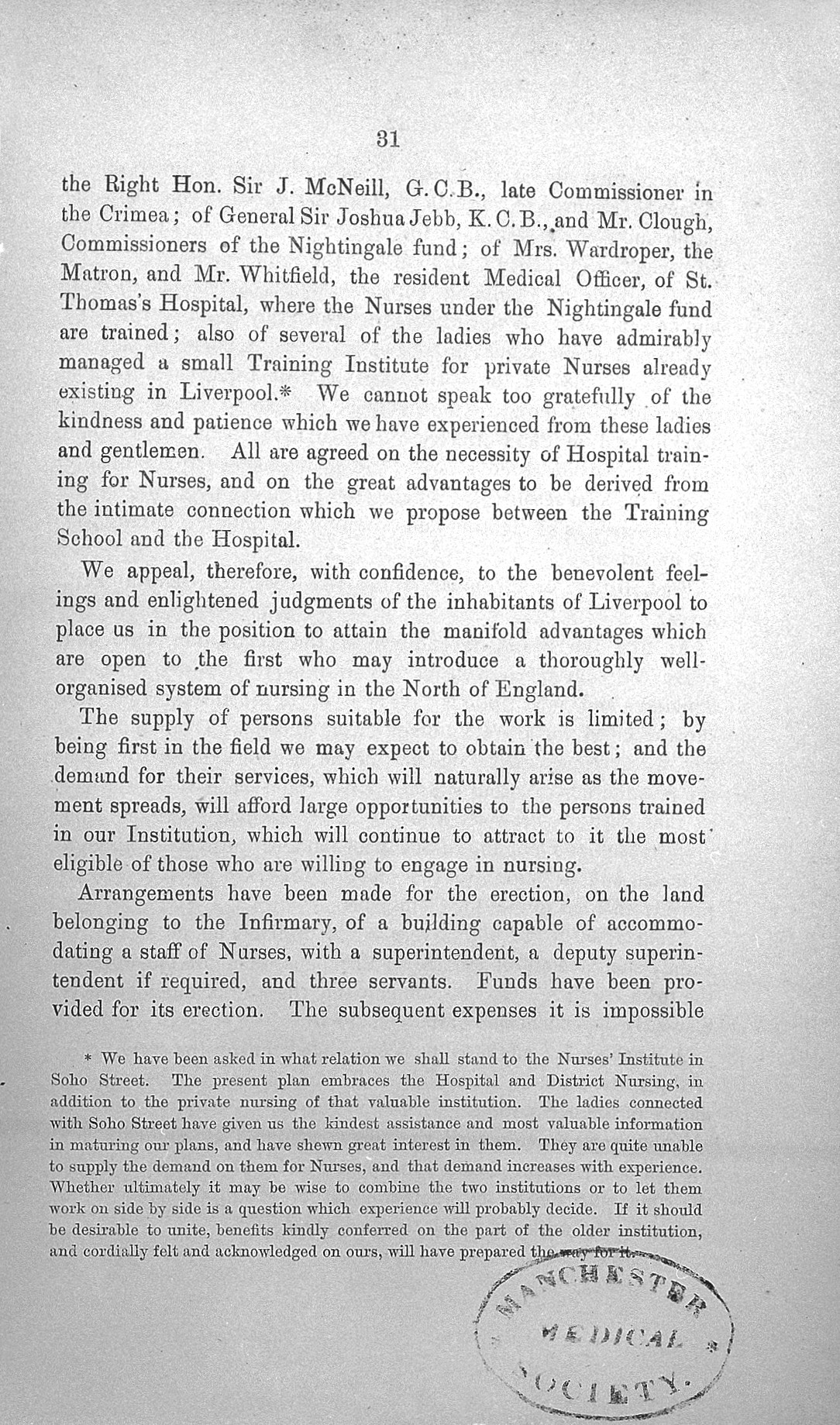
Scanned page 31 of an 1865 printed book on nursing organization. Text describes Liverpool nursing committee members and hospital training plans, with a footnote and a circular Manchester Medical Society library stamp at the bottom.Book

Primary source

The Organization of Nursing in a Large Town, with notes by Florence Nightingale

Member of the Committee of the Home and Training School, with notes by Florence Nightingale · 1865

Letter

Primary source

Letter to the Times Editor

Florence Nightingale · July 22, 1891

Book

Primary source

An Angel of Mercy: Florence Nightingale

D. W. Clark · 1863

Book

Tertiary source

Nightingale, Florence (Encyclopaedia Britannica, 1911)

1911

Book

Secondary source

The Life of Florence Nightingale

Sarah Tooley · 1904

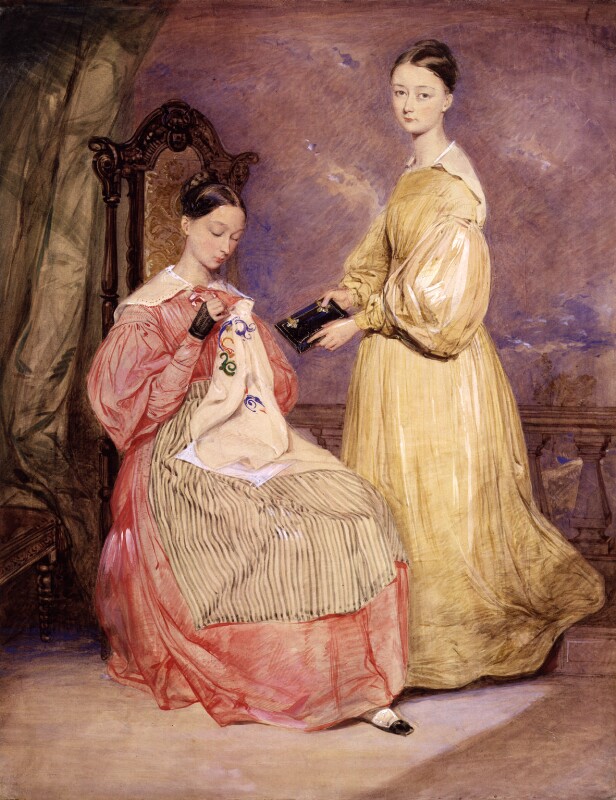
Watercolor painting of two young women in a room with a draped curtain, carved wooden chair, and balustrade. The seated woman in a pink dress with a white collar sews or embroiders white fabric. The standing woman in a yellow dress with puffed sleeves holds a dark book.Painting

Primary source

Florence and Parthenope Nightingale

William White · c. 1836

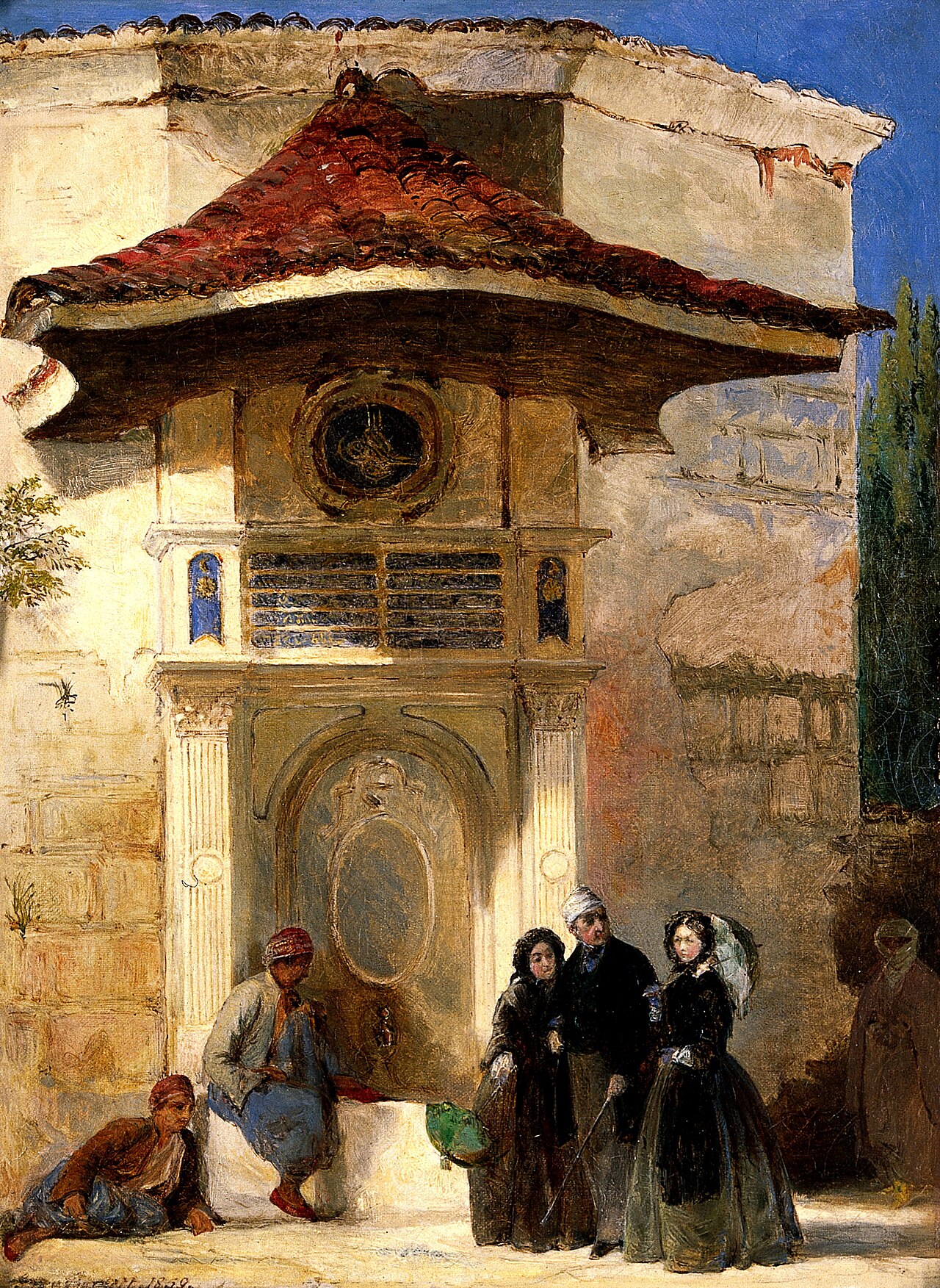
Oil painting of a street scene with a red-tiled roofed ornate stone fountain with an arched niche. Seated figures in turbans and loose clothing sit near its base. A older man in a white-topped cap and a woman in a dark dress with a white bonnet stand near a younger woman in dark dress holding a parasol, walking together. A figure in a turban stands at right, and cypress trees appear at the right edge under a blue sky.Painting

Primary source

Florence Nightingale with the Bracebridges in a Turkish Street

Jerry Barrett · 1859

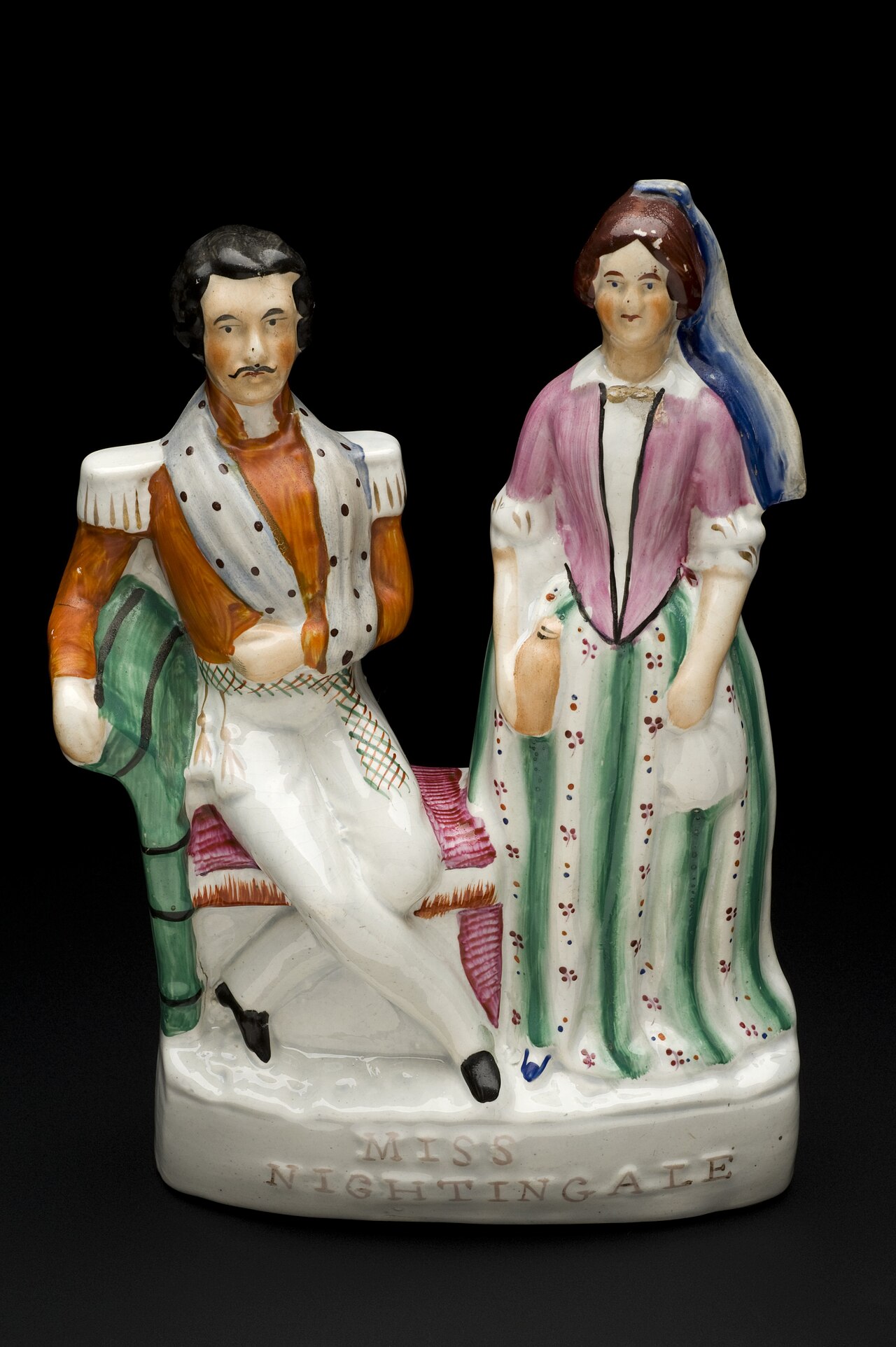
Glazed white porcelain Staffordshire-style figurine on a black background. A seated man with black curly hair and moustache wears an orange jacket and grey polka-dot cloak, leaning on a green cushion. Beside him a woman in a pink bodice and green-striped skirt, with a blue veil, stands. The base reads MISS NIGHTINGALE.Sculpture

Primary source

Victorian Figurine of Florence Nightingale and a Wounded Officer

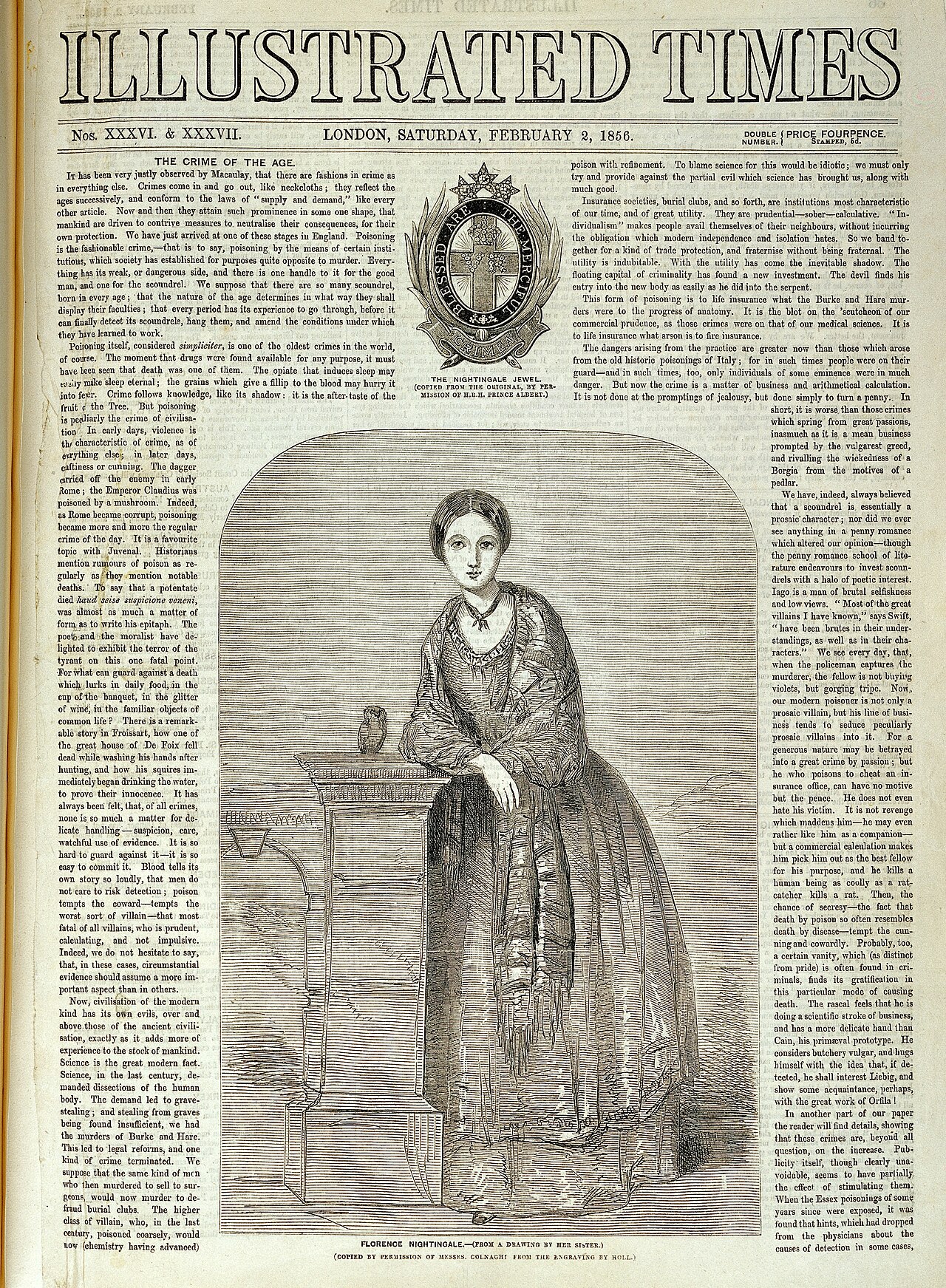
Newspaper page from The Illustrated Times, London, Saturday February 2, 1856. Central engraving shows Florence Nightingale standing beside a pedestal with a small bird, with a jewel emblem above. Dense article columns surround it.Newspaper article

Primary source

Cutting from The Illustrated Times with Nightingale Picture, 1856

27 February 1856

Scan of a handwritten letter in cursive ink on two facing pages, headed 'Barrack Hospital, Scutari' and dated July 1856. The text is written in a dense, slanted hand, with a page number '198' in the upper left and a catalogue annotation in the upper right corner.Letter

Primary source

Letters from Florence Nightingale, July 1856

Florence Nightingale · 4-5 July 1856

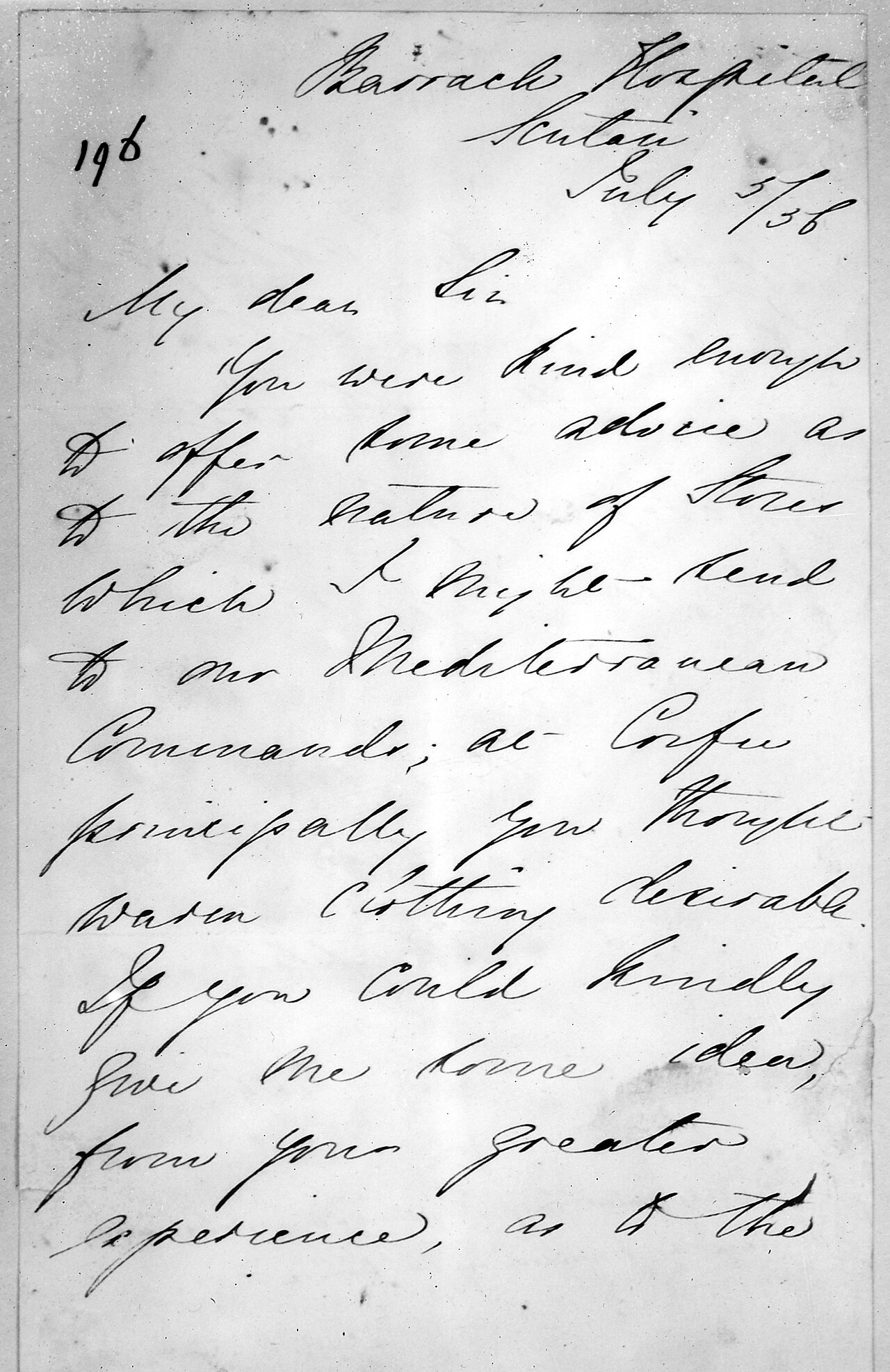
Handwritten letter in cursive ink on paper, headed 'Barrack Hospital, Scutari, July 5th 1856', with the number 196 in the upper left corner. It begins 'My dear Sir' and discusses advice on the nature of stores needed at Mediterranean commands, especially Corfu.Letter

Primary source

First page of a letter from Florence Nightingale, 5 July 1856

Florence Nightingale · 5 July 1856

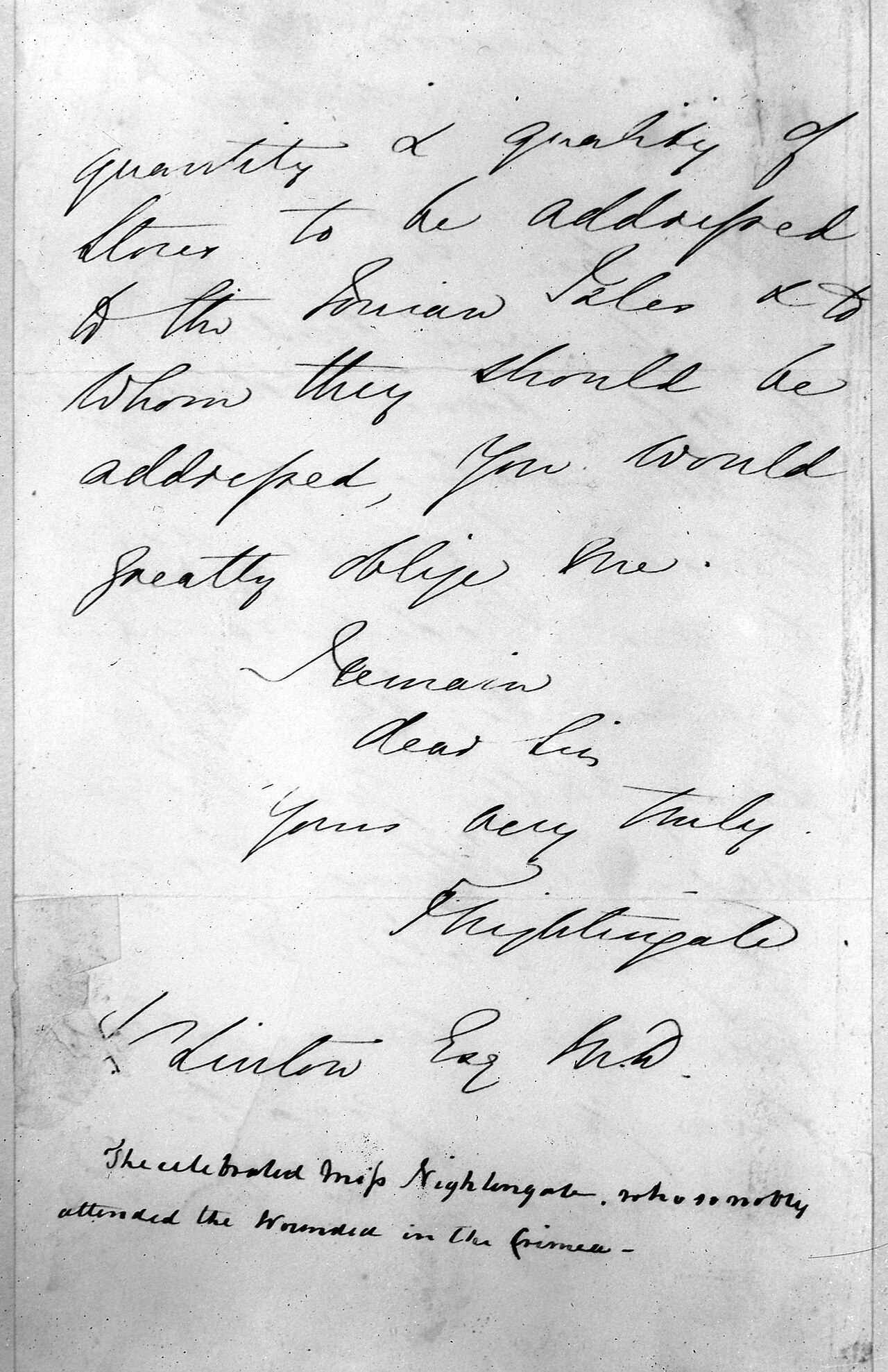
Handwritten letter page in cursive ink on aged paper. Text ends with 'Remain dear Sir, Yours very truly, Nightingale' and a note at the bottom reading 'Wm Wm Eq' with an annotation about 'The celebrated Miss Nightingale, who so nobly attended the Wounded in the Crimea'.Letter

Primary source

Last page of a signed letter from Florence Nightingale, 5 July 1856

Florence Nightingale · 5 July 1856

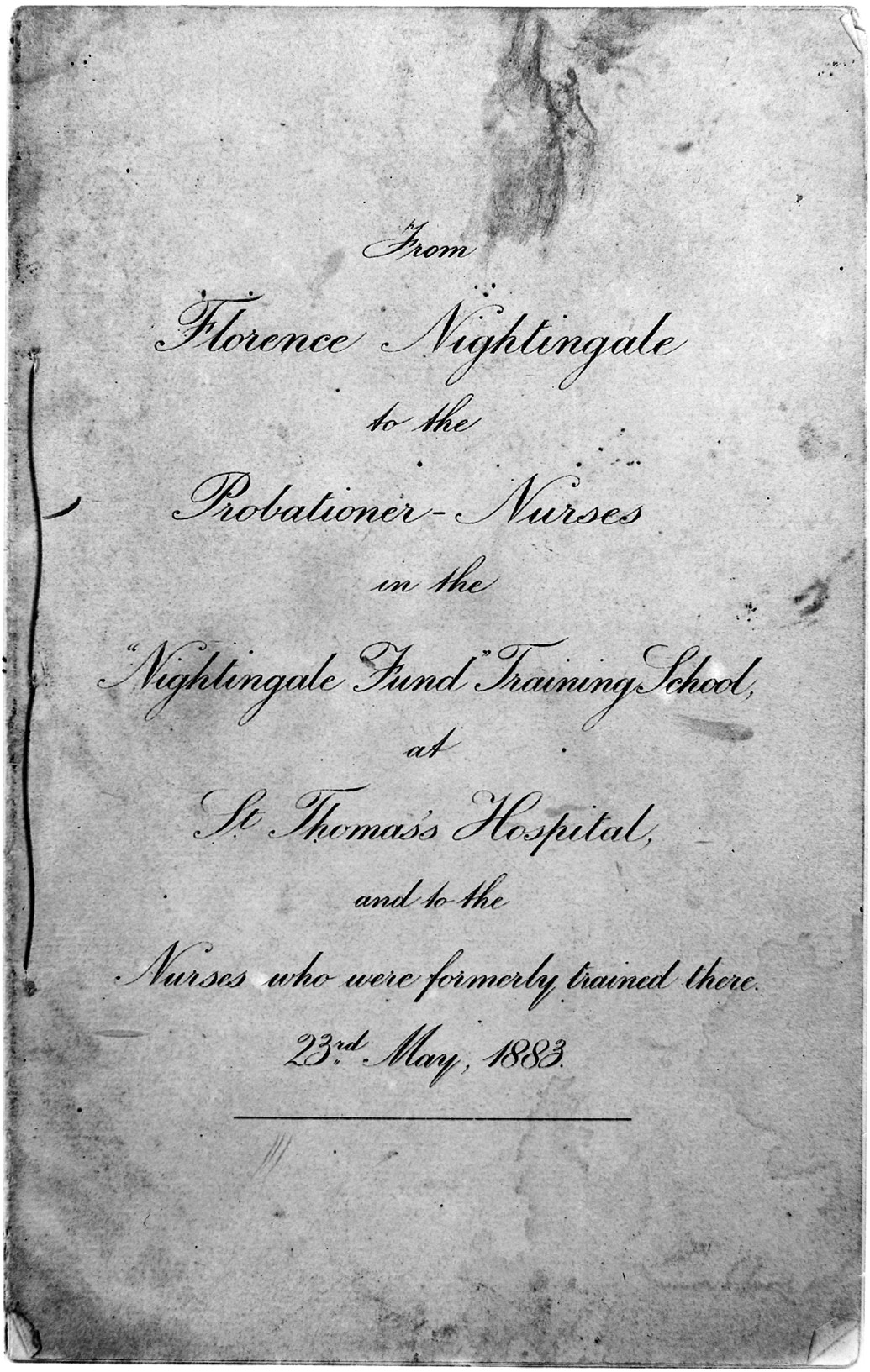
Black and white scan of a handwritten script title page reading: From Florence Nightingale to the Probationer-Nurses in the Nightingale Fund Training School at St Thomas's Hospital, and to the Nurses who were formerly trained there, 23rd May, 1883. A horizontal rule lies below the text; the page shows stains and a stitched binding edge on the left.Letter

Primary source

Florence Nightingale letter to St Thomas' probationer nurses, 1883

Florence Nightingale · 23 May 1883

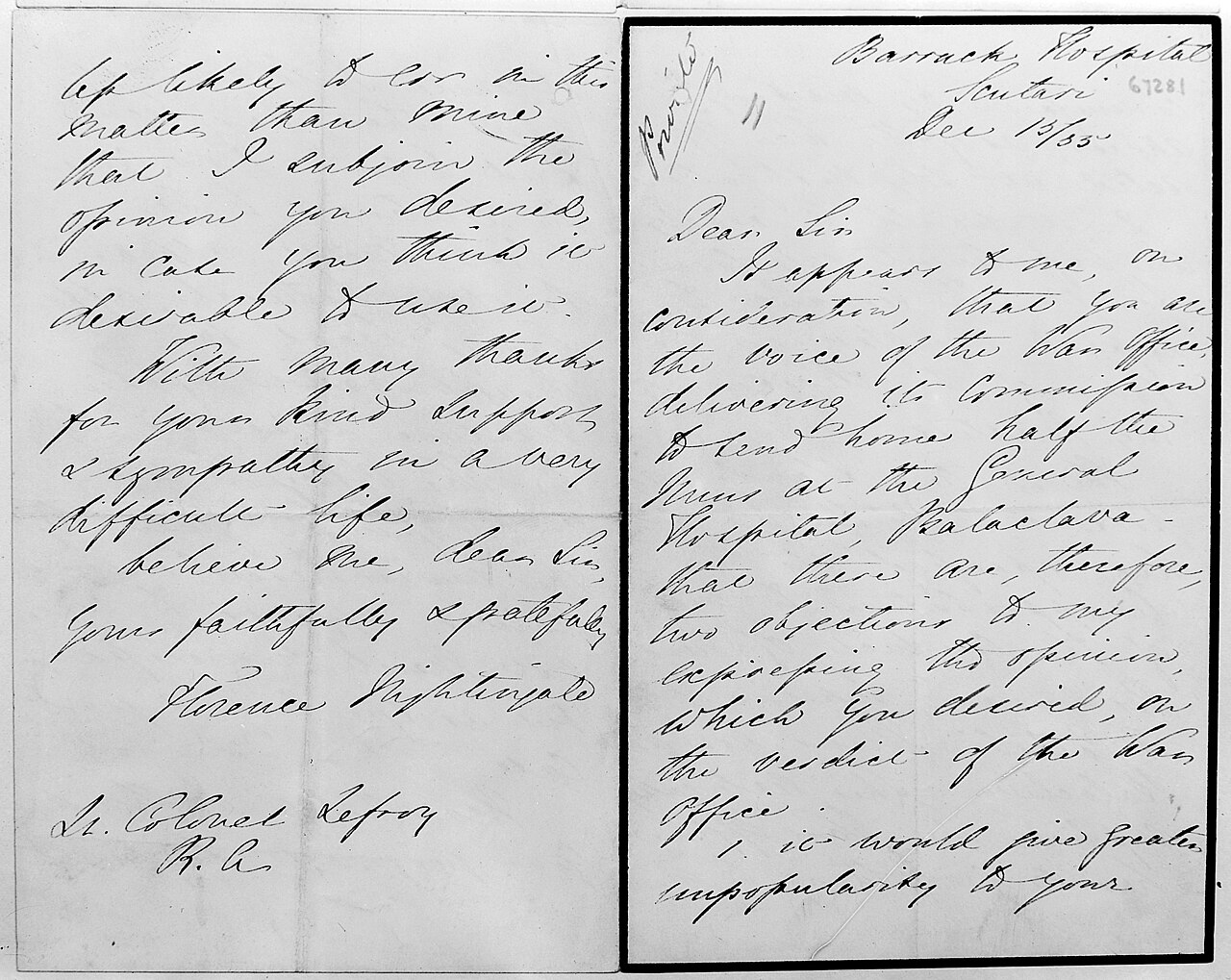
Photograph of a handwritten letter on two pages, signed Florence Nightingale, addressed to Lt. Col. Lefroy. The right page is headed Barrack Hospital, Scutari, dated Dec 13 (1855 range), with a black border. The left page shows the continuation and closing.Letter

Primary source

Florence Nightingale letter to Lt. Col. Lefroy, Scutari

Florence Nightingale · 13 December (1855 range)

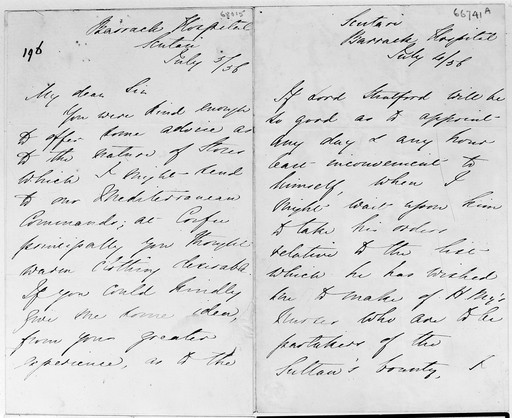
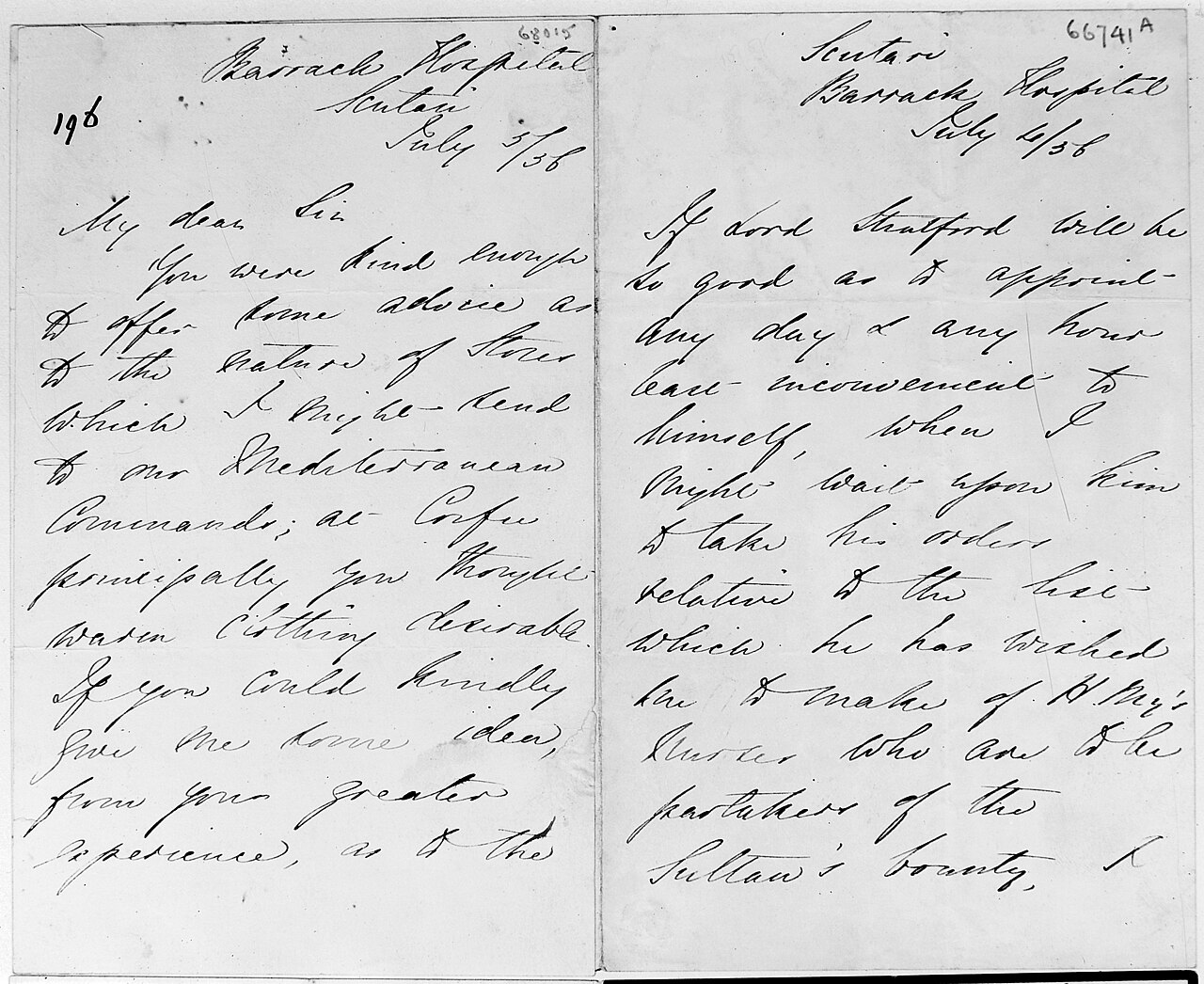
Two facing pages of handwritten letters in dark ink on aged paper. Left page headed Barrack Hospital, Scutari, July 5th 1856, beginning 'My dear Sir'. Right page headed Scutari, Barrack Hospital, July 4th 1856, with a flowing script about Lord Stratford and the Sultan's bounty. Archive numbers appear in the upper corners.Letter

Primary source

First pages of two Nightingale letters from Scutari, July 1856

Florence Nightingale · 4-5 July 1856

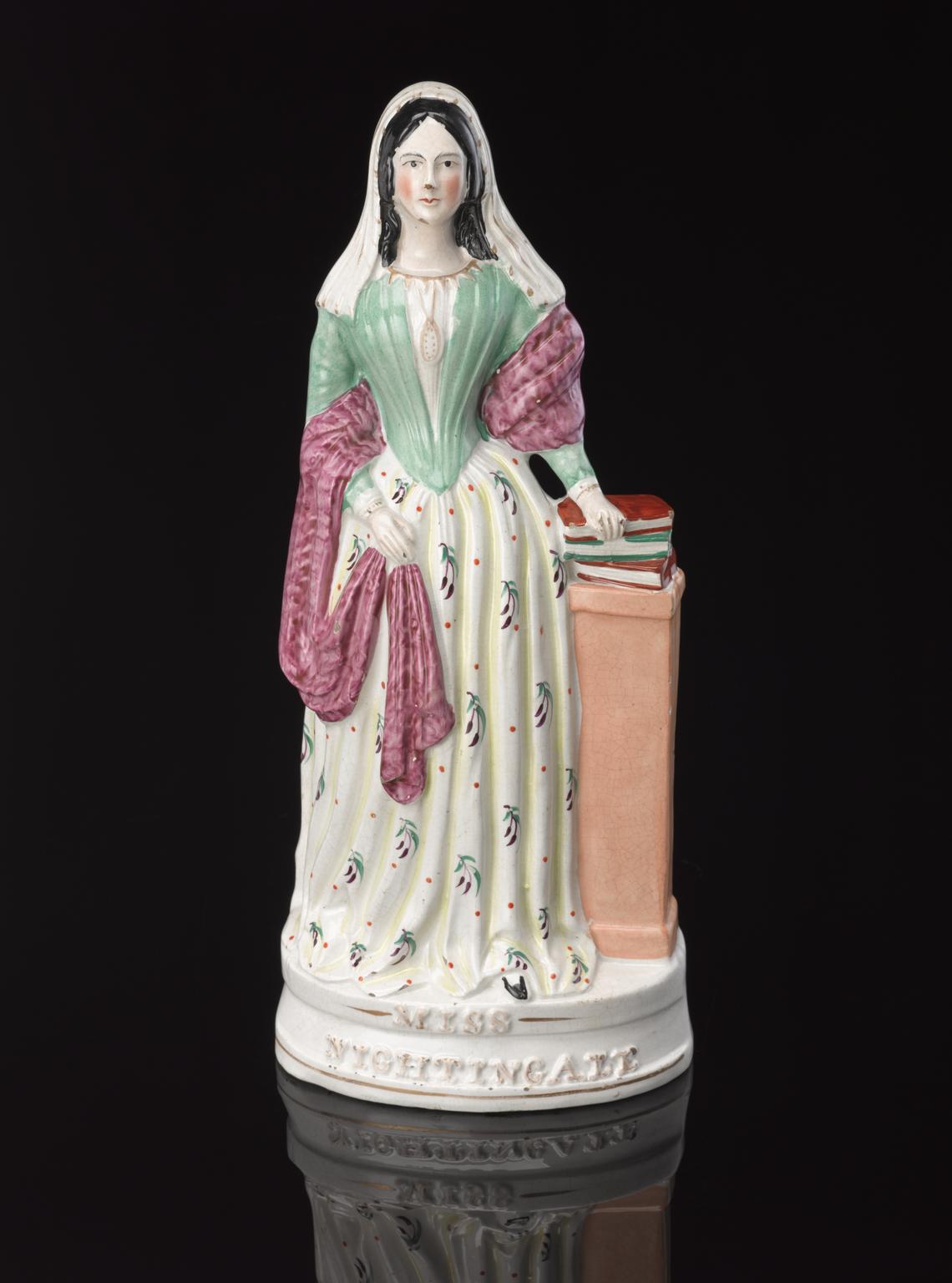
Glazed ceramic Staffordshire-style figurine of Florence Nightingale on a black background. She wears a white veil, green bodice, pink shawl and white patterned skirt, leaning on a pink pillar stacked with books. The base reads 'MISS NIGHTINGALE'.Sculpture

Secondary source

Statue of Florence Nightingale, Science Museum Group

Science Museum Group Studio

Want the full shelf? Chat with Florence Nightingale in the app and open the Sources panel — every quote links back to the original.

Use Florence Nightingale in class

1 collection

A ready-made collection from the Humy team that features Florence Nightingale. Preview it, then try it free.

Trusted by educators worldwide

Conversations
375,000+
Real exchanges between students and historical figures
Messages exchanged
4,142,000+
Across every figure, classroom and language
Historical figures
100,000+
Each informed by a curated biography and selected sources
Languages supported
50+
From English and Spanish to Arabic and Korean

Paying customers

Used by 98 schools and universities

Partner school logo
Tecnológico de Monterrey logo
Hyper Island logo
Partner school logo
Chambersburg Area School District logo
Broward County Public Schools logo
Nebo School District logo
National Louis University logo
South Florida PBS logo
Punahou School logo
University of Wisconsin–River Falls logo
Partner school logo
Partner school logo
Archbishop Mitty High School logo
Kingsburg High School logo
Norwalk Public Schools logo
Partner school logo
Connections logo
Partner school logo
Moore Public Schools logo
Partner school logo
Partner school logo
Partner school logo
Partner school logo
Robbinsville Public Schools logo
Partner school logo
Partner school logo
Partner school logo
Tecnológico de Monterrey logo
Hyper Island logo
Partner school logo
Chambersburg Area School District logo
Broward County Public Schools logo
Nebo School District logo
National Louis University logo
South Florida PBS logo
Punahou School logo
University of Wisconsin–River Falls logo
Partner school logo
Partner school logo
Archbishop Mitty High School logo
Kingsburg High School logo
Norwalk Public Schools logo
Partner school logo
Connections logo
Partner school logo
Moore Public Schools logo
Partner school logo
Partner school logo
Partner school logo
Partner school logo
Robbinsville Public Schools logo
Partner school logo
Partner school logo

What educators are saying

“We enjoyed the program last year and used it frequently.”
“My students say it’s a welcome change of pace. I’m not a fan of the “sage on the stage” model, so I try to incorporate research-oriented and self-paced activities. With Humy, students have to take charge of their learning. They’ve become more adept at critical thinking, forming better questions, and improving their reading comprehension. The interview feature has been my go-to tool. I create assignments where students must ask historical figures a set number of questions, then summarize the responses to ensure they’re truly absorbing the material. This approach lets them actively explore the past rather than passively consuming information.”
“Humy has helped me bring historical figures, sometimes long past, to life. When my students interact with these figures in real-time, it eliminates some of the perceived “ancient” characteristics of my curriculum. This has shifted my students’ thinking away from viewing history as abstract or irrelevant. Real-time interactions make historical figures relatable, even allowing students to ask off-topic questions that help put historical lives in a more relevant context for 13-year-olds. The feature I use the most is the interview feature. After teaching a topic, most recently Gandhi and Joan of Arc, I have the students ask pointed, focused questions. We practice good conversation techniques beforehand, teaching them to listen (or read) carefully and formulate thoughtful follow-up questions rather than just interrogating. It helps students practice effective conversation skills.”

FAQ

Frequently asked questions

Who is Florence Nightingale?
Pioneering nurse and statistician. On Humy.ai you can chat with an AI version of Florence Nightingale that draws on a short biography and 90 historical sources during the conversation — by text or voice, in 42 languages.
Is Florence Nightingale AI free?
Florence Nightingale is part of Humy's full library of more than 100,000 figures, which comes with a paid plan. A free account (no credit card) includes 20 messages a month with the free library's figures, so you can try how the conversations work first.
What sources does the Florence Nightingale AI use?
It draws on a short biography and 90 historical sources (books, documents and letters), including “Diagram of the Causes of Mortality in the Army in the East”, “Embley Park, Hampshire” and “Recording of the voice of Florence Nightingale”. Each source has its own page on Humy.ai.
How historically accurate is the AI version of Florence Nightingale?
Each figure uses a short biography and a small set of selected historical sources as context (retrieval-augmented generation), so answers stay closer to known material than the model's general knowledge alone. It isn't a citation-grade research tool — like any LLM, the AI can get details wrong or extrapolate. Treat it as a strong starting point for inquiry and cross-reference important claims.
Can I talk to Florence Nightingale by voice?
Yes. In addition to text chat, you can call Florence Nightingale and hear their voice respond in real time — useful for auditory learners, interview practice and Socratic dialogue.
Is Humy.ai safe and compliant for schools?
Yes. Humy.ai is used by more than 100 schools, universities and organisations. The platform is FERPA- and GDPR-aligned, supports SSO, and offers an IT-approval pack tailored for school procurement teams.

Cross-reference Florence Nightingale

Like any LLM, the AI version of Florence Nightingale can get details wrong. Open one of these sources in a new tab to verify what you’ve read.

Ready when you are

Start chatting with Florence Nightingale now.

20 messages free · No credit card · Available in 50+ languages.