


Primary sourceBookc. 1247
Rumi's Ghazal 163 ("Go, My Friends")
Rumi · c. 1247
A Persian love poem by Rumi, written around 1247 to persuade his companion Shams-e Tabriz to return to Konya.
Rumi wrote this ghazal himself to call his companion Shams-e Tabriz back to Konya, revealing the emotional core of his poetry.
About this source
What it is
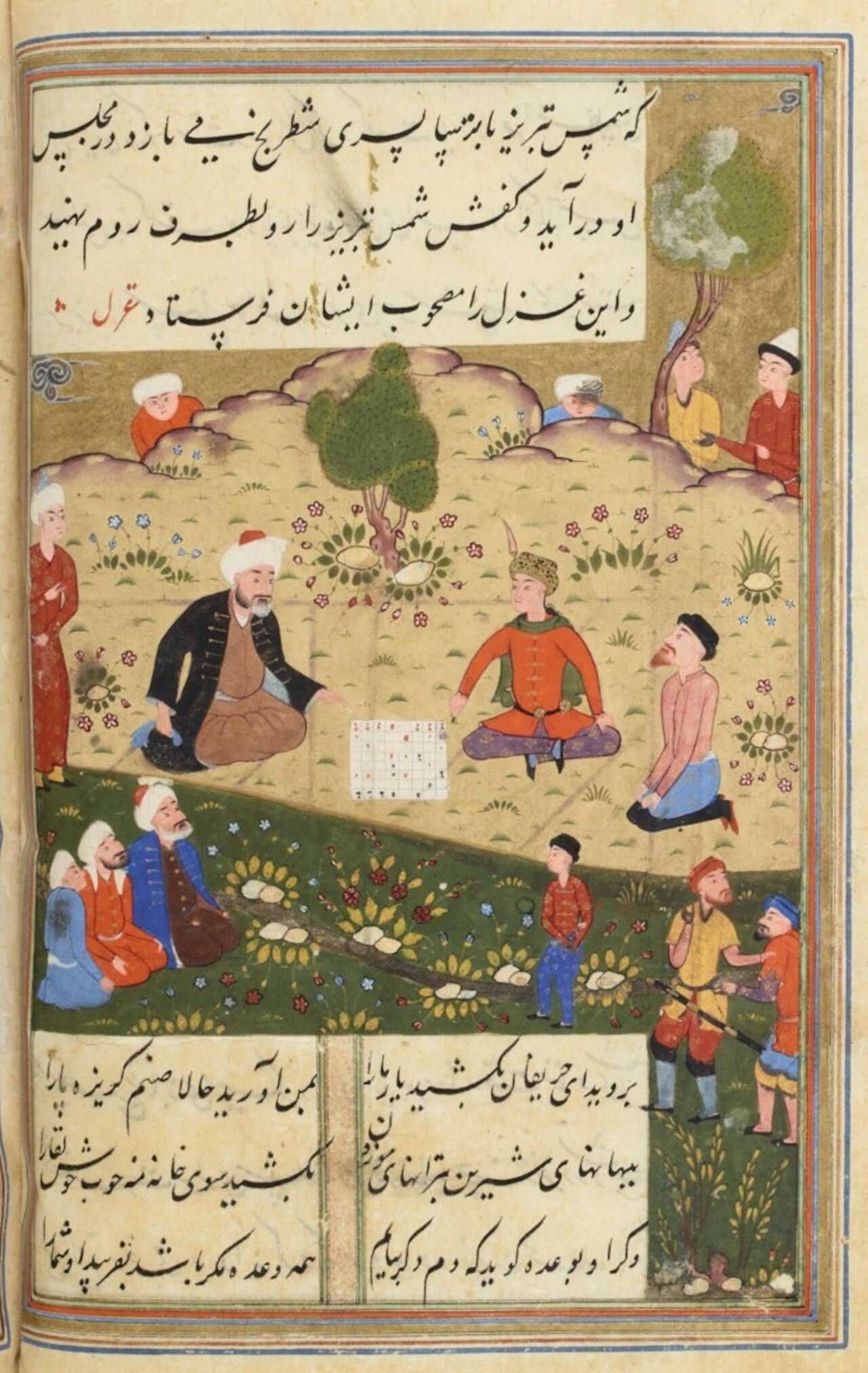
This is a seven-verse Persian ghazal by Jalal al-Din Rumi, beginning 'Beravid, ey harifan' ('Go, my friends'). It is said to have been written around 1247 and sent with Rumi's son Sultan Walad to Damascus, to persuade Rumi's companion Shams-e Tabriz to return to Konya. A famous Persian miniature painted around 1503, some 250 years later, illustrates the story with a scene of Shams playing chess.
Why it matters
The poem shows the intense devotion Rumi felt for Shams-e Tabriz, whose arrival and disappearance transformed Rumi from a religious teacher into one of history's great mystical poets. It remains popular in Persian-speaking countries today and has been set to music by modern singers, showing the long reach of Rumi's lyric voice.
Look closer
- What feelings does Rumi express toward his 'beloved friend' in these verses?
- Why might Rumi have sent a poem, rather than just a letter, to persuade Shams to return?
- What does the later miniature painting add to, or change about, the original poem?
This book is part of the curated material that grounds the AI version of Rumi (Jalāl ad-Dīn Muhammad Rūmī) on Humy.ai — when students ask about related events, the AI can quote it and cite it.
More Rumi (Jalāl ad-Dīn Muhammad Rūmī) sources
Meet the AI Rumi (Jalāl ad-Dīn Muhammad Rūmī) → Book
Primary source
Masnavi
Rumi · c. 1258-1273
BookPrimary source
Diwan-e Shams-e Tabrizi
Rumi · c. 1247 onward
 Artifact
Secondary source
Grave of Rumi
soon after 1273
 Book
Primary source
Fihi Ma Fihi
Rumi · c. 1260-1273
 Artifact
Secondary source
Mevlâna Museum
Badr al-Din Tabrizi (architect) · built soon after 1273; museum since 1926
Ready when you are
Start chatting with Rumi (Jalāl ad-Dīn Muhammad Rūmī) now.
20 messages free · No credit card · Available in 50+ languages.