Portrait of Béla Kun

AI Historical Figure

Béla Kun

Sensitive

Picture by Gyula Jelfy  Public domain  Wikimedia Commons

Hungarian Communist revolutionary and politician, the de facto leader of the Hungarian Soviet Republic in 1919, People's Commissar of Foreign Affairs

Chat with Béla Kun via text or voice — in 42 languages, drawing on a curated biography and 54 historical sources. Available 24/7.

Start chatting with Béla Kun20 messages free · No credit card
Lived
1886–1938
From
RomaniaHungary
Known for
Politics & governmentActivism & reform
Béla Kun

Béla Kun

Online · responds in seconds

Hello — I'm Béla Kun. Hungarian Communist revolutionary and politician, the de facto leader of the Hungarian Soviet Republic in 1919, People's Commissar of Foreign Affairs. What would you like to ask me?

20 messages free · No credit card · Powered by Humy.ai

Live preview · Switch between 42 languages above · Send a message to continue in the app

Multilingual

Talk to Béla Kun in 42 languages

Ask Béla Kun questions in any language below, and the rest of Humy's app speaks it too. Pick yours to open the chat in that language.

Also in German (Austria), German (Switzerland), English (UK), English (Australia), English (Canada).

The sources behind this AI

54 sources · 23 photographs · 9 artifacts · 7 sculptures · 6 documents · 4 books · 2 newspaper articles · 1 news clip · 1 painting · 1 diary entry

Béla Kun doesn’t improvise from thin air. The AI is grounded in 54 curated historical sources students can inspect. Open any of them to see what informs the conversation.

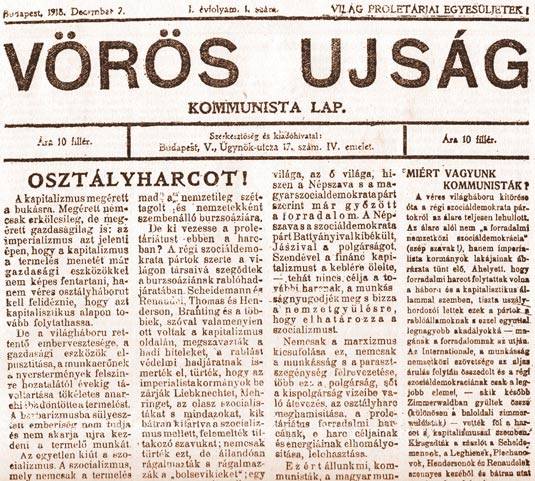
Front page of the first issue of the Hungarian newspaper Vörös Ujság, dated Budapest, 1918 December 7, with the masthead 'VÖRÖS ÚJSÁG' and subtitle 'KOMMUNISTA LAP', and a lead editorial titled 'Osztályharcot!' in several columns of Hungarian text.Newspaper article

Primary source

Vörös Újság: First Editorial

Béla Kun · 7 December 1918

Spine and cover of a bound book with a dark green spine and grey-brown boards. Gold lettering on the spine reads 'TREATY OF PEACE... HUNGARY' and 'Cmd. 896'. A white library barcode label reads 'DOCS. COLL. CU-1' and 'D001182819'. A Google digitized watermark appears at the lower right.Document

Primary source

Treaty of Trianon

4 June 1920

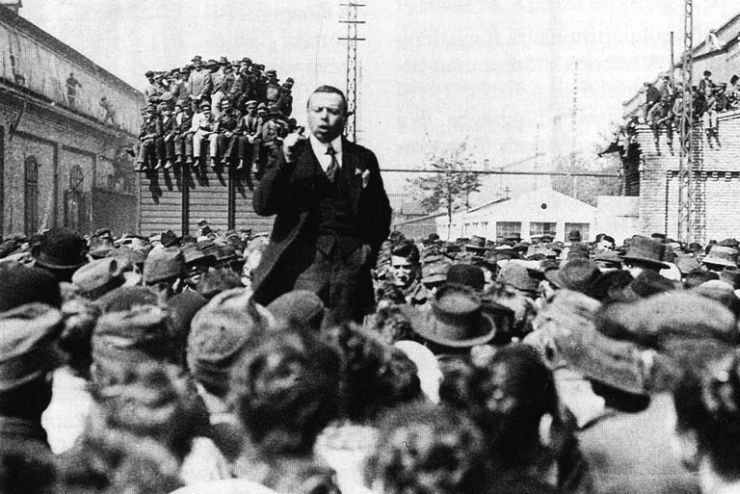
Black and white photograph of a man in a dark suit and vest speaking to a dense crowd of men in hats in front of a building; other men sit on a rooftop and balcony at left and right.Photograph

Primary source

Béla Kun, Leader of the 1919 Hungarian Revolution

1919

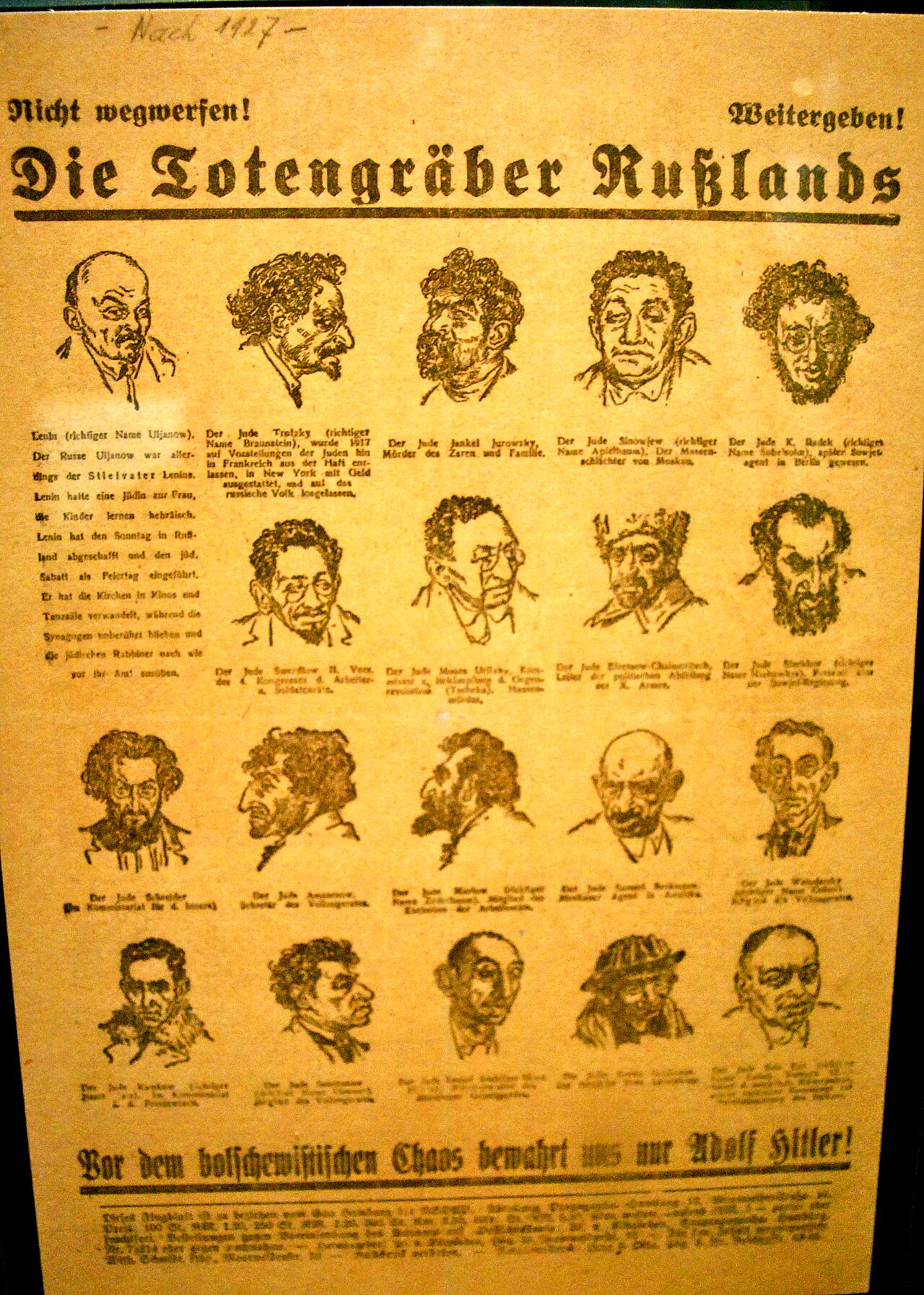
Photograph of a yellowed Nazi propaganda pamphlet titled 'Die Totengräber Russlands' with a headline 'Nicht wegwerfen!' and 'Weitergeben!'. It has rows of ink caricatures of men's faces with text captions naming Soviet communist leaders, and the slogan 'Vor dem bolschewistischen Chaos bewahrt uns nur Adolf Hitler!' at the bottom. A handwritten note 'März 1937' is at the top left.Photograph

Primary source

Die Totengräber Russlands

March 1937

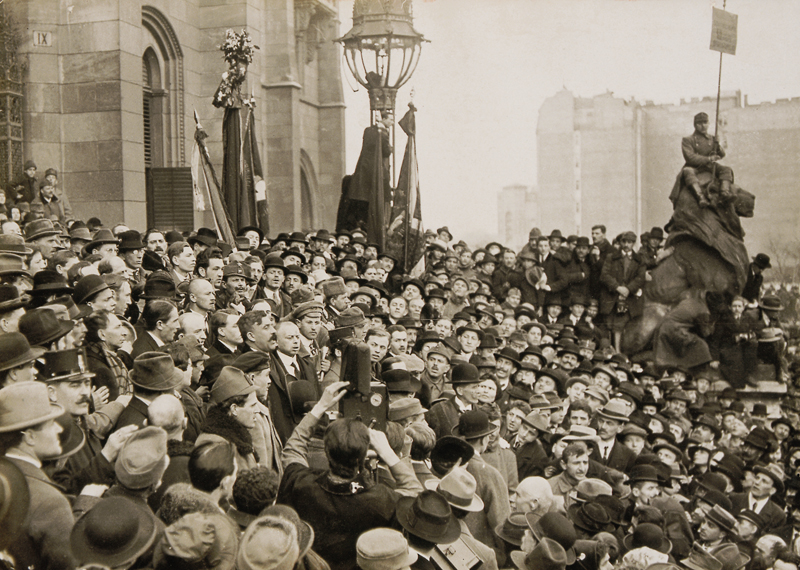
Sepia photograph of a dense crowd of men in hats and coats gathered in a city square in front of a stone building with arched windows. Lamp post and banners rise above them; a large statue on a pedestal stands at right, and a man on the far right holds a flag.Photograph

Primary source

Sándor Garbai and Béla Kun, Leaders of the Hungarian Soviet Republic

1919

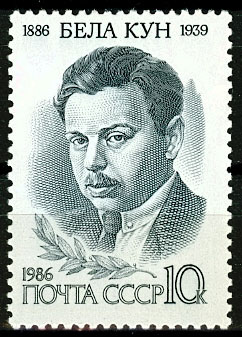
Soviet postage stamp, 10 kopeck denomination, 1986, printed with the name Бела Кун and dates 1886 and 1939 above a black-and-white engraved portrait of a man with short dark hair and a mustache, wearing a suit and tie, with a laurel branch below and the text ПОЧТА СССР 1986.Artifact

Secondary source

Soviet postage stamp honouring Béla Kun (1986)

1986

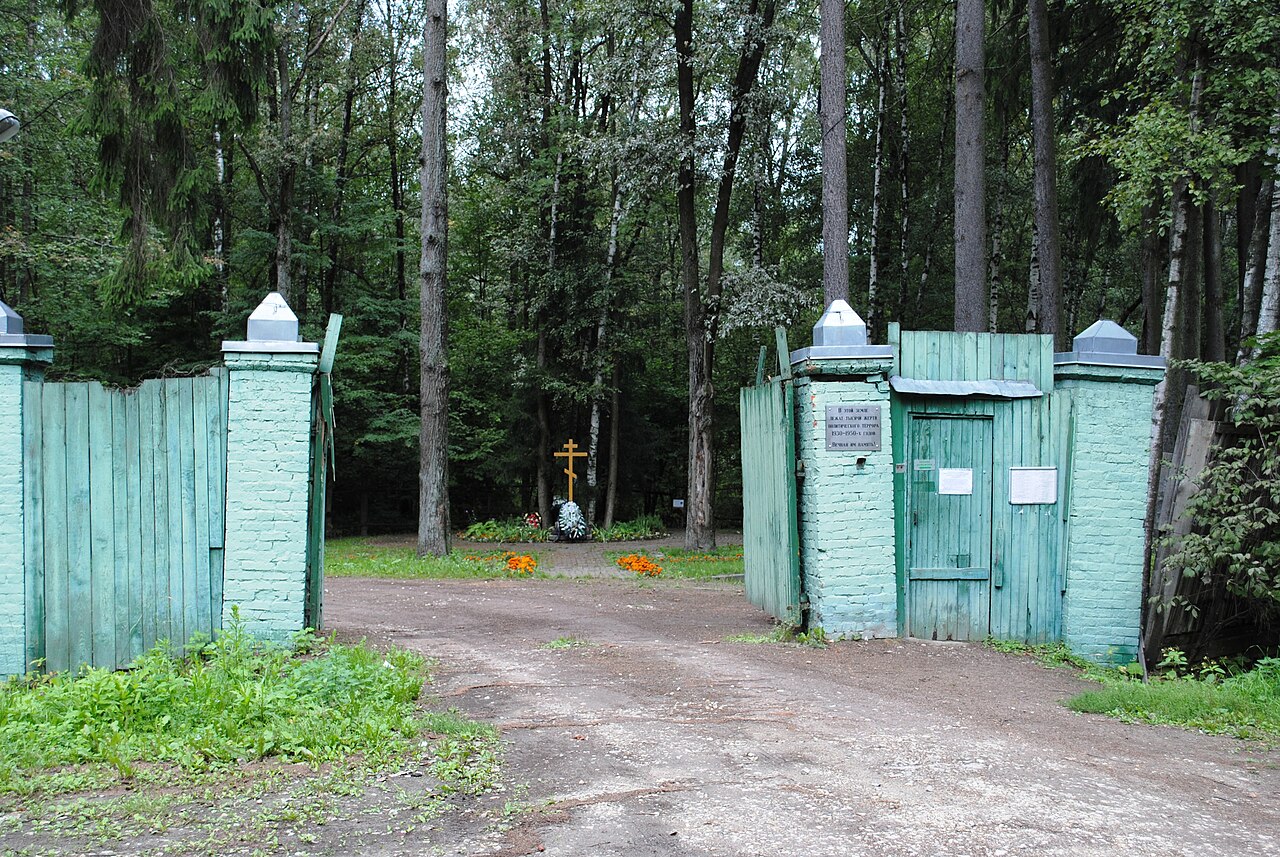
A green-painted wooden gate and fence set between two brick pillars with small caps, opening onto a gravel road through a birch and pine forest. Inside, a wooden cross stands near a small memorial with flowers and a wreath.Artifact

Secondary source

Kommunarka shooting ground

1937-1941

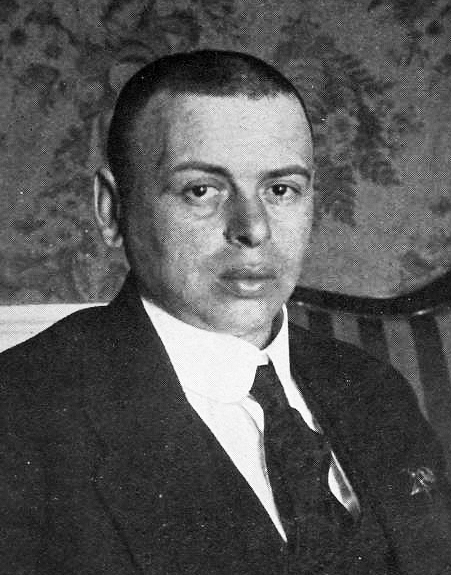
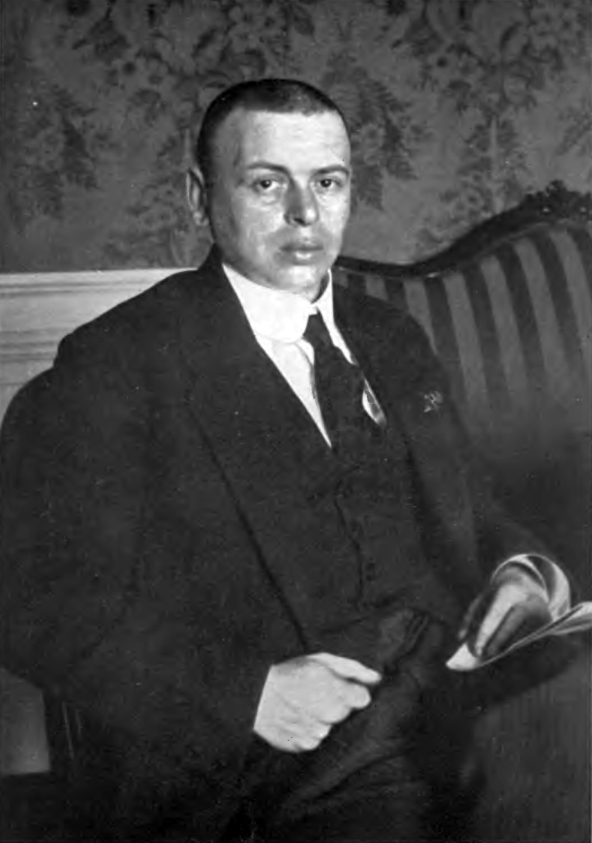
Black-and-white portrait photograph of a man with cropped hair in a dark suit, white collar, and dark tie, seated in front of a patterned tapestry background with a striped chair at right.Photograph

Primary source

Portrait of Béla Kun

Gyula Jelfy

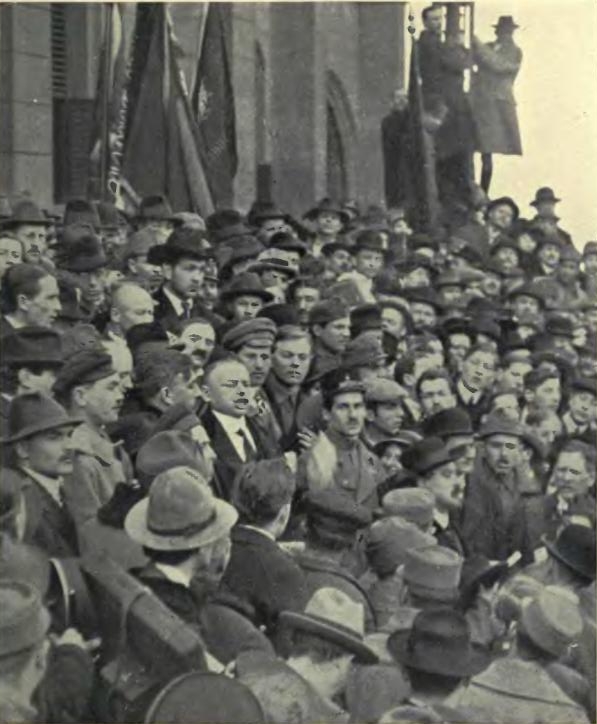
Black-and-white photograph of a dense crowd of men in hats and coats packed on stone steps in front of a building with arched windows. Red and dark banners rise on the left, and two men stand higher on the right near a pillar.Photograph

Primary source

Béla Kun Proclaiming the Soviet Republic

Cecile Tormay · 1919

News clip

Primary source

Hungarian Red Army in Kassa, 1919

"Est" Magazine, Budapest · 6 June 1919

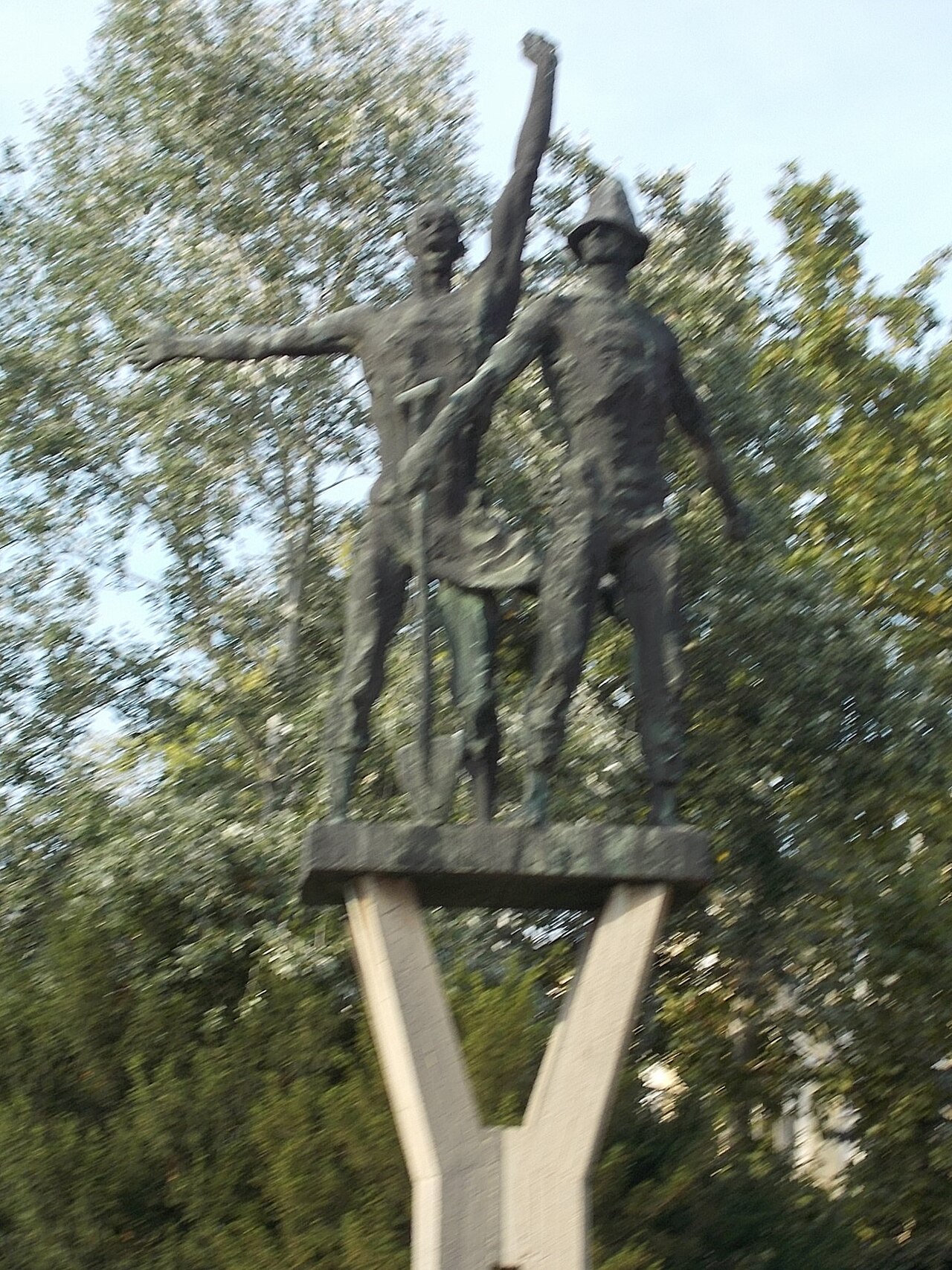
Bronze sculpture on a concrete Y-shaped pedestal in a park with trees behind it. A tall figure raises one fist high and extends the other arm sideways. A second figure in a cap stands beside him, reaching out with one arm. Both are weathered dark green-brown.Sculpture

Secondary source

Hungarian Soviet Republic memorial, Szentes

László Marton · 1969

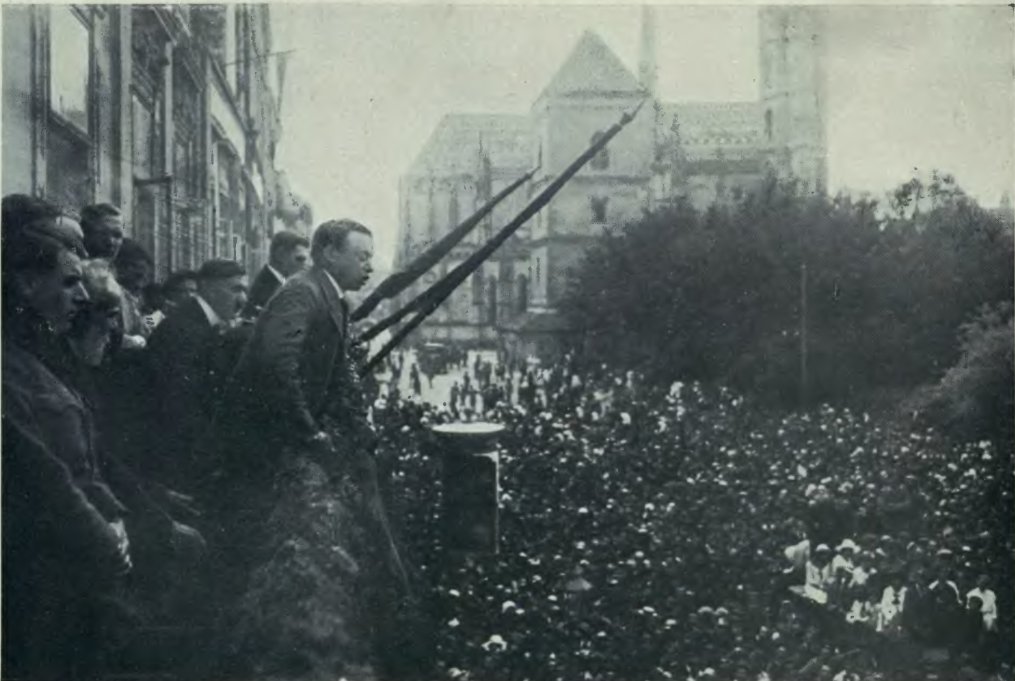
Black-and-white photograph of a man in a suit and light hat-less hair speaking from a raised platform to a dense crowd on a street. Behind him, rifles are propped up, and a large church with a tall tower stands in the background. Onlookers line a building on the left.Photograph

Primary source

Béla Kun Addressing a Crowd in Kassa

Cecile Tormay · 1919

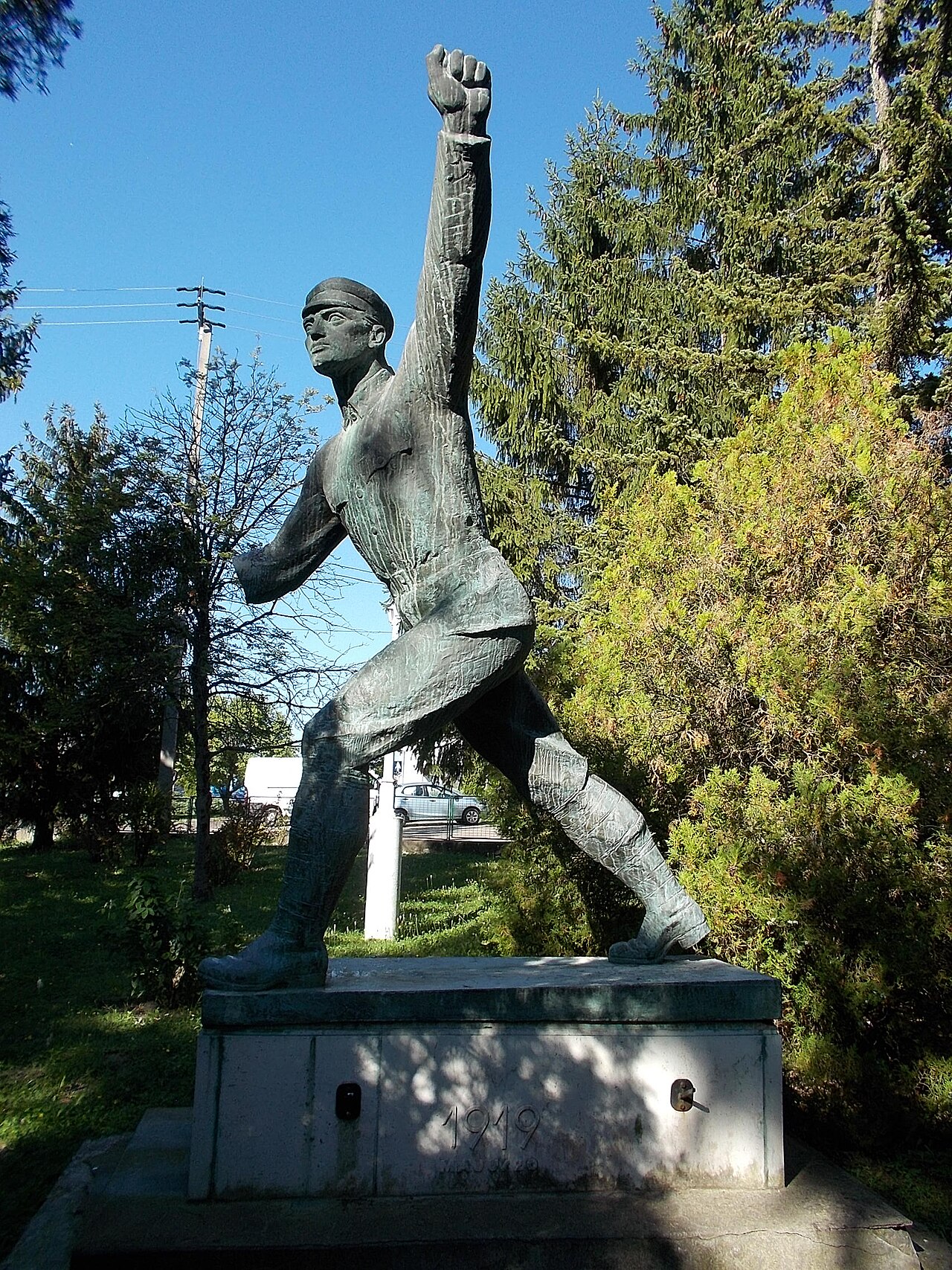
Bronze statue of a muscular male figure in a cap and work clothes, right arm raised with clenched fist, body leaning forward in a striding pose. Mounted on a white concrete plinth inscribed 1919, set among trees and grass on a sunny day.Sculpture

Secondary source

Hungarian Soviet Republic Monument, Bélapátfalva

István Kamotsay · 1949-1958 (style); photographed 2016

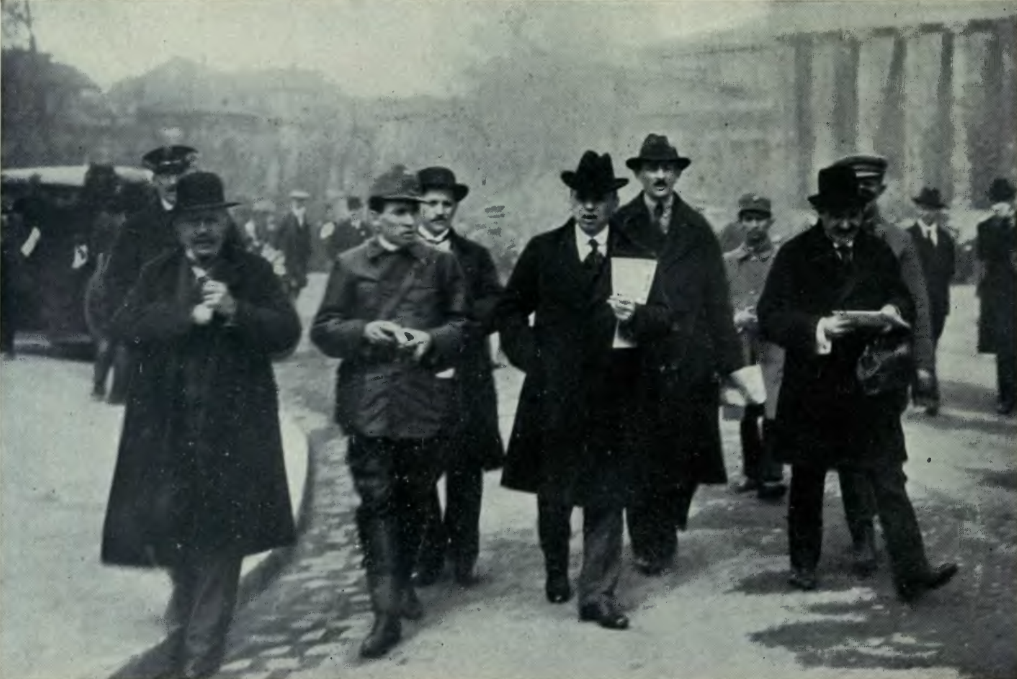
Black-and-white photograph of a group of men in hats and long overcoats walking along a cobblestone street in a city. A man in a leather jacket and breeches walks second from left. Central figure in a dark hat and coat holds papers. Buildings and a crowd are blurred in the background.Photograph

Primary source

Béla Kun and Tibor Szamuely at May Day Celebrations, 1919

Cecile Tormay · 1 May 1919

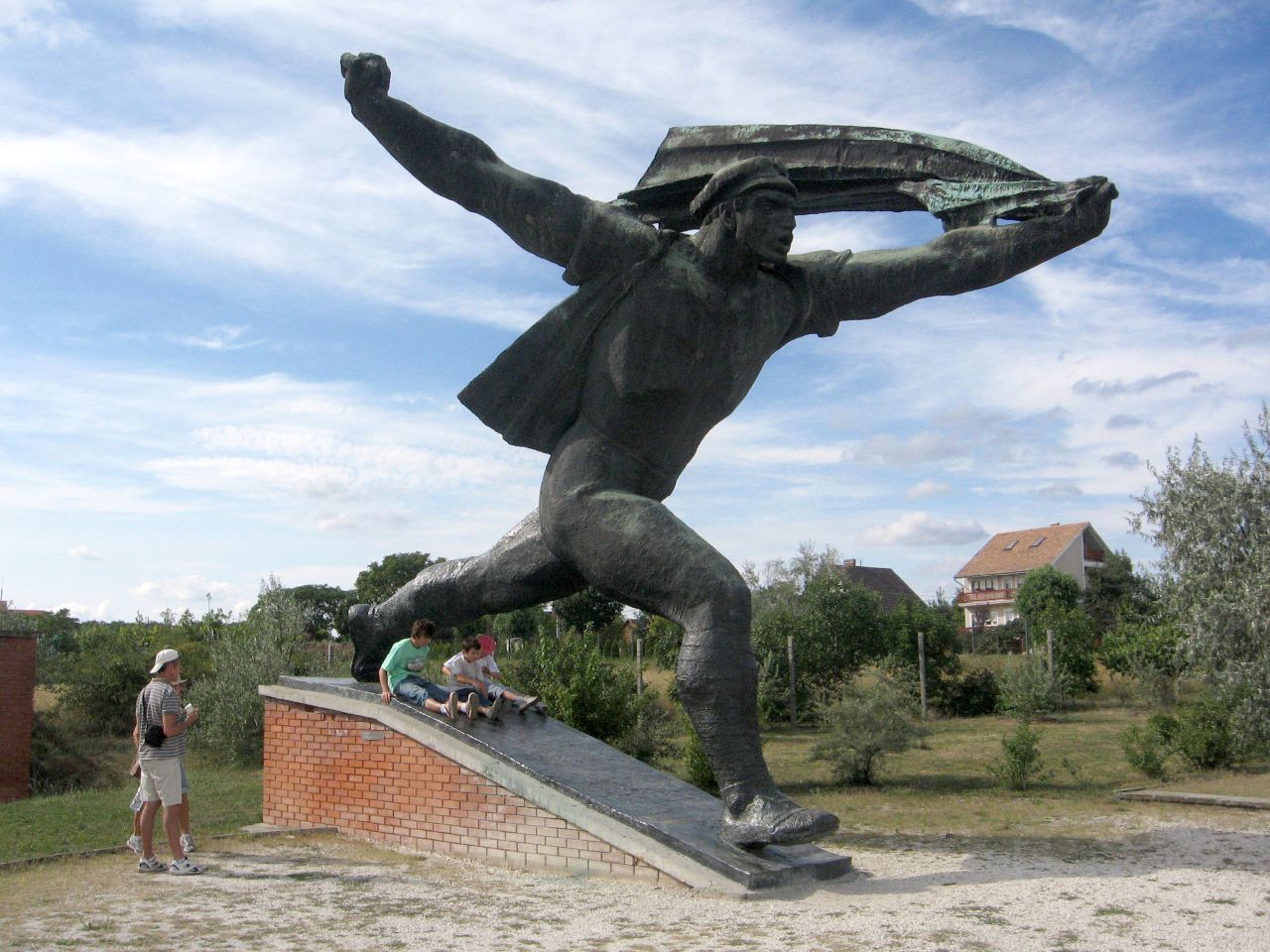
Bronze statue of a striding male figure with arms raised, wearing a cap and long coat, with a curved metal sheet behind him. The statue stands on a brick and concrete plinth. Two children sit on the plinth and two adults stand nearby on gravel under a partly cloudy sky.Sculpture

Secondary source

Republic of Councils Monument, Statue Park, Budapest

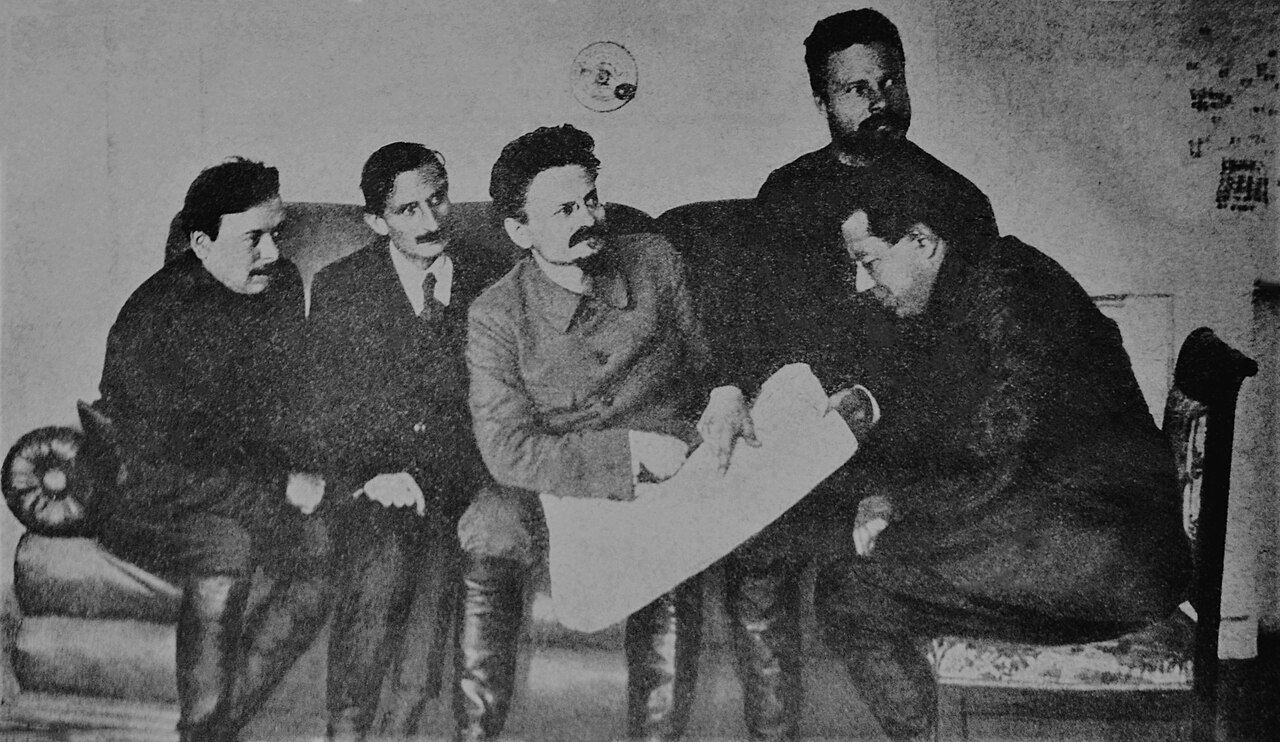
Black-and-white photograph of five men in a room. Four sit on a sofa and one stands at right, leaning over a large unrolled paper or map. The seated man at center wears a military-style tunic and boots and looks down at the paper. Others wear dark civilian coats, one with a bow tie. A round wall object is visible above.Photograph

Primary source

Béla Kun with Trotsky and Frunze at the Southern Front, 1920

1920

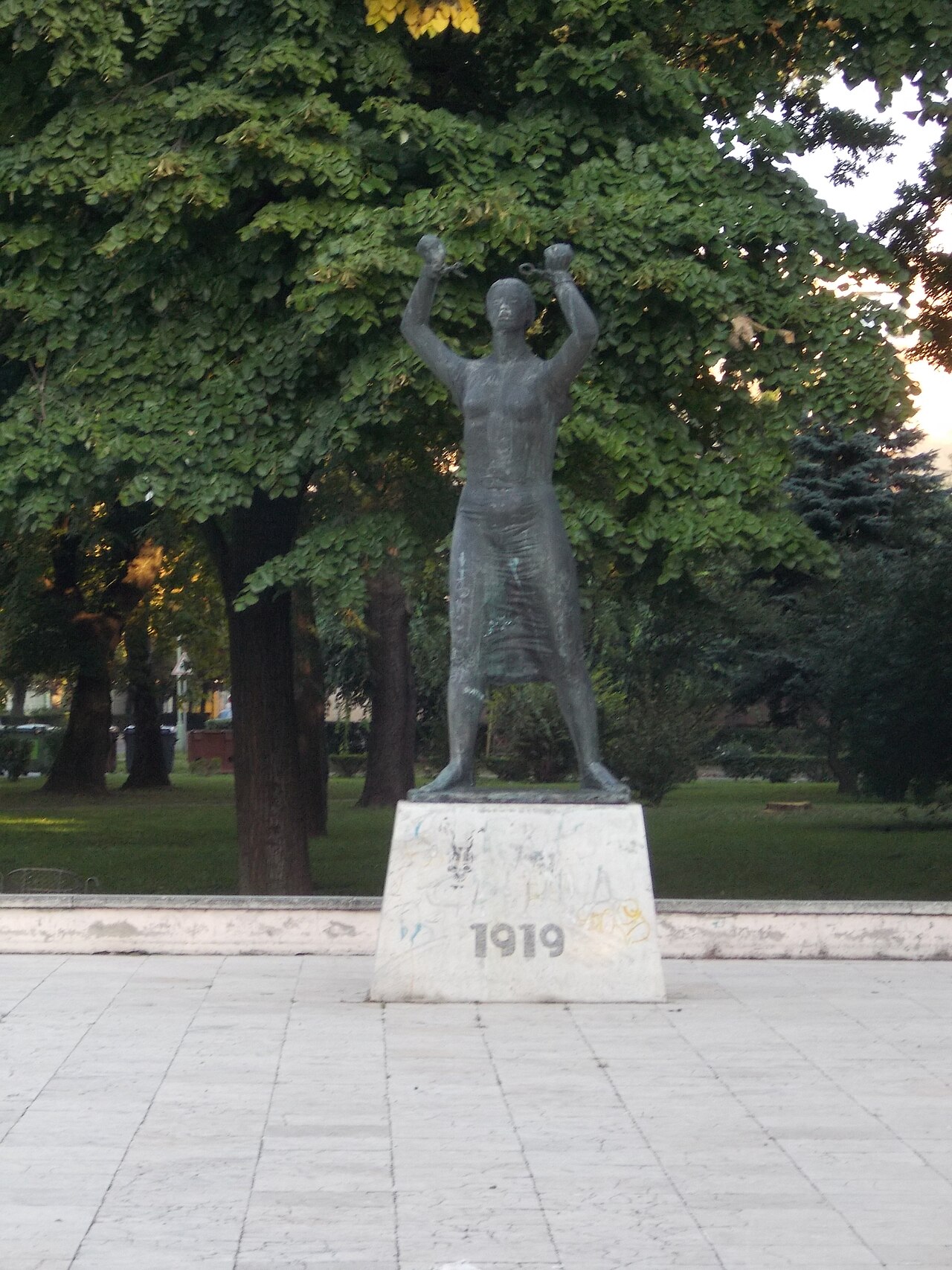
Bronze statue of a bare-chested male figure with arms raised above his head, wrists bound with chains, standing on a white pedestal inscribed 1919, in a park with tall trees and grass.Sculpture

Secondary source

Hungarian Soviet Republic Monument, Cegléd

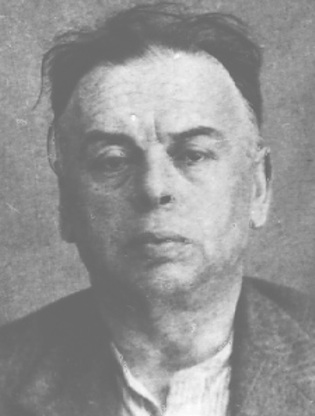
Black-and-white mug shot of an older man with disheveled dark hair, facing the camera with a neutral, somber expression. He wears a dark jacket over a light collared shirt against a plain grey background.Photograph

Primary source

NKVD Mug Shot of Béla Kun, 1937

NKVD · 1937

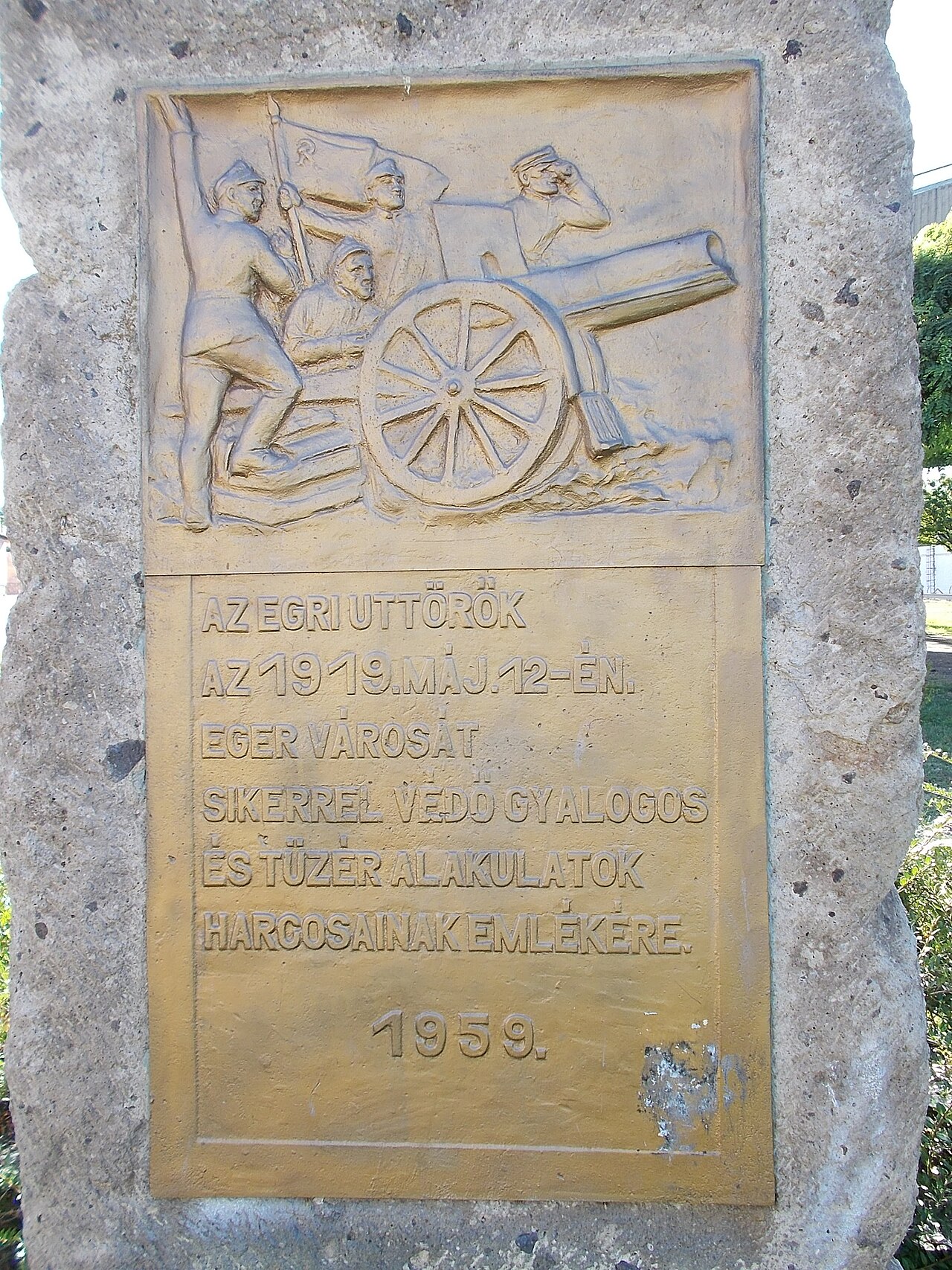
Photograph of a stone memorial with a bronze-colored relief panel showing three soldiers with a flag and a field gun with wheel, above an inscription plaque reading in Hungarian about the Egri uttörők (Eger defenders) of May 12, 1919, and the year 1959.Artifact

Secondary source

Memorial of the Siege of Eger, 1919

1959

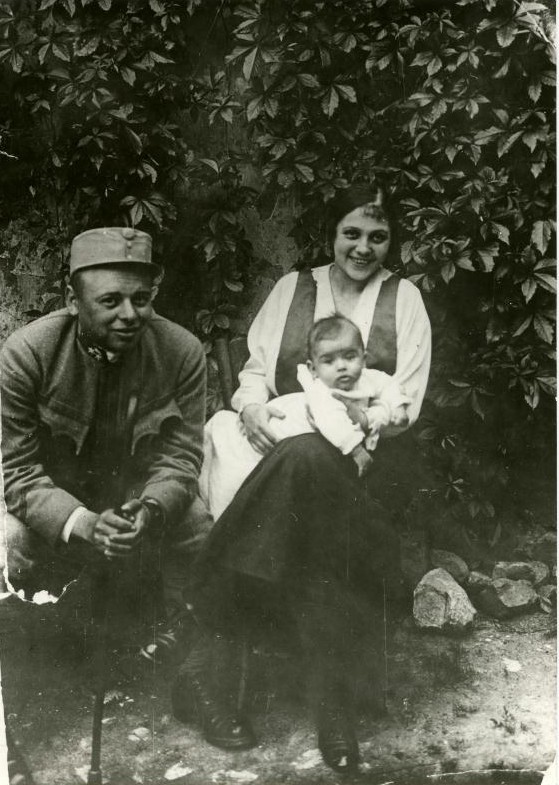
Black and white photograph of a man in a military-style cap and jacket seated at left, a smiling woman with dark hair in a light blouse and vest holding a baby on her lap, seated in front of dense leafy vines.Photograph

Primary source

Béla Kun and His Family, 1915

1915

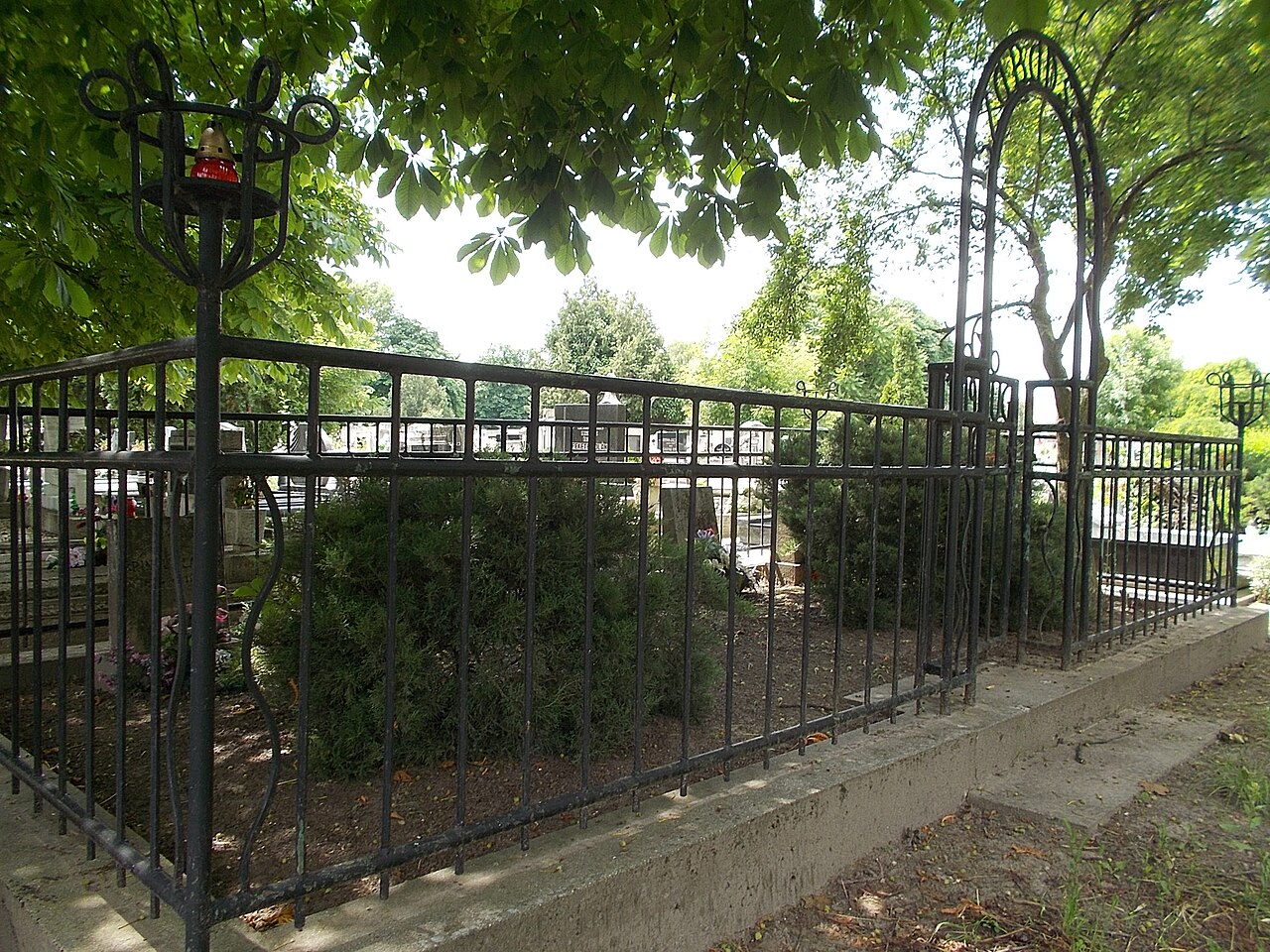
A black wrought-iron fence encloses a grave plot in a cemetery, with a small red lamp on an ornate iron post at left and a wrought-iron arched gate at right. Shrubs and graves are visible inside; trees and sky are behind.Artifact

Secondary source

Tomb of the Heroes of the Hungarian Soviet Republic, Kiskunhalas

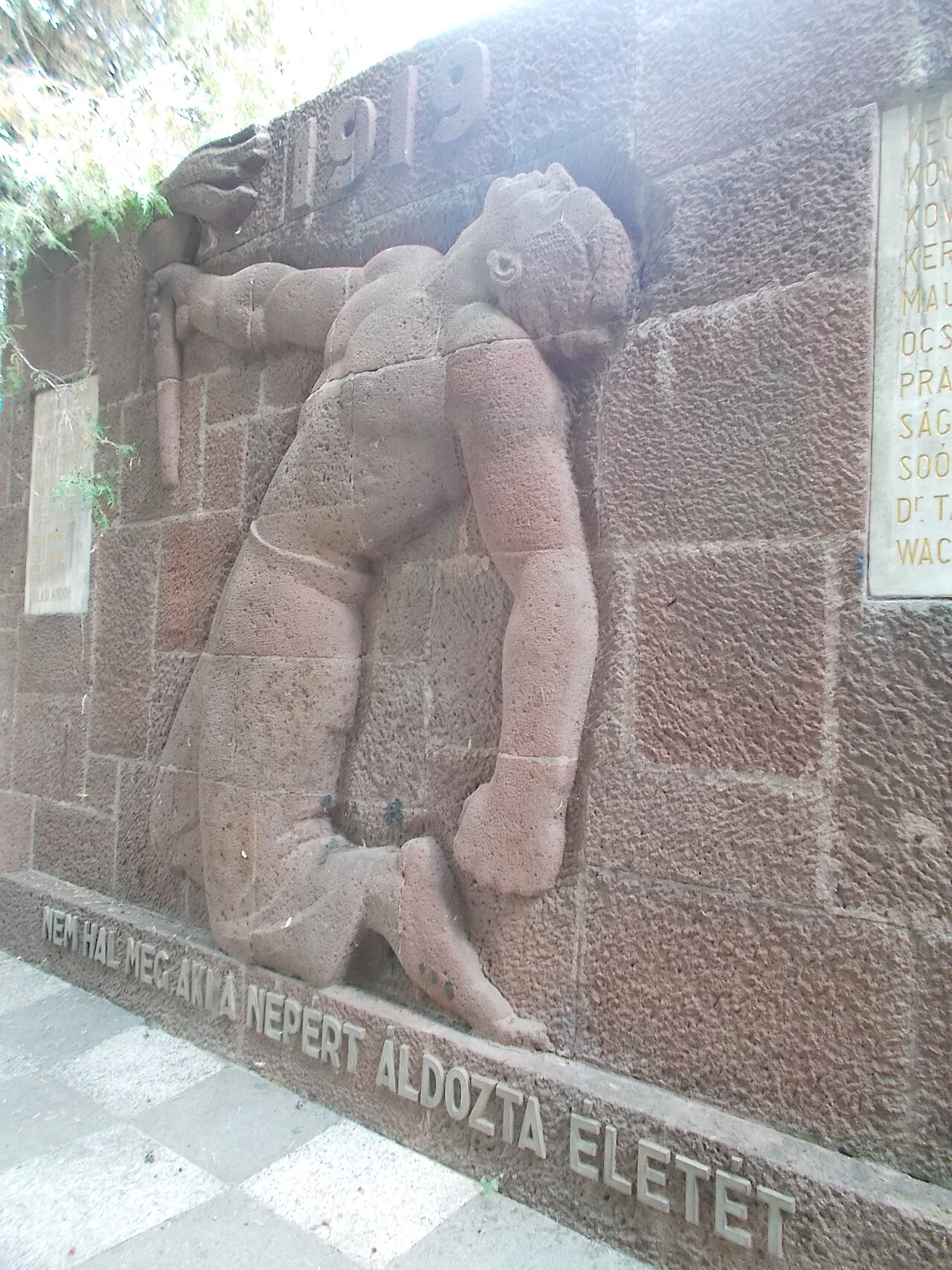
Photograph of a dark red stone wall monument in a cemetery. A carved relief shows a muscular male figure slumped and falling forward, one arm reaching up. The date 1919 is carved above, Hungarian inscription below, and a plaque with text is on the right.Artifact

Secondary source

Monument to the Martyrs of 1919, Szekszárd

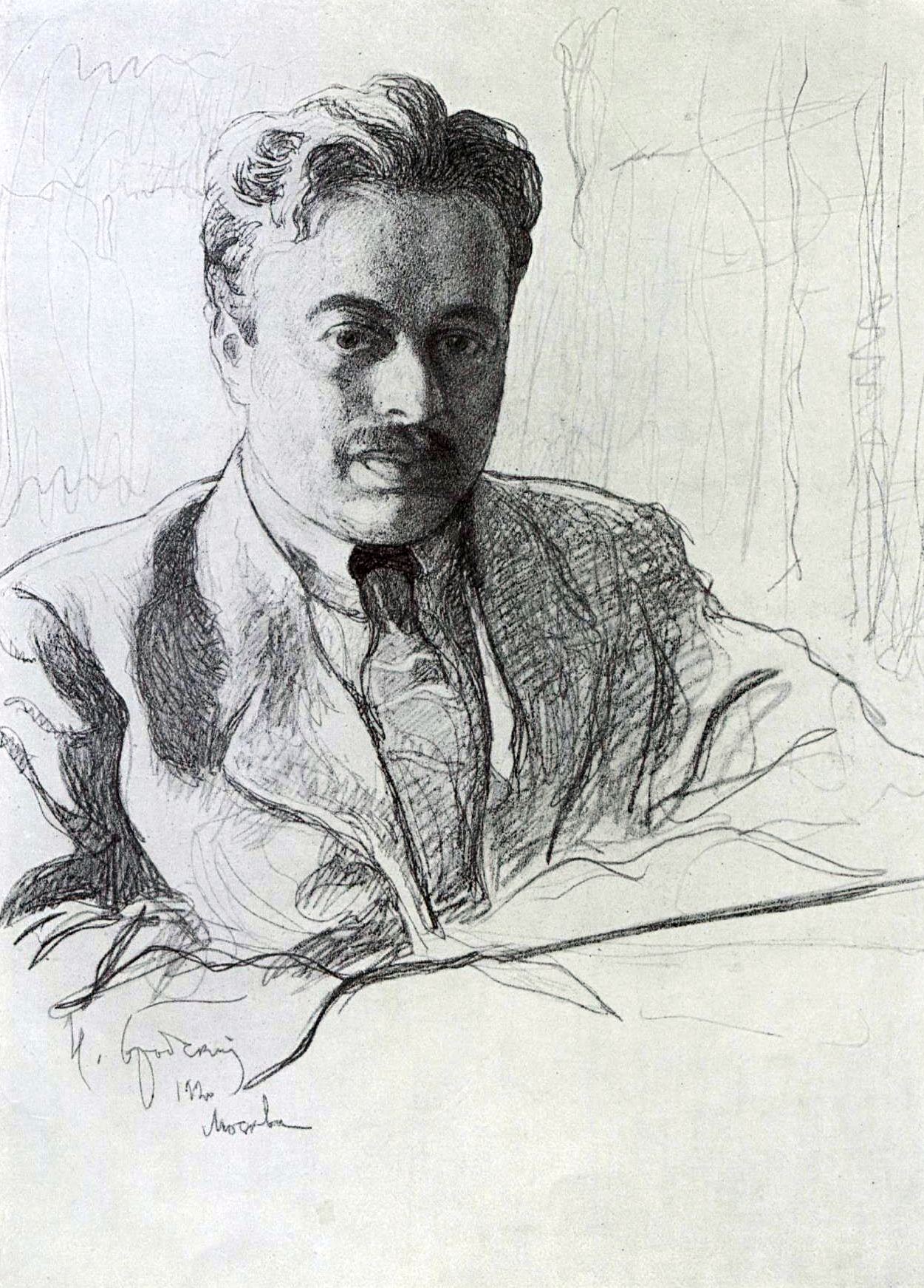
Pencil drawing of a man with wavy hair, a mustache, and a dark tie, seated with his arms resting on a table. Sketchy lines fill the background. The signature and the word Moscow with a date appear in the lower left corner.Painting

Primary source

Portrait Drawing of Béla Kun by Isaak Brodsky

Isaak Brodsky

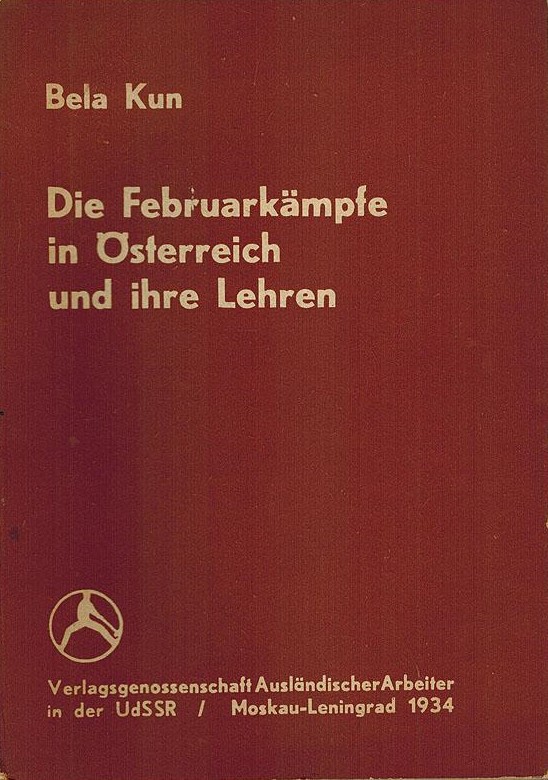
Front cover of a dark red booklet. Top left reads 'Bela Kun' in cream letters. Center title reads 'Die Februarkämpfe in Österreich und ihre Lehren'. Bottom has a circular emblem with a figure and text 'Verlagsgenossenschaft Ausländischer Arbeiter in der UdSSR / Moskau-Leningrad 1934'.Book

Primary source

Die Februarkämpfe in Österreich und ihre Lehren

Béla Kun · 1934

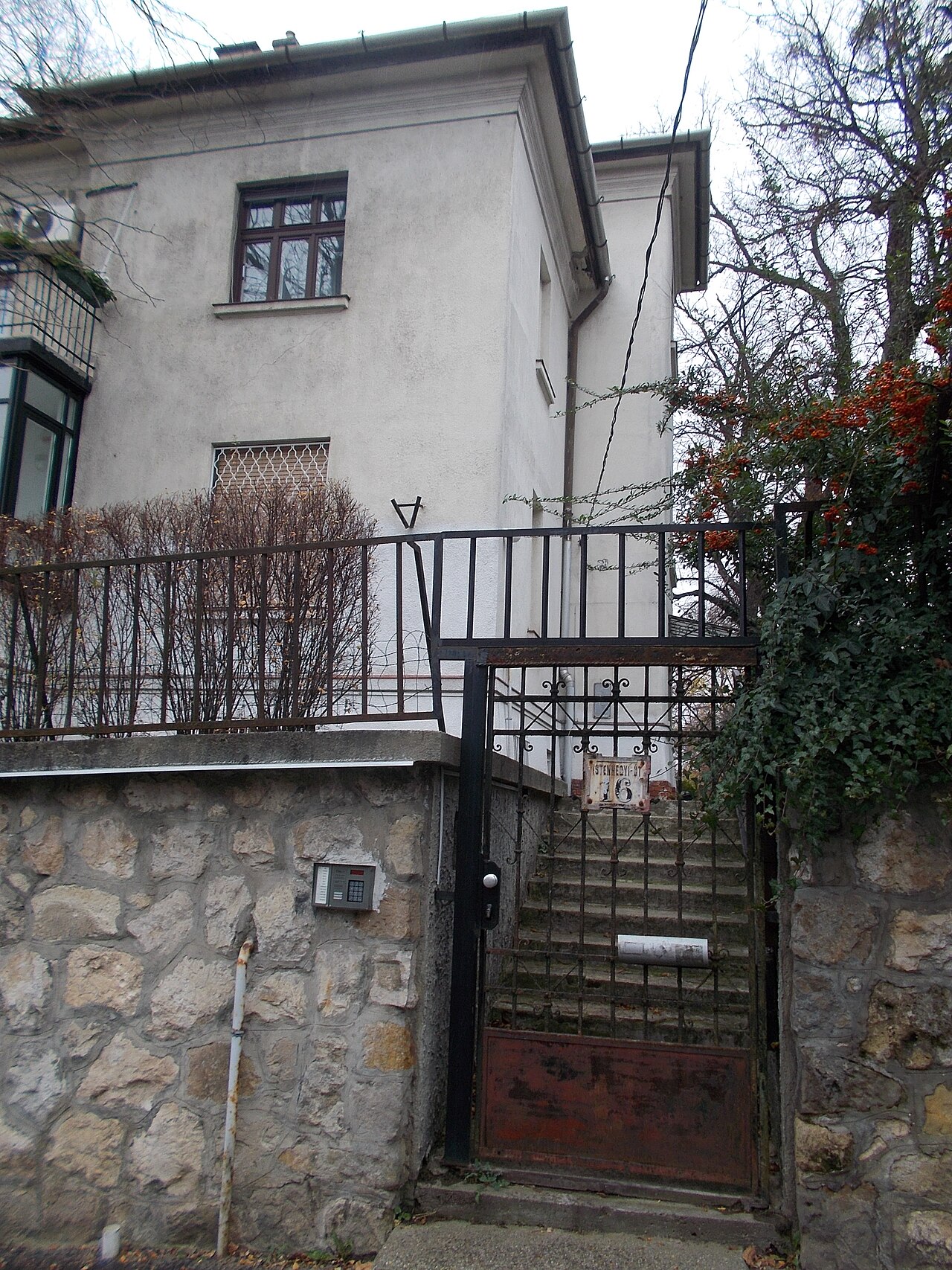
Front view of a two-storey whitewashed house behind a stone wall and wrought-iron gate with stairs. A sign reading 'Istenhegyi út 16' is on the gate. Bare trees and orange berries surround the building.Photograph

Secondary source

Former Party of Communists of Hungary Headquarters, Istenhegyi út 16

Globetrotter19 · 2015

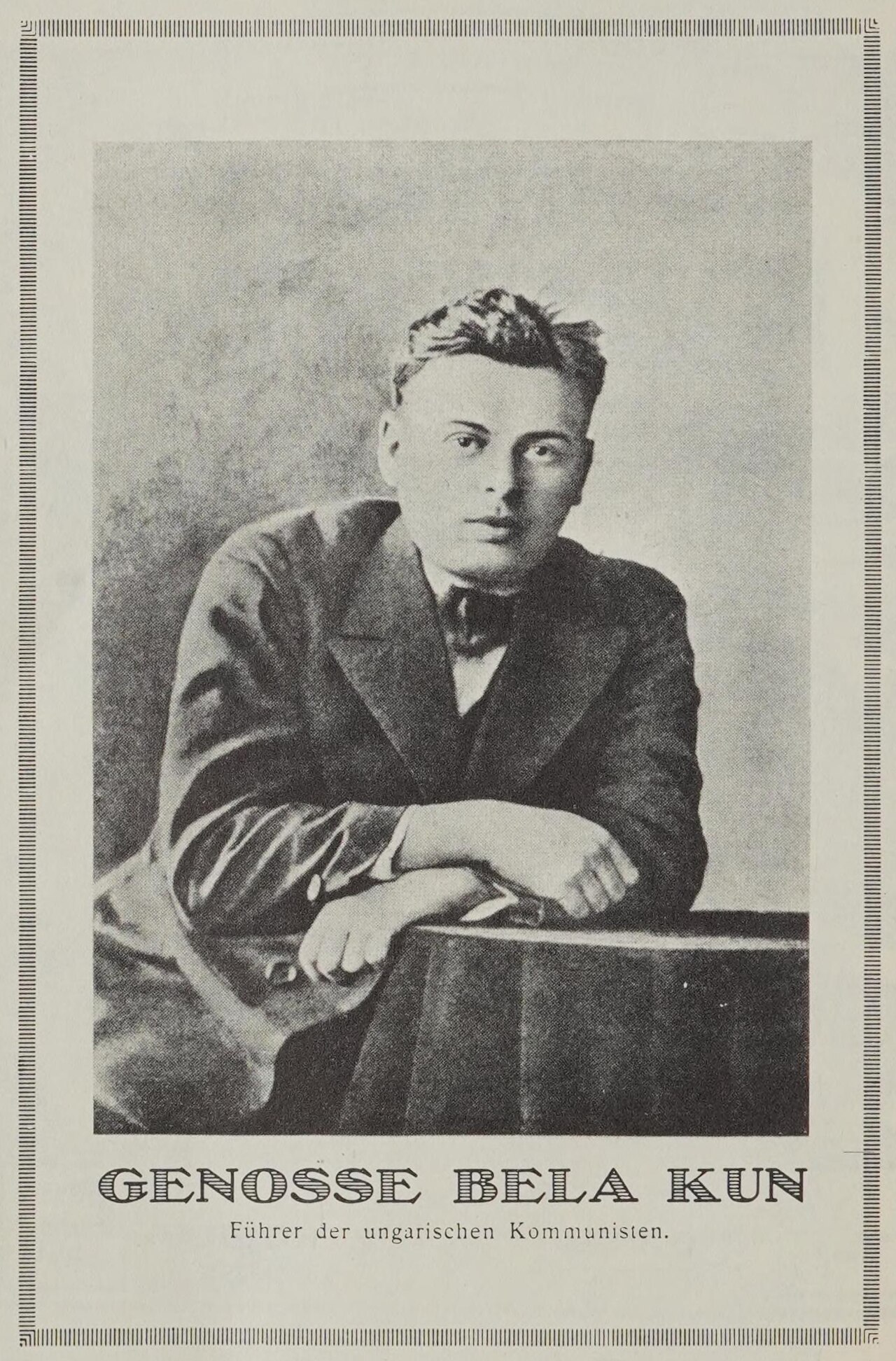
Black-and-white portrait of a young man with wavy hair, dark jacket and tie, leaning both forearms on a dark draped surface. Printed page with a decorative border and caption 'GENOSSE BELA KUN' and 'Führer der ungarischen Kommunisten'.Photograph

Primary source

Portrait of Béla Kun, 1919

1919

Black-and-white studio-style portrait of a man with short cropped hair, wearing a dark suit, vest, white collar and dark tie, seated on a striped upholstered chair in front of a floral wallpaper, holding a folded paper or book in his right hand.Photograph

Primary source

Portrait of Béla Kun

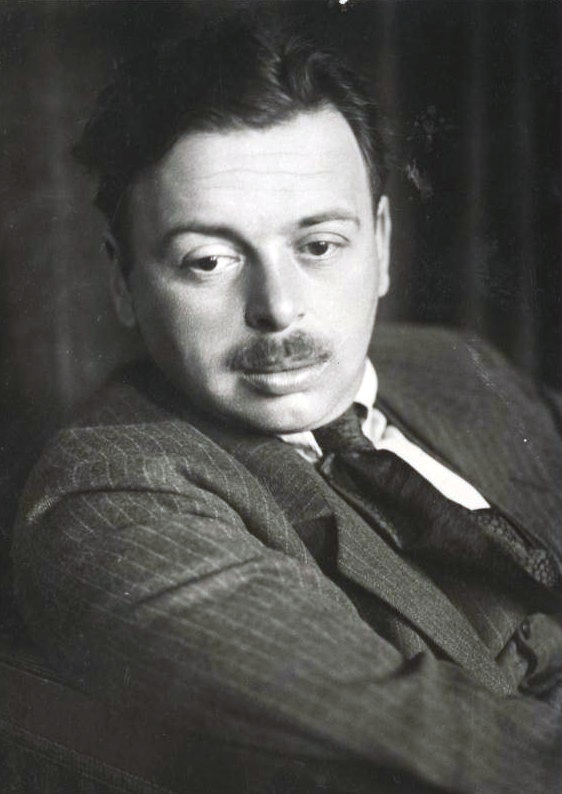
Black-and-white studio portrait of a man with dark, tousled hair and a thin mustache, wearing a pinstriped suit, dark tie and white collar, reclining with his head tilted and gazing to the side against a dark background.Photograph

Primary source

Béla Kun, c. 1922

c. 1922

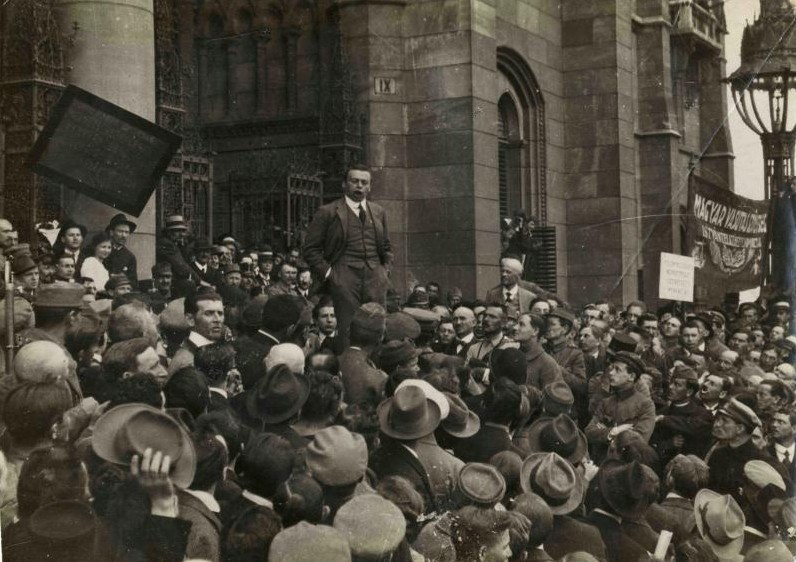
Black and white photograph of a large crowd of men in hats and coats gathered outside a stone building with arched windows. A man in a dark suit and vest stands on a raised platform, hands in pockets, addressing the crowd. A banner hangs at right, and a street lamp is visible.Photograph

Primary source

Béla Kun celebrating the capture of Kassa, 7 June 1919

7 June 1919

Document

Secondary source

Kun, Bela (Encyclopædia Britannica, 1922)

1922

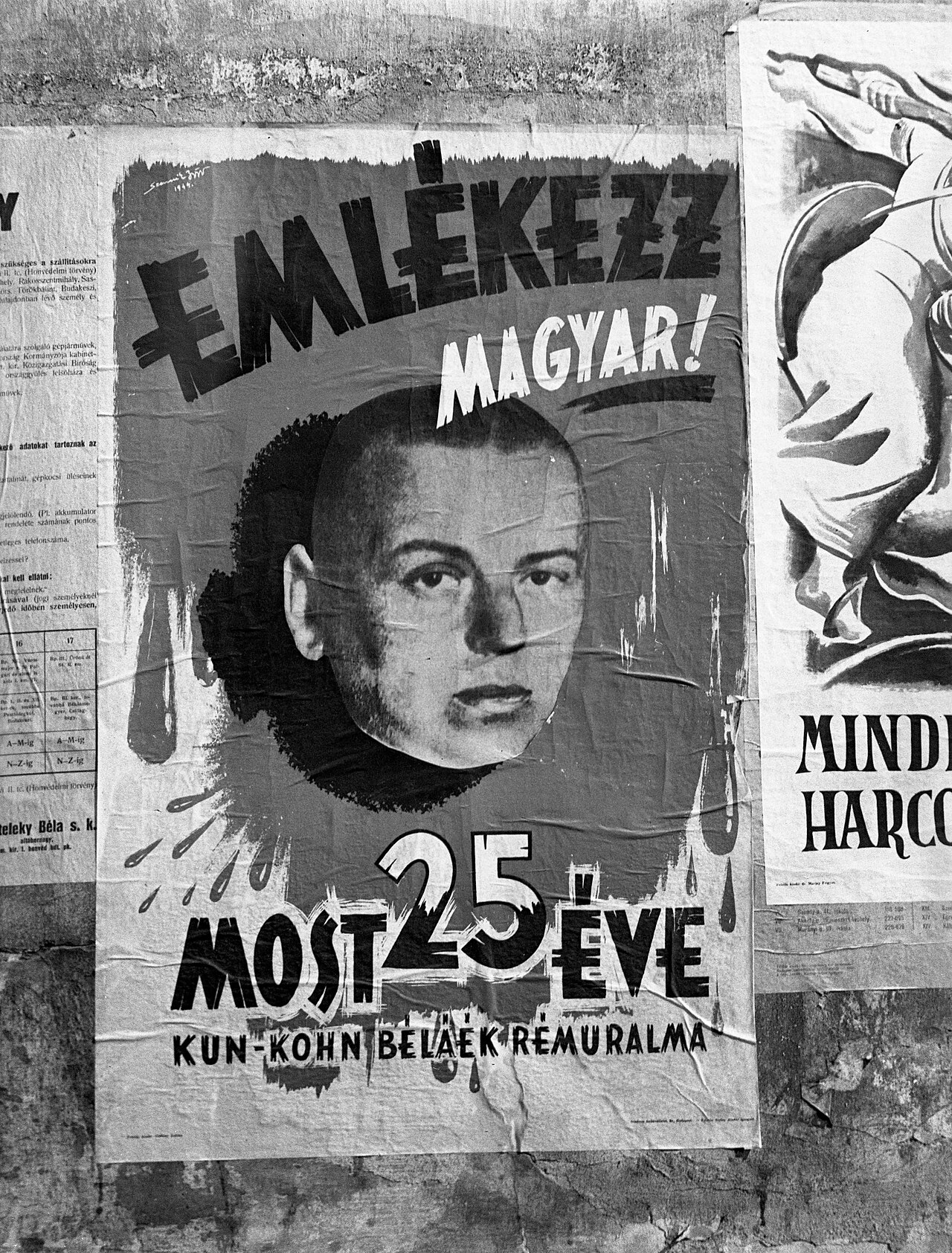
Black-and-white photo of a poster pasted on a weathered wall. Large letters read EMLÉKEZZ MAGYAR! Below is a photo of a close-cropped man's face, with dark drip shapes around it and the text MOST 25 ÉVE. Other posters are visible at the edges.Photograph

Primary source

Remember Hungarian! Poster

György Szennik · 1944

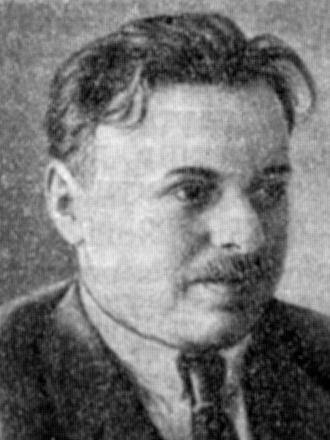
Black-and-white halftone photograph of a man with short, swept-back hair and a small mustache, wearing a dark suit jacket, collared shirt, and tie, looking slightly to the side of the camera.Photograph

Primary source

Photograph of Béla Kun

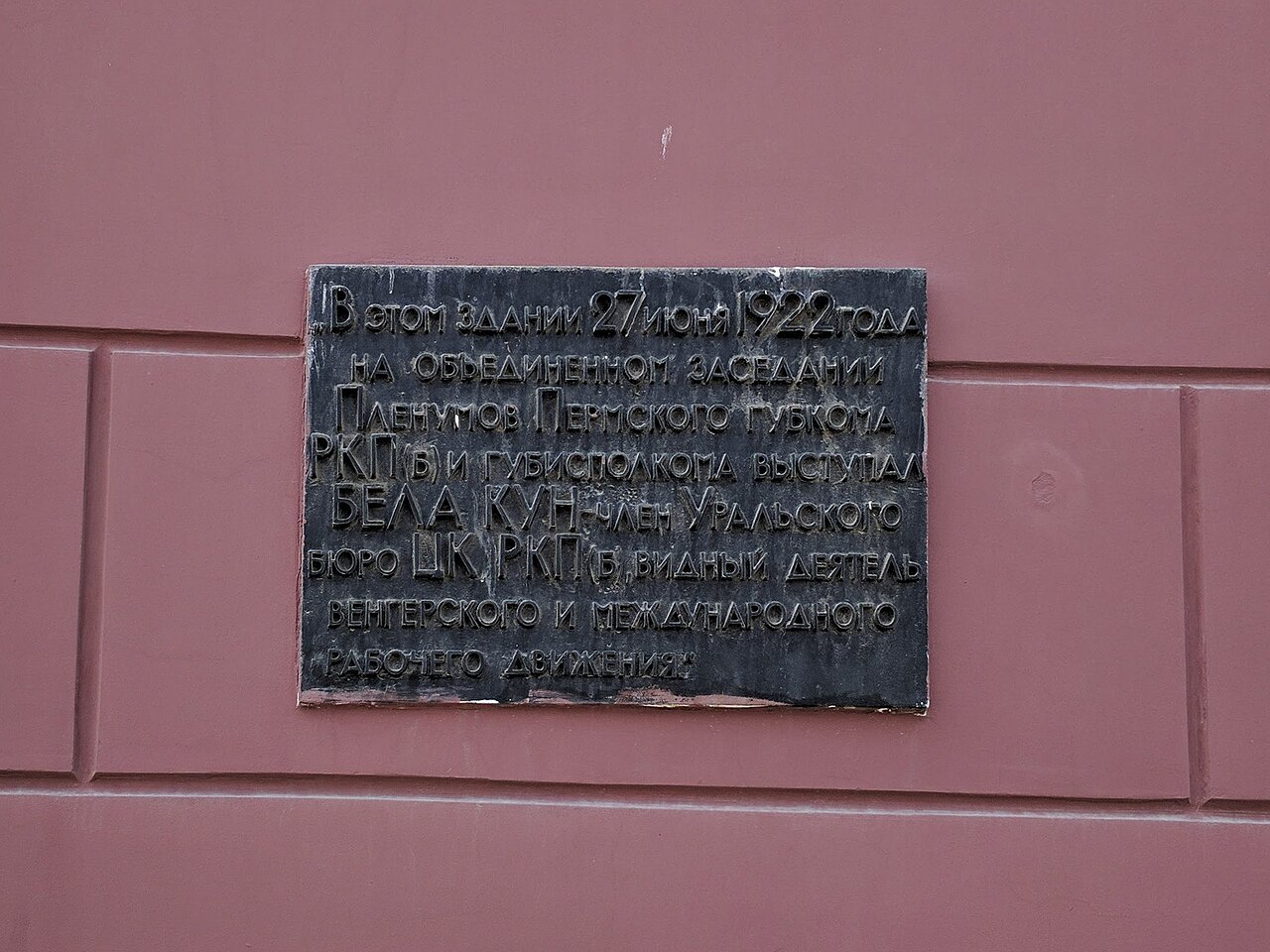
Photo of a dark memorial plaque mounted on a pinkish-red building wall, with raised Cyrillic lettering in several lines of text. The plaque text commemorates a 27 June 1922 joint plenum session where Béla Kun spoke.Artifact

Secondary source

Memorial Plaque to Béla Kun, Perm

Mnavi

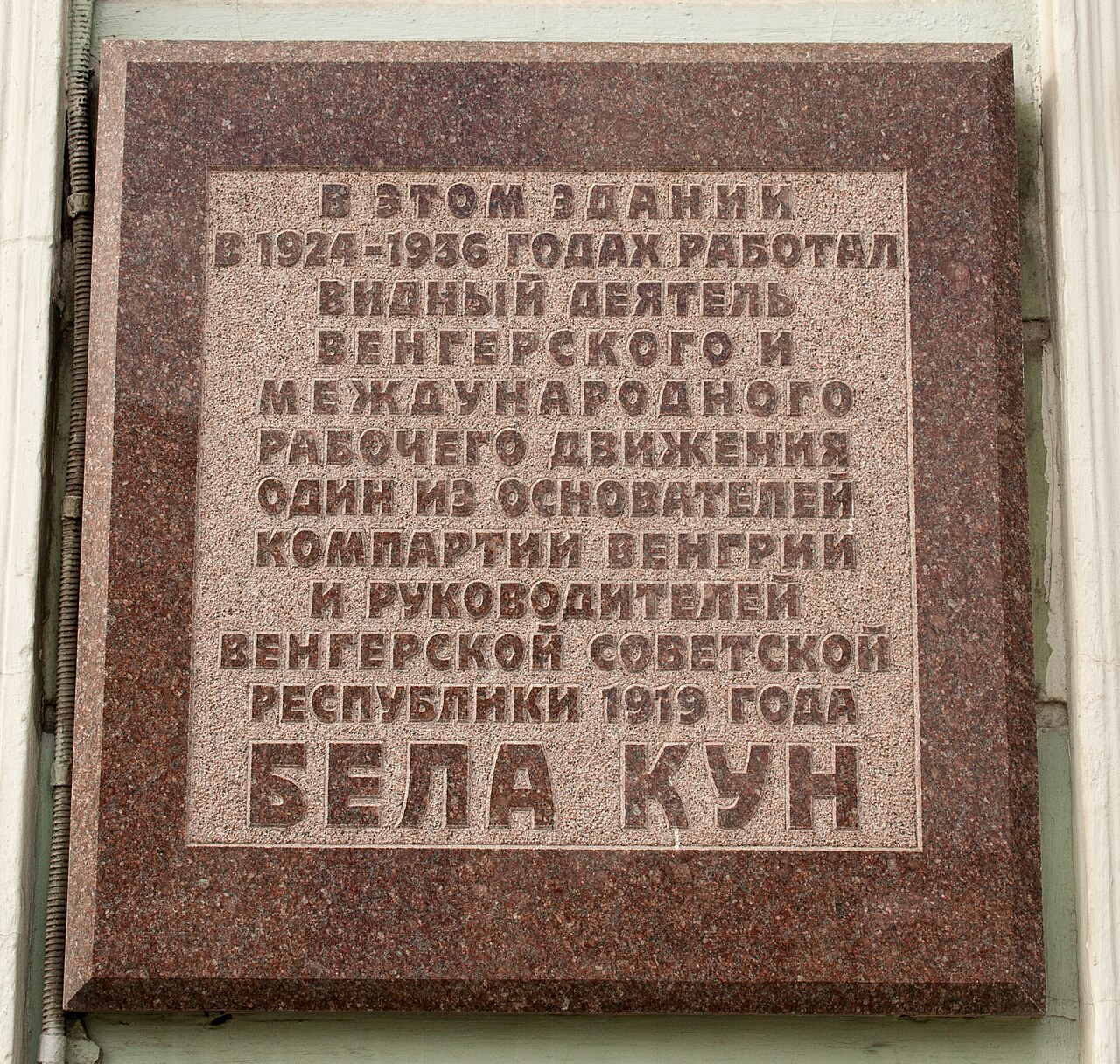
Photo of a square granite memorial plaque mounted on a building wall. Raised Cyrillic text in a lighter stone panel reads that in this building worked Béla Kun, 1924-1936, and ends with the name БЕЛА КУН in large letters.Artifact

Secondary source

Memorial Plaque of Béla Kun, Moscow

A green-patinated metal street sign mounted on a green metal post, reading 'KUN BÉLA' with '12' below and 'HRSZ: 5369' at the bottom. Bare winter branches with snow are behind it.Artifact

Secondary source

Kun Béla Street Sign

Solymári

Revolutionary EssaysBook

Primary source

Revolutionary Essays

Béla Kun · 1919

133 Days of Hungarian BolshevismBook

Primary source

133 Days of Hungarian Bolshevism

László Bizony · 1920

Document

Primary source

Communication on the Wireless Negotiations with Béla Kun

Vladimir Lenin · End of March 1919

Diary entry

Primary source

An Outlaw's Diary

Cécile Tormay · 1923

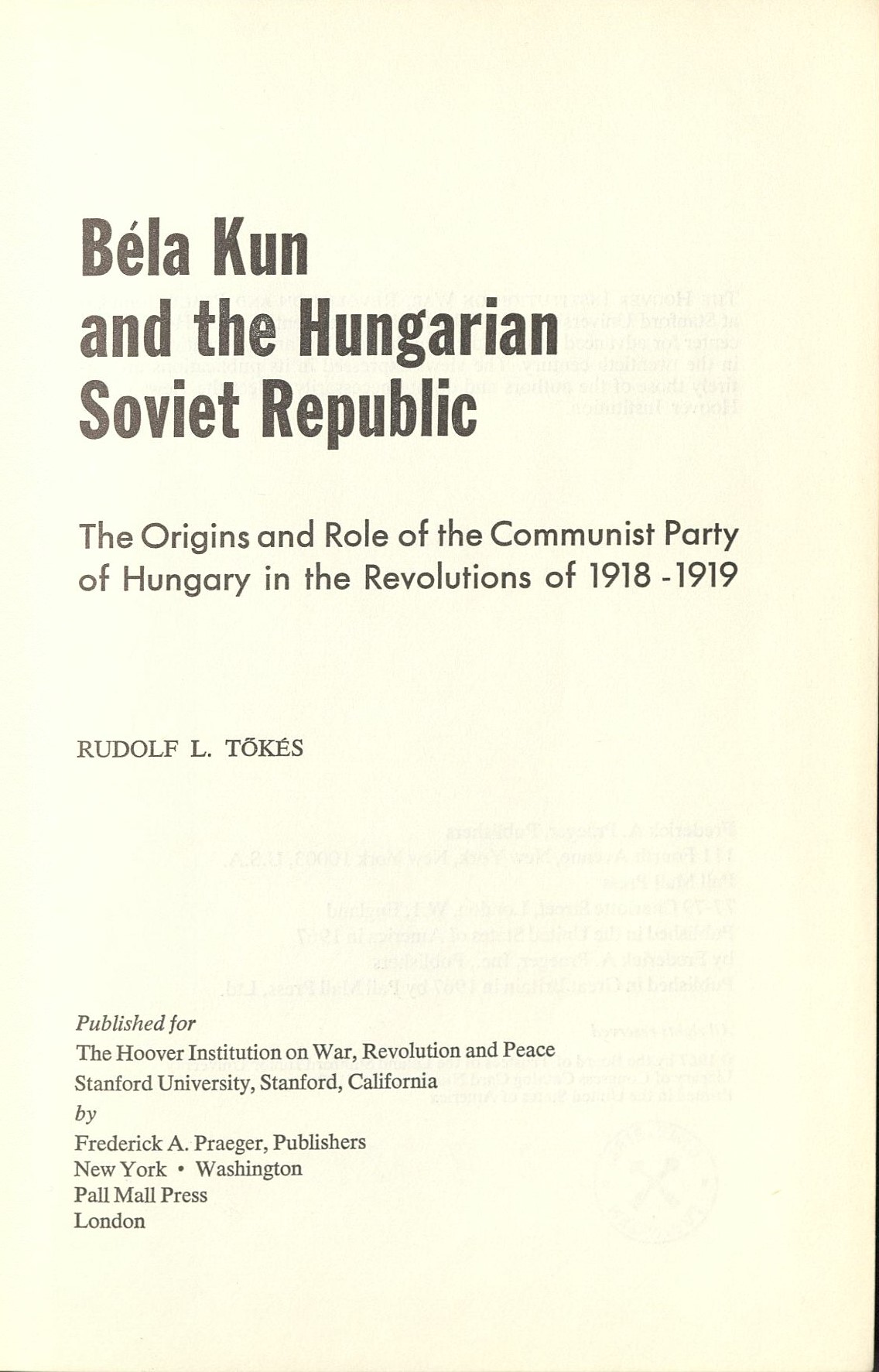
Title page of the book Béla Kun and the Hungarian Soviet Republic. Large bold title at top, subtitle below about the Communist Party of Hungary in the 1918-1919 revolutions, author Rudolf L. Tőkés, and publisher details at bottom.Book

Secondary source

Béla Kun and the Hungarian Soviet Republic

Rudolf L. Tőkés · 1967

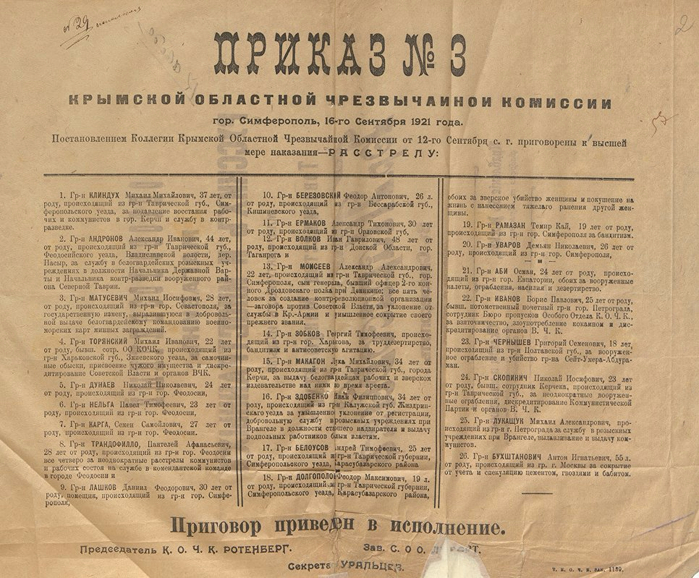
Printed Russian order No. 3 of the Crimean regional Cheka commission, Simferopol, 16 September 1921, listing names and sentences, with the heading 'Приговор приведен в исполнение' and signatures at the bottom.Document

Primary source

Crimean Cheka Execution Order No. 3

Ротенберг А. И. · 16 September 1921

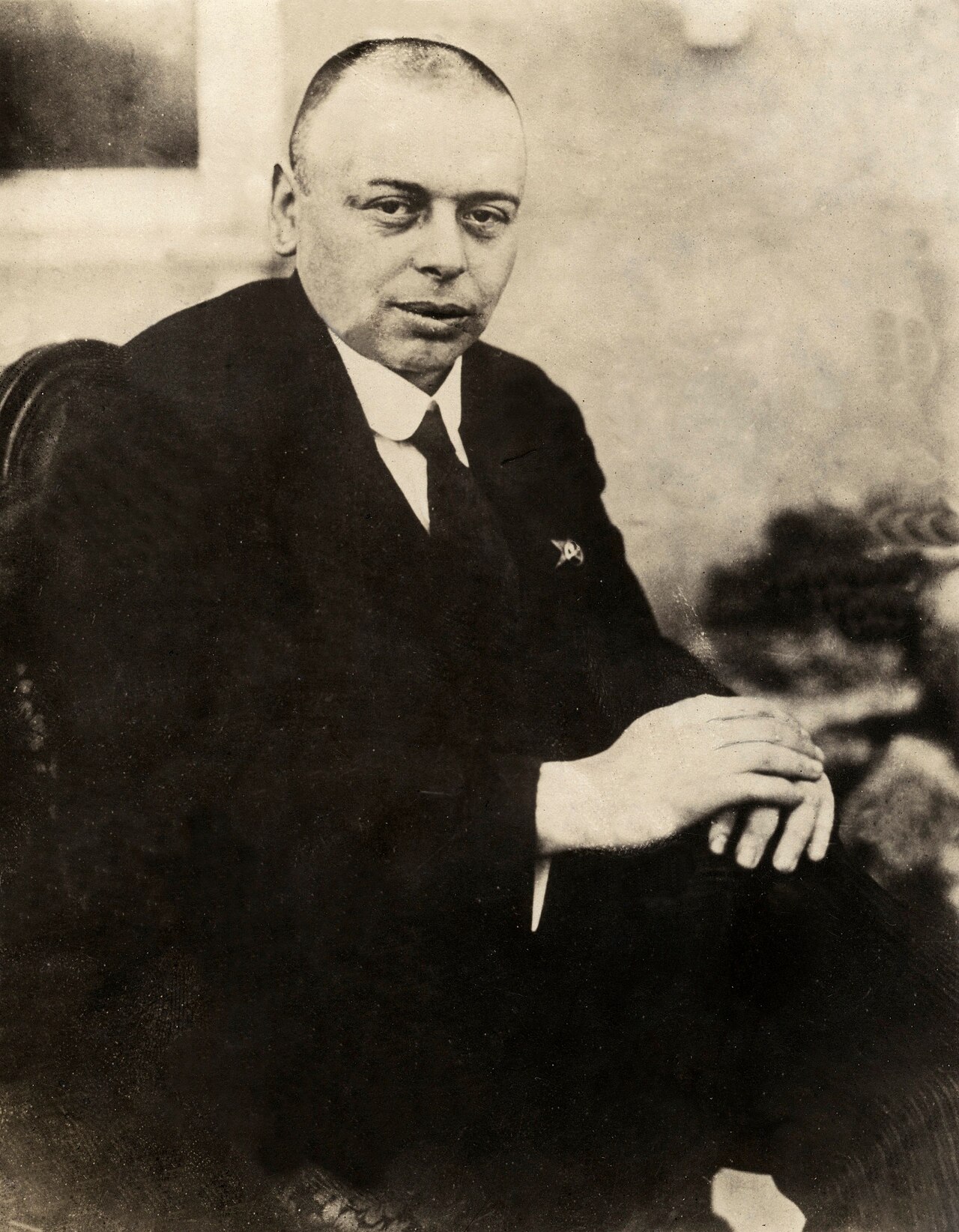
Black and white sepia-toned portrait of a bald man in a dark suit, white shirt, and dark tie, with a small lapel pin, seated in a chair with his hands clasped on his knee. Plain light background.Photograph

Primary source

Portrait of Béla Kun, 1928

Unknown author · 1928

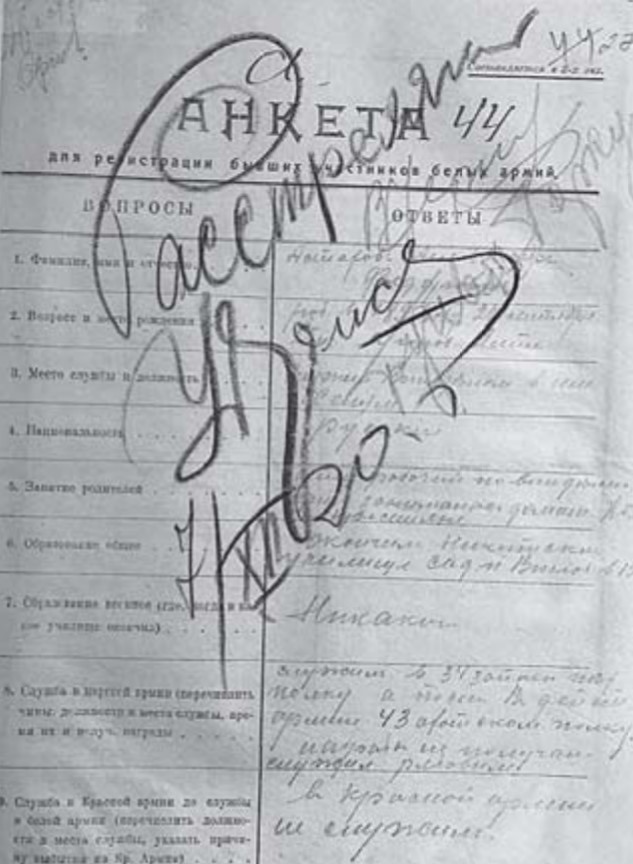
Scanned Russian questionnaire titled 'Анкета' for registration of former White Army participants, form number 44, with handwritten answers and a large handwritten annotation reading 'Расстрелять' (execute) with a signature-like mark across the page.Document

Primary source

Prisoner File with Execution Order, Yalta

Официальный документ ВЧК, подписан Э. М. Удрисом · 7 December 1920

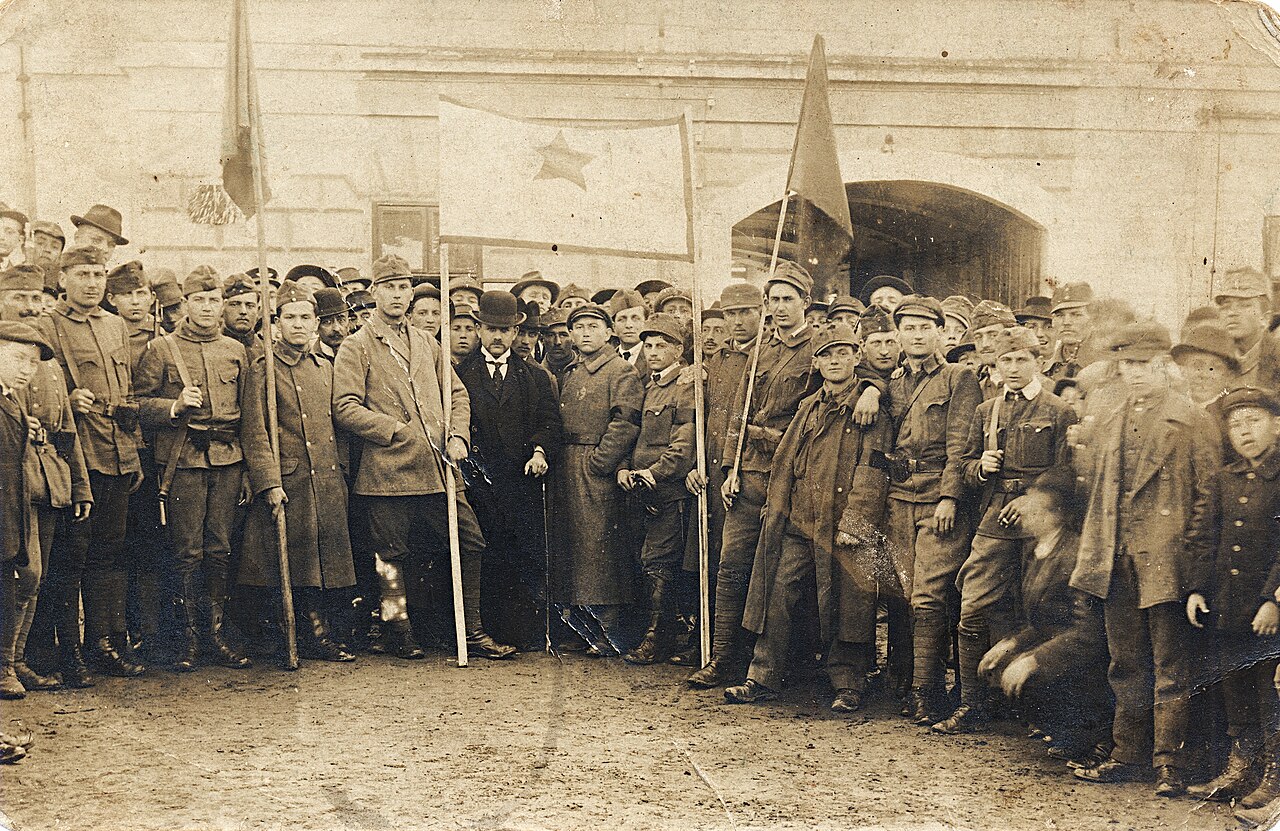
Sepia photograph of a crowd of men in military-style caps, coats and boots standing outdoors in front of a plastered building with an arched doorway. A white banner with a red star outline is held on a pole at center, and a dark flag is at right. A man in a bowler hat and dark suit stands in the middle.Photograph

Primary source

Red Star Tableau from the Hungarian Soviet Republic

1919

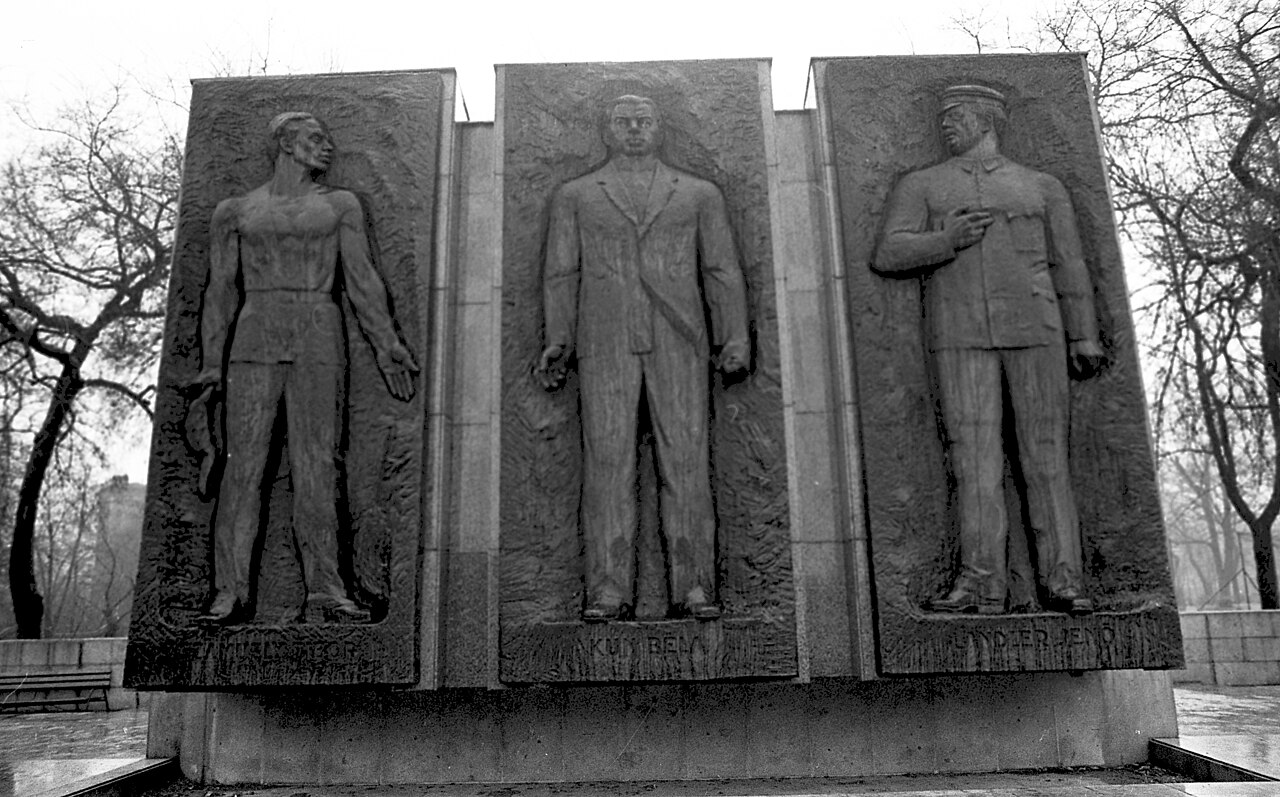
Black and white photograph of a stone relief monument with three tall panels set on a plinth in a park. Three standing male figures in relief: left shirtless, center in a suit, right in a long coat and cap. Bare winter trees behind.Sculpture

Secondary source

Workers' Movement Memorial, Ludovika (Kun Béla) tér

Olcsai Kiss Zoltán, Farkas Aladár, Herczeg Klára · 1973

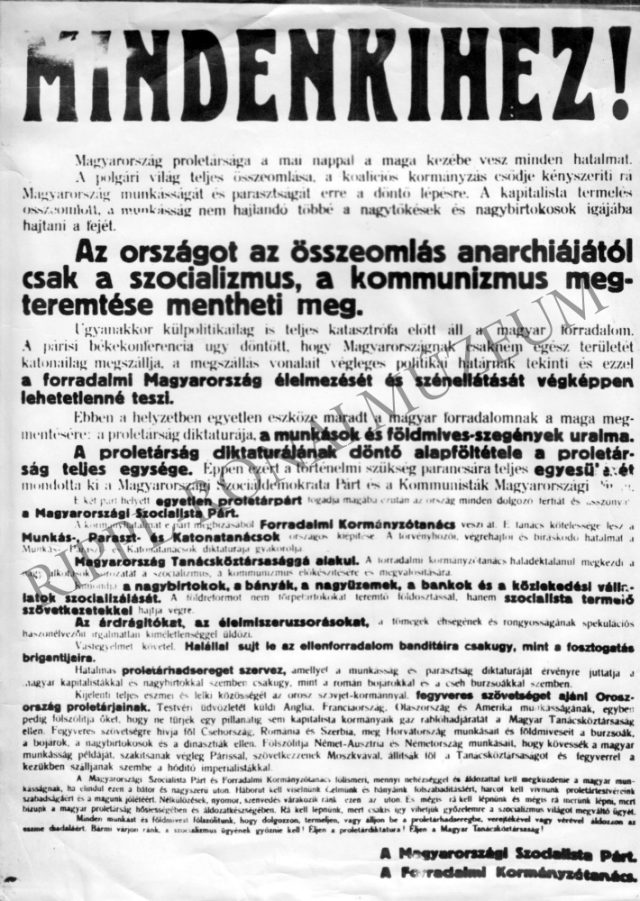
Mindenkihez! (To Everyone!) PosterNewspaper article

Primary source

Mindenkihez! (To Everyone!) Poster

Magyarországi Szocialista Párt · 1919

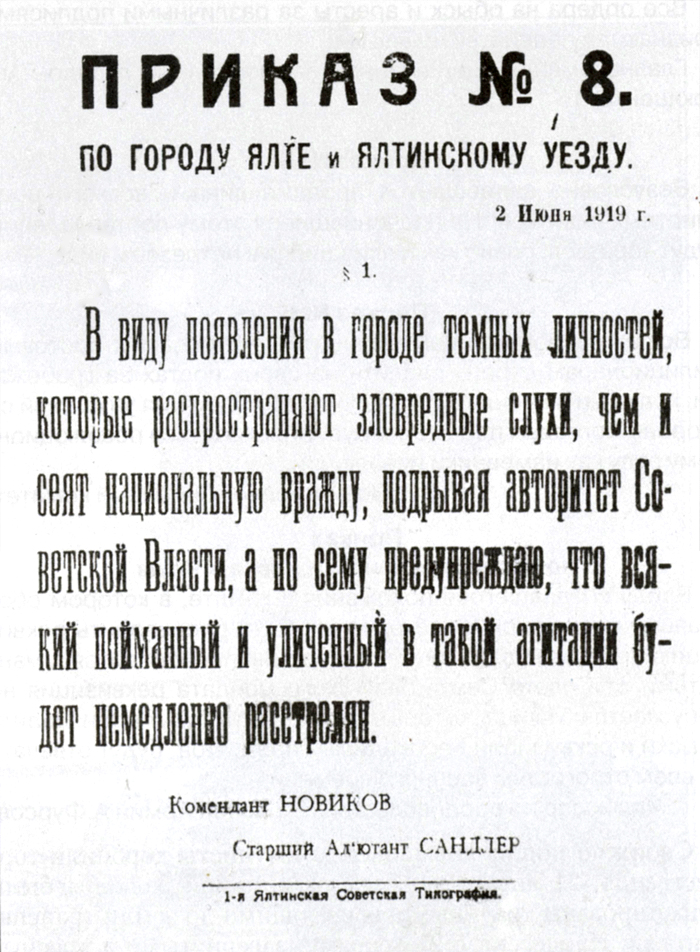
Scan of a printed Russian order titled Приказ № 8, to the city of Yalta and Yalta district, dated 2 June 1919. It warns that anyone caught spreading rumours and inciting national hostility will be immediately shot. Signed by Commandant Novikov and senior adjutant Sandler, printed by the Yalta Soviet Typography.Document

Primary source

Yalta Commandant's Order on Executions

Комендант Новиков · 2 June 1919

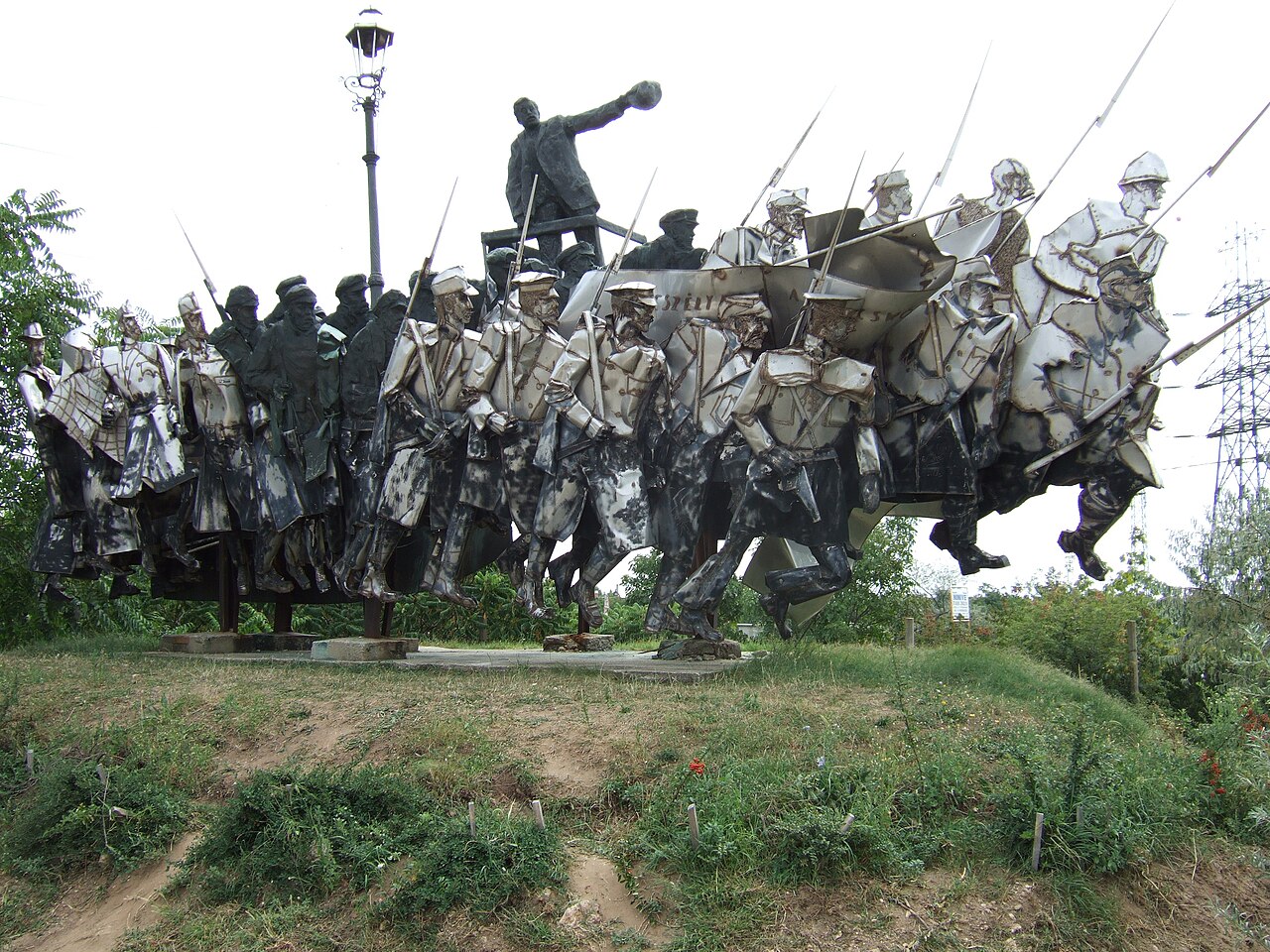
Outdoor bronze-and-metal sculpture of a group of marching revolutionary figures, some in caps and coats with rifles raised, with a larger central figure raising a fist on a pedestal, set on a grassy hill beside a lamp post and power lines.Sculpture

Secondary source

Béla Kun Memorial by Imre Varga, Memento Park

Imre Varga · 1986 (statue); photographed 22 August 2008

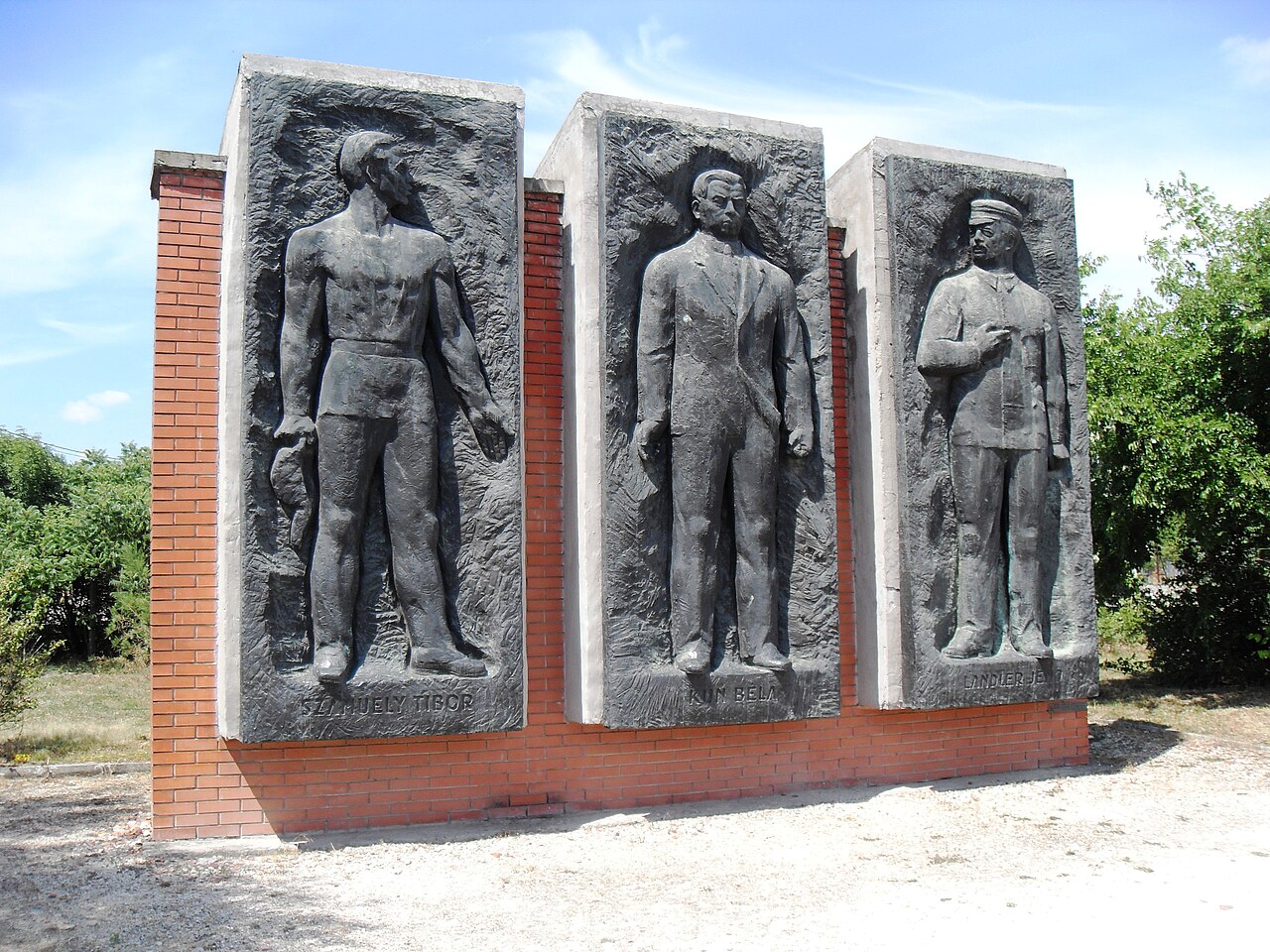
Three tall dark bronze reliefs of standing male figures set on a red brick wall in a gravel yard under blue sky. Left: a shirtless figure with a cap. Center: a man in suit and tie. Right: a man in a cap and jacket. Names are inscribed at the bottom of each panel.Sculpture

Secondary source

Béla Kun, Jenő Landler and Tibor Szamuely Memorial

Olcsai-Kiss Zoltán, Herczeg Klára, Farkas Aladár · 1967 (statue); photographed 11 June 2011

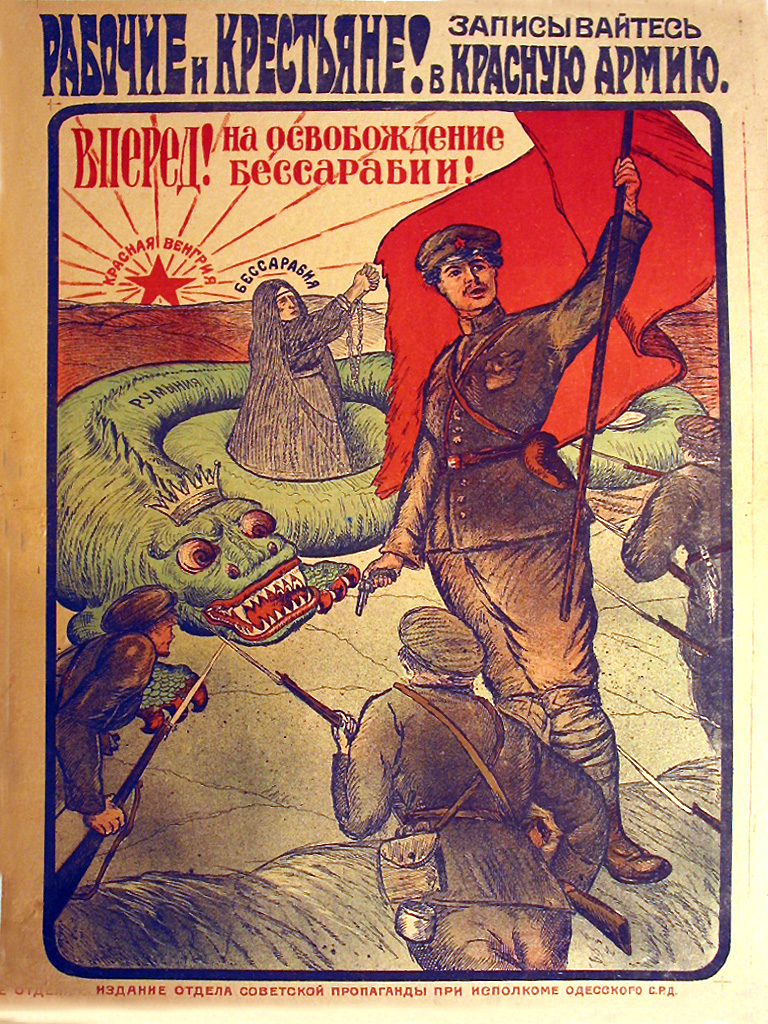
Soviet-era lithograph recruitment poster. Top Russian headline reads 'Workers and peasants! Enlist in the Red Army.' A red-coated soldier in cap holds a red flag and stands over a fallen enemy soldier. A green serpent-like dragon wearing a crown, labeled Romania, bites at a soldier. A woman in a veil, labeled Bessarabia, is chained to the dragon. A red star with rays, labeled Red Hungary, shines above.Artifact

Primary source

Odessa Soviet Red Army Recruitment Poster

Department of Soviet Propaganda of the Executive Committee of the Soviet of Working Deputies, Odessa · 1919

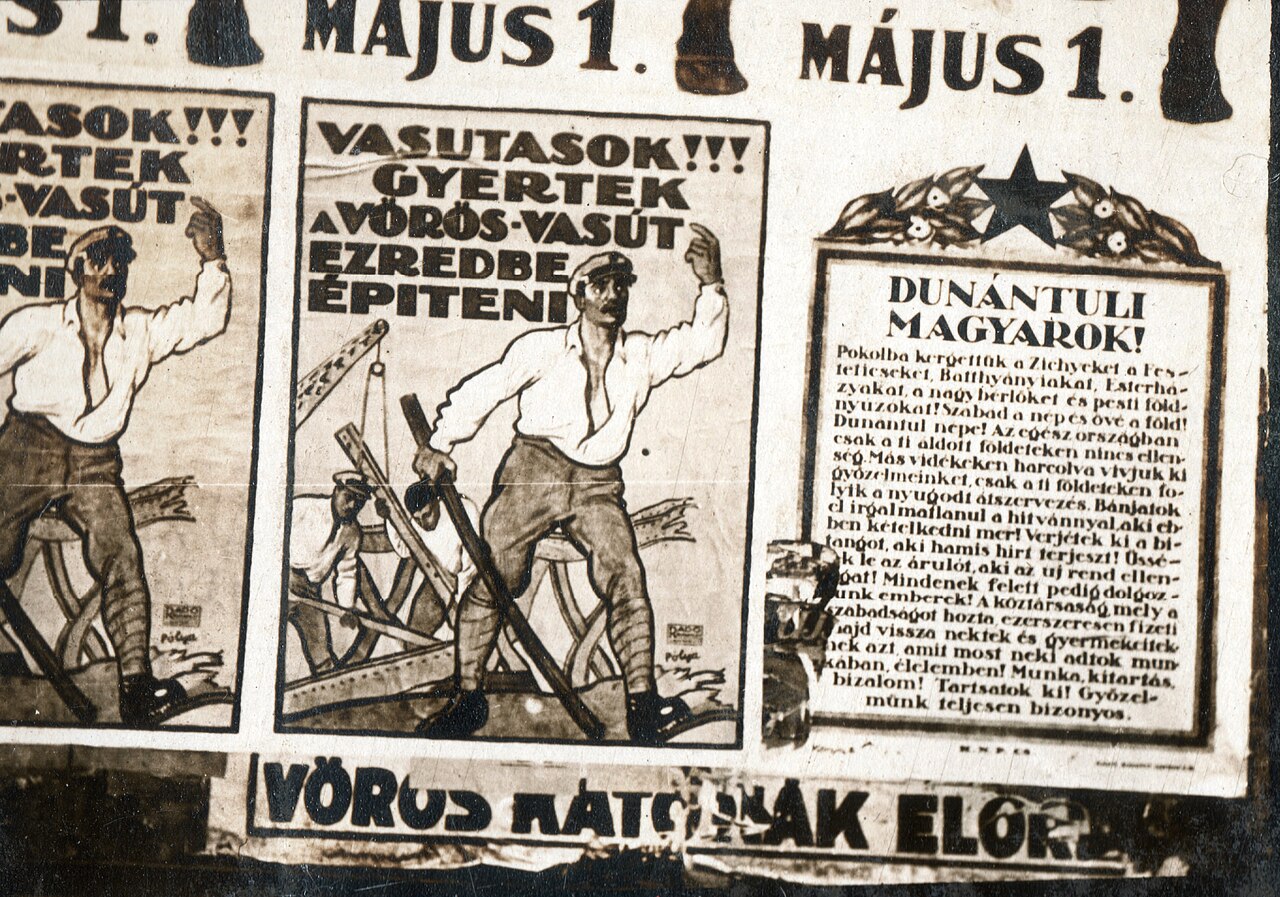
Photograph of several 1919 Hungarian Soviet Republic propaganda posters pasted on a wall, with 'MÁJUS 1' headings. The central poster shows a worker in shirtsleeves raising a fist and carrying a pole beside railway workers; its text reads 'VASUTASOK!!! GYERTEK A VÖRÖS-VASÚT EZREDBE ÉPITENI'. A text poster on the right reads 'DUNÁNTÚLI MAGYAROK!'. A red-star emblem sits above it, and a banner at the bottom reads 'VÖRÖS HATALOM...' in large letters.Photograph

Primary source

Hungarian Soviet Republic Propaganda Posters, Budapest

Péchy László (donor); Tibor Pólya (graphics) · 1919

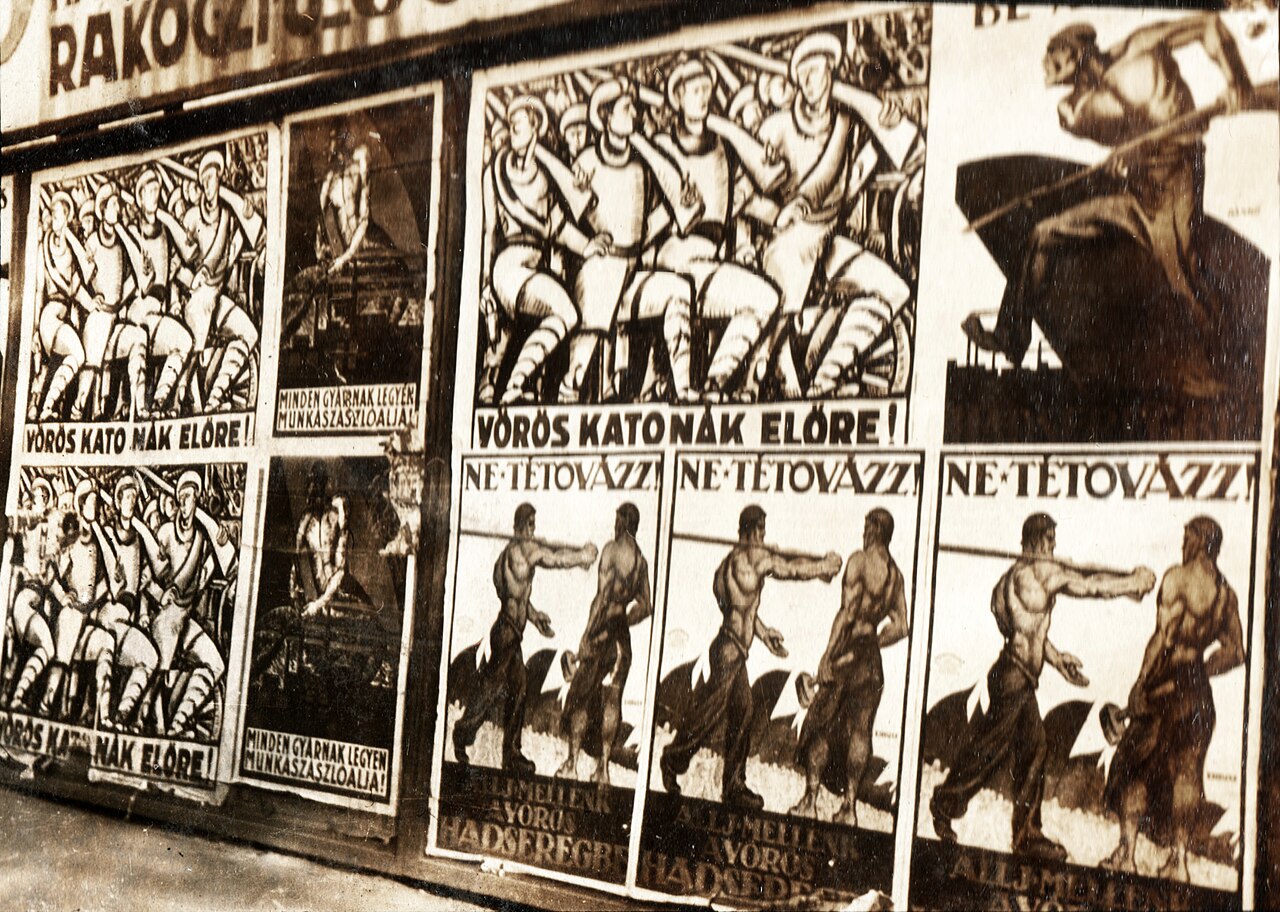
Sepia photograph of a wall covered with Hungarian Soviet Republic propaganda posters, with a faded sign reading RAKOCZI above. Posters show rows of marching workers and soldiers with the slogan VÖRÖS KATONÁK ELŐRE, and figures pushing and straining with NE TÉTOVÁZZ headings.Photograph

Primary source

Hungarian Soviet Republic Propaganda Graphics, Budapest (Fortepan 75868)

Péchy László (donor); Béla Uitz and Ödön Dankó (graphics) · 1919

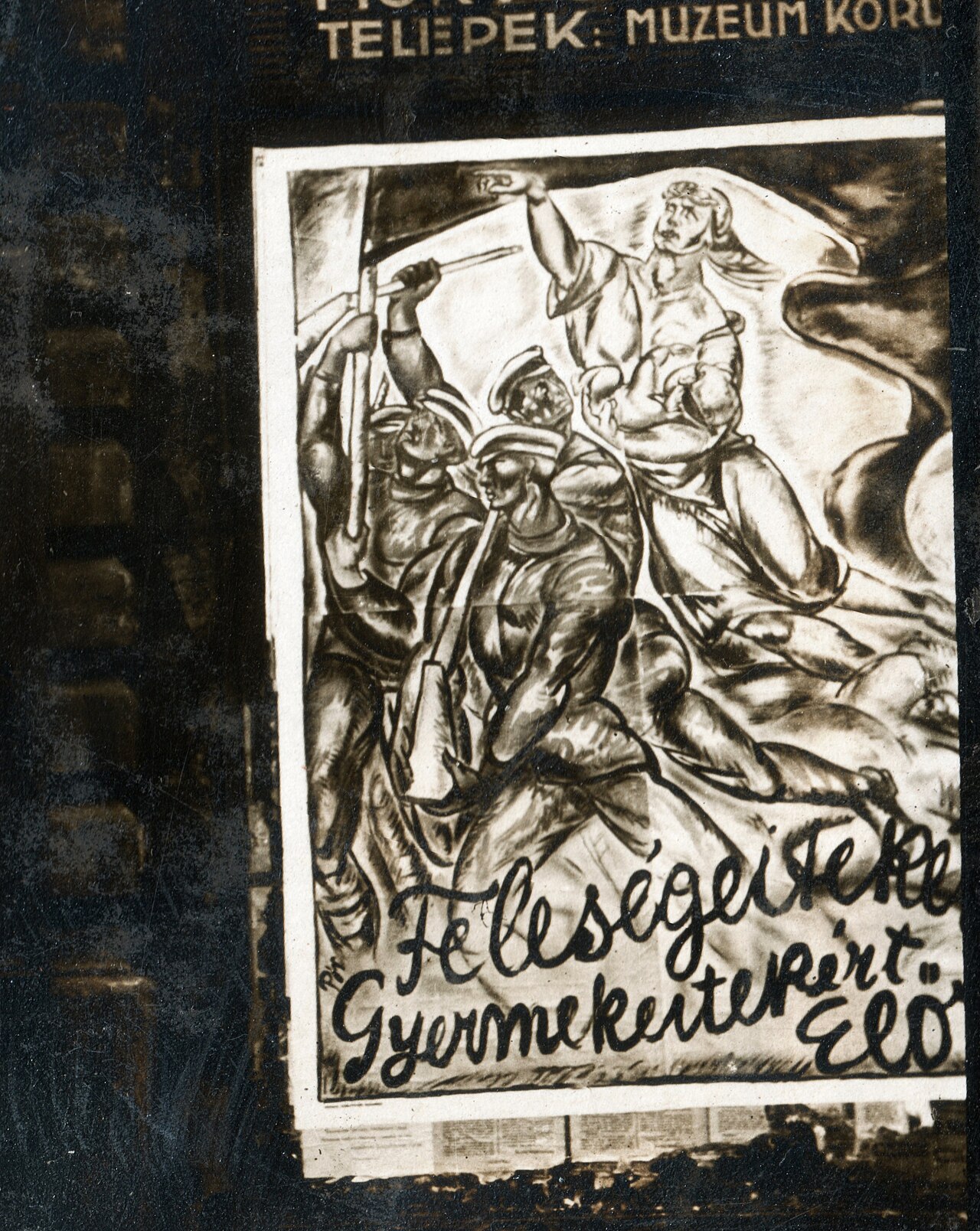
Black-and-white photograph of a 1919 propaganda poster in a dark frame. A woman with a raised arm stands above a group of armed workers and soldiers, one holding a rifle and a flag. Handwritten Hungarian text at bottom reads 'Feleségeikért Gyermekeikért Előre'. Partially visible printed text is at the top of the image.Photograph

Primary source

Hungarian Soviet Republic Poster by Pór Bertalan, Budapest

Péchy László (donor); Pór Bertalan (graphics) · 1919

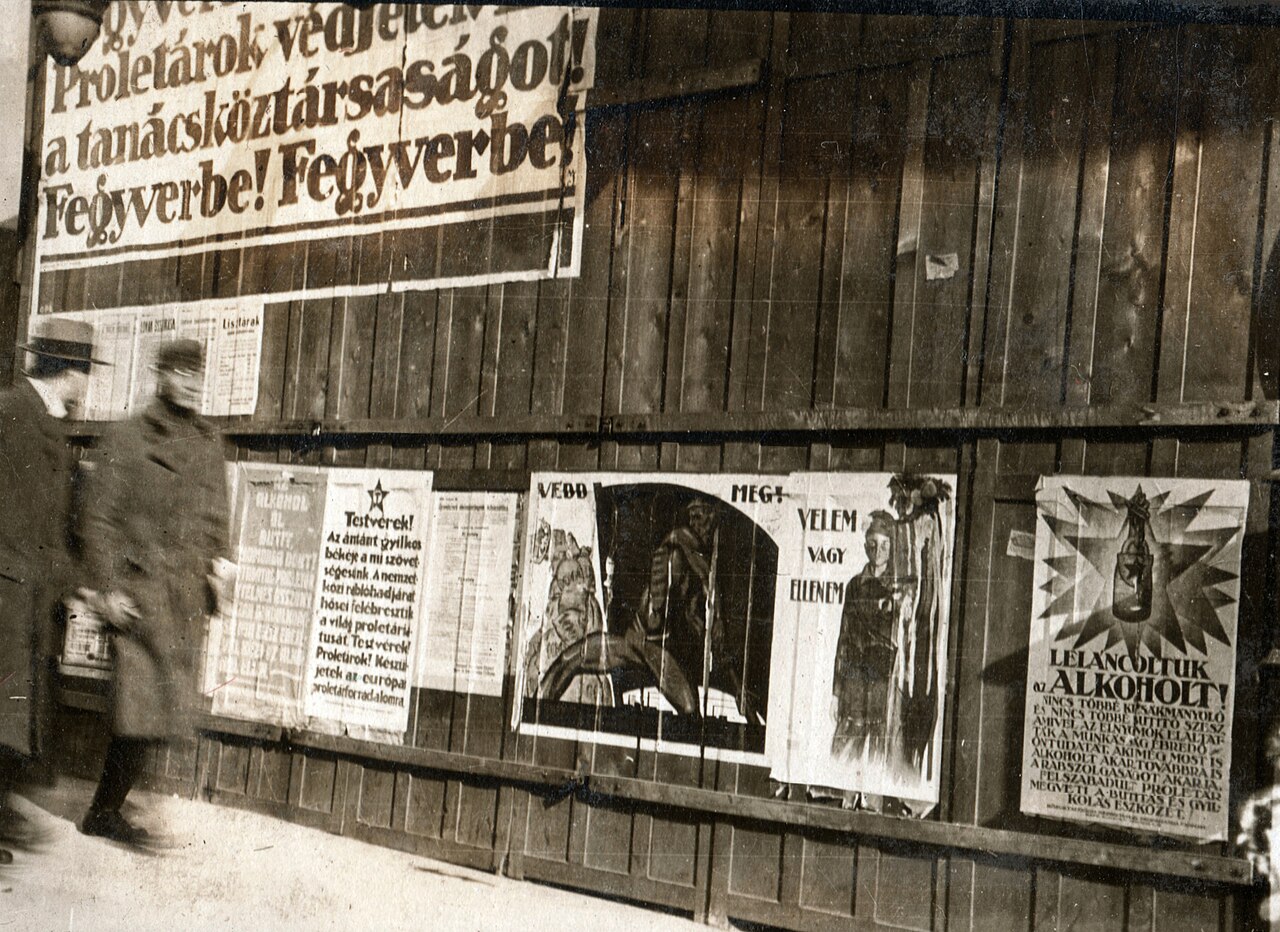
Black-and-white street photograph of a wooden wall covered with Hungarian Soviet Republic posters. A large banner reads 'Proletárok védjétek a tanácsköztársaságot! Fegyverbe!' Below are smaller posters, including one with 'VELEM VAGY ELLENEM' and one reading 'Lelánczoltuk az alkoholt!' Two pedestrians in long coats and hats walk past on the left.Photograph

Primary source

Hungarian Soviet Republic Posters, Budapest (Fortepan 75863)

Péchy László (donor); Ödön Dankó and Marcell Vértes (graphics) · 1919

Want the full shelf? Chat with Béla Kun in the app and open the Sources panel — every quote links back to the original.

Trusted by educators worldwide

Conversations
375,000+
Real exchanges between students and historical figures
Messages exchanged
4,142,000+
Across every figure, classroom and language
Historical figures
100,000+
Each informed by a curated biography and selected sources
Languages supported
50+
From English and Spanish to Arabic and Korean

Paying customers

Used by 98 schools and universities

Partner school logo
Tecnológico de Monterrey logo
Hyper Island logo
Partner school logo
Chambersburg Area School District logo
Broward County Public Schools logo
Nebo School District logo
National Louis University logo
South Florida PBS logo
Punahou School logo
University of Wisconsin–River Falls logo
Partner school logo
Partner school logo
Archbishop Mitty High School logo
Kingsburg High School logo
Norwalk Public Schools logo
Partner school logo
Connections logo
Partner school logo
Moore Public Schools logo
Partner school logo
Partner school logo
Partner school logo
Partner school logo
Robbinsville Public Schools logo
Partner school logo
Partner school logo
Partner school logo
Tecnológico de Monterrey logo
Hyper Island logo
Partner school logo
Chambersburg Area School District logo
Broward County Public Schools logo
Nebo School District logo
National Louis University logo
South Florida PBS logo
Punahou School logo
University of Wisconsin–River Falls logo
Partner school logo
Partner school logo
Archbishop Mitty High School logo
Kingsburg High School logo
Norwalk Public Schools logo
Partner school logo
Connections logo
Partner school logo
Moore Public Schools logo
Partner school logo
Partner school logo
Partner school logo
Partner school logo
Robbinsville Public Schools logo
Partner school logo
Partner school logo

What educators are saying

“We enjoyed the program last year and used it frequently.”
“My students say it’s a welcome change of pace. I’m not a fan of the “sage on the stage” model, so I try to incorporate research-oriented and self-paced activities. With Humy, students have to take charge of their learning. They’ve become more adept at critical thinking, forming better questions, and improving their reading comprehension. The interview feature has been my go-to tool. I create assignments where students must ask historical figures a set number of questions, then summarize the responses to ensure they’re truly absorbing the material. This approach lets them actively explore the past rather than passively consuming information.”
“Humy has helped me bring historical figures, sometimes long past, to life. When my students interact with these figures in real-time, it eliminates some of the perceived “ancient” characteristics of my curriculum. This has shifted my students’ thinking away from viewing history as abstract or irrelevant. Real-time interactions make historical figures relatable, even allowing students to ask off-topic questions that help put historical lives in a more relevant context for 13-year-olds. The feature I use the most is the interview feature. After teaching a topic, most recently Gandhi and Joan of Arc, I have the students ask pointed, focused questions. We practice good conversation techniques beforehand, teaching them to listen (or read) carefully and formulate thoughtful follow-up questions rather than just interrogating. It helps students practice effective conversation skills.”

FAQ

Frequently asked questions

Who is Béla Kun?
Hungarian Communist revolutionary and politician, the de facto leader of the Hungarian Soviet Republic in 1919, People's Commissar of Foreign Affairs On Humy.ai you can chat with an AI version of Béla Kun that draws on a short biography and 54 historical sources during the conversation — by text or voice, in 42 languages.
Is Béla Kun AI free?
Béla Kun is part of Humy's full library of more than 100,000 figures, which comes with a paid plan. A free account (no credit card) includes 20 messages a month with the free library's figures, so you can try how the conversations work first.
What sources does the Béla Kun AI use?
It draws on a short biography and 54 historical sources (photographs, artifacts and sculptures), including “Vörös Újság: First Editorial”, “Treaty of Trianon” and “Béla Kun, Leader of the 1919 Hungarian Revolution”. Each source has its own page on Humy.ai.
How historically accurate is the AI version of Béla Kun?
Each figure uses a short biography and a small set of selected historical sources as context (retrieval-augmented generation), so answers stay closer to known material than the model's general knowledge alone. It isn't a citation-grade research tool — like any LLM, the AI can get details wrong or extrapolate. Treat it as a strong starting point for inquiry and cross-reference important claims.
Can I talk to Béla Kun by voice?
Yes. In addition to text chat, you can call Béla Kun and hear their voice respond in real time — useful for auditory learners, interview practice and Socratic dialogue.
Is Humy.ai safe and compliant for schools?
Yes. Humy.ai is used by more than 100 schools, universities and organisations. The platform is FERPA- and GDPR-aligned, supports SSO, and offers an IT-approval pack tailored for school procurement teams.

Ready when you are

Start chatting with Béla Kun now.

20 messages free · No credit card · Available in 50+ languages.