Portrait of Elizabeth Cady Stanton

AI Historical Figure

Elizabeth Cady Stanton

Leading figure in the women's suffrage movement in the United States.

Chat with Elizabeth Cady Stanton via text or voice — in 42 languages, drawing on a curated biography and 82 historical sources. Available 24/7.

Start chatting with Elizabeth Cady Stanton20 messages free · No credit card
Lived
1815–1902
From
United States
Known for
Literature & writingActivism & reform
Elizabeth Cady Stanton

Elizabeth Cady Stanton

Online · responds in seconds

Hello — I'm Elizabeth Cady Stanton. Leading figure in the women's suffrage movement in the United States. What would you like to ask me?

20 messages free · No credit card · Powered by Humy.ai

Live preview · Switch between 42 languages above · Send a message to continue in the app

Multilingual

Talk to Elizabeth Cady Stanton in 42 languages

Ask Elizabeth Cady Stanton questions in any language below, and the rest of Humy's app speaks it too. Pick yours to open the chat in that language.

Also in German (Austria), German (Switzerland), English (UK), English (Australia), English (Canada).

The sources behind this AI

82 sources · 21 documents · 15 photographs · 13 newspaper articles · 12 paintings · 7 books · 5 speeches · 4 artifacts · 2 letters · 2 sculptures · 1 documentary

Elizabeth Cady Stanton doesn’t improvise from thin air. The AI is grounded in 82 curated historical sources students can inspect. Open any of them to see what informs the conversation.

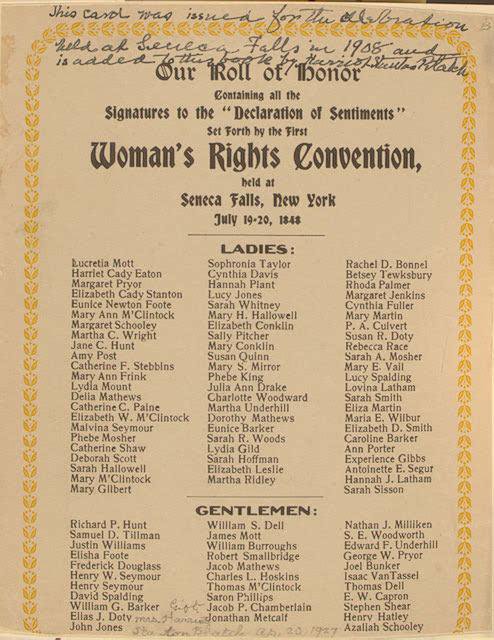
Printed broadside titled "Our Roll of Honor" listing the signatories to the Declaration of Sentiments from the 1848 Woman's Rights Convention at Seneca Falls, New York. Names are arranged in columns under headings Ladies and Gentlemen, with handwritten notes across the top and bottom margins.Document

Primary source

Declaration of Sentiments

Elizabeth Cady Stanton · 1848

Speech

Primary source

Solitude of Self

Elizabeth Cady Stanton · 1892

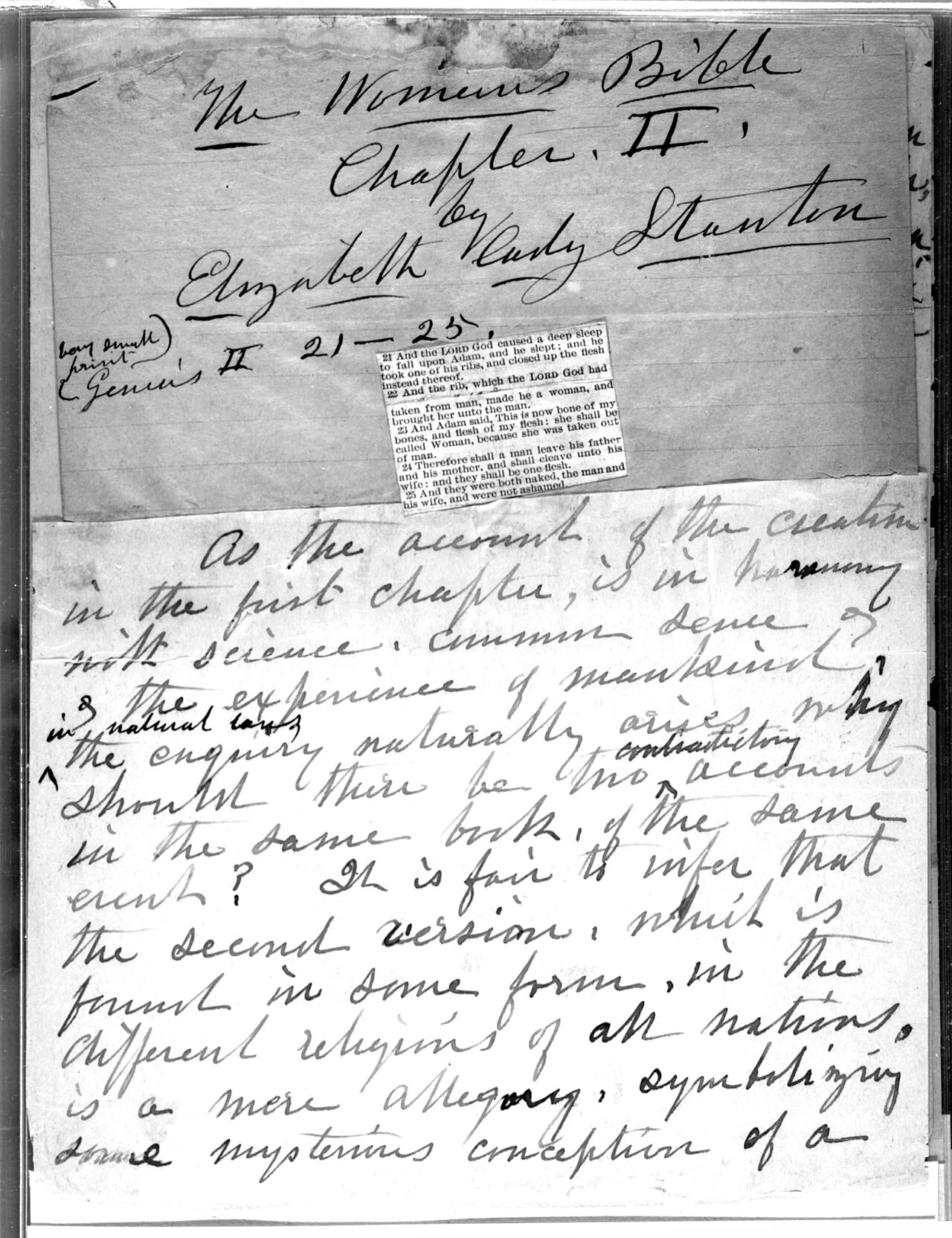
Scanned black-and-white page of handwritten manuscript. Top section has a title reading 'The Woman's Bible, Chapter II, by Elizabeth Cady Stanton' with a pasted printed Bible passage (Genesis 2:21-25) and a note 'Gen II 21-25'. Below, handwritten paragraphs discuss the two accounts of creation in Genesis and whether the second version is an allegory.Book

Primary source

The Woman's Bible

Elizabeth Cady Stanton · 1895–1898

Dark, nearly black book cover with faint embossed decorative ornament in the center and a white library barcode label on the upper left reading 3 1761 04261 4271 printed vertically.Book

Secondary source

History of Woman Suffrage

Elizabeth Cady Stanton · 1881-1922

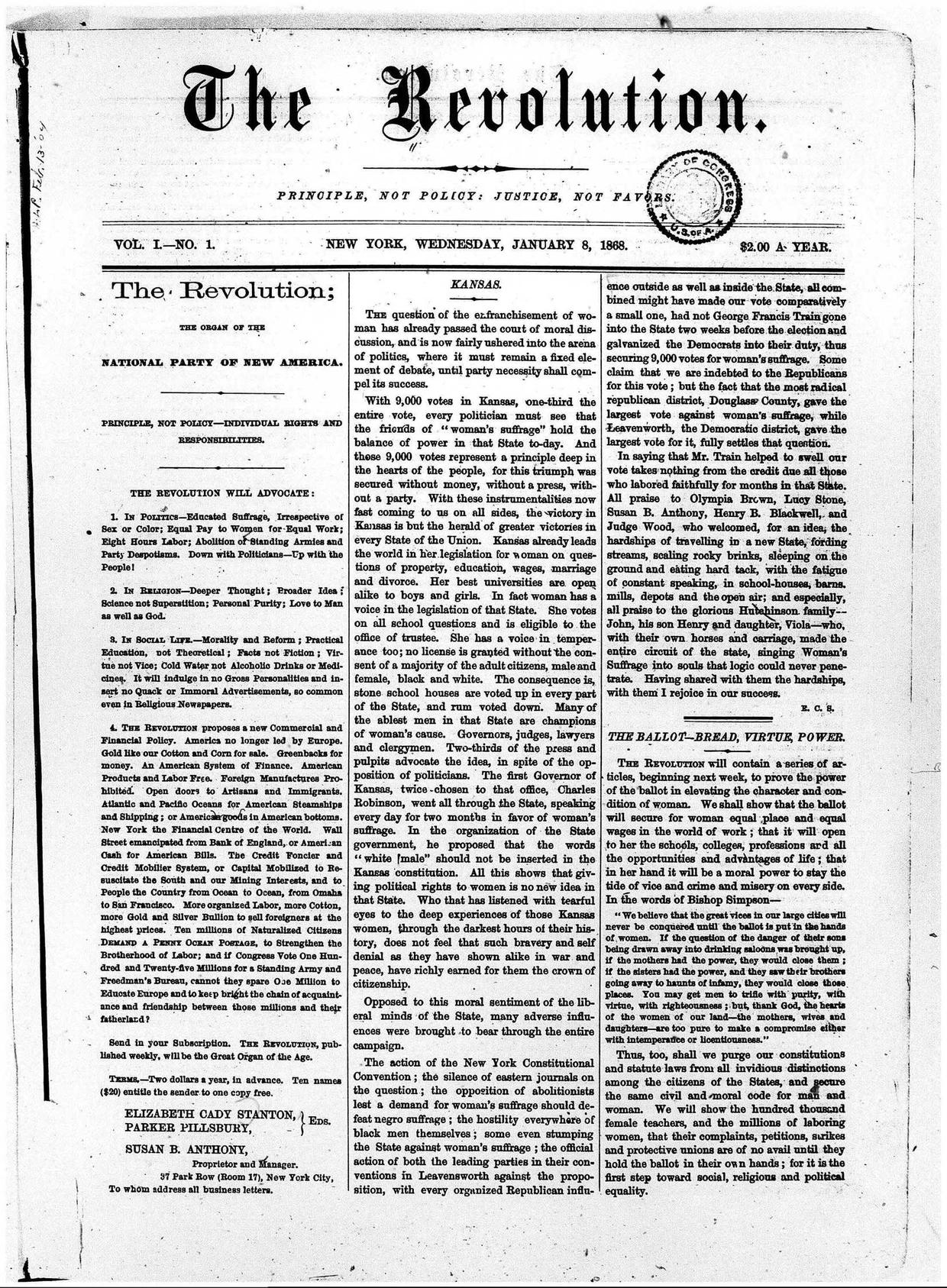
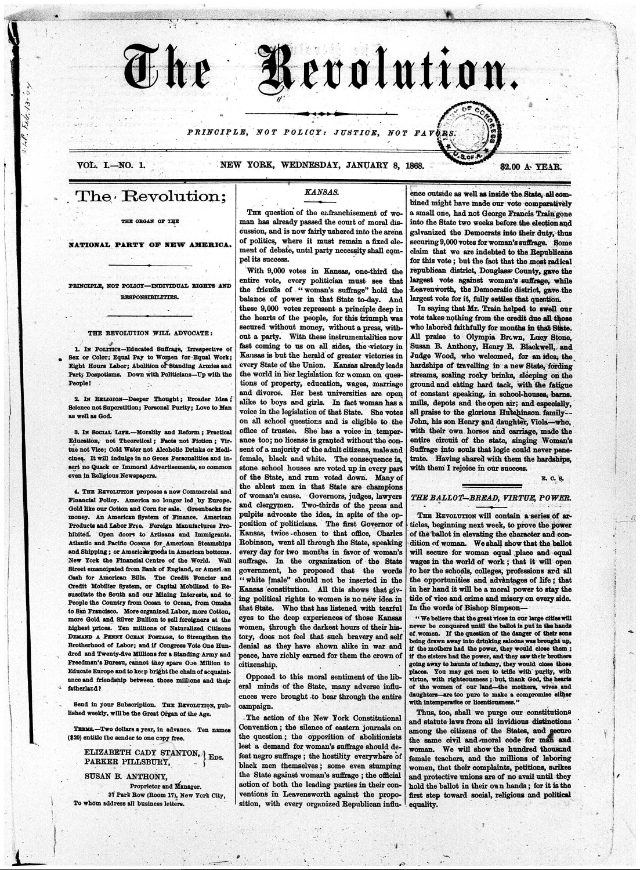
Scan of the front page of the first issue of The Revolution, dated New York, Wednesday, January 8, 1868. Masthead reads 'The Revolution' with the motto 'Principle, not policy; justice, not favors.' Three columns of small print include editorials on Kansas woman suffrage and a statement of editors Elizabeth Cady Stanton and Parker Pillsbury and Susan B. Anthony. A round Library of Congress stamp appears at upper right.Newspaper article

Primary source

The Revolution

Elizabeth Cady Stanton · 1868

Book

Primary source

Eighty Years and More: Reminiscences 1815–1897

Elizabeth Cady Stanton · 1898

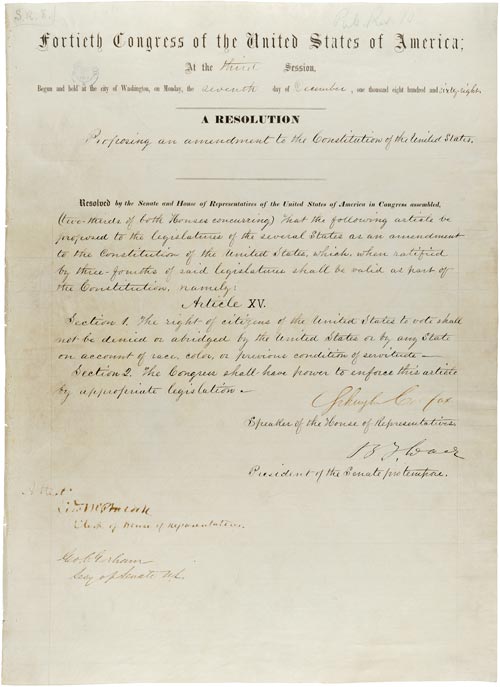
Scanned page of the 1868 joint resolution of the Fortieth Congress proposing the 15th Amendment, with Article XV text, Speaker and Vice President signature lines, and clerk and secretary attestations.Document

Primary source

15th Amendment to the U.S. Constitution: Voting Rights

United States Congress · 1870

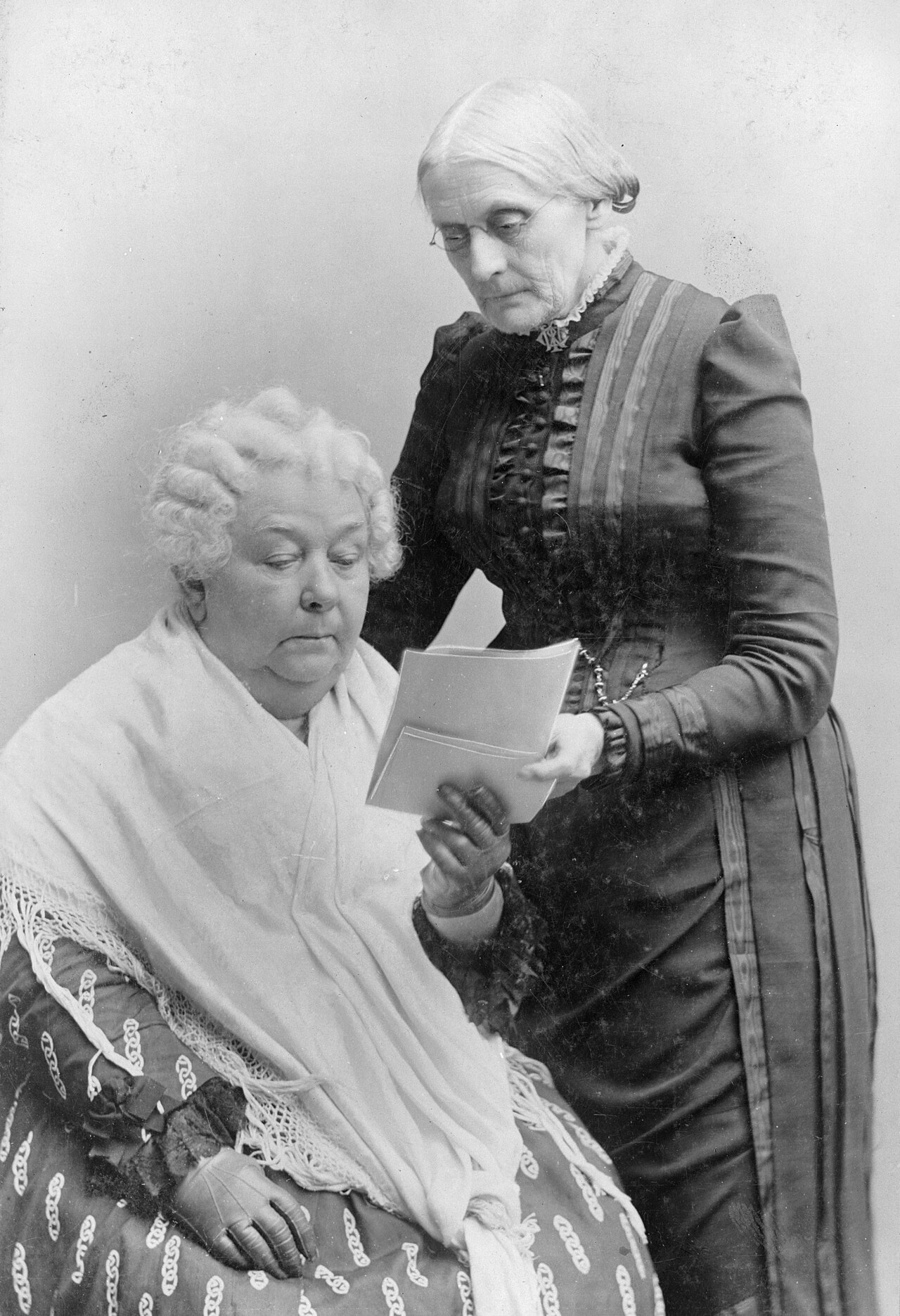
Black-and-white studio portrait of two elderly women. A seated woman with curly white hair, wearing a light lace-edged shawl and patterned dress, looks down at papers. A standing woman with white hair in a bun and wire-rimmed glasses, wearing a dark dress with ruffled bodice, holds the papers and looks down at them. Plain grey backdrop.Photograph

Primary source

Elizabeth Cady Stanton and Susan B. Anthony

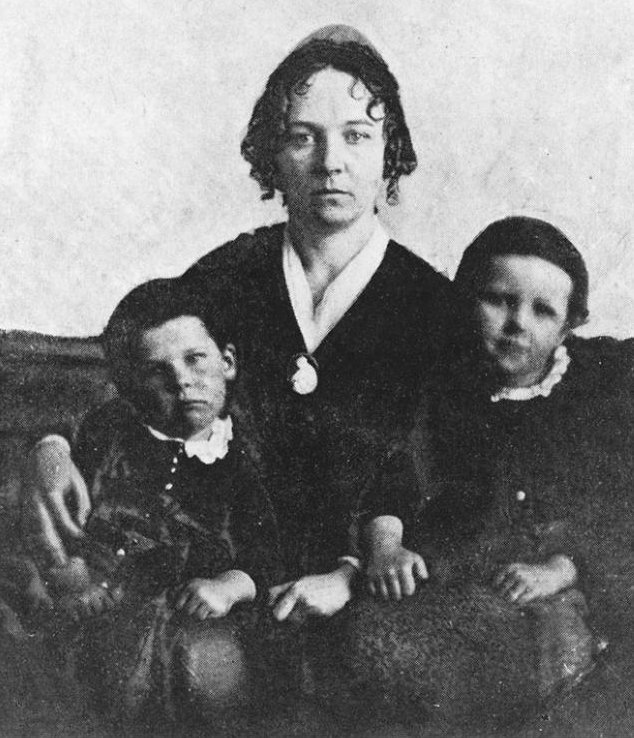
Black-and-white photograph of a woman with curly hair and a light cap, wearing a dark dress with a white collar and a cameo brooch, seated between two young boys in dark clothing with white lace collars. Plain light background.Photograph

Primary source

Elizabeth Cady Stanton with Her Sons Daniel and Henry

Unknown author · 1848

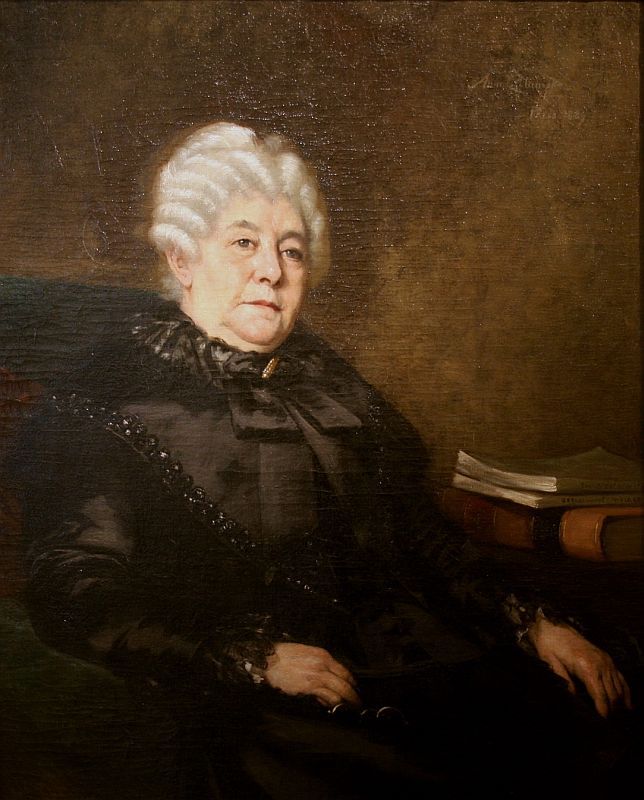
Oil portrait of an elderly woman with white curled hair, wearing a dark black dress with a high ruffled collar, lace trim, and a bow at the neck. She sits with hands folded near a stack of books and papers on a table at right, against a dark brown background.Painting

Primary source

Elizabeth Cady Stanton, 1889

Anna Elizabeth Klumpke · 1889

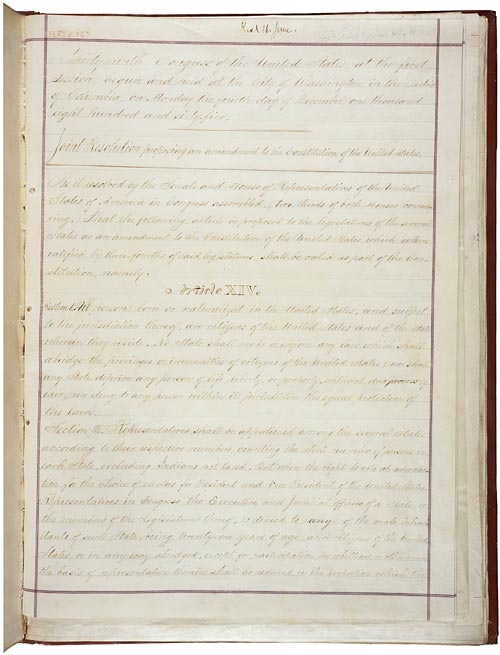
Handwritten manuscript page of the Joint Resolution proposing an amendment to the Constitution, with the heading 'Joint Resolution proposing an amendment to the Constitution of the United States' and the text of Section 1 of the 14th Amendment, including 'Article XIV.' Ruled border lines frame the text.Document

Primary source

14th Amendment to the U.S. Constitution: Civil Rights

United States Congress · 1868

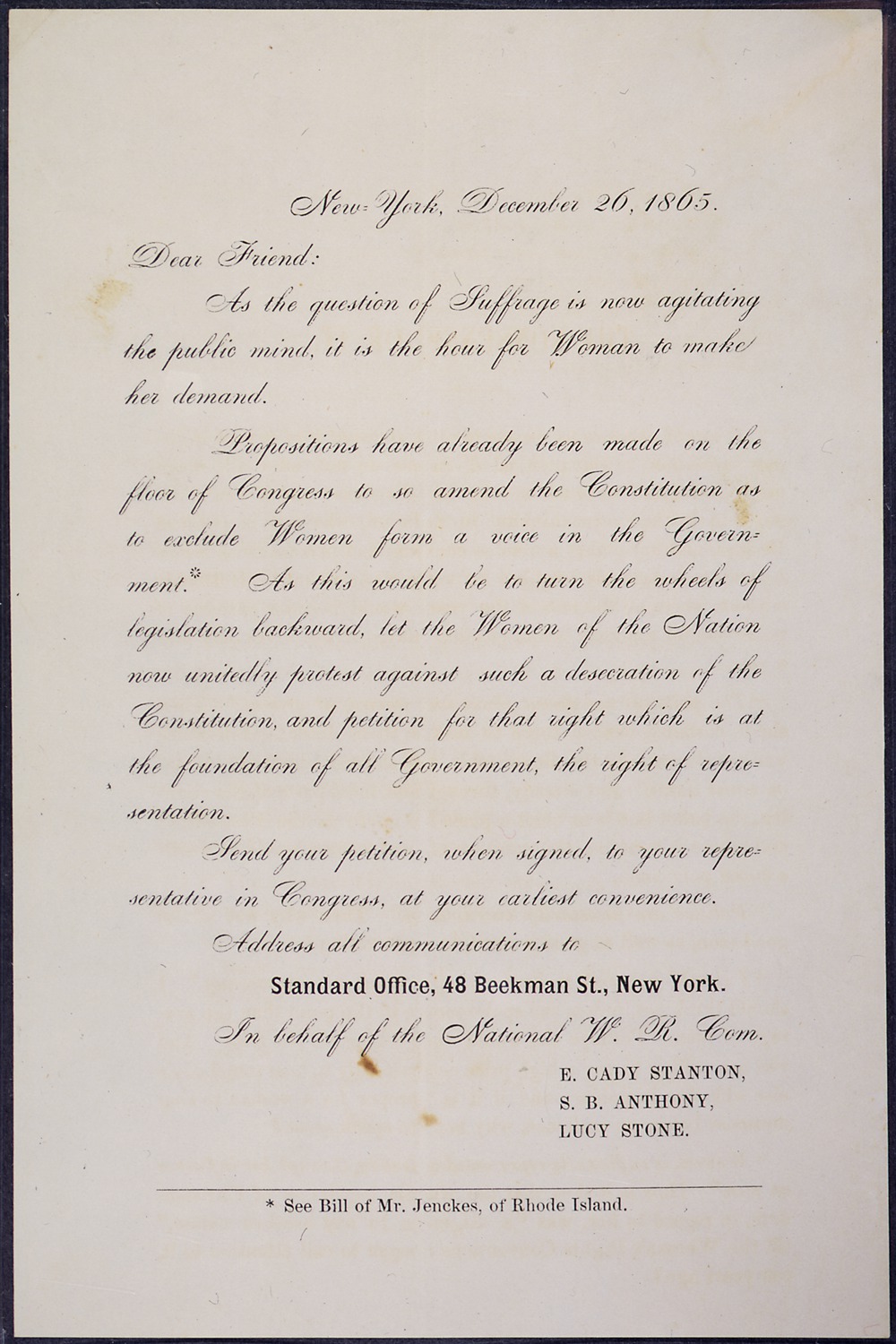
Printed form letter dated New-York, December 26, 1865, in cursive script, addressed 'Dear Friend', urging women to protest proposed amendments excluding women from government and to send signed petitions to Congress. Signed by E. Cady Stanton, S. B. Anthony, and Lucy Stone.Letter

Primary source

Form Letter from E. Cady Stanton, Susan B. Anthony, and Lucy Stone Asking Friends to Send Petitions for Woman Suffrage

Susan B. Anthony · 26 December 1865

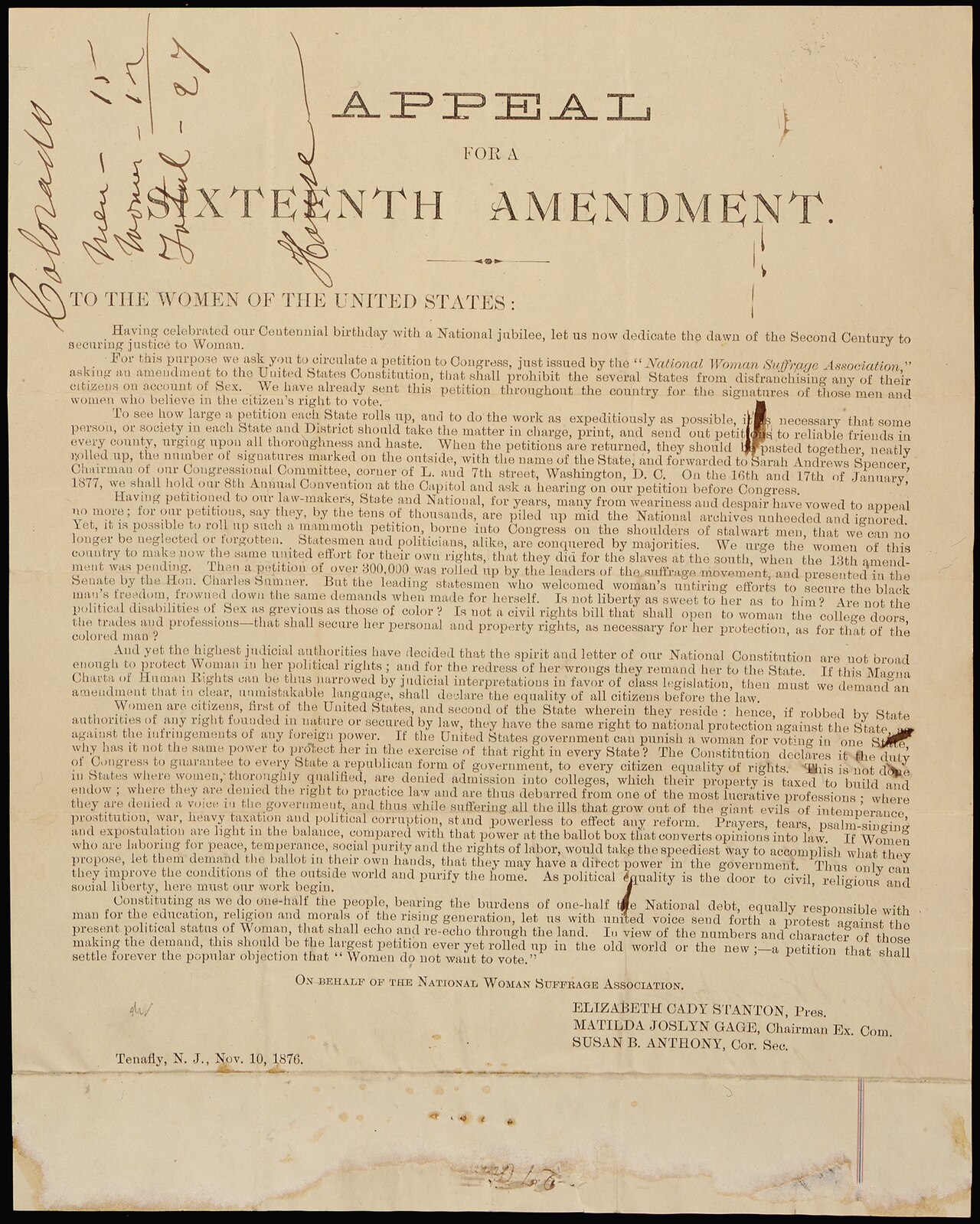
Scan of a printed broadside titled 'Appeal for a Sixteenth Amendment', addressed to the women of the United States, with dense body text, signed on behalf of the National Woman Suffrage Association by Elizabeth Cady Stanton, Matilda Joslyn Gage and Susan B. Anthony, dated Tenafly, N.J., Nov. 10, 1876. Handwritten notes appear at the top left.Document

Primary source

Appeal for a Sixteenth Amendment

Elizabeth Cady Stanton, Matilda Joslyn Gage, Susan B. Anthony · 10 November 1876

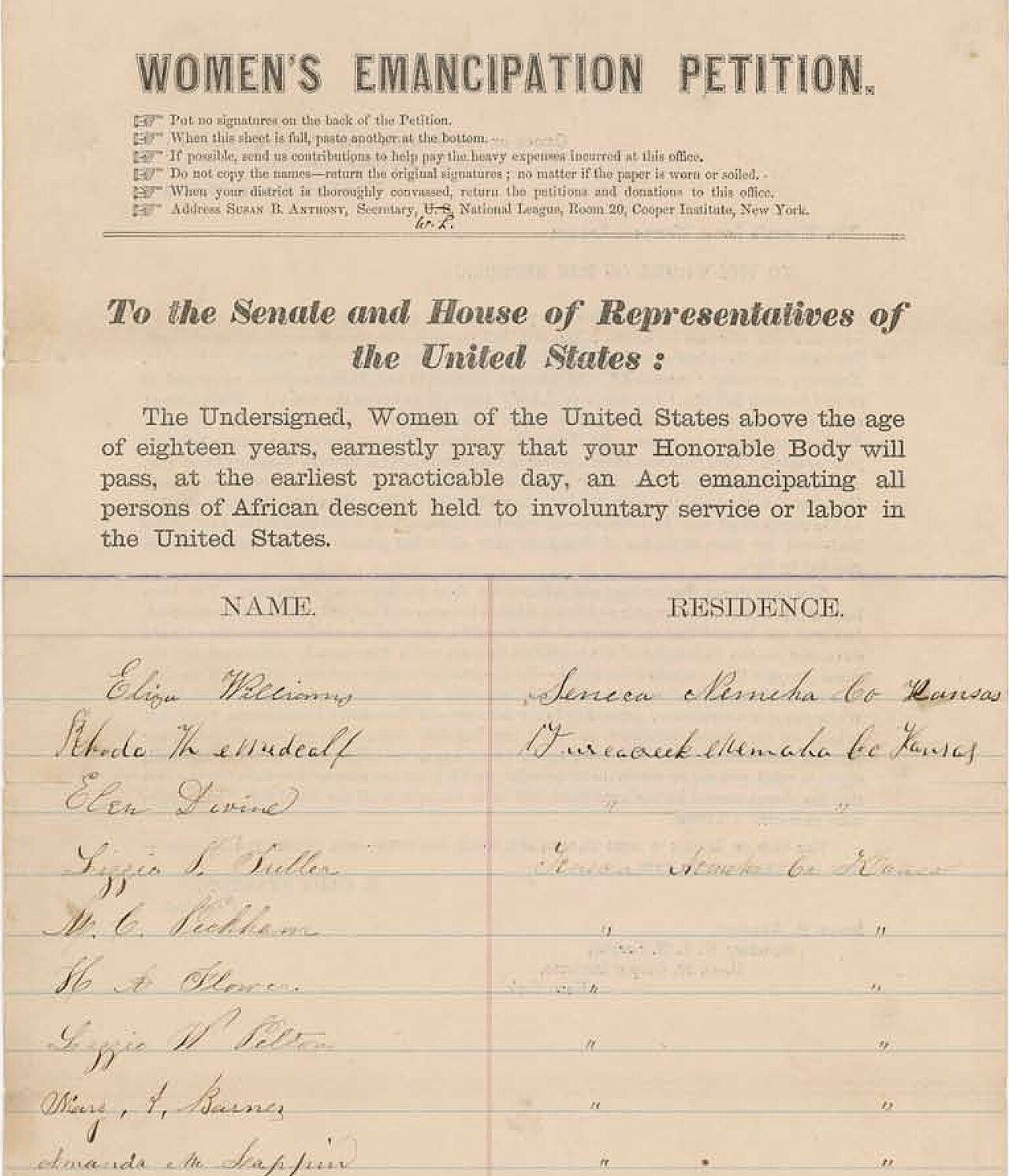
Scan of the upper portion of the Women's Emancipation Petition, a printed form with instructions for collecting signatures, addressed to the Senate and House of Representatives, followed by handwritten names and residences of signers in columns.Document

Primary source

Women's Loyal National League petition for the abolition of slavery

Women's Loyal National League (Elizabeth Cady Stanton, president) · 25 January 1864

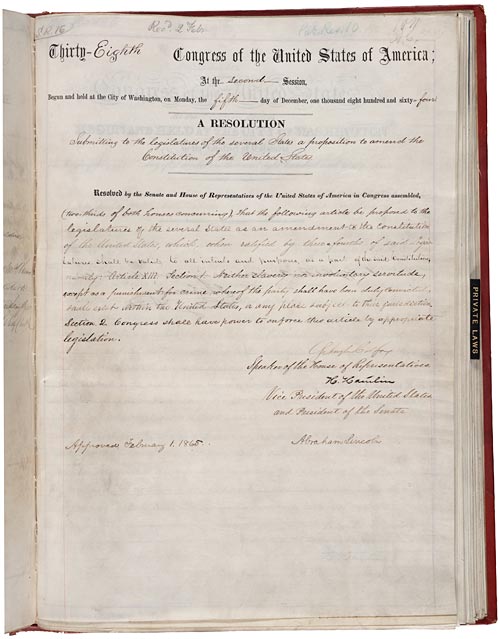
Scanned page of the 1865 joint resolution of the Thirty-Eighth Congress proposing the 13th Amendment, with the heading 'A Resolution Submitting to the Legislatures of the several States a proposition to amend the Constitution of the United States,' handwritten text, signatures of the Speaker and Vice President, and 'Approved February 1, 1865' at lower left.Document

Primary source

13th Amendment to the U.S. Constitution

1865

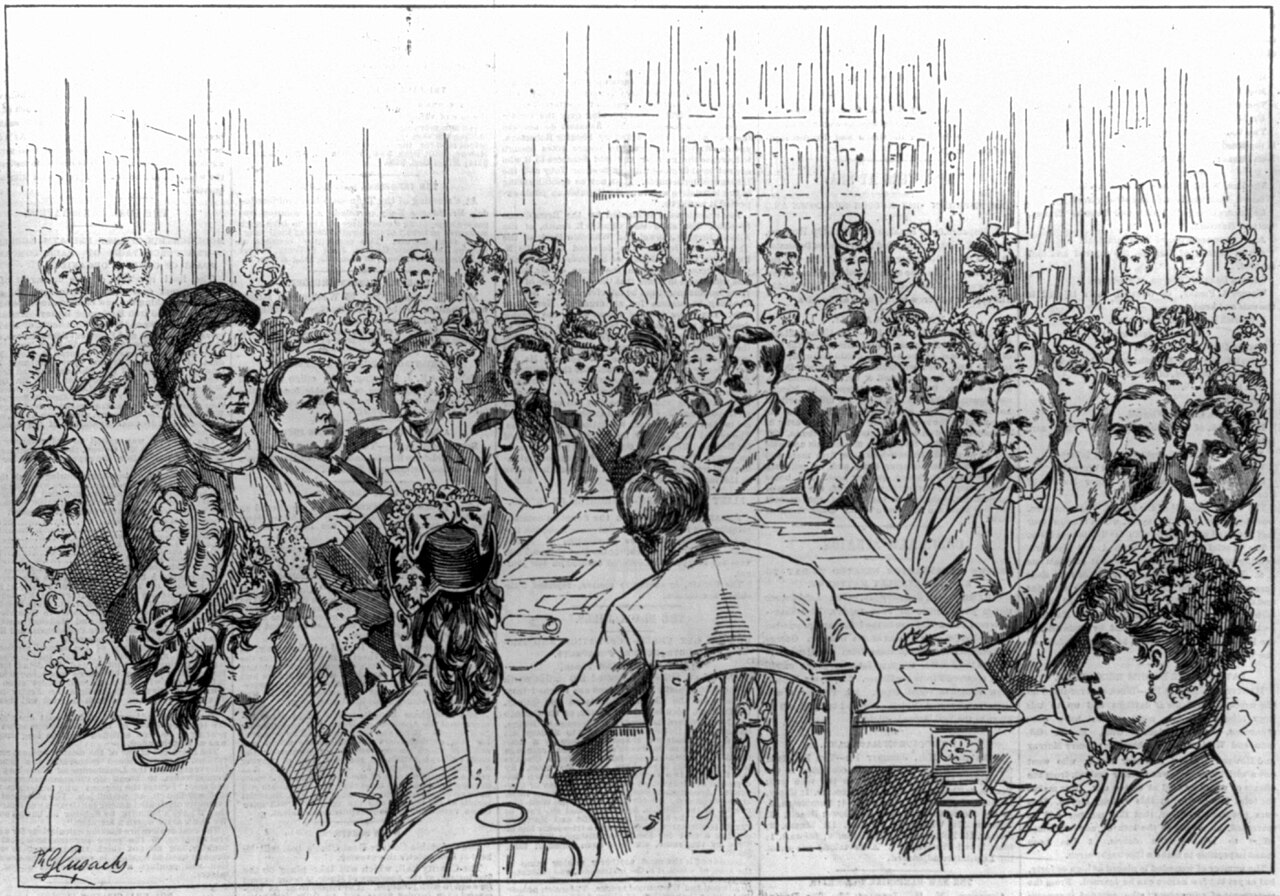
Engraved newspaper illustration of a crowded hearing room. A woman in a dark hat and scarf stands at left addressing a long table where men in suits sit, with a seated man at the front. Dense audience of spectators fills the background.Painting

Primary source

Elizabeth Cady Stanton before the Senate Committee on Privileges and Elections

Ph. Glusacks · 16 January 1878

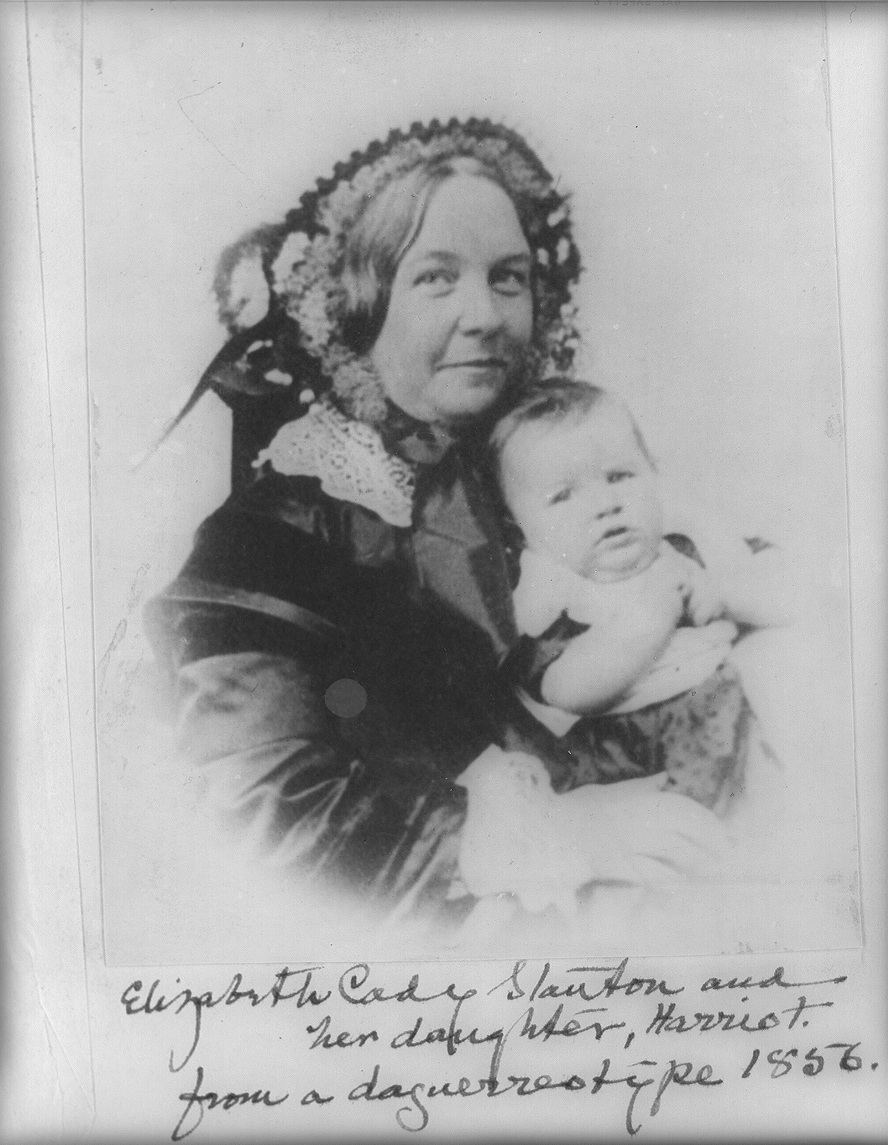
Black and white photograph of a woman in a lace-trimmed bonnet and dark dress holding a young toddler on her lap. Handwritten caption at the bottom reads: Elizabeth Cady Stanton and her daughter, Harriot, from a daguerreotype 1856.Photograph

Primary source

Elizabeth Cady Stanton and her daughter

1856

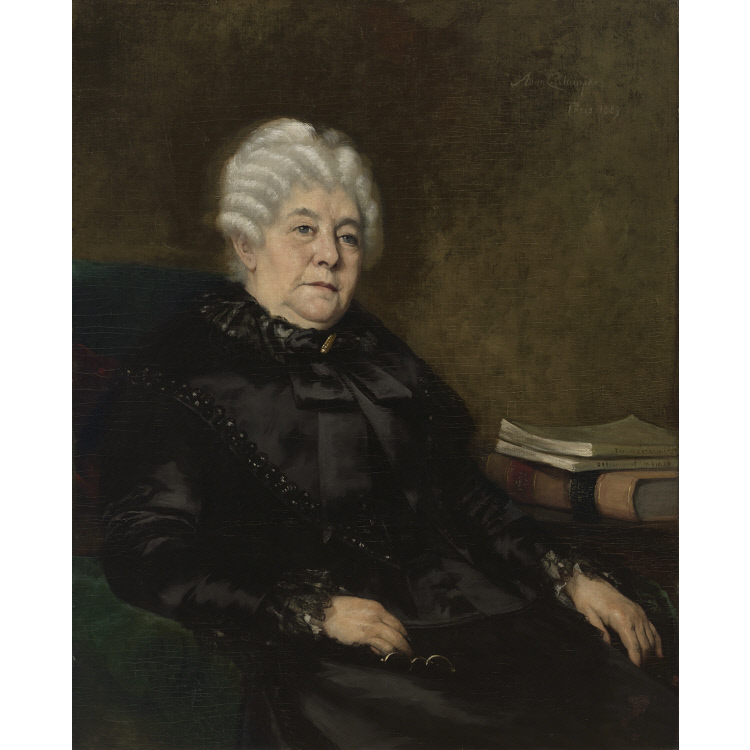
Oil portrait of an elderly woman with white curled hair, wearing a dark black dress with lace collar and cuffs, seated in a green chair. Her hands rest in her lap. Stacked books sit on a table at right. Signature and date in upper right.Painting

Primary source

Elizabeth Cady Stanton

Anna Elizabeth Klumpke · 1889

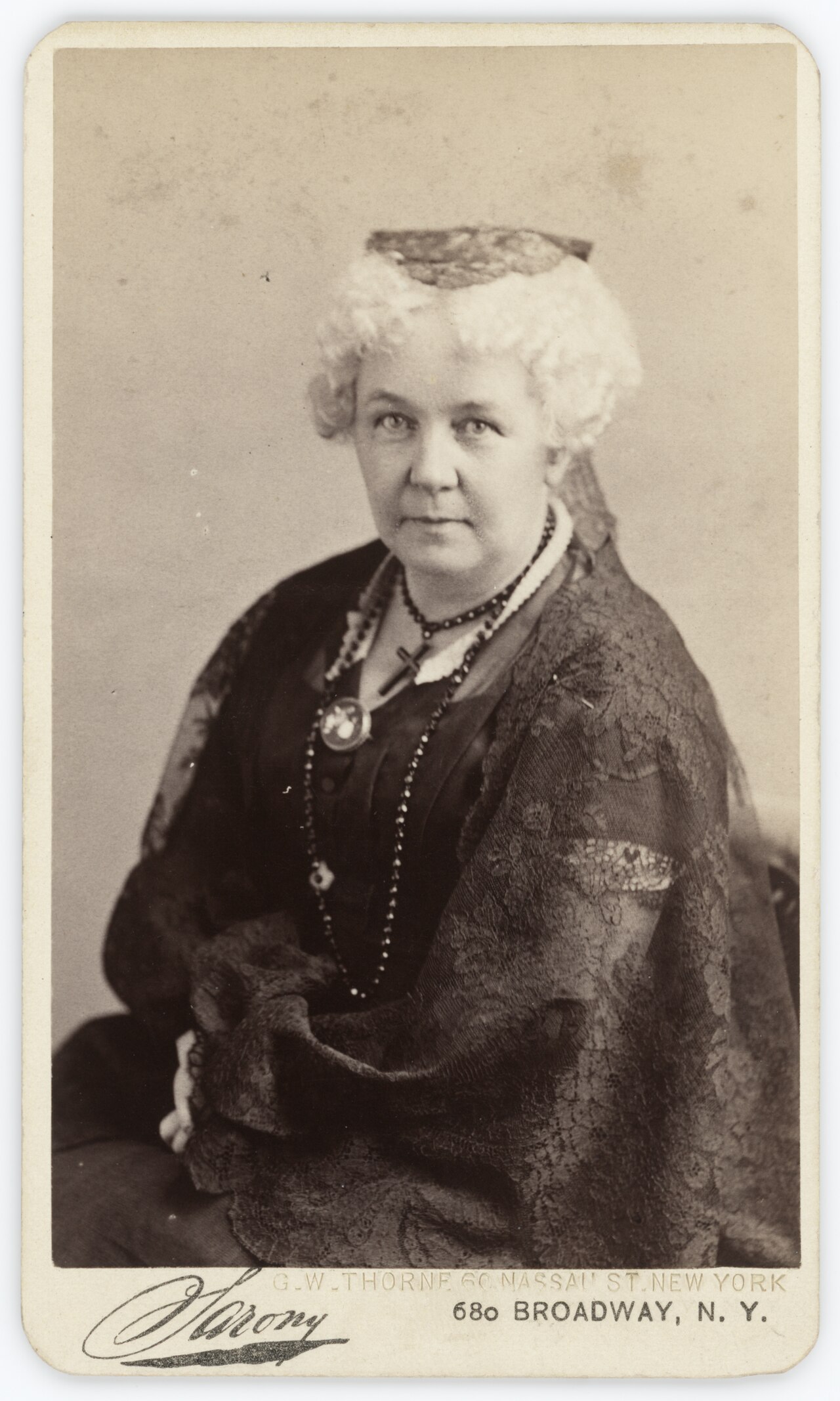
Sepia carte de visite portrait of an older woman with curly white hair under a dark lace headpiece, wearing a dark lace shawl, a dark dress, a cameo brooch and long beaded necklaces, seated with hands clasped. Printed mount reads G.W. Thorne, 6 Nassau St, New York, and Sarony signature with 680 Broadway, N.Y.Photograph

Primary source

Elizabeth Cady Stanton (Sarony Portrait)

Napoleon Sarony

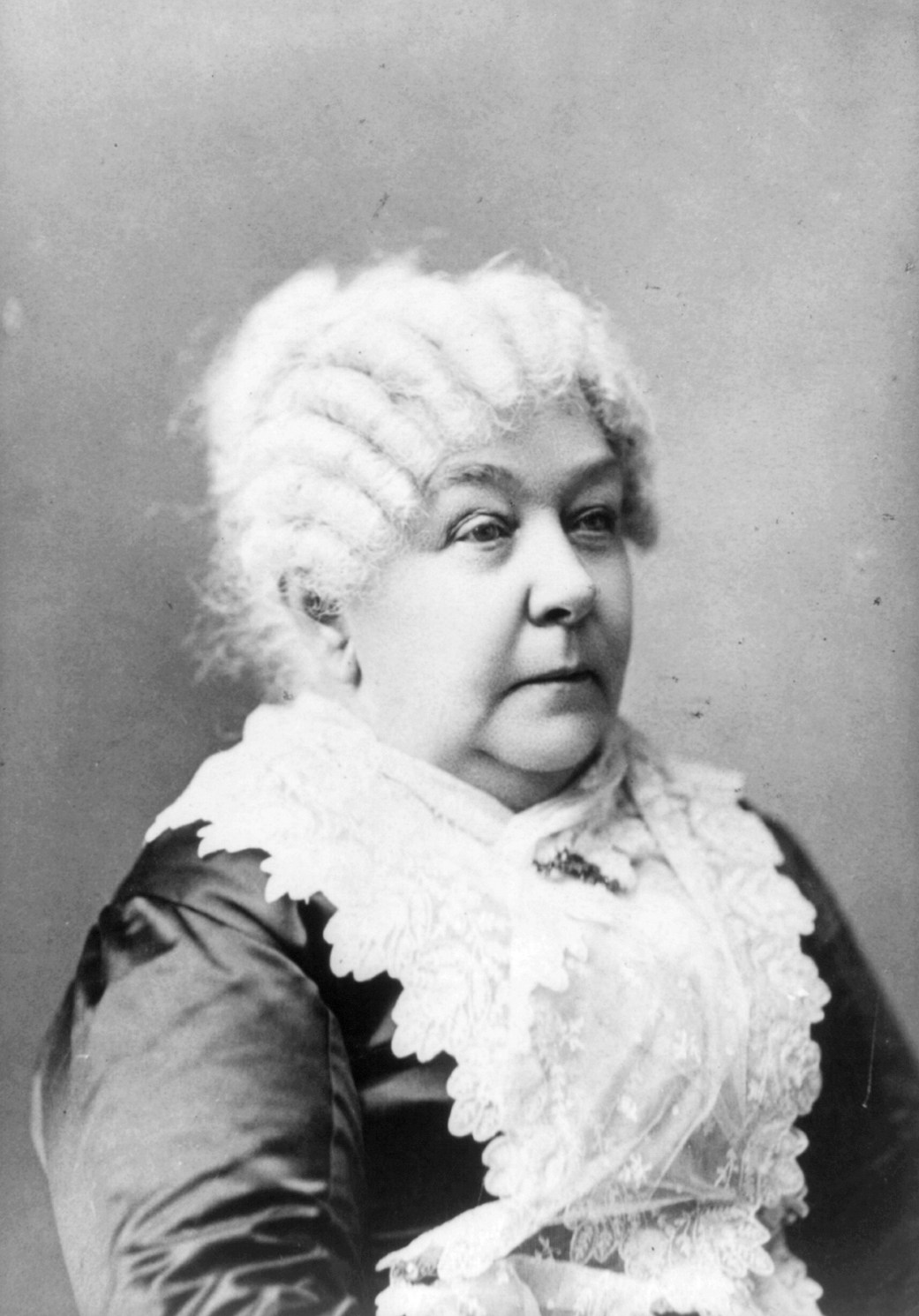
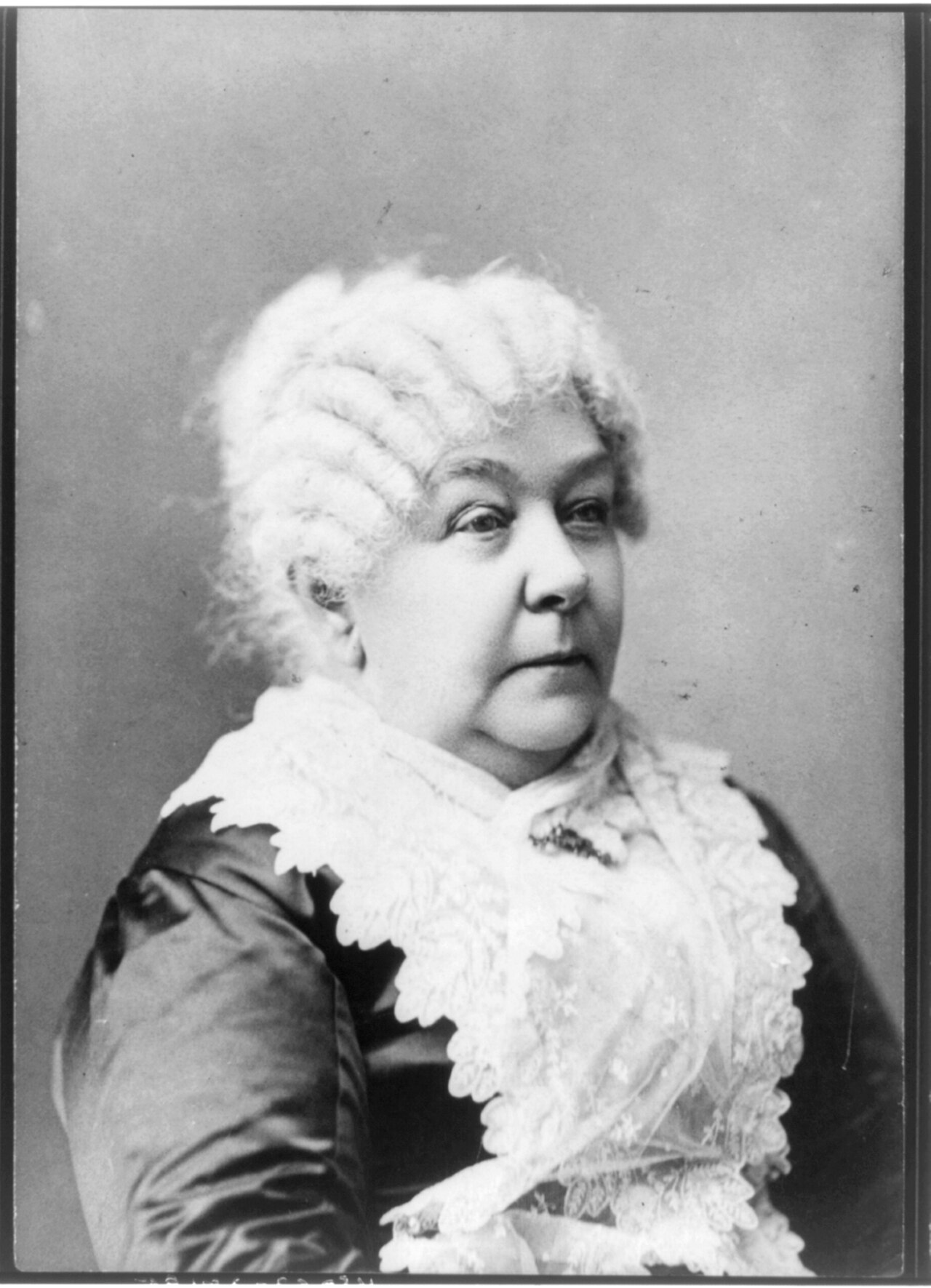
Black and white studio portrait of an older woman with white curled hair, wearing a dark satin dress with a large white lace collar and a brooch at the neck, looking to the side against a plain gray backdrop.Photograph

Primary source

Elizabeth Cady Stanton (Veeder Portrait)

Veeder

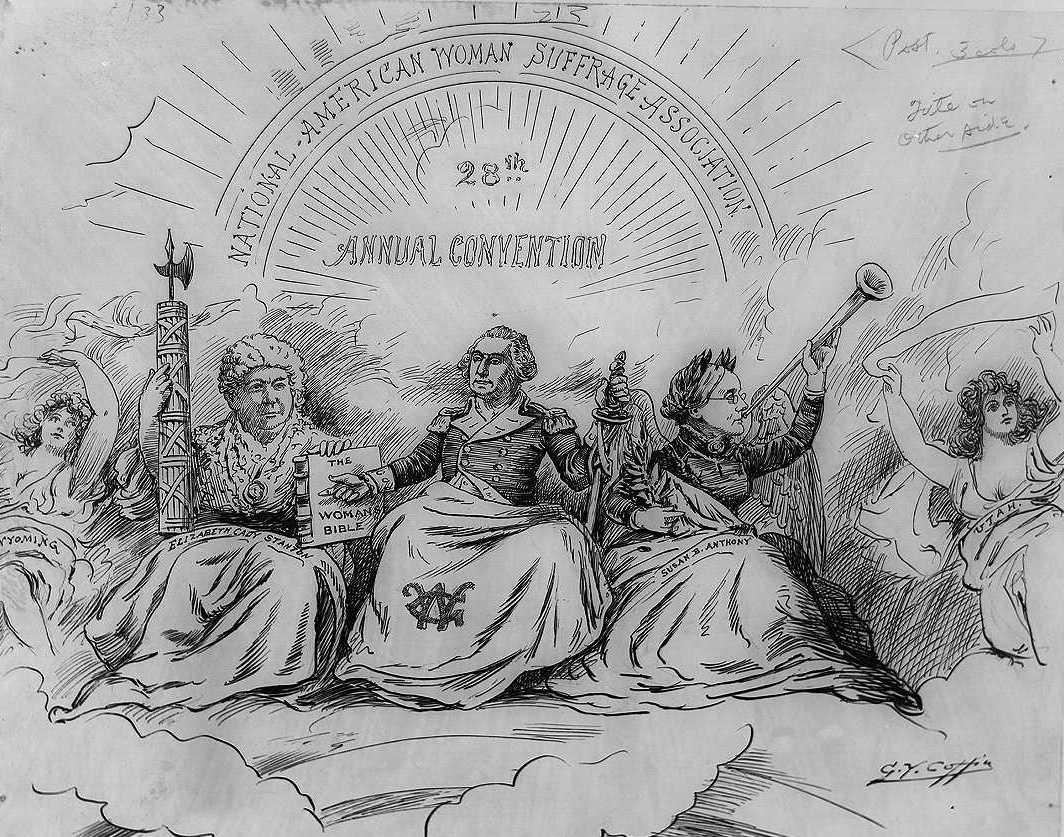
Black-and-white ink drawing of a suffrage allegory. Under an arch reading 'National American Woman Suffrage Association, 28th Annual Convention', three seated women and George Washington sit on clouds. Stanton holds a book labeled 'The Woman's Bible' and a tall torch; Susan B. Anthony blows a trumpet. Figures at the edges include a woman labeled Wyoming and another labeled Utah. Signed G.Y. Coffin.Painting

Primary source

The Apotheosis of Suffrage

George Yost Coffin

Black-and-white photograph of a two-story shingled wooden house with a steep gabled front, a stone foundation, a central entry with steps, and a sign reading Elizabeth Cady Stanton Station on a post at left, with large trees around.Artifact

Primary source

Elizabeth Cady Stanton House

c. 1847

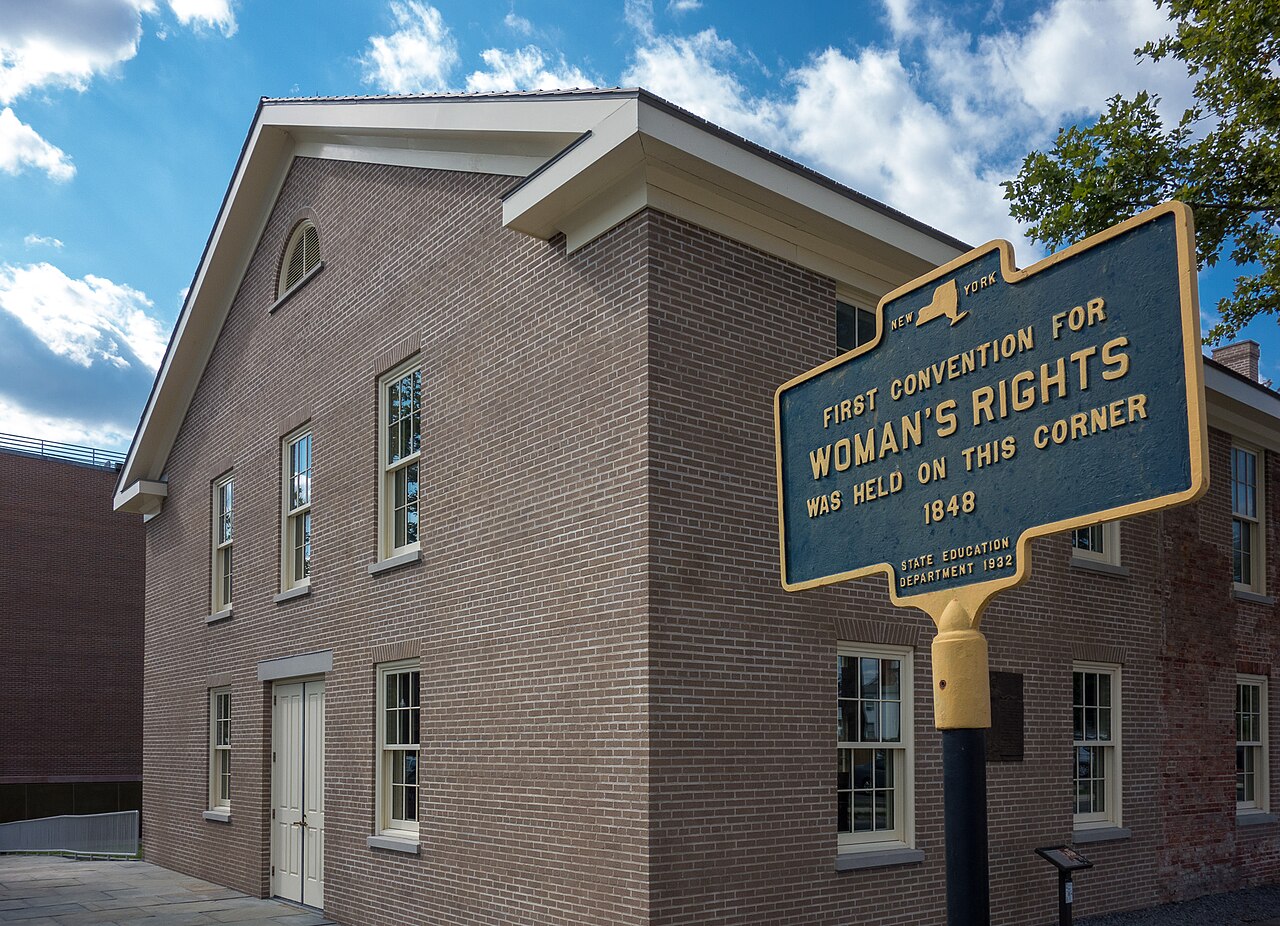
Two-story red brick building with a gabled roof, white trim, and multi-pane windows, photographed on a sunny day under blue sky with clouds. A blue and gold New York State historical marker on a black post in the foreground reads 'First Convention for Woman's Rights was held on this corner 1848'.Artifact

Primary source

Wesleyan Methodist Church, Seneca Falls

1843

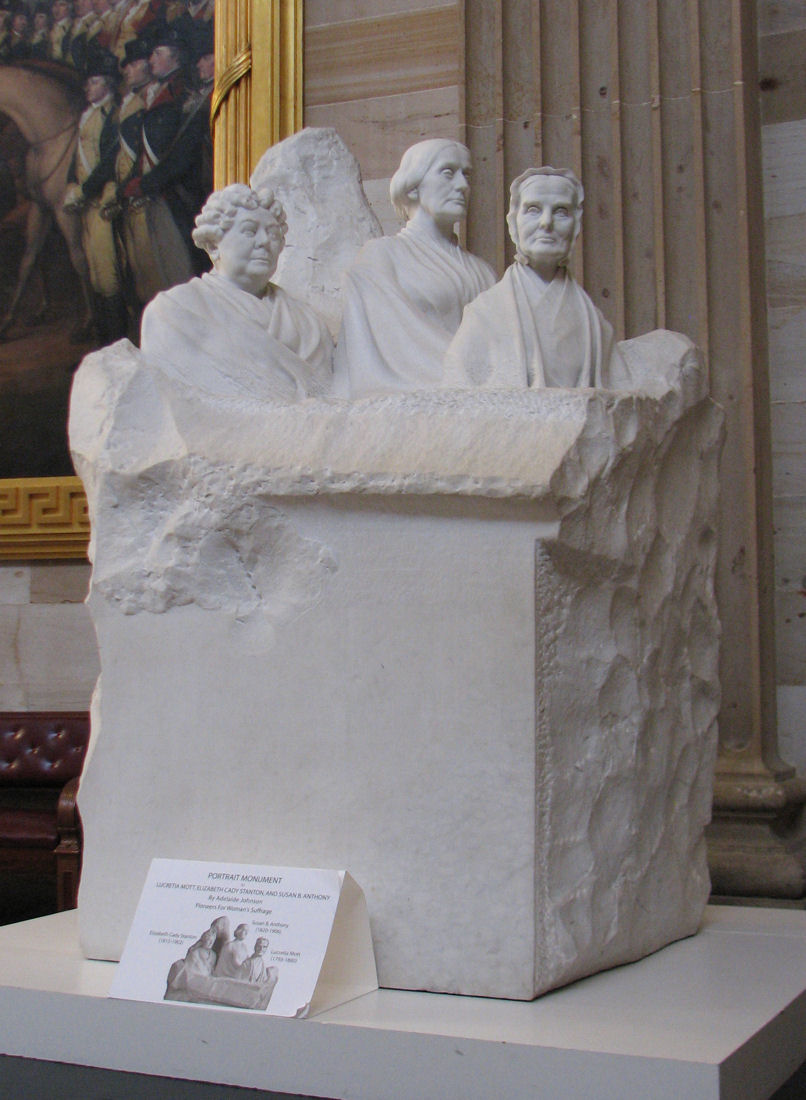
White marble sculpture called Portrait Monument, showing three women's busts emerging from a rough-hewn block. A placard in front lists the names of the three women. Behind is a painting and a column in the Capitol Rotunda.Sculpture

Secondary source

Portrait Monument

Adelaide Johnson · 1920

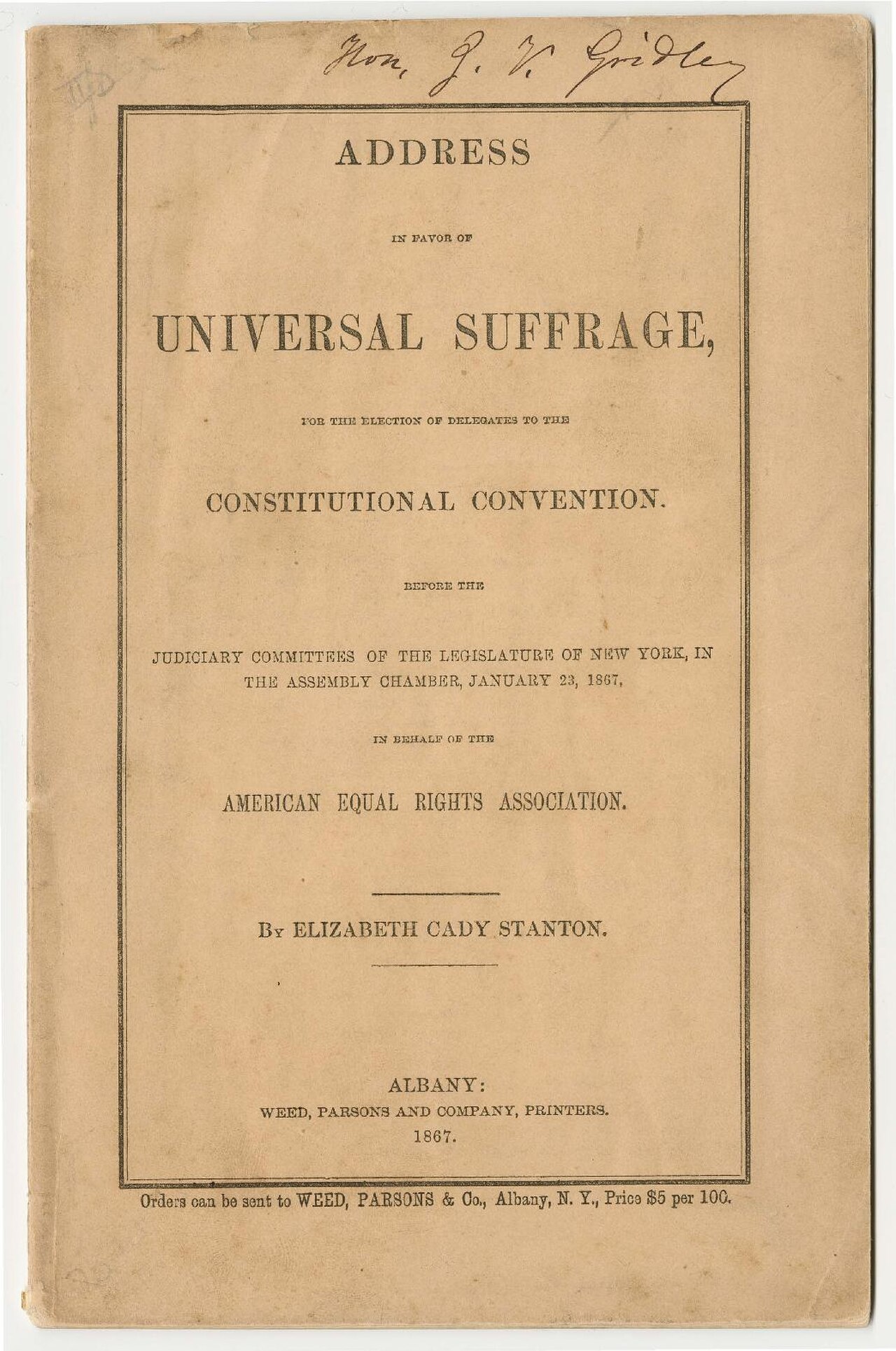
Front cover of a printed pamphlet, tan paper with a double-ruled border. Title reads: Address in Favor of Universal Suffrage, for the Election of Delegates to the Constitutional Convention, by Elizabeth Cady Stanton, Albany, 1867. Handwritten inscription at top reads Hon. J. V. Gridley.Speech

Primary source

Address in Favor of Universal Suffrage before the Judiciary Committees of the Legislature of New York

Elizabeth Cady Stanton · 1867

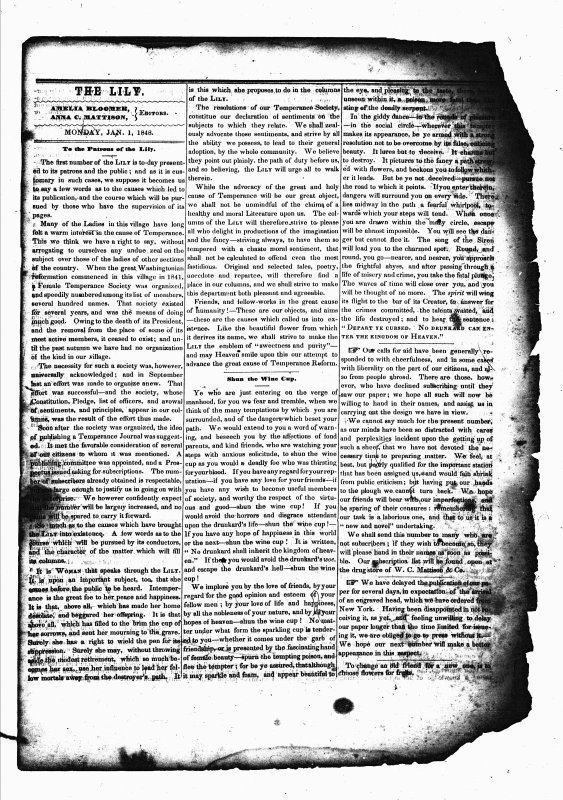
Scanned front page of the first issue of The Lily, dated Monday, January 1, 1849, showing the masthead with editors Amelia Bloomer and Anna C. Mattison, and dense columns of text including an address 'To the Patrons of The Lily' and a temperance piece titled 'Shun the Wine Cup'. The scan is slightly skewed with some pages' edges and notes visible.Newspaper article

Primary source

The Lily

Amelia Bloomer · 1848

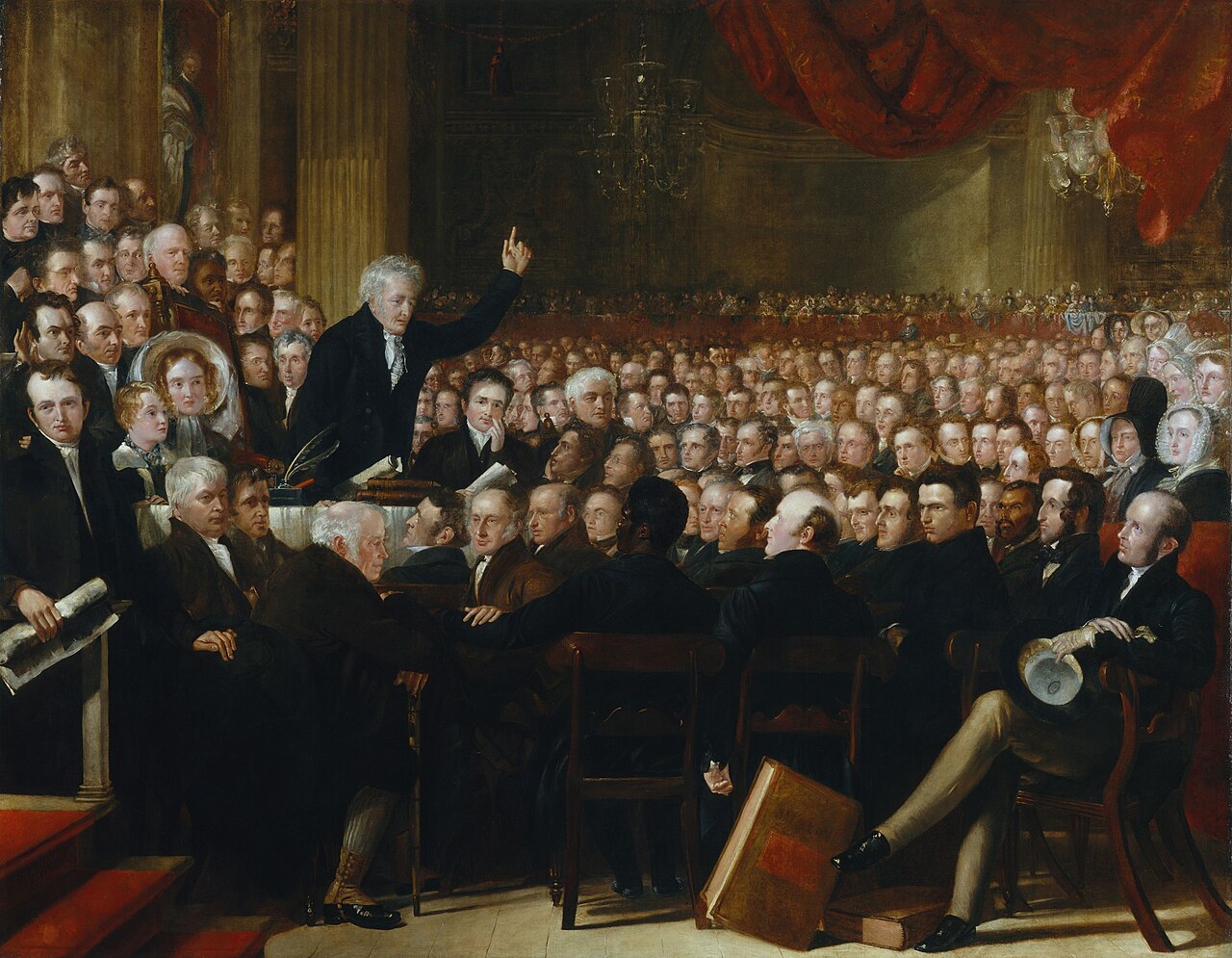
Oil painting of a crowded convention hall where a white-haired man in dark clothing stands on a raised platform pointing upward while addressing a large seated audience of men, with some women in bonnets on the right, red drapery and columns in the background.Painting

Primary source

The Anti-Slavery Society Convention, 1840

Benjamin Robert Haydon · 1841

Front cover of a dark green cloth book. A gold embossed decorative cartouche in the center reads 'Eminent Women of the Age' with ornamental flourishes and fleurons. Thin gold border lines frame the cover.Book

Secondary source

Elizabeth Cady Stanton, by Theodore Tilton, in Eminent Women of the Age

Theodore Tilton · 1868

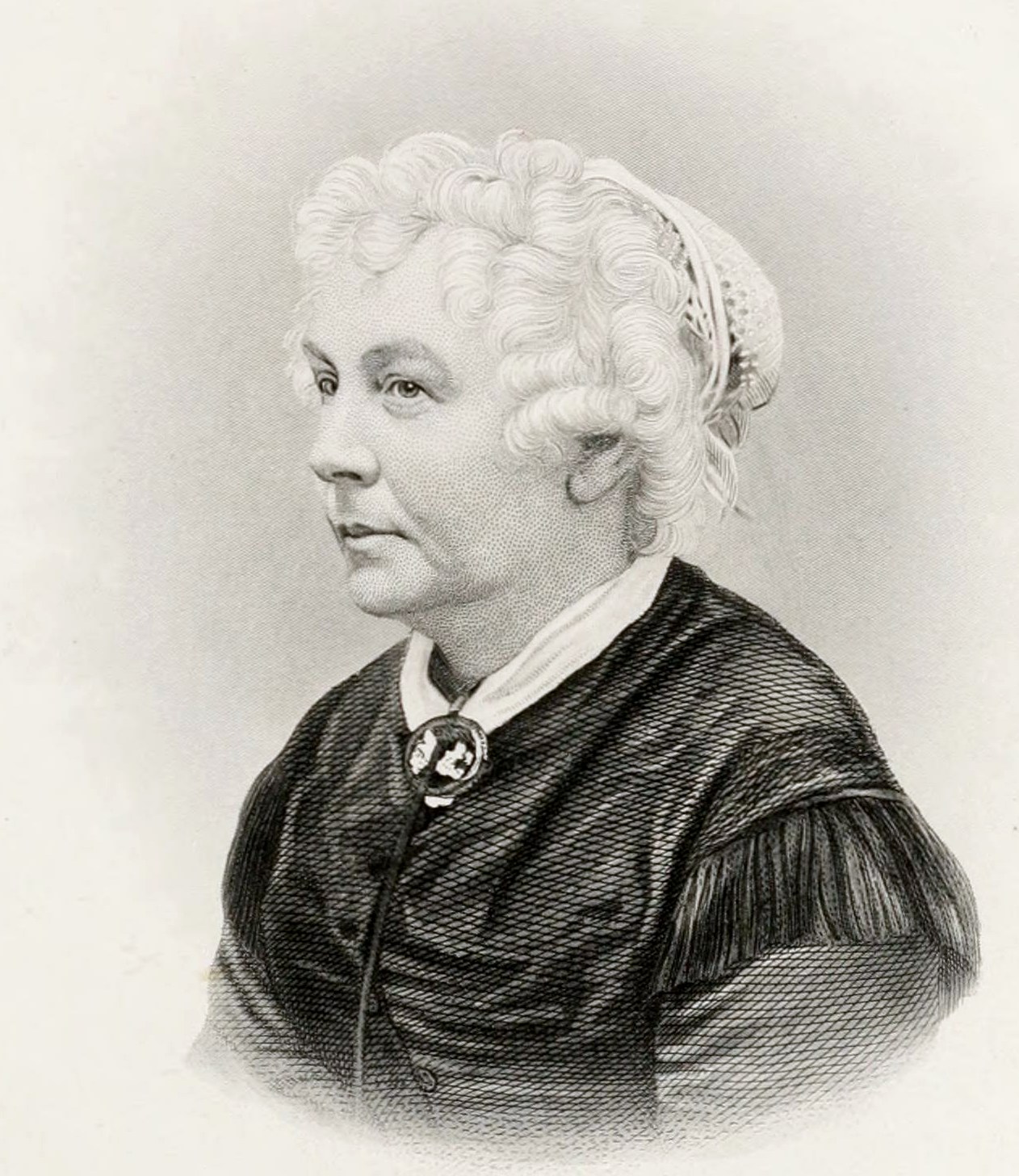
Black and white engraved portrait of an older woman in three-quarter profile facing left. She has light, curled hair under a lace cap, wears a dark dress with a white collar and a dark oval brooch at the neck.Painting

Secondary source

Elizabeth Cady Stanton Engraving by Henry Bryan Hall

Henry Bryan Hall, Jr.

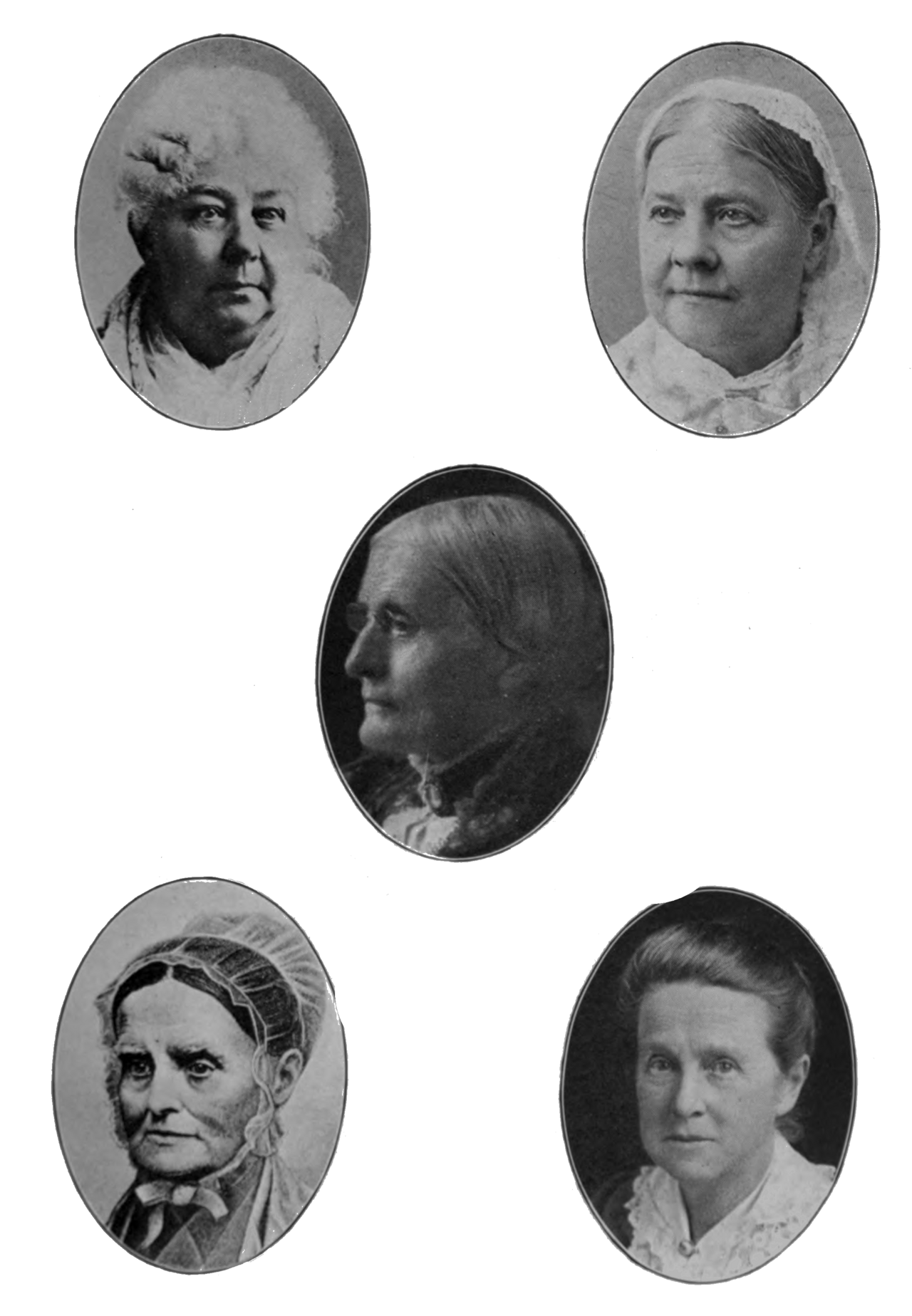
Black and white plate of five oval portrait photographs of older women, arranged in a staggered layout: top left a woman with light curly hair, top right a woman in a white cap, center a woman in profile facing left, bottom left a woman in a bonnet, bottom right a woman with hair pulled back in a white collar.Photograph

Secondary source

Pioneer Women of Suffrage

Ida Husted Harper (editor)

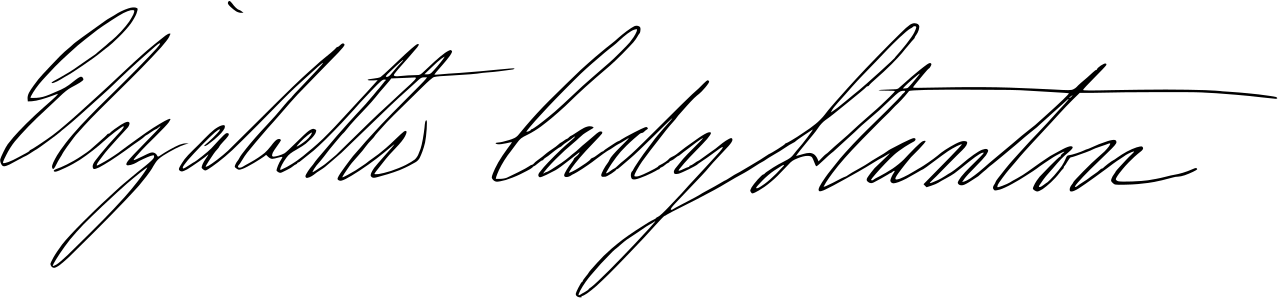
Handwritten cursive signature in black ink on white background reading "Elizabeth Cady Stanton", with long looping strokes and a flourish extending to the right.Document

Primary source

Signature of Elizabeth Cady Stanton

Elizabeth Cady Stanton

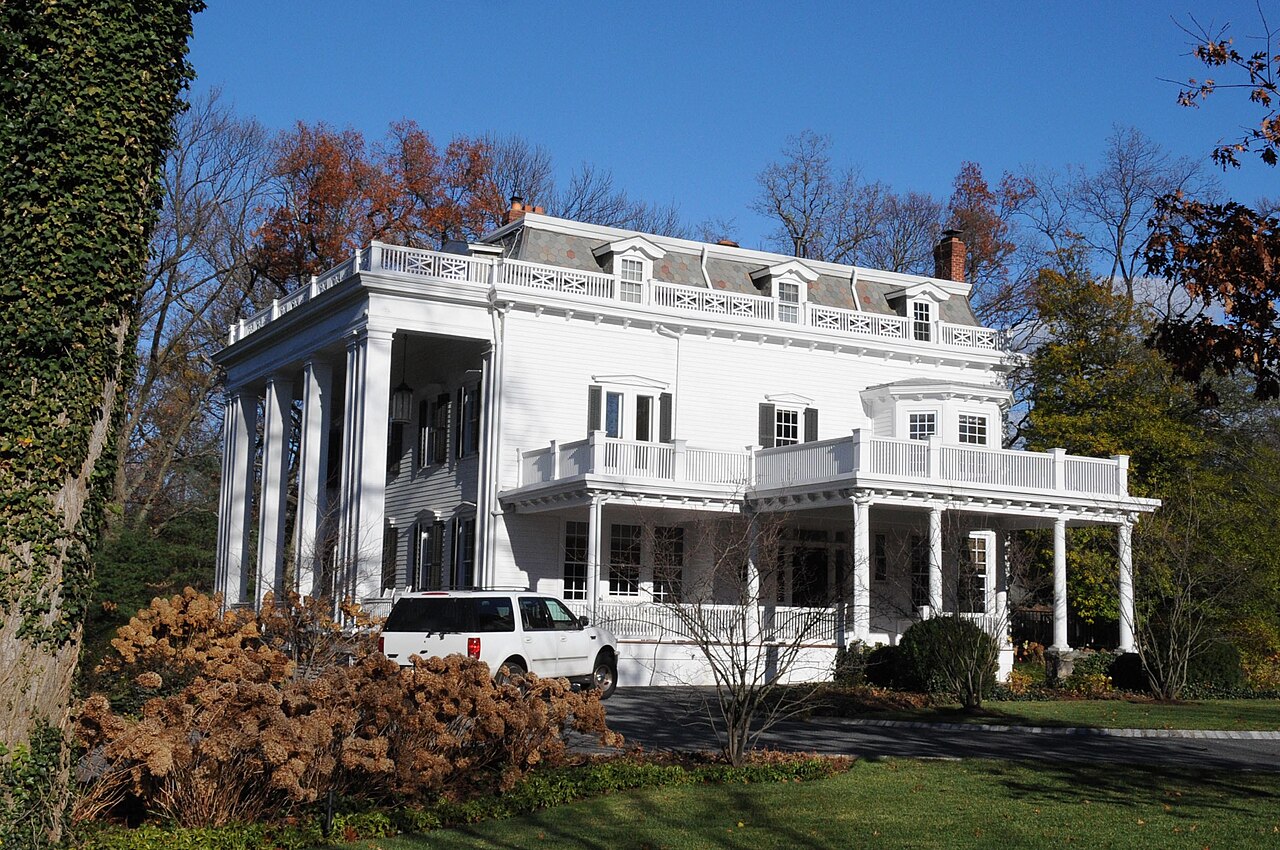
A large white two-story Greek Revival style house with tall white columns across a front porch, a second-floor balcony with white railings, dormer windows in a slate roof, and a white SUV parked in a circular driveway. Bare and autumn-colored trees and dry shrubs surround it under a clear blue sky.Artifact

Primary source

Elizabeth Cady Stanton House

1846

Book

Secondary source

Woman of the Century: Elizabeth Cady Stanton

1893

Document

Tertiary source

Encyclopædia Britannica Entry on Elizabeth Cady Stanton

1911

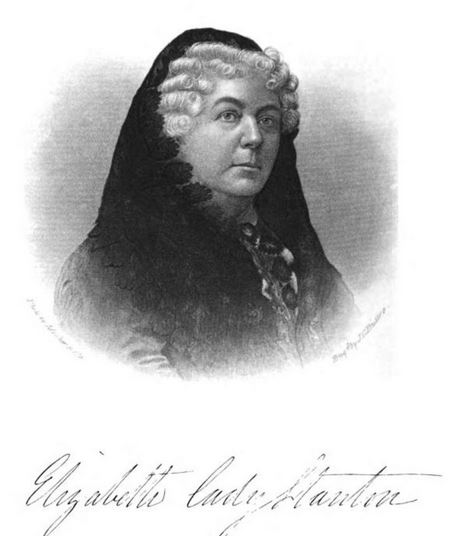
Engraved portrait of an older woman with curly light hair, wearing a dark fur-trimmed shawl or cape over her shoulders, looking to the right. Below the portrait is a handwritten signature reading 'Elizabeth Cady Stanton'.Painting

Secondary source

Elizabeth Cady Stanton, 1887 Engraving

1887

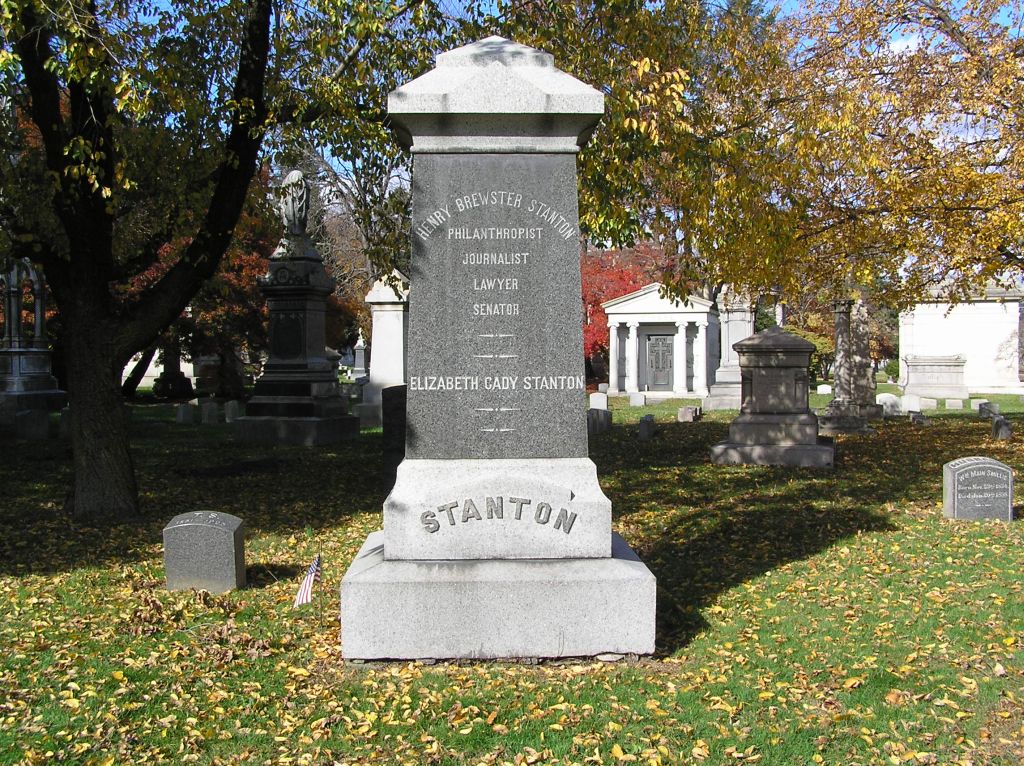
A tall grey granite obelisk-style monument in a cemetery, inscribed with names including Henry Brewster Stanton and Elizabeth Cady Stanton, with the word STANTON carved on its base. Autumn leaves cover the grass; other headstones and trees are nearby.Photograph

Secondary source

Elizabeth Cady Stanton Monument

Anthony22

Proceedings of the Loyal Women of the Republic MeetingDocument

Primary source

Proceedings of the Loyal Women of the Republic Meeting

Women's National Loyal League · 1863

Document

Primary source

Memorial to Congress by Stanton, Hooker, Anthony and Others

Elizabeth Cady Stanton, Isabella Beecher Hooker, Elizabeth L. Bladen, Olympia Brown, Susan B. Anthony, Josephine L. Griffing · 1872

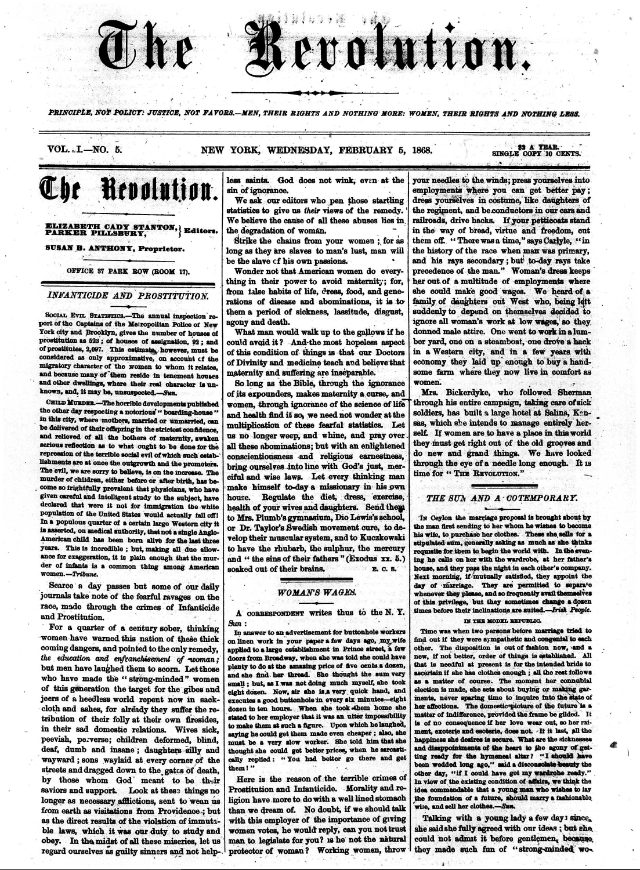
The Revolution, February 5, 1868Newspaper article

Primary source

The Revolution, February 5, 1868

Elizabeth Cady Stanton · 5 February 1868

Letters of Elizabeth Cady Stanton, Worcester 1850 and Syracuse 1852Letter

Primary source

Letters of Elizabeth Cady Stanton, Worcester 1850 and Syracuse 1852

Elizabeth Cady Stanton · 1850-1852

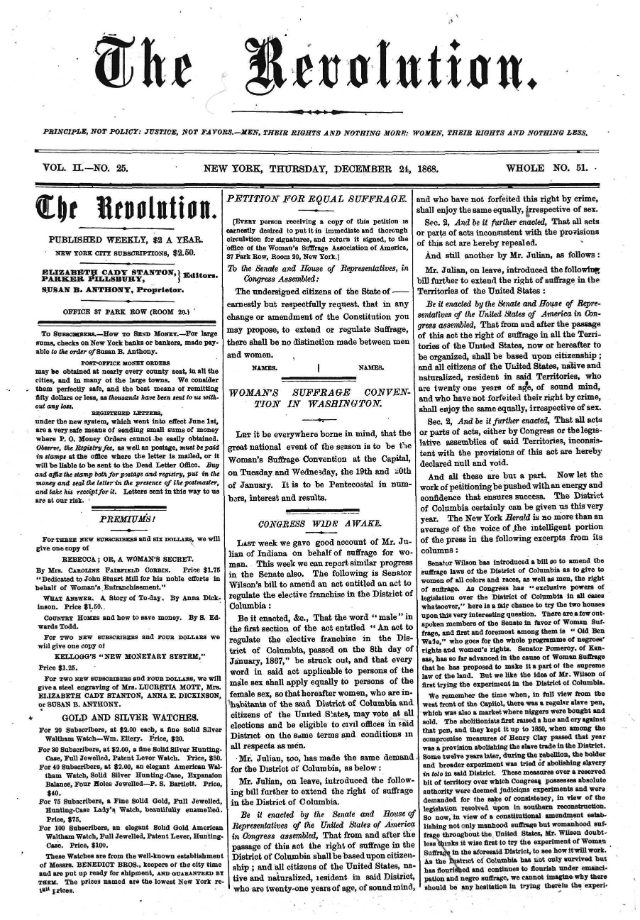
The Revolution, December 24, 1868Newspaper article

Primary source

The Revolution, December 24, 1868

Elizabeth Cady Stanton · 24 December 1868

The Revolution, January 8, 1868 (first issue)Newspaper article

Primary source

The Revolution, January 8, 1868 (first issue)

Elizabeth Cady Stanton · 8 January 1868

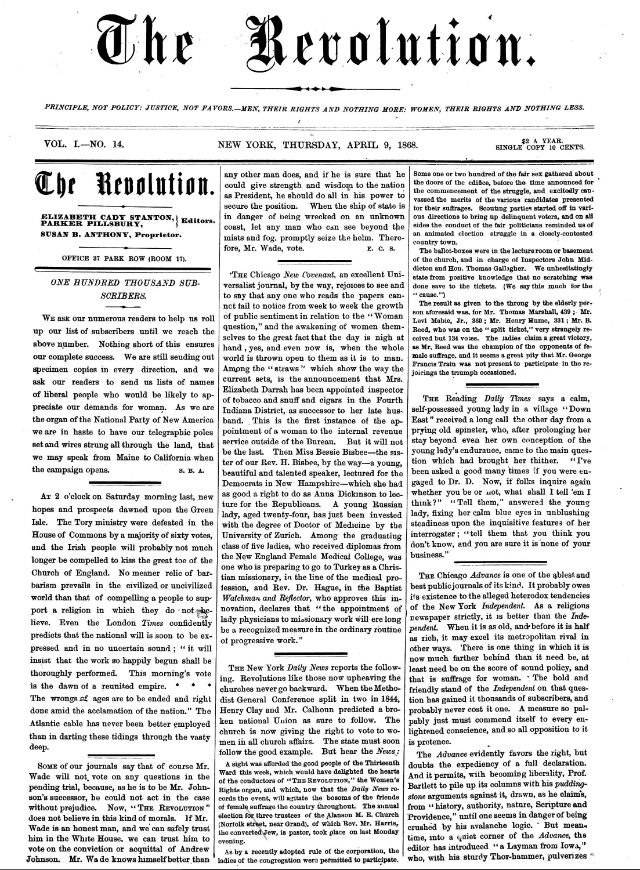
The Revolution, April 9, 1868Newspaper article

Primary source

The Revolution, April 9, 1868

Elizabeth Cady Stanton · 9 April 1868

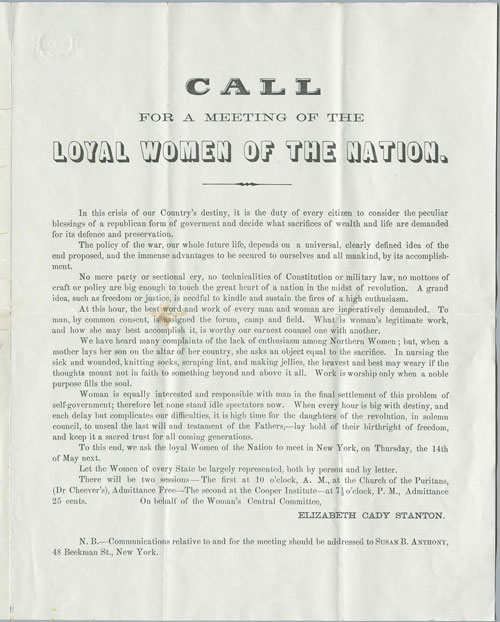
Scan of a printed broadside titled 'Call for a Meeting of the Loyal Women of the Nation' in large display type, followed by dense body text and signed by Elizabeth Cady Stanton, with an N.B. naming Susan B. Anthony.Document

Primary source

Call to the Founding Convention of the Woman's National Loyal League

Elizabeth Cady Stanton and Susan B. Anthony · 1863

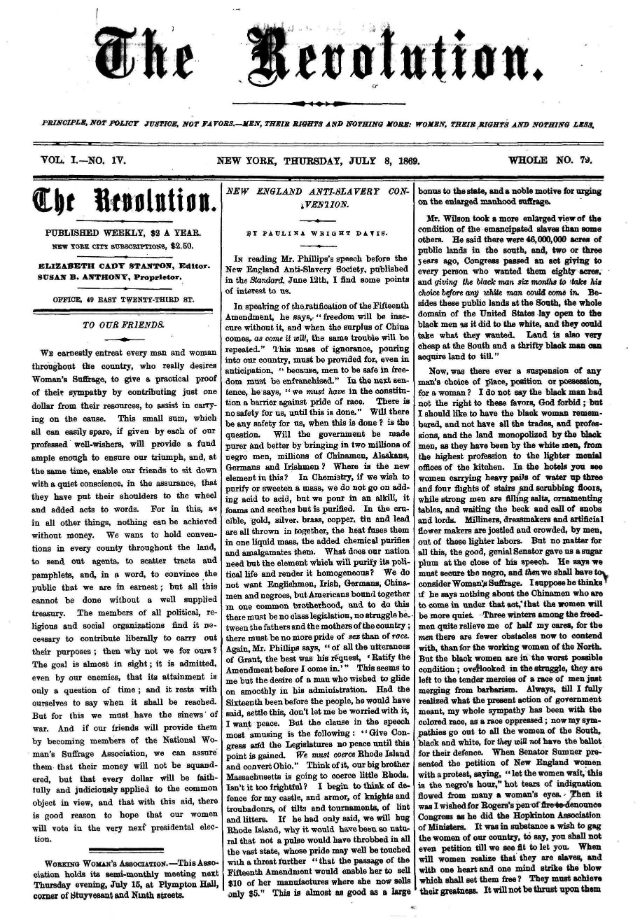
The Revolution, July 8, 1869Newspaper article

Primary source

The Revolution, July 8, 1869

Elizabeth Cady Stanton · 8 July 1869

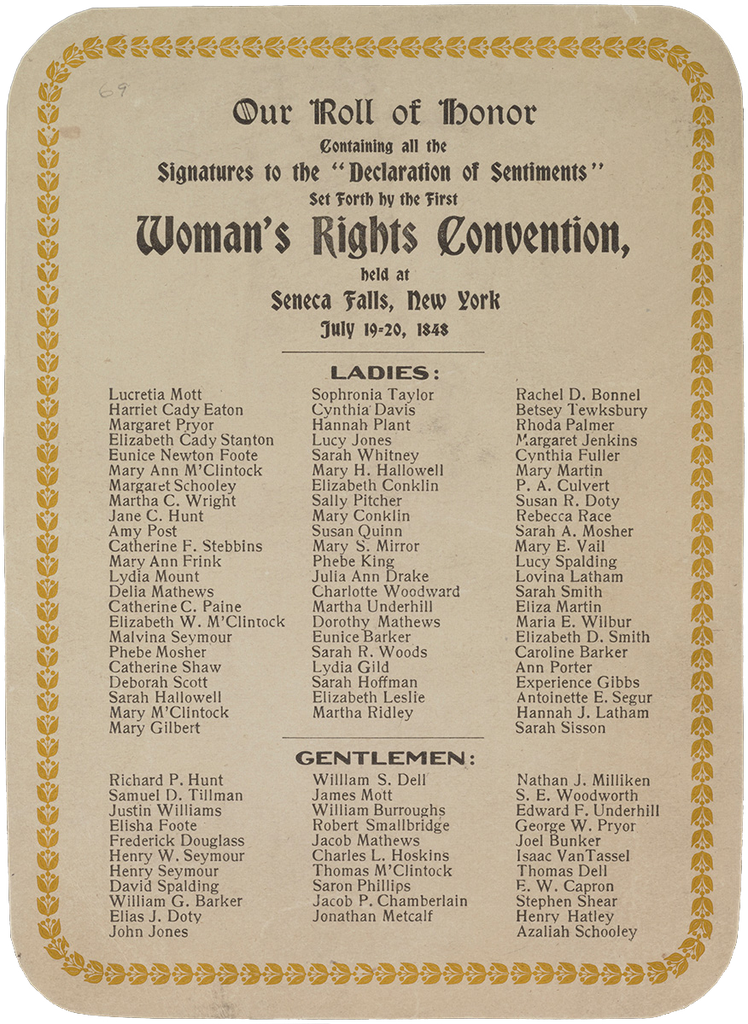
Printed broadside titled 'Our Roll of Honor' listing signatories to the Declaration of Sentiments from the 1848 Seneca Falls Woman's Rights Convention, in two sections: Ladies in three columns and Gentlemen in three columns, framed by a decorative gold leaf border on tan paper.Document

Primary source

Roll of Honor, Women's Rights Convention

1 July 1848

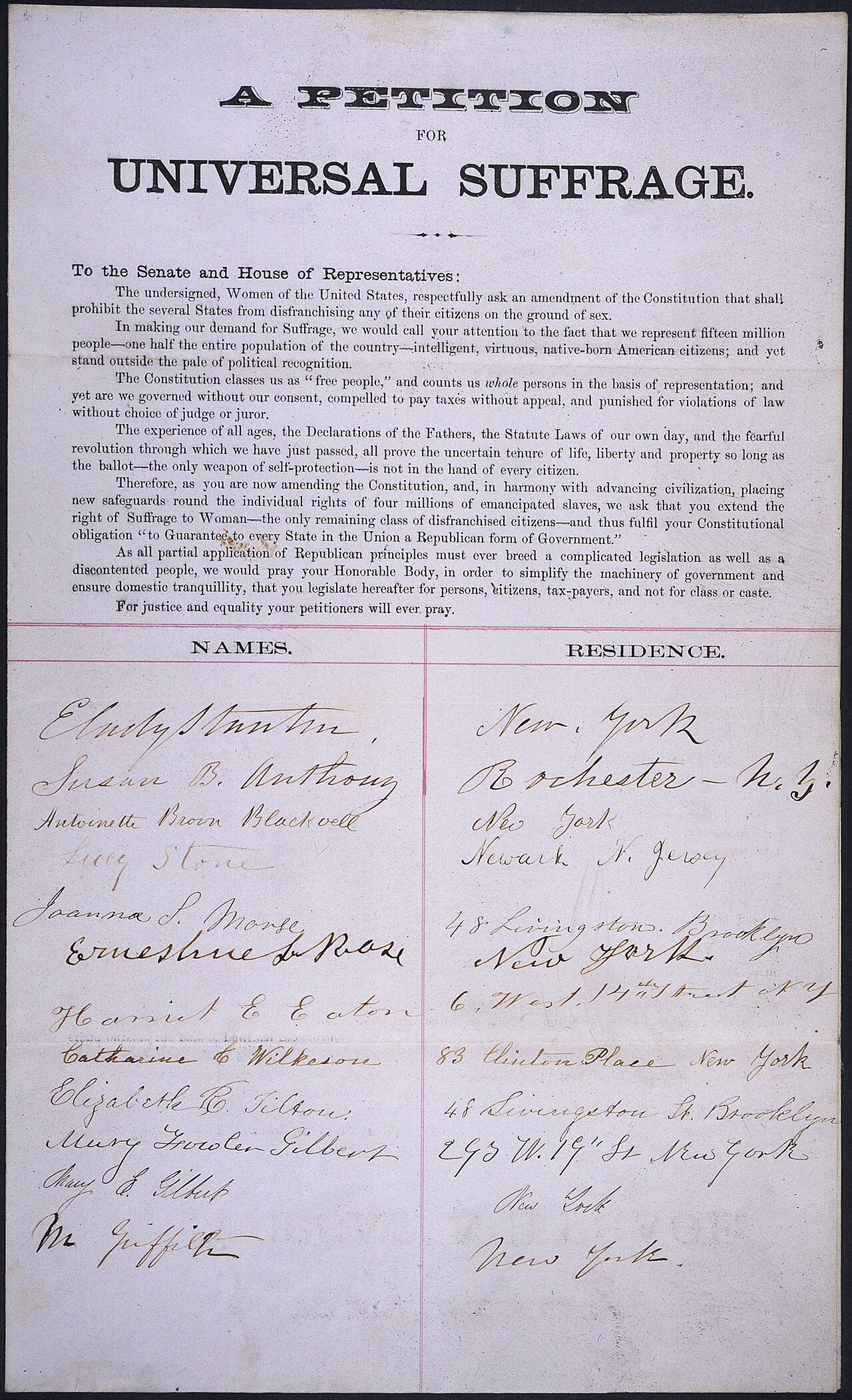
Scan of a printed and handwritten petition titled 'A Petition for Universal Suffrage,' addressed to the Senate and House of Representatives. Below the text is a two-column list of handwritten signatures under 'Names' and 'Residence,' including Elizabeth Cady Stanton and Susan B. Anthony, with places such as New York, Rochester, and Brooklyn.Document

Primary source

Petition for Universal Suffrage, circa 1865

Susan B. Anthony and others · circa 1865

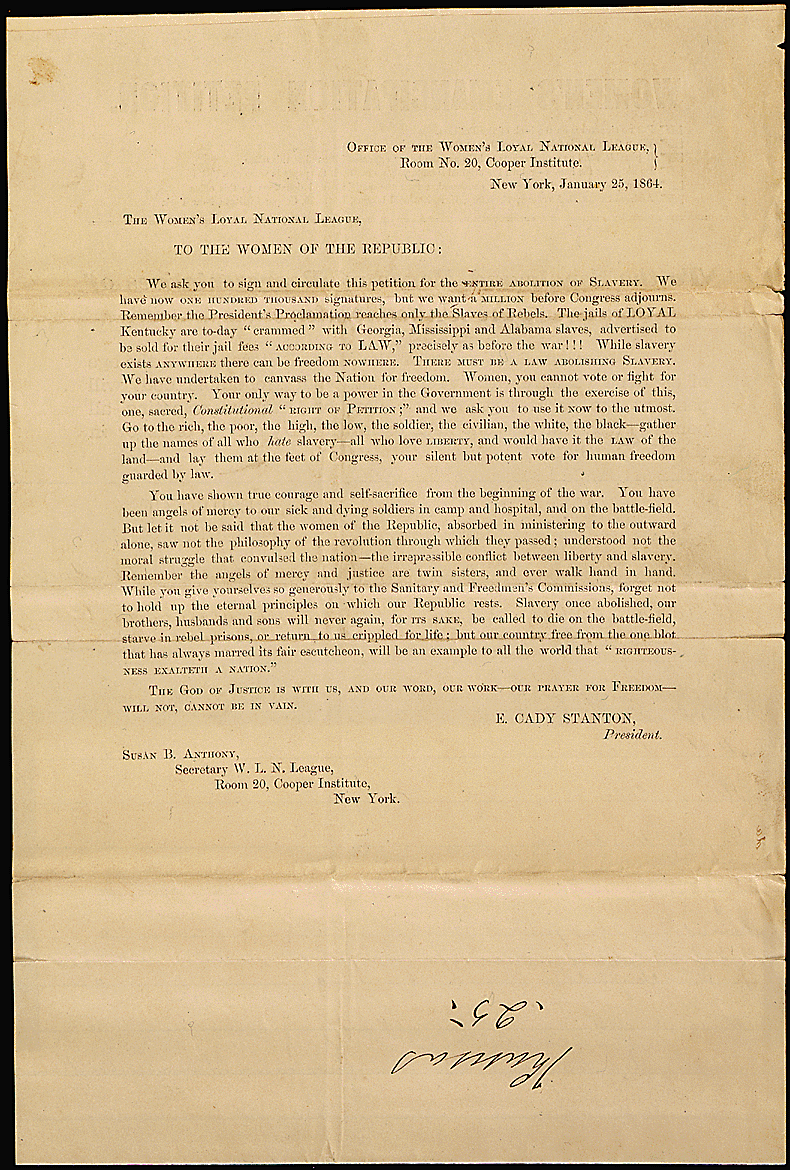
Scan of a printed 1864 address on aged, yellowed paper from the Women's Loyal National League, headed 'To the Women of the Republic', urging support for the abolition of slavery. Signed by E. Cady Stanton as President and Susan B. Anthony as Secretary, with a handwritten signature at the bottom.Document

Primary source

Address from the Women's Loyal National League to the Women of the Republic

Women's Loyal National League · 25 January 1864

Book

Primary source

Pray You, Sir, Whose Daughter?

Helen H. Gardener · 1892

Document

Tertiary source

Stanton, Elizabeth Cady, in The New Student's Reference Work

1914

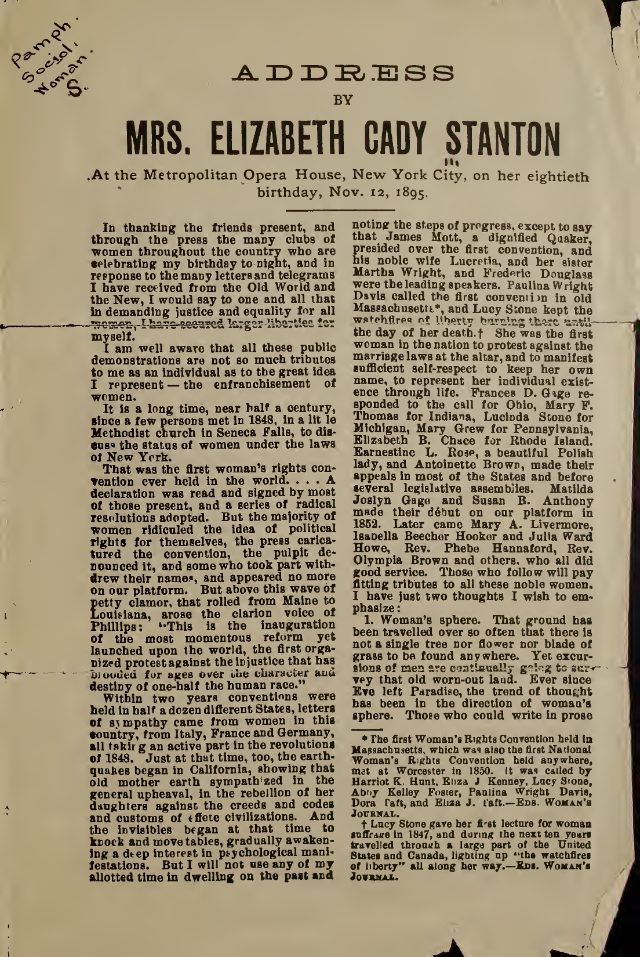
Address by Elizabeth Cady Stanton, 1895Speech

Primary source

Address by Elizabeth Cady Stanton, 1895

Elizabeth Cady Stanton · 1895

Black-and-white studio portrait of an older woman with light, curly hair piled high, wearing a dark satin dress with a wide ruffled white lace collar and a brooch, looking toward the viewer.Photograph

Primary source

Elizabeth Cady Stanton photographic print

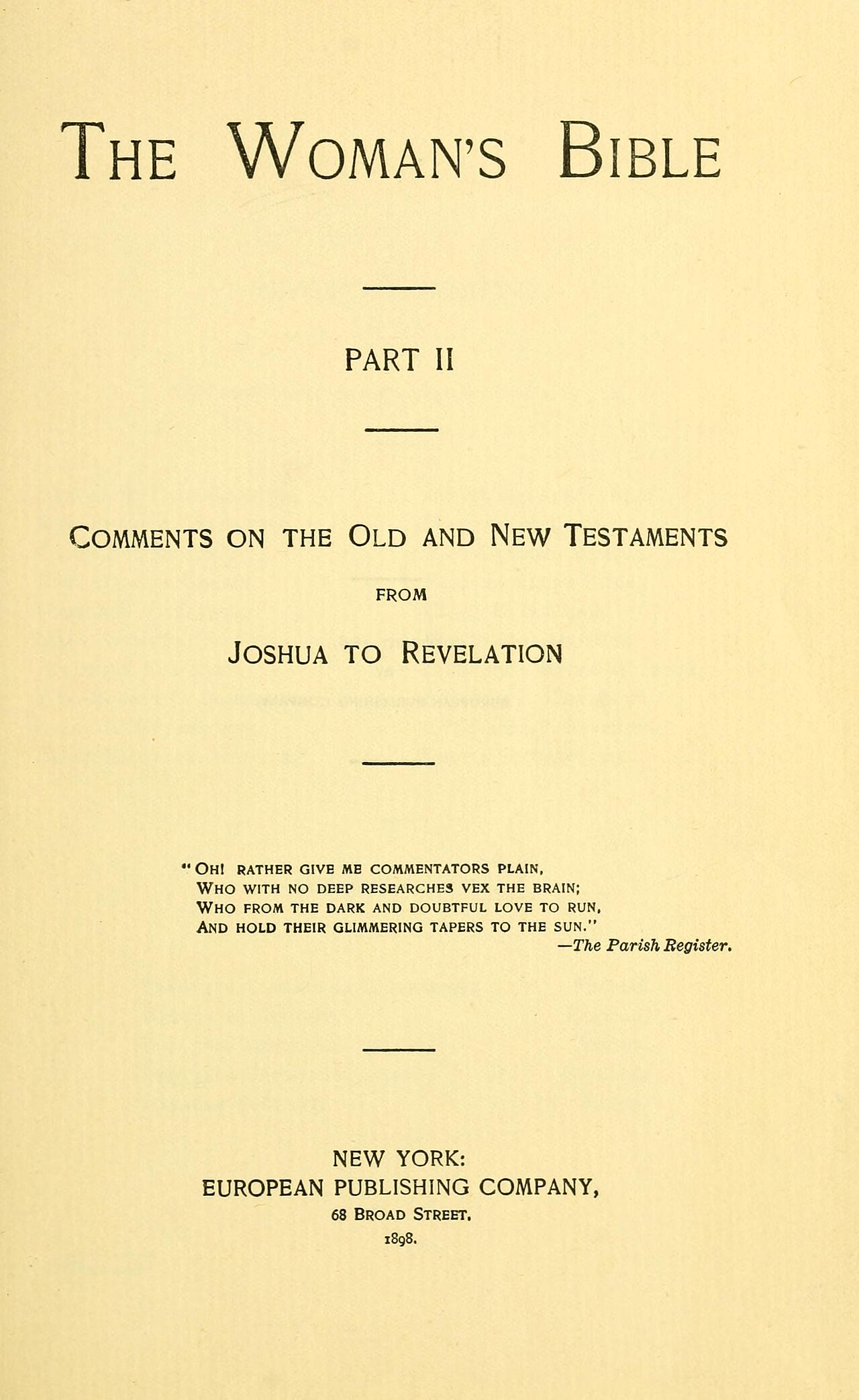
Title page of The Woman's Bible, Part II. Large heading 'The Woman's Bible', then 'Part II', then 'Comments on the Old and New Testaments from Joshua to Revelation'. A four-line verse quote from The Parish Register is attributed below. Publication: New York, European Publishing Company, 68 Broad Street, 1898.Book

Primary source

Title page of The Woman's Bible, Part II

Elizabeth Cady Stanton · 1898

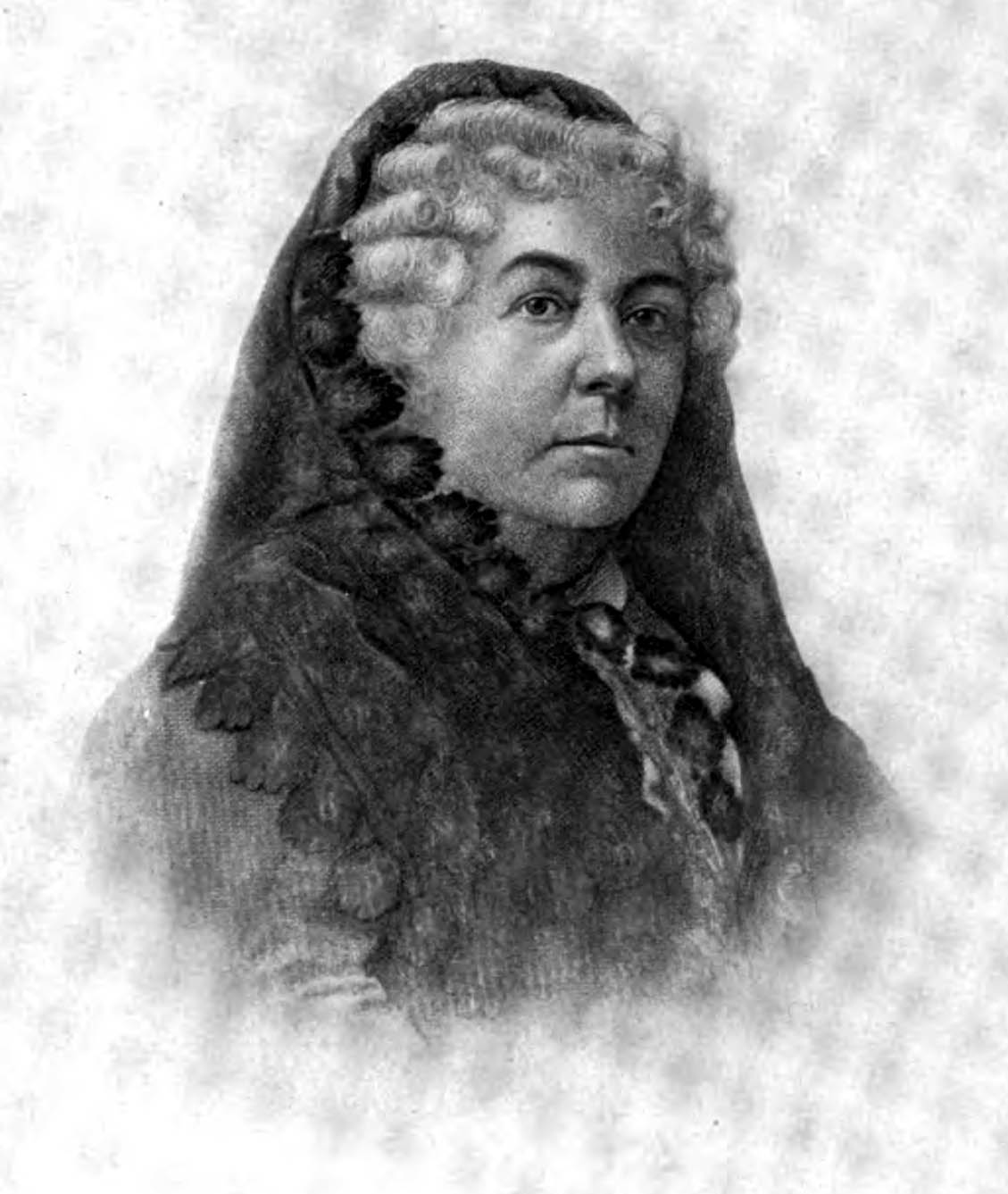
Black and white engraved-style portrait of an older woman with light curled hair under a dark lace-trimmed veil or shawl, looking toward the viewer with a serious expression, shoulders and dark garment visible against a mottled light background.Photograph

Secondary source

Portrait Photograph of Elizabeth Cady Stanton

Unknown photographer · published 1920

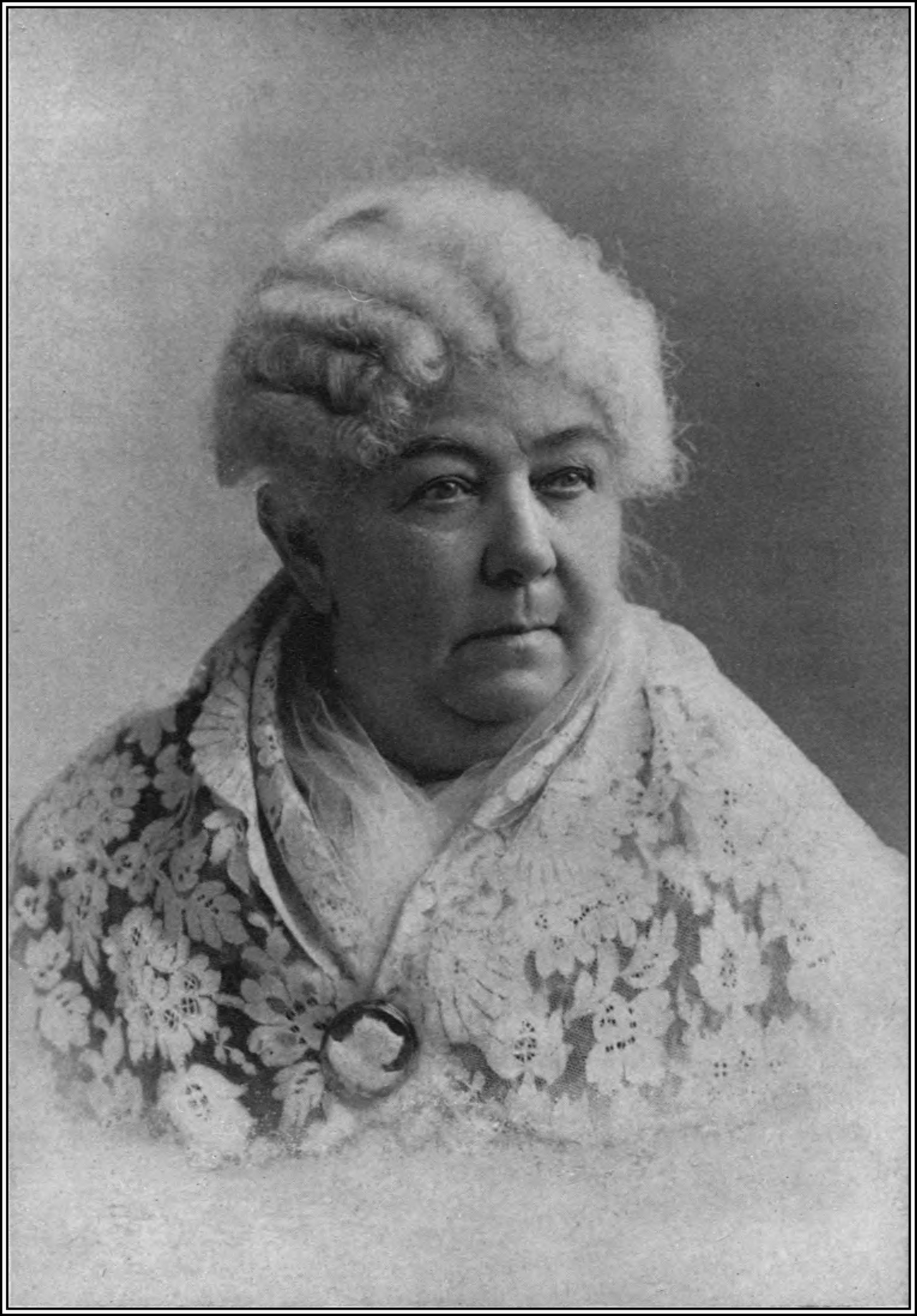
Black and white photographic portrait of an elderly woman with light, curly upswept hair, wearing a lace shawl with floral patterns fastened by a round brooch. She faces slightly to the side with a serious expression.Photograph

Secondary source

Mrs Elizabeth Cady Stanton, History of Woman Suffrage

Unknown photographer · 1897

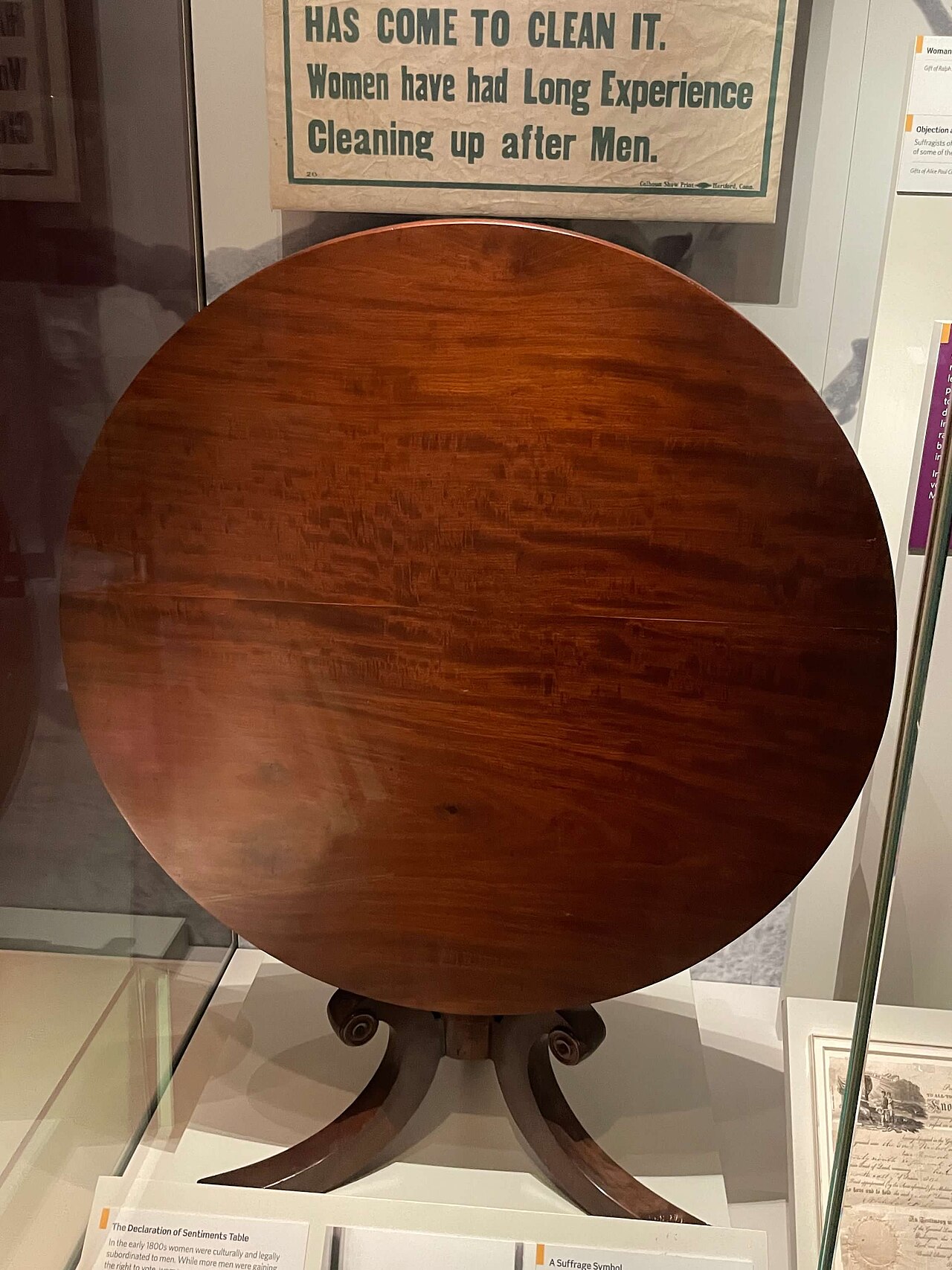
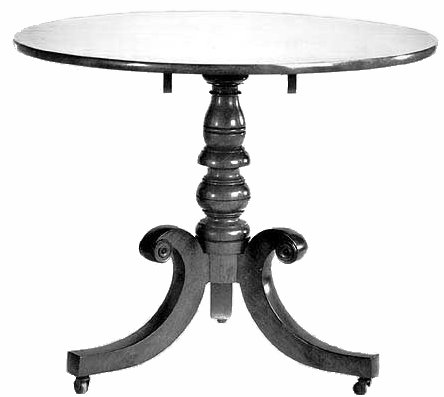
Round wooden table with a polished reddish-brown top and a pedestal base with three curved, scrolled legs, displayed in a museum case. Above it hangs a sign reading 'Women have had Long Experience Cleaning up after Men.'Artifact

Secondary source

Declaration of Sentiments Table, Seneca Falls

CryolophosaurusEllioti · photographed 2023 (table from 1848)

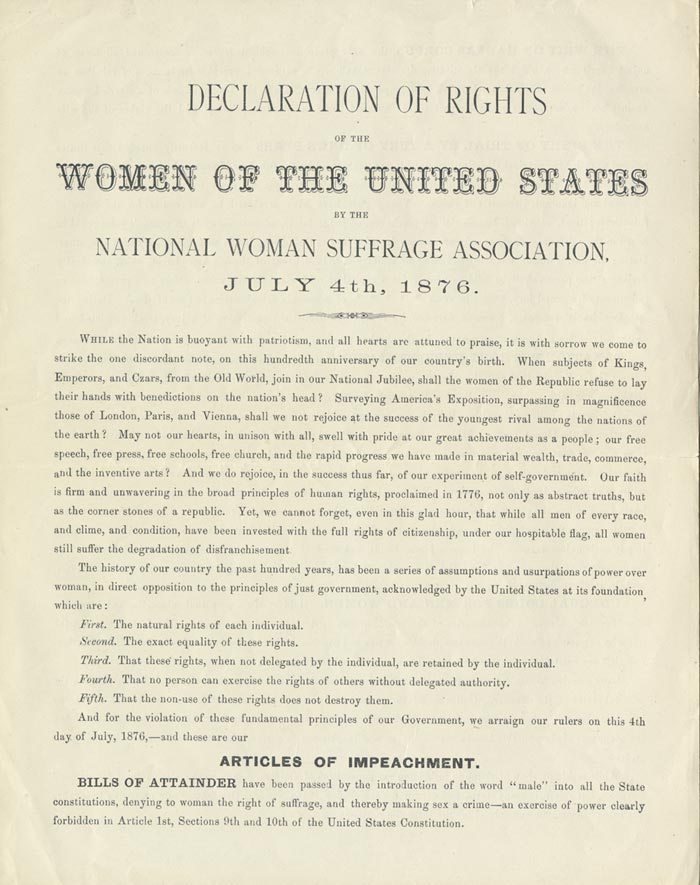
Scanned first page of the 1876 Declaration of Rights of the Women of the United States, printed by the National Woman Suffrage Association. Decorative title in large type, followed by body text of the printed declaration on cream paper.Document

Primary source

Declaration of Rights of the Women of the United States

National Woman Suffrage Association · 1876

Document

Tertiary source

Stanton, Elizabeth Cady, in The Encyclopedia Americana

1920

Speech Presenting Marble Busts of Mott, Stanton and Anthony to CongressSpeech

Secondary source

Speech Presenting Marble Busts of Mott, Stanton and Anthony to Congress

Sara Bard Field · 15 February 1921

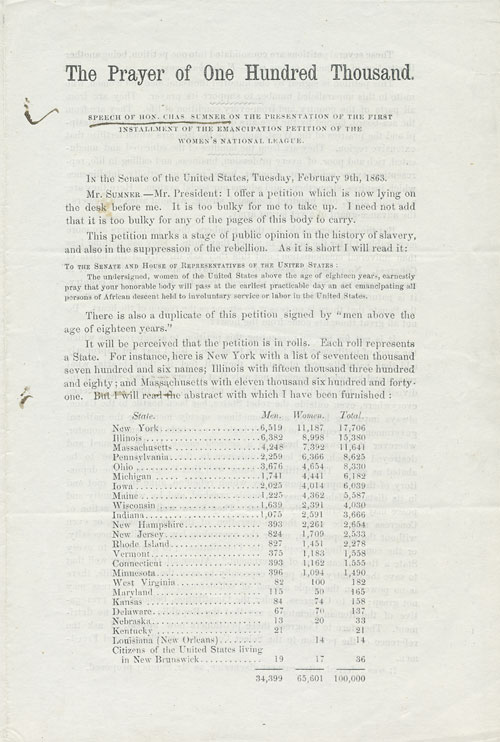
Printed first page of Senator Charles Sumner's 1863 speech titled 'The Prayer of One Hundred Thousand.' The text describes the Senate presentation of the first installment of the emancipation petition from the Woman's National Loyal League. Below the text is a table of petition signature counts by state, with columns for men, women, and total, ending with a total of 100,000.Speech

Primary source

The Prayer of One Hundred Thousand

Charles Sumner · 1863

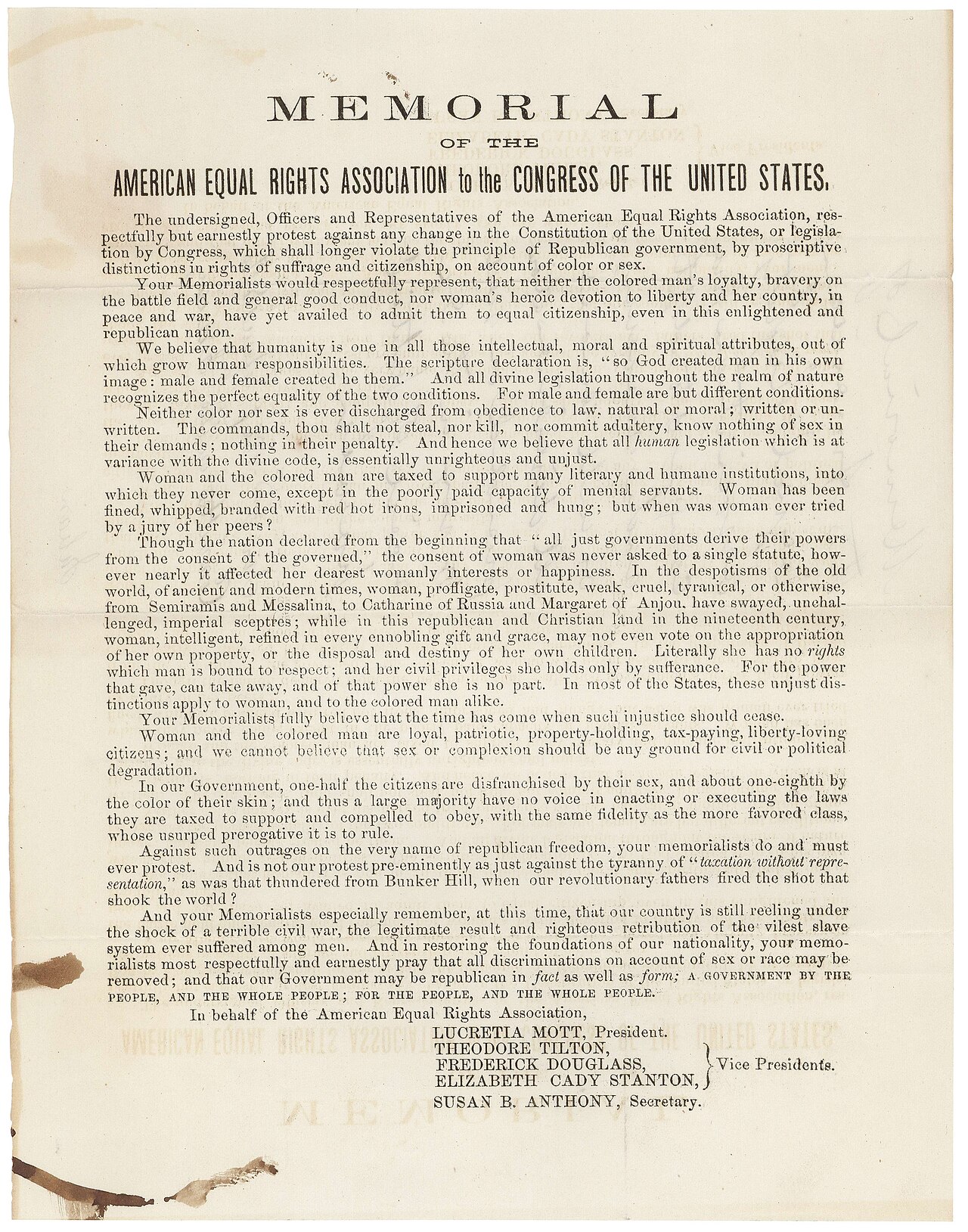
Scanned printed page titled MEMORIAL OF THE AMERICAN EQUAL RIGHTS ASSOCIATION to the Congress of the United States. Dense body text in several paragraphs, with signatures at the bottom including Lucretia Mott, Theodore Tilton, Frederick Douglass, Elizabeth Cady Stanton, and Susan B. Anthony. Some stains on the page.Document

Primary source

American Equal Rights Association Memorial to Congress

3 January 1867

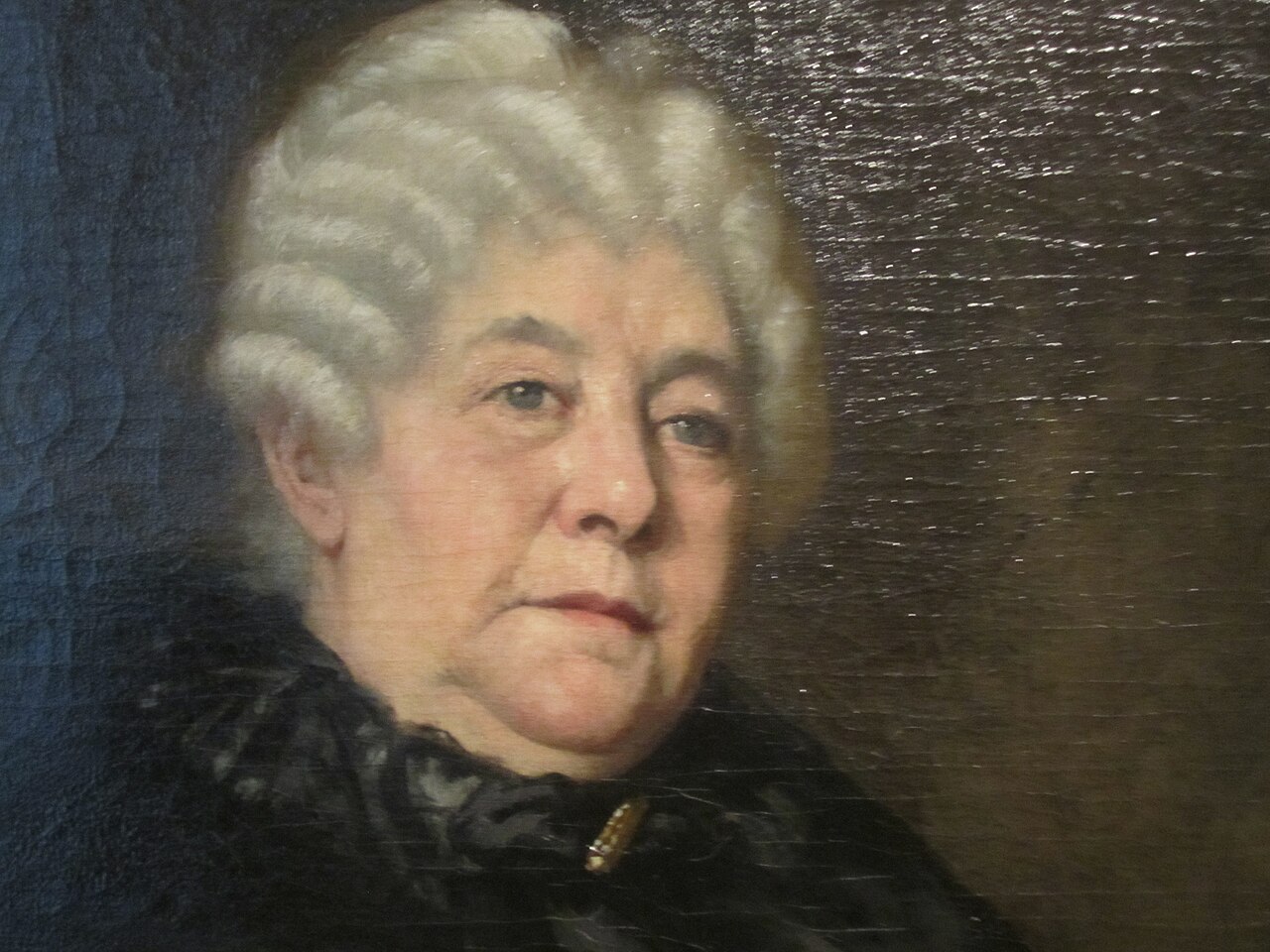
Oil portrait of an elderly woman with white curled hair, dark high-collared black garment with a brooch, set against a blue and dark brown background. She gazes toward the viewer with a neutral expression.Painting

Secondary source

Photograph of a Portrait of Elizabeth Cady Stanton at the National Portrait Gallery

Billy Hathorn · photographed 29 July 2011

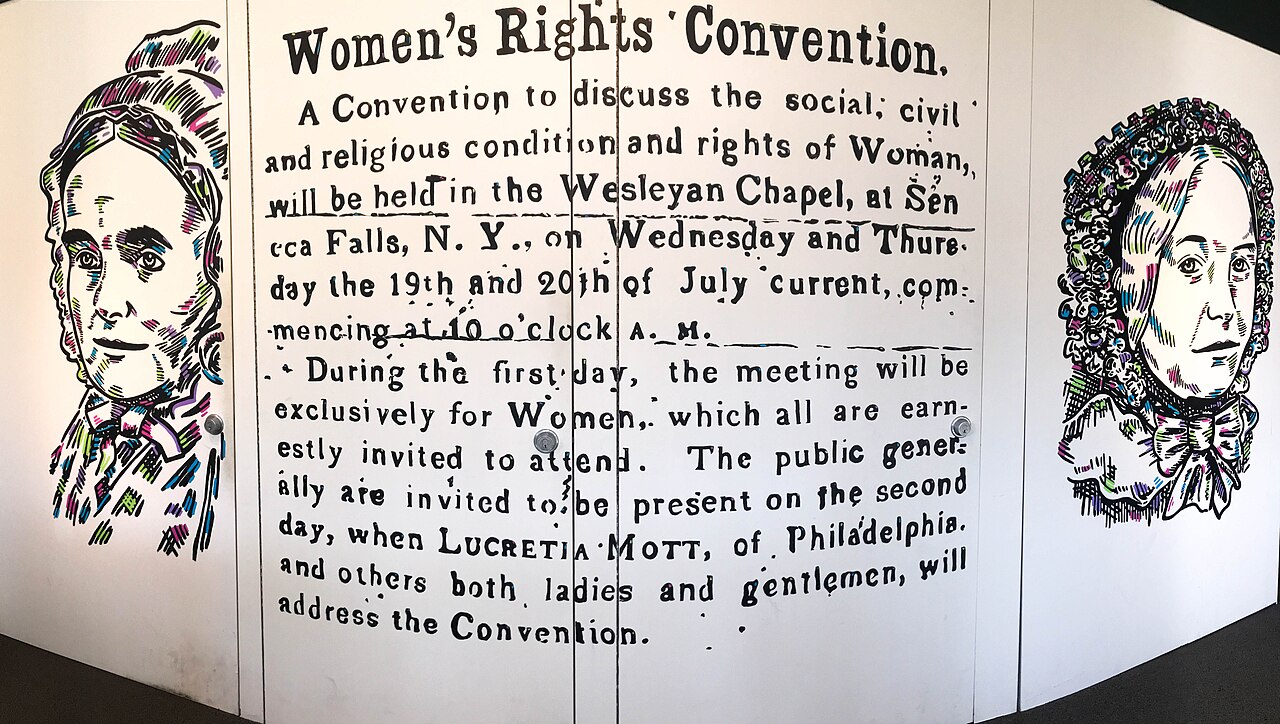
Colorful sketched mural panels with a printed-style announcement titled Women's Rights Convention. Left: a drawn portrait of Lucretia Mott. Right: a drawn portrait of Elizabeth Cady Stanton in a lace cap. Center text announces the convention at the Wesleyan Chapel in Seneca Falls, N.Y., on July 19th and 20th.Painting

Secondary source

Mural Depicting Lucretia Mott and Elizabeth Cady Stanton

Blake Chamberlain · 2019 (photograph); mural created by Blake Chamberlain

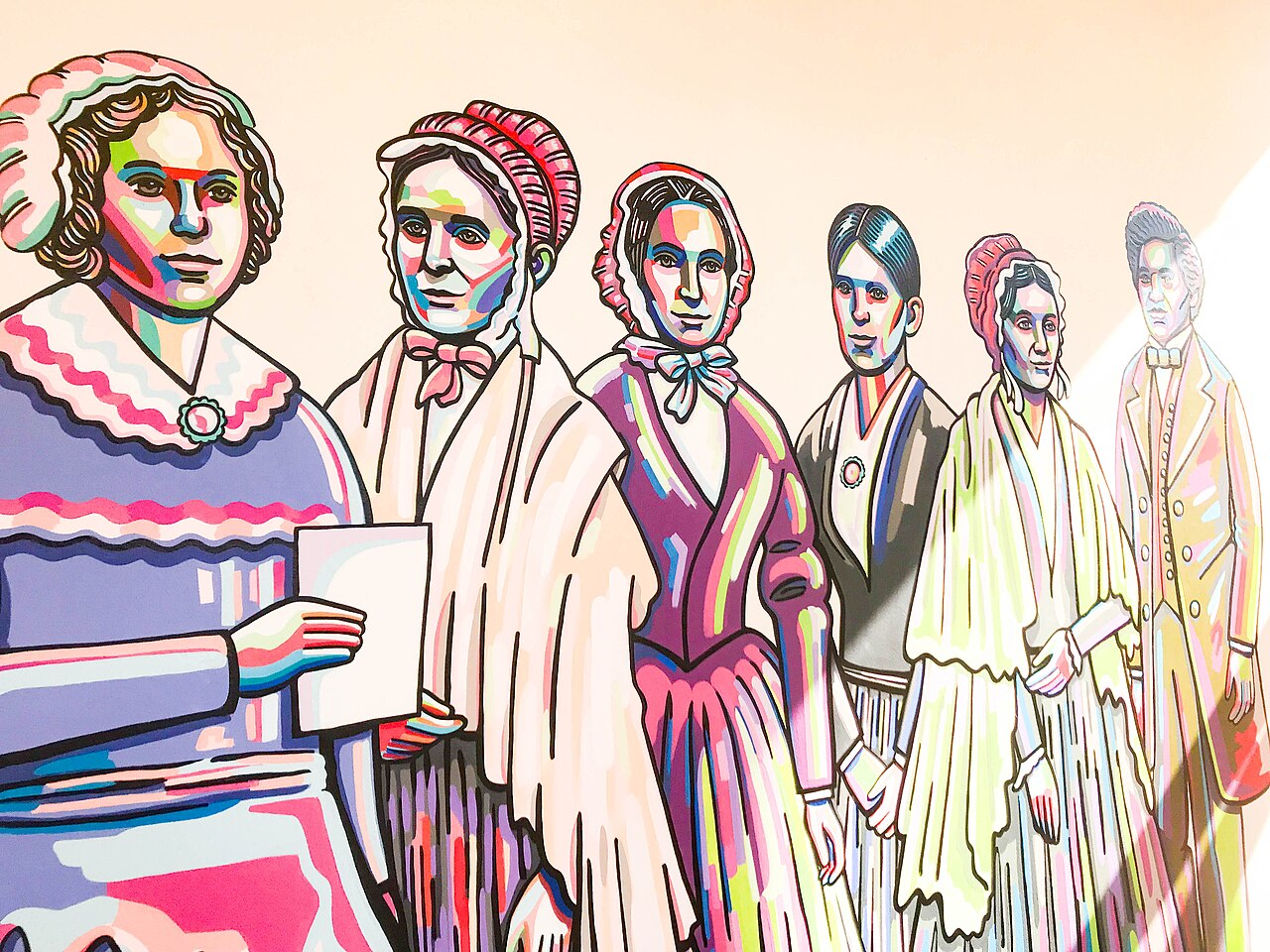
Colorful painted mural of six figures in 19th-century dress standing in a row against a pale wall. The leftmost woman holds a blank white sheet of paper. A man in a long coat stands at the far right, partly faded.Painting

Secondary source

Mural of Suffrage Leaders by Blake Chamberlain

Blake Chamberlain · 2019

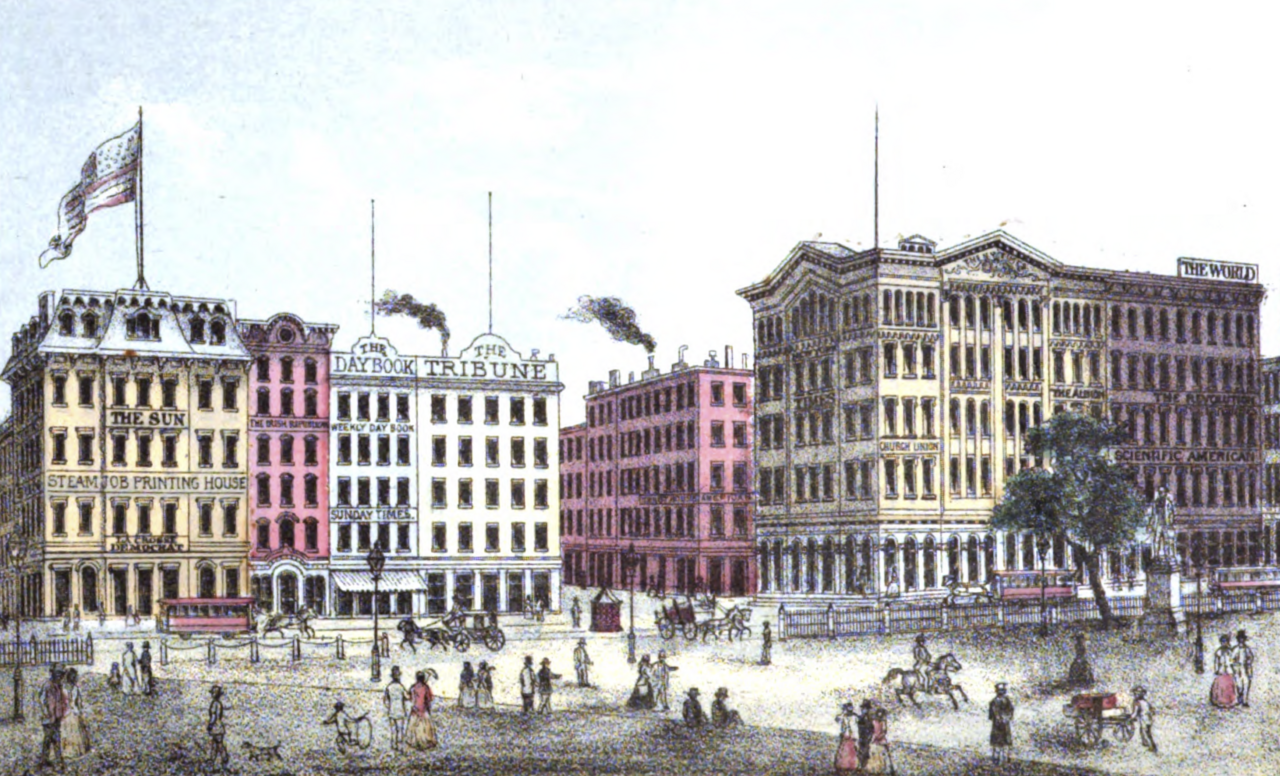
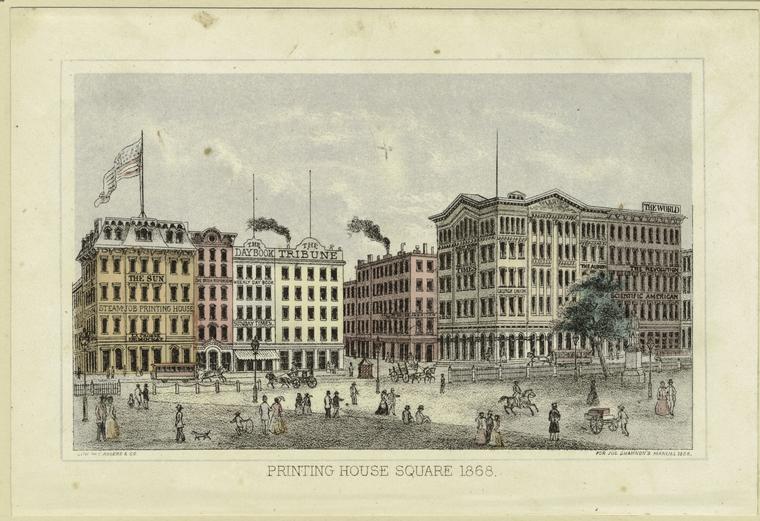
Hand-colored lithograph of Printing House Square, New York City, showing multi-story buildings with signs for The Sun, The Daybook, The Tribune, The World, and Scientific American, with horse carriages, street trams, pedestrians, a flagpole, and a tree.Painting

Primary source

Printing House Square, New York City, 1868 lithograph

W. C. Rogers & Co. · 1868

Hand-colored lithograph titled Printing House Square 1868. It shows a city square with multi-story newspaper buildings bearing signs for The Sun, The Daybook, The Tribune, The World, and Scientific American. An American flag flies from a rooftop. Pedestrians, horse-drawn carriages, a dog, and a tree fill the street.Painting

Primary source

Printing House Square, 1868

W. C. Rogers & Co. · 1868

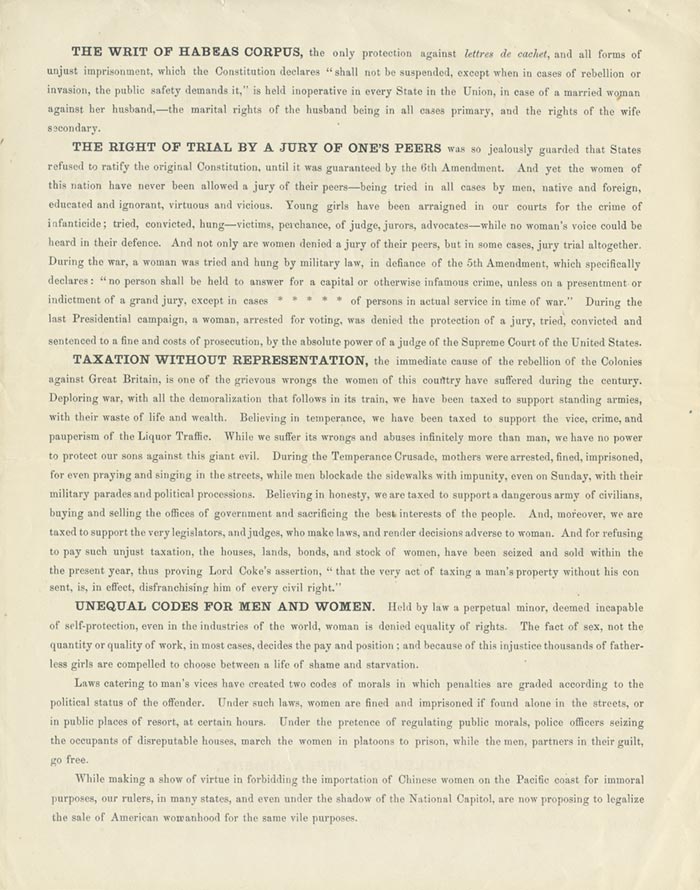
Scanned printed page of text in serif type with bold section headings: 'The Writ of Habeas Corpus', 'The Right of Trial by a Jury of One's Peers', 'Taxation Without Representation', and 'Unequal Codes for Men and Women'. Paragraphs argue for women's legal and political rights.Document

Primary source

Declaration of Rights of the Women of the United States, page 2

National Woman Suffrage Association · 1876

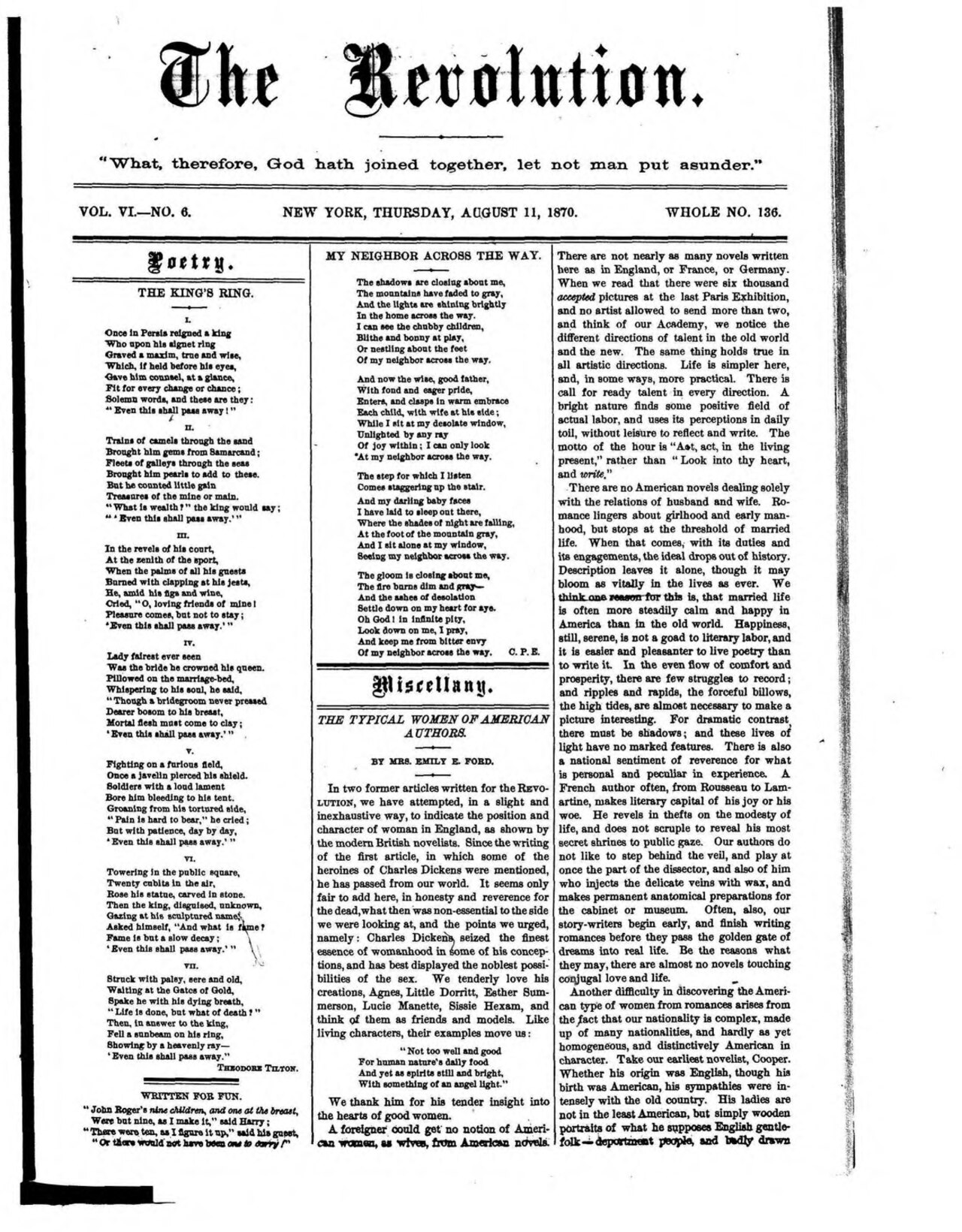
Front page scan of The Revolution, Vol. VI, No. 6, New York, Thursday, August 11, 1870, whole number 136. Masthead reads The Revolution with a quotation about marriage. Columns include Poetry, a poem titled The King's Ring, My Neighbor Across the Way, and Miscellany with an essay on typical women American authors.Newspaper article

Primary source

The Revolution, Vol. 6 No. 6, August 11, 1870

Laura Curtis Bullard · 11 August 1870

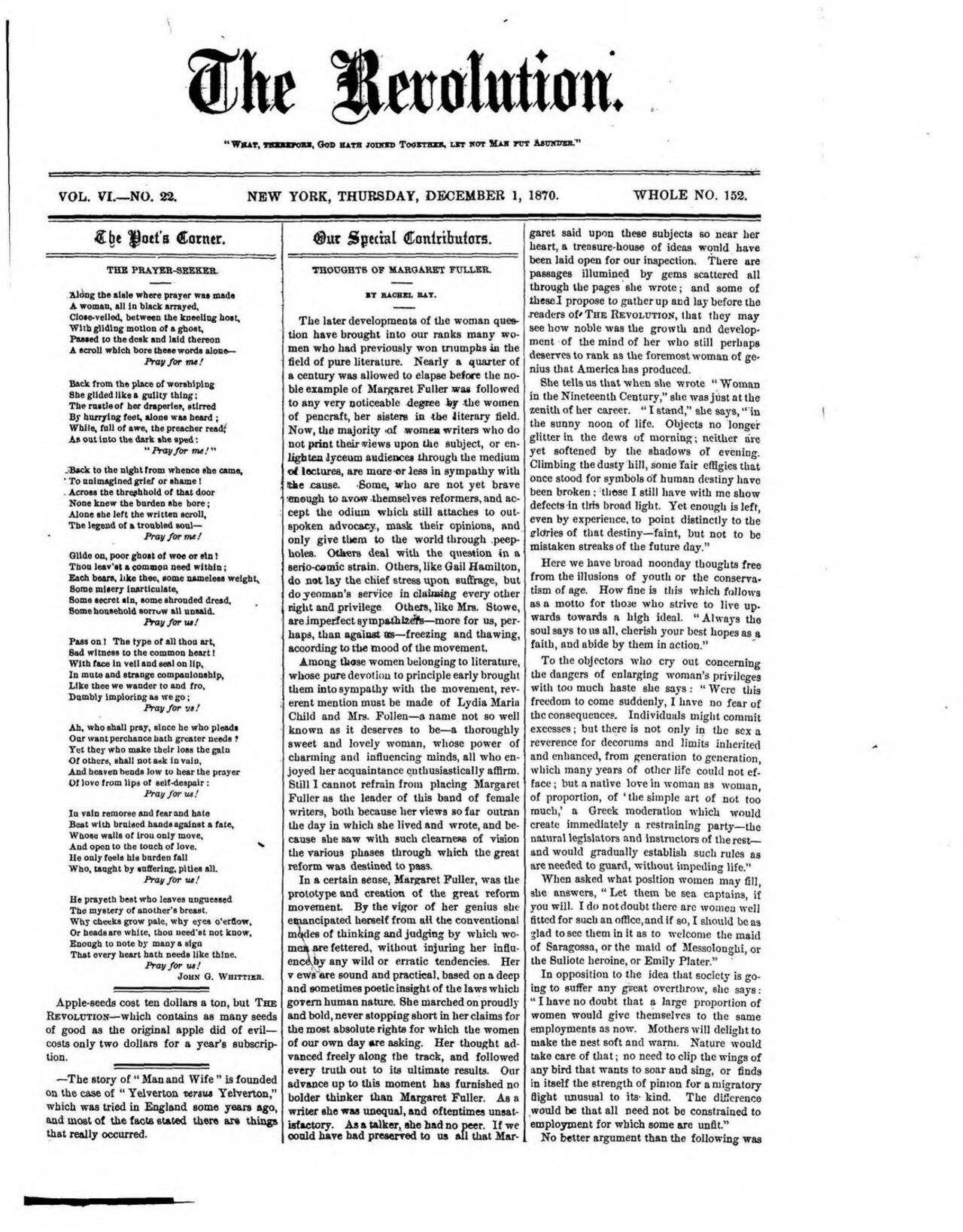
Front page scan of The Revolution, Vol. VI, No. 22, New York, Thursday, December 1, 1870. Masthead in blackletter type with motto 'What God hath joined together, let not man put asunder.' Three columns of text including poems and articles.Newspaper article

Primary source

The Revolution, Vol. 6 No. 22, December 1, 1870

Laura Curtis Bullard · 1 December 1870

Blackletter masthead reading 'The Revolution.' in large ornate black type, with a decorative rule with small diamond-shaped flourishes beneath it.Newspaper article

Primary source

Masthead banner of The Revolution

Susan B. Anthony · 1868-01

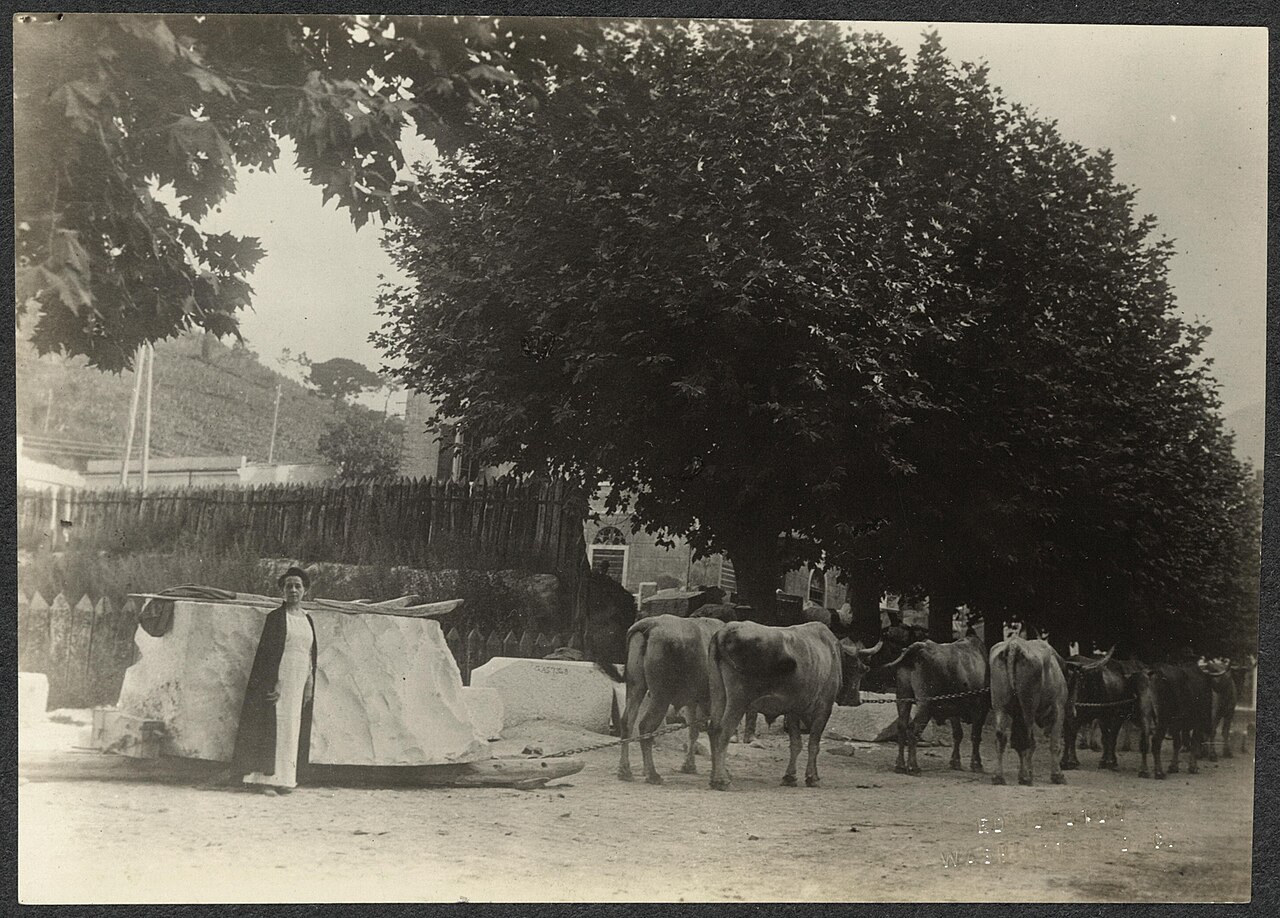
Sepia photograph of a woman in a long dark coat and light dress standing at left beside a large rough block of marble on a wooden base. Behind her, a team of oxen with yokes stands in a dirt street beneath large trees, with a building and fence in the background.Photograph

Primary source

Adelaide Johnson with marble for Women's Pioneer Statue

circa 1919

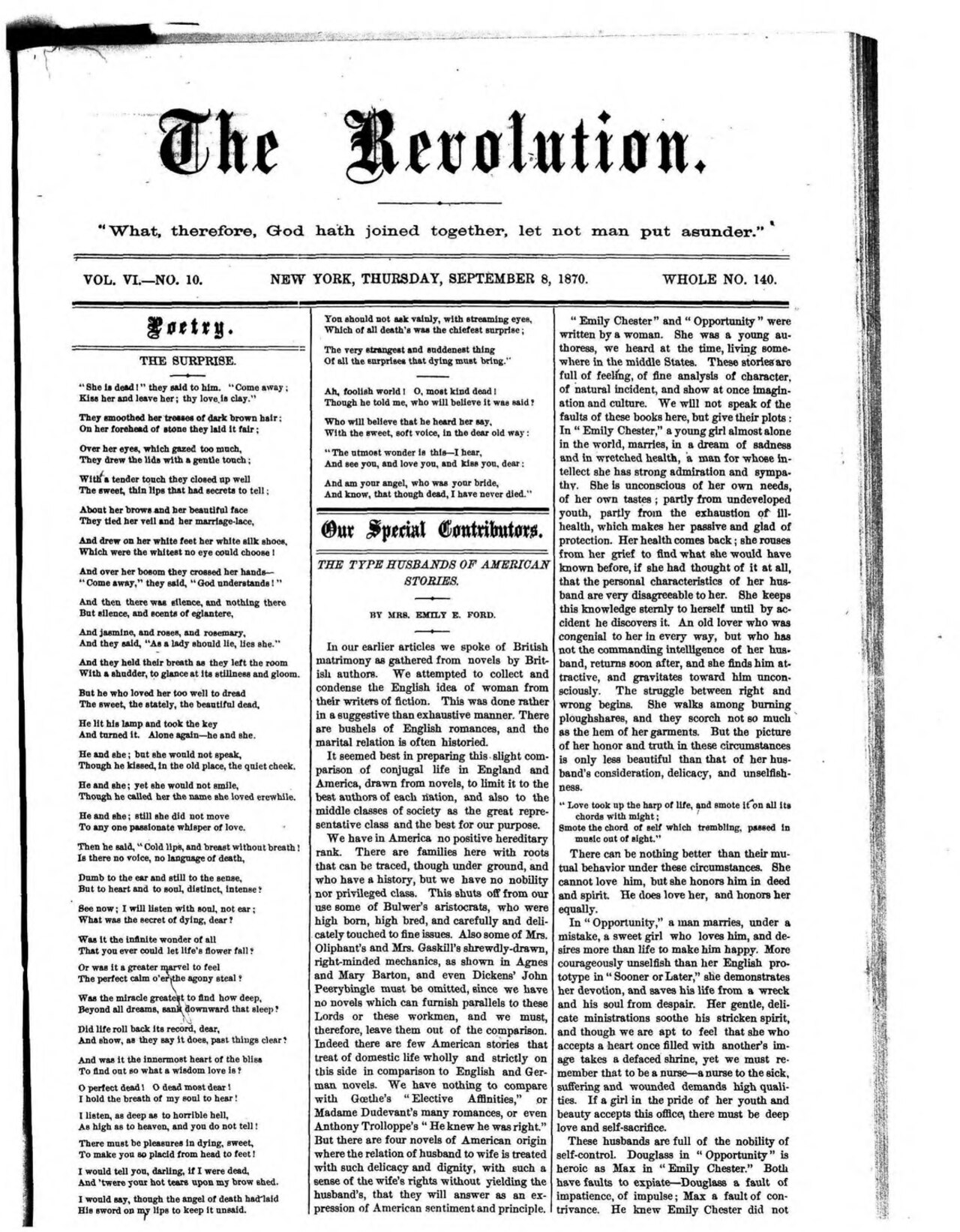
Front page of The Revolution, Vol. VI, No. 10, New York, Thursday, September 8, 1870, whole number 140. The masthead reads The Revolution in large black blackletter type with the motto 'What, therefore, God hath joined together, let not man put asunder.' Three columns of text appear below, including a poem titled 'The Surprise' under the Poetry heading, and a column headed 'Our Special Contributors' with an article titled 'The Type Husbands of American Stories' by Mrs. Emily E. Ford.Newspaper article

Primary source

The Revolution, Vol. 6 No. 10, September 8, 1870

Laura Curtis Bullard · 1870-09-08

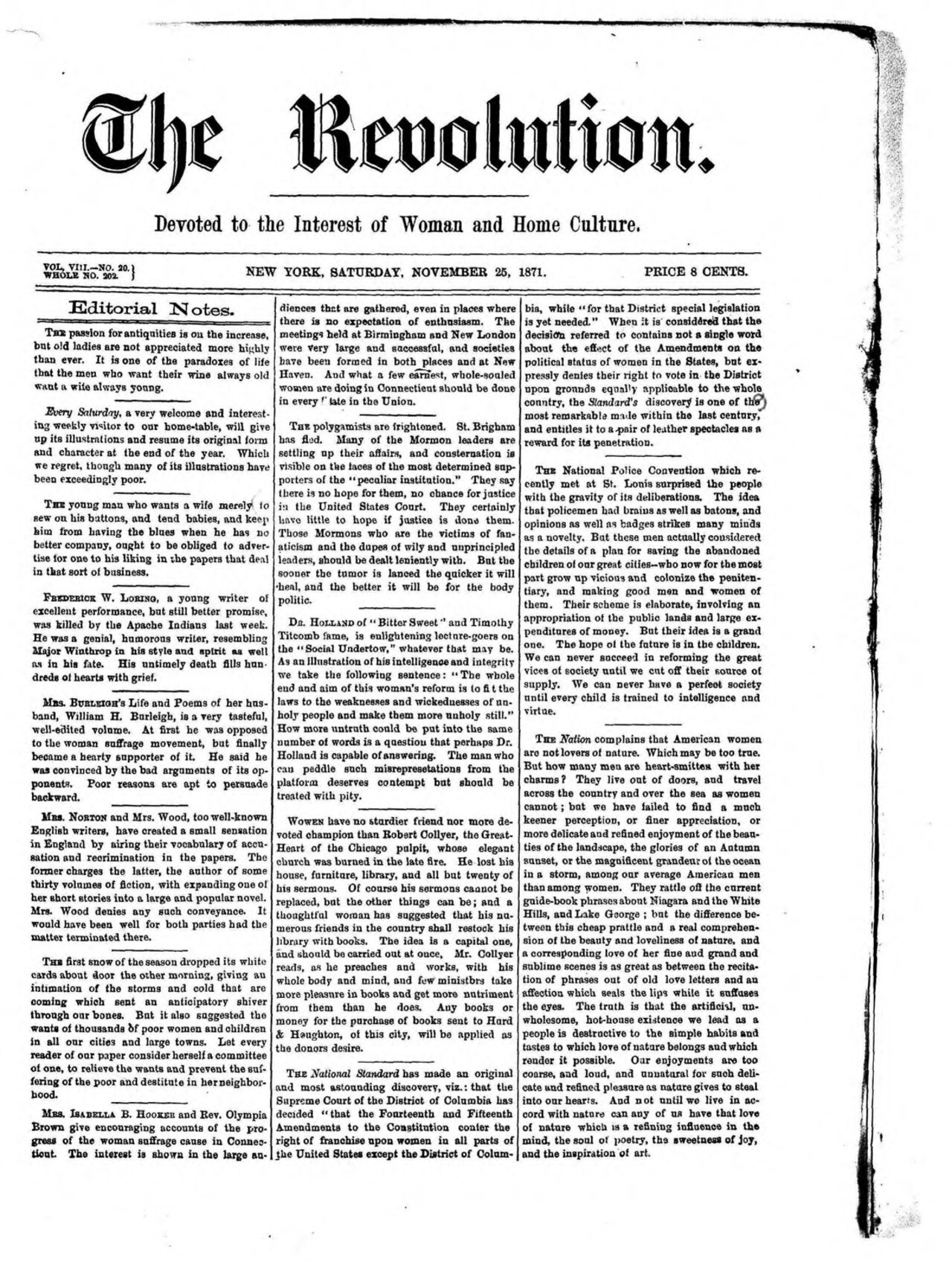
Front page scan of The Revolution, Vol. VIII, No. 20, New York, Saturday, November 25, 1871. The masthead reads 'The Revolution' in large black letters, with the subtitle 'Devoted to the Interest of Woman and Home Culture.' Three columns of small print appear below, headed by 'Editorial Notes.'Newspaper article

Primary source

The Revolution, Vol. 8 No. 20, November 25, 1871

W. T. Clarke · 1871-11-25

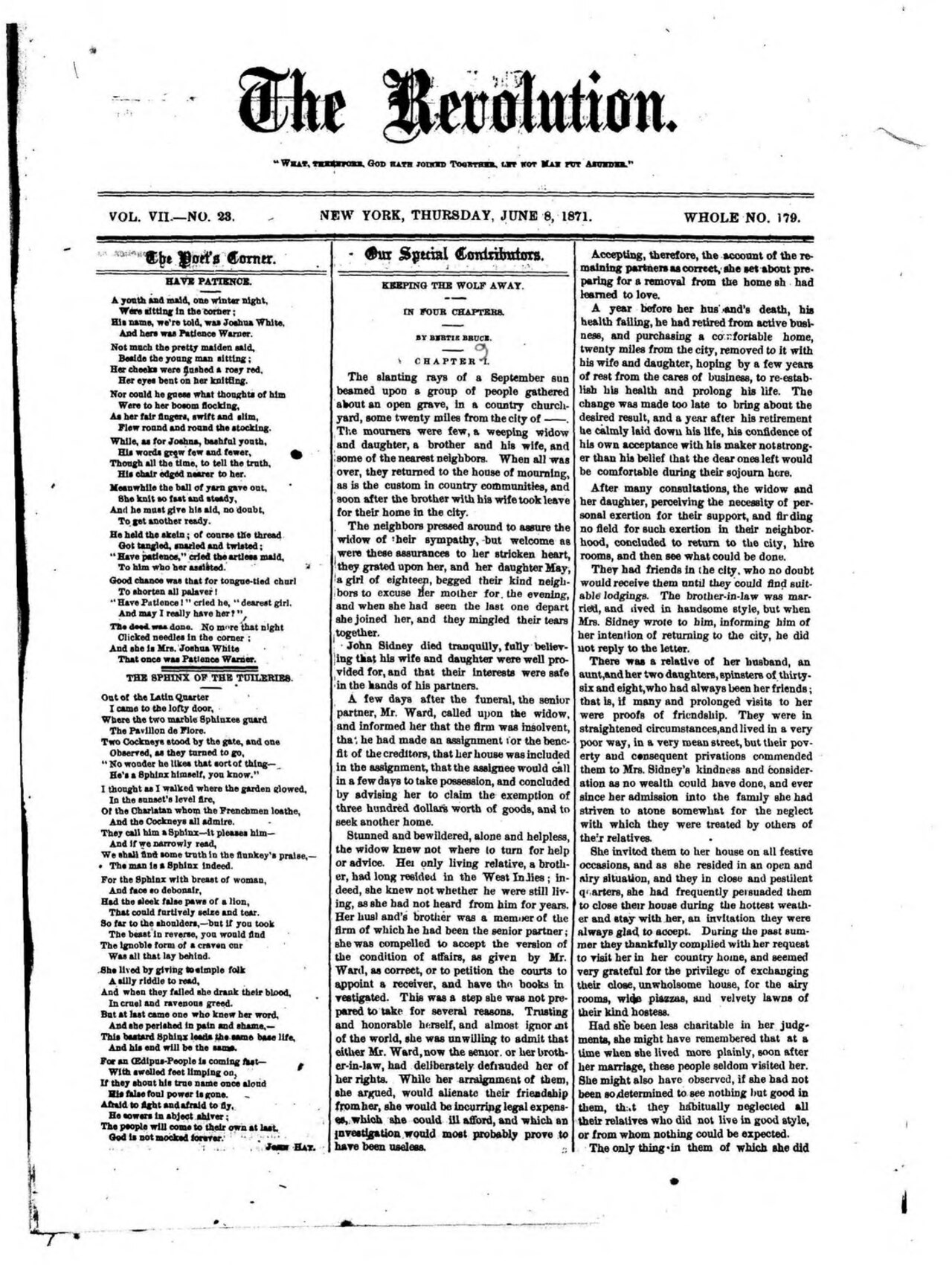
Front page scan of The Revolution, Vol. VII, No. 23, New York, Thursday, June 8, 1871, Whole No. 179. Masthead in large blackletter type with a motto above the columns. Columns include a poem titled 'Have Patience' and a serialized story 'Keeping the Wolf Away' by Bertha Bruce.Newspaper article

Primary source

The Revolution, Vol. 7 No. 23, June 8, 1871

Laura Curtis Bullard · 1871-06-08

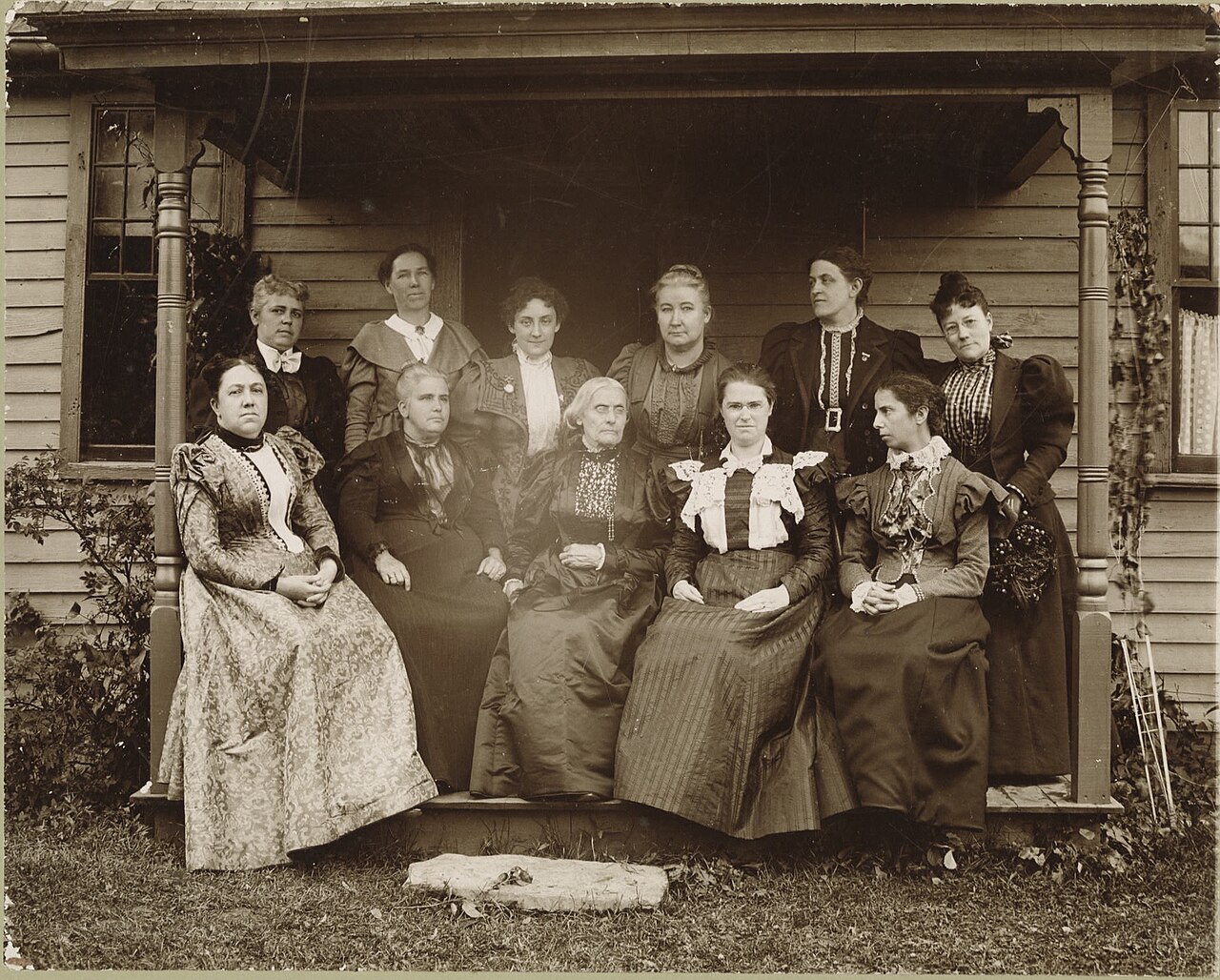
Sepia group photograph of eleven women posed on and around a wooden front porch of a clapboard house. Seated in front, an elderly woman with white hair sits at center in a dark dress with lace collar. Women in long Victorian dresses and high collars stand behind and beside her, some with hands folded, and one at far right wears a dark dress with puffed sleeves. Windows and a porch column frame the scene.Photograph

Primary source

Susan B. Anthony with Woman's Rights Leaders, 1896

1896

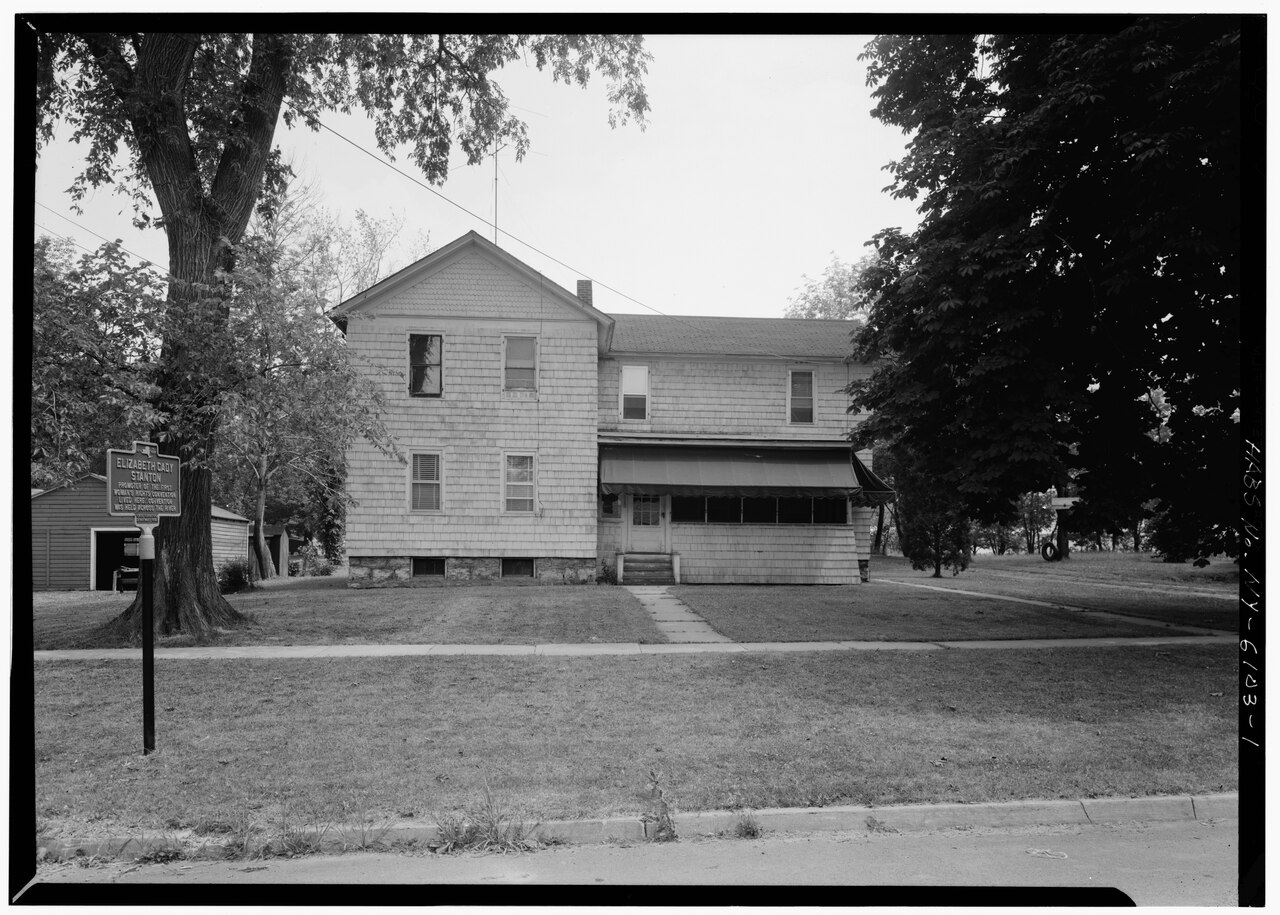
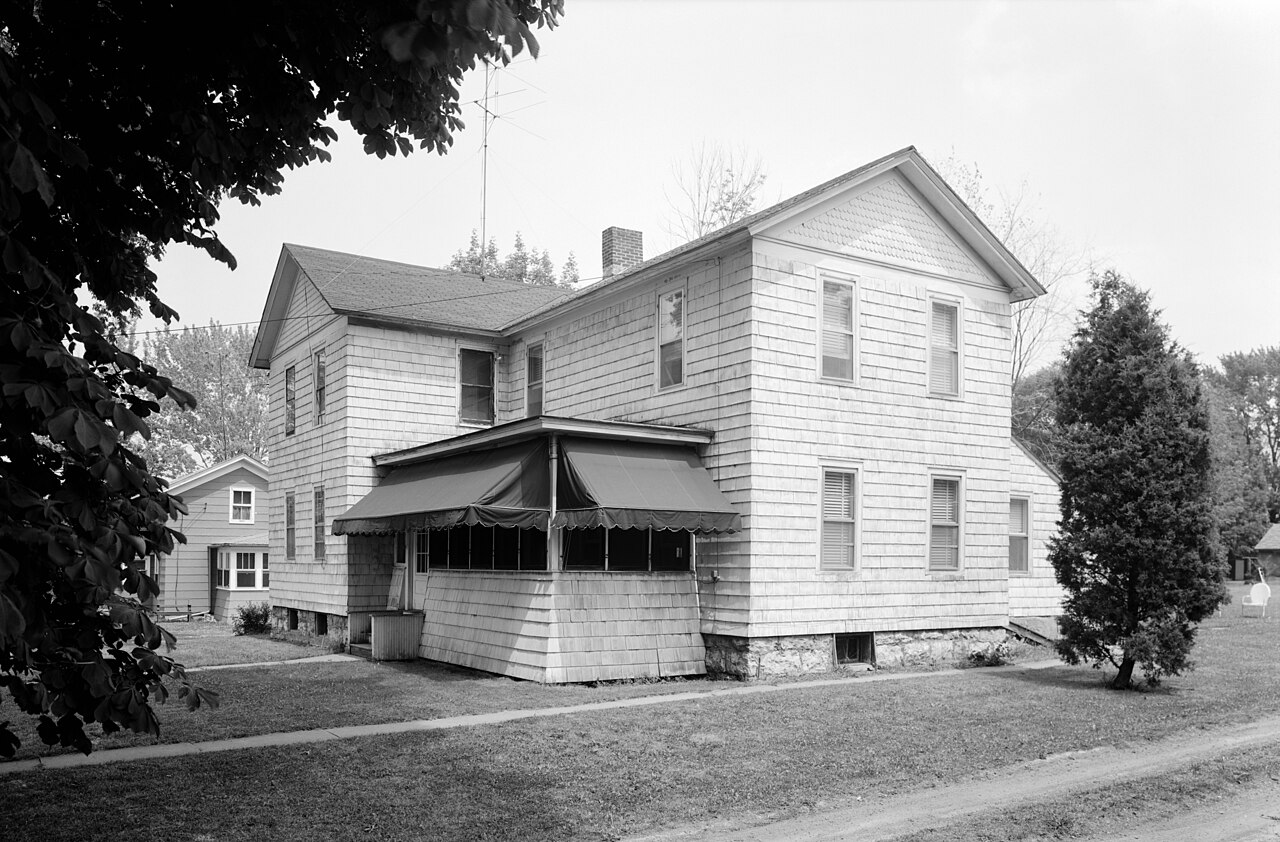
Black-and-white photo of a two-story wood-shingled house with a gabled roof, a brick chimney, and a front porch with awning. Trees and a small outbuilding are at left, and a tall evergreen is at right.Photograph

Secondary source

Elizabeth Cady Stanton House, Seneca Falls

J. Carl Burke, Jr. · 19 July 1968

Black-and-white photograph of a round-topped mahogany pedestal parlor table with a turned central column, three scrolled legs ending in brass-capped feet on casters.Photograph

Secondary source

Mahogany Parlor Table Used to Write the Declaration of Sentiments

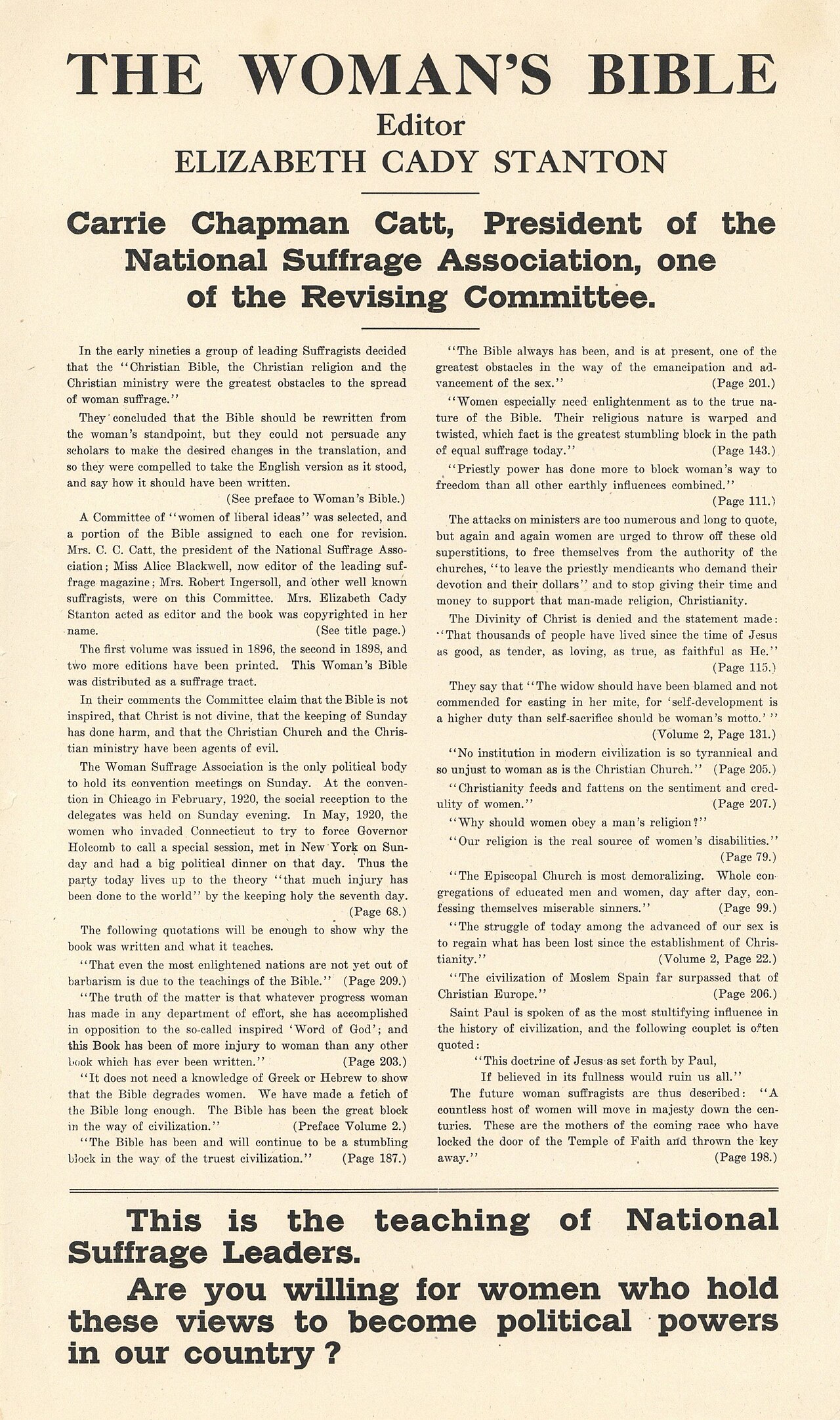
Anti-suffrage broadside titled The Woman's Bible, editor Elizabeth Cady Stanton, with a headline naming Carrie Chapman Catt as a Revising Committee member. Two columns of quoted passages criticize the Bible and Christianity, with page references. Bottom text asks whether readers are willing for women holding these views to become political powers.Document

Secondary source

The Woman's Bible Anti-Suffrage Broadside

15 July 1920

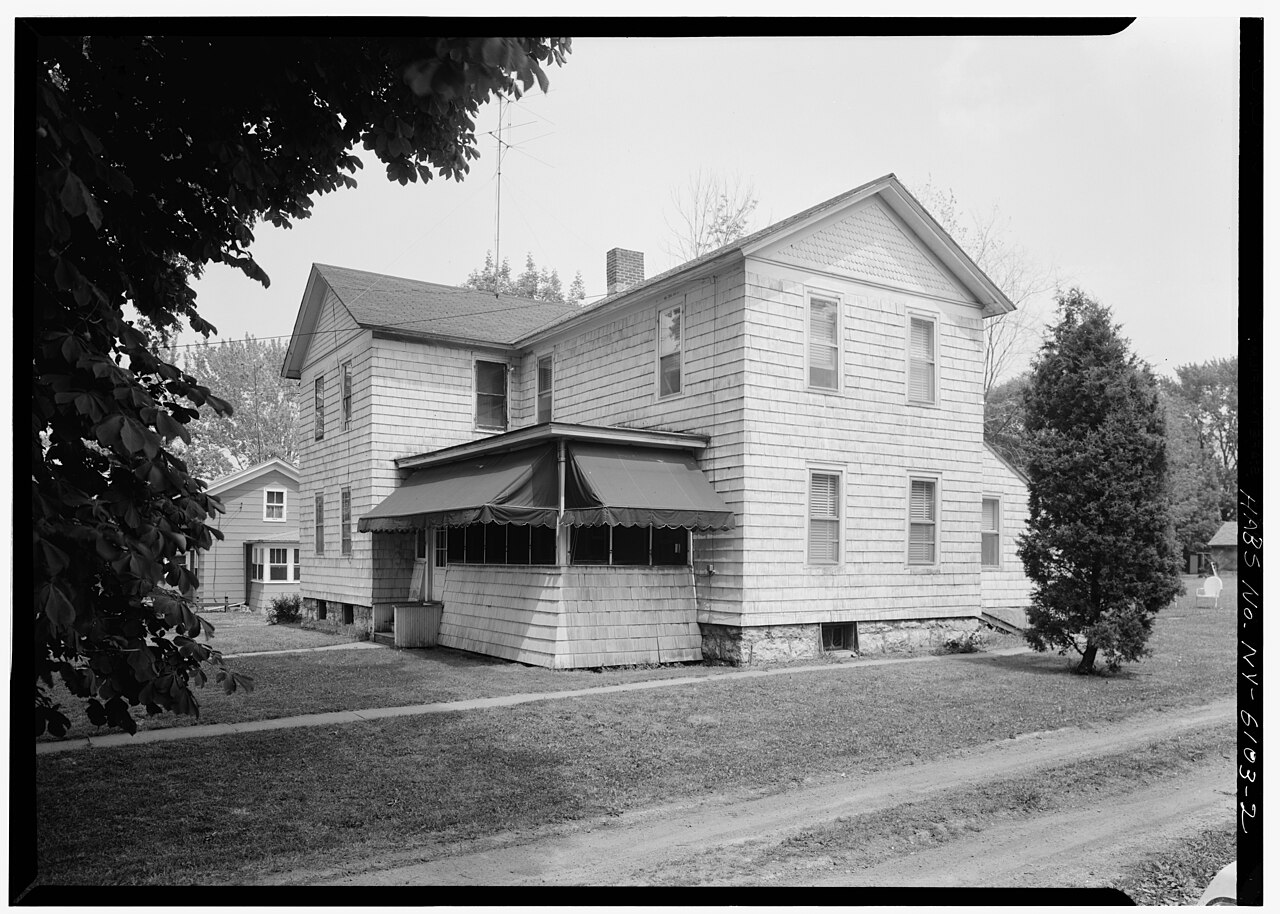
Black-and-white photograph of a two-story wood-shingled house with a gabled roof, a brick chimney, and a screened porch with an awning on the side. A large evergreen tree stands to the right, and a dirt road runs along the foreground.Photograph

Secondary source

Elizabeth Cady Stanton House, Seneca Falls, Side View

J. Carl Burke, Jr. · 19 July 1968

Printed broadside titled 'Our Roll of Honor' listing signatories to the Declaration of Sentiments from the first Woman's Rights Convention held at Seneca Falls, New York, July 19-20, 1848. Names are in columns under headings Ladies and Gentlemen. Handwritten note at top reads that this card was issued for the celebration held at Seneca Falls in 1905.Document

Secondary source

Our Roll of Honor: Signers of the Declaration of Sentiments

1905 (card issued for the Seneca Falls celebration)

Documentary

Secondary source

Portrait Monument to Stanton, Anthony and Mott

Adelaide Johnson · presented to Congress 10 February 1921; unveiled 15 February 1921

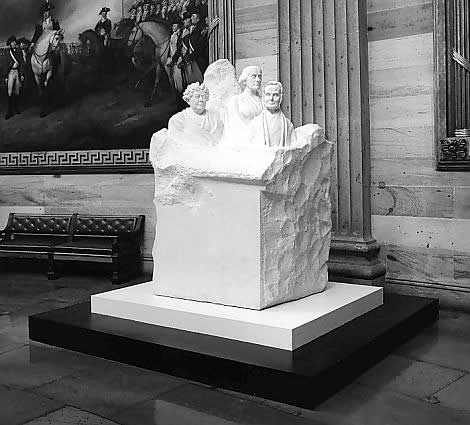
Black-and-white photo of a white marble sculpture on a dark square base in a stone-walled hall. Three carved human heads emerge from a rough-cut block, with a smooth carved face on the right. A painting of a military scene and a dark leather bench are behind it.Sculpture

Secondary source

Suffrage statue

1921

Want the full shelf? Chat with Elizabeth Cady Stanton in the app and open the Sources panel — every quote links back to the original.

Use Elizabeth Cady Stanton in class

1 collection

A ready-made collection from the Humy team that features Elizabeth Cady Stanton. Preview it, then try it free.

Trusted by educators worldwide

Conversations
375,000+
Real exchanges between students and historical figures
Messages exchanged
4,142,000+
Across every figure, classroom and language
Historical figures
100,000+
Each informed by a curated biography and selected sources
Languages supported
50+
From English and Spanish to Arabic and Korean

Paying customers

Used by 98 schools and universities

Partner school logo
Tecnológico de Monterrey logo
Hyper Island logo
Partner school logo
Chambersburg Area School District logo
Broward County Public Schools logo
Nebo School District logo
National Louis University logo
South Florida PBS logo
Punahou School logo
University of Wisconsin–River Falls logo
Partner school logo
Partner school logo
Archbishop Mitty High School logo
Kingsburg High School logo
Norwalk Public Schools logo
Partner school logo
Connections logo
Partner school logo
Moore Public Schools logo
Partner school logo
Partner school logo
Partner school logo
Partner school logo
Robbinsville Public Schools logo
Partner school logo
Partner school logo
Partner school logo
Tecnológico de Monterrey logo
Hyper Island logo
Partner school logo
Chambersburg Area School District logo
Broward County Public Schools logo
Nebo School District logo
National Louis University logo
South Florida PBS logo
Punahou School logo
University of Wisconsin–River Falls logo
Partner school logo
Partner school logo
Archbishop Mitty High School logo
Kingsburg High School logo
Norwalk Public Schools logo
Partner school logo
Connections logo
Partner school logo
Moore Public Schools logo
Partner school logo
Partner school logo
Partner school logo
Partner school logo
Robbinsville Public Schools logo
Partner school logo
Partner school logo

What educators are saying

“We enjoyed the program last year and used it frequently.”
“My students say it’s a welcome change of pace. I’m not a fan of the “sage on the stage” model, so I try to incorporate research-oriented and self-paced activities. With Humy, students have to take charge of their learning. They’ve become more adept at critical thinking, forming better questions, and improving their reading comprehension. The interview feature has been my go-to tool. I create assignments where students must ask historical figures a set number of questions, then summarize the responses to ensure they’re truly absorbing the material. This approach lets them actively explore the past rather than passively consuming information.”
“Humy has helped me bring historical figures, sometimes long past, to life. When my students interact with these figures in real-time, it eliminates some of the perceived “ancient” characteristics of my curriculum. This has shifted my students’ thinking away from viewing history as abstract or irrelevant. Real-time interactions make historical figures relatable, even allowing students to ask off-topic questions that help put historical lives in a more relevant context for 13-year-olds. The feature I use the most is the interview feature. After teaching a topic, most recently Gandhi and Joan of Arc, I have the students ask pointed, focused questions. We practice good conversation techniques beforehand, teaching them to listen (or read) carefully and formulate thoughtful follow-up questions rather than just interrogating. It helps students practice effective conversation skills.”

FAQ

Frequently asked questions

Who is Elizabeth Cady Stanton?
Leading figure in the women's suffrage movement in the United States. On Humy.ai you can chat with an AI version of Elizabeth Cady Stanton that draws on a short biography and 82 historical sources during the conversation — by text or voice, in 42 languages.
Is Elizabeth Cady Stanton AI free?
Elizabeth Cady Stanton is part of Humy's full library of more than 100,000 figures, which comes with a paid plan. A free account (no credit card) includes 20 messages a month with the free library's figures, so you can try how the conversations work first.
What sources does the Elizabeth Cady Stanton AI use?
It draws on a short biography and 82 historical sources (documents, photographs and newspaper articles), including “Declaration of Sentiments”, “Solitude of Self” and “The Woman's Bible”. Each source has its own page on Humy.ai.
How historically accurate is the AI version of Elizabeth Cady Stanton?
Each figure uses a short biography and a small set of selected historical sources as context (retrieval-augmented generation), so answers stay closer to known material than the model's general knowledge alone. It isn't a citation-grade research tool — like any LLM, the AI can get details wrong or extrapolate. Treat it as a strong starting point for inquiry and cross-reference important claims.
Can I talk to Elizabeth Cady Stanton by voice?
Yes. In addition to text chat, you can call Elizabeth Cady Stanton and hear their voice respond in real time — useful for auditory learners, interview practice and Socratic dialogue.
Is Humy.ai safe and compliant for schools?
Yes. Humy.ai is used by more than 100 schools, universities and organisations. The platform is FERPA- and GDPR-aligned, supports SSO, and offers an IT-approval pack tailored for school procurement teams.

Cross-reference Elizabeth Cady Stanton

Like any LLM, the AI version of Elizabeth Cady Stanton can get details wrong. Open one of these sources in a new tab to verify what you’ve read.

Ready when you are

Start chatting with Elizabeth Cady Stanton now.

20 messages free · No credit card · Available in 50+ languages.